DR ROWAN MOLNAR ANAESTHETICS STUDY
GUIDE PART 3
Gynaecological laparoscopy
PATIENT WITH POLYCYSTIC OVARIES FOR
LAPAROSCOPIC CYSTOTOMIES AS DAY CASE
PROCEDURE
HISTORY
 25 year old woman
 Height 165cm, weight 80kg
 BMI 29.5
 Typical PCOS history/findings.
 Allergies nil
 Rx: Metformin 0.5G b.d.
 Previous GA – E/O wisdom teeth – OK
 O/Ex: Overweight, otherwise unremarkable.
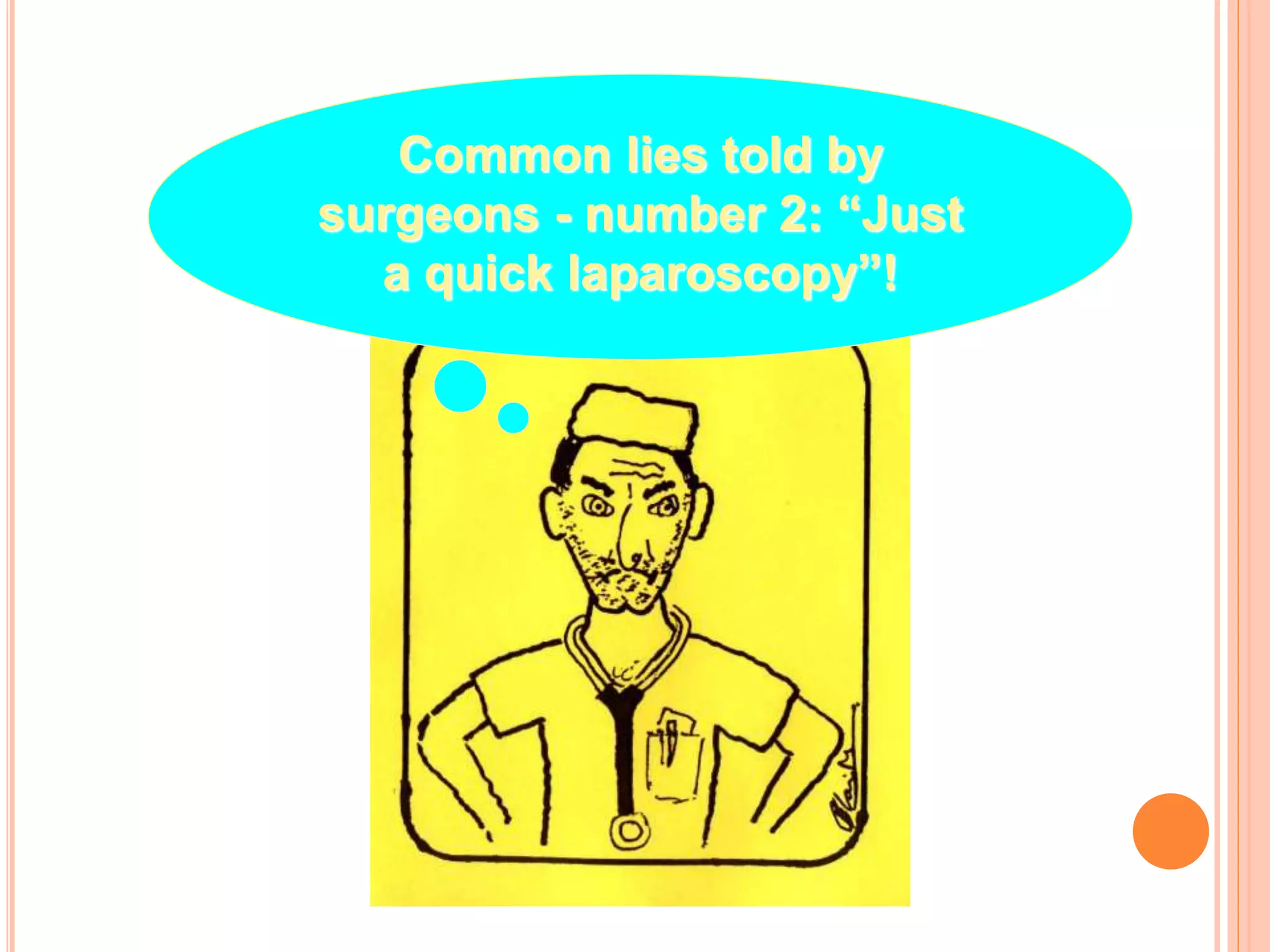
Common lies told by
surgeons - number 2: “Just
a quick laparoscopy”!
What are the issues and risks here?
ANAESTHETIC ISSUES
 Medical condition
 Prolonged surgery
 Laparoscopy/pneumoperitoneum
 Trendellenberg
 Analgesia
 PONV
“QUIET VICTORY”
 Largely uneventful anaesthesia/surgery
 Problems maintaining normocarbia without excessive
airway pressures when head down
 Mild permissive hypercapnoea, corrected at end
 Polymodal antiemetic therapy – no PONV
 Comfortable on combined analgesia
 Home as day case.
 A typical “straightforward” case that was expected to
go well - & did - so is not memorable to anyone but
the anaesthetist who worked hard to make it that way.
“THERE ARE A MILLION STORIES IN THE NAKED
CITY, THIS IS ONE OF THEM.”
- THE NAKED CITY, US CRIME DRAMA SERIES
The practice, safety & reputation of
anaesthesia is built on thousands of such
cases – far more so than the glamorous
emergency cases & heroic saves.
PART IV:
ANAESTHETIC EQUIPMENT
& AIRWAY MANAGEMENT
INTRODUCTION TO/OVERVIEW OF THE
ANAESTHETIC MACHINE
Consists of three main parts:
1. “A cocktail bar”
This is the backbar – which blends piped &/or bottle gasses:
O2, N2O & air, and the vapour of (usually one only) volatile
anaesthetic agent (liquid) to produce the desired blend.
2. “A delivery service”
This is the breathing circuit – which delivers the fresh gas
mixture to the patient and removes carbon dioxide. (There are
three main classes of circuits – discussed later)
3. “A bunch of hangers on”
These are all the ancillaries attached to the anaesthetic
machine but not part of its core function: typically suction
system, patient monitors, drawers/trays for airway
equipment, and a mechanical ventilator for hands-free
controlled ventilation.
A NOTE OF CAUTION:
 Modern anaesthetic machines are complex devices
that require special knowledge to operate.
 In particular, knowledge of the pharmacology of
inhaled anaesthetic agents is essential.
 Undetected mishaps can be rapidly fatal.
 A thorough check prior to use, appropriate for the
particular machine, by an experienced person, is vital.
 Some parts of the circuit e.g. filters & hoses, need to
be changed after every or certain cases, or a different
type of circuit may be selected & attached. An
abbreviated re-check must be carried out after any
such change.
ANAESTHETIC CIRCUITS
Three principal types:
1. Drawover or “semi-open” systems: where non-rebreathing valves
are used to ensure unidirectional flow of gas. Principally now used
in resuscitation & field anaesthetic systems, because of the ability
to use ambient air instead of (some or even all) pressurised gas
supply.
2. Simple or “semi-closed” systems with pressurised fresh gas inflow,
reservoir tube & bag in one of several different configurations.
(Sometimes called Maplesen systems, after the man who classified
& evaluated the different configurations). The patient breathes ‘to &
fro’ through the reservoir tube & bag & the system relies on an
adequate fresh gas flow to minimise rebreathing. Commonest
example: the “Jackson-Rees T-piece (Maplesen “F”)” paediatric
circuit.
3. Circle, or closed circuit systems which use one way valves to direct
expired gas through a carbon dioxide absorber. This gas can then
be supplemented with only enough fresh gas mix to replenish the
oxygen and anaesthetic agents taken up, and then rebreathed.
This is the commonest type of anaesthetic circuit in modern
practice.
REMEMBER:
The commonest anaesthetic circuit most medical &
nursing staff will ever use is the non-rebreathing
resuscitation bag (“Laerdal bag” or similar) . . .
. . . to give the commonest anaesthetic and
resuscitation drug of all: Oxygen
ANOTHER RULE OF THREE:
THE TRIAD OF RESUSCITATION
A – AIRWAY
B – BREATHING
C – CIRCULATION
Or . . . Alternatively:
(The triad of resuscitation – my own version)
1. Air goes in & out
2. Blood goes round & round
3. Variations on the first two are a BAD THING
Note that airway always comes first
Airway isn’t everything . . .
. . . but without it everything else is nothing.
This is why anaesthetists are good people to have
around at a resuscitation – and why a grounding in
anaesthesia is good training for emergencies.
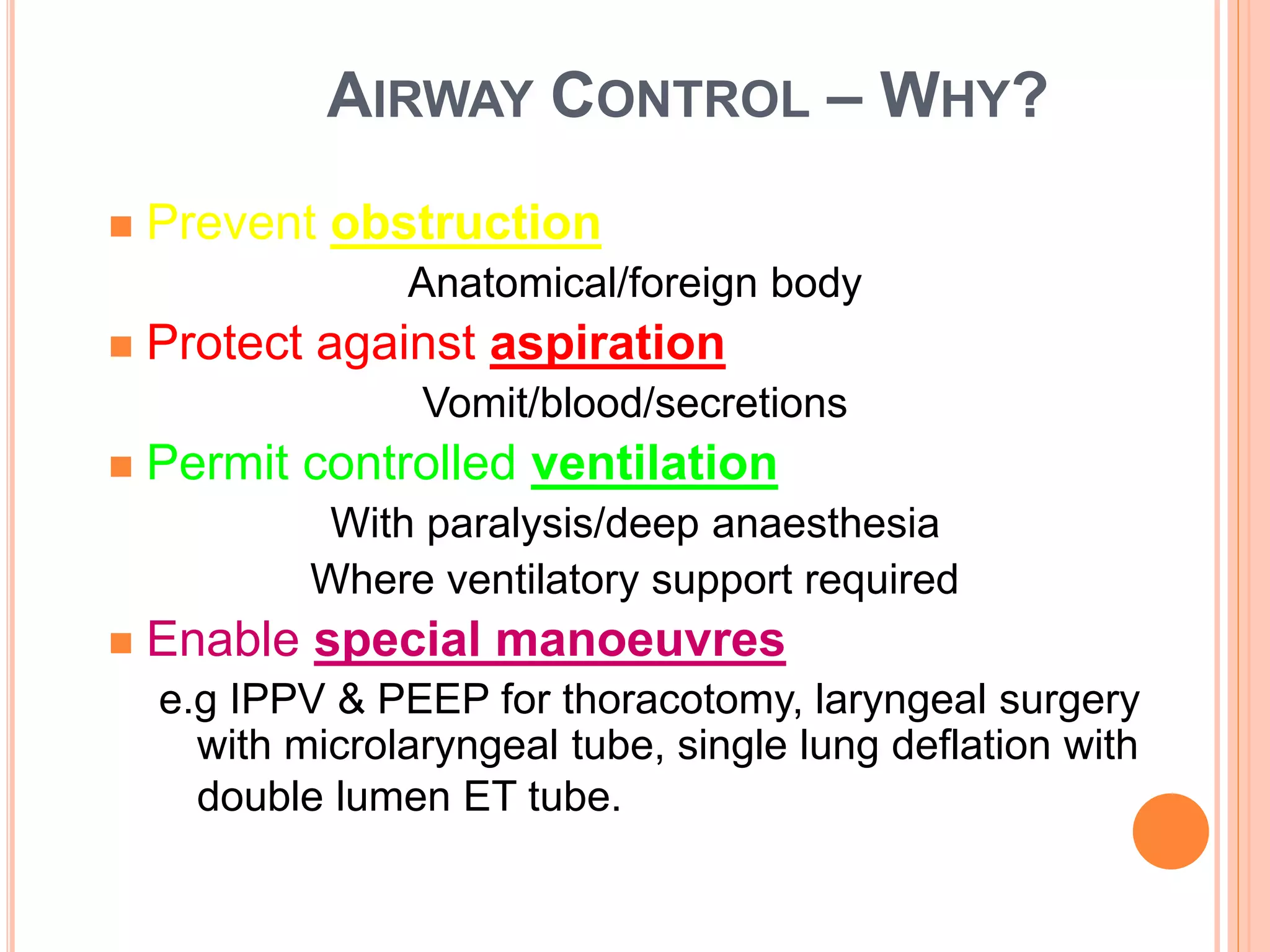
AIRWAY CONTROL – WHY?
 Prevent obstruction
Anatomical/foreign body
 Protect against aspiration
Vomit/blood/secretions
 Permit controlled ventilation
With paralysis/deep anaesthesia
Where ventilatory support required
 Enable special manoeuvres
e.g IPPV & PEEP for thoracotomy, laryngeal surgery
with microlaryngeal tube, single lung deflation with
double lumen ET tube.
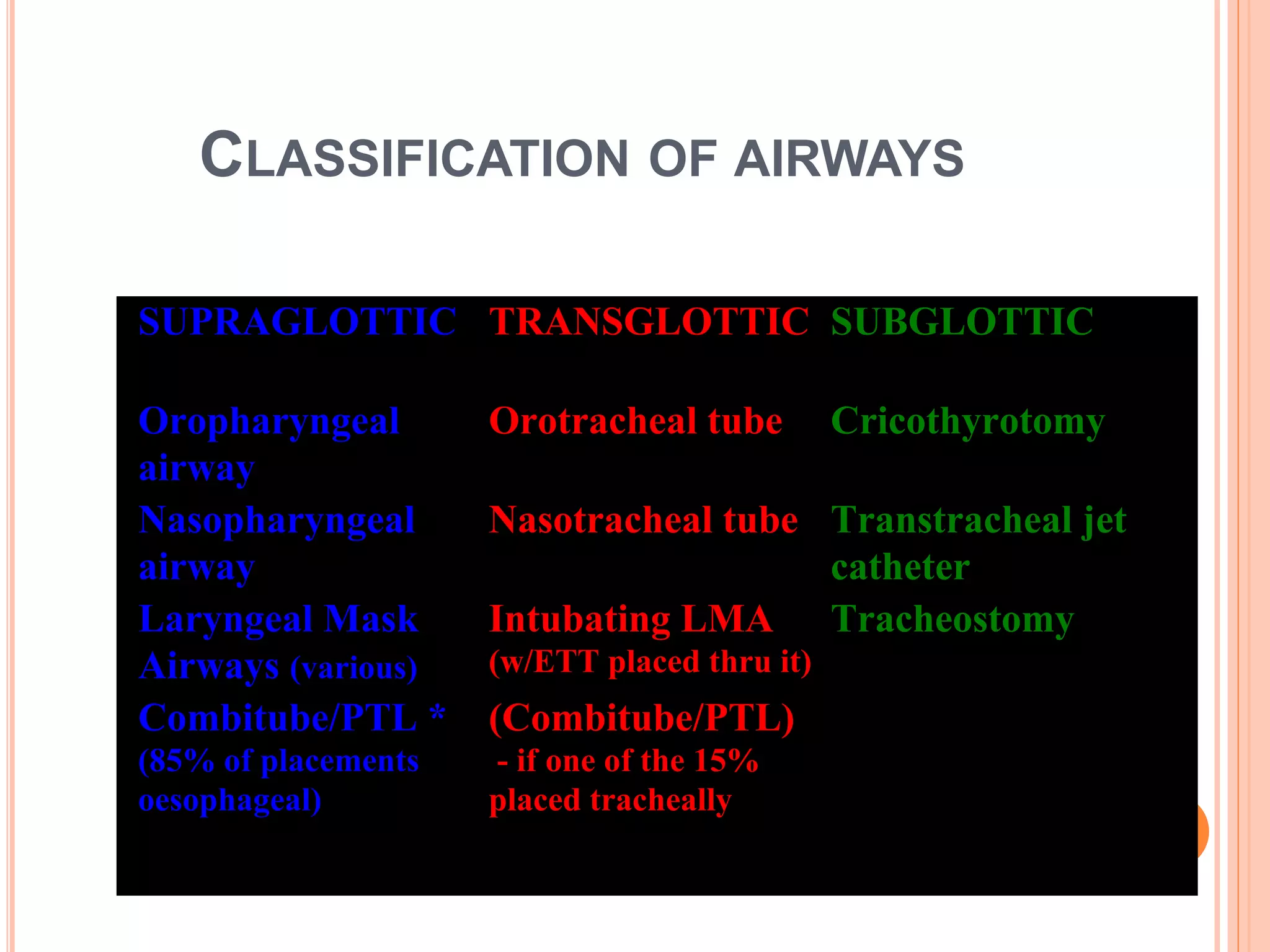
CLASSIFICATION OF AIRWAYS
SUPRAGLOTTIC TRANSGLOTTIC SUBGLOTTIC
Oropharyngeal
airway
Orotracheal tube Cricothyrotomy
Nasopharyngeal
airway
Nasotracheal tube Transtracheal jet
catheter
Laryngeal Mask
Airways (various)
Intubating LMA
(w/ETT placed thru it)
Tracheostomy
Combitube/PTL *
(85% of placements
oesophageal)
(Combitube/PTL)
- if one of the 15%
placed tracheally
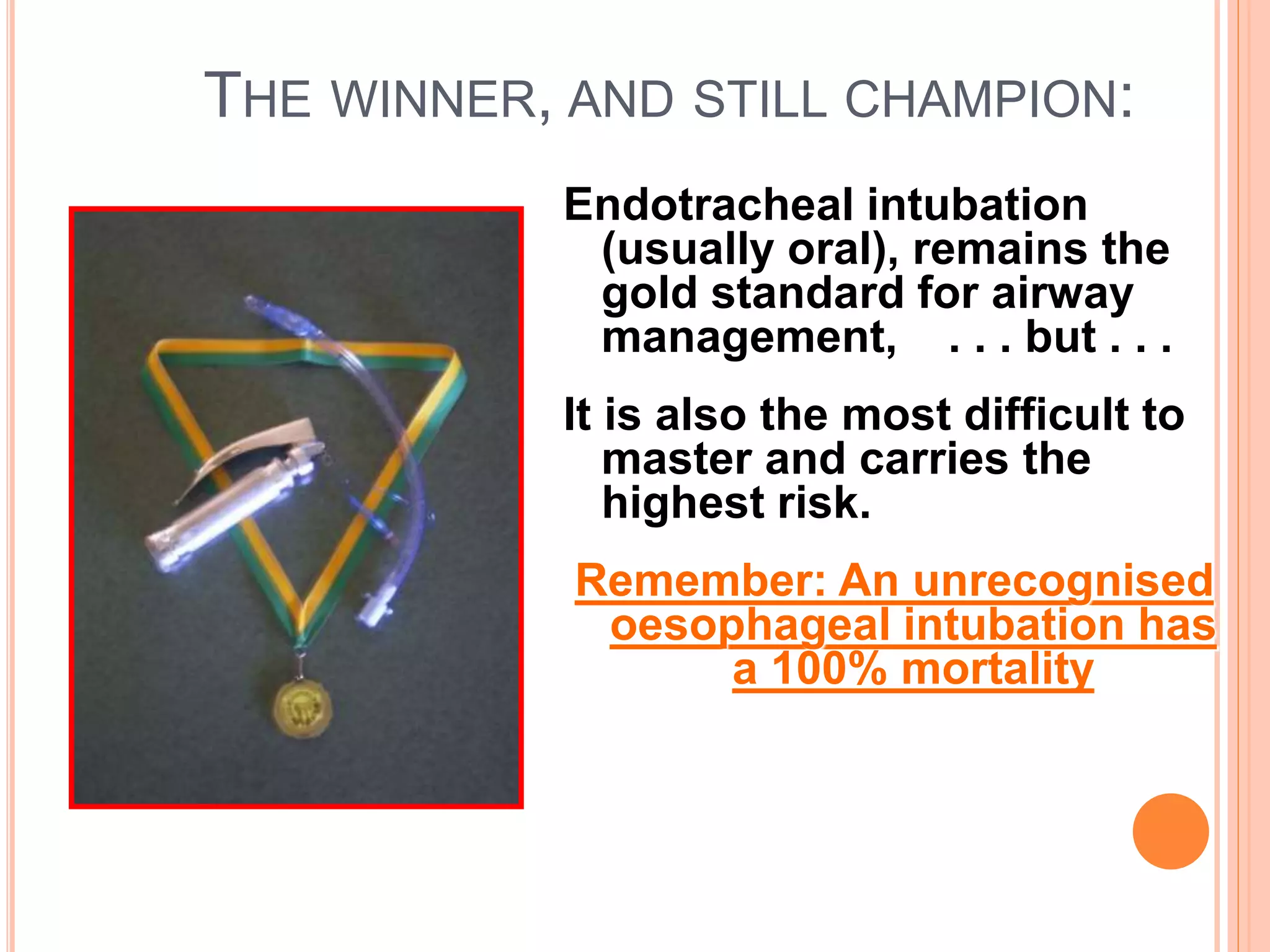
THE WINNER, AND STILL CHAMPION:
Endotracheal intubation
(usually oral), remains the
gold standard for airway
management, . . . but . . .
It is also the most difficult to
master and carries the
highest risk.
Remember: An unrecognised
oesophageal intubation has
a 100% mortality
EMERGENCY AIRWAY MANAGEMENT
(IN ANAESTHESIA & RESUSCITATION)
Rapid sequence
intubation
[or unmodified
(“cold”) intubation if
apnoeic & arreflexic]
Other
techniques:
Fibreoptic intubation
Supraglottic airway
Surgical airway
>90% <10%
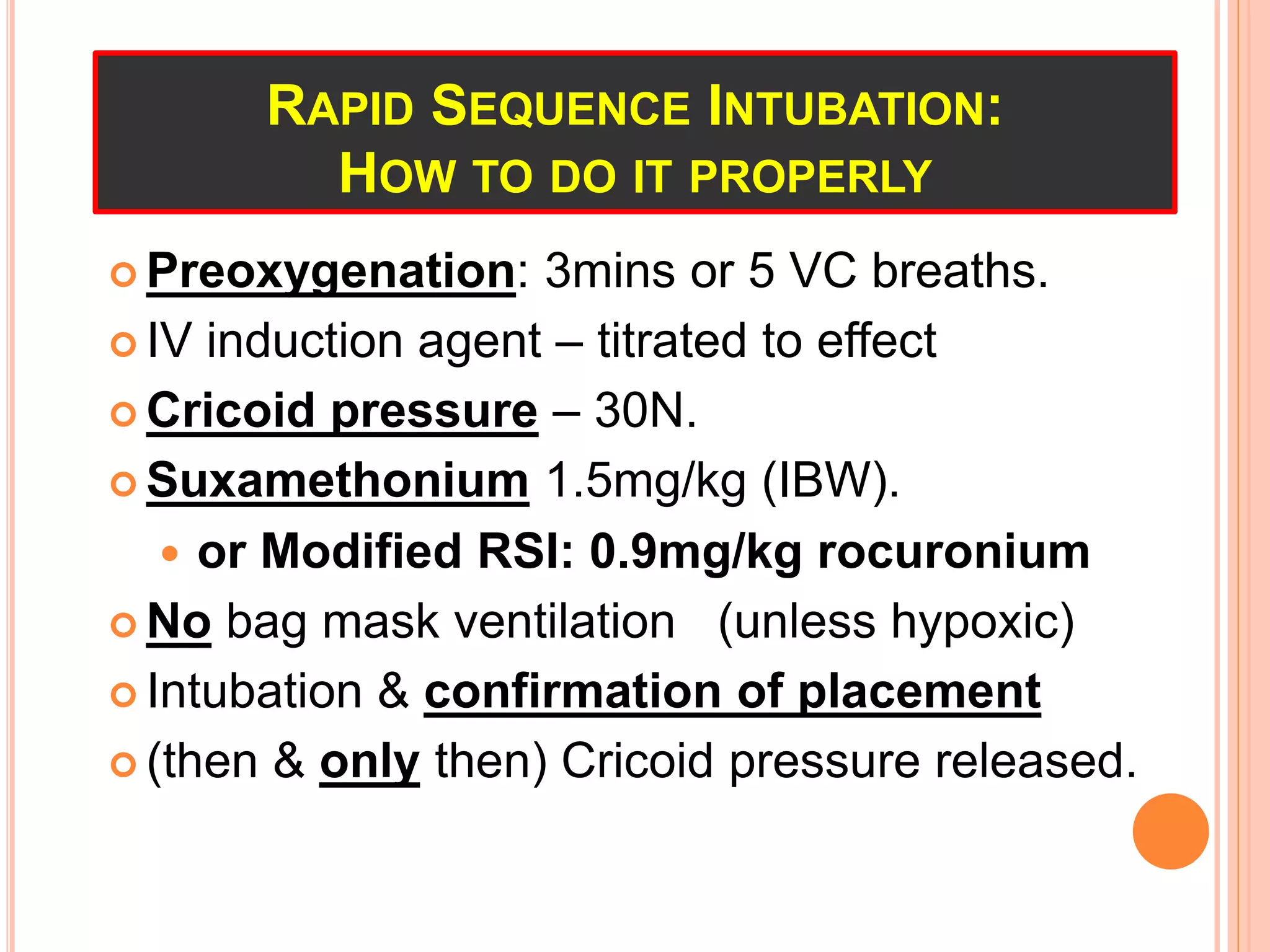
RAPID SEQUENCE INTUBATION:
HOW TO DO IT PROPERLY
 Preoxygenation: 3mins or 5 VC breaths.
 IV induction agent – titrated to effect
 Cricoid pressure – 30N.
 Suxamethonium 1.5mg/kg (IBW).
 or Modified RSI: 0.9mg/kg rocuronium
 No bag mask ventilation (unless hypoxic)
 Intubation & confirmation of placement
 (then & only then) Cricoid pressure released.
Remember (1) : every intubation attempt is a
potential failed intubation.
 You should always have a backup plan
- i.e. a failed intubation drill.
 Backup begins even before you start - with
preoxygenation for every IV induction
Remember (2): People don’t die of failure to intubate,
but of failure to oxygenate
Supraglottic rescue airway
e.g. LMA
SUCCESSFUL?
Subglottic (surgical) airway
1. Bag mask ventilation
2. Repeat attempt &/or
alternate technique to
intubate
SUCCESSFUL?
FIRSTLY MAINTAIN
OXYGENATION!
FAILED INTUBATION DRILL
CAN YOU MASK VENTILATE? [With
Geudels &/or nasopharyngeal airway if
necessary]
NO
NO
YES
NO
NON ENDOTRACHEAL AIRWAYS
There’s more to anaesthetic airways than just ET
tubes!
Laryngeal masks (of various types) are the most
widely used airways in modern anaesthetic
practice:
 Classic (original) & its various copies – reuseable or
single use.
 Reinforced – kink resistant & more flexible upper
lumen to permit alternative positioning after insertion
for oral/facial procedures.
 Proseal - second lumen to communicate with
oesophagus & allow drainage of gastric contents or
placement of gastric tube.
 Intubating – modified shape, more rigid, & lacking
apeture bars – to enable passage of a special ET
tube through it.
NON ENDOTRACHEAL AIRWAYS II
Advantages of laryngeal
masks:
 Hands free (compared to face
mask/oral airway)
 Easier to insert & become
proficient at compared to ETT
 Tolerated at lighter plane of
anaesthesia than ETT.
 Good protection against “top”
aspiration - of saliva/mucus.
 Pressure support & in some
cases IPPV can be given.
Disadvantages of laryngeal
masks
 Less secure airway - more prone
to dislodgement than ETT
 No protection against
laryngospasm
 Poor protection against “bottom”
aspiration – of gastric contents
(Except “Proseal”)
 Not guaranteed to permit
satisfactory IPPV – especially
where high pressures required.
Remember, the traditional facemask/chin lift +/- Geudel’s airway is still
an acceptable – possibly even underutilised – technique for short
simple cases.

Dr rowan molnar anaesthetics study guide part iii

  • 1.
    DR ROWAN MOLNARANAESTHETICS STUDY GUIDE PART 3 Gynaecological laparoscopy
  • 2.
    PATIENT WITH POLYCYSTICOVARIES FOR LAPAROSCOPIC CYSTOTOMIES AS DAY CASE PROCEDURE
  • 4.
    HISTORY  25 yearold woman  Height 165cm, weight 80kg  BMI 29.5  Typical PCOS history/findings.  Allergies nil  Rx: Metformin 0.5G b.d.  Previous GA – E/O wisdom teeth – OK  O/Ex: Overweight, otherwise unremarkable.
  • 5.
    Common lies toldby surgeons - number 2: “Just a quick laparoscopy”!
  • 6.
    What are theissues and risks here?
  • 7.
    ANAESTHETIC ISSUES  Medicalcondition  Prolonged surgery  Laparoscopy/pneumoperitoneum  Trendellenberg  Analgesia  PONV
  • 8.
    “QUIET VICTORY”  Largelyuneventful anaesthesia/surgery  Problems maintaining normocarbia without excessive airway pressures when head down  Mild permissive hypercapnoea, corrected at end  Polymodal antiemetic therapy – no PONV  Comfortable on combined analgesia  Home as day case.  A typical “straightforward” case that was expected to go well - & did - so is not memorable to anyone but the anaesthetist who worked hard to make it that way.
  • 9.
    “THERE ARE AMILLION STORIES IN THE NAKED CITY, THIS IS ONE OF THEM.” - THE NAKED CITY, US CRIME DRAMA SERIES The practice, safety & reputation of anaesthesia is built on thousands of such cases – far more so than the glamorous emergency cases & heroic saves.
  • 10.
  • 11.
    INTRODUCTION TO/OVERVIEW OFTHE ANAESTHETIC MACHINE Consists of three main parts: 1. “A cocktail bar” This is the backbar – which blends piped &/or bottle gasses: O2, N2O & air, and the vapour of (usually one only) volatile anaesthetic agent (liquid) to produce the desired blend. 2. “A delivery service” This is the breathing circuit – which delivers the fresh gas mixture to the patient and removes carbon dioxide. (There are three main classes of circuits – discussed later) 3. “A bunch of hangers on” These are all the ancillaries attached to the anaesthetic machine but not part of its core function: typically suction system, patient monitors, drawers/trays for airway equipment, and a mechanical ventilator for hands-free controlled ventilation.
  • 12.
    A NOTE OFCAUTION:  Modern anaesthetic machines are complex devices that require special knowledge to operate.  In particular, knowledge of the pharmacology of inhaled anaesthetic agents is essential.  Undetected mishaps can be rapidly fatal.  A thorough check prior to use, appropriate for the particular machine, by an experienced person, is vital.  Some parts of the circuit e.g. filters & hoses, need to be changed after every or certain cases, or a different type of circuit may be selected & attached. An abbreviated re-check must be carried out after any such change.
  • 13.
    ANAESTHETIC CIRCUITS Three principaltypes: 1. Drawover or “semi-open” systems: where non-rebreathing valves are used to ensure unidirectional flow of gas. Principally now used in resuscitation & field anaesthetic systems, because of the ability to use ambient air instead of (some or even all) pressurised gas supply. 2. Simple or “semi-closed” systems with pressurised fresh gas inflow, reservoir tube & bag in one of several different configurations. (Sometimes called Maplesen systems, after the man who classified & evaluated the different configurations). The patient breathes ‘to & fro’ through the reservoir tube & bag & the system relies on an adequate fresh gas flow to minimise rebreathing. Commonest example: the “Jackson-Rees T-piece (Maplesen “F”)” paediatric circuit. 3. Circle, or closed circuit systems which use one way valves to direct expired gas through a carbon dioxide absorber. This gas can then be supplemented with only enough fresh gas mix to replenish the oxygen and anaesthetic agents taken up, and then rebreathed. This is the commonest type of anaesthetic circuit in modern practice.
  • 14.
    REMEMBER: The commonest anaestheticcircuit most medical & nursing staff will ever use is the non-rebreathing resuscitation bag (“Laerdal bag” or similar) . . . . . . to give the commonest anaesthetic and resuscitation drug of all: Oxygen
  • 15.
    ANOTHER RULE OFTHREE: THE TRIAD OF RESUSCITATION A – AIRWAY B – BREATHING C – CIRCULATION Or . . . Alternatively: (The triad of resuscitation – my own version) 1. Air goes in & out 2. Blood goes round & round 3. Variations on the first two are a BAD THING
  • 16.
    Note that airwayalways comes first Airway isn’t everything . . . . . . but without it everything else is nothing. This is why anaesthetists are good people to have around at a resuscitation – and why a grounding in anaesthesia is good training for emergencies.
  • 17.
    AIRWAY CONTROL –WHY?  Prevent obstruction Anatomical/foreign body  Protect against aspiration Vomit/blood/secretions  Permit controlled ventilation With paralysis/deep anaesthesia Where ventilatory support required  Enable special manoeuvres e.g IPPV & PEEP for thoracotomy, laryngeal surgery with microlaryngeal tube, single lung deflation with double lumen ET tube.
  • 18.
    CLASSIFICATION OF AIRWAYS SUPRAGLOTTICTRANSGLOTTIC SUBGLOTTIC Oropharyngeal airway Orotracheal tube Cricothyrotomy Nasopharyngeal airway Nasotracheal tube Transtracheal jet catheter Laryngeal Mask Airways (various) Intubating LMA (w/ETT placed thru it) Tracheostomy Combitube/PTL * (85% of placements oesophageal) (Combitube/PTL) - if one of the 15% placed tracheally
  • 19.
    THE WINNER, ANDSTILL CHAMPION: Endotracheal intubation (usually oral), remains the gold standard for airway management, . . . but . . . It is also the most difficult to master and carries the highest risk. Remember: An unrecognised oesophageal intubation has a 100% mortality
  • 20.
    EMERGENCY AIRWAY MANAGEMENT (INANAESTHESIA & RESUSCITATION) Rapid sequence intubation [or unmodified (“cold”) intubation if apnoeic & arreflexic] Other techniques: Fibreoptic intubation Supraglottic airway Surgical airway >90% <10%
  • 21.
    RAPID SEQUENCE INTUBATION: HOWTO DO IT PROPERLY  Preoxygenation: 3mins or 5 VC breaths.  IV induction agent – titrated to effect  Cricoid pressure – 30N.  Suxamethonium 1.5mg/kg (IBW).  or Modified RSI: 0.9mg/kg rocuronium  No bag mask ventilation (unless hypoxic)  Intubation & confirmation of placement  (then & only then) Cricoid pressure released.
  • 22.
    Remember (1) :every intubation attempt is a potential failed intubation.  You should always have a backup plan - i.e. a failed intubation drill.  Backup begins even before you start - with preoxygenation for every IV induction Remember (2): People don’t die of failure to intubate, but of failure to oxygenate
  • 23.
    Supraglottic rescue airway e.g.LMA SUCCESSFUL? Subglottic (surgical) airway 1. Bag mask ventilation 2. Repeat attempt &/or alternate technique to intubate SUCCESSFUL? FIRSTLY MAINTAIN OXYGENATION! FAILED INTUBATION DRILL CAN YOU MASK VENTILATE? [With Geudels &/or nasopharyngeal airway if necessary] NO NO YES NO
  • 24.
    NON ENDOTRACHEAL AIRWAYS There’smore to anaesthetic airways than just ET tubes! Laryngeal masks (of various types) are the most widely used airways in modern anaesthetic practice:  Classic (original) & its various copies – reuseable or single use.  Reinforced – kink resistant & more flexible upper lumen to permit alternative positioning after insertion for oral/facial procedures.  Proseal - second lumen to communicate with oesophagus & allow drainage of gastric contents or placement of gastric tube.  Intubating – modified shape, more rigid, & lacking apeture bars – to enable passage of a special ET tube through it.
  • 25.
    NON ENDOTRACHEAL AIRWAYSII Advantages of laryngeal masks:  Hands free (compared to face mask/oral airway)  Easier to insert & become proficient at compared to ETT  Tolerated at lighter plane of anaesthesia than ETT.  Good protection against “top” aspiration - of saliva/mucus.  Pressure support & in some cases IPPV can be given. Disadvantages of laryngeal masks  Less secure airway - more prone to dislodgement than ETT  No protection against laryngospasm  Poor protection against “bottom” aspiration – of gastric contents (Except “Proseal”)  Not guaranteed to permit satisfactory IPPV – especially where high pressures required. Remember, the traditional facemask/chin lift +/- Geudel’s airway is still an acceptable – possibly even underutilised – technique for short simple cases.