Care Of Clients With
Chest Tube
DEFINITION
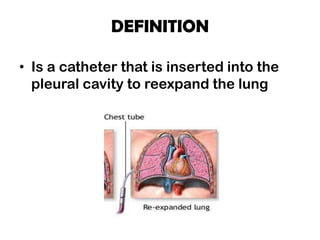
• Is a catheter that is inserted into the
pleural cavity to reexpand the lung
INDICATIONS
1.Traumatic pneumothorax
2.Hemopneumothorax
3.Spontaneous pneumothorax
4. Latrogenic pneumothorax
5.Bronchopleural fistula
6. Emphysema
7. Malignant
8. Pleural effusion
PURPOSE
• 1. To permit drainage of air and fluid
from the pleural cavity
• 2. To establish normal negative
pressure in the pleural cavity for lung
expansion
• 3. To equalize pressure on both sides
of the thoracic cavity
• 4. To provide continuous suction to
prevent tension pneumothorax
SITES FOR CHEST TUBE INSERTION
1. Thoracic surgery.
• 2 chest tube inserted – Anterior chest
tube & Posterior chest tube
2. Anterior chest :
• Upper/anterior chest wall
• Inserted in the 2nd intercostal space to
remove the air arising from the pleural
cavity
CON’T
3.Posterior chest tube :
• Placed at the posterior chest in the 8th
or 9th intercostal space at the mid-
axilllary line.
• Indication to remove serogeneous fluid
at the lower area of pleural cavity
• Diameter of tube in the lower section
is wider or longer compare to the
upper tube.
CON’T
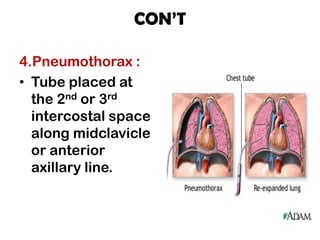
4.Pneumothorax :
• Tube placed at
the 2nd or 3rd
intercostal space
along midclavicle
or anterior
axillary line.
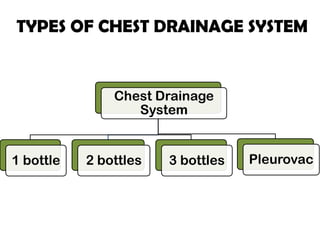
TYPES OF CHEST DRAINAGE SYSTEM
Chest Drainage
System
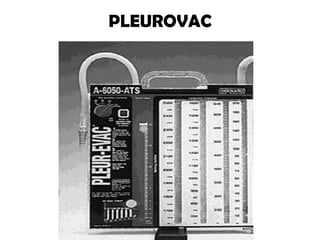
1 bottle 2 bottles 3 bottles Pleurovac
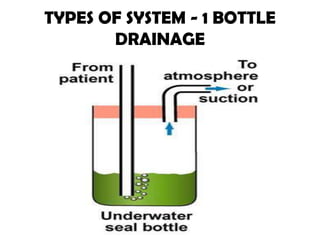
TYPES OF SYSTEM - 1 BOTTLE
DRAINAGE
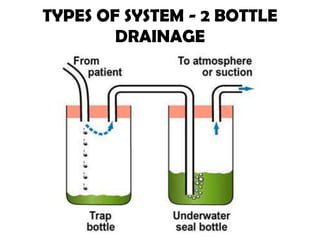
TYPES OF SYSTEM - 2 BOTTLE
DRAINAGE
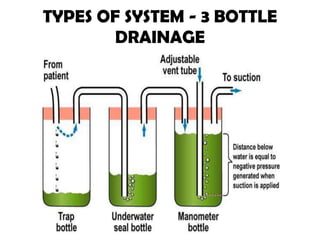
TYPES OF SYSTEM - 3 BOTTLE
DRAINAGE
PLEUROVAC
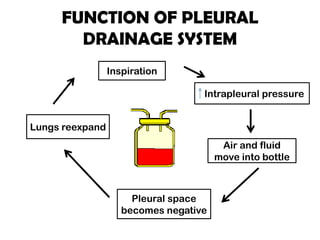
FUNCTION OF PLEURAL
DRAINAGE SYSTEM
Inspiration
Intrapleural pressure
Air and fluid
move into bottle
Pleural space
becomes negative
Lungs reexpand
PRINCIPLES OF THE CHEST TUBE
1. Gravity
2. Under Water Seal
3. Suction
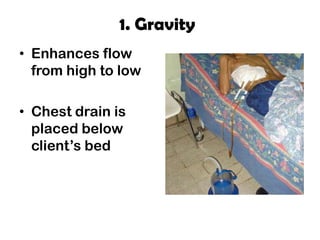
1. Gravity
• Enhances flow
from high to low
• Chest drain is
placed below
client’s bed
2. Water Seal
• Is a barrier to prevents backflow into
pleural space.
• Rod – depth determines the negative
pressure
• Air bubbles is released through the rod
• Air vent – to allow drained air to
escape to prevent pressure build up
3. Suction
• Is a pull force
• MUST be in another bottle
• Purpose for the suction when :
- Gravity drainage is not enough.
- Patient’s respiration and cough are too
weak
- Air leak is fast into the pleural space
- Need to speed up removal from pleural
space
Nursing Responsibilities
1. Pre procedure.
2. During
3. Post procedure
4. Emergency care
Pre-procedure care
1. Confirm :
• Open thoracotomy – during surgery
• Closed thoracotomy – at patient’s
bedside.
2. Inform patient
3. Check for consent
4. X-ray – with report to determine the
affected lung
CON’T
5. Prepare equipments (Top shelf) :
• T & S set that contains :
- Swab cotton wool & gauze
- Forceps, sponge holding forceps, dissecting, toothed
Holder, artery forceps, scissors, kidney dish,
gallipot,sterile towel.
• Trocar and cannula set FG 33.
• Syringe 20 cc,50cc,5cc
• Needle – 21G,23G & 25G(2 each)
• Suture – Mersilk size 0,2/0 reserve cutting.
• Blade size 11
CON’T
6. Prepare equipments (bottom shelf) :
• Sterile glove depending dr size.
• Mask
• Connecting tubing & bottle drainage.
• Cleansing lotion – alcohol 70% and povidone.
• Op-site spray.
• Sterile specimen bottle
• Elastoplast
• Counter scissors
• Local anesthetic lignocaine 2% or 1%.
• Low suction pump – if required
• Clinical waste.
• Regular waste bin
CON’T
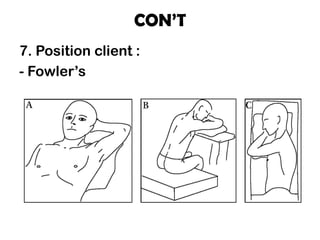
7. Position client :
- Fowler’s
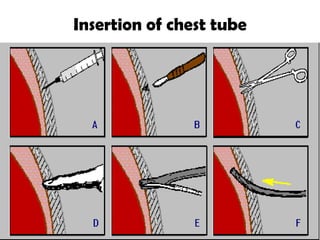
Insertion of chest tube
DURING – INSERTION OF CHEST
TUBE
Procedure :
1. Chest tubes can be inserted in the ER,
client’s bedside,or in OT
2. In OT the chest tube is inserted via the
thoracotomy insertion.
3. In ER, client’s bedside the client is
placed in the sitting position or is
lying down with the affected side
elevated
CON’T
4. The area is prepared with antiseptic
solution, and the site is infiltrated with
a local anesthetic agent.
5. After a small incision is made, one or
two chest tubes are inserted into the
pleural space.
CON’T
6. One catheter is placed anteriorly
through the 2nd intercostal space; the
other is placed posteriorly through the
8th or 10th space to drain fluid and
blood.
7. The tubes are sutured to the chest
wall, and the puncture wound is
covered with an airtight dressing.
CON’T
8. During insertion, the tubes are kept
clamped
9. After the tubes are in place in the
pleural space, they are connected to
drainage tubing and pleural drainage
and clamp is removed.
10. Each tube may be connected to a
separate drainage system and suction.
CON’T
11. More commonly, a Y connecter is
used to attach both chest tubes to the
same drainage system.
DURING THE PROCEDURE –
NURSING RESPONSIBILITIES
1. Observe respiration.
2. Reduce anxiety
3. Monitor saturation
4. Prepare the under water seal
5. Connect the closed system fast
POST PROCEDURE CARE
1. Respiratory status :
- Vital signs (15 min x 1 hour,30 mins x 1
hour,1 hr x 4 hours)
- Respiration rate,pattern and rhythm
- Color, chest pain, rapid pulse.
- Check saturation
- Administer oxygen when necessary.
POST PROCEDURE CARE –
RESPIRATORY STATUS
2. Auscultate :
- Every 2 hours
- Listen for breath sound
- Listen for increased area of absent
breath sound
- Place patient in flowler’s or high
fowler’s.
POST PROCEDURE CARE –
ANXIETY
• Due to fear of pain and complication.
• Increase the need for oxygen
• Explain to the patient – care of tube,
the fluid drained and frequent checks.
• Pay attention to their needs.
• Allow relatives to stay.
POST PROCEDURE CARE –
WOUND STATUS
• Change the gauze when necessary
• Strict aseptic technique.
• Skin integrity – redness,swelling and
loose suture
POST PROCEDURE CARE –
TUBING
1. Intact and taped
2. Maintain patency.
- Check for obstruction
CON’T
1. Teach the patient on how to care for
the tubing.
- Place a pillow between patient and
tubing.
- Instruct the patient to cough if tube is
blocked
- Milking and stripping of the tube when
blocked
POST PROCEDURE CARE –
CLAMPS
• Use rubber tips.
• Clamped at the bedside.
• Clamping :
- During transfer
- Not > 1 min
- Upon doctor’s orders.
POST PROCEDURE CARE –
WATER SEAL
• Place below patient’s chest wall
• Fill with sterile water
• Rod must be immersed 2 cm in water
• Observe for the fluctuation of water
level.
CON’T
1. Fluctuation (tidaling)
• To ensure patency of system.
• Stops when :
- Lung is fully expanded (36-72 hours)
- When there is an obstruction
• Check for obstruction.
- Tubing – kinked
- Patients position
- Ask patient to take a deep breath and
cough
CON’T
2. Observe for bubbling :
- Intermittent bubbling is normal
- Continuous bubbling is abnormal.
- Check for
• Wound
• Tube
• Connection
- If rapid bubbling without air leak –
inform the doctor immediately
CON’T
3. Drainage output :
- 70 – 100 mls/hour
- Observe for change in drainage colour.
- Mark the amount.
• Mark the time of measurement and the fluid
level on the drainage chamber according to
the prescribed orders
• Marking intervals may range from once per
hour to every 8 hours.
• Any change in the quantity or characteristics
of drainage ( eg. Clear yellow to bloody )
should be reported to Dr.
CON’T
3. Drainage output (con’t)
- Document in the I/O chart
- Change bottle every 24 hours or when
full
POST PROCEDURE CARE –
SUCTION APPARATUS
1. Low suction pump :
- Must be controlled
- Suction valve / meter is inserted for wall
suction.
- Check for bubbling.
- If no bubbles :
• Clamp the chest tube to check for air
leaks
• Check the tubing and connection.
• Observe patient’s condition while chest
tube is clamped
POST PROCEDURE CARE –
SAFETY
1. Tube :
- Prevent kinking
- Place a pillow as a barrier
- Never clamp unnecessarily.
- Assist patient during ambulation the
first time
CON’T
2. Bottle :
- Bottles must be below chest level
- Keep bottle in a basin
- Inform relatives and housekeeping
regarding bottles
- Bed must be locked
- Activity should be limited to avoid injury
POST PROCEDURE CARE –
AMBULATION
- Explain to client
- Encourage change of position to
promote drainage.
- Can sit up, get in and out of bed.
- Stop the suction
- No need to clamp the tube.
- Maintain chest drain below chest wall.
POST PROCEDURE CARE –
DEEP BREATHING AND ARM
EXERCISE
1. On the 1st post op day.
2. When patient is not in severe pain
3. Enhances lung expansion – expels air
and fluid
CON’T
4. Prevents stiffness of the arm
5. Assist patient .
- Deep breathing exercise
- Support when patient is coughing
- Abdominal breathing
POST PROCEDURE CARE -
COMFORT
• Administer analgesic in the first 24 hours
• Allow position that is comfortable for the
patient.
• Assist patient in providing self-care
REMOVAL OF CHEST TUBE
• The chest tubes are removed when the
lungs are reexpanded and fluid
drainage.
• Assessment :
• - X-ray is done to check the progress
• - Clamp for 2 hours
• Chest tube is removed.
EMERGENCY CARE
1. Bleeding Post Chest tube insertion :
- Observe wound dressing
- Observe drainage
- Inform the surgeon immediately
CON’T
2. Dislodgement :
- From insertion site – place a gauze
immediately over the wound
- From connection – clamp the chest
tube immediately.
CON’T
3. Bottle breaks :
- Identify patient’s problem –
pneumothorax or hemothorax.
- Observe patient fortension
pneumothorax
- Place the tube in saline immediately.
- Unclamp immediately – prevent
respiratory distress
COMPLICATIONS
1. Bleeding
2. Pulmonary Embolus
3. Cardiac Tamponade
4. Atelectasis
Chest tube cross
Chest tube cross

Chest tube cross

  • 1.
    Care Of ClientsWith Chest Tube
  • 2.
    DEFINITION • Is acatheter that is inserted into the pleural cavity to reexpand the lung
  • 3.
    INDICATIONS 1.Traumatic pneumothorax 2.Hemopneumothorax 3.Spontaneous pneumothorax 4.Latrogenic pneumothorax 5.Bronchopleural fistula 6. Emphysema 7. Malignant 8. Pleural effusion
  • 4.
    PURPOSE • 1. Topermit drainage of air and fluid from the pleural cavity • 2. To establish normal negative pressure in the pleural cavity for lung expansion • 3. To equalize pressure on both sides of the thoracic cavity • 4. To provide continuous suction to prevent tension pneumothorax
  • 5.
    SITES FOR CHESTTUBE INSERTION 1. Thoracic surgery. • 2 chest tube inserted – Anterior chest tube & Posterior chest tube 2. Anterior chest : • Upper/anterior chest wall • Inserted in the 2nd intercostal space to remove the air arising from the pleural cavity
  • 6.
    CON’T 3.Posterior chest tube: • Placed at the posterior chest in the 8th or 9th intercostal space at the mid- axilllary line. • Indication to remove serogeneous fluid at the lower area of pleural cavity • Diameter of tube in the lower section is wider or longer compare to the upper tube.
  • 7.
    CON’T 4.Pneumothorax : • Tubeplaced at the 2nd or 3rd intercostal space along midclavicle or anterior axillary line.
  • 8.
    TYPES OF CHESTDRAINAGE SYSTEM Chest Drainage System 1 bottle 2 bottles 3 bottles Pleurovac
  • 9.
    TYPES OF SYSTEM- 1 BOTTLE DRAINAGE
  • 10.
    TYPES OF SYSTEM- 2 BOTTLE DRAINAGE
  • 11.
    TYPES OF SYSTEM- 3 BOTTLE DRAINAGE
  • 12.
  • 13.
    FUNCTION OF PLEURAL DRAINAGESYSTEM Inspiration Intrapleural pressure Air and fluid move into bottle Pleural space becomes negative Lungs reexpand
  • 14.
    PRINCIPLES OF THECHEST TUBE 1. Gravity 2. Under Water Seal 3. Suction
  • 15.
    1. Gravity • Enhancesflow from high to low • Chest drain is placed below client’s bed
  • 16.
    2. Water Seal •Is a barrier to prevents backflow into pleural space. • Rod – depth determines the negative pressure • Air bubbles is released through the rod • Air vent – to allow drained air to escape to prevent pressure build up
  • 17.
    3. Suction • Isa pull force • MUST be in another bottle • Purpose for the suction when : - Gravity drainage is not enough. - Patient’s respiration and cough are too weak - Air leak is fast into the pleural space - Need to speed up removal from pleural space
  • 18.
    Nursing Responsibilities 1. Preprocedure. 2. During 3. Post procedure 4. Emergency care
  • 19.
    Pre-procedure care 1. Confirm: • Open thoracotomy – during surgery • Closed thoracotomy – at patient’s bedside. 2. Inform patient 3. Check for consent 4. X-ray – with report to determine the affected lung
  • 20.
    CON’T 5. Prepare equipments(Top shelf) : • T & S set that contains : - Swab cotton wool & gauze - Forceps, sponge holding forceps, dissecting, toothed Holder, artery forceps, scissors, kidney dish, gallipot,sterile towel. • Trocar and cannula set FG 33. • Syringe 20 cc,50cc,5cc • Needle – 21G,23G & 25G(2 each) • Suture – Mersilk size 0,2/0 reserve cutting. • Blade size 11
  • 21.
    CON’T 6. Prepare equipments(bottom shelf) : • Sterile glove depending dr size. • Mask • Connecting tubing & bottle drainage. • Cleansing lotion – alcohol 70% and povidone. • Op-site spray. • Sterile specimen bottle • Elastoplast • Counter scissors • Local anesthetic lignocaine 2% or 1%. • Low suction pump – if required • Clinical waste. • Regular waste bin
  • 22.
  • 23.
  • 24.
    DURING – INSERTIONOF CHEST TUBE Procedure : 1. Chest tubes can be inserted in the ER, client’s bedside,or in OT 2. In OT the chest tube is inserted via the thoracotomy insertion. 3. In ER, client’s bedside the client is placed in the sitting position or is lying down with the affected side elevated
  • 25.
    CON’T 4. The areais prepared with antiseptic solution, and the site is infiltrated with a local anesthetic agent. 5. After a small incision is made, one or two chest tubes are inserted into the pleural space.
  • 26.
    CON’T 6. One catheteris placed anteriorly through the 2nd intercostal space; the other is placed posteriorly through the 8th or 10th space to drain fluid and blood. 7. The tubes are sutured to the chest wall, and the puncture wound is covered with an airtight dressing.
  • 27.
    CON’T 8. During insertion,the tubes are kept clamped 9. After the tubes are in place in the pleural space, they are connected to drainage tubing and pleural drainage and clamp is removed. 10. Each tube may be connected to a separate drainage system and suction.
  • 28.
    CON’T 11. More commonly,a Y connecter is used to attach both chest tubes to the same drainage system.
  • 29.
    DURING THE PROCEDURE– NURSING RESPONSIBILITIES 1. Observe respiration. 2. Reduce anxiety 3. Monitor saturation 4. Prepare the under water seal 5. Connect the closed system fast
  • 30.
    POST PROCEDURE CARE 1.Respiratory status : - Vital signs (15 min x 1 hour,30 mins x 1 hour,1 hr x 4 hours) - Respiration rate,pattern and rhythm - Color, chest pain, rapid pulse. - Check saturation - Administer oxygen when necessary.
  • 31.
    POST PROCEDURE CARE– RESPIRATORY STATUS 2. Auscultate : - Every 2 hours - Listen for breath sound - Listen for increased area of absent breath sound - Place patient in flowler’s or high fowler’s.
  • 32.
    POST PROCEDURE CARE– ANXIETY • Due to fear of pain and complication. • Increase the need for oxygen • Explain to the patient – care of tube, the fluid drained and frequent checks. • Pay attention to their needs. • Allow relatives to stay.
  • 33.
    POST PROCEDURE CARE– WOUND STATUS • Change the gauze when necessary • Strict aseptic technique. • Skin integrity – redness,swelling and loose suture
  • 34.
    POST PROCEDURE CARE– TUBING 1. Intact and taped 2. Maintain patency. - Check for obstruction
  • 35.
    CON’T 1. Teach thepatient on how to care for the tubing. - Place a pillow between patient and tubing. - Instruct the patient to cough if tube is blocked - Milking and stripping of the tube when blocked
  • 36.
    POST PROCEDURE CARE– CLAMPS • Use rubber tips. • Clamped at the bedside. • Clamping : - During transfer - Not > 1 min - Upon doctor’s orders.
  • 37.
    POST PROCEDURE CARE– WATER SEAL • Place below patient’s chest wall • Fill with sterile water • Rod must be immersed 2 cm in water • Observe for the fluctuation of water level.
  • 38.
    CON’T 1. Fluctuation (tidaling) •To ensure patency of system. • Stops when : - Lung is fully expanded (36-72 hours) - When there is an obstruction • Check for obstruction. - Tubing – kinked - Patients position - Ask patient to take a deep breath and cough
  • 39.
    CON’T 2. Observe forbubbling : - Intermittent bubbling is normal - Continuous bubbling is abnormal. - Check for • Wound • Tube • Connection - If rapid bubbling without air leak – inform the doctor immediately
  • 40.
    CON’T 3. Drainage output: - 70 – 100 mls/hour - Observe for change in drainage colour. - Mark the amount. • Mark the time of measurement and the fluid level on the drainage chamber according to the prescribed orders • Marking intervals may range from once per hour to every 8 hours. • Any change in the quantity or characteristics of drainage ( eg. Clear yellow to bloody ) should be reported to Dr.
  • 41.
    CON’T 3. Drainage output(con’t) - Document in the I/O chart - Change bottle every 24 hours or when full
  • 42.
    POST PROCEDURE CARE– SUCTION APPARATUS 1. Low suction pump : - Must be controlled - Suction valve / meter is inserted for wall suction. - Check for bubbling. - If no bubbles : • Clamp the chest tube to check for air leaks • Check the tubing and connection. • Observe patient’s condition while chest tube is clamped
  • 43.
    POST PROCEDURE CARE– SAFETY 1. Tube : - Prevent kinking - Place a pillow as a barrier - Never clamp unnecessarily. - Assist patient during ambulation the first time
  • 44.
    CON’T 2. Bottle : -Bottles must be below chest level - Keep bottle in a basin - Inform relatives and housekeeping regarding bottles - Bed must be locked - Activity should be limited to avoid injury
  • 45.
    POST PROCEDURE CARE– AMBULATION - Explain to client - Encourage change of position to promote drainage. - Can sit up, get in and out of bed. - Stop the suction - No need to clamp the tube. - Maintain chest drain below chest wall.
  • 46.
    POST PROCEDURE CARE– DEEP BREATHING AND ARM EXERCISE 1. On the 1st post op day. 2. When patient is not in severe pain 3. Enhances lung expansion – expels air and fluid
  • 47.
    CON’T 4. Prevents stiffnessof the arm 5. Assist patient . - Deep breathing exercise - Support when patient is coughing - Abdominal breathing
  • 48.
    POST PROCEDURE CARE- COMFORT • Administer analgesic in the first 24 hours • Allow position that is comfortable for the patient. • Assist patient in providing self-care
  • 49.
    REMOVAL OF CHESTTUBE • The chest tubes are removed when the lungs are reexpanded and fluid drainage. • Assessment : • - X-ray is done to check the progress • - Clamp for 2 hours • Chest tube is removed.
  • 50.
    EMERGENCY CARE 1. BleedingPost Chest tube insertion : - Observe wound dressing - Observe drainage - Inform the surgeon immediately
  • 51.
    CON’T 2. Dislodgement : -From insertion site – place a gauze immediately over the wound - From connection – clamp the chest tube immediately.
  • 52.
    CON’T 3. Bottle breaks: - Identify patient’s problem – pneumothorax or hemothorax. - Observe patient fortension pneumothorax - Place the tube in saline immediately. - Unclamp immediately – prevent respiratory distress
  • 53.
    COMPLICATIONS 1. Bleeding 2. PulmonaryEmbolus 3. Cardiac Tamponade 4. Atelectasis