Combined Military Hospital Dhaka
By Capt Shams
Emergency Thoracotomy
Introduction
Types
Indications
Contraindications
Approaches
Complications
Conclusion
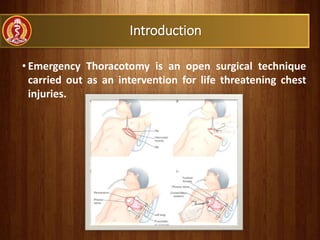
• Emergency Thoracotomy is an open surgical technique
carried out as an intervention for life threatening chest
injuries.
Introduction
• Emergency department thoracotomy or sternotomy:
• Performed immediately
• At the emergency department
• Planned emergency thoracotomy:
• Following diagnosis of a specific injury
• At the operation theatre
Types
Indication
• Pericardial tamponade
• Control of haemorrhage from intra thoracic injury
• Initial haemorrhage > 1500 ml through chest tube
• Ongoing haemorrhage > 200 ml/h over 3-4 hours
• Systolic BP < 70 mmHg despite resuscitation
• Control of massive air leak
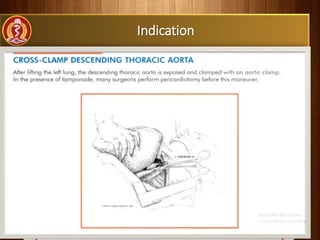
• Clamping of the thoracic aorta
• Open cardiac massage
• Control of air embolism
Indication
• Pericardial tamponade
• Control of haemorrhage from intra thoracic injury
• Initial haemorrhage > 1500 ml through chest tube
• Ongoing haemorrhage > 200 ml/h over 3-4 hours
• Systolic BP < 70 mmHg despite resuscitation
• Control of massive air leak
• Clamping of the thoracic aorta
• Open cardiac massage
• Control of air embolism
Contraindication
• CPR in absence of intubation > 5 minutes
• CPR despite intubation > 10 minutes
• Blunt trauma with no sign of life
Approaches
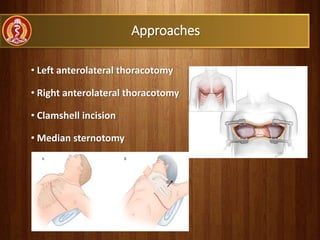
• Left anterolateral thoracotomy
• Right anterolateral thoracotomy
• Clamshell incision
• Median sternotomy
Complications
• Injury to the surrounding structures
• Left phrenic nerve, coronal vessels, etc.
• Bleeding
• Infection
• Complications related to chest drain
•A chest drain is kept in situ following the surgery
and is monitored regularly to assess the post
operative recovery.
•Emergency thoracic surgery is an essential part of
the skill of any surgeon dealing with major trauma.
Conclusion
Emergency Thoracotomy

Emergency Thoracotomy

  • 1.
    Combined Military HospitalDhaka By Capt Shams Emergency Thoracotomy
  • 2.
  • 3.
    • Emergency Thoracotomyis an open surgical technique carried out as an intervention for life threatening chest injuries. Introduction
  • 4.
    • Emergency departmentthoracotomy or sternotomy: • Performed immediately • At the emergency department • Planned emergency thoracotomy: • Following diagnosis of a specific injury • At the operation theatre Types
  • 5.
    Indication • Pericardial tamponade •Control of haemorrhage from intra thoracic injury • Initial haemorrhage > 1500 ml through chest tube • Ongoing haemorrhage > 200 ml/h over 3-4 hours • Systolic BP < 70 mmHg despite resuscitation • Control of massive air leak • Clamping of the thoracic aorta • Open cardiac massage • Control of air embolism
  • 6.
    Indication • Pericardial tamponade •Control of haemorrhage from intra thoracic injury • Initial haemorrhage > 1500 ml through chest tube • Ongoing haemorrhage > 200 ml/h over 3-4 hours • Systolic BP < 70 mmHg despite resuscitation • Control of massive air leak • Clamping of the thoracic aorta • Open cardiac massage • Control of air embolism
  • 7.
    Contraindication • CPR inabsence of intubation > 5 minutes • CPR despite intubation > 10 minutes • Blunt trauma with no sign of life
  • 8.
    Approaches • Left anterolateralthoracotomy • Right anterolateral thoracotomy • Clamshell incision • Median sternotomy
  • 9.
    Complications • Injury tothe surrounding structures • Left phrenic nerve, coronal vessels, etc. • Bleeding • Infection • Complications related to chest drain
  • 10.
    •A chest drainis kept in situ following the surgery and is monitored regularly to assess the post operative recovery. •Emergency thoracic surgery is an essential part of the skill of any surgeon dealing with major trauma. Conclusion