

AIRWAY DEVICES AND
THEIR SPECIFICATIONS
Dr . S.K.Varma
KG Hospital, Coimbatore
Classification
 Extra glottic
 Intra glottic
Simple Airway Devices
 Face Mask
 Oropharyngeal Airways
 Nasopharyngeal Airways
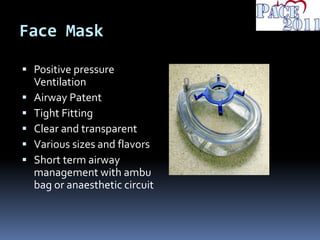
Face Mask
 Positive pressure
Ventilation
 Airway Patent
 Tight Fitting
 Clear and transparent
 Various sizes and flavors
 Short term airway
management with ambu
bag or anaesthetic circuit
Signs of successful seal and
ventilation
• the rising of the chest with delivery of positive
pressure
• breath sounds on auscultation
• a firm/taught/full bag
• return carbon dioxide on exhalation capnography
• Foggy Mask
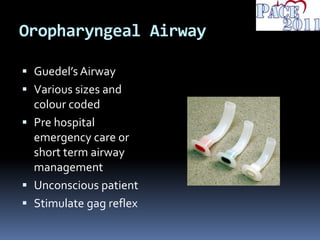
Oropharyngeal Airway
 Guedel’s Airway
 Various sizes and
colour coded
 Pre hospital
emergency care or
short term airway
management
 Unconscious patient
 Stimulate gag reflex
Risks of use
 Patient may vomit if they have intact gag
reflex
 Too large can close glottis and obstruct the
airway
 Insertion can become traumatic and cause
bleeding
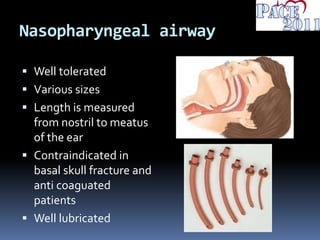
Nasopharyngeal airway
 Well tolerated
 Various sizes
 Length is measured
from nostril to meatus
of the ear
 Contraindicated in
basal skull fracture and
anti coaguated
patients
 Well lubricated
Supraglottic Airway
 Placed above the vocal cord level
 Those devices which allow hands-free
maintenance of an open airway
 Allows spontaneous or assisted
ventilation
General Characteristics
 Ability to be placed without direct visualization
 Better cardio vascular stability both during insertion
and removal
 Minimal IOP and ICP changes
 Provide little protection against aspiration
 Contraindicated in full stomach patients
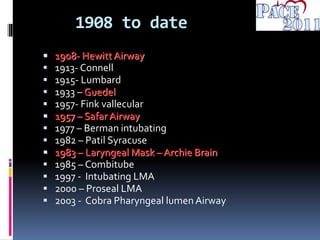
1908 to date
 1908- Hewitt Airway
 1913- Connell
 1915- Lumbard
 1933 – Guedel
 1957- Fink vallecular
 1957 – Safar Airway
 1977 – Berman intubating
 1982 – Patil Syracuse
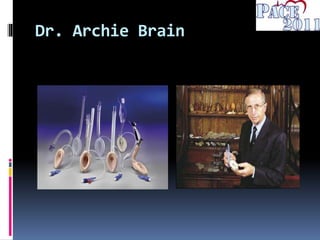
 1983 – Laryngeal Mask – Archie Brain
 1985 – Combitube
 1997 - Intubating LMA
 2000 – Proseal LMA
 2003 - Cobra Pharyngeal lumen Airway
Dr. Archie Brain
Laryngeal Mask Airway
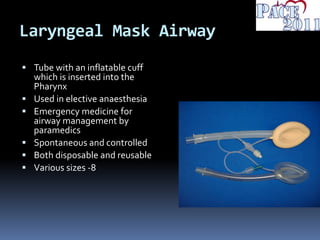
 Tube with an inflatable cuff
which is inserted into the
Pharynx
 Used in elective anaesthesia
 Emergency medicine for
airway management by
paramedics
 Spontaneous and controlled
 Both disposable and reusable
 Various sizes -8
Laryngeal Mask Airway
 Incidence of aspiration is 2 in 10000 (0.02%)
 One death attributed directly to LMA out of 2
million users
 It is included by theAmericanTask Force in
the difficult airway algorithm in 1995
C. Keller et al – Aspiration and LMA – a review of literature
BJA 93(4) 579-82: 2004
Brimacombe JR et al-The Larynfeal Mask Airway- in the
difficult airway.Anaesthesiology clin of North America
June 13(2) ; 411-37 : 1995
Proseal & LMA Supreme
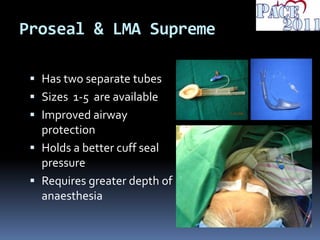
 Has two separate tubes
 Sizes 1-5 are available
 Improved airway
protection
 Holds a better cuff seal
pressure
 Requires greater depth of
anaesthesia
Flexible LMA
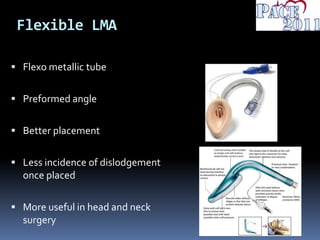
 Flexo metallic tube
 Preformed angle
 Better placement
 Less incidence of dislodgement
once placed
 More useful in head and neck
surgery
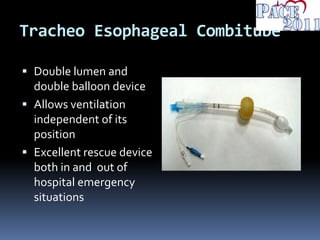
Tracheo Esophageal Combitube
 Double lumen and
double balloon device
 Allows ventilation
independent of its
position
 Excellent rescue device
both in and out of
hospital emergency
situations
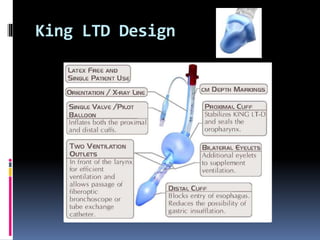
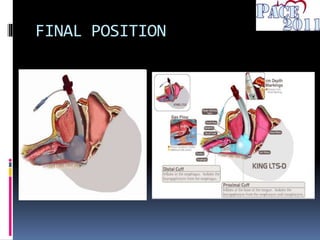
King LTD Design
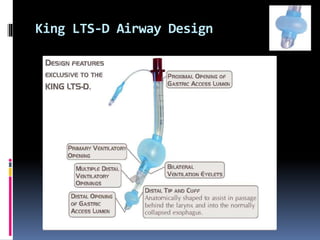
King LTS-D Airway Design
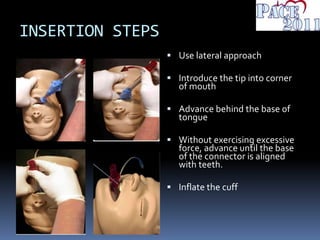
INSERTION STEPS
 Use lateral approach
 Introduce the tip into corner
of mouth
 Advance behind the base of
tongue
 Without exercising excessive
force, advance until the base
of the connector is aligned
with teeth.
 Inflate the cuff
FINAL POSITION
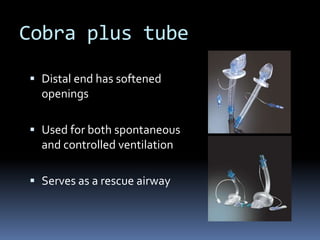
Cobra plus tube
 Distal end has softened
openings
 Used for both spontaneous
and controlled ventilation
 Serves as a rescue airway
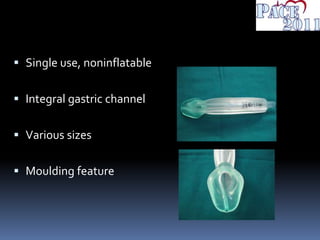
 Single use, noninflatable
 Integral gastric channel
 Various sizes
 Moulding feature
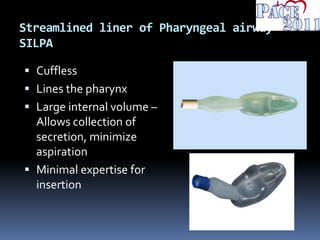
Streamlined liner of Pharyngeal airway -
SILPA
 Cuffless
 Lines the pharynx
 Large internal volume –
Allows collection of
secretion, minimize
aspiration
 Minimal expertise for
insertion
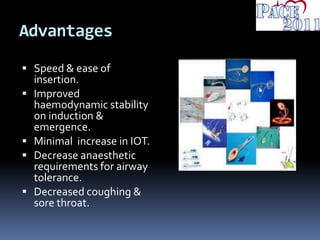
Advantages
 Speed & ease of
insertion.
 Improved
haemodynamic stability
on induction &
emergence.
 Minimal increase in IOT.
 Decrease anaesthetic
requirements for airway
tolerance.
 Decreased coughing &
sore throat.
Intraglottic devices-History
 1864- First endotracheal anaesthesia using
tracheotomy cannula by German surgeon
 1880- SirWilliam Macewen – Glasgow
surgeon was the first to introduce
orotracheal intubation
 1921- Sir Ivan Magill endotracheal rubber
tubes
 1928- Cuffed endotracheal anaesthesia
Indications for endotracheal
intubation
 Airway Protection
 Pulmonary toileting
 Applications of positive pressure
ventilation
 Maintenance of adequate oxygenation
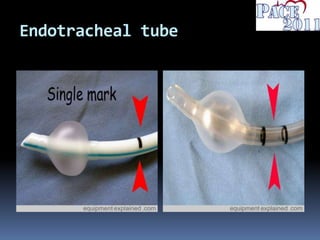
Endotracheal tubes
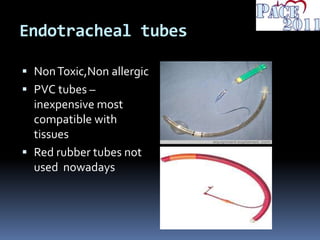
 NonToxic,Non allergic
 PVC tubes –
inexpensive most
compatible with
tissues
 Red rubber tubes not
used nowadays
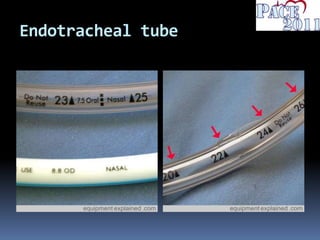
Endotracheal tube
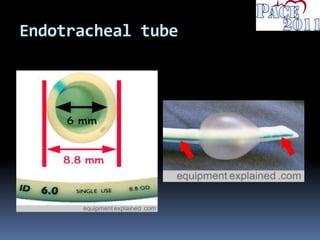
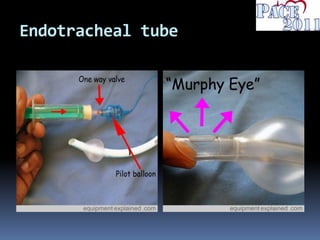
Endotracheal tube
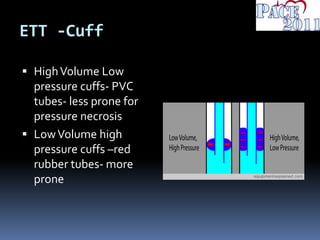
ETT -Cuff
 HighVolume Low
pressure cuffs- PVC
tubes- less prone for
pressure necrosis
 LowVolume high
pressure cuffs –red
rubber tubes- more
prone
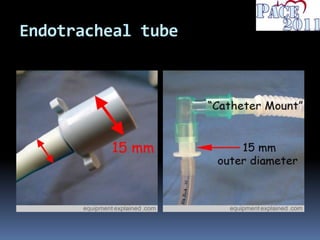
Endotracheal tube
Endotracheal tube
Endotracheal tube
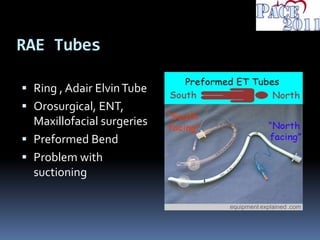
RAE Tubes
 Ring , Adair ElvinTube
 Orosurgical, ENT,
Maxillofacial surgeries
 Preformed Bend
 Problem with
suctioning
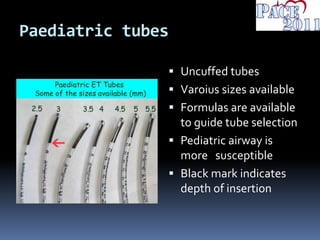
Paediatric tubes
 Uncuffed tubes
 Varoius sizes available
 Formulas are available
to guide tube selection
 Pediatric airway is
more susceptible
 Black mark indicates
depth of insertion
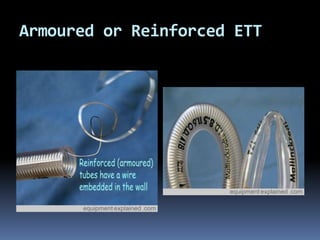
Armoured or Reinforced ETT
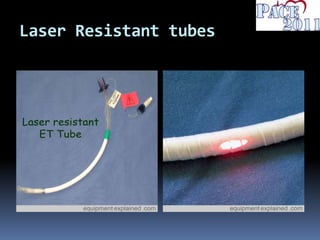
Laser Resistant tubes
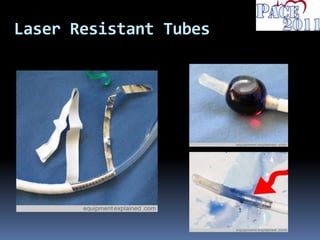
Laser Resistant Tubes
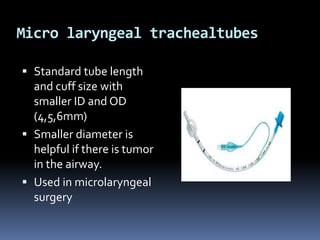
Micro laryngeal trachealtubes
 Standard tube length
and cuff size with
smaller ID and OD
(4,5,6mm)
 Smaller diameter is
helpful if there is tumor
in the airway.
 Used in microlaryngeal
surgery
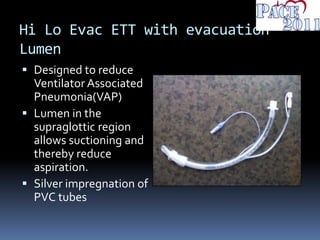
Hi Lo Evac ETT with evacuation
Lumen
 Designed to reduce
Ventilator Associated
Pneumonia(VAP)
 Lumen in the
supraglottic region
allows suctioning and
thereby reduce
aspiration.
 Silver impregnation of
PVC tubes
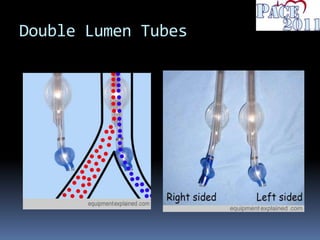
Double Lumen Tubes
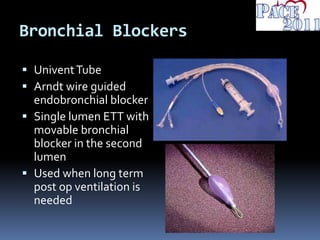
Bronchial Blockers
 UniventTube
 Arndt wire guided
endobronchial blocker
 Single lumen ETT with
movable bronchial
blocker in the second
lumen
 Used when long term
post op ventilation is
needed
Intubating Aids
 Direct laryngoscopes
 Gum elastic bougie
 Flexible fibre optic bronchoscopes
 Intubating laryngeal mask airway (Fastrach)
 Light wand
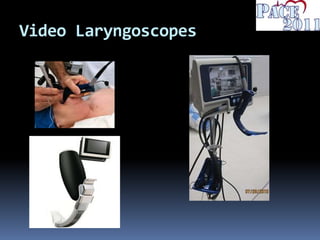
 Video laryngoscopes
 Indirect fibreoptic laryngoscopes(Bullard)
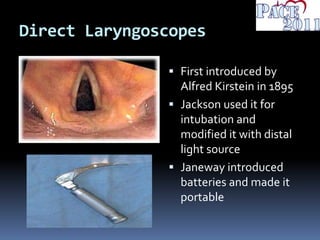
Direct Laryngoscopes
 First introduced by
Alfred Kirstein in 1895
 Jackson used it for
intubation and
modified it with distal
light source
 Janeway introduced
batteries and made it
portable
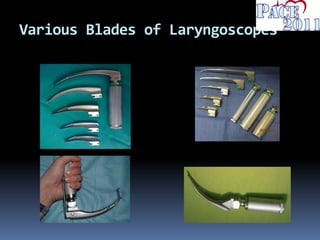
Various Blades of Laryngoscopes
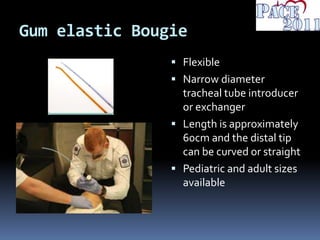
Gum elastic Bougie
 Flexible
 Narrow diameter
tracheal tube introducer
or exchanger
 Length is approximately
60cm and the distal tip
can be curved or straight
 Pediatric and adult sizes
available
Video Laryngoscopes
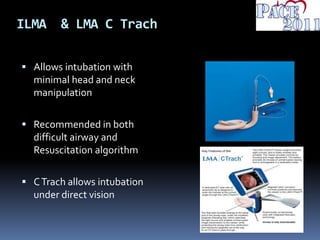
ILMA & LMA C Trach
 Allows intubation with
minimal head and neck
manipulation
 Recommended in both
difficult airway and
Resuscitation algorithm
 CTrach allows intubation
under direct vision
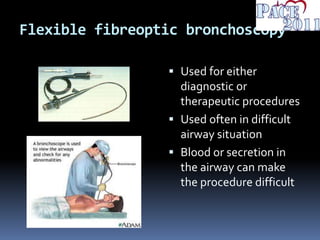
Flexible fibreoptic bronchoscopy
 Used for either
diagnostic or
therapeutic procedures
 Used often in difficult
airway situation
 Blood or secretion in
the airway can make
the procedure difficult
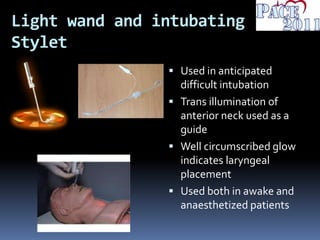
Light wand and intubating
Stylet
 Used in anticipated
difficult intubation
 Trans illumination of
anterior neck used as a
guide
 Well circumscribed glow
indicates laryngeal
placement
 Used both in awake and
anaesthetized patients
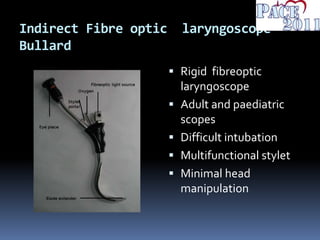
Indirect Fibre optic laryngoscope-
Bullard
 Rigid fibreoptic
laryngoscope
 Adult and paediatric
scopes
 Difficult intubation
 Multifunctional stylet
 Minimal head
manipulation
Case Scenario
 40 year old -180 kg man with history of sleep
apnoea and EF 25% has Strept .pneumonia
in his left lower lobe and progressive resp
insufficency
 O/E he has 50degree neck extension and
Mallampati 2
 How will you proceed?
 Patient airway anatomy is not suggestive of
difficulty.
 Supine position – subcutaneous tissues may
impair your ability to ventilate
 Use reverseTrendlenburg position, shoulder
roll to make ventilation better-gravity
 Have some accessory airway equipment
ready – like fibreoptic , ILMA , LMA
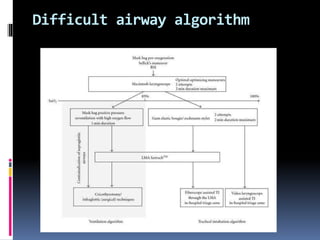
Difficult airway algorithm
Conclusion
 Wide variety of airway armamentarium available
 Provides great margin of safety
 Ask for senior help early
 Always have plan B and plan C available in case
plan A fails in difficult airway situations
Thank you
Airway Devices Management

Airway Devices Management

  • 1.
    AIRWAY DEVICES AND THEIRSPECIFICATIONS Dr . S.K.Varma KG Hospital, Coimbatore
  • 2.
  • 3.
    Simple Airway Devices Face Mask  Oropharyngeal Airways  Nasopharyngeal Airways
  • 4.
    Face Mask  Positivepressure Ventilation  Airway Patent  Tight Fitting  Clear and transparent  Various sizes and flavors  Short term airway management with ambu bag or anaesthetic circuit
  • 5.
    Signs of successfulseal and ventilation • the rising of the chest with delivery of positive pressure • breath sounds on auscultation • a firm/taught/full bag • return carbon dioxide on exhalation capnography • Foggy Mask
  • 6.
    Oropharyngeal Airway  Guedel’sAirway  Various sizes and colour coded  Pre hospital emergency care or short term airway management  Unconscious patient  Stimulate gag reflex
  • 7.
    Risks of use Patient may vomit if they have intact gag reflex  Too large can close glottis and obstruct the airway  Insertion can become traumatic and cause bleeding
  • 8.
    Nasopharyngeal airway  Welltolerated  Various sizes  Length is measured from nostril to meatus of the ear  Contraindicated in basal skull fracture and anti coaguated patients  Well lubricated
  • 9.
    Supraglottic Airway  Placedabove the vocal cord level  Those devices which allow hands-free maintenance of an open airway  Allows spontaneous or assisted ventilation
  • 10.
    General Characteristics  Abilityto be placed without direct visualization  Better cardio vascular stability both during insertion and removal  Minimal IOP and ICP changes  Provide little protection against aspiration  Contraindicated in full stomach patients
  • 11.
    1908 to date 1908- Hewitt Airway  1913- Connell  1915- Lumbard  1933 – Guedel  1957- Fink vallecular  1957 – Safar Airway  1977 – Berman intubating  1982 – Patil Syracuse  1983 – Laryngeal Mask – Archie Brain  1985 – Combitube  1997 - Intubating LMA  2000 – Proseal LMA  2003 - Cobra Pharyngeal lumen Airway
  • 12.
  • 13.
    Laryngeal Mask Airway Tube with an inflatable cuff which is inserted into the Pharynx  Used in elective anaesthesia  Emergency medicine for airway management by paramedics  Spontaneous and controlled  Both disposable and reusable  Various sizes -8
  • 14.
    Laryngeal Mask Airway Incidence of aspiration is 2 in 10000 (0.02%)  One death attributed directly to LMA out of 2 million users  It is included by theAmericanTask Force in the difficult airway algorithm in 1995 C. Keller et al – Aspiration and LMA – a review of literature BJA 93(4) 579-82: 2004 Brimacombe JR et al-The Larynfeal Mask Airway- in the difficult airway.Anaesthesiology clin of North America June 13(2) ; 411-37 : 1995
  • 15.
    Proseal & LMASupreme  Has two separate tubes  Sizes 1-5 are available  Improved airway protection  Holds a better cuff seal pressure  Requires greater depth of anaesthesia
  • 16.
    Flexible LMA  Flexometallic tube  Preformed angle  Better placement  Less incidence of dislodgement once placed  More useful in head and neck surgery
  • 17.
    Tracheo Esophageal Combitube Double lumen and double balloon device  Allows ventilation independent of its position  Excellent rescue device both in and out of hospital emergency situations
  • 18.
  • 19.
  • 20.
    INSERTION STEPS  Uselateral approach  Introduce the tip into corner of mouth  Advance behind the base of tongue  Without exercising excessive force, advance until the base of the connector is aligned with teeth.  Inflate the cuff
  • 21.
  • 22.
    Cobra plus tube Distal end has softened openings  Used for both spontaneous and controlled ventilation  Serves as a rescue airway
  • 24.
     Single use,noninflatable  Integral gastric channel  Various sizes  Moulding feature
  • 25.
    Streamlined liner ofPharyngeal airway - SILPA  Cuffless  Lines the pharynx  Large internal volume – Allows collection of secretion, minimize aspiration  Minimal expertise for insertion
  • 26.
    Advantages  Speed &ease of insertion.  Improved haemodynamic stability on induction & emergence.  Minimal increase in IOT.  Decrease anaesthetic requirements for airway tolerance.  Decreased coughing & sore throat.
  • 27.
    Intraglottic devices-History  1864-First endotracheal anaesthesia using tracheotomy cannula by German surgeon  1880- SirWilliam Macewen – Glasgow surgeon was the first to introduce orotracheal intubation  1921- Sir Ivan Magill endotracheal rubber tubes  1928- Cuffed endotracheal anaesthesia
  • 28.
    Indications for endotracheal intubation Airway Protection  Pulmonary toileting  Applications of positive pressure ventilation  Maintenance of adequate oxygenation
  • 29.
    Endotracheal tubes  NonToxic,Nonallergic  PVC tubes – inexpensive most compatible with tissues  Red rubber tubes not used nowadays
  • 30.
  • 31.
  • 32.
    ETT -Cuff  HighVolumeLow pressure cuffs- PVC tubes- less prone for pressure necrosis  LowVolume high pressure cuffs –red rubber tubes- more prone
  • 33.
  • 34.
  • 35.
  • 36.
    RAE Tubes  Ring, Adair ElvinTube  Orosurgical, ENT, Maxillofacial surgeries  Preformed Bend  Problem with suctioning
  • 37.
    Paediatric tubes  Uncuffedtubes  Varoius sizes available  Formulas are available to guide tube selection  Pediatric airway is more susceptible  Black mark indicates depth of insertion
  • 38.
  • 39.
  • 40.
  • 41.
    Micro laryngeal trachealtubes Standard tube length and cuff size with smaller ID and OD (4,5,6mm)  Smaller diameter is helpful if there is tumor in the airway.  Used in microlaryngeal surgery
  • 42.
    Hi Lo EvacETT with evacuation Lumen  Designed to reduce Ventilator Associated Pneumonia(VAP)  Lumen in the supraglottic region allows suctioning and thereby reduce aspiration.  Silver impregnation of PVC tubes
  • 43.
  • 44.
    Bronchial Blockers  UniventTube Arndt wire guided endobronchial blocker  Single lumen ETT with movable bronchial blocker in the second lumen  Used when long term post op ventilation is needed
  • 45.
    Intubating Aids  Directlaryngoscopes  Gum elastic bougie  Flexible fibre optic bronchoscopes  Intubating laryngeal mask airway (Fastrach)  Light wand  Video laryngoscopes  Indirect fibreoptic laryngoscopes(Bullard)
  • 46.
    Direct Laryngoscopes  Firstintroduced by Alfred Kirstein in 1895  Jackson used it for intubation and modified it with distal light source  Janeway introduced batteries and made it portable
  • 47.
    Various Blades ofLaryngoscopes
  • 48.
    Gum elastic Bougie Flexible  Narrow diameter tracheal tube introducer or exchanger  Length is approximately 60cm and the distal tip can be curved or straight  Pediatric and adult sizes available
  • 49.
  • 50.
    ILMA & LMAC Trach  Allows intubation with minimal head and neck manipulation  Recommended in both difficult airway and Resuscitation algorithm  CTrach allows intubation under direct vision
  • 51.
    Flexible fibreoptic bronchoscopy Used for either diagnostic or therapeutic procedures  Used often in difficult airway situation  Blood or secretion in the airway can make the procedure difficult
  • 52.
    Light wand andintubating Stylet  Used in anticipated difficult intubation  Trans illumination of anterior neck used as a guide  Well circumscribed glow indicates laryngeal placement  Used both in awake and anaesthetized patients
  • 53.
    Indirect Fibre opticlaryngoscope- Bullard  Rigid fibreoptic laryngoscope  Adult and paediatric scopes  Difficult intubation  Multifunctional stylet  Minimal head manipulation
  • 54.
    Case Scenario  40year old -180 kg man with history of sleep apnoea and EF 25% has Strept .pneumonia in his left lower lobe and progressive resp insufficency  O/E he has 50degree neck extension and Mallampati 2  How will you proceed?
  • 55.
     Patient airwayanatomy is not suggestive of difficulty.  Supine position – subcutaneous tissues may impair your ability to ventilate  Use reverseTrendlenburg position, shoulder roll to make ventilation better-gravity  Have some accessory airway equipment ready – like fibreoptic , ILMA , LMA
  • 56.
  • 57.
    Conclusion  Wide varietyof airway armamentarium available  Provides great margin of safety  Ask for senior help early  Always have plan B and plan C available in case plan A fails in difficult airway situations
  • 58.