Difficult Airway
Ricardo Poveda Jaramillo
Anestesiólogo Cardiovascular & Torácico
Clínica del Norte, IPS León XIII & HGM
¿Qué es vía aérea difícil?
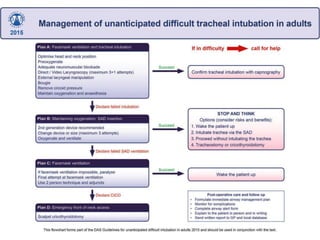
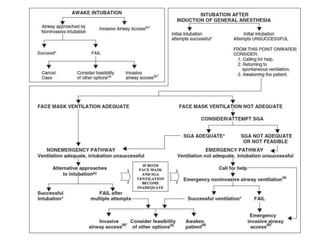
1. Difficult facemask or supraglottic airway (SGA) ventilation
(e.g. , laryngeal mask airway [LMA]): It is not possible for the
anesthesiologist to provide adequate ventilation
2. SGA placement requires multiple attempts, in the presence
or absence of tracheal pathology.
3. It is not possible to visualize any portion of the vocal cords
after multiple attempts at conventional laryngoscopy.
4. Difficult tracheal intubation: Tracheal intubation requires
multiple attempts, in the presence or absence of tracheal
pathology.
5. Failed intubation: Placement of the endotracheal tube fails
after multiple attempts.
Apfelbaum JL, Hagberg CA, Caplan RA, et al; American Society of Anesthesiologists Task Force on Management of the Difficult Airway. Practice guidelines for
management of the difficult airway: an updated report by the American Society of Anesthesiologists Task Force on Management of the Difficult Airway. Anesthesiology.
2013 Feb;118(2):251-70.
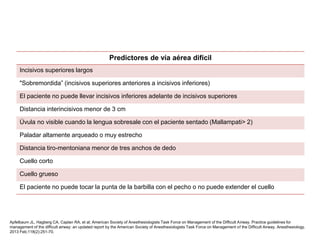
Predictores de vía aérea difícil
Incisivos superiores largos
"Sobremordida” (incisivos superiores anteriores a incisivos inferiores)
El paciente no puede llevar incisivos inferiores adelante de incisivos superiores
Distancia interincisivos menor de 3 cm
Úvula no visible cuando la lengua sobresale con el paciente sentado (Mallampati> 2)
Paladar altamente arqueado o muy estrecho
Distancia tiro-mentoniana menor de tres anchos de dedo
Cuello corto
Cuello grueso
El paciente no puede tocar la punta de la barbilla con el pecho o no puede extender el cuello
Apfelbaum JL, Hagberg CA, Caplan RA, et al; American Society of Anesthesiologists Task Force on Management of the Difficult Airway. Practice guidelines for
management of the difficult airway: an updated report by the American Society of Anesthesiologists Task Force on Management of the Difficult Airway. Anesthesiology.
2013 Feb;118(2):251-70.
“The principle that anaesthetists
should have back-up plans in
place before performing primary
techniques still holds true”.
Frerk C et al; Difficult Airway Society intubation guidelines working group.. Difficult Airway Society 2015 guidelines for
management of unanticipated difficult intubation in adults. Br J Anaesth. 2015 Dec;115(6):827-48.
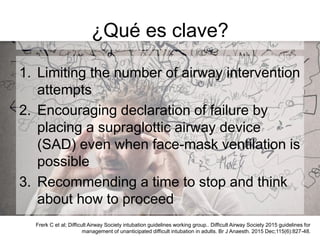
¿Qué es clave?
1. Limiting the number of airway intervention
attempts
2. Encouraging declaration of failure by
placing a supraglottic airway device
(SAD) even when face-mask ventilation is
possible
3. Recommending a time to stop and think
about how to proceed
Frerk C et al; Difficult Airway Society intubation guidelines working group.. Difficult Airway Society 2015 guidelines for
management of unanticipated difficult intubation in adults. Br J Anaesth. 2015 Dec;115(6):827-48.
“The complexities of difficult airway
management cannot
be distilled into a single algorithm, and even
the best anaesthetic
teams supported by the best guidelines will
still struggle to perform optimally if the
systems in which they operate are flawed”.
Frerk C et al; Difficult Airway Society intubation guidelines working group.. Difficult Airway Society 2015 guidelines for
management of unanticipated difficult intubation in adults. Br J Anaesth. 2015 Dec;115(6):827-48.
Factores humanos que llaman al
desastre
• Poor communication
• Poor training and teamwork
• Deficiencies in equipment
• Inadequate systems and processes
Frerk C et al; Difficult Airway Society intubation guidelines working group.. Difficult Airway Society 2015 guidelines for
management of unanticipated difficult intubation in adults. Br J Anaesth. 2015 Dec;115(6):827-48.
Frerk C et al; Difficult Airway Society intubation guidelines working group.. Difficult Airway Society 2015 guidelines for
management of unanticipated difficult intubation in adults. Br J Anaesth. 2015 Dec;115(6):827-48.
“Mechanical drainage by nasogastric
tube should be considered in order to
reduce residual gastric volume in patients
with severely delayed gastric emptying or
intestinal obstruction”.
Frerk C et al; Difficult Airway Society intubation guidelines working group.. Difficult Airway Society 2015 guidelines for
management of unanticipated difficult intubation in adults. Br J Anaesth. 2015 Dec;115(6):827-48.
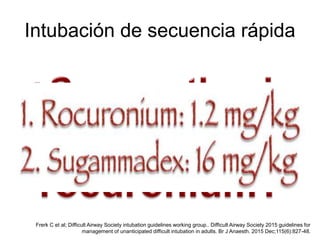
Intubación de secuencia rápida
Frerk C et al; Difficult Airway Society intubation guidelines working group.. Difficult Airway Society 2015 guidelines for
management of unanticipated difficult intubation in adults. Br J Anaesth. 2015 Dec;115(6):827-48.
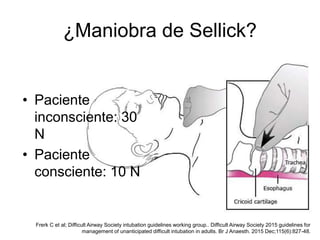
¿Maniobra de Sellick?
• Paciente
inconsciente: 30
N
• Paciente
consciente: 10 N
Frerk C et al; Difficult Airway Society intubation guidelines working group.. Difficult Airway Society 2015 guidelines for
management of unanticipated difficult intubation in adults. Br J Anaesth. 2015 Dec;115(6):827-48.
Frerk C et al; Difficult Airway Society intubation guidelines working group.. Difficult Airway Society 2015 guidelines for
management of unanticipated difficult intubation in adults. Br J Anaesth. 2015 Dec;115(6):827-48.
Frerk C et al; Difficult Airway Society intubation guidelines working group.. Difficult Airway Society 2015 guidelines for
management of unanticipated difficult intubation in adults. Br J Anaesth. 2015 Dec;115(6):827-48.
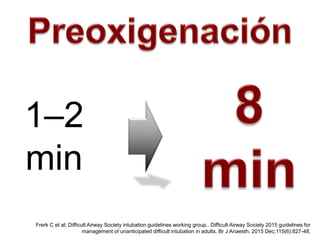
1–2
min
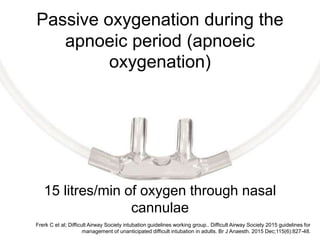
Passive oxygenation during the
apnoeic period (apnoeic
oxygenation)
15 litres/min of oxygen through nasal
cannulae
Frerk C et al; Difficult Airway Society intubation guidelines working group.. Difficult Airway Society 2015 guidelines for
management of unanticipated difficult intubation in adults. Br J Anaesth. 2015 Dec;115(6):827-48.
Inductor ideal
Frerk C et al; Difficult Airway Society intubation guidelines working group.. Difficult Airway Society 2015 guidelines for
management of unanticipated difficult intubation in adults. Br J Anaesth. 2015 Dec;115(6):827-48.
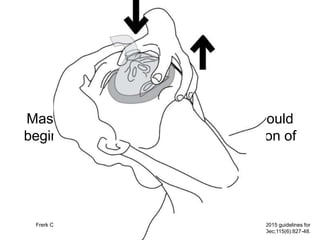
Mask ventilation
Mask ventilation with 100% oxygen should
begin as soon as possible after induction of
anaesthesia
Frerk C et al; Difficult Airway Society intubation guidelines working group.. Difficult Airway Society 2015 guidelines for
management of unanticipated difficult intubation in adults. Br J Anaesth. 2015 Dec;115(6):827-48.
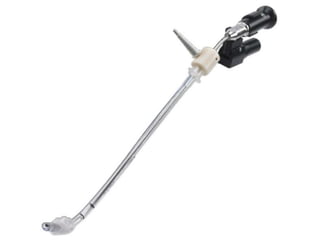
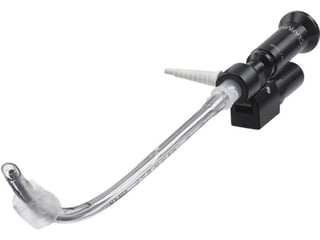
Elección del laringoscopio
Videolaryngoscopes are
now the first choice or default device for
some anaesthetists
Frerk C et al; Difficult Airway Society intubation guidelines working group.. Difficult Airway Society 2015 guidelines for
management of unanticipated difficult intubation in adults. Br J Anaesth. 2015 Dec;115(6):827-48.
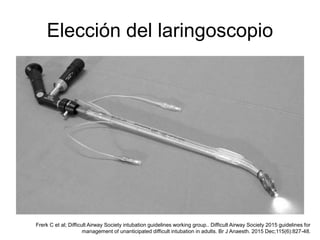
Elección del laringoscopio
Frerk C et al; Difficult Airway Society intubation guidelines working group.. Difficult Airway Society 2015 guidelines for
management of unanticipated difficult intubation in adults. Br J Anaesth. 2015 Dec;115(6):827-48.
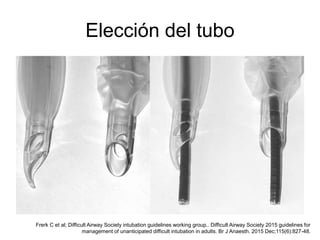
Elección del tubo
Frerk C et al; Difficult Airway Society intubation guidelines working group.. Difficult Airway Society 2015 guidelines for
management of unanticipated difficult intubation in adults. Br J Anaesth. 2015 Dec;115(6):827-48.
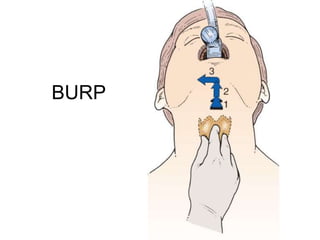
BURP
Uso del bougie o estilete luminoso
Frerk C et al; Difficult Airway Society intubation guidelines working group.. Difficult Airway Society 2015 guidelines for
management of unanticipated difficult intubation in adults. Br J Anaesth. 2015 Dec;115(6):827-48.
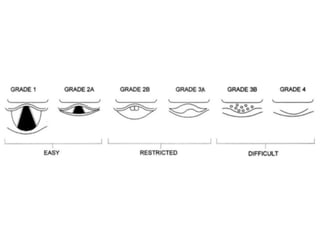
Blind bougie insertion is associated with
trauma and is not recommended in a grade
3b or 4 view
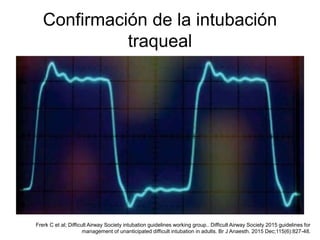
Confirmación de la intubación
traqueal
Frerk C et al; Difficult Airway Society intubation guidelines working group.. Difficult Airway Society 2015 guidelines for
management of unanticipated difficult intubation in adults. Br J Anaesth. 2015 Dec;115(6):827-48.
Frerk C et al; Difficult Airway Society intubation guidelines working group.. Difficult Airway Society 2015 guidelines for
management of unanticipated difficult intubation in adults. Br J Anaesth. 2015 Dec;115(6):827-48.
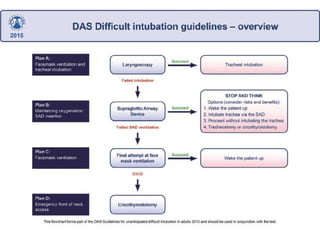
A maximum of
three attempts at intubation; a
fourth attempt by a more
experienced colleague is
permissible
If unsuccessful, a failed intubation
should be declared and Plan B
implemented.
Frerk C et al; Difficult Airway Society intubation guidelines working group.. Difficult Airway Society 2015 guidelines for
management of unanticipated difficult intubation in adults. Br J Anaesth. 2015 Dec;115(6):827-48.
Frerk C et al; Difficult Airway Society intubation guidelines working group.. Difficult Airway Society 2015 guidelines for
management of unanticipated difficult intubation in adults. Br J Anaesth. 2015 Dec;115(6):827-48.
Frerk C et al; Difficult Airway Society intubation guidelines working group.. Difficult Airway Society 2015 guidelines for
management of unanticipated difficult intubation in adults. Br J Anaesth. 2015 Dec;115(6):827-48.
Frerk C et al; Difficult Airway Society intubation guidelines working group.. Difficult Airway Society 2015 guidelines for
management of unanticipated difficult intubation in adults. Br J Anaesth. 2015 Dec;115(6):827-48.
Frerk C et al; Difficult Airway Society intubation guidelines working group.. Difficult Airway Society 2015 guidelines for
management of unanticipated difficult intubation in adults. Br J Anaesth. 2015 Dec;115(6):827-48.
Frerk C et al; Difficult Airway Society intubation guidelines working group.. Difficult Airway Society 2015 guidelines for
management of unanticipated difficult intubation in adults. Br J Anaesth. 2015 Dec;115(6):827-48.
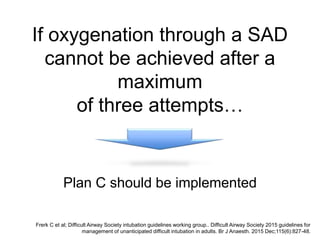
If oxygenation through a SAD
cannot be achieved after a
maximum
of three attempts…
Plan C should be implemented
Frerk C et al; Difficult Airway Society intubation guidelines working group.. Difficult Airway Society 2015 guidelines for
management of unanticipated difficult intubation in adults. Br J Anaesth. 2015 Dec;115(6):827-48.
Frerk C et al; Difficult Airway Society intubation guidelines working group.. Difficult Airway Society 2015 guidelines for
management of unanticipated difficult intubation in adults. Br J Anaesth. 2015 Dec;115(6):827-48.
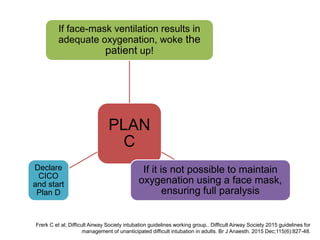
PLAN
C
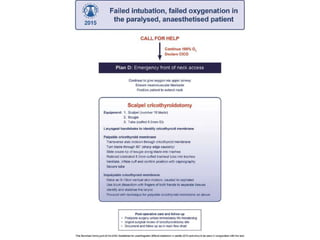
If face-mask ventilation results in
adequate oxygenation, woke the
patient up!
If it is not possible to maintain
oxygenation using a face mask,
ensuring full paralysis
Declare
CICO
and start
Plan D
Frerk C et al; Difficult Airway Society intubation guidelines working group.. Difficult Airway Society 2015 guidelines for
management of unanticipated difficult intubation in adults. Br J Anaesth. 2015 Dec;115(6):827-48.
Frerk C et al; Difficult Airway Society intubation guidelines working group.. Difficult Airway Society 2015 guidelines for
management of unanticipated difficult intubation in adults. Br J Anaesth. 2015 Dec;115(6):827-48.
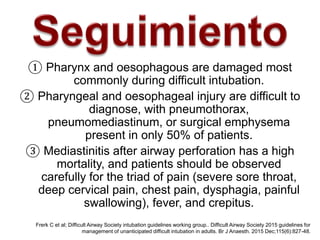
① Pharynx and oesophagous are damaged most
commonly during difficult intubation.
② Pharyngeal and oesophageal injury are difficult to
diagnose, with pneumothorax,
pneumomediastinum, or surgical emphysema
present in only 50% of patients.
③ Mediastinitis after airway perforation has a high
mortality, and patients should be observed
carefully for the triad of pain (severe sore throat,
deep cervical pain, chest pain, dysphagia, painful
swallowing), fever, and crepitus.
…qué dice la ASA?
The will to win, the desire to
succeed, the urge to reach your
full potential…these are the
keys to unlock the door to
personal excellence. Confucius
Gracias

Difficult airway

  • 1.
    Difficult Airway Ricardo PovedaJaramillo Anestesiólogo Cardiovascular & Torácico Clínica del Norte, IPS León XIII & HGM
  • 2.
    ¿Qué es víaaérea difícil? 1. Difficult facemask or supraglottic airway (SGA) ventilation (e.g. , laryngeal mask airway [LMA]): It is not possible for the anesthesiologist to provide adequate ventilation 2. SGA placement requires multiple attempts, in the presence or absence of tracheal pathology. 3. It is not possible to visualize any portion of the vocal cords after multiple attempts at conventional laryngoscopy. 4. Difficult tracheal intubation: Tracheal intubation requires multiple attempts, in the presence or absence of tracheal pathology. 5. Failed intubation: Placement of the endotracheal tube fails after multiple attempts. Apfelbaum JL, Hagberg CA, Caplan RA, et al; American Society of Anesthesiologists Task Force on Management of the Difficult Airway. Practice guidelines for management of the difficult airway: an updated report by the American Society of Anesthesiologists Task Force on Management of the Difficult Airway. Anesthesiology. 2013 Feb;118(2):251-70.
  • 3.
    Predictores de víaaérea difícil Incisivos superiores largos "Sobremordida” (incisivos superiores anteriores a incisivos inferiores) El paciente no puede llevar incisivos inferiores adelante de incisivos superiores Distancia interincisivos menor de 3 cm Úvula no visible cuando la lengua sobresale con el paciente sentado (Mallampati> 2) Paladar altamente arqueado o muy estrecho Distancia tiro-mentoniana menor de tres anchos de dedo Cuello corto Cuello grueso El paciente no puede tocar la punta de la barbilla con el pecho o no puede extender el cuello Apfelbaum JL, Hagberg CA, Caplan RA, et al; American Society of Anesthesiologists Task Force on Management of the Difficult Airway. Practice guidelines for management of the difficult airway: an updated report by the American Society of Anesthesiologists Task Force on Management of the Difficult Airway. Anesthesiology. 2013 Feb;118(2):251-70.
  • 4.
    “The principle thatanaesthetists should have back-up plans in place before performing primary techniques still holds true”. Frerk C et al; Difficult Airway Society intubation guidelines working group.. Difficult Airway Society 2015 guidelines for management of unanticipated difficult intubation in adults. Br J Anaesth. 2015 Dec;115(6):827-48.
  • 5.
    ¿Qué es clave? 1.Limiting the number of airway intervention attempts 2. Encouraging declaration of failure by placing a supraglottic airway device (SAD) even when face-mask ventilation is possible 3. Recommending a time to stop and think about how to proceed Frerk C et al; Difficult Airway Society intubation guidelines working group.. Difficult Airway Society 2015 guidelines for management of unanticipated difficult intubation in adults. Br J Anaesth. 2015 Dec;115(6):827-48.
  • 6.
    “The complexities ofdifficult airway management cannot be distilled into a single algorithm, and even the best anaesthetic teams supported by the best guidelines will still struggle to perform optimally if the systems in which they operate are flawed”. Frerk C et al; Difficult Airway Society intubation guidelines working group.. Difficult Airway Society 2015 guidelines for management of unanticipated difficult intubation in adults. Br J Anaesth. 2015 Dec;115(6):827-48.
  • 7.
    Factores humanos quellaman al desastre • Poor communication • Poor training and teamwork • Deficiencies in equipment • Inadequate systems and processes Frerk C et al; Difficult Airway Society intubation guidelines working group.. Difficult Airway Society 2015 guidelines for management of unanticipated difficult intubation in adults. Br J Anaesth. 2015 Dec;115(6):827-48.
  • 8.
    Frerk C etal; Difficult Airway Society intubation guidelines working group.. Difficult Airway Society 2015 guidelines for management of unanticipated difficult intubation in adults. Br J Anaesth. 2015 Dec;115(6):827-48.
  • 10.
    “Mechanical drainage bynasogastric tube should be considered in order to reduce residual gastric volume in patients with severely delayed gastric emptying or intestinal obstruction”. Frerk C et al; Difficult Airway Society intubation guidelines working group.. Difficult Airway Society 2015 guidelines for management of unanticipated difficult intubation in adults. Br J Anaesth. 2015 Dec;115(6):827-48.
  • 11.
    Intubación de secuenciarápida Frerk C et al; Difficult Airway Society intubation guidelines working group.. Difficult Airway Society 2015 guidelines for management of unanticipated difficult intubation in adults. Br J Anaesth. 2015 Dec;115(6):827-48.
  • 12.
    ¿Maniobra de Sellick? •Paciente inconsciente: 30 N • Paciente consciente: 10 N Frerk C et al; Difficult Airway Society intubation guidelines working group.. Difficult Airway Society 2015 guidelines for management of unanticipated difficult intubation in adults. Br J Anaesth. 2015 Dec;115(6):827-48.
  • 13.
    Frerk C etal; Difficult Airway Society intubation guidelines working group.. Difficult Airway Society 2015 guidelines for management of unanticipated difficult intubation in adults. Br J Anaesth. 2015 Dec;115(6):827-48.
  • 14.
    Frerk C etal; Difficult Airway Society intubation guidelines working group.. Difficult Airway Society 2015 guidelines for management of unanticipated difficult intubation in adults. Br J Anaesth. 2015 Dec;115(6):827-48. 1–2 min
  • 15.
    Passive oxygenation duringthe apnoeic period (apnoeic oxygenation) 15 litres/min of oxygen through nasal cannulae Frerk C et al; Difficult Airway Society intubation guidelines working group.. Difficult Airway Society 2015 guidelines for management of unanticipated difficult intubation in adults. Br J Anaesth. 2015 Dec;115(6):827-48.
  • 16.
    Inductor ideal Frerk Cet al; Difficult Airway Society intubation guidelines working group.. Difficult Airway Society 2015 guidelines for management of unanticipated difficult intubation in adults. Br J Anaesth. 2015 Dec;115(6):827-48.
  • 17.
    Mask ventilation Mask ventilationwith 100% oxygen should begin as soon as possible after induction of anaesthesia Frerk C et al; Difficult Airway Society intubation guidelines working group.. Difficult Airway Society 2015 guidelines for management of unanticipated difficult intubation in adults. Br J Anaesth. 2015 Dec;115(6):827-48.
  • 18.
    Elección del laringoscopio Videolaryngoscopesare now the first choice or default device for some anaesthetists Frerk C et al; Difficult Airway Society intubation guidelines working group.. Difficult Airway Society 2015 guidelines for management of unanticipated difficult intubation in adults. Br J Anaesth. 2015 Dec;115(6):827-48.
  • 19.
    Elección del laringoscopio FrerkC et al; Difficult Airway Society intubation guidelines working group.. Difficult Airway Society 2015 guidelines for management of unanticipated difficult intubation in adults. Br J Anaesth. 2015 Dec;115(6):827-48.
  • 22.
    Elección del tubo FrerkC et al; Difficult Airway Society intubation guidelines working group.. Difficult Airway Society 2015 guidelines for management of unanticipated difficult intubation in adults. Br J Anaesth. 2015 Dec;115(6):827-48.
  • 23.
  • 24.
    Uso del bougieo estilete luminoso Frerk C et al; Difficult Airway Society intubation guidelines working group.. Difficult Airway Society 2015 guidelines for management of unanticipated difficult intubation in adults. Br J Anaesth. 2015 Dec;115(6):827-48. Blind bougie insertion is associated with trauma and is not recommended in a grade 3b or 4 view
  • 26.
    Confirmación de laintubación traqueal Frerk C et al; Difficult Airway Society intubation guidelines working group.. Difficult Airway Society 2015 guidelines for management of unanticipated difficult intubation in adults. Br J Anaesth. 2015 Dec;115(6):827-48.
  • 27.
    Frerk C etal; Difficult Airway Society intubation guidelines working group.. Difficult Airway Society 2015 guidelines for management of unanticipated difficult intubation in adults. Br J Anaesth. 2015 Dec;115(6):827-48. A maximum of three attempts at intubation; a fourth attempt by a more experienced colleague is permissible If unsuccessful, a failed intubation should be declared and Plan B implemented.
  • 28.
    Frerk C etal; Difficult Airway Society intubation guidelines working group.. Difficult Airway Society 2015 guidelines for management of unanticipated difficult intubation in adults. Br J Anaesth. 2015 Dec;115(6):827-48.
  • 30.
    Frerk C etal; Difficult Airway Society intubation guidelines working group.. Difficult Airway Society 2015 guidelines for management of unanticipated difficult intubation in adults. Br J Anaesth. 2015 Dec;115(6):827-48.
  • 31.
    Frerk C etal; Difficult Airway Society intubation guidelines working group.. Difficult Airway Society 2015 guidelines for management of unanticipated difficult intubation in adults. Br J Anaesth. 2015 Dec;115(6):827-48.
  • 35.
    Frerk C etal; Difficult Airway Society intubation guidelines working group.. Difficult Airway Society 2015 guidelines for management of unanticipated difficult intubation in adults. Br J Anaesth. 2015 Dec;115(6):827-48.
  • 36.
    Frerk C etal; Difficult Airway Society intubation guidelines working group.. Difficult Airway Society 2015 guidelines for management of unanticipated difficult intubation in adults. Br J Anaesth. 2015 Dec;115(6):827-48.
  • 37.
    Frerk C etal; Difficult Airway Society intubation guidelines working group.. Difficult Airway Society 2015 guidelines for management of unanticipated difficult intubation in adults. Br J Anaesth. 2015 Dec;115(6):827-48. If oxygenation through a SAD cannot be achieved after a maximum of three attempts… Plan C should be implemented
  • 38.
    Frerk C etal; Difficult Airway Society intubation guidelines working group.. Difficult Airway Society 2015 guidelines for management of unanticipated difficult intubation in adults. Br J Anaesth. 2015 Dec;115(6):827-48.
  • 39.
    Frerk C etal; Difficult Airway Society intubation guidelines working group.. Difficult Airway Society 2015 guidelines for management of unanticipated difficult intubation in adults. Br J Anaesth. 2015 Dec;115(6):827-48. PLAN C If face-mask ventilation results in adequate oxygenation, woke the patient up! If it is not possible to maintain oxygenation using a face mask, ensuring full paralysis Declare CICO and start Plan D
  • 40.
    Frerk C etal; Difficult Airway Society intubation guidelines working group.. Difficult Airway Society 2015 guidelines for management of unanticipated difficult intubation in adults. Br J Anaesth. 2015 Dec;115(6):827-48.
  • 44.
    Frerk C etal; Difficult Airway Society intubation guidelines working group.. Difficult Airway Society 2015 guidelines for management of unanticipated difficult intubation in adults. Br J Anaesth. 2015 Dec;115(6):827-48. ① Pharynx and oesophagous are damaged most commonly during difficult intubation. ② Pharyngeal and oesophageal injury are difficult to diagnose, with pneumothorax, pneumomediastinum, or surgical emphysema present in only 50% of patients. ③ Mediastinitis after airway perforation has a high mortality, and patients should be observed carefully for the triad of pain (severe sore throat, deep cervical pain, chest pain, dysphagia, painful swallowing), fever, and crepitus.
  • 45.
  • 47.
    The will towin, the desire to succeed, the urge to reach your full potential…these are the keys to unlock the door to personal excellence. Confucius Gracias