Suctioning
BY
Dr. Sachin chaudhary.
M.P.Th ( Cardiovascular & Respiratory PT)
DMCOP Nagpur.
LEARNING OBJECTIVES
Sr. no Learning
objectives
domain level criteria
1 Indication of
suctioning.
Cognitive Must know All
2 Explain types of
suctioning.
Cognitive &
Psychomotor
Must know All
3 Explain types of
suctioning
equipments.
Cognitive &
Psychomotor
Must know All
4 Explain precaution
& hazards of
suctioning.
Cognitive &
Psychomotor
Must know All
OBJECTIVES
• INDICATIONS
• TYPES
• EQUIPMENTS
• PROCEDURE
• PRECAUTIONS
• HAZARDS
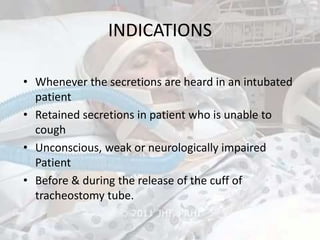
INDICATIONS
• Whenever the secretions are heard in an intubated
patient
• Retained secretions in patient who is unable to
cough
• Unconscious, weak or neurologically impaired
Patient
• Before & during the release of the cuff of
tracheostomy tube.
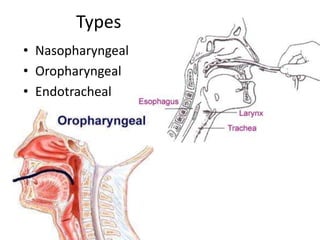
Types
• Nasopharyngeal
• Oropharyngeal
• Endotracheal
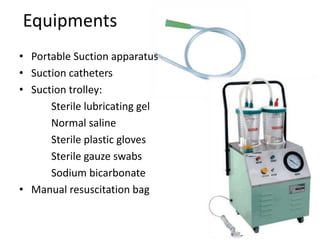
Equipments
• Portable Suction apparatus
• Suction catheters
• Suction trolley:
Sterile lubricating gel
Normal saline
Sterile plastic gloves
Sterile gauze swabs
Sodium bicarbonate
• Manual resuscitation bag
Endotracheal suctioning
• Check equipments & make sure
that all necessary equipments are
reachable
• Check monitor.
• Wash your hands
• Inform patient about the
procedure
• Hyperoxygnate with 100% O2 for 3
to 5 breaths with manual
resuscitation bag
• Place the patients neck in
extension
• Lubricate catheter with sterile
saline
• Kink the catheter and then insert
it till the resistance is felt (Carina)
• Pull the catheter slightly out &
release the kink
•Negative suction pressure for Adults: -100
to -120 mmHg
•Negative suction pressure for children : -
80 to -100 mmHg
•Negative suction pressure for Neonates : -
50 to -80 mmHg
•Do no extend the suction time for more
than 15 seconds.
•The patient is allowed to rest for several
seconds & again the procedure is repeated.
•Check the breath sounds & repeat the
procedure if necessary.
•Always check for monitors for O2
saturation & arrythmias.
•Discard the used equipments & wash
hands.
Nasopharyngeal suction
• Extend the patient’s neck & the head is tilted
backwards resting on a pillow
• Ask the patient to protrude the tongue if he/she
cooperates.
• Lubricate the catheter & insert it backwards & upwards
untill the resistance is felt.
• Gentle rolling of the catheter at this point allows the
advancement of the catheter into pharynx.
• The catheter should be inserted during inspiration with
mouth open. The aim is to stimulate cough reflex.
• It must be remembered that it is a very unpleasant
experience hence should only be used when absolutely
necessary.
• Always observe the patient for signs of Hypoxia
• If patient already has low PaO2, oxygenate the patient or hyperinflate if
patient is intubated
• If the patient is mechanically ventilated, never disconnect the patient for
more than 15 seconds.
• If possible, rotate the head to one side while suctioning to avoid the
aspiration of gastric contents.
• Reconnect the patient immediately to ventilator or oxygen supply after
suctioning.
• Check for deviated nasal septum, nasal polyps or nasal fractures before
nasal suctioning
PRECAUTIONS
Hazards of suctioning
• Risk of infection if its not performed under sterile conditions
• Trauma due to incorrect choice of catheter & excessive
negative pressure
• Hypoxia
• Cardiac arrhythmias
• Atelectasis
Question
• Indications of suctioning.
• Types of suctioning apparatus.
• Types of catheter used in suctioning.
• Types of suctioning.
• Hazards of suctioning.
Bibliography
• Cash textbook of medical & surgical .
Thank you

Suctioning

  • 1.
    Suctioning BY Dr. Sachin chaudhary. M.P.Th( Cardiovascular & Respiratory PT) DMCOP Nagpur.
  • 2.
    LEARNING OBJECTIVES Sr. noLearning objectives domain level criteria 1 Indication of suctioning. Cognitive Must know All 2 Explain types of suctioning. Cognitive & Psychomotor Must know All 3 Explain types of suctioning equipments. Cognitive & Psychomotor Must know All 4 Explain precaution & hazards of suctioning. Cognitive & Psychomotor Must know All
  • 3.
    OBJECTIVES • INDICATIONS • TYPES •EQUIPMENTS • PROCEDURE • PRECAUTIONS • HAZARDS
  • 4.
    INDICATIONS • Whenever thesecretions are heard in an intubated patient • Retained secretions in patient who is unable to cough • Unconscious, weak or neurologically impaired Patient • Before & during the release of the cuff of tracheostomy tube.
  • 5.
  • 7.
    Equipments • Portable Suctionapparatus • Suction catheters • Suction trolley: Sterile lubricating gel Normal saline Sterile plastic gloves Sterile gauze swabs Sodium bicarbonate • Manual resuscitation bag
  • 8.
    Endotracheal suctioning • Checkequipments & make sure that all necessary equipments are reachable • Check monitor. • Wash your hands • Inform patient about the procedure • Hyperoxygnate with 100% O2 for 3 to 5 breaths with manual resuscitation bag • Place the patients neck in extension • Lubricate catheter with sterile saline • Kink the catheter and then insert it till the resistance is felt (Carina) • Pull the catheter slightly out & release the kink •Negative suction pressure for Adults: -100 to -120 mmHg •Negative suction pressure for children : - 80 to -100 mmHg •Negative suction pressure for Neonates : - 50 to -80 mmHg •Do no extend the suction time for more than 15 seconds. •The patient is allowed to rest for several seconds & again the procedure is repeated. •Check the breath sounds & repeat the procedure if necessary. •Always check for monitors for O2 saturation & arrythmias. •Discard the used equipments & wash hands.
  • 9.
    Nasopharyngeal suction • Extendthe patient’s neck & the head is tilted backwards resting on a pillow • Ask the patient to protrude the tongue if he/she cooperates. • Lubricate the catheter & insert it backwards & upwards untill the resistance is felt. • Gentle rolling of the catheter at this point allows the advancement of the catheter into pharynx. • The catheter should be inserted during inspiration with mouth open. The aim is to stimulate cough reflex. • It must be remembered that it is a very unpleasant experience hence should only be used when absolutely necessary.
  • 10.
    • Always observethe patient for signs of Hypoxia • If patient already has low PaO2, oxygenate the patient or hyperinflate if patient is intubated • If the patient is mechanically ventilated, never disconnect the patient for more than 15 seconds. • If possible, rotate the head to one side while suctioning to avoid the aspiration of gastric contents. • Reconnect the patient immediately to ventilator or oxygen supply after suctioning. • Check for deviated nasal septum, nasal polyps or nasal fractures before nasal suctioning PRECAUTIONS
  • 11.
    Hazards of suctioning •Risk of infection if its not performed under sterile conditions • Trauma due to incorrect choice of catheter & excessive negative pressure • Hypoxia • Cardiac arrhythmias • Atelectasis
  • 12.
    Question • Indications ofsuctioning. • Types of suctioning apparatus. • Types of catheter used in suctioning. • Types of suctioning. • Hazards of suctioning.
  • 13.
    Bibliography • Cash textbookof medical & surgical .
  • 14.