Contraception
Dr. Rabinarayan Satapathy
Asst. Professor
Dept. of Obst.& Gynae
S.C.B. Medical College,Cuttack
Historical & Social Perspective
 Evidence of contraception since the
beginning of recorded history
 U.S. contraceptive efforts
– Comstock laws in 1800s restricted
contraceptive information through the mail
– 1915: Margaret Sanger’s illegal clinic &
contraceptive information
Historical & Social Perspective
 U.S. contraceptive efforts - cont’d
– 1965 U.S. Supreme Court ruling: states
could not prohibit use of contraception by
married couples: extended to single people
in 1972
– most states allow dispensing of
contraception to minors without parental
consent
– controversy re: TV ads for condoms,
government funded contraceptive services
for minors without parental notification
Historical & Social Perspective
 Contemporary issues
– growing emphasis on planning for
unwanted children
– population growth as a concern
– wide diversity of views among religious
leaders
Sharing responsibility
Benefits of shared
responsibility
 decreases “surprise
pregnancy”
 reduces stress &
increases trust
How to share
responsibility
 ask about BC before
intercourse
 read & discuss
options together
 attend a class or
clinic together
 share expenses
 help each other with
various methods
Choosing a birth control method
 Consider effectiveness
*failure rates reported for each method
*influenced by human error
*backup methods increase effectiveness
 consider cost; ease of use; side effects;
 consider noncoital methods of sexual
intimacy (“outercourse”)
*kissing, *mutual masturbation
*touching, petting * oral or anal sex
Hormone-based contraceptives
Oral contraceptives:
*combination pill:
contains estrogen &
progestin; inhibits
ovulation, thickens
cervical mucus, &
makes uterine lining
less receptive to
implantation
Advantages: spontaneity;
reversible;  effective;
may  dysmenorrhea,
PMS s/s, & some other
conditions; minipill has
no estrogen-related SE
Disadvantages:
*no STD protection
*estrogen-related side
effects
*spotting
Hormone-based contraceptives
Oral contraceptives:
*minipill: progestin
only; thickens
cervical mucus,
makes uterine lining
less receptive to
implantation, may
inhibit ovulation
Advantages:spontaneity;
reversible;  effective;
may  dysmenorrhea,
PMS s/s, & some other
conditions; minipill has
no estrogen-related SE
Disadvantages:
*no STD protection
*estrogen-related side
effects
*spotting
Hormone-based contraceptives
Norplant:
6 progestin filled
capsules implanted
under skin; time-
release over 5 years;
requires medical
insertion; works like
the minipill
Advantages:
*less hormone, but
constancy s
effectiveness
*no daily pill
Disadvantages:
*high initial cost
*may be hard to remove
*same as minipill
Hormone-based contraceptives
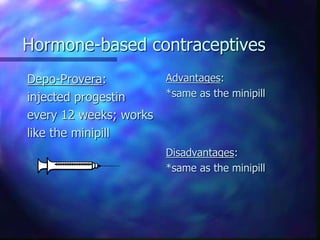
Depo-Provera:
injected progestin
every 12 weeks; works
like the minipill
Advantages:
*same as the minipill
Disadvantages:
*same as the minipill
Barrier methods
Condom:
a sheath that fits over
erect penis; forms
mechanical barrier to
keep sperm out of
vagina; lubricated
latex works best
Advantages:
*effective if used properly
*provides some STD
protection
*relatively cheap
Disadvantages:
*may disturb spontaneity
*may  some sensations
*possible allergy to latex
Barrier methods
Female condom:
a sheath that fits
inside vagina with
closed ring at the top,
open ring at vaginal
opening
Advantages:
*effective if used properly
*provides some STD
protection
*relatively cheap
Disadvantages:
*may disturb spontaneity
*may  some sensations
*possible allergy to latex
Barrier methods
Diaphragm:
latex or plastic dome with
flexible spring around the
rim; forms mechanical
barrier that keeps sperm
out of cervix/uterus; fitted
by Dr. who teacheshow
to insert & check proper
placement; place
spermicide around rim;
stays in for 6-8 hrs.
Advantages:
*no side effects
*s comfort & self-
knowledge
*spermicide may prevent
some STDs, infections
Disadvantages:
* failure rate than others
*messier
*poor fit s problems
*allergy to spermicide
*s spontaneity
Barrier methods
Cervical cap:
thimble-shaped latex
or plastic cup; works
like diaphragm; fitted
by Dr.; filled with
spermicide & pressed
onto cervix; stays in
for 6-24 hrs.
Advantages:
*alternative for  who
cannot wear diaphragm
*does not need repeated
doses of spermicide
Disadvantages:
* failure rate than others
*may damage cervix
*cannot fit up to 6% of 
Barrier methods
Vaginal spermicides:
creams & jellies should
be used with
diaphragm or cervical
cap; not to be used
alone
Barrier methods
Vaginal spermicides:
foam, suppositories,
film; sperm are killed;
follow package
directions carefully
Advantages:
*no doctor
*no dangerous side effects
*provides extra lubrication
*prevents some STDs
Disadvantages:
*messy
*irritation of vaginal tissue
*may  yeast infections
*unpleasant taste, scent
* spontaneity
Intrauterine devices
Copper-T: affects sperm
motility & viability
Progestasert-T: works
like minipill; both
prevent fertilization,
irritate & inflame
uterine lining to prevent
implantation; alters
timing of the ovum’s
passage through
fallopian tube
Advantages:
*highly effective
*convenient
*s spontaneity
*ok for  who breastfeed
Disadvantages:
*initial cost
* PID risk
*discomfort
*risk of miscarriage
*2-20% expelled in 1st yr.
*rarely punctures womb
Emergency contraception
Hormonal:
birth control pills taken
within 72 hours of
unprotected
intercourse; works
like combination pill
Advantages:
*backup for rape or other
unplanned event
Disadvantages:
*nausea or vomiting
*unknown long-term
effects
Emergency contraception
Copper-T IUD:
inserted up to 7 days
after unprotected
intercourse; works
same as regular use
of IUD
Advantages:
*failure <1%
*backup for rape or other
unplanned event
Disadvantages:
*see IUD
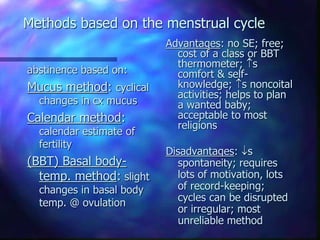
Methods based on the menstrual cycle
abstinence based on:
Mucus method: cyclical
changes in cx mucus
Calendar method:
calendar estimate of
fertility
(BBT) Basal body-
temp. method: slight
changes in basal body
temp. @ ovulation
Advantages: no SE; free;
cost of a class or BBT
thermometer; s
comfort & self-
knowledge; s noncoital
activities; helps to plan
a wanted baby;
acceptable to most
religions
Disadvantages: s
spontaneity; requires
lots of motivation, lots
of record-keeping;
cycles can be disrupted
or irregular; most
unreliable method
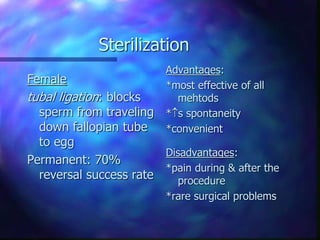
Sterilization
Female
tubal ligation: blocks
sperm from traveling
down fallopian tube
to egg
Permanent: 70%
reversal success rate
Advantages:
*most effective of all
mehtods
*s spontaneity
*convenient
Disadvantages:
*pain during & after the
procedure
*rare surgical problems
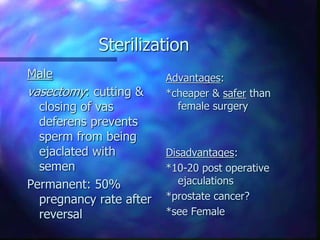
Sterilization
Male
vasectomy: cutting &
closing of vas
deferens prevents
sperm from being
ejaclated with
semen
Permanent: 50%
pregnancy rate after
reversal
Advantages:
*cheaper & safer than
female surgery
Disadvantages:
*10-20 post operative
ejaculations
*prostate cancer?
*see Female
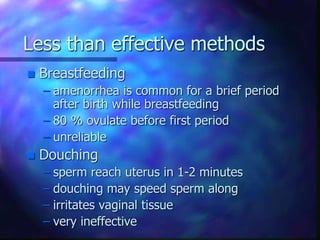
Less than effective methods
 Breastfeeding
– amenorrhea is common for a brief period
after birth while breastfeeding
– 80 % ovulate before first period
– unreliable
 Douching
– sperm reach uterus in 1-2 minutes
– douching may speed sperm along
– irritates vaginal tissue
– very ineffective
Less than effective methods
 Withdrawal before ejaculation
– difficult to judge when to withdraw
– anxiety may  pleasure
– preejaculatory secretions from Cowper’s
gland may carry sperm
– postejaculatory sperm on vulva may travel
into vagina/uterus
– unreliable
New directions in contraception
For men
– currently limited to condoms, vasectomy, &
withdrawal
– GRH inhibitor may  # & motility of sperm
*requires daily injections
*drop in testosterone
*possible erectile difficulty
New directions in contraception
 For men (cont’d)
– testosterone-derivative & progestin-related
drugs may  sperm count
*weekly injections; possible implant
– drugs that would inhibit ejaculation but not
orgasm
– NoFertil (Brazilian developed pill) destroys
male sperm without loss of erection
*potential 10-15% irreversible infertility
New directions in contraception
 For women
– implants, especially fewer than Norplant, or
biodegradable
– injectables
– progestin cream that is absorbed through
the skin
– vaginal rings that slowly release hormones
– one-sized & disposable diaphragms &
cervical caps
New directions in contraception
 For women (cont’d)
– IUDs with different shapes & hormones
– RU-486: an antiprogesterone substance
that prevents implantation & cause
menstruation
“Women who miscalculate are called
mothers.” Abigail Van Buren

Dr rabi contraception

  • 1.
    Contraception Dr. Rabinarayan Satapathy Asst.Professor Dept. of Obst.& Gynae S.C.B. Medical College,Cuttack
  • 2.
    Historical & SocialPerspective  Evidence of contraception since the beginning of recorded history  U.S. contraceptive efforts – Comstock laws in 1800s restricted contraceptive information through the mail – 1915: Margaret Sanger’s illegal clinic & contraceptive information
  • 3.
    Historical & SocialPerspective  U.S. contraceptive efforts - cont’d – 1965 U.S. Supreme Court ruling: states could not prohibit use of contraception by married couples: extended to single people in 1972 – most states allow dispensing of contraception to minors without parental consent – controversy re: TV ads for condoms, government funded contraceptive services for minors without parental notification
  • 4.
    Historical & SocialPerspective  Contemporary issues – growing emphasis on planning for unwanted children – population growth as a concern – wide diversity of views among religious leaders
  • 5.
    Sharing responsibility Benefits ofshared responsibility  decreases “surprise pregnancy”  reduces stress & increases trust How to share responsibility  ask about BC before intercourse  read & discuss options together  attend a class or clinic together  share expenses  help each other with various methods
  • 6.
    Choosing a birthcontrol method  Consider effectiveness *failure rates reported for each method *influenced by human error *backup methods increase effectiveness  consider cost; ease of use; side effects;  consider noncoital methods of sexual intimacy (“outercourse”) *kissing, *mutual masturbation *touching, petting * oral or anal sex
  • 7.
    Hormone-based contraceptives Oral contraceptives: *combinationpill: contains estrogen & progestin; inhibits ovulation, thickens cervical mucus, & makes uterine lining less receptive to implantation Advantages: spontaneity; reversible;  effective; may  dysmenorrhea, PMS s/s, & some other conditions; minipill has no estrogen-related SE Disadvantages: *no STD protection *estrogen-related side effects *spotting
  • 8.
    Hormone-based contraceptives Oral contraceptives: *minipill:progestin only; thickens cervical mucus, makes uterine lining less receptive to implantation, may inhibit ovulation Advantages:spontaneity; reversible;  effective; may  dysmenorrhea, PMS s/s, & some other conditions; minipill has no estrogen-related SE Disadvantages: *no STD protection *estrogen-related side effects *spotting
  • 9.
    Hormone-based contraceptives Norplant: 6 progestinfilled capsules implanted under skin; time- release over 5 years; requires medical insertion; works like the minipill Advantages: *less hormone, but constancy s effectiveness *no daily pill Disadvantages: *high initial cost *may be hard to remove *same as minipill
  • 10.
    Hormone-based contraceptives Depo-Provera: injected progestin every12 weeks; works like the minipill Advantages: *same as the minipill Disadvantages: *same as the minipill
  • 11.
    Barrier methods Condom: a sheaththat fits over erect penis; forms mechanical barrier to keep sperm out of vagina; lubricated latex works best Advantages: *effective if used properly *provides some STD protection *relatively cheap Disadvantages: *may disturb spontaneity *may  some sensations *possible allergy to latex
  • 12.
    Barrier methods Female condom: asheath that fits inside vagina with closed ring at the top, open ring at vaginal opening Advantages: *effective if used properly *provides some STD protection *relatively cheap Disadvantages: *may disturb spontaneity *may  some sensations *possible allergy to latex
  • 13.
    Barrier methods Diaphragm: latex orplastic dome with flexible spring around the rim; forms mechanical barrier that keeps sperm out of cervix/uterus; fitted by Dr. who teacheshow to insert & check proper placement; place spermicide around rim; stays in for 6-8 hrs. Advantages: *no side effects *s comfort & self- knowledge *spermicide may prevent some STDs, infections Disadvantages: * failure rate than others *messier *poor fit s problems *allergy to spermicide *s spontaneity
  • 14.
    Barrier methods Cervical cap: thimble-shapedlatex or plastic cup; works like diaphragm; fitted by Dr.; filled with spermicide & pressed onto cervix; stays in for 6-24 hrs. Advantages: *alternative for  who cannot wear diaphragm *does not need repeated doses of spermicide Disadvantages: * failure rate than others *may damage cervix *cannot fit up to 6% of 
  • 15.
    Barrier methods Vaginal spermicides: creams& jellies should be used with diaphragm or cervical cap; not to be used alone
  • 16.
    Barrier methods Vaginal spermicides: foam,suppositories, film; sperm are killed; follow package directions carefully Advantages: *no doctor *no dangerous side effects *provides extra lubrication *prevents some STDs Disadvantages: *messy *irritation of vaginal tissue *may  yeast infections *unpleasant taste, scent * spontaneity
  • 17.
    Intrauterine devices Copper-T: affectssperm motility & viability Progestasert-T: works like minipill; both prevent fertilization, irritate & inflame uterine lining to prevent implantation; alters timing of the ovum’s passage through fallopian tube Advantages: *highly effective *convenient *s spontaneity *ok for  who breastfeed Disadvantages: *initial cost * PID risk *discomfort *risk of miscarriage *2-20% expelled in 1st yr. *rarely punctures womb
  • 18.
    Emergency contraception Hormonal: birth controlpills taken within 72 hours of unprotected intercourse; works like combination pill Advantages: *backup for rape or other unplanned event Disadvantages: *nausea or vomiting *unknown long-term effects
  • 19.
    Emergency contraception Copper-T IUD: insertedup to 7 days after unprotected intercourse; works same as regular use of IUD Advantages: *failure <1% *backup for rape or other unplanned event Disadvantages: *see IUD
  • 20.
    Methods based onthe menstrual cycle abstinence based on: Mucus method: cyclical changes in cx mucus Calendar method: calendar estimate of fertility (BBT) Basal body- temp. method: slight changes in basal body temp. @ ovulation Advantages: no SE; free; cost of a class or BBT thermometer; s comfort & self- knowledge; s noncoital activities; helps to plan a wanted baby; acceptable to most religions Disadvantages: s spontaneity; requires lots of motivation, lots of record-keeping; cycles can be disrupted or irregular; most unreliable method
  • 21.
    Sterilization Female tubal ligation: blocks spermfrom traveling down fallopian tube to egg Permanent: 70% reversal success rate Advantages: *most effective of all mehtods *s spontaneity *convenient Disadvantages: *pain during & after the procedure *rare surgical problems
  • 22.
    Sterilization Male vasectomy: cutting & closingof vas deferens prevents sperm from being ejaclated with semen Permanent: 50% pregnancy rate after reversal Advantages: *cheaper & safer than female surgery Disadvantages: *10-20 post operative ejaculations *prostate cancer? *see Female
  • 23.
    Less than effectivemethods  Breastfeeding – amenorrhea is common for a brief period after birth while breastfeeding – 80 % ovulate before first period – unreliable  Douching – sperm reach uterus in 1-2 minutes – douching may speed sperm along – irritates vaginal tissue – very ineffective
  • 24.
    Less than effectivemethods  Withdrawal before ejaculation – difficult to judge when to withdraw – anxiety may  pleasure – preejaculatory secretions from Cowper’s gland may carry sperm – postejaculatory sperm on vulva may travel into vagina/uterus – unreliable
  • 25.
    New directions incontraception For men – currently limited to condoms, vasectomy, & withdrawal – GRH inhibitor may  # & motility of sperm *requires daily injections *drop in testosterone *possible erectile difficulty
  • 26.
    New directions incontraception  For men (cont’d) – testosterone-derivative & progestin-related drugs may  sperm count *weekly injections; possible implant – drugs that would inhibit ejaculation but not orgasm – NoFertil (Brazilian developed pill) destroys male sperm without loss of erection *potential 10-15% irreversible infertility
  • 27.
    New directions incontraception  For women – implants, especially fewer than Norplant, or biodegradable – injectables – progestin cream that is absorbed through the skin – vaginal rings that slowly release hormones – one-sized & disposable diaphragms & cervical caps
  • 28.
    New directions incontraception  For women (cont’d) – IUDs with different shapes & hormones – RU-486: an antiprogesterone substance that prevents implantation & cause menstruation “Women who miscalculate are called mothers.” Abigail Van Buren