PROSTAGLANDINS IN
LABOUR
DR. RABI NARAYAN SATAPATHY
ASST.PROFESSOR
DEPT. OF OBST.& GYNAECOLOGY
SCB MEDICAL COLLEGE, CUTTACK
MOB-09861281510
EMAIL-drrabisatpathy@gmail.com
The role of all technological advances is to reduce
human suffering.
In relation to obstetrics it can be achieved by:
• Reducing Maternal morbidity and mortality.
• Reducing perinatal mortality and morbidity
• Relievingpain of a parturient mother and thereby
reducing her suffering
Historical developments in the development
of Prostaglandins
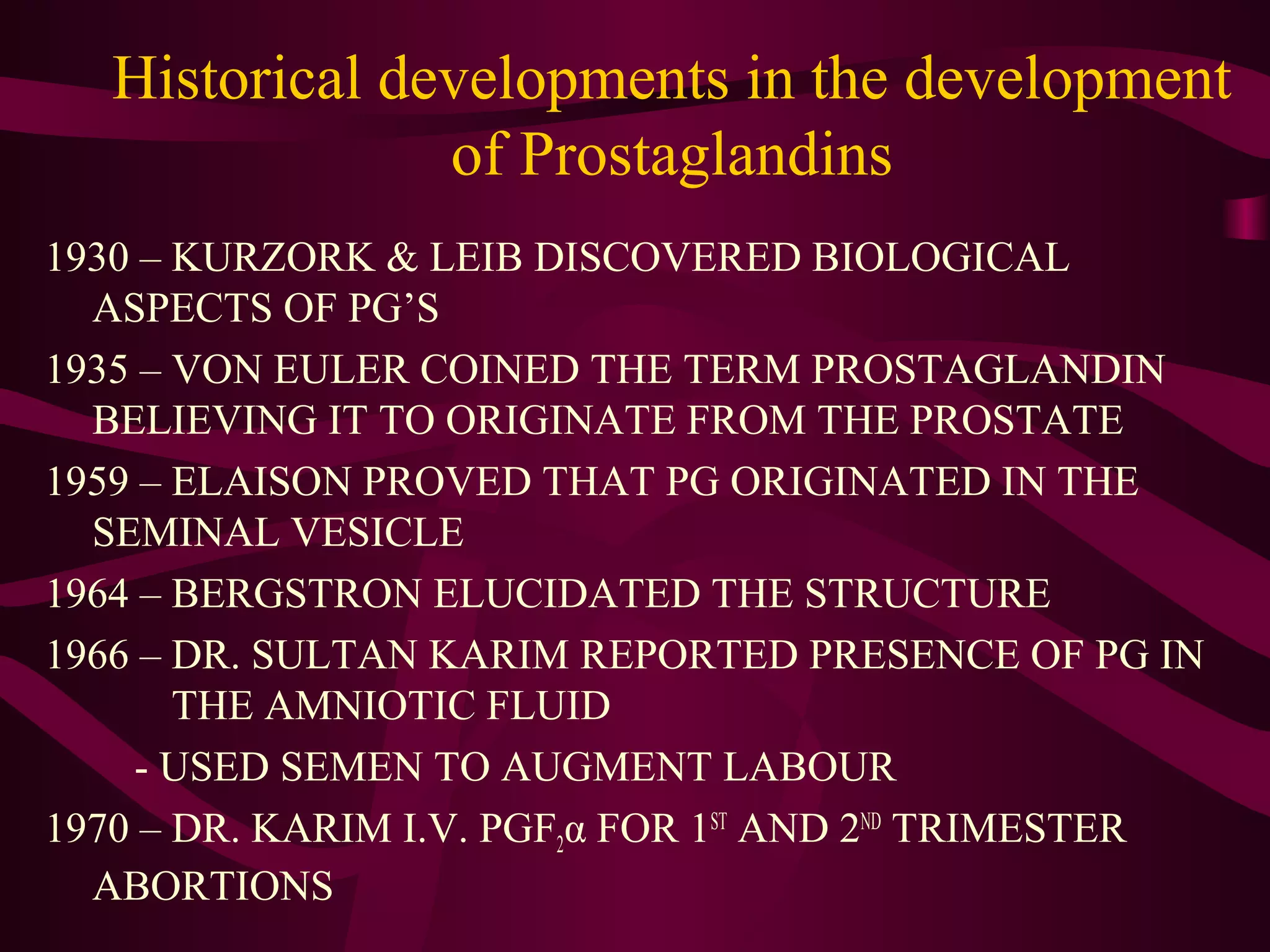
1930 – KURZORK & LEIB DISCOVERED BIOLOGICAL
ASPECTS OF PG’S
1935 – VON EULER COINED THE TERM PROSTAGLANDIN
BELIEVING IT TO ORIGINATE FROM THE PROSTATE
1959 – ELAISON PROVED THAT PG ORIGINATED IN THE
SEMINAL VESICLE
1964 – BERGSTRON ELUCIDATED THE STRUCTURE
1966 – DR. SULTAN KARIM REPORTED PRESENCE OF PG IN
THE AMNIOTIC FLUID
- USED SEMEN TO AUGMENT LABOUR
1970 – DR. KARIM I.V. PGF2α FOR 1ST
AND 2ND
TRIMESTER
ABORTIONS
Prostaglandins in Reproduction
Parturition
Birth
Ovulation
Fertilization &
implantation
Pregnancy
Fetal placental
hemodynamics
PPH
Lactation
Toxaemia
Ductus
Aretriosus
patency
Spontaneous
abortion
Preterm labour
Sperm
transport
PDA closure
Umbilical
cord
closure
dysmenorrhoea
Leutolysis
menstruation
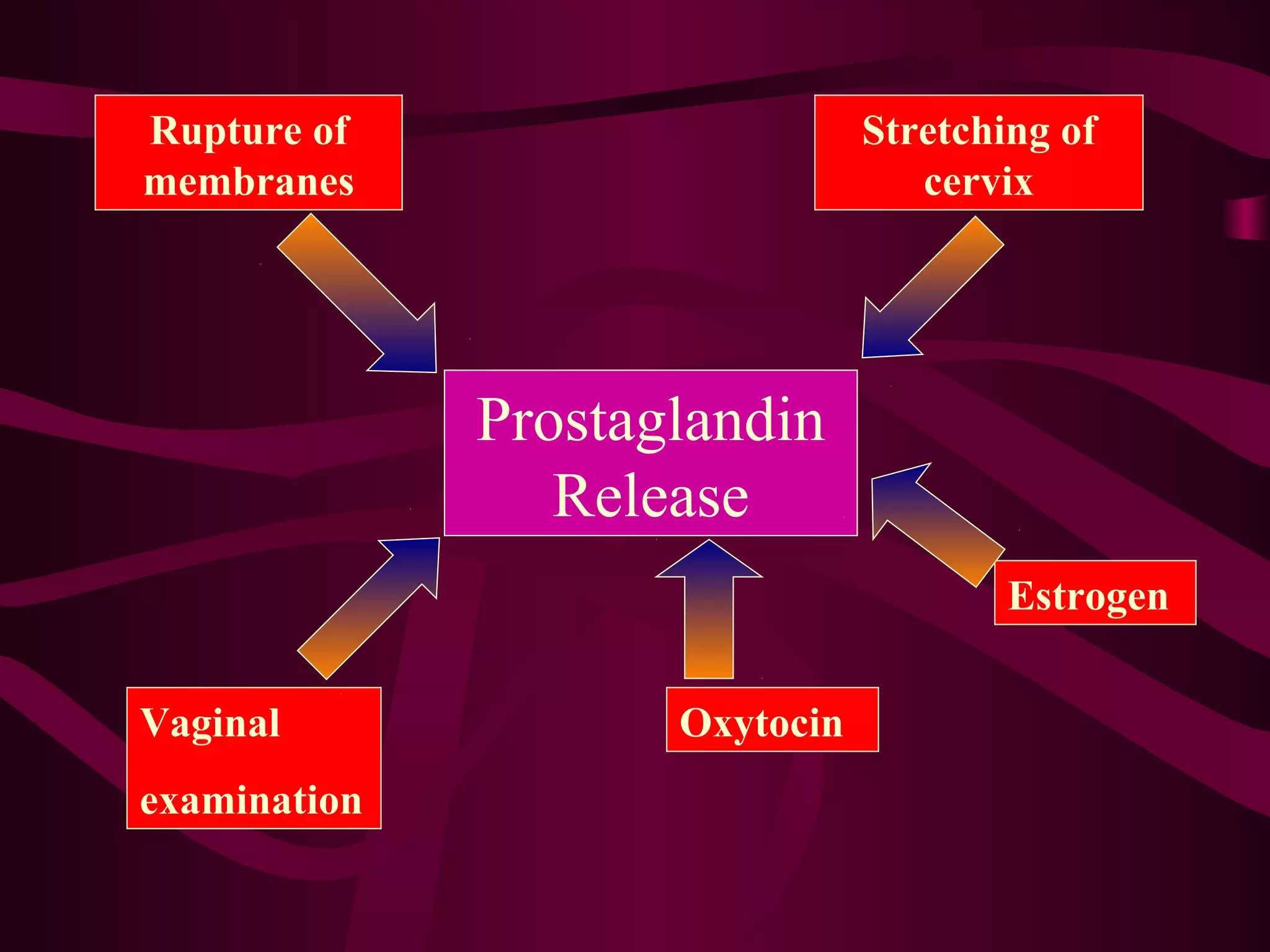
Prostaglandin
Release
Rupture of
membranes
Stretching of
cervix
Vaginal
examination
Oxytocin
Estrogen
OXYTOCIN INDUCED
High amplitude
Higher frequency
Higher intensity
Quicker onset
Stops when infusion discontinued
PROSTAGLANDIN INDUCED
Low amplitude
Low frequency
Lower intensity
Continues even after
discontinuing treatment
UTERINE
CONTRACTIONS
PROSTAGLANDINS
Membrane Phospholipids
Arachidonic acid (AA)
NSAID
PGE2
PGH2
Cyclooxygenese
PGI2 PGD2 PGE2 PGF2α Thromboxanes
A2 & B2 (TXA2,TXB2)
GlucocorticoidsPhospholipase A2
PG synthesis
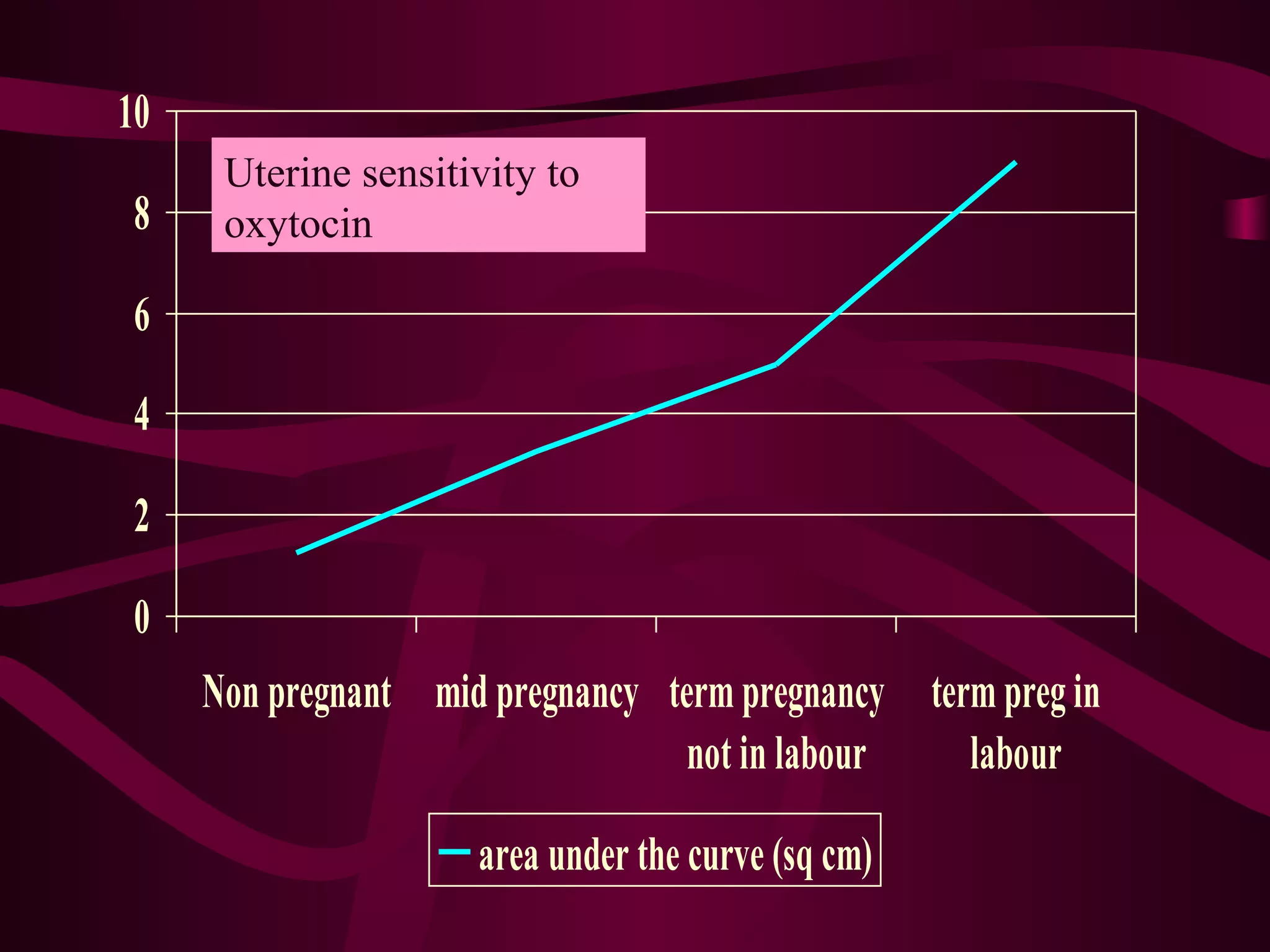
0
2
4
6
8
10
Non pregnant mid pregnancy term pregnancy
not in labour
term preg in
labour
area under the curve (sq cm)
Uterine sensitivity to
oxytocin
10
50
90
not in
labour
early
stage 1
late
stage 1
II stage III stage
oxytocin
pg/ml
0
12
24
2 cm 4 cm 6 cm 8 cm 10 cm
PGF2
PGE2
Amniotic fluid PG
during labour
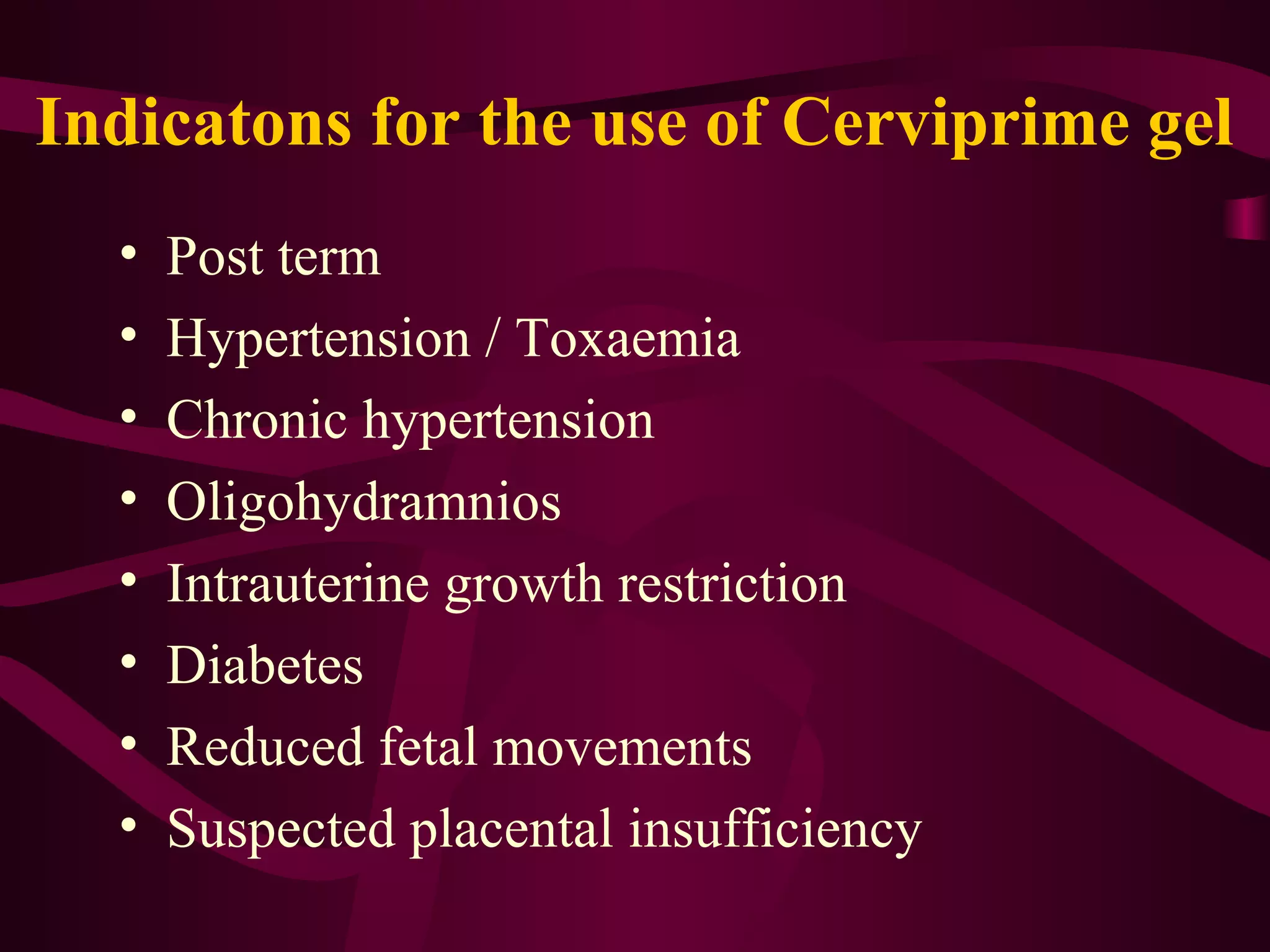
Indicatons for the use of Cerviprime gel
• Post term
• Hypertension / Toxaemia
• Chronic hypertension
• Oligohydramnios
• Intrauterine growth restriction
• Diabetes
• Reduced fetal movements
• Suspected placental insufficiency
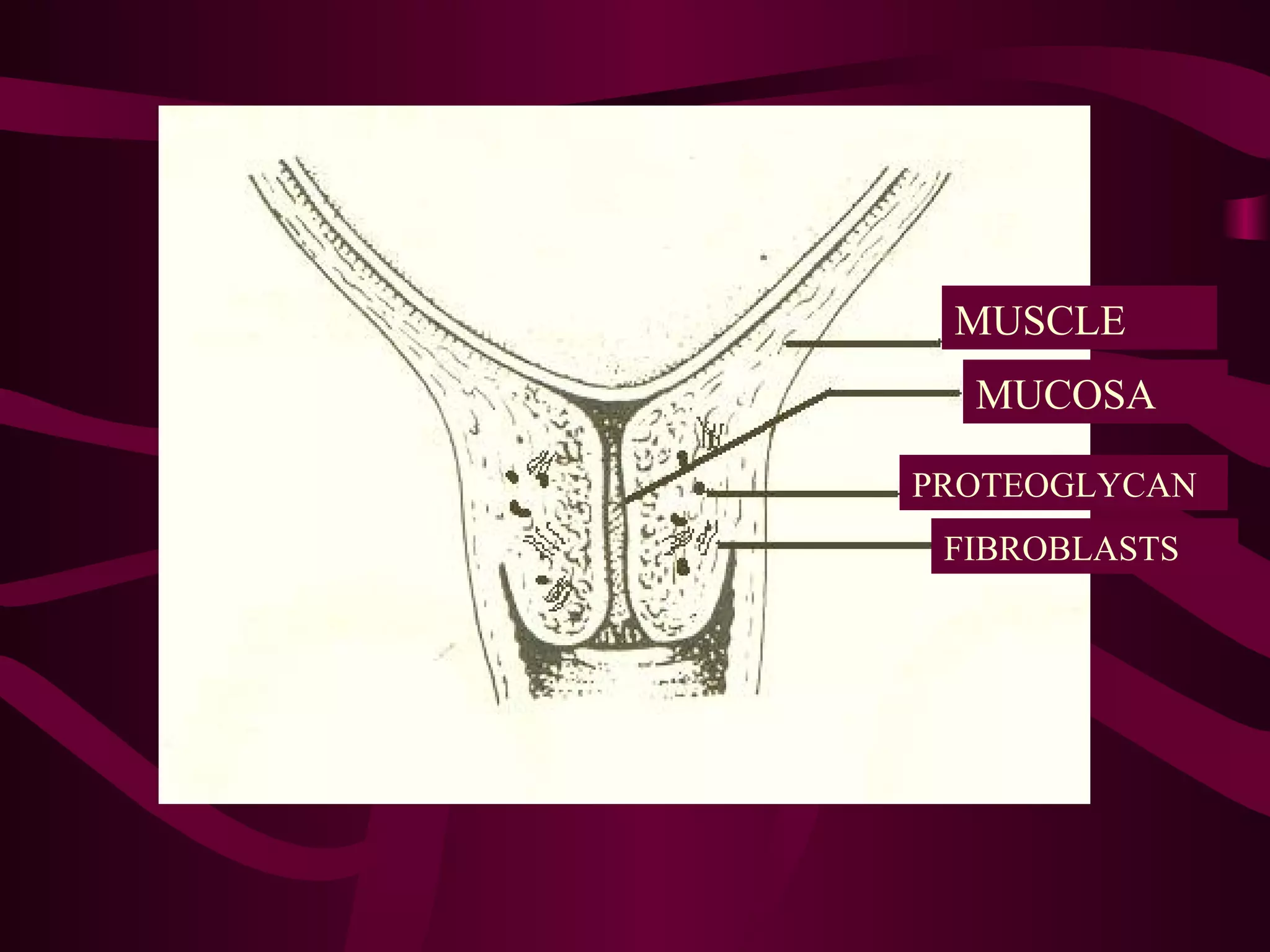
MUSCLE
MUCOSA
PROTEOGLYCAN
FIBROBLASTS
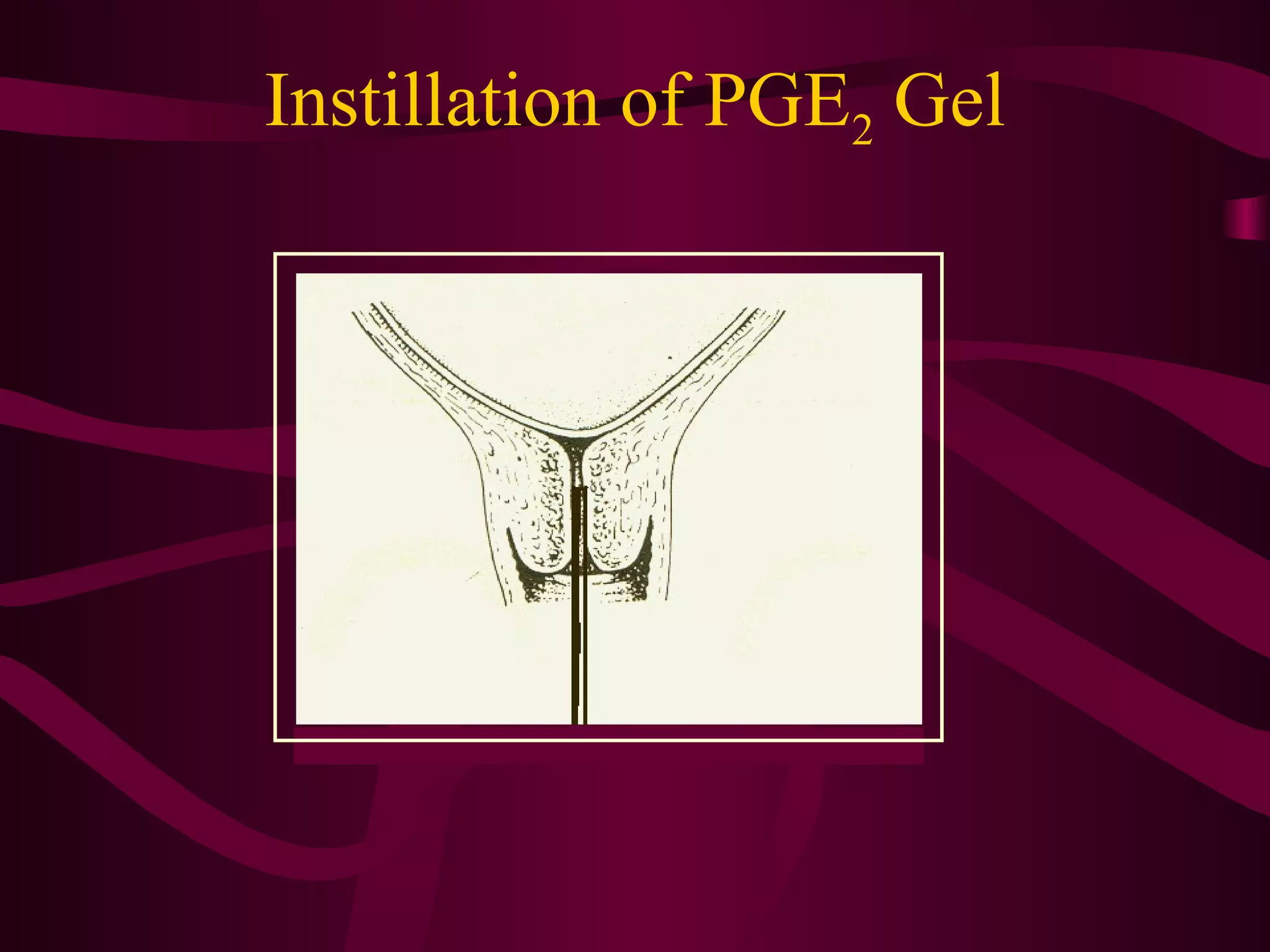
Instillation of PGE2 Gel
Cervical priming
COLLAGEN DEGRADATION
COLLAGEN IS RESISTANT TO MOST PROTEINASES
I COLLAGENASE
II LEUCOCYTE ELASTASE
Fibroblast activation
Vasacular permiability
Tissue hydration
Destabilization of
Proteoglycans
Collagen dsegradation
PGE2
Cervical
ripening
PGE2
FIBROBLAST
VASCULATURE
Relaxin, Collagenase
Leucocyte
infiltration
Tissue
hydration
Collagen
Collagen breakdown
Cervical ripening
Proteoglycans
Expression,
production
Increased vascular
permiability
Progressive cervical dilatation
Cervical changes during labour
Nulliparous cervix near term
During labour - effacement
Fully dilated
Cerviprime to improve Bishop score
Authors year No. of
Pts
Bishop score
Before After
Bernstein 1987 42 3.2 7.7
ICMR
study
1988 221 <3.0 >6.0
Bhide 1992 68 2.8 8.5
Patki &
Daftary
1992 80 2.7 6.0
Cerviprime for labour outcome
Authors Year No. of Pts Vaginal
delivery
(%)
Legarht 1988 57 84.2
ICMR
Study
1988 221 80.5
Bhide 1991 40 97.0
Patki &
Daftary
1992 80 92.5
Prostaglandin induction of Labour (1993-94)
S
No.
Author Place % Vag
Del.
% C
sec.
Avg Dur of lab(hrs)
Primi Multi
1 Patki Mumbai 92.5 7.5 7.3 7.3
2 Bhide Mumbai 90 10 16.4
3 Dubey Kanpur 92.2 7.1 14.6 8.2
4 Mehta Jaipur 100 - 8.0 6.0
5 R. Jina Gorakhpur 95 5 8.13 7.06
6 Sasikala Pondicherry 91.4 8.6 7.4 7.4
7 Daftary G. S. Mumbai 80 20 10.6 8.4
8 Handa P.R. Jamshedpur 85.7 14.3 12 10
Prostaglandin induction of Labour (1995-96)
S
No.
Author Place % Vag
Del.
% C
sec.
Avg Dur of lab(hrs)
Primi Multi
1 S. Gupta Jaipur 79.7 21.3 12.6
2 S. Bhattacharya Calcutta 62.4 37.6 8.2 8.2
3 Sandhu Amritsar 85 15 10.35 6.08
4 S. Kore Mumbai 88 12 11.4 7.6
5 Mukherjee Allhabad 84 16 16.3 10.3
6 Vaneetkuma Jammu 81 19 12.0 -
7 A. Sone Simla 93 7 10 7.4
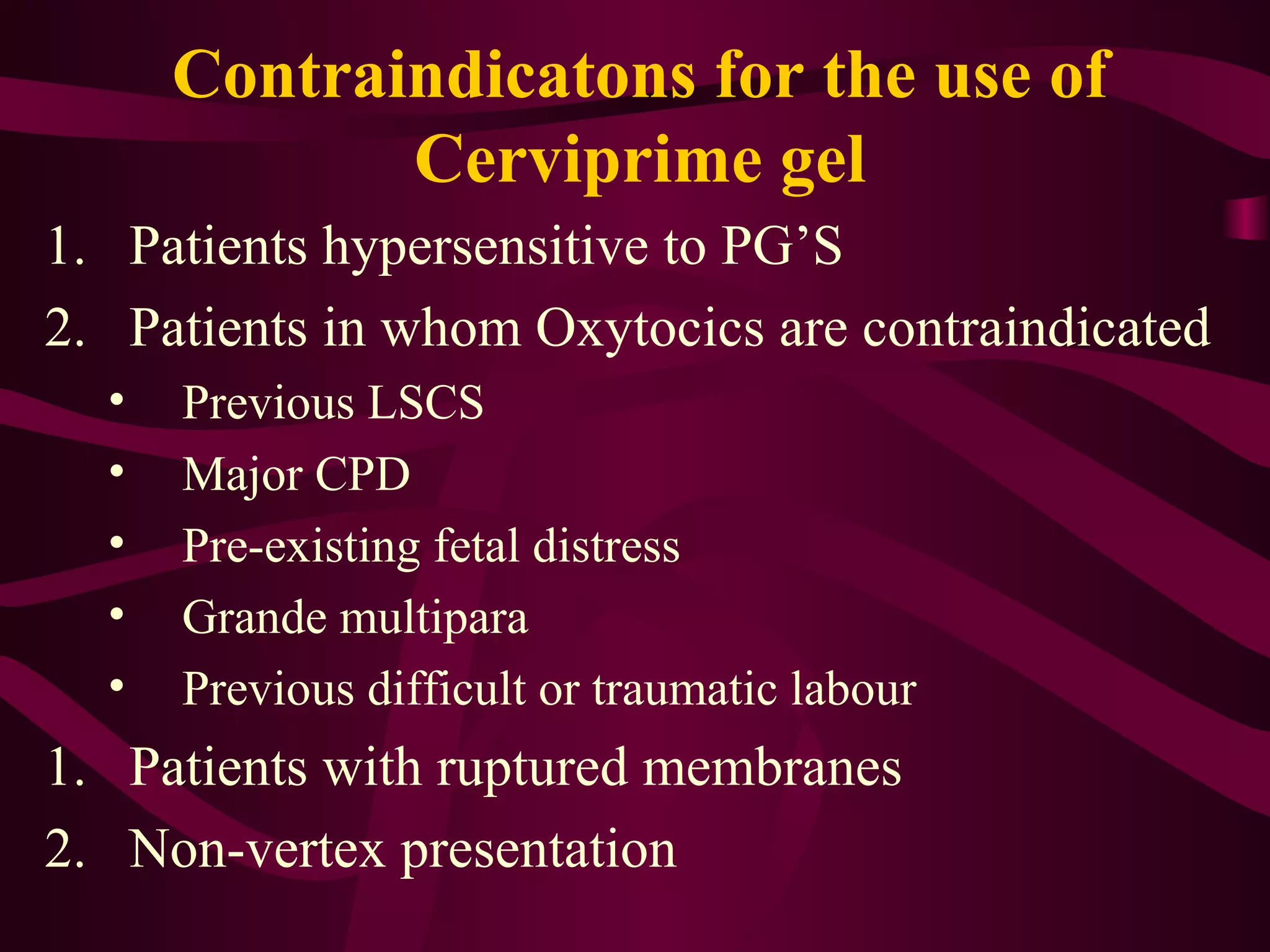
Contraindicatons for the use of
Cerviprime gel
1. Patients hypersensitive to PG’S
2. Patients in whom Oxytocics are contraindicated
• Previous LSCS
• Major CPD
• Pre-existing fetal distress
• Grande multipara
• Previous difficult or traumatic labour
1. Patients with ruptured membranes
2. Non-vertex presentation
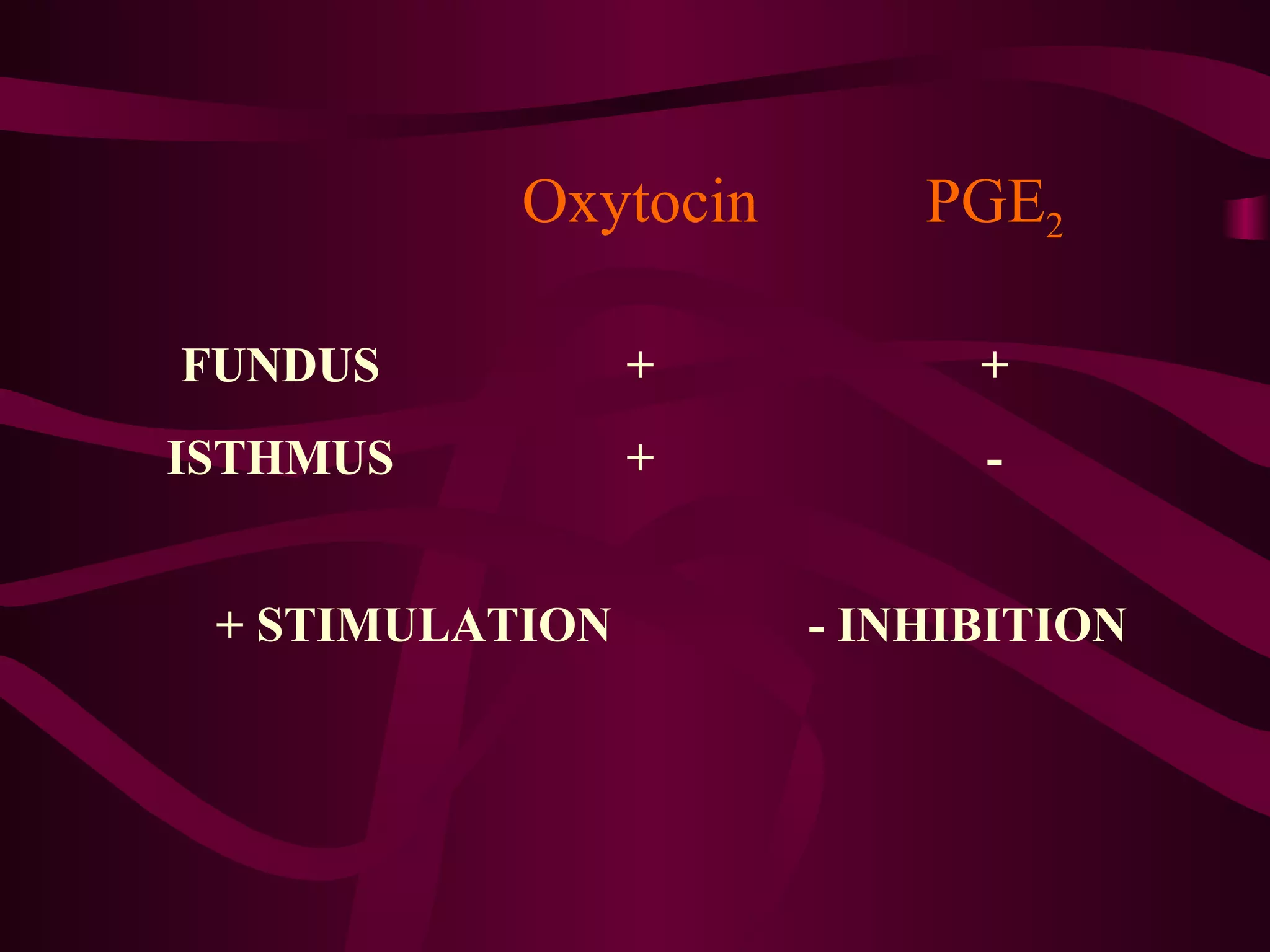
Oxytocin PGE2
FUNDUS + +
ISTHMUS + -
+ STIMULATION - INHIBITION
Comparison of PG vs. Pitocin
for Induction of labour
Distribution of cases
Oxytocin PGE2
Total cases 200 200
Indications
Post datism 25 60
P.R.O.M. 75 80
P.I.H. 40 30
Meconium stained
liquor
50 15
I.U.G.R 10 15
Effect on Bishop score after single
Intracervical Gel or oxytocin drip after 4 hours
Oxytocin PGE2
Initial Bishop score 2.71± 0.96 2.65± 1.04
Follow up Bishop score 3.86± 1.45 5.02± 1.58
Mean change in Bishop
score
1.15 2.37
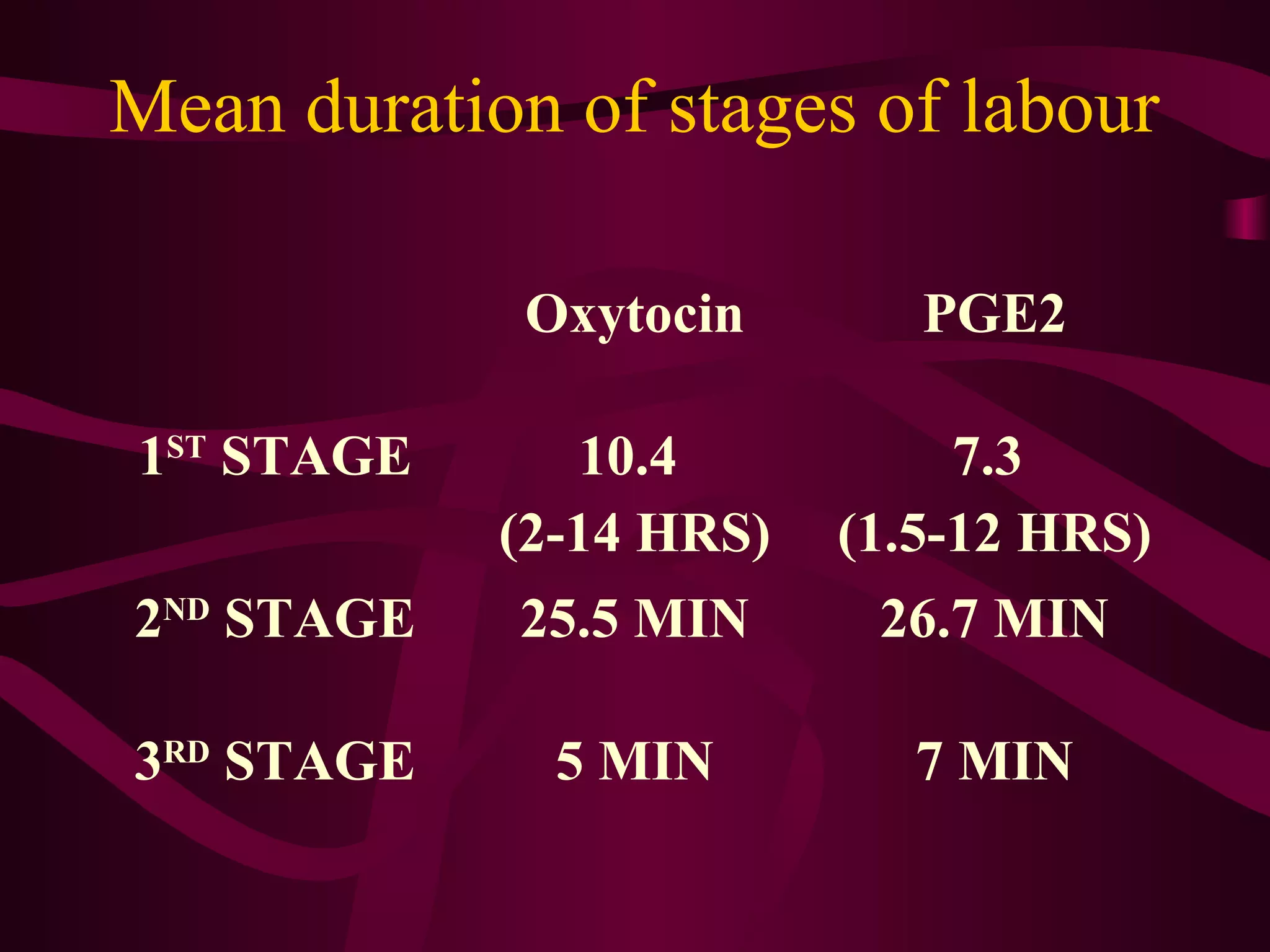
Mean duration of stages of labour
Oxytocin PGE2
1ST
STAGE 10.4
(2-14 HRS)
7.3
(1.5-12 HRS)
2ND
STAGE 25.5 MIN 26.7 MIN
3RD
STAGE 5 MIN 7 MIN
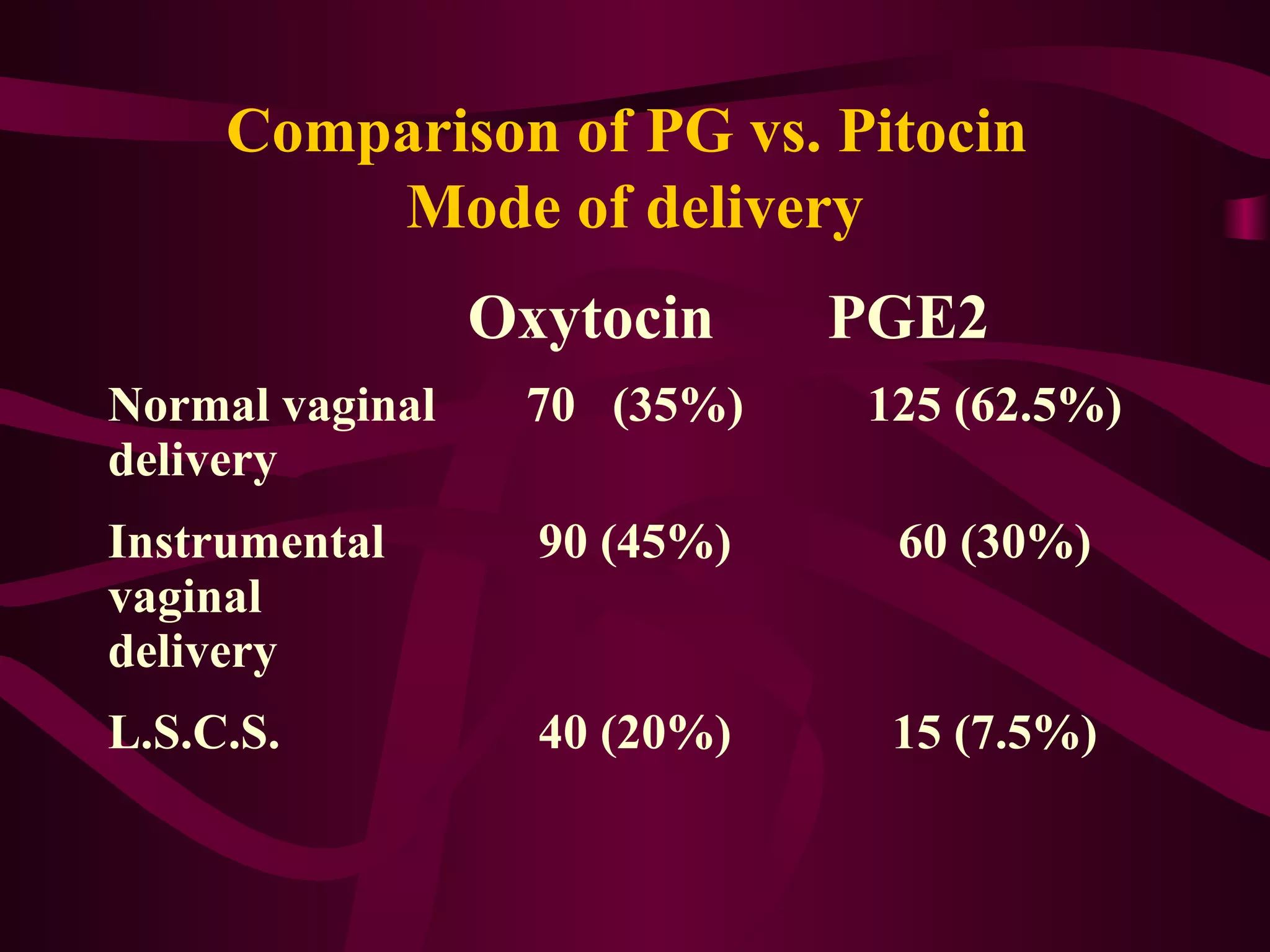
Comparison of PG vs. Pitocin
Mode of delivery
Oxytocin PGE2
Normal vaginal
delivery
70 (35%) 125 (62.5%)
Instrumental
vaginal
delivery
90 (45%) 60 (30%)
L.S.C.S. 40 (20%) 15 (7.5%)
Prostaglandins – Induction of labour
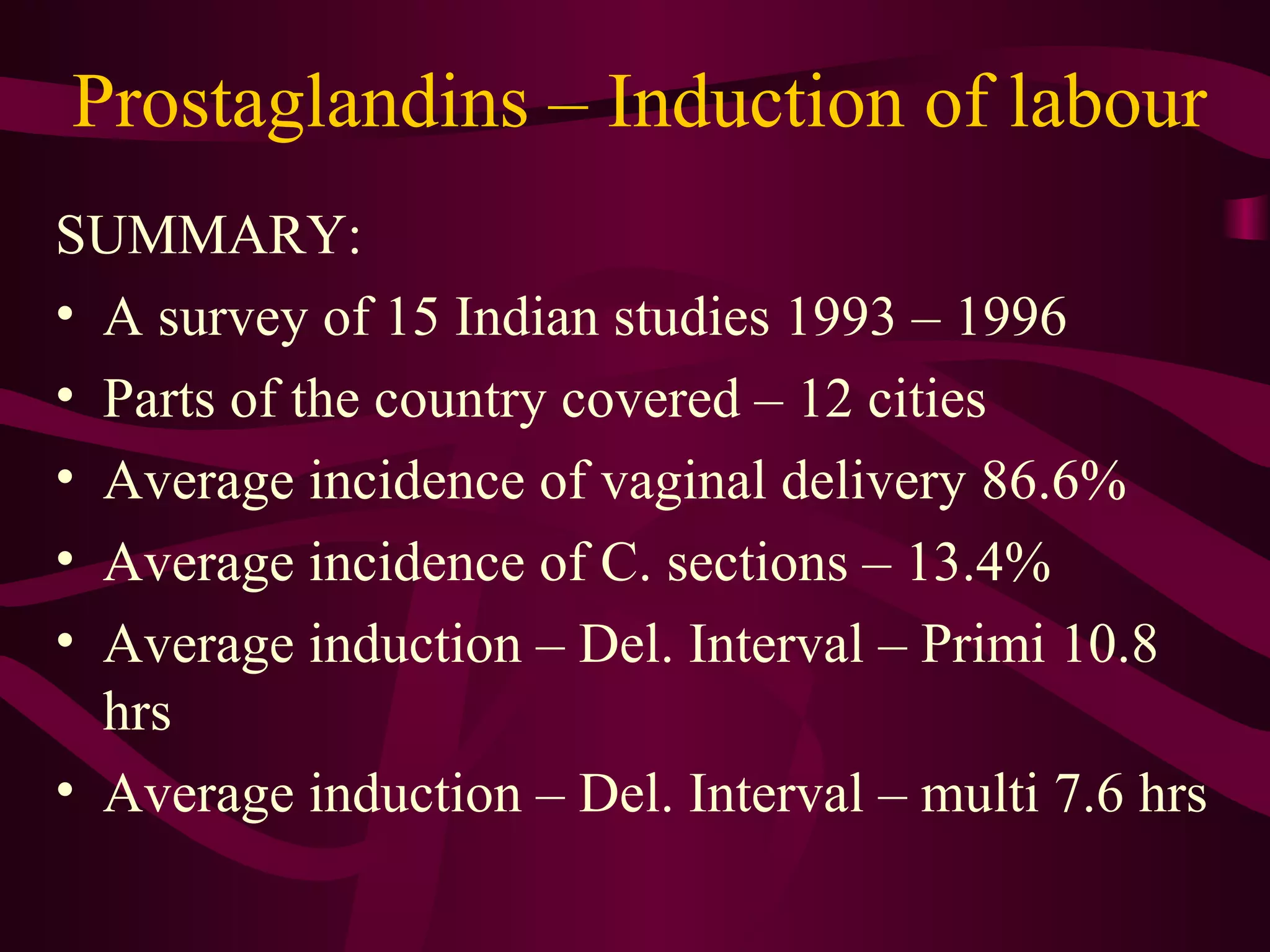
SUMMARY:
• A survey of 15 Indian studies 1993 – 1996
• Parts of the country covered – 12 cities
• Average incidence of vaginal delivery 86.6%
• Average incidence of C. sections – 13.4%
• Average induction – Del. Interval – Primi 10.8
hrs
• Average induction – Del. Interval – multi 7.6 hrs
Pitocin induction of labour
Summary:
• Survey of six Indian studies
• Average incidence of vaginal deliveries – 72.8%
• Average incidence of C. section – 27.2%
• Average induction – delivery time: 16.2 hrs in
primi
• Average induction – delivery time: 9.6 hrs in
Multi
• Incidence of low APGAR scores 1.5 – 2 times
higher
Comparison of PG vs. Pitocin for Induction
S
no
Authors drug %
success
LSCS %
incidence
Ind-Del
interval
hrs
Perinatal
outcome
low apgar
1 Gupta et al,
Jaipur, 1995
PG
O
73.3
55.5
13.3
44.4
16.4
27.9
4.4%
13.3%
2 Muhkerjee,
Allhabad,1996
PG
O
72.7
50
16.3
40
16.3
22.5
-
-
3 Sandhu et al,
Amritsar,1995
PG
O
10
15
9.5
10.4
-
-
4 Patki et al,
Mumbai,1993
PG
O
75
20
7.8
10.9
5%
7.5%
5 Dubey,
kanpur, 1994
PG
O
7.1
12.5
14.6
16.2
NIL
4.7%
6 k. Gupta,
Agra, 1994
PG
O
12%
20%
5.6
6.3
8.3%
8.3%
Time lag due to oral
administration leads to longer
induction – delivery interval as
compared to I.V. Oxytocin
(Lange 1986)
Oral PGE2 – less GI symptoms
& more effective than PGF2α and
has become the standard for
induction and acceleration of
labour
PG’S are effective even in unripe
cervices due to the direct
softening effect on the cervix as
compared to Oxytocin
Prostaglandins in the induction of
labour have been shown to be
devoid of deleterious effects on
the physical and psychomotor
development of the Neonate
Prostaglandin formulations in Obstetric practice
PROSTAGLANDINS
CERVICAL RIPENING
Cerviprime gel
FETAL DEATH
Prostodin injection
Cerviprime Gel +
Oxytocic
LABOUR
INDUCTION
Primiprost tablet
LABOUR
AUGMENTATION
Primiprost Tablets
THIRD STAGE
COMPLICATIONS
Prostodin injections

1. prostaglandins in labour dr rabi

  • 1.
    PROSTAGLANDINS IN LABOUR DR. RABINARAYAN SATAPATHY ASST.PROFESSOR DEPT. OF OBST.& GYNAECOLOGY SCB MEDICAL COLLEGE, CUTTACK MOB-09861281510 EMAIL-drrabisatpathy@gmail.com
  • 2.
    The role ofall technological advances is to reduce human suffering. In relation to obstetrics it can be achieved by: • Reducing Maternal morbidity and mortality. • Reducing perinatal mortality and morbidity • Relievingpain of a parturient mother and thereby reducing her suffering
  • 3.
    Historical developments inthe development of Prostaglandins 1930 – KURZORK & LEIB DISCOVERED BIOLOGICAL ASPECTS OF PG’S 1935 – VON EULER COINED THE TERM PROSTAGLANDIN BELIEVING IT TO ORIGINATE FROM THE PROSTATE 1959 – ELAISON PROVED THAT PG ORIGINATED IN THE SEMINAL VESICLE 1964 – BERGSTRON ELUCIDATED THE STRUCTURE 1966 – DR. SULTAN KARIM REPORTED PRESENCE OF PG IN THE AMNIOTIC FLUID - USED SEMEN TO AUGMENT LABOUR 1970 – DR. KARIM I.V. PGF2α FOR 1ST AND 2ND TRIMESTER ABORTIONS
  • 4.
    Prostaglandins in Reproduction Parturition Birth Ovulation Fertilization& implantation Pregnancy Fetal placental hemodynamics PPH Lactation Toxaemia Ductus Aretriosus patency Spontaneous abortion Preterm labour Sperm transport PDA closure Umbilical cord closure dysmenorrhoea Leutolysis menstruation
  • 5.
  • 6.
    OXYTOCIN INDUCED High amplitude Higherfrequency Higher intensity Quicker onset Stops when infusion discontinued PROSTAGLANDIN INDUCED Low amplitude Low frequency Lower intensity Continues even after discontinuing treatment UTERINE CONTRACTIONS
  • 7.
    PROSTAGLANDINS Membrane Phospholipids Arachidonic acid(AA) NSAID PGE2 PGH2 Cyclooxygenese PGI2 PGD2 PGE2 PGF2α Thromboxanes A2 & B2 (TXA2,TXB2) GlucocorticoidsPhospholipase A2
  • 8.
  • 10.
    0 2 4 6 8 10 Non pregnant midpregnancy term pregnancy not in labour term preg in labour area under the curve (sq cm) Uterine sensitivity to oxytocin
  • 11.
    10 50 90 not in labour early stage 1 late stage1 II stage III stage oxytocin pg/ml
  • 12.
    0 12 24 2 cm 4cm 6 cm 8 cm 10 cm PGF2 PGE2 Amniotic fluid PG during labour
  • 13.
    Indicatons for theuse of Cerviprime gel • Post term • Hypertension / Toxaemia • Chronic hypertension • Oligohydramnios • Intrauterine growth restriction • Diabetes • Reduced fetal movements • Suspected placental insufficiency
  • 14.
  • 16.
  • 17.
    Cervical priming COLLAGEN DEGRADATION COLLAGENIS RESISTANT TO MOST PROTEINASES I COLLAGENASE II LEUCOCYTE ELASTASE
  • 18.
    Fibroblast activation Vasacular permiability Tissuehydration Destabilization of Proteoglycans Collagen dsegradation PGE2 Cervical ripening
  • 19.
  • 20.
  • 21.
    Cervical changes duringlabour Nulliparous cervix near term During labour - effacement Fully dilated
  • 22.
    Cerviprime to improveBishop score Authors year No. of Pts Bishop score Before After Bernstein 1987 42 3.2 7.7 ICMR study 1988 221 <3.0 >6.0 Bhide 1992 68 2.8 8.5 Patki & Daftary 1992 80 2.7 6.0
  • 23.
    Cerviprime for labouroutcome Authors Year No. of Pts Vaginal delivery (%) Legarht 1988 57 84.2 ICMR Study 1988 221 80.5 Bhide 1991 40 97.0 Patki & Daftary 1992 80 92.5
  • 24.
    Prostaglandin induction ofLabour (1993-94) S No. Author Place % Vag Del. % C sec. Avg Dur of lab(hrs) Primi Multi 1 Patki Mumbai 92.5 7.5 7.3 7.3 2 Bhide Mumbai 90 10 16.4 3 Dubey Kanpur 92.2 7.1 14.6 8.2 4 Mehta Jaipur 100 - 8.0 6.0 5 R. Jina Gorakhpur 95 5 8.13 7.06 6 Sasikala Pondicherry 91.4 8.6 7.4 7.4 7 Daftary G. S. Mumbai 80 20 10.6 8.4 8 Handa P.R. Jamshedpur 85.7 14.3 12 10
  • 25.
    Prostaglandin induction ofLabour (1995-96) S No. Author Place % Vag Del. % C sec. Avg Dur of lab(hrs) Primi Multi 1 S. Gupta Jaipur 79.7 21.3 12.6 2 S. Bhattacharya Calcutta 62.4 37.6 8.2 8.2 3 Sandhu Amritsar 85 15 10.35 6.08 4 S. Kore Mumbai 88 12 11.4 7.6 5 Mukherjee Allhabad 84 16 16.3 10.3 6 Vaneetkuma Jammu 81 19 12.0 - 7 A. Sone Simla 93 7 10 7.4
  • 26.
    Contraindicatons for theuse of Cerviprime gel 1. Patients hypersensitive to PG’S 2. Patients in whom Oxytocics are contraindicated • Previous LSCS • Major CPD • Pre-existing fetal distress • Grande multipara • Previous difficult or traumatic labour 1. Patients with ruptured membranes 2. Non-vertex presentation
  • 27.
    Oxytocin PGE2 FUNDUS ++ ISTHMUS + - + STIMULATION - INHIBITION
  • 28.
    Comparison of PGvs. Pitocin for Induction of labour Distribution of cases Oxytocin PGE2 Total cases 200 200 Indications Post datism 25 60 P.R.O.M. 75 80 P.I.H. 40 30 Meconium stained liquor 50 15 I.U.G.R 10 15
  • 29.
    Effect on Bishopscore after single Intracervical Gel or oxytocin drip after 4 hours Oxytocin PGE2 Initial Bishop score 2.71± 0.96 2.65± 1.04 Follow up Bishop score 3.86± 1.45 5.02± 1.58 Mean change in Bishop score 1.15 2.37
  • 30.
    Mean duration ofstages of labour Oxytocin PGE2 1ST STAGE 10.4 (2-14 HRS) 7.3 (1.5-12 HRS) 2ND STAGE 25.5 MIN 26.7 MIN 3RD STAGE 5 MIN 7 MIN
  • 31.
    Comparison of PGvs. Pitocin Mode of delivery Oxytocin PGE2 Normal vaginal delivery 70 (35%) 125 (62.5%) Instrumental vaginal delivery 90 (45%) 60 (30%) L.S.C.S. 40 (20%) 15 (7.5%)
  • 32.
    Prostaglandins – Inductionof labour SUMMARY: • A survey of 15 Indian studies 1993 – 1996 • Parts of the country covered – 12 cities • Average incidence of vaginal delivery 86.6% • Average incidence of C. sections – 13.4% • Average induction – Del. Interval – Primi 10.8 hrs • Average induction – Del. Interval – multi 7.6 hrs
  • 33.
    Pitocin induction oflabour Summary: • Survey of six Indian studies • Average incidence of vaginal deliveries – 72.8% • Average incidence of C. section – 27.2% • Average induction – delivery time: 16.2 hrs in primi • Average induction – delivery time: 9.6 hrs in Multi • Incidence of low APGAR scores 1.5 – 2 times higher
  • 34.
    Comparison of PGvs. Pitocin for Induction S no Authors drug % success LSCS % incidence Ind-Del interval hrs Perinatal outcome low apgar 1 Gupta et al, Jaipur, 1995 PG O 73.3 55.5 13.3 44.4 16.4 27.9 4.4% 13.3% 2 Muhkerjee, Allhabad,1996 PG O 72.7 50 16.3 40 16.3 22.5 - - 3 Sandhu et al, Amritsar,1995 PG O 10 15 9.5 10.4 - - 4 Patki et al, Mumbai,1993 PG O 75 20 7.8 10.9 5% 7.5% 5 Dubey, kanpur, 1994 PG O 7.1 12.5 14.6 16.2 NIL 4.7% 6 k. Gupta, Agra, 1994 PG O 12% 20% 5.6 6.3 8.3% 8.3%
  • 35.
    Time lag dueto oral administration leads to longer induction – delivery interval as compared to I.V. Oxytocin (Lange 1986)
  • 36.
    Oral PGE2 –less GI symptoms & more effective than PGF2α and has become the standard for induction and acceleration of labour
  • 37.
    PG’S are effectiveeven in unripe cervices due to the direct softening effect on the cervix as compared to Oxytocin
  • 38.
    Prostaglandins in theinduction of labour have been shown to be devoid of deleterious effects on the physical and psychomotor development of the Neonate
  • 39.
    Prostaglandin formulations inObstetric practice PROSTAGLANDINS CERVICAL RIPENING Cerviprime gel FETAL DEATH Prostodin injection Cerviprime Gel + Oxytocic LABOUR INDUCTION Primiprost tablet LABOUR AUGMENTATION Primiprost Tablets THIRD STAGE COMPLICATIONS Prostodin injections