Dr. Rabinarayan Satapathy
Asst. Professor
Dept. of Obst.& Gynae
S.C.B. Medical College,Cuttack
 What is different about contraception in
postpartum period?
 When should we counsel?
 What are the options?
 How do we use them?
 Why do we recommend using them in this
way?
• breastfeeding
• hypercoagulable state
 different contraceptive needs
 Pregnancy
 Prolactin secretion in pregnancy -> breast growth,
milk biosynthesis
 Progesterone (and estrogen) ->interferes with
prolactin binding, inhibits lactation
 Birth
 Rapid decline placental progesterone -> initiation of
lactation
 Suckling -> oxytocin release -> contraction of the
myoepithelial cells -> milk ejection
 Day 2-4 postpartum,
 Steroid hormones cleared -> maintenance of milk
production
 High serum prolactin -> inhibits pulsatile GnRH ->
prevent ovulation -----> maintained?
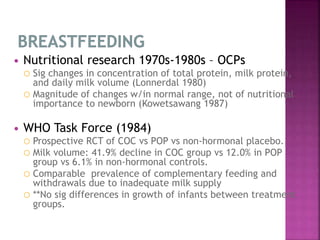
 Nutritional research 1970s-1980s – OCPs
 Sig changes in concentration of total protein, milk protein,
and daily milk volume (Lonnerdal 1980)
 Magnitude of changes w/in normal range, not of nutritional
importance to newborn (Kowetsawang 1987)
 WHO Task Force (1984)
 Prospective RCT of COC vs POP vs non-hormonal placebo.
 Milk volume: 41.9% decline in COC group vs 12.0% in POP
group vs 6.1% in non-hormonal controls.
 Comparable prevalence of complementary feeding and
withdrawals due to inadequate milk supply
 **No sig differences in growth of infants between treatment
groups.
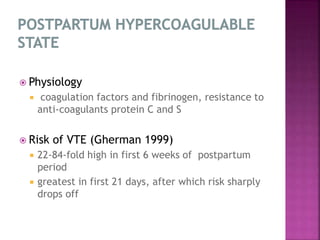
 Physiology
 coagulation factors and fibrinogen, resistance to
anti-coagulants protein C and S
 Risk of VTE (Gherman 1999)
 22-84-fold high in first 6 weeks of postpartum
period
 greatest in first 21 days, after which risk sharply
drops off
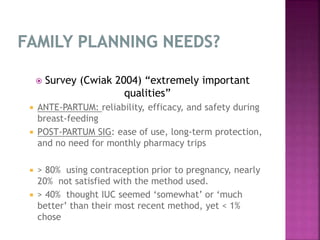
 Survey (Cwiak 2004) “extremely important
qualities”
 ANTE-PARTUM: reliability, efficacy, and safety during
breast-feeding
 POST-PARTUM SIG: ease of use, long-term protection,
and no need for monthly pharmacy trips
 > 80% using contraception prior to pregnancy, nearly
20% not satisfied with the method used.
 > 40% thought IUC seemed ‘somewhat’ or ‘much
better’ than their most recent method, yet < 1%
chose
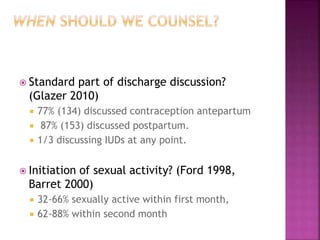
 Standard part of discharge discussion?
(Glazer 2010)
 77% (134) discussed contraception antepartum
 87% (153) discussed postpartum.
 1/3 discussing IUDs at any point.
 Initiation of sexual activity? (Ford 1998,
Barret 2000)
 32-66% sexually active within first month,
 62-88% within second month
 Effectiveness of antenatal counseling (Smith
2002)
 Expert advice vs ‘routine standard advice’ in
prenatal period
 Pregnancy rates at 1 year not significantly
different, even when considering intention
 Contraceptive practice differed significantly
(only because those not intending to get
pregnant chose sterilization)
 Not many great studies out there…..
 Cochrane Review of effects of postpartum
interventions (Lopez 2002, 2010)
 Increased contraception use, decreased
unplanned pregnancies in 2/4 interventional
trials,
 More effective when interventions longer
(beyond hospital stay period), incorporating
home visits
 What are the options? How do we use them?
Why do we recommend using them in this
way?
 Ovulation within 3 months in exclusive
breastfeeders,
 As early as 3-6 weeks in women who are not
exclusively breastfeeding
 May precede menstruation
 EBM
 < 2% “failure rate” in women exclusively or
‘mostly’ breastfeeding (DEF - feeding both night
and day, ammenorheic, infant less than 6 months
old and receiving >90% nutrition from breastmilk)
(WHO)
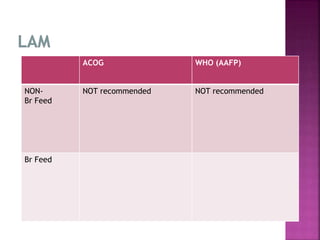
ACOG WHO (AAFP)
NON-
Br Feed
NOT recommended NOT recommended
Br Feed
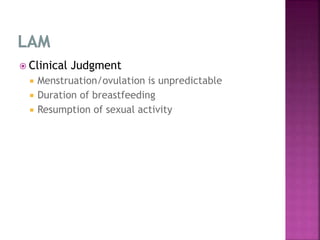
 Clinical Judgment
 Menstruation/ovulation is unpredictable
 Duration of breastfeeding
 Resumption of sexual activity
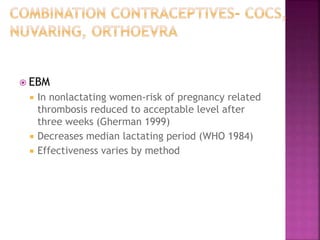
 EBM
 In nonlactating women-risk of pregnancy related
thrombosis reduced to acceptable level after
three weeks (Gherman 1999)
 Decreases median lactating period (WHO 1984)
 Effectiveness varies by method
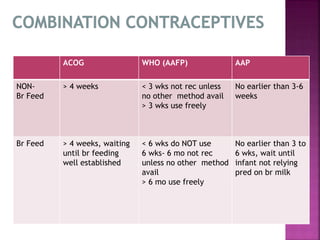
ACOG WHO (AAFP) AAP
NON-
Br Feed
> 4 weeks < 3 wks not rec unless
no other method avail
> 3 wks use freely
No earlier than 3-6
weeks
Br Feed > 4 weeks, waiting
until br feeding
well established
< 6 wks do NOT use
6 wks- 6 mo not rec
unless no other method
avail
> 6 mo use freely
No earlier than 3 to
6 wks, wait until
infant not relying
pred on br milk
 Clinical Judgment
 Acceptable reduction of risk of thrombosis
 Perceived effect on establishment of
breastfeeding patterns
 Ease of use for mother
 Theoretical effect based on understanding of
physiology
 Existing data of poor quality
 EBM
 Progesterone little effect on coagulation factors,
BP, lipids
 NOT been shown to effect milk quality sig, NO
effect on infant growth and development (Truitt
2003,WHO 1994,)
 Early initiation had NO effect on short-term
breastfeeding patterns (Halderman 2003)
 Expulsion rates?
 Use: insert 20 minutes within delivery of
placenta, using special technique OR 4-6 weeks
postpartum, once uterus has involuted (24-48
hour interval not recommended)
 0.1%/0.1% one year failure rate (WHO)
 RCT of post-NVD insertion- Postplacental group
24% expulsion rate, Interval group 4.4% expulsion
rate (Chen 2010)
 Breastfeeding (Hannon, 1997)
 NON-sig effect on duration or frequency of lactation
 NON-sig effect on timing of introduction of formula
 Adolescents (Templeton 2000)
 55% Depo vs 24% OC users continued method at 1
year.
 Total incidence of repeat pregnancy 10.6% at 1 year.
 24% in OC users and 2.6% in Depo users pregnant at 1
year.
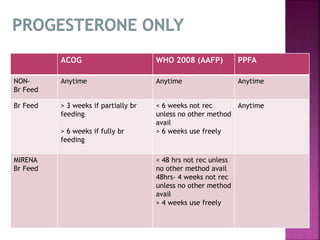
ACOG WHO 2008 (AAFP) PPFA
NON-
Br Feed
Anytime Anytime Anytime
Br Feed > 3 weeks if partially br
feeding
> 6 weeks if fully br
feeding
< 6 weeks not rec
unless no other method
avail
> 6 weeks use freely
Anytime
MIRENA
Br Feed
< 48 hrs not rec unless
no other method avail
48hrs- 4 weeks not rec
unless no other method
avail
> 4 weeks use freely
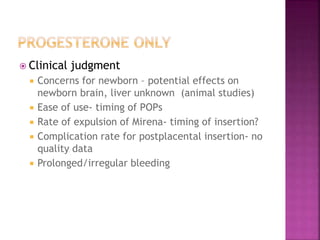
 Clinical judgment
 Concerns for newborn – potential effects on
newborn brain, liver unknown (animal studies)
 Ease of use- timing of POPs
 Rate of expulsion of Mirena- timing of insertion?
 Complication rate for postplacental insertion- no
quality data
 Prolonged/irregular bleeding
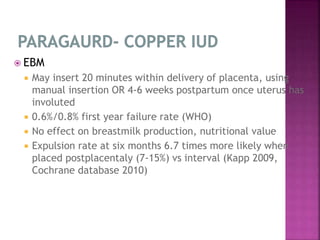
 EBM
 May insert 20 minutes within delivery of placenta, using
manual insertion OR 4-6 weeks postpartum once uterus has
involuted
 0.6%/0.8% first year failure rate (WHO)
 No effect on breastmilk production, nutritional value
 Expulsion rate at six months 6.7 times more likely when
placed postplacentaly (7-15%) vs interval (Kapp 2009,
Cochrane database 2010)
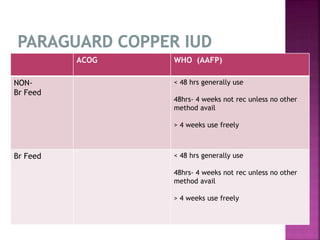
ACOG WHO (AAFP)
NON-
Br Feed
< 48 hrs generally use
48hrs- 4 weeks not rec unless no other
method avail
> 4 weeks use freely
Br Feed < 48 hrs generally use
48hrs- 4 weeks not rec unless no other
method avail
> 4 weeks use freely
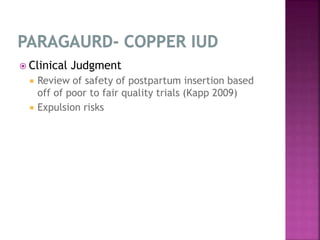
 Clinical Judgment
 Review of safety of postpartum insertion based
off of poor to fair quality trials (Kapp 2009)
 Expulsion risks
 Sterilization (Tubal, Essure, Vasectomy)-
 Can be done at any immediatly after
delivery/CS, within 24-48 hours or at an interval
of 4-6 weeks, effective immediately, no effect on
breast milk, NOT reversible
 Condoms-
 Can be used at any time, effective immediately,
no effect on breast milk, protects against STIs,
NOT always practical?
 EBM
 No increased risk of VTEs for mom
 No effect on breastmilk
 Clinical Judgment
 Availability
 What is different about contraception in
postpartum period?
 When should we counsel?
 What are the options?
 How do we use them?
 Why do we recommend using them in this
way?

Dr rabi postpartum contraception

  • 1.
    Dr. Rabinarayan Satapathy Asst.Professor Dept. of Obst.& Gynae S.C.B. Medical College,Cuttack
  • 2.
     What isdifferent about contraception in postpartum period?  When should we counsel?  What are the options?  How do we use them?  Why do we recommend using them in this way?
  • 3.
    • breastfeeding • hypercoagulablestate  different contraceptive needs
  • 4.
     Pregnancy  Prolactinsecretion in pregnancy -> breast growth, milk biosynthesis  Progesterone (and estrogen) ->interferes with prolactin binding, inhibits lactation  Birth  Rapid decline placental progesterone -> initiation of lactation  Suckling -> oxytocin release -> contraction of the myoepithelial cells -> milk ejection  Day 2-4 postpartum,  Steroid hormones cleared -> maintenance of milk production  High serum prolactin -> inhibits pulsatile GnRH -> prevent ovulation -----> maintained?
  • 5.
     Nutritional research1970s-1980s – OCPs  Sig changes in concentration of total protein, milk protein, and daily milk volume (Lonnerdal 1980)  Magnitude of changes w/in normal range, not of nutritional importance to newborn (Kowetsawang 1987)  WHO Task Force (1984)  Prospective RCT of COC vs POP vs non-hormonal placebo.  Milk volume: 41.9% decline in COC group vs 12.0% in POP group vs 6.1% in non-hormonal controls.  Comparable prevalence of complementary feeding and withdrawals due to inadequate milk supply  **No sig differences in growth of infants between treatment groups.
  • 6.
     Physiology  coagulationfactors and fibrinogen, resistance to anti-coagulants protein C and S  Risk of VTE (Gherman 1999)  22-84-fold high in first 6 weeks of postpartum period  greatest in first 21 days, after which risk sharply drops off
  • 7.
     Survey (Cwiak2004) “extremely important qualities”  ANTE-PARTUM: reliability, efficacy, and safety during breast-feeding  POST-PARTUM SIG: ease of use, long-term protection, and no need for monthly pharmacy trips  > 80% using contraception prior to pregnancy, nearly 20% not satisfied with the method used.  > 40% thought IUC seemed ‘somewhat’ or ‘much better’ than their most recent method, yet < 1% chose
  • 8.
     Standard partof discharge discussion? (Glazer 2010)  77% (134) discussed contraception antepartum  87% (153) discussed postpartum.  1/3 discussing IUDs at any point.  Initiation of sexual activity? (Ford 1998, Barret 2000)  32-66% sexually active within first month,  62-88% within second month
  • 9.
     Effectiveness ofantenatal counseling (Smith 2002)  Expert advice vs ‘routine standard advice’ in prenatal period  Pregnancy rates at 1 year not significantly different, even when considering intention  Contraceptive practice differed significantly (only because those not intending to get pregnant chose sterilization)  Not many great studies out there…..
  • 10.
     Cochrane Reviewof effects of postpartum interventions (Lopez 2002, 2010)  Increased contraception use, decreased unplanned pregnancies in 2/4 interventional trials,  More effective when interventions longer (beyond hospital stay period), incorporating home visits
  • 11.
     What arethe options? How do we use them? Why do we recommend using them in this way?
  • 12.
     Ovulation within3 months in exclusive breastfeeders,  As early as 3-6 weeks in women who are not exclusively breastfeeding  May precede menstruation  EBM  < 2% “failure rate” in women exclusively or ‘mostly’ breastfeeding (DEF - feeding both night and day, ammenorheic, infant less than 6 months old and receiving >90% nutrition from breastmilk) (WHO)
  • 13.
    ACOG WHO (AAFP) NON- BrFeed NOT recommended NOT recommended Br Feed
  • 14.
     Clinical Judgment Menstruation/ovulation is unpredictable  Duration of breastfeeding  Resumption of sexual activity
  • 15.
     EBM  Innonlactating women-risk of pregnancy related thrombosis reduced to acceptable level after three weeks (Gherman 1999)  Decreases median lactating period (WHO 1984)  Effectiveness varies by method
  • 16.
    ACOG WHO (AAFP)AAP NON- Br Feed > 4 weeks < 3 wks not rec unless no other method avail > 3 wks use freely No earlier than 3-6 weeks Br Feed > 4 weeks, waiting until br feeding well established < 6 wks do NOT use 6 wks- 6 mo not rec unless no other method avail > 6 mo use freely No earlier than 3 to 6 wks, wait until infant not relying pred on br milk
  • 17.
     Clinical Judgment Acceptable reduction of risk of thrombosis  Perceived effect on establishment of breastfeeding patterns  Ease of use for mother
  • 18.
     Theoretical effectbased on understanding of physiology  Existing data of poor quality  EBM  Progesterone little effect on coagulation factors, BP, lipids  NOT been shown to effect milk quality sig, NO effect on infant growth and development (Truitt 2003,WHO 1994,)  Early initiation had NO effect on short-term breastfeeding patterns (Halderman 2003)
  • 19.
     Expulsion rates? Use: insert 20 minutes within delivery of placenta, using special technique OR 4-6 weeks postpartum, once uterus has involuted (24-48 hour interval not recommended)  0.1%/0.1% one year failure rate (WHO)  RCT of post-NVD insertion- Postplacental group 24% expulsion rate, Interval group 4.4% expulsion rate (Chen 2010)
  • 20.
     Breastfeeding (Hannon,1997)  NON-sig effect on duration or frequency of lactation  NON-sig effect on timing of introduction of formula  Adolescents (Templeton 2000)  55% Depo vs 24% OC users continued method at 1 year.  Total incidence of repeat pregnancy 10.6% at 1 year.  24% in OC users and 2.6% in Depo users pregnant at 1 year.
  • 21.
    ACOG WHO 2008(AAFP) PPFA NON- Br Feed Anytime Anytime Anytime Br Feed > 3 weeks if partially br feeding > 6 weeks if fully br feeding < 6 weeks not rec unless no other method avail > 6 weeks use freely Anytime MIRENA Br Feed < 48 hrs not rec unless no other method avail 48hrs- 4 weeks not rec unless no other method avail > 4 weeks use freely
  • 22.
     Clinical judgment Concerns for newborn – potential effects on newborn brain, liver unknown (animal studies)  Ease of use- timing of POPs  Rate of expulsion of Mirena- timing of insertion?  Complication rate for postplacental insertion- no quality data  Prolonged/irregular bleeding
  • 23.
     EBM  Mayinsert 20 minutes within delivery of placenta, using manual insertion OR 4-6 weeks postpartum once uterus has involuted  0.6%/0.8% first year failure rate (WHO)  No effect on breastmilk production, nutritional value  Expulsion rate at six months 6.7 times more likely when placed postplacentaly (7-15%) vs interval (Kapp 2009, Cochrane database 2010)
  • 24.
    ACOG WHO (AAFP) NON- BrFeed < 48 hrs generally use 48hrs- 4 weeks not rec unless no other method avail > 4 weeks use freely Br Feed < 48 hrs generally use 48hrs- 4 weeks not rec unless no other method avail > 4 weeks use freely
  • 25.
     Clinical Judgment Review of safety of postpartum insertion based off of poor to fair quality trials (Kapp 2009)  Expulsion risks
  • 26.
     Sterilization (Tubal,Essure, Vasectomy)-  Can be done at any immediatly after delivery/CS, within 24-48 hours or at an interval of 4-6 weeks, effective immediately, no effect on breast milk, NOT reversible  Condoms-  Can be used at any time, effective immediately, no effect on breast milk, protects against STIs, NOT always practical?
  • 27.
     EBM  Noincreased risk of VTEs for mom  No effect on breastmilk  Clinical Judgment  Availability
  • 28.
     What isdifferent about contraception in postpartum period?  When should we counsel?  What are the options?  How do we use them?  Why do we recommend using them in this way?

Editor's Notes

  • #5 Prolactin binds alvealor cells
  • #6 Research in 70s and 80s- evidence on which much of our recommendations originally based off of. large large body of research coming out of nutrition community examined affect of hormonal contraception nutritional value and actual quantity of br milk produced, did indeed find significant difference between women who used horm contraceptives vs …… however further research showed that these alterations still within a normal range ,speculating that did not have effect on growth and development of infants. WHO took serious look at this question.
  • #7 AJOG, sweden,
  • #8 Most participants in our study at emory were Caucasian, married, highly educated and of higher income status.
  • #9 Postpartum patients in an urban university hospital were asked to complete a written survey on postpartum contraception. Participants were asked about contraception counseling offered both antepartum and postpartum. Participants were also asked if they would have elected to have an intrauterine device (IUD) inserted immediately after delivery. Considered standard of postpartum care, but efficacious is it in practice? Many women feel that this service is just provided as part of a checklist. Few providers and researchers have looked at how well the counseling works. Some people have questioned the basis for such programs. 
  • #10 Internationally conducted study in Edinburg, Shangai, Cape town, very different contraceptive practices and preferences
  • #11 That is, we do not know if postpartum women want to use family planning or whether they will return to a health center for family planning adviceSystematic review published this year in OB & Gyne Survey (Lopez 2010),
  • #13 Suckling -> prolactin -> inhibition of ovulation Small body of evidence regarding ovulation, imprecise
  • #15 Menstruation resumes at unpredictable rate Duration feeding- typical short Resumption of sexual activity- typically early
  • #19 Thickens cervical mucous, atrophic endometrium Unpredictably prevents ovulation Minipill- short half-life, must be taken very succinctly
  • #20 2010 Cochrane review of postpartum iuc insertion found nine RCTs; only one directly compared immediate post-partum insertion with delayed insertion, Chen green journal
  • #21 Prospective cohort in urban hospital in baltimore, self-reported survey louisville
  • #23 Evidence based off of small trials, short lengths of followup, non-standardization of evaluation methods
  • #24 Better studied, Foreign body rxn, spermicidal, no systemic effect
  • #26 Contraception