PRESENTATION
ON
EMERGENCY AND TERMINAL METHODS
OF CONTRACEPTION
PREPARED BY
MRS.REENA YADAV
LECTURER
PUSHPANJALI COLLEGE OF NSG,
AGRA
FAMILY PLANNING
Family planning is defined as the voluntary,
responsible decision made by individuals and
couples as to the desired family size and timing of
births.
FAMILY PLANNING
Family planning is the ability for a woman or couple
to determine when and how many children they are
going to have by practicing safe sexual practices.
OBJECTIVES FAMILY PLANNING
According to WHO expert committee-----
To avoid unwanted births
To regulate the interval between pregnancies
To control the time at which birth occurs.
To determine the number of children in a family.
DEFINITION OF ELIGIBLE COUPLE-
An eligible couple refers to a currently married
couple wherein the wife is in the reproductive age,
which is generally assumed to lie between the ages
of 15-45 years. There will be at least 150-180 such
couples per 1000 populations in India.
DEFINITION OF TARGET COUPLE
The term target couples are applied who have 2-3
living children, and family planning was largely
directed to such couples.
DEFINITION OF SMALL FAMILY NORM
it is composed of mother , father and few children.
HEALTH ASPECT OF FAMILY PLANNING
ADVANTAGES TO MOTHER
•-- Reasonable gap between two children will give the
mother sufficient time to replenish her body nutrients
depleted due to the earlier pregnancy.
•Loss of fear about unwanted pregnancy.
- More time and energy to give proper attention and
love to her children.
- More time to participate in other fruitful activities like
education, vocational training, community projects etc.
- Can avail of better job opportunities when not tied
down by small children.
HEALTH ASPECT OF FAMILY PLANNING
ADVANTAGES TO FATHER
- Can provide sound economic base for the family.
- Can provide children with better education,
comfort, food, clothing, recreation etc.
- Can be more relaxed and enjoy good
health.
- Improved living standards, better health,
more productive labour force
HEALTH ASPECT OF FAMILY PLANNING
ADVANTAGES TO CHILD
Less chances of foetal death, birth
defects, mortality during infancy and
childhood.
Conducive atmosphere for proper
physical and psychological growth of the child.
Get proper nutrition, education,
parental care and love.
HEALTH ASPECT OF FAMILY PLANNING
ADVANTAGES TO COMMUNITY AND COUNTRY
-Conversation of natural resources and savings.
- Enough schools, hospitals and other basic services.
- More employment
- Planned families would gradually bring happiness,
peace, harmony, prosperity.
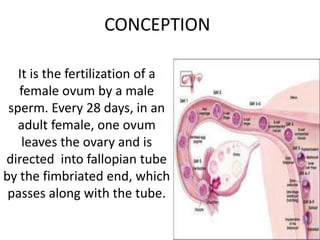
CONCEPTION
It is the fertilization of a
female ovum by a male
sperm. Every 28 days, in an
adult female, one ovum
leaves the ovary and is
directed into fallopian tube
by the fimbriated end, which
passes along with the tube.
CONTRACEPTION
it is the voluntary prevention of pregnancy, a
process with individual and social implications.
Contraception (birth control) prevents pregnancy
by interfering with the normal process of ovulation,
fertilization, and implantation. There are different
kinds of birth control that act at different points in
the process.
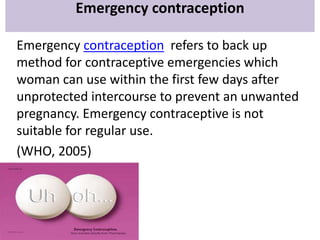
Emergency contraception
Emergency contraception refers to back up
method for contraceptive emergencies which
woman can use within the first few days after
unprotected intercourse to prevent an unwanted
pregnancy. Emergency contraceptive is not
suitable for regular use.
(WHO, 2005)
•After voluntary sexual act without contraceptive protection.
•Incorrect or inconsistent use of regular contraceptive
methods. Failure to take oral contraceptive for more than
three days.
•In case of contraceptive failure or mishap, miscalculation of
infertile period, expulsion of an intrauterine device and
failed coitus interruptus or in case of leakage of condom.
•In the case of sexual assault.
•Emergency contraception should not be used as regular
birth control. Other birth control methods are much better
at keeping women from becoming pregnant.
INDICATIONS OF EMERGENCY
CONTRACEPTIVES
METHODS OF EMERGENCY CONTRACEPTION
Emergency contraceptive pills (ECPs) emergency
contraceptive pills; ECPs
Medication containing synthetic hormones for preventing
pregnancy after unprotected vaginal intercourse.
All the hormonal oral contraceptive pills (combined as well
as single) in varying doses and IUD can be used for EC. The
method currently used in india are :
High dose of progesterone only pill containing
levonorgestrel (LNG).
high doses of combined oral contraceptive containing
ethylestradiol and levonorgestrol (yuzpe regimen).
Cont…..
•Copper releasing intrauterine devices (IUCD) such
as CuT 380A.
•Under the national family welfare programme, the
drug controller of india has only approved
levonorgestrel (LNG) 0.75mg tablet for use as ECP.
LNG is the specially packaged at the correct doses
for use as ECP.
MODE OF ACTION OF ECPs
Inhibition or delay of ovulation.
Thickening of cervical mucus.
Direct inhibition of fertilization.
Alteration in endometrium leading to impaired
endometrium receptivity to implantation of the
fertilized egg..
MODE OF ACTION OF ECPs
Alteration in transport of egg, sperm and
embryo.
Interference with corpus luteum and luteolysis
Effectiveness of ECPs
The probability of conception after single act of
intercourse is approximately 8%.
 A normally fertile sexually active couple not using
contraception has an average monthly chance of
conceiving of 20-25% (counting on pregnancies that
result in live births.
 ECPs taken within 72 hours of unprotected
vaginal intercourse are 85% effective .
ECPs are more effective if used within 12-24 hours
of unprotected intercourse any delay in taking the
pills decrease the efficiency of ECPs.
ADVANTAGES OF ECPs
Effective if taken correctly as prescribed.
Safe for all woman including those who have
conditions, that are listed as precautions in case of
other hormonal contraceptives.
Does not affect lactation.
Can be taken at any time during the monthly
cycle.
It is available without a prescription (over the
counter medicine)
Use not associated with foetal malformation or
congenital defects.
DISADVANTAGES
•Has to be used within 72 hours of the first act of
sexual intercourse as use of ECP beyond this
period increases the risk of pregnancy.
•Effectiveness decreases with frequent use.
•Does not protect from STIs/HIV.
•Side effects: nausea, vomiting, irregular bleeding
per vagina, breast tenderness, headache,
dizziness, fatigue.
MODE OF INTAKE
ECPs must be taken 72 hours of an unprotected
act of intercourse best to be taken as soon as
possible after the unprotected act and as a single
dose of 2 tabs of 0.75 mg each.
There is an option of taking 2 doses of 1 tablet
0.75 mg each, 12 hours apart.
 However no woman should be denied the pills in
case she comes later than 3 days (maximum 120
hours) but should be counseled regarding the
decreased efficacy).
EMERGENCY CONTRACEPTION PILLS
Calculation of 72 hours (three days interval)
Calculation of 72 hours or three days should
start from the first unprotected penetrative
vaginal intercourse the woman has had
during the particular menstrual cycle.
Side effects of ECPS
 Nausea and vomiting
. Headache,
dizziness,
irregular bleeding,
breast tenderness,
 fatigue
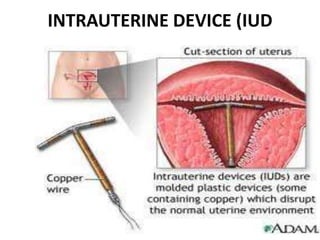
INTRAUTERINE DEVICE (IUD
• IUD is a small, T-shaped device placed into the
uterus by a doctor within 5 days after having
unprotected sex.
•This prevents implantation.
•The IUD works by keeping the sperm from joining
the egg or keeping a fertilized egg from attaching to
the uterus.
•It can remove the IUD after next period. Or left in
place for up to 10 years
STERILIZATION
Sterilization refers to surgical procedures intended
to render the person infertile. Most procedure
involve the occlusion of the passageways for the
ova and sperm.
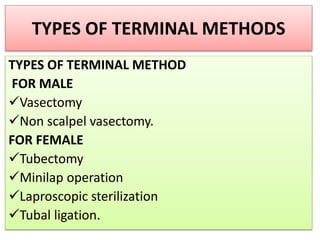
TYPES OF TERMINAL METHODS
TYPES OF TERMINAL METHOD
FOR MALE
Vasectomy
Non scalpel vasectomy.
FOR FEMALE
Tubectomy
Minilap operation
Laproscopic sterilization
Tubal ligation.
MALE STERILIZATION - VASECTOMY
 Male sterilization or vasectomy being a
comparatively simple and permanent method.
 can be performed even in primary health
centres by trained doctors LA.
 through a small scrotal incision on an out
patient basis.
 When carried out under strict aseptic
conditions,.
TECHNIQUE OF MALE STERILIZATION
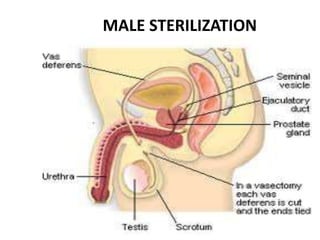
 The tubes through which sperm travels from the
testes to the penis are cut and blocked.
 So that spermatozoa can no longer enter the
semen that is ejaculated.
 It is customary to remove a piece of vas at least 1
cm after clamping.
The ends are ligated and be then folded back on
themselves and sutured into portion so that the cut
ends face away from each other.
MALE STERILIZATION
.
MALE STERILIZATION
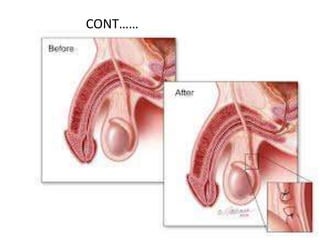
The passage of the sperm along with the vas
deferens is blocked,
so that the sperm that is ejaculated does not
contain sperm.
 It is important to stress that the acceptor is not
immediately sterile after the operation,
 usually until approximately 30 ejaculations have
taken place.
 During this intermediate period another method
of contraception must be used.
CONT……
MINOR COMPLICATION OF
VASECTOMY
Swelling
•Pain
•Blood Clots
•Infection
•Epididimitis
CARE AFTER OPERATION
•
Avoid heavy works for at least 3 days.
Avoid cycling for at least 7 days.
Avoid taking bath for at least 24 hours
after the operation.
Use contraceptives until aspermia has
been established
THE PATIENT NEEDS
Prescribe medicine.
Adequate diet.
Dry and clean dressing.
Scrotal support for one month.
Niroth to be used at least 12 ejeculation
after operation.
Suture removed after 3 rd day.

NONSCALPEL VASECTOMY
This new method of sterilization is being
actively promoted by the W.H.O.
it was developed in 1974 by Dr. Li Shungiang at
chongging Family Planning Scientific Research
Institute, peoples republic of china.
 In contrast to the standard incisional method
of vasectomy, which requires several pieces of
surgical instruments, this new technique needs
only two essential instrument.
TECHNIQUE OF NON SCALPEL
VASECTOMY
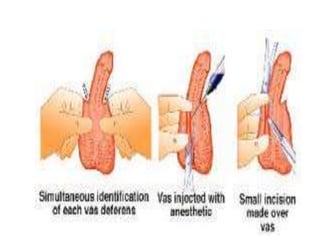
The first is the vas fixation clamp, used to grasp
the vas deferens from outside of the scrotal skin.
 The second is the vas dissecting clamp, used to
make a puncture into the skin over lying the fixed
vas . after widening the essential punctured hole
with the vas dissecting clamp, the vas can be seen
and elevated out for any preferred methods of vas
occlusion.
FEMALE STERILIZATION
Occlusion of the fallopian tubes in some form is
the underlying principle to achieve female
sterilization. It is most popular method of
terminal contraception.
Time of operation
• Immediately after birth (within 24 to
48 hours)
• At the time of abortion.
• An interval procedure (during proliferative
phase of menstrual cycle )
METHOD OF FEMALE STERILIZATION
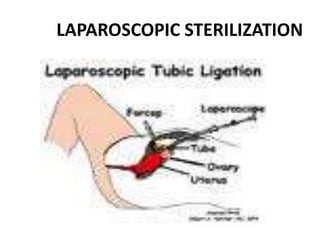
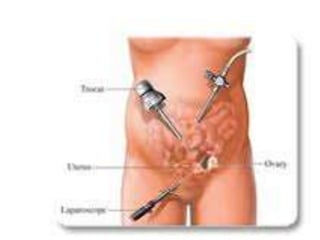
LAPAROSCOPIC STERILIZATION
This is a technique of female sterilization through
abdominal approach with a specialized instrument
called “laparoscope”. The abdomen is inflated with
gas(carbon dioxide, nitrous oxide or air).
Instrument is introduced into the abdominal cavity
to visualize the tubes.
Once the tubes are accessible, the Falope rings are
applied to occlude the tubes.
LAPAROSCOPIC STERILIZATION
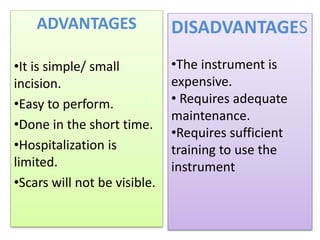
ADVANTAGES
•It is simple/ small
incision.
•Easy to perform.
•Done in the short time.
•Hospitalization is
limited.
•Scars will not be visible.
DISADVANTAGES
•The instrument is
expensive.
• Requires adequate
maintenance.
•Requires sufficient
training to use the
instrument
MINILAP OPERATION
•Much simpler procedure requiring a smaller
abdominal incision of only 2.5 to 3 cm conducted
under local aneaesthesia.
•Minilap is used for tubal ligtion through the cutting
of the tubes or to application of the band or clip.
PUERPERAL STERILIZATION
Currently puerperal sterilization is becoming more
popular, an account for 85-90% and male
sterilization for 10-15% only in india. sterlization
services are provided free of charge in
government institution.
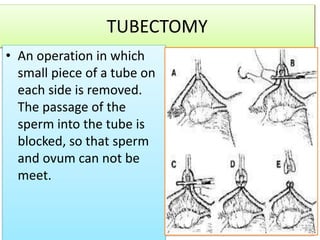
TUBECTOMY
• An operation in which
small piece of a tube on
each side is removed.
The passage of the
sperm into the tube is
blocked, so that sperm
and ovum can not be
meet.
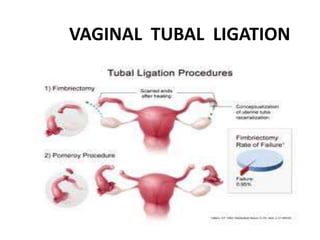
VAGINAL TUBAL LIGATION
Tubal ligation through vaginal route is also done.
This approach to the tube is through posterior
colpotomy.
It can be done in the interval period or following
delivery or abortion, provided the uterus is smaller
than 12 weeks size.
VAGINAL TUBAL LIGATION
COMPLICATION RELATED TO
STERILIZATION
General complication
•Loss of weight
•Occasional obesity
•Psychological upset.
•Gynaecological complication
•Chronic pelvic pain
•Congestive dysmenorrheal and.menstrual
abnormality such as menorrhagia,
hypomenorrhagia or irregular periods and
alteration in libido.
Incentives of terminal methods
The acceptor now receive a one time payment of
Rs 800 for vasectomy and 145 for laproscopic
tubectomy and Rs. 20 are given to IUD receptor.
 Motivator also received a small amount (Rs 10 for
tubectomy and Rs 40 for vasectomy).
 State govt employees, who undergo sterilization
after two or three children are eligible for a special
increments after 2 children and one after 3 children ).
 Central Govt employees get one increment after
sterilization.
They get special leave (14 days for woman and 7
days for men). No maternity leave is allowed after 3
children.
In the event of death following sterilization,
recanalisation, or IUD insertion, ex-gratia payment
of Rs. 20,000 has been authorized to be paid to the
surviving spouse, natural heir, etc.
The state Govt has been requested to: issue
Green cards to individual acceptors of terminal
methods after two children as a mark of recognition
and for priority attention in scheme where
preferential treatment was feasible.
Administrative role -
Supervisory role.
Functional role
Educational role-
Role in research
 Role in evaluation -
ROLE OF NURSE IN FAMILY PLANNING
BIBLIOGRAPHY
•Basawanthappa B. T, (2008),” Community Health Nursing”, Pp 600-
6001.
•Kamalam S. (2005), Essential In Community Health Nursing Practice,
Pp 319-321
•Lowdermilk Leonard Deitra, Perry Phinon E. (1997), “Maternity And
Woman Health Care”, New York, PP 1192-1195.
•Mahajan B. K, Gupta M.C. (1972),“ Textbook Of Preventive And Social
Medicin”, Second Edition, pp- 608.
•May Antley Katharyan, Laura Mahlmeister, “Comprehensive
Maternity Nursing” Pp-192.
•Jacob annamma, (2005), a comprehensive textbook of midwifery”, pp
– 242-245.
•Myles Margret f.,(1975), “text book for midwifes” pp 421.
•Park K. Preventive And Social Medicine , 20th Edition, Pp
•Gulani K. K, Community Health Nursing” First Edition, Pp 318-321.
•.wikipedia.com.
Ppt on emergency and terminal contra

Ppt on emergency and terminal contra

  • 1.
    PRESENTATION ON EMERGENCY AND TERMINALMETHODS OF CONTRACEPTION PREPARED BY MRS.REENA YADAV LECTURER PUSHPANJALI COLLEGE OF NSG, AGRA
  • 2.
    FAMILY PLANNING Family planningis defined as the voluntary, responsible decision made by individuals and couples as to the desired family size and timing of births.
  • 3.
    FAMILY PLANNING Family planningis the ability for a woman or couple to determine when and how many children they are going to have by practicing safe sexual practices.
  • 4.
    OBJECTIVES FAMILY PLANNING Accordingto WHO expert committee----- To avoid unwanted births To regulate the interval between pregnancies To control the time at which birth occurs. To determine the number of children in a family.
  • 5.
    DEFINITION OF ELIGIBLECOUPLE- An eligible couple refers to a currently married couple wherein the wife is in the reproductive age, which is generally assumed to lie between the ages of 15-45 years. There will be at least 150-180 such couples per 1000 populations in India.
  • 6.
    DEFINITION OF TARGETCOUPLE The term target couples are applied who have 2-3 living children, and family planning was largely directed to such couples.
  • 7.
    DEFINITION OF SMALLFAMILY NORM it is composed of mother , father and few children.
  • 8.
    HEALTH ASPECT OFFAMILY PLANNING ADVANTAGES TO MOTHER •-- Reasonable gap between two children will give the mother sufficient time to replenish her body nutrients depleted due to the earlier pregnancy. •Loss of fear about unwanted pregnancy. - More time and energy to give proper attention and love to her children. - More time to participate in other fruitful activities like education, vocational training, community projects etc. - Can avail of better job opportunities when not tied down by small children.
  • 9.
    HEALTH ASPECT OFFAMILY PLANNING ADVANTAGES TO FATHER - Can provide sound economic base for the family. - Can provide children with better education, comfort, food, clothing, recreation etc. - Can be more relaxed and enjoy good health. - Improved living standards, better health, more productive labour force
  • 10.
    HEALTH ASPECT OFFAMILY PLANNING ADVANTAGES TO CHILD Less chances of foetal death, birth defects, mortality during infancy and childhood. Conducive atmosphere for proper physical and psychological growth of the child. Get proper nutrition, education, parental care and love.
  • 11.
    HEALTH ASPECT OFFAMILY PLANNING ADVANTAGES TO COMMUNITY AND COUNTRY -Conversation of natural resources and savings. - Enough schools, hospitals and other basic services. - More employment - Planned families would gradually bring happiness, peace, harmony, prosperity.
  • 12.
    CONCEPTION It is thefertilization of a female ovum by a male sperm. Every 28 days, in an adult female, one ovum leaves the ovary and is directed into fallopian tube by the fimbriated end, which passes along with the tube.
  • 13.
    CONTRACEPTION it is thevoluntary prevention of pregnancy, a process with individual and social implications. Contraception (birth control) prevents pregnancy by interfering with the normal process of ovulation, fertilization, and implantation. There are different kinds of birth control that act at different points in the process.
  • 14.
    Emergency contraception Emergency contraceptionrefers to back up method for contraceptive emergencies which woman can use within the first few days after unprotected intercourse to prevent an unwanted pregnancy. Emergency contraceptive is not suitable for regular use. (WHO, 2005)
  • 15.
    •After voluntary sexualact without contraceptive protection. •Incorrect or inconsistent use of regular contraceptive methods. Failure to take oral contraceptive for more than three days. •In case of contraceptive failure or mishap, miscalculation of infertile period, expulsion of an intrauterine device and failed coitus interruptus or in case of leakage of condom. •In the case of sexual assault. •Emergency contraception should not be used as regular birth control. Other birth control methods are much better at keeping women from becoming pregnant. INDICATIONS OF EMERGENCY CONTRACEPTIVES
  • 16.
    METHODS OF EMERGENCYCONTRACEPTION Emergency contraceptive pills (ECPs) emergency contraceptive pills; ECPs Medication containing synthetic hormones for preventing pregnancy after unprotected vaginal intercourse. All the hormonal oral contraceptive pills (combined as well as single) in varying doses and IUD can be used for EC. The method currently used in india are : High dose of progesterone only pill containing levonorgestrel (LNG). high doses of combined oral contraceptive containing ethylestradiol and levonorgestrol (yuzpe regimen).
  • 17.
    Cont….. •Copper releasing intrauterinedevices (IUCD) such as CuT 380A. •Under the national family welfare programme, the drug controller of india has only approved levonorgestrel (LNG) 0.75mg tablet for use as ECP. LNG is the specially packaged at the correct doses for use as ECP.
  • 18.
    MODE OF ACTIONOF ECPs Inhibition or delay of ovulation. Thickening of cervical mucus. Direct inhibition of fertilization. Alteration in endometrium leading to impaired endometrium receptivity to implantation of the fertilized egg..
  • 19.
    MODE OF ACTIONOF ECPs Alteration in transport of egg, sperm and embryo. Interference with corpus luteum and luteolysis
  • 20.
    Effectiveness of ECPs Theprobability of conception after single act of intercourse is approximately 8%.  A normally fertile sexually active couple not using contraception has an average monthly chance of conceiving of 20-25% (counting on pregnancies that result in live births.  ECPs taken within 72 hours of unprotected vaginal intercourse are 85% effective . ECPs are more effective if used within 12-24 hours of unprotected intercourse any delay in taking the pills decrease the efficiency of ECPs.
  • 21.
    ADVANTAGES OF ECPs Effectiveif taken correctly as prescribed. Safe for all woman including those who have conditions, that are listed as precautions in case of other hormonal contraceptives. Does not affect lactation. Can be taken at any time during the monthly cycle. It is available without a prescription (over the counter medicine) Use not associated with foetal malformation or congenital defects.
  • 22.
    DISADVANTAGES •Has to beused within 72 hours of the first act of sexual intercourse as use of ECP beyond this period increases the risk of pregnancy. •Effectiveness decreases with frequent use. •Does not protect from STIs/HIV. •Side effects: nausea, vomiting, irregular bleeding per vagina, breast tenderness, headache, dizziness, fatigue.
  • 23.
    MODE OF INTAKE ECPsmust be taken 72 hours of an unprotected act of intercourse best to be taken as soon as possible after the unprotected act and as a single dose of 2 tabs of 0.75 mg each. There is an option of taking 2 doses of 1 tablet 0.75 mg each, 12 hours apart.  However no woman should be denied the pills in case she comes later than 3 days (maximum 120 hours) but should be counseled regarding the decreased efficacy).
  • 24.
    EMERGENCY CONTRACEPTION PILLS Calculationof 72 hours (three days interval) Calculation of 72 hours or three days should start from the first unprotected penetrative vaginal intercourse the woman has had during the particular menstrual cycle.
  • 25.
    Side effects ofECPS  Nausea and vomiting . Headache, dizziness, irregular bleeding, breast tenderness,  fatigue
  • 26.
  • 27.
    INTRAUTERINE DEVICE (IUD •IUD is a small, T-shaped device placed into the uterus by a doctor within 5 days after having unprotected sex. •This prevents implantation. •The IUD works by keeping the sperm from joining the egg or keeping a fertilized egg from attaching to the uterus. •It can remove the IUD after next period. Or left in place for up to 10 years
  • 28.
    STERILIZATION Sterilization refers tosurgical procedures intended to render the person infertile. Most procedure involve the occlusion of the passageways for the ova and sperm.
  • 29.
    TYPES OF TERMINALMETHODS TYPES OF TERMINAL METHOD FOR MALE Vasectomy Non scalpel vasectomy. FOR FEMALE Tubectomy Minilap operation Laproscopic sterilization Tubal ligation.
  • 30.
    MALE STERILIZATION -VASECTOMY  Male sterilization or vasectomy being a comparatively simple and permanent method.  can be performed even in primary health centres by trained doctors LA.  through a small scrotal incision on an out patient basis.  When carried out under strict aseptic conditions,.
  • 31.
    TECHNIQUE OF MALESTERILIZATION  The tubes through which sperm travels from the testes to the penis are cut and blocked.  So that spermatozoa can no longer enter the semen that is ejaculated.  It is customary to remove a piece of vas at least 1 cm after clamping. The ends are ligated and be then folded back on themselves and sutured into portion so that the cut ends face away from each other.
  • 32.
  • 33.
    MALE STERILIZATION The passageof the sperm along with the vas deferens is blocked, so that the sperm that is ejaculated does not contain sperm.  It is important to stress that the acceptor is not immediately sterile after the operation,  usually until approximately 30 ejaculations have taken place.  During this intermediate period another method of contraception must be used.
  • 34.
  • 35.
  • 36.
    CARE AFTER OPERATION • Avoidheavy works for at least 3 days. Avoid cycling for at least 7 days. Avoid taking bath for at least 24 hours after the operation. Use contraceptives until aspermia has been established
  • 37.
    THE PATIENT NEEDS Prescribemedicine. Adequate diet. Dry and clean dressing. Scrotal support for one month. Niroth to be used at least 12 ejeculation after operation. Suture removed after 3 rd day. 
  • 38.
    NONSCALPEL VASECTOMY This newmethod of sterilization is being actively promoted by the W.H.O. it was developed in 1974 by Dr. Li Shungiang at chongging Family Planning Scientific Research Institute, peoples republic of china.  In contrast to the standard incisional method of vasectomy, which requires several pieces of surgical instruments, this new technique needs only two essential instrument.
  • 40.
    TECHNIQUE OF NONSCALPEL VASECTOMY The first is the vas fixation clamp, used to grasp the vas deferens from outside of the scrotal skin.  The second is the vas dissecting clamp, used to make a puncture into the skin over lying the fixed vas . after widening the essential punctured hole with the vas dissecting clamp, the vas can be seen and elevated out for any preferred methods of vas occlusion.
  • 41.
    FEMALE STERILIZATION Occlusion ofthe fallopian tubes in some form is the underlying principle to achieve female sterilization. It is most popular method of terminal contraception. Time of operation • Immediately after birth (within 24 to 48 hours) • At the time of abortion. • An interval procedure (during proliferative phase of menstrual cycle )
  • 42.
    METHOD OF FEMALESTERILIZATION
  • 43.
    LAPAROSCOPIC STERILIZATION This isa technique of female sterilization through abdominal approach with a specialized instrument called “laparoscope”. The abdomen is inflated with gas(carbon dioxide, nitrous oxide or air). Instrument is introduced into the abdominal cavity to visualize the tubes. Once the tubes are accessible, the Falope rings are applied to occlude the tubes.
  • 44.
  • 46.
    ADVANTAGES •It is simple/small incision. •Easy to perform. •Done in the short time. •Hospitalization is limited. •Scars will not be visible. DISADVANTAGES •The instrument is expensive. • Requires adequate maintenance. •Requires sufficient training to use the instrument
  • 47.
    MINILAP OPERATION •Much simplerprocedure requiring a smaller abdominal incision of only 2.5 to 3 cm conducted under local aneaesthesia. •Minilap is used for tubal ligtion through the cutting of the tubes or to application of the band or clip.
  • 49.
    PUERPERAL STERILIZATION Currently puerperalsterilization is becoming more popular, an account for 85-90% and male sterilization for 10-15% only in india. sterlization services are provided free of charge in government institution.
  • 50.
    TUBECTOMY • An operationin which small piece of a tube on each side is removed. The passage of the sperm into the tube is blocked, so that sperm and ovum can not be meet.
  • 51.
    VAGINAL TUBAL LIGATION Tuballigation through vaginal route is also done. This approach to the tube is through posterior colpotomy. It can be done in the interval period or following delivery or abortion, provided the uterus is smaller than 12 weeks size.
  • 52.
  • 53.
    COMPLICATION RELATED TO STERILIZATION Generalcomplication •Loss of weight •Occasional obesity •Psychological upset. •Gynaecological complication •Chronic pelvic pain •Congestive dysmenorrheal and.menstrual abnormality such as menorrhagia, hypomenorrhagia or irregular periods and alteration in libido.
  • 54.
    Incentives of terminalmethods The acceptor now receive a one time payment of Rs 800 for vasectomy and 145 for laproscopic tubectomy and Rs. 20 are given to IUD receptor.  Motivator also received a small amount (Rs 10 for tubectomy and Rs 40 for vasectomy).  State govt employees, who undergo sterilization after two or three children are eligible for a special increments after 2 children and one after 3 children ).  Central Govt employees get one increment after sterilization.
  • 55.
    They get specialleave (14 days for woman and 7 days for men). No maternity leave is allowed after 3 children. In the event of death following sterilization, recanalisation, or IUD insertion, ex-gratia payment of Rs. 20,000 has been authorized to be paid to the surviving spouse, natural heir, etc. The state Govt has been requested to: issue Green cards to individual acceptors of terminal methods after two children as a mark of recognition and for priority attention in scheme where preferential treatment was feasible.
  • 56.
    Administrative role - Supervisoryrole. Functional role Educational role- Role in research  Role in evaluation - ROLE OF NURSE IN FAMILY PLANNING
  • 57.
    BIBLIOGRAPHY •Basawanthappa B. T,(2008),” Community Health Nursing”, Pp 600- 6001. •Kamalam S. (2005), Essential In Community Health Nursing Practice, Pp 319-321 •Lowdermilk Leonard Deitra, Perry Phinon E. (1997), “Maternity And Woman Health Care”, New York, PP 1192-1195. •Mahajan B. K, Gupta M.C. (1972),“ Textbook Of Preventive And Social Medicin”, Second Edition, pp- 608. •May Antley Katharyan, Laura Mahlmeister, “Comprehensive Maternity Nursing” Pp-192. •Jacob annamma, (2005), a comprehensive textbook of midwifery”, pp – 242-245. •Myles Margret f.,(1975), “text book for midwifes” pp 421. •Park K. Preventive And Social Medicine , 20th Edition, Pp •Gulani K. K, Community Health Nursing” First Edition, Pp 318-321. •.wikipedia.com.