DR. RABI NARAYAN SATAPATHY
ASST.PROFESSOR
DEPT. OF OBST.& GYNAECOLOGY
SCB MEDICAL COLLEGE, CUTTACK
MOB-09861281510
EMAIL-drrabisatpathy@gmail.com
Relative Prevalence Of The Etiologies Of Infertility
10% 10%
40-50%
25-40%
Both male & female
factor
Female factor
Male factor
Unexplained
infertility
Incidence of Male Infertility is increasing ! !Incidence of Male Infertility is increasing ! !
PRESENTATION OF MALE INFERTILITYPRESENTATION OF MALE INFERTILITY
ABNORMAL SEMEN PROFILEABNORMAL SEMEN PROFILE MALE SEXUAL DYSFUNCTIONMALE SEXUAL DYSFUNCTION
 AZOOSPERMIAAZOOSPERMIA  ERECTILE DYSFUNCTIONERECTILE DYSFUNCTION
 OLIGOSPERMIAOLIGOSPERMIA  EJACUALATORY DYSFUNCTIONEJACUALATORY DYSFUNCTION
 ASTHENOSPERMIAASTHENOSPERMIA  RETROGRADE EJACULATIONRETROGRADE EJACULATION
 TERATOZOOSPERMIATERATOZOOSPERMIA  PREMATURE EJACULATIONPREMATURE EJACULATION
 HIGH LEUCOCYTE COUNTHIGH LEUCOCYTE COUNT LOCAL ANATOMICAL DEFECTLOCAL ANATOMICAL DEFECT
 COMBINATIONCOMBINATION
PretesticularPretesticular TesticularTesticular PosttesticularPosttesticular
EndocrineEndocrine
Hypogonadotropic hypogonadismHypogonadotropic hypogonadism
Hypothyroidism,Hypothyroidism,
HyperprolatinaemiaHyperprolatinaemia
DiabetesDiabetes
Coital disordersCoital disorders
Erectile dysfunctionErectile dysfunction
Ejaculatory failureEjaculatory failure
GeneticGenetic
Klinefelter’s SyndromeKlinefelter’s Syndrome
Y chromosome deletionY chromosome deletion
Immotile cilia syndromeImmotile cilia syndrome
CongenitalCongenital
CryptorchidismCryptorchidism
Infective (orchitis)Infective (orchitis)
Antispermatogenic agentsAntispermatogenic agents
Heat, Chemotherapy, Drugs,Heat, Chemotherapy, Drugs,
IrradiationIrradiation
VascularVascular
TorsionTorsion
VaricoceleVaricocele
ImmunologicalImmunological
IdiopathicIdiopathic
ObstructiveObstructive
EpididymalEpididymal
CongenitalCongenital
InfectiveInfective
VasalVasal
Genetic: Cystic fibrosisGenetic: Cystic fibrosis
Aquired: VasectomyAquired: Vasectomy
Ejaculatory duct obstructionEjaculatory duct obstruction
Epididymal hostilityEpididymal hostility
Epididymal asthenospermiaEpididymal asthenospermia
Accessory glandAccessory gland
infectioninfection
ImmunologicalImmunological
IdiopathicIdiopathic
Post vasectomyPost vasectomy
ETIOLOGICAL FACTORS IN MALE INFERTILITYETIOLOGICAL FACTORS IN MALE INFERTILITY
CAUSECAUSE PERCENTAGEPERCENTAGE
No demonstrable causeNo demonstrable cause
Idiopathic abnormal semenIdiopathic abnormal semen
VaricoceleVaricocele
Infectious factorsInfectious factors
Immunologic factorImmunologic factor
Other acquired factorsOther acquired factors
Congenital factorsCongenital factors
Sexual factorsSexual factors
Endocrine disturbancesEndocrine disturbances
48.5%48.5%
26.4%26.4%
12.3%12.3%
6.6%6.6%
3.1%3.1%
2.6%2.6%
2.1%2.1%
1.7%1.7%
0.6%0.6%
Frequency of Etiologies in Male Factor InfertilityFrequency of Etiologies in Male Factor Infertility
WHO Study 1994, Eshre Capri Workshop Group (7057 men)WHO Study 1994, Eshre Capri Workshop Group (7057 men)
EVALUATION OF MALEEVALUATION OF MALE
INFERTILITYINFERTILITY
 HistoryHistory
 Physical examinationPhysical examination
 Semen analysisSemen analysis
 Additional proceduresAdditional procedures
- Sperm function tests- Sperm function tests
- Immunological tests- Immunological tests
- Semen culture- Semen culture
- Hormone assays- Hormone assays
-Testicular biopsy-Testicular biopsy
- Chromosomal analysis- Chromosomal analysis
-Vasography-Vasography
- Scrotal ultrasound- Scrotal ultrasound
-Transrectal ultrasound (TRU)-Transrectal ultrasound (TRU)
- DNA integrity tests- DNA integrity tests
HISTORYHISTORY
 Age and duration of marriageAge and duration of marriage
 Occupation –hyperthermia, pesticides, bicycling, stressOccupation –hyperthermia, pesticides, bicycling, stress
 H/O childhood problems – Cryptorchidism – surgeryH/O childhood problems – Cryptorchidism – surgery
Delayed pubertyDelayed puberty
 Medical History – Mumps, syphilis, leprosy, tuberculosisMedical History – Mumps, syphilis, leprosy, tuberculosis
Chronic respiratory diseases –Chronic respiratory diseases –
Young’s syndrome – epididymal obstructionYoung’s syndrome – epididymal obstruction
Immotile cilia syndrome – Sperms are immotileImmotile cilia syndrome – Sperms are immotile
Cystic fibrosis – Congenital absence of VASCystic fibrosis – Congenital absence of VAS
Endocrine disorder, diabetes, hypothyroidism,Endocrine disorder, diabetes, hypothyroidism,
Renal failure, Liver disease, hypertension, multiple sclerosisRenal failure, Liver disease, hypertension, multiple sclerosis
HISTORY (Contd…)HISTORY (Contd…)
 Surgical & Traumatic History – Damage of VAS –Surgical & Traumatic History – Damage of VAS –
Hernia,Hernia,
Orchidopexy, Vasectomy, Trauma, Torsion, Spinal cordOrchidopexy, Vasectomy, Trauma, Torsion, Spinal cord
injuryinjury
 Sexual history – Timing, frequency ,conception windowSexual history – Timing, frequency ,conception window
H/O–Erectile & Ejaculatory problem -H/O–Erectile & Ejaculatory problem -
Nocturnal penile trumescence (NPT)Nocturnal penile trumescence (NPT)
 Family history –Family history –
 History of smoking, alcohol, radiation, heavy metals,History of smoking, alcohol, radiation, heavy metals,
estrogen exposureestrogen exposure
 Drugs – Antipsychotic, Antihypertensives, CimetidineDrugs – Antipsychotic, Antihypertensives, Cimetidine
Anticonvulsants, Sex steroids, EnvironmentalAnticonvulsants, Sex steroids, Environmental
PHYSICAL EXAMINATIONPHYSICAL EXAMINATION
 General – Obesity, Secondary sexual character , gynaecomastia, BodyGeneral – Obesity, Secondary sexual character , gynaecomastia, Body
habitus, Thyroid gland, Galactorrhoea, Visual field defect, Features ofhabitus, Thyroid gland, Galactorrhoea, Visual field defect, Features of
endocrinopathyendocrinopathy
 Per abdomen – Scar of hernia, lymph nodePer abdomen – Scar of hernia, lymph node
 Local examinationLocal examination
* Scrotum- hernia, hydrocele, varicocele* Scrotum- hernia, hydrocele, varicocele
* Testes – Present or absent* Testes – Present or absent
Size (18-20ml)Size (18-20ml)
SensationSensation
* Penis – Hypospadius, phimosis* Penis – Hypospadius, phimosis
* Epididymis & VAS – Presence, feel, presence of cyst* Epididymis & VAS – Presence, feel, presence of cyst
* Rectal examination* Rectal examination
Varicocele
SEMEN ANALYSIS (WHO 1999)SEMEN ANALYSIS (WHO 1999)
VolumeVolume > 2ml> 2ml
pHpH 7.2-7.87.2-7.8
Sperm concentrationSperm concentration ≥≥20milion/ml20milion/ml
Total sperm countTotal sperm count ≥≥40milion40milion
MotilityMotility ≥≥50% with normal50% with normal
morphologymorphology
MorphologyMorphology ≥≥30% normal forms30% normal forms
WBCWBC < 1 X 10< 1 X 1066
/ ml/ ml
MAR testMAR test < 10% spermatozoa with< 10% spermatozoa with
adherent particleadherent particle
SEMEN ANALYSISSEMEN ANALYSIS
ENDTZ test can distinguish between leukocytes &ENDTZ test can distinguish between leukocytes &
immature germ cells (both round cells)immature germ cells (both round cells)
Sperm vitality test:Sperm vitality test:
* Eosin Nigration test* Eosin Nigration test
** Hypoosmotic swelling testHypoosmotic swelling test
* H33258 Flurochrome test* H33258 Flurochrome test
Fructose estimation-Absent in Ejaculatory duct obstructionFructose estimation-Absent in Ejaculatory duct obstruction
Split Ejaculate-Split Ejaculate-
Limitations of WHO criteria
 Significant overlapping of sperm characteristics
between fertile and infertile men
 Sperm motility and concentration are more
important than sperm morphology
 Change of cut off values and introduction of new
parameters are needed to differentiate between
fertile and infertile men
Kiran P et al;Fertil Steril, vol 85,No 3,March 2006:629-34
MATURE SPERMATOZOA
SPERM FUNCTION TESTSPERM FUNCTION TEST
 Sperm cervical mucus interactionsSperm cervical mucus interactions
a. In Vivo –a. In Vivo – Post Coital TestPost Coital Test (Sim’s Hunner test)(Sim’s Hunner test)
b. In Vitro –b. In Vitro –
I. Sperm cervical mucus contact test (SCMC test)I. Sperm cervical mucus contact test (SCMC test)
II. Tube test (Kremar test)II. Tube test (Kremar test)
 Hemizona test (Human zona binding assay)Hemizona test (Human zona binding assay)
 Hypoosmotic swelling testHypoosmotic swelling test
 Swim up testSwim up test
 Computerised assisted seminal analysis (CASA)Computerised assisted seminal analysis (CASA)
 Evidence of acrosomal reactionEvidence of acrosomal reaction
IMMUNOLOGICAL TESTSIMMUNOLOGICAL TESTS
Indications –
• Abnormal semen profile
• Abnormal cervical mucus sperm interaction
• Failed Vasectomy reversal
• Marked Agglutination (more than 10%)
Two Tests –
a. Immunobead testa. Immunobead test
b. MAR testb. MAR test
c. Others – TAT test, Kibrick’s test, Frankling Duke test, Isojama’s
test (Not done now a days)
MIXED AGGLUTINATION REACTION
(MAR) TEST
 Screening test for detection of antisperm antibodies
on the surface of sperm head or tail.
 Washed sperms from the patient are mixed with
antibody coated RBC, (Sheep RBC + rabbit antibody)
 These antibody will form mixed agglutinates with
motile sperms carrying immunoglobulins
 MAR test is positive when particulate binding is found
in over 10% spermatozoa.
HORMONE ASSAYSHORMONE ASSAYS
Indication-Indication- when Sperm count is less than 10when Sperm count is less than 10
million/mlmillion/ml
 FSHFSH
 LHLH
 TestosteroneTestosterone
 EstradiolEstradiol
 ProlactinProlactin
 TSHTSH
HORMONAL CONTROL OF SPERMATOGENESISHORMONAL CONTROL OF SPERMATOGENESIS
HypothalamusHypothalamus
GGnnRHRH
Anterior PituitaryAnterior Pituitary
FSHFSH LHLH
Sertoli cellSertoli cell Leydig cellLeydig cell
InhibinInhibin ABGABG TT
ABG+TABG+T
- Ve- Ve - Ve- Ve
- Ve- Ve
SpermatogenesisSpermatogenesis andand
spermsperm maturationmaturation
Hormones in different clinicalHormones in different clinical
conditionsconditions
FINDINGSFINDINGS DIAGNOSISDIAGNOSIS
1.1. Azoospermia or OligospermiaAzoospermia or Oligospermia
Small testesSmall testes
FSH - HighFSH - High
Primary testicular failurePrimary testicular failure
(Severe tubular damage)(Severe tubular damage)
2. Azoospermia2. Azoospermia
Normal testicular volumeNormal testicular volume
FSH – Normal levelFSH – Normal level
i. Bilateral genital tract obstructioni. Bilateral genital tract obstruction
ii.Sertoli cell only syndromeii.Sertoli cell only syndrome
3. FSH – Lower or undetectable3. FSH – Lower or undetectable
LH – LowLH – Low
Testosterone – LowTestosterone – Low
Other evidences of androgen def.Other evidences of androgen def.
HypogonadismHypogonadism
4. LH – High4. LH – High
Testosterone – HighTestosterone – High
Androgen receptor defectAndrogen receptor defect
TESTICULAR BIOPSYTESTICULAR BIOPSY
 Obstructive AzoospermiaObstructive Azoospermia
 Non Obstructive Azoospermia – To detect isolatedNon Obstructive Azoospermia – To detect isolated
areas containing sperm cells for TESE – ICSIareas containing sperm cells for TESE – ICSI
Grading – Johonson’s Scoring System ( 1 – 10)Grading – Johonson’s Scoring System ( 1 – 10)
2 – Sertoli cell only2 – Sertoli cell only
3 – Spermatogonia3 – Spermatogonia
4,5 – Spermatocytes4,5 – Spermatocytes
6,7 – Spermatids6,7 – Spermatids
8,9,10 – Spermatozoa8,9,10 – Spermatozoa
Histology Of Normal Testis
Histology of seminiferous
tubule
GENETIC ANALYSISGENETIC ANALYSIS
IndicationsIndications
 Azoospermia, Severe Oligozoospermia,Azoospermia, Severe Oligozoospermia,
VarietiesVarieties
 Klinefelter’s Syndrome (47XXY), Sex ReversalKlinefelter’s Syndrome (47XXY), Sex Reversal
Syndrome (46 – XX male)Syndrome (46 – XX male)
 Deletion of a part of Long arm of Y containingDeletion of a part of Long arm of Y containing
azoospermic factor (AZF) means Azoospermiaazoospermic factor (AZF) means Azoospermia
 Mutation of specific gene like mutation of CFTR geneMutation of specific gene like mutation of CFTR gene
in cystic fibrosisin cystic fibrosis
Y Chromosome in Azoospermic
men
 Solid bars indicate
presence of genetic
material
 Dashed regions indicate
missing of genetic
material in NOA men
 Y-chromosome deletion
in AZFb region indicates
absence of sperms in
sperm retrieval
procedure
Sex Chromosome Abnormalities LeadingSex Chromosome Abnormalities Leading
to Male Infertilityto Male Infertility
Syndrome Karyotpe abnormalities Phenotype
Klinefelter’s syndrome 46, XY/47, XXY mosaic,
47, XXY – 49, XXXY
Male with increased
height, small firm testes
possibly female hair
distribution
Mixed gonadal dysgensis 45, X/ 46, XY mosaic,
possibly normal 46, XY
Male, female, or
ambiguous genitalia, testis
are streak
XX male syndrome 46, XX SRY translocation
to the short arm of X
Male with Sertoli-cell-
only on testis biopsy
XYY male 47, XYY Male, possibly increased
height
TREATMENT MODALITIES OF MALETREATMENT MODALITIES OF MALE
INFERTILITYINFERTILITY
• General MeasuresGeneral Measures
• Medical ManagementMedical Management
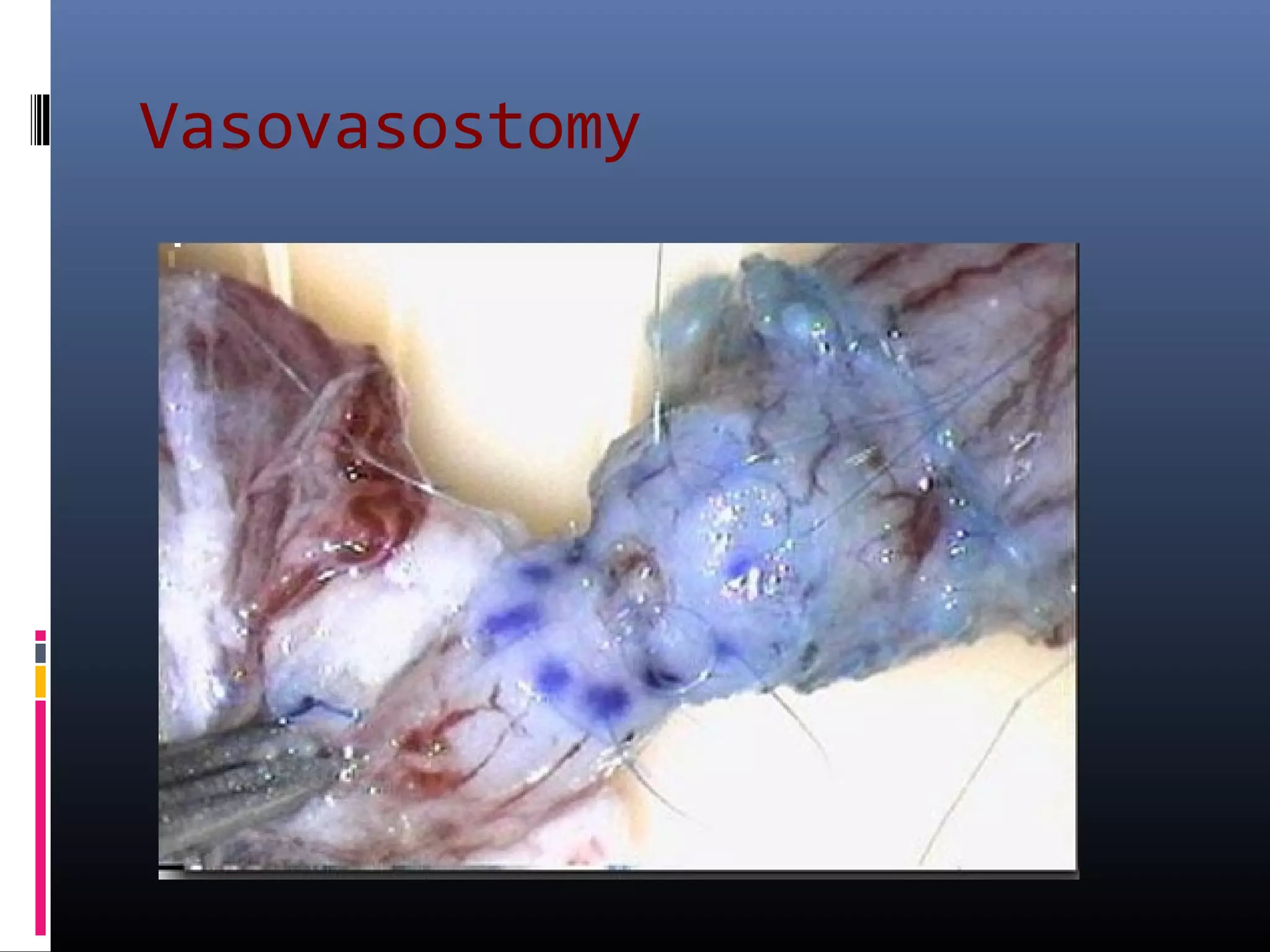
• Surgical Management:-Surgical Management:- Vasovasostomy, Epididymovasostomy,Vasovasostomy, Epididymovasostomy,
Repair of varicocele, Orchidopexy, Surgery forRepair of varicocele, Orchidopexy, Surgery for
HypospadiusHypospadius
• Artificial Insemination:-Artificial Insemination:- Intrauterine insemination (IUI)Intrauterine insemination (IUI)
• Assisted Reproductive Technology:-Assisted Reproductive Technology:- IVF & ET,IVF & ET,
Intracytoplasmic sperm injection (ICSI),Intracytoplasmic sperm injection (ICSI), PESA, MESA &PESA, MESA &
TESE –TESE – ICSI, GIFT, ZIFTICSI, GIFT, ZIFT
• Management of Male Sexual DysfunctionManagement of Male Sexual Dysfunction
Medical ManagementMedical Management
• Hormonal –Hormonal – HCG, HMG, GHCG, HMG, GnnRH, Testosterone, CC,RH, Testosterone, CC,
Thyroxine, BromocryptineThyroxine, Bromocryptine
• Antibiotics, Corticosteroids, Aromatase inhibitorAntibiotics, Corticosteroids, Aromatase inhibitor
• Sperm Vitalising Agents –Sperm Vitalising Agents – Pentoxifylline, KallikreinPentoxifylline, Kallikrein
• Emperical TherapyEmperical Therapy
• AntioxidantsAntioxidants – In increased ROS– In increased ROS
Oxidative stress status in an ejaculate.Oxidative stress status in an ejaculate.
Pro-and anti-oxidative molecules have antagonisticPro-and anti-oxidative molecules have antagonistic
functions in semenfunctions in semen
Vasectomy Reversal
Vasovasostomy
Repair of Vericocele
Verecocelectomy-Testis is
delivered to ligate
internal spermatic veins
INTRAUTERINE INSEMINATION
(I U I)
 Washed sperms are injected inside
the
uterine cavity in stimulated cycle with
proper monitoring of ovulation
Both fresh or frozen sperm can be used
Male:
 SEMINOPATHIES – OLIGOSPERMIA,
ASTHENOTERATOSPERMIA, LOW VOLUME SEMEN,
HIGH VISCOUS SEMEN
 ERECTILE FAILURE, EJACULATORY FAILURE,
PREMATURE EJACULATION, RETROGRADE
EJACULATION
Female:
 CERVICAL FACTOR ,OVULATORY
DYSFUNCTION,ENDOMETRIOSIS,VAGINISMUS
 UNEXPLAINED INFERTILITY
 IMMUNOLOGICAL INFFERTILITY
INDICATIONS OF I U I
STEPS OF INTRA-UTERINE
INSEMINATION
Ensure tubal patency Semen analysis & culture
Ovarian stimulation Sperm Collection
Monitoring of ovarian
Response & fixation of Sperm processing
Ovulation time
Insemination
& Luteal support
SWIM – UP TECHNIQUESWIM – UP TECHNIQUE
Semen processing media(Ham’s F-10)Semen processing media(Ham’s F-10)
&&
SEMEN SAMPLESEMEN SAMPLE
INCUBATE AT 370
C
30 MINUTE
Liquefied semen sample
Equal Quantity of MEDIA
Aspirate upper & middle
part
In another centrifuge tube
Centrifuge at 2000 RPM
FOR 1 MINUTE
Discard supermatant & Leave pellet
Centrifugation
at 2000 RPM
15 minute
Mix
well
Discard supernatant
& leave pellet
MEDIA
Pellet
Keep the tube
inclined at 300
In incubator at 370
c
For 45 minute
Layer 2 ml Media
Over Pellet
Add 0.5 ml. Semen processing media
& mix well
Sample ready for
IUI
SINGLE LAYER DENSITY GRADIENT CENTRIFUGATION TECHNIQUE
* DENSITY GRADIENT MEDIA
* SPERM WASHING * SEMEN SAMPLE
MEDIA (Han’s F10)
INCUBATE AT 370
C
30 MINUTE
Centrifugation
At 2000 RPM
LIQUEFIED SEMEN
D.G. Media
15 minute
Disard Supermatant Centrifugation at 2000 RPM Pellet with 2ml Add 2ml. Spermwashing
& Leave pellet 5 minute Spermwashing medium
Medium mix well with pellet Discard
supermatant
& leave pellet
Add 0.5 ml. Of
sperm washing
medium
Mix well with pellet
Pellet with
0.5 ml. Sperm washing medium
Keep at 370
c
10-15 minute
Sample ready for IUI
SWIM UP TECHNIQUE Vs LAYER
TECHNIOUE
 Simple
 Less expensive
 Not suitable for
abnormal semen
sample
 Time consuming
 Not so simple
 More expensive
 For seminopathy it is
better
 Less time is needed
RESULTS OF IUI
CLINICAL PREGNANCY – 10-25% IN AIH
20-40% IN AID
20-25% END IN MISCARRIAGE
Gamete Micromanipulation
 P Z D-Partial Zona dissection
 S U Z I-Subzonal dissection of sperm
 I C SI-Intracytoplasmic sperm
injection
Intracytoplasmic spermIntracytoplasmic sperm
injection (ICSI)injection (ICSI)
It involves the direct insertion of a single sperm cell intoIt involves the direct insertion of a single sperm cell into
the cytoplasm of a single oocyte by micropuncturethe cytoplasm of a single oocyte by micropuncture
 Indications –Indications –
Severe OATSevere OAT
ObstructiveObstructive azoospermiaazoospermia by MESA, PESA,TESAby MESA, PESA,TESA
````Nonobstructive azoospermiaNonobstructive azoospermia (NOA)(NOA) by TESEby TESE
Unexplained infertilityUnexplained infertility
Source of Sperms for ICSI
 EJACULATED SPERMS
 MESA: Microsurgical Epididymal sperm aspiration
 PESA: Percutaneous Epididymal sperm aspiration
 TESE: Testicular sperm extraction
 TESA: Testicular sperm aspiration
Distribution of sperms in
tubules of epididymis in obst.
azoospermia  Proximal part contains
maximum good sperms
 Distal part (identified by
yellow colour) contains
less and damaged
sperms
P E S A
M E S A
Testicular Fine Needle
Aspiration (TESA--TFNA)
PercBiopsy
MULTIPLE LARGETEST. BIOPSY
T E S E
Microsurgical
Conventional
ICSI Laboratory
ICSI IS GOING ON (IRM,
Kolkata)
RESULTS OF ICSIRESULTS OF ICSI
Fertilization rate -Fertilization rate - 60-70%60-70%
Pregnancy rate –Pregnancy rate – 20-40%20-40% /Embryo transfer/Embryo transfer
Male partner having abnormal karyotype inMale partner having abnormal karyotype in
Y-Chromosome micro deletion should undergoY-Chromosome micro deletion should undergo
genetic counselling before ICSIgenetic counselling before ICSI
TREATMENT OF OLIGOASTHENOTERATOZOOSPERMIATREATMENT OF OLIGOASTHENOTERATOZOOSPERMIA
(OAT)(OAT)
Infective
* Antibodies
Immunological
* Corticosteroid
* Condom
Endocrinal
* GnRH
* hCG
* hMG
* Testosterone
* CC
* Bromocryptine
* Thyroxin
Idiopathic
* CC
* Empirical
*Antioxidants
If FailsIf Fails
* IUI
*ART
TREATMENT OF AZOOSPERMIA
Azoospermia
Obstructive
* Surgery
* Epididymal sperm
Aspiration (MESA, PESA)
IVF-ET
GIFT
ZIFT
ICSI
* TESE – ICSI
* TDI
Non obstructive
* TESE – ICSI
* TDI
Endocrinal (Rare)
* GNRH
* HCG
* HMG
* CC
Treatment of
Erectile and Ejaculatory
DysfunctionErectile Dysfunction
* Withdrawal of drugs
* Treatment of underlying cause
* Psychosexual therapy
* Local injection ,Vacuum pump
* Transurethral pellet ,Penile implant
* Sildenafil(Viagra),Tadalafil,Vardenafil
Ejaculatory Dysfunction
* Psychosexual therapy
* Vibrator
* Electro-Ejaculation
Retrograde Ejaculation
* Coitus in full bladder
* Alphaadrenergic or cholinergic
drugs
* Insemination with post-voided urine
after processing
Premature Ejaculation
* Use of condom
* Pelvic Floor exercise
* Squeeze techniques
* IUI with ejaculated sperm
CONCLUSION
 Male factor is involved up to half of infertile couples
 Thorough evaluation is needed to detect the
abnormality.
 There are only few cases in practice where specific
drug therapy is indicated
 Though IUI is an effective procedure it has little role
in severe OAT.
 ICSI has revolutionized the management of male
infertility. But it is a very expensive procedure
CONCLUSION (Contd…)
 Sexual dysfunction should always be enquired and be dealt
with sympathy
 Vibrator and Viagra are two effective tools available in
ejaculatory and erectile failure
 More research is needed to know paracrine regulation of
spermatogenesis and to develop newer treatment to
improve sperm parameters in VIVO
 Irrespective of problems adoption of general measure is
important in achieving pregnancy
Male  infertility  dr rabi

Male infertility dr rabi

  • 1.
    DR. RABI NARAYANSATAPATHY ASST.PROFESSOR DEPT. OF OBST.& GYNAECOLOGY SCB MEDICAL COLLEGE, CUTTACK MOB-09861281510 EMAIL-drrabisatpathy@gmail.com
  • 2.
    Relative Prevalence OfThe Etiologies Of Infertility 10% 10% 40-50% 25-40% Both male & female factor Female factor Male factor Unexplained infertility Incidence of Male Infertility is increasing ! !Incidence of Male Infertility is increasing ! !
  • 3.
    PRESENTATION OF MALEINFERTILITYPRESENTATION OF MALE INFERTILITY ABNORMAL SEMEN PROFILEABNORMAL SEMEN PROFILE MALE SEXUAL DYSFUNCTIONMALE SEXUAL DYSFUNCTION  AZOOSPERMIAAZOOSPERMIA  ERECTILE DYSFUNCTIONERECTILE DYSFUNCTION  OLIGOSPERMIAOLIGOSPERMIA  EJACUALATORY DYSFUNCTIONEJACUALATORY DYSFUNCTION  ASTHENOSPERMIAASTHENOSPERMIA  RETROGRADE EJACULATIONRETROGRADE EJACULATION  TERATOZOOSPERMIATERATOZOOSPERMIA  PREMATURE EJACULATIONPREMATURE EJACULATION  HIGH LEUCOCYTE COUNTHIGH LEUCOCYTE COUNT LOCAL ANATOMICAL DEFECTLOCAL ANATOMICAL DEFECT  COMBINATIONCOMBINATION
  • 4.
    PretesticularPretesticular TesticularTesticular PosttesticularPosttesticular EndocrineEndocrine HypogonadotropichypogonadismHypogonadotropic hypogonadism Hypothyroidism,Hypothyroidism, HyperprolatinaemiaHyperprolatinaemia DiabetesDiabetes Coital disordersCoital disorders Erectile dysfunctionErectile dysfunction Ejaculatory failureEjaculatory failure GeneticGenetic Klinefelter’s SyndromeKlinefelter’s Syndrome Y chromosome deletionY chromosome deletion Immotile cilia syndromeImmotile cilia syndrome CongenitalCongenital CryptorchidismCryptorchidism Infective (orchitis)Infective (orchitis) Antispermatogenic agentsAntispermatogenic agents Heat, Chemotherapy, Drugs,Heat, Chemotherapy, Drugs, IrradiationIrradiation VascularVascular TorsionTorsion VaricoceleVaricocele ImmunologicalImmunological IdiopathicIdiopathic ObstructiveObstructive EpididymalEpididymal CongenitalCongenital InfectiveInfective VasalVasal Genetic: Cystic fibrosisGenetic: Cystic fibrosis Aquired: VasectomyAquired: Vasectomy Ejaculatory duct obstructionEjaculatory duct obstruction Epididymal hostilityEpididymal hostility Epididymal asthenospermiaEpididymal asthenospermia Accessory glandAccessory gland infectioninfection ImmunologicalImmunological IdiopathicIdiopathic Post vasectomyPost vasectomy ETIOLOGICAL FACTORS IN MALE INFERTILITYETIOLOGICAL FACTORS IN MALE INFERTILITY
  • 5.
    CAUSECAUSE PERCENTAGEPERCENTAGE No demonstrablecauseNo demonstrable cause Idiopathic abnormal semenIdiopathic abnormal semen VaricoceleVaricocele Infectious factorsInfectious factors Immunologic factorImmunologic factor Other acquired factorsOther acquired factors Congenital factorsCongenital factors Sexual factorsSexual factors Endocrine disturbancesEndocrine disturbances 48.5%48.5% 26.4%26.4% 12.3%12.3% 6.6%6.6% 3.1%3.1% 2.6%2.6% 2.1%2.1% 1.7%1.7% 0.6%0.6% Frequency of Etiologies in Male Factor InfertilityFrequency of Etiologies in Male Factor Infertility WHO Study 1994, Eshre Capri Workshop Group (7057 men)WHO Study 1994, Eshre Capri Workshop Group (7057 men)
  • 6.
    EVALUATION OF MALEEVALUATIONOF MALE INFERTILITYINFERTILITY  HistoryHistory  Physical examinationPhysical examination  Semen analysisSemen analysis  Additional proceduresAdditional procedures - Sperm function tests- Sperm function tests - Immunological tests- Immunological tests - Semen culture- Semen culture - Hormone assays- Hormone assays -Testicular biopsy-Testicular biopsy - Chromosomal analysis- Chromosomal analysis -Vasography-Vasography - Scrotal ultrasound- Scrotal ultrasound -Transrectal ultrasound (TRU)-Transrectal ultrasound (TRU) - DNA integrity tests- DNA integrity tests
  • 7.
    HISTORYHISTORY  Age andduration of marriageAge and duration of marriage  Occupation –hyperthermia, pesticides, bicycling, stressOccupation –hyperthermia, pesticides, bicycling, stress  H/O childhood problems – Cryptorchidism – surgeryH/O childhood problems – Cryptorchidism – surgery Delayed pubertyDelayed puberty  Medical History – Mumps, syphilis, leprosy, tuberculosisMedical History – Mumps, syphilis, leprosy, tuberculosis Chronic respiratory diseases –Chronic respiratory diseases – Young’s syndrome – epididymal obstructionYoung’s syndrome – epididymal obstruction Immotile cilia syndrome – Sperms are immotileImmotile cilia syndrome – Sperms are immotile Cystic fibrosis – Congenital absence of VASCystic fibrosis – Congenital absence of VAS Endocrine disorder, diabetes, hypothyroidism,Endocrine disorder, diabetes, hypothyroidism, Renal failure, Liver disease, hypertension, multiple sclerosisRenal failure, Liver disease, hypertension, multiple sclerosis
  • 8.
    HISTORY (Contd…)HISTORY (Contd…) Surgical & Traumatic History – Damage of VAS –Surgical & Traumatic History – Damage of VAS – Hernia,Hernia, Orchidopexy, Vasectomy, Trauma, Torsion, Spinal cordOrchidopexy, Vasectomy, Trauma, Torsion, Spinal cord injuryinjury  Sexual history – Timing, frequency ,conception windowSexual history – Timing, frequency ,conception window H/O–Erectile & Ejaculatory problem -H/O–Erectile & Ejaculatory problem - Nocturnal penile trumescence (NPT)Nocturnal penile trumescence (NPT)  Family history –Family history –  History of smoking, alcohol, radiation, heavy metals,History of smoking, alcohol, radiation, heavy metals, estrogen exposureestrogen exposure  Drugs – Antipsychotic, Antihypertensives, CimetidineDrugs – Antipsychotic, Antihypertensives, Cimetidine Anticonvulsants, Sex steroids, EnvironmentalAnticonvulsants, Sex steroids, Environmental
  • 9.
    PHYSICAL EXAMINATIONPHYSICAL EXAMINATION General – Obesity, Secondary sexual character , gynaecomastia, BodyGeneral – Obesity, Secondary sexual character , gynaecomastia, Body habitus, Thyroid gland, Galactorrhoea, Visual field defect, Features ofhabitus, Thyroid gland, Galactorrhoea, Visual field defect, Features of endocrinopathyendocrinopathy  Per abdomen – Scar of hernia, lymph nodePer abdomen – Scar of hernia, lymph node  Local examinationLocal examination * Scrotum- hernia, hydrocele, varicocele* Scrotum- hernia, hydrocele, varicocele * Testes – Present or absent* Testes – Present or absent Size (18-20ml)Size (18-20ml) SensationSensation * Penis – Hypospadius, phimosis* Penis – Hypospadius, phimosis * Epididymis & VAS – Presence, feel, presence of cyst* Epididymis & VAS – Presence, feel, presence of cyst * Rectal examination* Rectal examination
  • 11.
  • 15.
    SEMEN ANALYSIS (WHO1999)SEMEN ANALYSIS (WHO 1999) VolumeVolume > 2ml> 2ml pHpH 7.2-7.87.2-7.8 Sperm concentrationSperm concentration ≥≥20milion/ml20milion/ml Total sperm countTotal sperm count ≥≥40milion40milion MotilityMotility ≥≥50% with normal50% with normal morphologymorphology MorphologyMorphology ≥≥30% normal forms30% normal forms WBCWBC < 1 X 10< 1 X 1066 / ml/ ml MAR testMAR test < 10% spermatozoa with< 10% spermatozoa with adherent particleadherent particle
  • 16.
    SEMEN ANALYSISSEMEN ANALYSIS ENDTZtest can distinguish between leukocytes &ENDTZ test can distinguish between leukocytes & immature germ cells (both round cells)immature germ cells (both round cells) Sperm vitality test:Sperm vitality test: * Eosin Nigration test* Eosin Nigration test ** Hypoosmotic swelling testHypoosmotic swelling test * H33258 Flurochrome test* H33258 Flurochrome test Fructose estimation-Absent in Ejaculatory duct obstructionFructose estimation-Absent in Ejaculatory duct obstruction Split Ejaculate-Split Ejaculate-
  • 17.
    Limitations of WHOcriteria  Significant overlapping of sperm characteristics between fertile and infertile men  Sperm motility and concentration are more important than sperm morphology  Change of cut off values and introduction of new parameters are needed to differentiate between fertile and infertile men Kiran P et al;Fertil Steril, vol 85,No 3,March 2006:629-34
  • 18.
  • 19.
    SPERM FUNCTION TESTSPERMFUNCTION TEST  Sperm cervical mucus interactionsSperm cervical mucus interactions a. In Vivo –a. In Vivo – Post Coital TestPost Coital Test (Sim’s Hunner test)(Sim’s Hunner test) b. In Vitro –b. In Vitro – I. Sperm cervical mucus contact test (SCMC test)I. Sperm cervical mucus contact test (SCMC test) II. Tube test (Kremar test)II. Tube test (Kremar test)  Hemizona test (Human zona binding assay)Hemizona test (Human zona binding assay)  Hypoosmotic swelling testHypoosmotic swelling test  Swim up testSwim up test  Computerised assisted seminal analysis (CASA)Computerised assisted seminal analysis (CASA)  Evidence of acrosomal reactionEvidence of acrosomal reaction
  • 20.
    IMMUNOLOGICAL TESTSIMMUNOLOGICAL TESTS Indications– • Abnormal semen profile • Abnormal cervical mucus sperm interaction • Failed Vasectomy reversal • Marked Agglutination (more than 10%) Two Tests – a. Immunobead testa. Immunobead test b. MAR testb. MAR test c. Others – TAT test, Kibrick’s test, Frankling Duke test, Isojama’s test (Not done now a days)
  • 21.
    MIXED AGGLUTINATION REACTION (MAR)TEST  Screening test for detection of antisperm antibodies on the surface of sperm head or tail.  Washed sperms from the patient are mixed with antibody coated RBC, (Sheep RBC + rabbit antibody)  These antibody will form mixed agglutinates with motile sperms carrying immunoglobulins  MAR test is positive when particulate binding is found in over 10% spermatozoa.
  • 22.
    HORMONE ASSAYSHORMONE ASSAYS Indication-Indication-when Sperm count is less than 10when Sperm count is less than 10 million/mlmillion/ml  FSHFSH  LHLH  TestosteroneTestosterone  EstradiolEstradiol  ProlactinProlactin  TSHTSH
  • 23.
    HORMONAL CONTROL OFSPERMATOGENESISHORMONAL CONTROL OF SPERMATOGENESIS HypothalamusHypothalamus GGnnRHRH Anterior PituitaryAnterior Pituitary FSHFSH LHLH Sertoli cellSertoli cell Leydig cellLeydig cell InhibinInhibin ABGABG TT ABG+TABG+T - Ve- Ve - Ve- Ve - Ve- Ve SpermatogenesisSpermatogenesis andand spermsperm maturationmaturation
  • 24.
    Hormones in differentclinicalHormones in different clinical conditionsconditions FINDINGSFINDINGS DIAGNOSISDIAGNOSIS 1.1. Azoospermia or OligospermiaAzoospermia or Oligospermia Small testesSmall testes FSH - HighFSH - High Primary testicular failurePrimary testicular failure (Severe tubular damage)(Severe tubular damage) 2. Azoospermia2. Azoospermia Normal testicular volumeNormal testicular volume FSH – Normal levelFSH – Normal level i. Bilateral genital tract obstructioni. Bilateral genital tract obstruction ii.Sertoli cell only syndromeii.Sertoli cell only syndrome 3. FSH – Lower or undetectable3. FSH – Lower or undetectable LH – LowLH – Low Testosterone – LowTestosterone – Low Other evidences of androgen def.Other evidences of androgen def. HypogonadismHypogonadism 4. LH – High4. LH – High Testosterone – HighTestosterone – High Androgen receptor defectAndrogen receptor defect
  • 25.
    TESTICULAR BIOPSYTESTICULAR BIOPSY Obstructive AzoospermiaObstructive Azoospermia  Non Obstructive Azoospermia – To detect isolatedNon Obstructive Azoospermia – To detect isolated areas containing sperm cells for TESE – ICSIareas containing sperm cells for TESE – ICSI Grading – Johonson’s Scoring System ( 1 – 10)Grading – Johonson’s Scoring System ( 1 – 10) 2 – Sertoli cell only2 – Sertoli cell only 3 – Spermatogonia3 – Spermatogonia 4,5 – Spermatocytes4,5 – Spermatocytes 6,7 – Spermatids6,7 – Spermatids 8,9,10 – Spermatozoa8,9,10 – Spermatozoa
  • 26.
  • 27.
  • 30.
    GENETIC ANALYSISGENETIC ANALYSIS IndicationsIndications Azoospermia, Severe Oligozoospermia,Azoospermia, Severe Oligozoospermia, VarietiesVarieties  Klinefelter’s Syndrome (47XXY), Sex ReversalKlinefelter’s Syndrome (47XXY), Sex Reversal Syndrome (46 – XX male)Syndrome (46 – XX male)  Deletion of a part of Long arm of Y containingDeletion of a part of Long arm of Y containing azoospermic factor (AZF) means Azoospermiaazoospermic factor (AZF) means Azoospermia  Mutation of specific gene like mutation of CFTR geneMutation of specific gene like mutation of CFTR gene in cystic fibrosisin cystic fibrosis
  • 32.
    Y Chromosome inAzoospermic men  Solid bars indicate presence of genetic material  Dashed regions indicate missing of genetic material in NOA men  Y-chromosome deletion in AZFb region indicates absence of sperms in sperm retrieval procedure
  • 33.
    Sex Chromosome AbnormalitiesLeadingSex Chromosome Abnormalities Leading to Male Infertilityto Male Infertility Syndrome Karyotpe abnormalities Phenotype Klinefelter’s syndrome 46, XY/47, XXY mosaic, 47, XXY – 49, XXXY Male with increased height, small firm testes possibly female hair distribution Mixed gonadal dysgensis 45, X/ 46, XY mosaic, possibly normal 46, XY Male, female, or ambiguous genitalia, testis are streak XX male syndrome 46, XX SRY translocation to the short arm of X Male with Sertoli-cell- only on testis biopsy XYY male 47, XYY Male, possibly increased height
  • 34.
    TREATMENT MODALITIES OFMALETREATMENT MODALITIES OF MALE INFERTILITYINFERTILITY • General MeasuresGeneral Measures • Medical ManagementMedical Management • Surgical Management:-Surgical Management:- Vasovasostomy, Epididymovasostomy,Vasovasostomy, Epididymovasostomy, Repair of varicocele, Orchidopexy, Surgery forRepair of varicocele, Orchidopexy, Surgery for HypospadiusHypospadius • Artificial Insemination:-Artificial Insemination:- Intrauterine insemination (IUI)Intrauterine insemination (IUI) • Assisted Reproductive Technology:-Assisted Reproductive Technology:- IVF & ET,IVF & ET, Intracytoplasmic sperm injection (ICSI),Intracytoplasmic sperm injection (ICSI), PESA, MESA &PESA, MESA & TESE –TESE – ICSI, GIFT, ZIFTICSI, GIFT, ZIFT • Management of Male Sexual DysfunctionManagement of Male Sexual Dysfunction
  • 35.
    Medical ManagementMedical Management •Hormonal –Hormonal – HCG, HMG, GHCG, HMG, GnnRH, Testosterone, CC,RH, Testosterone, CC, Thyroxine, BromocryptineThyroxine, Bromocryptine • Antibiotics, Corticosteroids, Aromatase inhibitorAntibiotics, Corticosteroids, Aromatase inhibitor • Sperm Vitalising Agents –Sperm Vitalising Agents – Pentoxifylline, KallikreinPentoxifylline, Kallikrein • Emperical TherapyEmperical Therapy • AntioxidantsAntioxidants – In increased ROS– In increased ROS
  • 36.
    Oxidative stress statusin an ejaculate.Oxidative stress status in an ejaculate. Pro-and anti-oxidative molecules have antagonisticPro-and anti-oxidative molecules have antagonistic functions in semenfunctions in semen
  • 37.
  • 38.
  • 41.
  • 42.
    Verecocelectomy-Testis is delivered toligate internal spermatic veins
  • 43.
    INTRAUTERINE INSEMINATION (I UI)  Washed sperms are injected inside the uterine cavity in stimulated cycle with proper monitoring of ovulation Both fresh or frozen sperm can be used
  • 44.
    Male:  SEMINOPATHIES –OLIGOSPERMIA, ASTHENOTERATOSPERMIA, LOW VOLUME SEMEN, HIGH VISCOUS SEMEN  ERECTILE FAILURE, EJACULATORY FAILURE, PREMATURE EJACULATION, RETROGRADE EJACULATION Female:  CERVICAL FACTOR ,OVULATORY DYSFUNCTION,ENDOMETRIOSIS,VAGINISMUS  UNEXPLAINED INFERTILITY  IMMUNOLOGICAL INFFERTILITY INDICATIONS OF I U I
  • 45.
    STEPS OF INTRA-UTERINE INSEMINATION Ensuretubal patency Semen analysis & culture Ovarian stimulation Sperm Collection Monitoring of ovarian Response & fixation of Sperm processing Ovulation time Insemination & Luteal support
  • 46.
    SWIM – UPTECHNIQUESWIM – UP TECHNIQUE Semen processing media(Ham’s F-10)Semen processing media(Ham’s F-10) && SEMEN SAMPLESEMEN SAMPLE INCUBATE AT 370 C 30 MINUTE Liquefied semen sample Equal Quantity of MEDIA Aspirate upper & middle part In another centrifuge tube Centrifuge at 2000 RPM FOR 1 MINUTE Discard supermatant & Leave pellet Centrifugation at 2000 RPM 15 minute Mix well Discard supernatant & leave pellet MEDIA Pellet Keep the tube inclined at 300 In incubator at 370 c For 45 minute Layer 2 ml Media Over Pellet Add 0.5 ml. Semen processing media & mix well Sample ready for IUI
  • 47.
    SINGLE LAYER DENSITYGRADIENT CENTRIFUGATION TECHNIQUE * DENSITY GRADIENT MEDIA * SPERM WASHING * SEMEN SAMPLE MEDIA (Han’s F10) INCUBATE AT 370 C 30 MINUTE Centrifugation At 2000 RPM LIQUEFIED SEMEN D.G. Media 15 minute Disard Supermatant Centrifugation at 2000 RPM Pellet with 2ml Add 2ml. Spermwashing & Leave pellet 5 minute Spermwashing medium Medium mix well with pellet Discard supermatant & leave pellet Add 0.5 ml. Of sperm washing medium Mix well with pellet Pellet with 0.5 ml. Sperm washing medium Keep at 370 c 10-15 minute Sample ready for IUI
  • 48.
    SWIM UP TECHNIQUEVs LAYER TECHNIOUE  Simple  Less expensive  Not suitable for abnormal semen sample  Time consuming  Not so simple  More expensive  For seminopathy it is better  Less time is needed
  • 49.
    RESULTS OF IUI CLINICALPREGNANCY – 10-25% IN AIH 20-40% IN AID 20-25% END IN MISCARRIAGE
  • 50.
    Gamete Micromanipulation  PZ D-Partial Zona dissection  S U Z I-Subzonal dissection of sperm  I C SI-Intracytoplasmic sperm injection
  • 51.
    Intracytoplasmic spermIntracytoplasmic sperm injection(ICSI)injection (ICSI) It involves the direct insertion of a single sperm cell intoIt involves the direct insertion of a single sperm cell into the cytoplasm of a single oocyte by micropuncturethe cytoplasm of a single oocyte by micropuncture  Indications –Indications – Severe OATSevere OAT ObstructiveObstructive azoospermiaazoospermia by MESA, PESA,TESAby MESA, PESA,TESA ````Nonobstructive azoospermiaNonobstructive azoospermia (NOA)(NOA) by TESEby TESE Unexplained infertilityUnexplained infertility
  • 52.
    Source of Spermsfor ICSI  EJACULATED SPERMS  MESA: Microsurgical Epididymal sperm aspiration  PESA: Percutaneous Epididymal sperm aspiration  TESE: Testicular sperm extraction  TESA: Testicular sperm aspiration
  • 54.
    Distribution of spermsin tubules of epididymis in obst. azoospermia  Proximal part contains maximum good sperms  Distal part (identified by yellow colour) contains less and damaged sperms
  • 55.
  • 56.
  • 57.
  • 58.
  • 59.
    MULTIPLE LARGETEST. BIOPSY TE S E Microsurgical Conventional
  • 62.
  • 63.
    ICSI IS GOINGON (IRM, Kolkata)
  • 68.
    RESULTS OF ICSIRESULTSOF ICSI Fertilization rate -Fertilization rate - 60-70%60-70% Pregnancy rate –Pregnancy rate – 20-40%20-40% /Embryo transfer/Embryo transfer Male partner having abnormal karyotype inMale partner having abnormal karyotype in Y-Chromosome micro deletion should undergoY-Chromosome micro deletion should undergo genetic counselling before ICSIgenetic counselling before ICSI
  • 69.
    TREATMENT OF OLIGOASTHENOTERATOZOOSPERMIATREATMENTOF OLIGOASTHENOTERATOZOOSPERMIA (OAT)(OAT) Infective * Antibodies Immunological * Corticosteroid * Condom Endocrinal * GnRH * hCG * hMG * Testosterone * CC * Bromocryptine * Thyroxin Idiopathic * CC * Empirical *Antioxidants If FailsIf Fails * IUI *ART
  • 70.
    TREATMENT OF AZOOSPERMIA Azoospermia Obstructive *Surgery * Epididymal sperm Aspiration (MESA, PESA) IVF-ET GIFT ZIFT ICSI * TESE – ICSI * TDI Non obstructive * TESE – ICSI * TDI Endocrinal (Rare) * GNRH * HCG * HMG * CC
  • 71.
    Treatment of Erectile andEjaculatory DysfunctionErectile Dysfunction * Withdrawal of drugs * Treatment of underlying cause * Psychosexual therapy * Local injection ,Vacuum pump * Transurethral pellet ,Penile implant * Sildenafil(Viagra),Tadalafil,Vardenafil Ejaculatory Dysfunction * Psychosexual therapy * Vibrator * Electro-Ejaculation Retrograde Ejaculation * Coitus in full bladder * Alphaadrenergic or cholinergic drugs * Insemination with post-voided urine after processing Premature Ejaculation * Use of condom * Pelvic Floor exercise * Squeeze techniques * IUI with ejaculated sperm
  • 72.
    CONCLUSION  Male factoris involved up to half of infertile couples  Thorough evaluation is needed to detect the abnormality.  There are only few cases in practice where specific drug therapy is indicated  Though IUI is an effective procedure it has little role in severe OAT.  ICSI has revolutionized the management of male infertility. But it is a very expensive procedure
  • 73.
    CONCLUSION (Contd…)  Sexualdysfunction should always be enquired and be dealt with sympathy  Vibrator and Viagra are two effective tools available in ejaculatory and erectile failure  More research is needed to know paracrine regulation of spermatogenesis and to develop newer treatment to improve sperm parameters in VIVO  Irrespective of problems adoption of general measure is important in achieving pregnancy