Yousaf khan
Lecturer Renal Dialysis
IPMS- KMU
• The pharmacological effect of a drug depend on its
concentration at the site of action, which in turn is
determined by the dose of the drug administered. Such a
relationship is called dose- response relationship.
Graded dose response:
• As the concentration of a drug increases, its
pharmacologic effect also gradually increases until all the
receptors are occupied (the maximum effect)
Quantal dose response curve:
• Certain pharmacological effects which can not be
quantified but can only be said to be present or absent
(all or none).
• The relationship between the doses of a drug required to
produce desired and undesired effect.
• Therapeutic index = LD50/ ED50
• LD50: It is the dose of a drug, which is lethal for 50% of
the population.
• ED50: It is the dose of drug, which produce the desired
effect in 50% of the population.
• Drug potency: The amount of a drug required to produce a
desired response, the lower the dose required for a given
response,
• The dose or concentration of a drug required to produce a
given effect or the activity per unit weight of drug is called
potency.
• Drug efficacy: it is the maximum effect of drug, it depend on
the number of drug receptor complex formed and the
efficiency with which the activated receptor produce a cellular
function
• Therapeutic window: it is the range of concentration of the
drug which produce desired response with minimal toxicity.
Increased response:
• Summation or additive effect: The combined effect of two or
more drugs is equal to the sum of their individual effect.
• Effect of drugs A+B = effect of drug A + effect of drug B
• Synergism: when combined the net effect is greater than the
sum of their individual effect
• Potentiation: when one drugs has no apparent action by itself
on one system but increase the effect of another drug is
termed potentiation.
Decreased response ( drug antagonism): the effect of one drug is
decrease or abolished in the presence of another drug.
• Physical antagonism: the opposing action of two drugs is due to
their physical property, e.g adsorption of alkaloids by activated
charcoal – useful in alkaloid poisoning.
• Chemical antagonism: the opposing action of two drugs is due to
their chemical property e.gantacids are weak bases, they neutralize
gastric acid and useful in peptic ulcer
• Physiological antagonism: two drug act at different receptor or by
different mechanism on the same physiological system and produce
opposite effect e.g adrenaline and histamine on bronchial smooth
muscle
• Histamine – bronchoconstriction and adrenalin -- bronchodialtion
• Receptor antagonism: the antagonist binds to the same
receptor as the agonist and inhibits its effects. It can be
competitive or non- competitive.
• Competitive antagonism: (equilibrium type) both agonist and
the antagonist bind reversibly to the same site on the receptor
e.g
• Acetylcholine → muscarinic receptor ← atropine
• Non – competitive antagonism: the antagonist bind to a
different site on the receptor and prevent the agonist from
interacting wit the receptor, in this type antagonistic effect can
not be overcome by increasing the concentration of the
agonist.
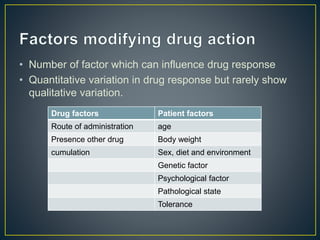
• Number of factor which can influence drug response
• Quantitative variation in drug response but rarely show
qualitative variation.
Drug factors Patient factors
Route of administration age
Presence other drug Body weight
cumulation Sex, diet and environment
Genetic factor
Psychological factor
Pathological state
Tolerance
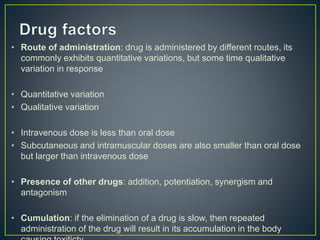
• Route of administration: drug is administered by different routes, its
commonly exhibits quantitative variations, but some time qualitative
variation in response
• Quantitative variation
• Qualitative variation
• Intravenous dose is less than oral dose
• Subcutaneous and intramuscular doses are also smaller than oral dose
but larger than intravenous dose
• Presence of other drugs: addition, potentiation, synergism and
antagonism
• Cumulation: if the elimination of a drug is slow, then repeated
administration of the drug will result in its accumulation in the body
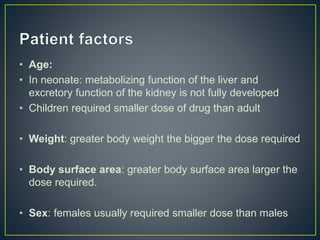
• Age:
• In neonate: metabolizing function of the liver and
excretory function of the kidney is not fully developed
• Children required smaller dose of drug than adult
• Weight: greater body weight the bigger the dose required
• Body surface area: greater body surface area larger the
dose required.
• Sex: females usually required smaller dose than males
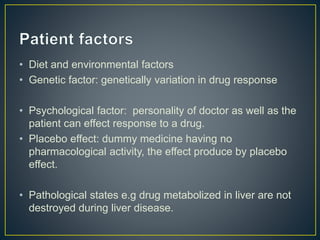
• Diet and environmental factors
• Genetic factor: genetically variation in drug response
• Psychological factor: personality of doctor as well as the
patient can effect response to a drug.
• Placebo effect: dummy medicine having no
pharmacological activity, the effect produce by placebo
effect.
• Pathological states e.g drug metabolized in liver are not
destroyed during liver disease.
• Tolerance: need for larger doses of a drug to produce a
given response.
• Natural tolerance : genetically determined reduce/ lack of
response to a drug
• Acquired tolerance: it develops on repeated exposure to
a drug.
• when two or more drug are given simultaneously the
effect of one drug may be altered by another drug.
• Drug interaction can be occur in vitro or in vivo
• Result in either beneficial or harmful effects
• Can occur as a result of incompatibilty ( physical and
chemical) of a drug with an intravenous solution
• When two or more drugs are mixed in the same syringe
i.v infusion
• This may result in precipitation or inactivation of one or
more drugs
• These occur when one drug alters the absorption,
distribution, metabolism or excretion of another drug.
• Absorption: antacids, iron etc interfere with the
absorption of tetracycline by forming unabsorbable
complexes with it
• Some drug affect absorption of other drugs by altering
gastrointestinal motility.
• Distribution: plasma protein binding can cause
displacement interaction, more than one drug can bind to
the same site on plasma protein. E.g salicylate displace
warfarin
• Metabolism: this occur when metabolism of one drug is
increased or decrease by other drug,
• Excretion: most of them occur in kidney e.g salicylates
interfere with the excretion of methotrexate and
potentiate its toxicity.
• The interaction is due to action of drugs on receptor or
physiological system. This may result either additive,
synergistic or antagonistic effect.
• The interaction may result harmful effect
Thank you dear

Dose response relationship

  • 1.
    Yousaf khan Lecturer RenalDialysis IPMS- KMU
  • 2.
    • The pharmacologicaleffect of a drug depend on its concentration at the site of action, which in turn is determined by the dose of the drug administered. Such a relationship is called dose- response relationship.
  • 3.
    Graded dose response: •As the concentration of a drug increases, its pharmacologic effect also gradually increases until all the receptors are occupied (the maximum effect) Quantal dose response curve: • Certain pharmacological effects which can not be quantified but can only be said to be present or absent (all or none).
  • 4.
    • The relationshipbetween the doses of a drug required to produce desired and undesired effect. • Therapeutic index = LD50/ ED50 • LD50: It is the dose of a drug, which is lethal for 50% of the population. • ED50: It is the dose of drug, which produce the desired effect in 50% of the population.
  • 5.
    • Drug potency:The amount of a drug required to produce a desired response, the lower the dose required for a given response, • The dose or concentration of a drug required to produce a given effect or the activity per unit weight of drug is called potency. • Drug efficacy: it is the maximum effect of drug, it depend on the number of drug receptor complex formed and the efficiency with which the activated receptor produce a cellular function • Therapeutic window: it is the range of concentration of the drug which produce desired response with minimal toxicity.
  • 6.
    Increased response: • Summationor additive effect: The combined effect of two or more drugs is equal to the sum of their individual effect. • Effect of drugs A+B = effect of drug A + effect of drug B • Synergism: when combined the net effect is greater than the sum of their individual effect • Potentiation: when one drugs has no apparent action by itself on one system but increase the effect of another drug is termed potentiation.
  • 7.
    Decreased response (drug antagonism): the effect of one drug is decrease or abolished in the presence of another drug. • Physical antagonism: the opposing action of two drugs is due to their physical property, e.g adsorption of alkaloids by activated charcoal – useful in alkaloid poisoning. • Chemical antagonism: the opposing action of two drugs is due to their chemical property e.gantacids are weak bases, they neutralize gastric acid and useful in peptic ulcer • Physiological antagonism: two drug act at different receptor or by different mechanism on the same physiological system and produce opposite effect e.g adrenaline and histamine on bronchial smooth muscle • Histamine – bronchoconstriction and adrenalin -- bronchodialtion
  • 8.
    • Receptor antagonism:the antagonist binds to the same receptor as the agonist and inhibits its effects. It can be competitive or non- competitive. • Competitive antagonism: (equilibrium type) both agonist and the antagonist bind reversibly to the same site on the receptor e.g • Acetylcholine → muscarinic receptor ← atropine • Non – competitive antagonism: the antagonist bind to a different site on the receptor and prevent the agonist from interacting wit the receptor, in this type antagonistic effect can not be overcome by increasing the concentration of the agonist.
  • 9.
    • Number offactor which can influence drug response • Quantitative variation in drug response but rarely show qualitative variation. Drug factors Patient factors Route of administration age Presence other drug Body weight cumulation Sex, diet and environment Genetic factor Psychological factor Pathological state Tolerance
  • 10.
    • Route ofadministration: drug is administered by different routes, its commonly exhibits quantitative variations, but some time qualitative variation in response • Quantitative variation • Qualitative variation • Intravenous dose is less than oral dose • Subcutaneous and intramuscular doses are also smaller than oral dose but larger than intravenous dose • Presence of other drugs: addition, potentiation, synergism and antagonism • Cumulation: if the elimination of a drug is slow, then repeated administration of the drug will result in its accumulation in the body
  • 11.
    • Age: • Inneonate: metabolizing function of the liver and excretory function of the kidney is not fully developed • Children required smaller dose of drug than adult • Weight: greater body weight the bigger the dose required • Body surface area: greater body surface area larger the dose required. • Sex: females usually required smaller dose than males
  • 12.
    • Diet andenvironmental factors • Genetic factor: genetically variation in drug response • Psychological factor: personality of doctor as well as the patient can effect response to a drug. • Placebo effect: dummy medicine having no pharmacological activity, the effect produce by placebo effect. • Pathological states e.g drug metabolized in liver are not destroyed during liver disease.
  • 13.
    • Tolerance: needfor larger doses of a drug to produce a given response. • Natural tolerance : genetically determined reduce/ lack of response to a drug • Acquired tolerance: it develops on repeated exposure to a drug.
  • 14.
    • when twoor more drug are given simultaneously the effect of one drug may be altered by another drug. • Drug interaction can be occur in vitro or in vivo • Result in either beneficial or harmful effects
  • 15.
    • Can occuras a result of incompatibilty ( physical and chemical) of a drug with an intravenous solution • When two or more drugs are mixed in the same syringe i.v infusion • This may result in precipitation or inactivation of one or more drugs
  • 16.
    • These occurwhen one drug alters the absorption, distribution, metabolism or excretion of another drug. • Absorption: antacids, iron etc interfere with the absorption of tetracycline by forming unabsorbable complexes with it • Some drug affect absorption of other drugs by altering gastrointestinal motility. • Distribution: plasma protein binding can cause displacement interaction, more than one drug can bind to the same site on plasma protein. E.g salicylate displace warfarin
  • 17.
    • Metabolism: thisoccur when metabolism of one drug is increased or decrease by other drug, • Excretion: most of them occur in kidney e.g salicylates interfere with the excretion of methotrexate and potentiate its toxicity.
  • 18.
    • The interactionis due to action of drugs on receptor or physiological system. This may result either additive, synergistic or antagonistic effect. • The interaction may result harmful effect
  • 19.