COMPLICATION OF PERITONEAL
DIALYSIS CATHETER
Yousaf khan
Lecturer Renal Dialysis
IPMS- KMU
MALFUNCTIONING CATHETERS
 Well functioning PD catheter – dialysate exchange (1.5 -3L) to be run
in over 5 -10 minute and drained out over 15-20 min under the force
of gravity alone.
The disadvantage of a slower dialysate flow rate are
 Inconvenience for patient – CAPD exchange take too long or the
APD machine will alarm ( interrupting sleep)
 Decrease efficiency of PD as exchange dwell time will be decreased
Poorly functioning catheters
 Poor drainage (out flow failure) – problem with inflow.
 Pts perform their exchange without full drainage of fluid abdominal
distension, fluid leak, and hernias secondary to increase intra
abdominal pressure can occur.
MALFUNCTIONING CATHETERS
Early non- functioning
 Occur from the time of catheter insertion
 About 30 -50% of new catheter will have some problem with
drainage and about 10% will need replacing for complete non
function
 Rarely PD catheter may fail to function at all in an individual even
after several attempts.
Late non- functioning
 Can also occur in pts on maintenance PD, but this is much less
common.
Cause Mechanisms Early
or
late
Inflow or drainage
problem
Constipation Stagnant loops of bowel loaded
with faces preventing free flow of
fluid
Catheter adhere to bowel wall
Both Predominantly
drainage, but on
occasion poor
inflow
Intra abdominal
adhesion form
previous surgery
Loculated area of intraperitoneal
fluid catheter tip trapped so only
small volume of fluid can be infused
early both
Intra abdominal
adhesions from
peritonitis
Loculated area of intraperitoneal
fluid catheter tip trapped so only
small volume of fluid can be infused
late Both
Catheter
migration up to
diaphragm
Catheter tip no longer in pelvis
where fluid pools (by gravity), can
be caused or complicated by
constipation
both drainage
Catheter kinking More commonly in catheters
stitched into peritoneum
both Both (more
commonly
drainage)
Blood in
peritoneum
Blood clot blocks catheter Early both
Fibrin formation Catheter blocked by fibrin late Both
peritonitis Catheter blocked by pus late both
Hernias (if large) Loculated fluid late drainage
INVESTIGATION AND MANAGEMENT OF
MALFUNCTIONING CATHETERS
 Depend on likely cause
 1st step is exclude blockage by blood, fibrin or as a
complication of peritonitis. The diagnosis is therefore usually
fairly obvious.
 Abdominal X ray – Position of catheter/ and any significant
faecal loading of the large bowel.
 X ray screening while infusing dialysate to which intravenous
X ray contrast material has been added will show whether the
fluid become loculated or moves freely into the abdominal
cavity.
 CT peritoneogram with contrast injected down the catheter
can also show loculated fluid, catheter leaks, hernias
 Management is successful in 60-90% of malfunctioning
catheter.
Cause:
 Constipation
 Intra abdominal adhesions from previous surgery
Diagnosis:
 History- conformed on X ray
 Previous surgery
 Only small amounts of fluid can be infused X ray with contrast
material
Management:
 Aperients and regular laxatives
 Re site catheter under direct vision into area free of adhesions
 Consider stitching catheter into pelvis remove catheter if further
attempts at PD fail or if adhesions thought to widespread
Intra abdominal adhesions from peritonitis
Diagnosis:
 History- conformed on X ray
 Previous surgery
 Only small amounts of fluid can be infused X ray with contrast material
Management:
 Catheter removal – adhesions usually too widespread to re site catheter
Catheter migration up to diaphragm:
Diagnosis:
 Occasionally history of episode of abdominal pain when catheter moved.
 Conform on X ray
Management:
 Use aperients if any faecal loading on X ray
 Encourage patient to walk around. If simple methods fail, either re site
catheter or exchange for oreopoulos catheter
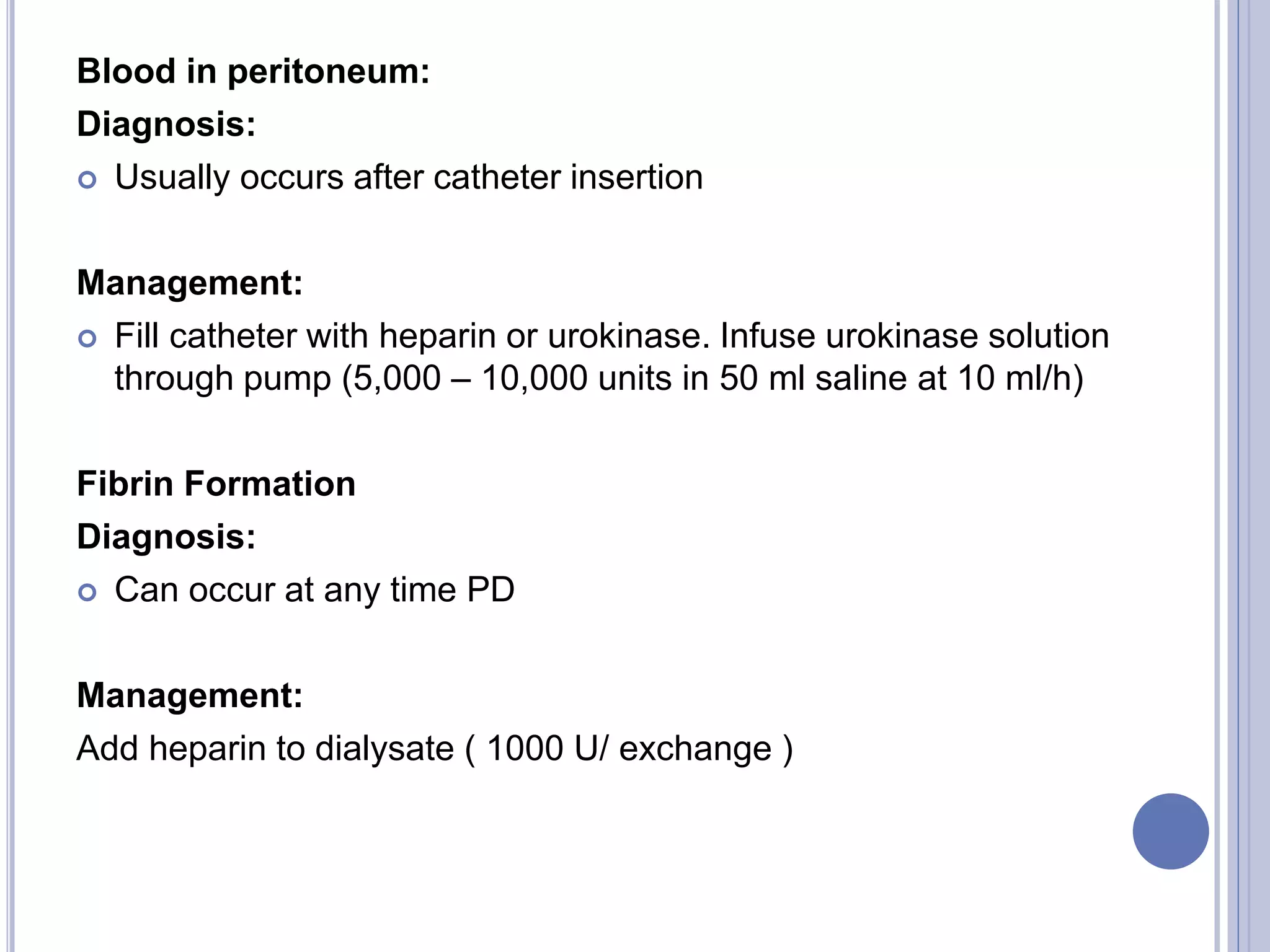
Blood in peritoneum:
Diagnosis:
 Usually occurs after catheter insertion
Management:
 Fill catheter with heparin or urokinase. Infuse urokinase solution
through pump (5,000 – 10,000 units in 50 ml saline at 10 ml/h)
Fibrin Formation
Diagnosis:
 Can occur at any time PD
Management:
Add heparin to dialysate ( 1000 U/ exchange )
Peritonitis:
Diagnosis:
 Blockage occurs if peritonitis severe
Management:
 Add heparin to dialysate (1000 U/ exchange)
 Consider catheter removal if peritonitis not improving
Hernias (if large)
Diagnosis:
 Clinically obvious
 X ray needed to check for other cause of malfunction
Management:
 Repair hernia if technically possible
CONSTIPATION IN PERITONEAL DIALYSIS PATIENT
 Management of malfunction catheter – constipation management
 Heavily loaded loops of bowel prevent the movement of fluid through
the peritoneal cavity - pools of loculated fluid and hence poor
drainage.
 Catheter migration- diaphragm is more likely – loaded loops of
bowel push the catheter up out of the pelvis.
 Risk of migration at the start of PD is reduce by the use of aperients
prior to catheter insertion b/w insertion and regular use and by pts
taking regular laxatives while they are on PD.
 More common in pts when starting PD.
 Regular exercise also helps to avoid constipation and encourage the
catheter to remain in the pelvis.
CAUSE OF CONSTIPATION AT THE START OF PD
 Reduced fiber in diet – pts are often anorectic or a placed on a diet
with less fiber, particularly if potassium is restricted.
 Reduced exercise
 Use of phosphate binder, most of which are constipating
 Iron supplement can cause constipation
 Many patients are elderly in whom there is already an increased risk
of constipation
REPOSITIONING PERITONEAL DIALYSIS CATHETER
 Upto 15% of new catheter need to repositioned, though this is less
frequent when the catheter is sutured directly into the pelvis at insertion.
 Various techniques to manipulating catheter
 Surgical: the catheter can be freed from any adhesions and then
replaced into the pelvis, where it should be sutured into position to avoid
further migration.
 Laproscopic repositioning: preferable to laparotomy because of
reduced postoperative morbidity, less pain and a smaller incision site
allowing earlier use of the catheter.
 Guidewire manipulation under X ray control is done at a few centers
depending on local expertise and availability of fluroscopic screening.
 There is high risk of re migration of the catheter.
Thank You

Complication of peritoneal dialysis

  • 1.
    COMPLICATION OF PERITONEAL DIALYSISCATHETER Yousaf khan Lecturer Renal Dialysis IPMS- KMU
  • 2.
    MALFUNCTIONING CATHETERS  Wellfunctioning PD catheter – dialysate exchange (1.5 -3L) to be run in over 5 -10 minute and drained out over 15-20 min under the force of gravity alone. The disadvantage of a slower dialysate flow rate are  Inconvenience for patient – CAPD exchange take too long or the APD machine will alarm ( interrupting sleep)  Decrease efficiency of PD as exchange dwell time will be decreased Poorly functioning catheters  Poor drainage (out flow failure) – problem with inflow.  Pts perform their exchange without full drainage of fluid abdominal distension, fluid leak, and hernias secondary to increase intra abdominal pressure can occur.
  • 3.
    MALFUNCTIONING CATHETERS Early non-functioning  Occur from the time of catheter insertion  About 30 -50% of new catheter will have some problem with drainage and about 10% will need replacing for complete non function  Rarely PD catheter may fail to function at all in an individual even after several attempts. Late non- functioning  Can also occur in pts on maintenance PD, but this is much less common.
  • 4.
    Cause Mechanisms Early or late Inflowor drainage problem Constipation Stagnant loops of bowel loaded with faces preventing free flow of fluid Catheter adhere to bowel wall Both Predominantly drainage, but on occasion poor inflow Intra abdominal adhesion form previous surgery Loculated area of intraperitoneal fluid catheter tip trapped so only small volume of fluid can be infused early both Intra abdominal adhesions from peritonitis Loculated area of intraperitoneal fluid catheter tip trapped so only small volume of fluid can be infused late Both Catheter migration up to diaphragm Catheter tip no longer in pelvis where fluid pools (by gravity), can be caused or complicated by constipation both drainage Catheter kinking More commonly in catheters stitched into peritoneum both Both (more commonly drainage)
  • 5.
    Blood in peritoneum Blood clotblocks catheter Early both Fibrin formation Catheter blocked by fibrin late Both peritonitis Catheter blocked by pus late both Hernias (if large) Loculated fluid late drainage
  • 6.
    INVESTIGATION AND MANAGEMENTOF MALFUNCTIONING CATHETERS  Depend on likely cause  1st step is exclude blockage by blood, fibrin or as a complication of peritonitis. The diagnosis is therefore usually fairly obvious.  Abdominal X ray – Position of catheter/ and any significant faecal loading of the large bowel.  X ray screening while infusing dialysate to which intravenous X ray contrast material has been added will show whether the fluid become loculated or moves freely into the abdominal cavity.  CT peritoneogram with contrast injected down the catheter can also show loculated fluid, catheter leaks, hernias  Management is successful in 60-90% of malfunctioning catheter.
  • 7.
    Cause:  Constipation  Intraabdominal adhesions from previous surgery Diagnosis:  History- conformed on X ray  Previous surgery  Only small amounts of fluid can be infused X ray with contrast material Management:  Aperients and regular laxatives  Re site catheter under direct vision into area free of adhesions  Consider stitching catheter into pelvis remove catheter if further attempts at PD fail or if adhesions thought to widespread
  • 8.
    Intra abdominal adhesionsfrom peritonitis Diagnosis:  History- conformed on X ray  Previous surgery  Only small amounts of fluid can be infused X ray with contrast material Management:  Catheter removal – adhesions usually too widespread to re site catheter Catheter migration up to diaphragm: Diagnosis:  Occasionally history of episode of abdominal pain when catheter moved.  Conform on X ray Management:  Use aperients if any faecal loading on X ray  Encourage patient to walk around. If simple methods fail, either re site catheter or exchange for oreopoulos catheter
  • 9.
    Blood in peritoneum: Diagnosis: Usually occurs after catheter insertion Management:  Fill catheter with heparin or urokinase. Infuse urokinase solution through pump (5,000 – 10,000 units in 50 ml saline at 10 ml/h) Fibrin Formation Diagnosis:  Can occur at any time PD Management: Add heparin to dialysate ( 1000 U/ exchange )
  • 10.
    Peritonitis: Diagnosis:  Blockage occursif peritonitis severe Management:  Add heparin to dialysate (1000 U/ exchange)  Consider catheter removal if peritonitis not improving Hernias (if large) Diagnosis:  Clinically obvious  X ray needed to check for other cause of malfunction Management:  Repair hernia if technically possible
  • 11.
    CONSTIPATION IN PERITONEALDIALYSIS PATIENT  Management of malfunction catheter – constipation management  Heavily loaded loops of bowel prevent the movement of fluid through the peritoneal cavity - pools of loculated fluid and hence poor drainage.  Catheter migration- diaphragm is more likely – loaded loops of bowel push the catheter up out of the pelvis.  Risk of migration at the start of PD is reduce by the use of aperients prior to catheter insertion b/w insertion and regular use and by pts taking regular laxatives while they are on PD.  More common in pts when starting PD.  Regular exercise also helps to avoid constipation and encourage the catheter to remain in the pelvis.
  • 12.
    CAUSE OF CONSTIPATIONAT THE START OF PD  Reduced fiber in diet – pts are often anorectic or a placed on a diet with less fiber, particularly if potassium is restricted.  Reduced exercise  Use of phosphate binder, most of which are constipating  Iron supplement can cause constipation  Many patients are elderly in whom there is already an increased risk of constipation
  • 13.
    REPOSITIONING PERITONEAL DIALYSISCATHETER  Upto 15% of new catheter need to repositioned, though this is less frequent when the catheter is sutured directly into the pelvis at insertion.  Various techniques to manipulating catheter  Surgical: the catheter can be freed from any adhesions and then replaced into the pelvis, where it should be sutured into position to avoid further migration.  Laproscopic repositioning: preferable to laparotomy because of reduced postoperative morbidity, less pain and a smaller incision site allowing earlier use of the catheter.  Guidewire manipulation under X ray control is done at a few centers depending on local expertise and availability of fluroscopic screening.  There is high risk of re migration of the catheter.
  • 14.