Biological Assay
Assay
An assay is an investigative (analytic) procedure
in laboratory medicine, pharmacology,
environmental biology, and molecular biology for
qualitatively assessing or quantitatively measuring
the presence or amount or the functional activity of
a target entity (the analyte) which can be
a drug or biochemical substance or organic sample.
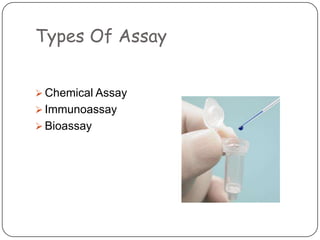
Types Of Assay
 Chemical Assay
 Immunoassay
 Bioassay
Chemical Assay:
It is the study of the separation, identification,
and quantification of the chemical components of
natural and artificial materials.
Immunoassay:
A technique that makes use of the binding between an
antigen and its homologous antibody in order to
identify and quantify the specific antigen or antibody
in a sample.
Biological Assay
Biological testing procedure for estimating the
concentration of a pharmaceutical drug substance
in a formulated drug product or bulk material.
The specific potency of drug is given to animal or
human volunteers and then drug response is
compared with the standards.
Comparison Of Chemical &
Bioassay
Bioassay
Less Precise
More time consuming
More expensive
Active constituent &
structure not known.
More sensitive
More men power
Required
Difficult to handle
Chemical Assay
More Precise
Less time consuming
Less expensive
Active constituent &
structure fully established.
Less sensitive
Less men power required
Easy to handle
Indications Of Bioassay
1. Chemical method is either
 Not available
 If available, too complex,
 Insensitive to low doses e.g. Histamine
2. If active principle of drug is not known e.g.
insulin
3. Unknown Chemical composition, e.g. long
acting thyroid stimulator
4. Chemical composition of drug variable but has same
pharmacological action e.g. cardiac glycosides.
5. Active principle cannot be isolated e.g. posterior
pituitary extract, insulin etc..
6. Biological activity of drug cannot defined by a
chemical assay e.g. Cis and Trans form of methyl
phenidate.
7. Not possible to separate interfering substance e.g.
Vitamin D.
Principles Of Bioassay
All bioassays should be comparative against a
standard drug
 Standard & new drug should be as far as possible
identical to each other
Activity assayed should be the activity of interest
The degree of pharmacological response produced
should be reproducible under identical conditions.
e.g. Adrenaline.
Method of comparison preferably (not essentially)
test therapeutic property of drug.
Individual variations must be minimised.
Classification Of Bioassay
There are three types of bioassay:
Quantal
Graded
Effect produced in confined period
Quantal
All or none response in all individuals,
e.g. Digitalis induced cardiac arrest in guinea pigs
hypoglycemic convulsions in mice by insulin and
Calculation of LD50 in mice or rats
Not précised
Employed for:
Comparison of LD50 and ED50
Comparison of Threshold response
Graded Bioassay
 Effect is produced gradually depending on dose.
 E.g. Contraction of smooth muscle preparation
Accuracy Limits Of Bioassay
“Accuracy improves the efficiency of bioassay for
pharmaceutical biological products.”
 An accuracy within 20 % of true value is good.
 An accuracy within 10 % of true value is
excellent.
Dependency Of Biological
Testing Procedure
Biological assay depends on:
 size of the dose
 intensity of drug
It is not necessary that the effect produced in animals
would be same for that produced in humans. But few
exceptions are there this is the main draw back of
bioassay.
Partial List Of Official Quantitative
Biological Tests
Drug and Dosage
form
Test Animal (s)
Antibiotics Suitable microorganism
Insulin Rabbit & Mice
Digitalis & other
glycosides
Pigeon & Guinea Pig
Vitamin A & D Rat
Parathyroid drugs Dog
Posterior pituitary Rat
Tubocurarine Chloride Rabbit
Purpose Of Bioassay
1. Compare test sample with standard substance to determine
quantity of test sample required to produce an equivalent
biological response to that of the standard substance.
2. Measuring pharmacological activity of new or chemically
undefined substance.
3. Test method employed in measuring the response of living
animals to toxicity of chemical contaminant. Certain no. of
individuals of sensitive specie are exposed to specific conc.
of contaminant for specific period to examine toxic effects.
4. Investigating function of endogenous mediators.
5. Determine conc. As well as potency of unknown substance.
6. Improving and maintaining standards of basic environmental
conditions affecting well-being of people e.g. pollutants
released by particular source.
7. To determine specificity of compounds to be used e.g.
penicillin's are effective against G+ve but not on G-ve.
Preparation of standard
A selective representative sample of a substance
for which it is to serve as a basis of the
measurement is called standard preparation.
Uniform quality
Stable
Types Of Standard
Preparation
Two type of standard preparation:
1) International standard and reference standard
 USP units(highly recognized-able and authorized
standard)
2) British standard and reference standard
 Country want to have its own standard
preparation, then used according to its own law.
 For biological assay and tests, units are referred
called GREAT BRITIAN.
 For specific biological activity small quantity of
standard preparation are used.
Potency
Measurement of drug activity expressed in terms
of amount required to produce an effect of given
intensity.
EXAMPLES:
Highly potent drugs like morphine, alprazolam,
chlorpromazine etc produced high response at low
conc. And low potent drugs like ibuprofen and
acetylsalicyclic acid produced low response at low
conc.
Affinity
Efficacy
Advantages
 Bioassays are procedures that can determine the
concentration of purity or biological activity of a
substance such as vitamin, hormone, and plant
growth factor.
While measuring the effect on an organism, tissue
cells, enzymes or the receptor is preparing to be
compared to a standard preparation.
Bioassays may be qualitative or quantitative.
Qualitative bioassays are used for assessing the
physical effects of a substance that may not be
quantified, such as abnormal development
or deformity.
Quantitative bioassays involve estimation of the
concentration or potency of a substance by
measurement of the biological response that it
produces. Quantitative bioassays are typically
analyzed using the methods of biostatistics.
 They not only help to determine the concentration
but also the potency of the sample.
 It is especially used to standardize drugs, vaccine,
toxins or poisons, disinfectants, antiseptics etc. as
these are all used over biological system in some or
other form.
 These also help determine the specificity of a
compound to be used ex: Penicillin's are effective
against Gram+ve but not on Gram-ve. Testing of
infected patients sputum helps determine which anti-
biotic be given for quick recovery .
 Certain complex compounds like Vitamin B-
12 which can't be analyzed by simple assay
techniques can be effectively estimated by
Bioassays.
Sometimes the chemical composition of samples are
different but have same biological activity.
For samples where no other methods of assays are
available.
Biological products like toxin, anti-toxin, sera can
be conveniently assayed. Measure minute (Nano
mole & Pico mole) quantities of active substances
can detect active substance without prior extraction
or other treatment.
Disadvantages
Key problem is variability in response
Large number of animal to be used
Expertise in experimental design, execution of assay
& analysis of data required
Leads to expensive & time consuming
Time related changes ins sensitivity of test organ.
Tachyphylactic responses of substance being assayed.
.
Biological Assay
Biological Assay

Biological Assay

  • 1.
  • 2.
    Assay An assay isan investigative (analytic) procedure in laboratory medicine, pharmacology, environmental biology, and molecular biology for qualitatively assessing or quantitatively measuring the presence or amount or the functional activity of a target entity (the analyte) which can be a drug or biochemical substance or organic sample.
  • 3.
    Types Of Assay Chemical Assay  Immunoassay  Bioassay
  • 4.
    Chemical Assay: It isthe study of the separation, identification, and quantification of the chemical components of natural and artificial materials. Immunoassay: A technique that makes use of the binding between an antigen and its homologous antibody in order to identify and quantify the specific antigen or antibody in a sample.
  • 5.
    Biological Assay Biological testingprocedure for estimating the concentration of a pharmaceutical drug substance in a formulated drug product or bulk material. The specific potency of drug is given to animal or human volunteers and then drug response is compared with the standards.
  • 6.
    Comparison Of Chemical& Bioassay Bioassay Less Precise More time consuming More expensive Active constituent & structure not known. More sensitive More men power Required Difficult to handle Chemical Assay More Precise Less time consuming Less expensive Active constituent & structure fully established. Less sensitive Less men power required Easy to handle
  • 7.
    Indications Of Bioassay 1.Chemical method is either  Not available  If available, too complex,  Insensitive to low doses e.g. Histamine 2. If active principle of drug is not known e.g. insulin 3. Unknown Chemical composition, e.g. long acting thyroid stimulator
  • 8.
    4. Chemical compositionof drug variable but has same pharmacological action e.g. cardiac glycosides. 5. Active principle cannot be isolated e.g. posterior pituitary extract, insulin etc..
  • 9.
    6. Biological activityof drug cannot defined by a chemical assay e.g. Cis and Trans form of methyl phenidate. 7. Not possible to separate interfering substance e.g. Vitamin D.
  • 10.
    Principles Of Bioassay Allbioassays should be comparative against a standard drug  Standard & new drug should be as far as possible identical to each other Activity assayed should be the activity of interest
  • 11.
    The degree ofpharmacological response produced should be reproducible under identical conditions. e.g. Adrenaline. Method of comparison preferably (not essentially) test therapeutic property of drug. Individual variations must be minimised.
  • 12.
    Classification Of Bioassay Thereare three types of bioassay: Quantal Graded Effect produced in confined period
  • 13.
    Quantal All or noneresponse in all individuals, e.g. Digitalis induced cardiac arrest in guinea pigs hypoglycemic convulsions in mice by insulin and Calculation of LD50 in mice or rats Not précised
  • 14.
    Employed for: Comparison ofLD50 and ED50 Comparison of Threshold response
  • 15.
    Graded Bioassay  Effectis produced gradually depending on dose.  E.g. Contraction of smooth muscle preparation
  • 16.
    Accuracy Limits OfBioassay “Accuracy improves the efficiency of bioassay for pharmaceutical biological products.”  An accuracy within 20 % of true value is good.  An accuracy within 10 % of true value is excellent.
  • 17.
    Dependency Of Biological TestingProcedure Biological assay depends on:  size of the dose  intensity of drug It is not necessary that the effect produced in animals would be same for that produced in humans. But few exceptions are there this is the main draw back of bioassay.
  • 18.
    Partial List OfOfficial Quantitative Biological Tests Drug and Dosage form Test Animal (s) Antibiotics Suitable microorganism Insulin Rabbit & Mice Digitalis & other glycosides Pigeon & Guinea Pig Vitamin A & D Rat Parathyroid drugs Dog Posterior pituitary Rat Tubocurarine Chloride Rabbit
  • 19.
    Purpose Of Bioassay 1.Compare test sample with standard substance to determine quantity of test sample required to produce an equivalent biological response to that of the standard substance. 2. Measuring pharmacological activity of new or chemically undefined substance. 3. Test method employed in measuring the response of living animals to toxicity of chemical contaminant. Certain no. of individuals of sensitive specie are exposed to specific conc. of contaminant for specific period to examine toxic effects.
  • 20.
    4. Investigating functionof endogenous mediators. 5. Determine conc. As well as potency of unknown substance. 6. Improving and maintaining standards of basic environmental conditions affecting well-being of people e.g. pollutants released by particular source. 7. To determine specificity of compounds to be used e.g. penicillin's are effective against G+ve but not on G-ve.
  • 21.
    Preparation of standard Aselective representative sample of a substance for which it is to serve as a basis of the measurement is called standard preparation. Uniform quality Stable
  • 22.
    Types Of Standard Preparation Twotype of standard preparation: 1) International standard and reference standard  USP units(highly recognized-able and authorized standard) 2) British standard and reference standard
  • 23.
     Country wantto have its own standard preparation, then used according to its own law.  For biological assay and tests, units are referred called GREAT BRITIAN.  For specific biological activity small quantity of standard preparation are used.
  • 24.
    Potency Measurement of drugactivity expressed in terms of amount required to produce an effect of given intensity. EXAMPLES: Highly potent drugs like morphine, alprazolam, chlorpromazine etc produced high response at low conc. And low potent drugs like ibuprofen and acetylsalicyclic acid produced low response at low conc.
  • 25.
  • 26.
    Advantages  Bioassays areprocedures that can determine the concentration of purity or biological activity of a substance such as vitamin, hormone, and plant growth factor. While measuring the effect on an organism, tissue cells, enzymes or the receptor is preparing to be compared to a standard preparation.
  • 27.
    Bioassays may bequalitative or quantitative. Qualitative bioassays are used for assessing the physical effects of a substance that may not be quantified, such as abnormal development or deformity. Quantitative bioassays involve estimation of the concentration or potency of a substance by measurement of the biological response that it produces. Quantitative bioassays are typically analyzed using the methods of biostatistics.
  • 28.
     They notonly help to determine the concentration but also the potency of the sample.  It is especially used to standardize drugs, vaccine, toxins or poisons, disinfectants, antiseptics etc. as these are all used over biological system in some or other form.  These also help determine the specificity of a compound to be used ex: Penicillin's are effective against Gram+ve but not on Gram-ve. Testing of infected patients sputum helps determine which anti- biotic be given for quick recovery .
  • 29.
     Certain complexcompounds like Vitamin B- 12 which can't be analyzed by simple assay techniques can be effectively estimated by Bioassays. Sometimes the chemical composition of samples are different but have same biological activity. For samples where no other methods of assays are available.
  • 30.
    Biological products liketoxin, anti-toxin, sera can be conveniently assayed. Measure minute (Nano mole & Pico mole) quantities of active substances can detect active substance without prior extraction or other treatment.
  • 31.
    Disadvantages Key problem isvariability in response Large number of animal to be used Expertise in experimental design, execution of assay & analysis of data required Leads to expensive & time consuming
  • 32.
    Time related changesins sensitivity of test organ. Tachyphylactic responses of substance being assayed. .