Dr.RAGHU PRASADA M S
MBBS,MD
ASSISTANT PROFESSOR
DEPT. OF PHARMACOLOGY
SSIMS & RC.
Quantitative estimation of drugs
 Biological methods
 Physico-chemical methods-chromatographic,
spectrophotometric, flourimetric and mass
spectrometric techniques
 Radio-immunological methods
 Microbiological methods
 Means the measurement of the concentration or
potency of a drug from the magnitude of its
biological effect.
 Bioassay involves comparison of the main
pharmacological response of unknown preparation
with that of the standard
 Types –Quantal and Graded
 Dose response relationships describe the effect
on an organism caused by differing levels of
exposure (or dose)
Dose levels are usually expressed in mg/kg body
weight of the test animal for solids and mg/m3 or
parts per million for aerosols/vapours
 These levels can be plotted on a graph against
the response
 The dose response curve is a valuable tool to
understand the levels at which substances begin
to exert adverse effects and the degree of harm
expected at various levels
 Dose is the amount of a substance administered at
one time.
 Dosage is the amount per unit weight of the
exposed individual.
 Exposure is characterized by
 Number of doses
 Frequency of dosing
 The total period of time for the exposure .
5
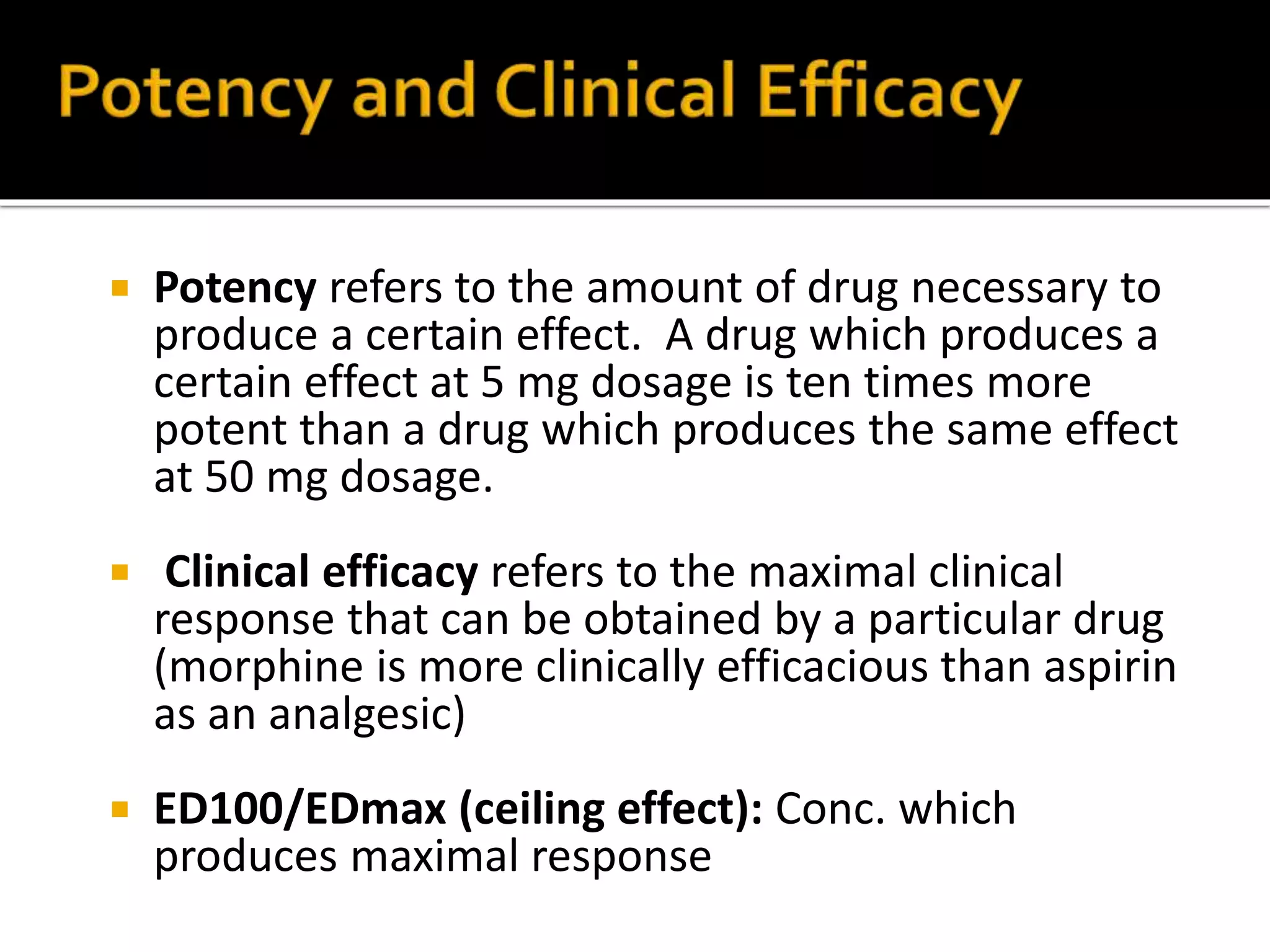
 Graded – response measured on a
continuous scale (efficacy)
 Quantal – response is an either/or
event(potency)
 relates dose and frequency of response in
a population of individuals
 often derived from frequency distribution
of doses required to produce a specified
effect
2004-2005
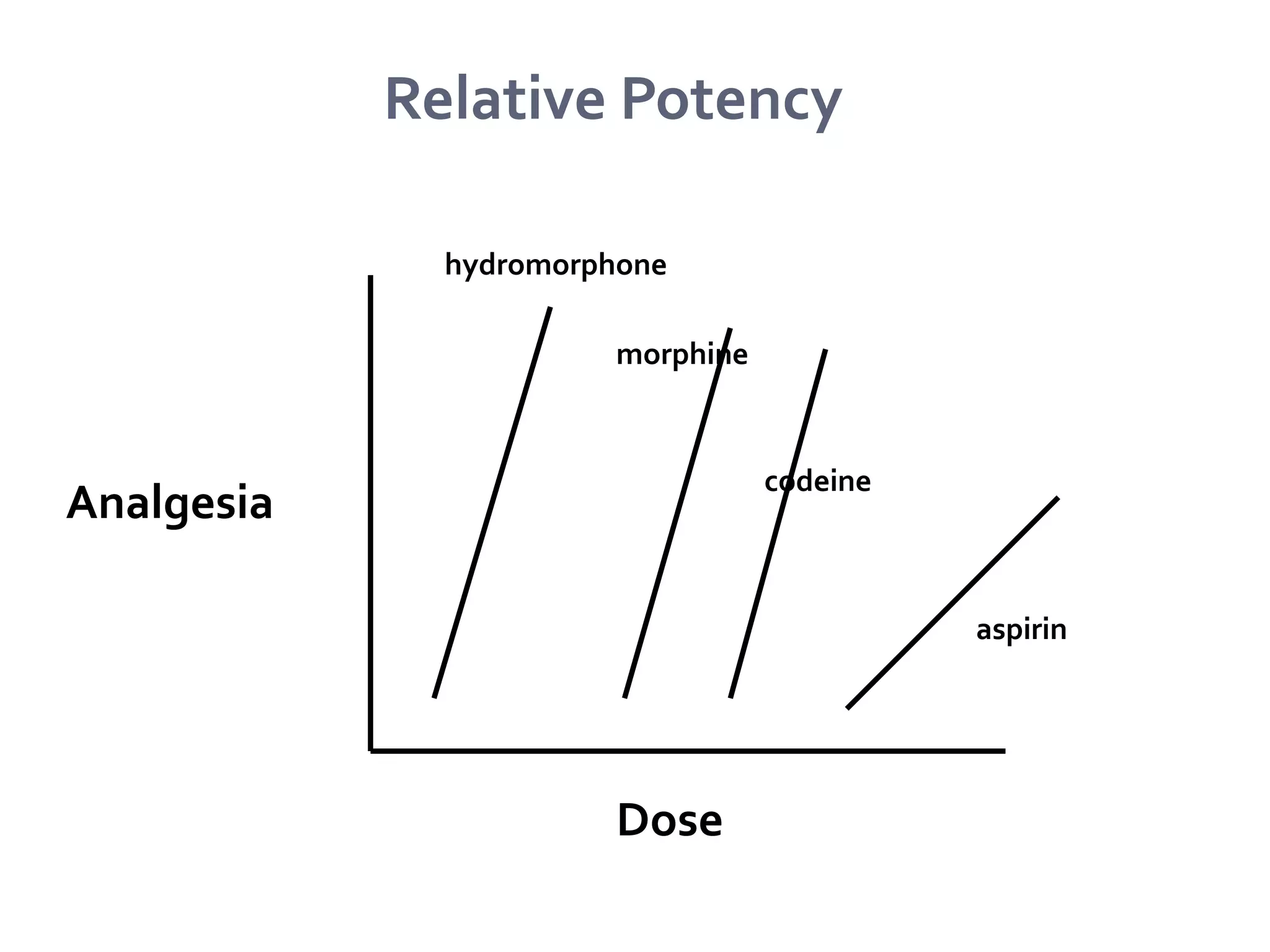
 Potency refers to the amount of drug necessary to
produce a certain effect. A drug which produces a
certain effect at 5 mg dosage is ten times more
potent than a drug which produces the same effect
at 50 mg dosage.
 Clinical efficacy refers to the maximal clinical
response that can be obtained by a particular drug
(morphine is more clinically efficacious than aspirin
as an analgesic)
 ED100/EDmax (ceiling effect): Conc. which
produces maximal response
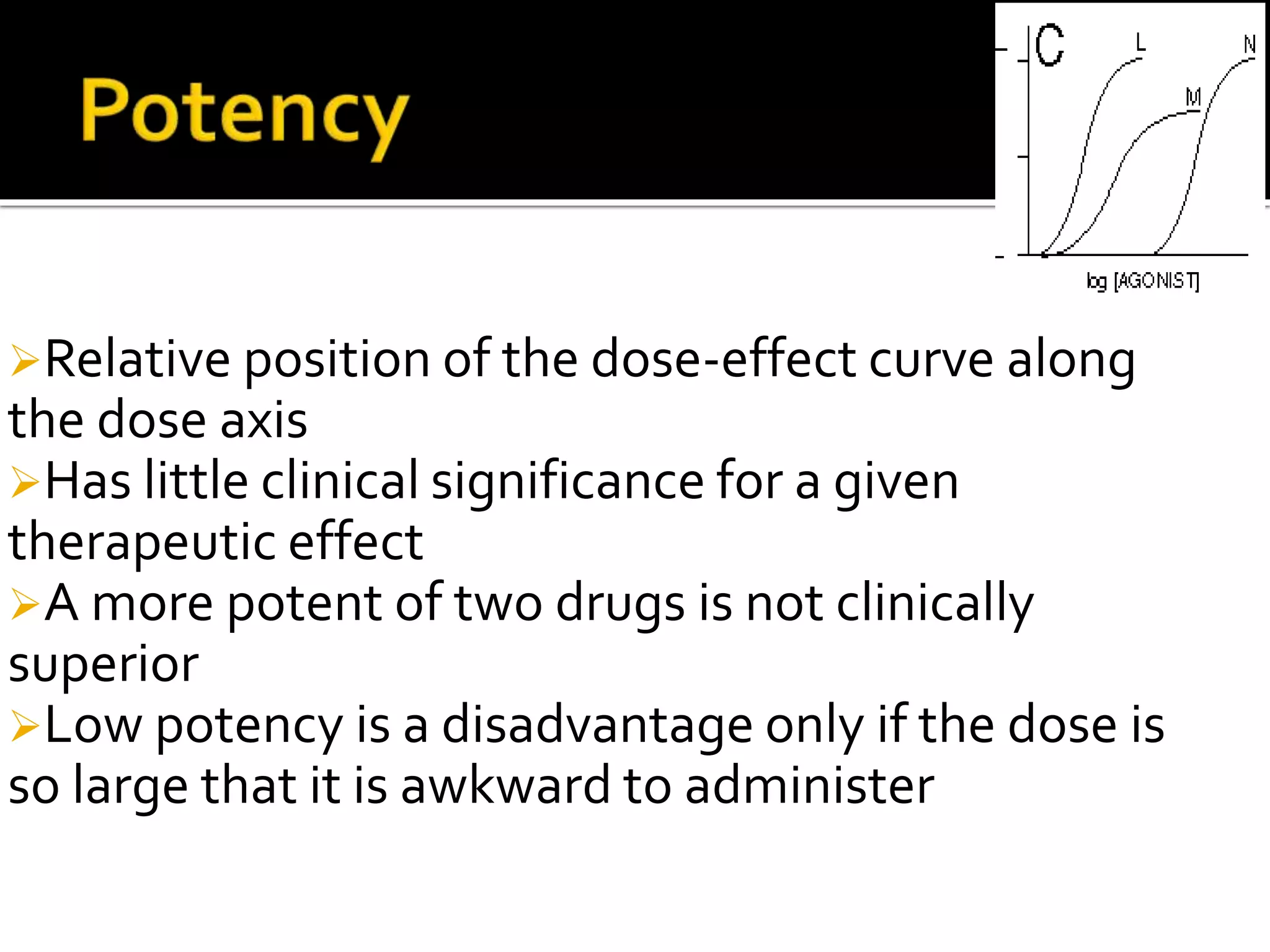
Relative position of the dose-effect curve along
the dose axis
Has little clinical significance for a given
therapeutic effect
A more potent of two drugs is not clinically
superior
Low potency is a disadvantage only if the dose is
so large that it is awkward to administer
Analgesia
Dose
hydromorphone
morphine
codeine
aspirin
Relative Potency
When dose of drug results as response
e.g., contraction or relaxation of muscles, ∆ BP, ∆ blood
sugar etc.
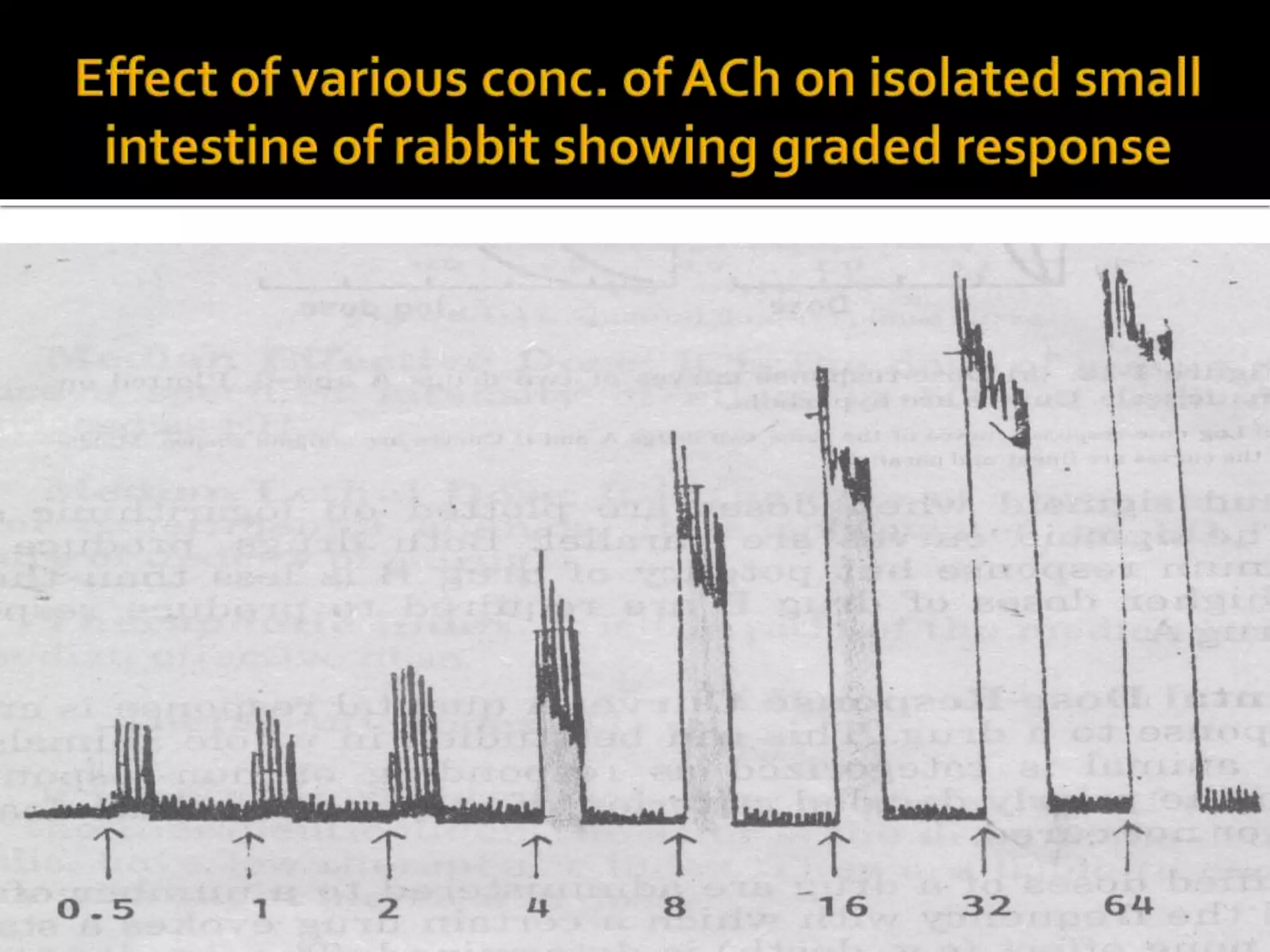
Studied in vitro on a piece of small intestine
Relationship b/w dose & response can be plotted on
curve (x-axis=dose; y-axis=response)
Conc./dose on arithmetic scale, curve is hyperbolic
(not linear relationship)
Conc./dose on log scale, curve is sigmoid-shaped (semi
log dose-response curve)
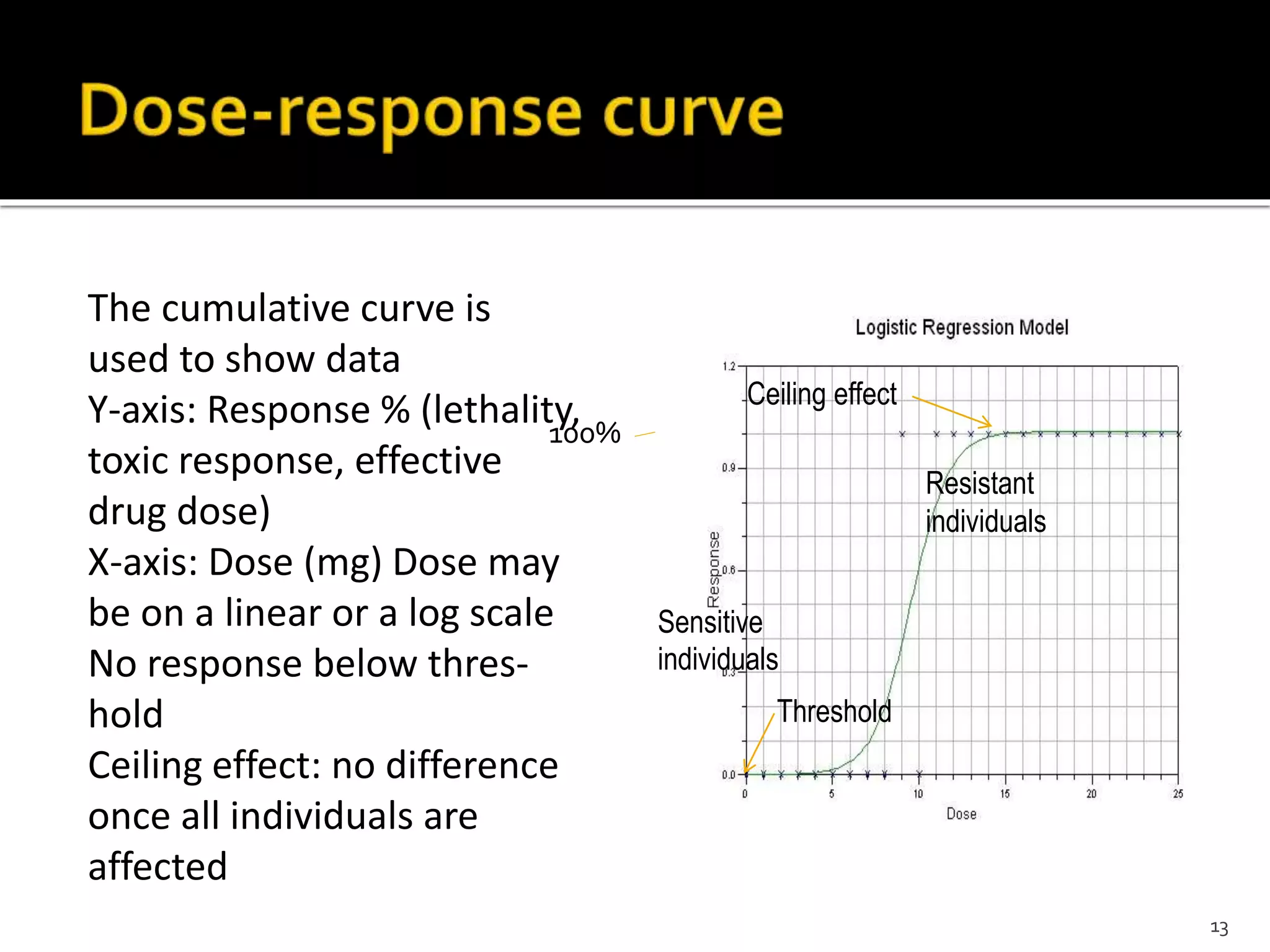
The cumulative curve is
used to show data
Y-axis: Response % (lethality,
toxic response, effective
drug dose)
X-axis: Dose (mg) Dose may
be on a linear or a log scale
No response below thres-
hold
Ceiling effect: no difference
once all individuals are
affected
13
Resistant
individuals
Threshold
Sensitive
individuals
Ceiling effect
100%
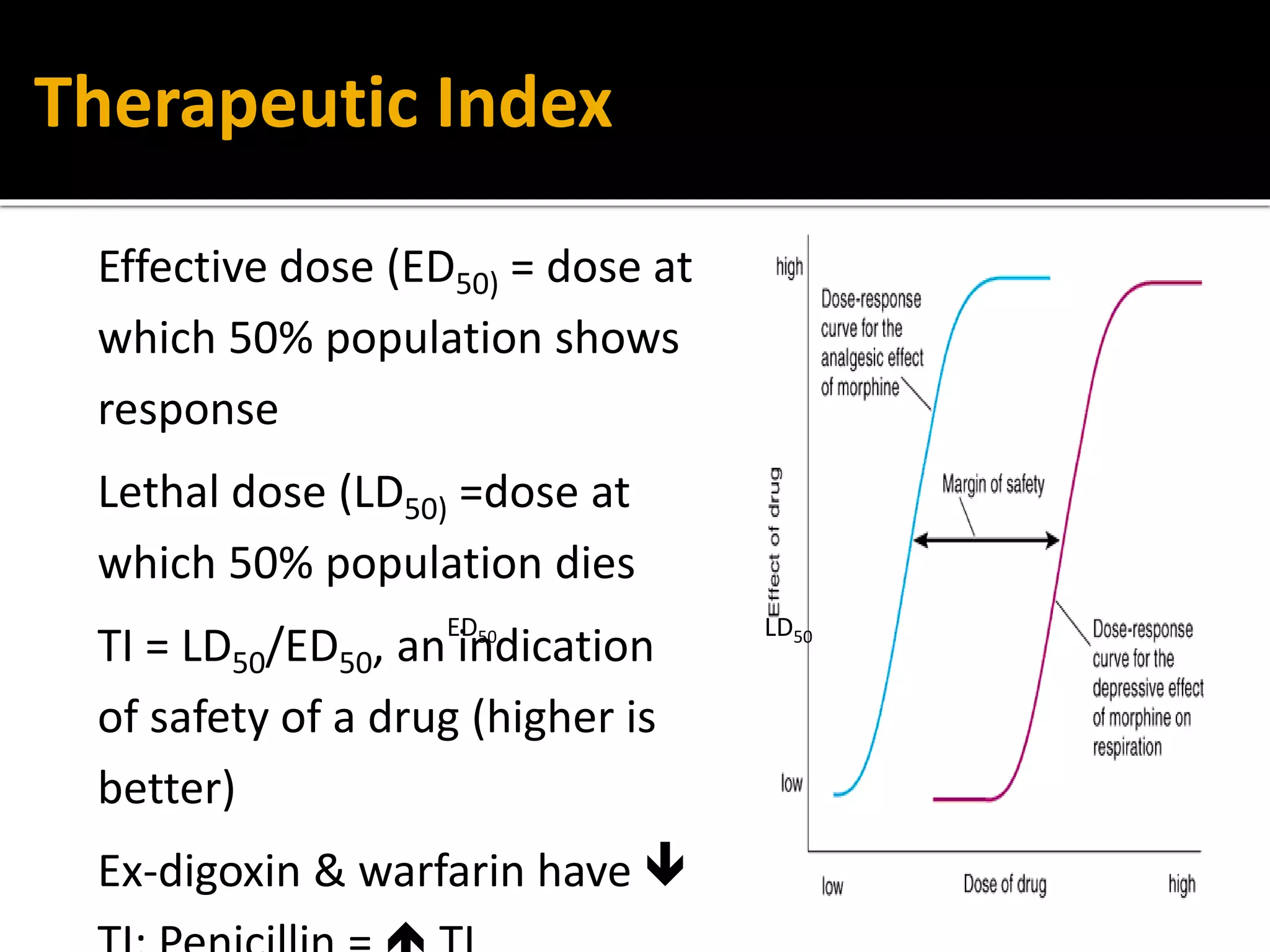
Therapeutic Index
Effective dose (ED50) = dose at
which 50% population shows
response
Lethal dose (LD50) =dose at
which 50% population dies
TI = LD50/ED50, an indication
of safety of a drug (higher is
better)
Ex-digoxin & warfarin have 
ED50 LD50
Wide range of drug doses is depicted
Easy comparison between agonists
Easy study of antagonists
The middle portion (25-75%) of curve is linear; direct
relationship between dose and
response can be obtained
 Response follow all or none phenomenon (e.g.,
analgesics, convulsants, anticonvulsant activity, death
etc)
 Dose of drug evokes a fixed pharmacological response
 Studied in whole animal (in vivo); data derived from
group of animals or population
 Results can be plotted as Log dose-percentage curve
 Gaussian Distribution Curve (sigmoid > graded
response) is obtained by keeping log doses on
horizontal-axis and % response on vertical-axis
0
10
20
30
40
50
1 3 5 7 9 11 13 15
Following valuable data can be drawn -
Median Effective Dose (ED50)-Dose of a drug required
to produce 50% of maximum response
TD50 - Median Toxic Dose 50 - dose at which 50
percent of the population manifests a given toxic
effect
Median lethal dose (LD50)-Dose of a drug required to
kill 50% of experimental animals; measurement of
toxicity
 Two terms often
encountered are No
Observed Adverse Effect
Level (NOAEL) and Low
Observed Adverse Effect
Level (LOAEL).
 They are the actual data
points from human
clinical or experimental
animal studies.
20
http://aquaticpath.umd.edu/appliedtox/module1-dose.html
1. Identify the therapeutic dose/concentration
2. Define site of drug action (receptor)
3. Classify effect produced by drug-receptor
interaction (agonist, antagonist)
4. Compare the relative potency and efficacy of
drugs that produce the same effect
5. Assess mechanism of drug interactions
 LD50 – Median Lethal Dose, quantity of the chemical
that is estimated to be fatal to 50% of the organisms
LD50 values are the standard for comparison of
acute toxicity between chemical compounds and
between species
 TD50 – Median Toxic Dose
 ED50 – Median Effective Dose
 LC50 – Median Lethal Concentration
“All substances are poisons;
there is none which is not a poison.
The right dose differentiates a poison from a remedy.”
Paracelsus (1493-1541)
THANKYOU
Download slides from
Authorstream/presentations/raghuprasada
Slideshare/presentations/raghuprasada
Youtube/raghuprasada

Class dose response curve

  • 1.
    Dr.RAGHU PRASADA MS MBBS,MD ASSISTANT PROFESSOR DEPT. OF PHARMACOLOGY SSIMS & RC.
  • 2.
    Quantitative estimation ofdrugs  Biological methods  Physico-chemical methods-chromatographic, spectrophotometric, flourimetric and mass spectrometric techniques  Radio-immunological methods  Microbiological methods
  • 3.
     Means themeasurement of the concentration or potency of a drug from the magnitude of its biological effect.  Bioassay involves comparison of the main pharmacological response of unknown preparation with that of the standard  Types –Quantal and Graded
  • 4.
     Dose responserelationships describe the effect on an organism caused by differing levels of exposure (or dose) Dose levels are usually expressed in mg/kg body weight of the test animal for solids and mg/m3 or parts per million for aerosols/vapours  These levels can be plotted on a graph against the response  The dose response curve is a valuable tool to understand the levels at which substances begin to exert adverse effects and the degree of harm expected at various levels
  • 5.
     Dose isthe amount of a substance administered at one time.  Dosage is the amount per unit weight of the exposed individual.  Exposure is characterized by  Number of doses  Frequency of dosing  The total period of time for the exposure . 5
  • 6.
     Graded –response measured on a continuous scale (efficacy)  Quantal – response is an either/or event(potency)  relates dose and frequency of response in a population of individuals  often derived from frequency distribution of doses required to produce a specified effect 2004-2005
  • 7.
     Potency refersto the amount of drug necessary to produce a certain effect. A drug which produces a certain effect at 5 mg dosage is ten times more potent than a drug which produces the same effect at 50 mg dosage.  Clinical efficacy refers to the maximal clinical response that can be obtained by a particular drug (morphine is more clinically efficacious than aspirin as an analgesic)  ED100/EDmax (ceiling effect): Conc. which produces maximal response
  • 8.
    Relative position ofthe dose-effect curve along the dose axis Has little clinical significance for a given therapeutic effect A more potent of two drugs is not clinically superior Low potency is a disadvantage only if the dose is so large that it is awkward to administer
  • 9.
  • 11.
    When dose ofdrug results as response e.g., contraction or relaxation of muscles, ∆ BP, ∆ blood sugar etc. Studied in vitro on a piece of small intestine Relationship b/w dose & response can be plotted on curve (x-axis=dose; y-axis=response) Conc./dose on arithmetic scale, curve is hyperbolic (not linear relationship) Conc./dose on log scale, curve is sigmoid-shaped (semi log dose-response curve)
  • 13.
    The cumulative curveis used to show data Y-axis: Response % (lethality, toxic response, effective drug dose) X-axis: Dose (mg) Dose may be on a linear or a log scale No response below thres- hold Ceiling effect: no difference once all individuals are affected 13 Resistant individuals Threshold Sensitive individuals Ceiling effect 100%
  • 14.
    Therapeutic Index Effective dose(ED50) = dose at which 50% population shows response Lethal dose (LD50) =dose at which 50% population dies TI = LD50/ED50, an indication of safety of a drug (higher is better) Ex-digoxin & warfarin have  ED50 LD50
  • 15.
    Wide range ofdrug doses is depicted Easy comparison between agonists Easy study of antagonists The middle portion (25-75%) of curve is linear; direct relationship between dose and response can be obtained
  • 16.
     Response followall or none phenomenon (e.g., analgesics, convulsants, anticonvulsant activity, death etc)  Dose of drug evokes a fixed pharmacological response  Studied in whole animal (in vivo); data derived from group of animals or population  Results can be plotted as Log dose-percentage curve  Gaussian Distribution Curve (sigmoid > graded response) is obtained by keeping log doses on horizontal-axis and % response on vertical-axis
  • 17.
  • 18.
    Following valuable datacan be drawn - Median Effective Dose (ED50)-Dose of a drug required to produce 50% of maximum response TD50 - Median Toxic Dose 50 - dose at which 50 percent of the population manifests a given toxic effect Median lethal dose (LD50)-Dose of a drug required to kill 50% of experimental animals; measurement of toxicity
  • 20.
     Two termsoften encountered are No Observed Adverse Effect Level (NOAEL) and Low Observed Adverse Effect Level (LOAEL).  They are the actual data points from human clinical or experimental animal studies. 20 http://aquaticpath.umd.edu/appliedtox/module1-dose.html
  • 21.
    1. Identify thetherapeutic dose/concentration 2. Define site of drug action (receptor) 3. Classify effect produced by drug-receptor interaction (agonist, antagonist) 4. Compare the relative potency and efficacy of drugs that produce the same effect 5. Assess mechanism of drug interactions
  • 22.
     LD50 –Median Lethal Dose, quantity of the chemical that is estimated to be fatal to 50% of the organisms LD50 values are the standard for comparison of acute toxicity between chemical compounds and between species  TD50 – Median Toxic Dose  ED50 – Median Effective Dose  LC50 – Median Lethal Concentration
  • 23.
    “All substances arepoisons; there is none which is not a poison. The right dose differentiates a poison from a remedy.” Paracelsus (1493-1541) THANKYOU Download slides from Authorstream/presentations/raghuprasada Slideshare/presentations/raghuprasada Youtube/raghuprasada