Sarita Sharma
Assistant professor of pharmacology
Mumbai
METABOLISM OR BIOTRANSFORMATION
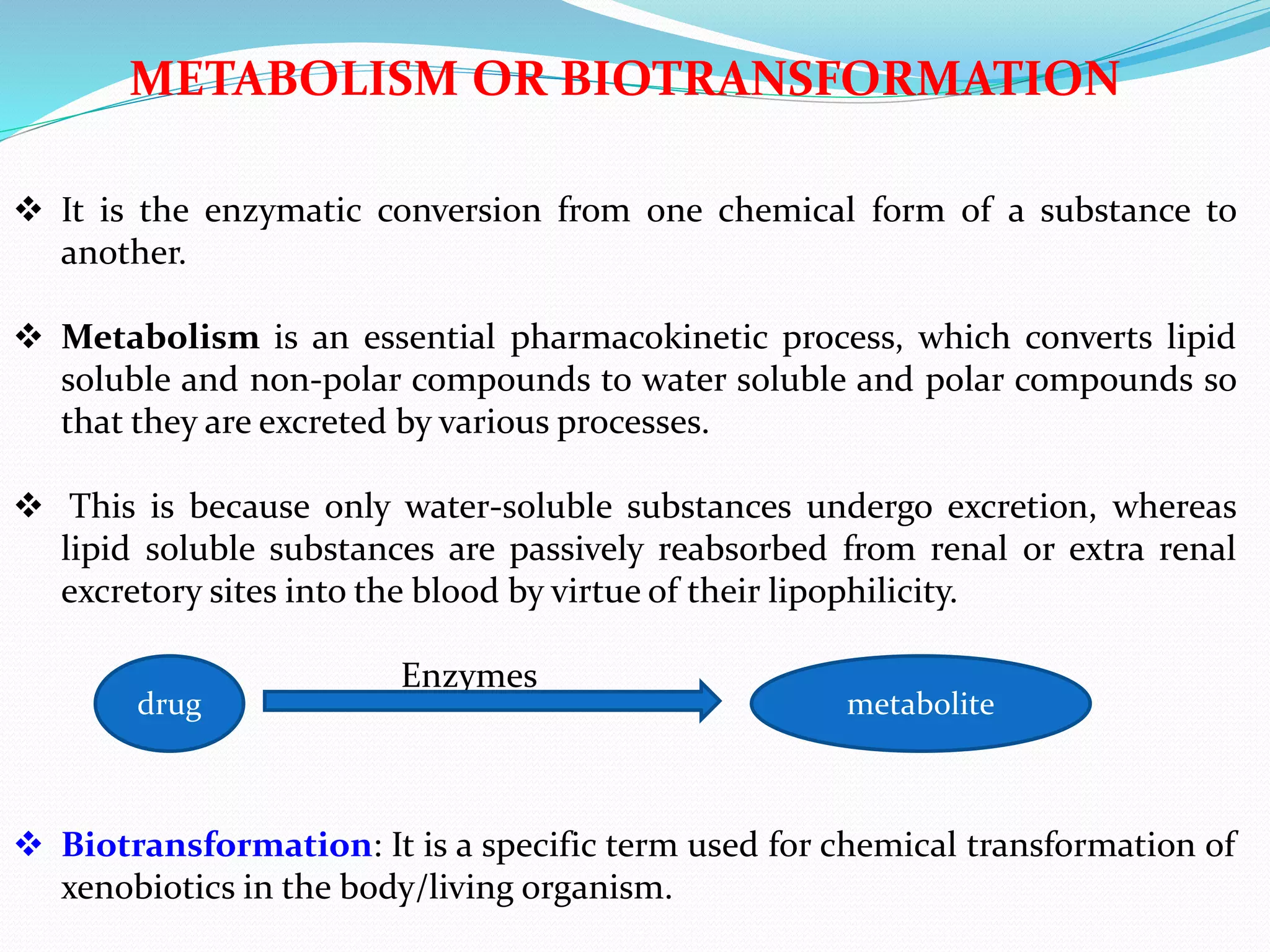
 It is the enzymatic conversion from one chemical form of a substance to
another.
 Metabolism is an essential pharmacokinetic process, which converts lipid
soluble and non-polar compounds to water soluble and polar compounds so
that they are excreted by various processes.
 This is because only water-soluble substances undergo excretion, whereas
lipid soluble substances are passively reabsorbed from renal or extra renal
excretory sites into the blood by virtue of their lipophilicity.
Enzymes
 Biotransformation: It is a specific term used for chemical transformation of
xenobiotics in the body/living organism.
drug metabolite
Xenobiotics : These are all chemical substances
that are not nutrient for body (foreign to body) and
which enter the body through ingestion, inhalation
or dermal exposure.
They include :
drugs, industrial chemicals, pesticides, pollutants,
plant and animal toxins, etc.
Biotransformation results in…
It causes conversion of an
active drug to inactive or
less active metabolite(s)
called as
pharmacological
inactivation.
It causes conversion of an
active to more active
metabolite(s) called as
bioactivation or
toxicological
activation.
• It causes conversion of an
inactive drug (pro-drug) to
active metabolite(s) called
as pharmacological
activation
• It causes conversion of an
active drug to equally
active metabolite(s) (no
change in
pharmacological activity)
Site/Organs of drug metabolism
The major site of drug metabolism is the liver
(microsomal enzyme systems of hepatocytes)
Secondary organs of biotransformation
 kidney (proximal tubule)
 lungs
 testes (Sertoli cells)
 skin (epithelial cells); plasma. nervous tissue
(brain); intestines
Metabolic enzymes:
 Microsomal
enzymes
Non-Microsomal
enzymes
Found in smooth ER of
liver cells Found in cytoplasm &
mitochondria of liver cells
CYP-450, mono oxygenase,
flavin mono oxygenase
Alcohol dehydrogenase, aldehyde
dehydrogenase, MAO
Types of biotransformation
Phase-I OR
Functionalization
OR Non synthetic
• Oxidation
• Hydrolysis
• Reduction
Phase-II OR
Conjugation OR
Synthetic
Glucoronic conjugation
Sulfate conjugation
Glycine conjugation
Methylation
Aceylation
Phase-I /Functionalization / Non
synthetic reactions:
 Attechment of functional groups (OH, COOH, NH2
etc)
 Metabolite- active or Inactivate
 Convert to more hydrophilic in nature
• Examples:
• Oxidation-phenytoin, barbiturates
• Hydrolysis-aspirin
• Reduction- benzodiazepines
Phase-II / Conjugation / Synthetic
reactions:
Detoxification reactions and almost always results in loss
of biological activity of a compound.
 Endogenous polar molecule is conjugated(as carbohydrates
and amino acids like glucoronic acid, methyl gp, sulphate,
glycine)
Converted to hydrophilic & pharmacologically inactive
Examples:
Glucoronic conjugation- paracetamol, chloramphenicol
PHASE I BIOTRANSFORMATION
1.Oxidation
 Addition of oxygen OR removal of hydrogen.
 Oxidation by cytochrome P450 enzymes (microsomal mixed-
function oxidases).
 Oxidation by enzymes other than cytochrome P450 is—most
of these
 (a) oxidation of alcohol by alcohol dehydrogenase,
 (b) oxidation of aldehyde by aldehyde dehydrogenase,
 (c) N-dealkylation by monoamineoxidase.
 Eg. phenytoin, barbiturates, propranolol, imipramine etc.
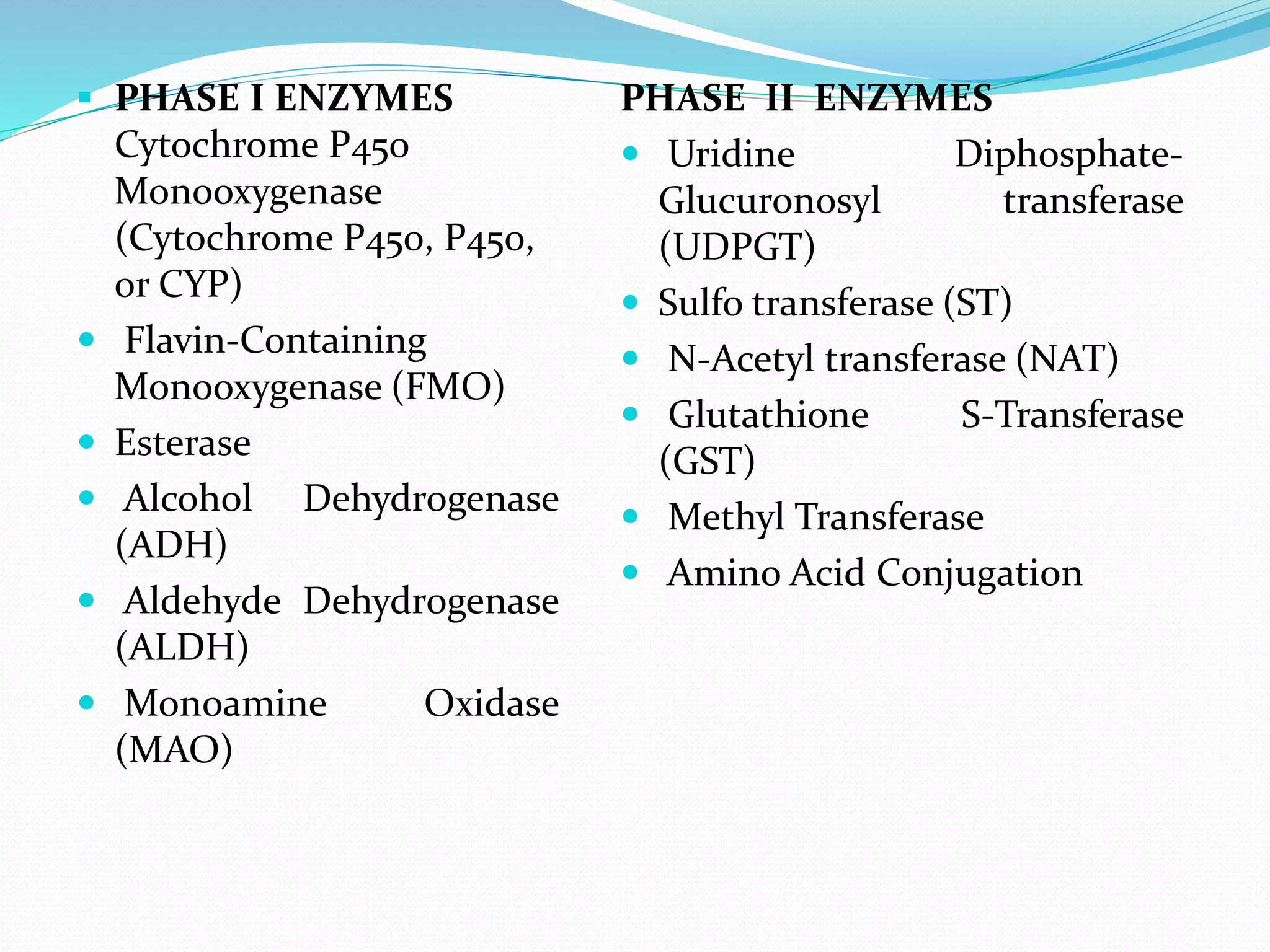
 PHASE I ENZYMES
Cytochrome P450
Monooxygenase
(Cytochrome P450, P450,
or CYP)
 Flavin-Containing
Monooxygenase (FMO)
 Esterase
 Alcohol Dehydrogenase
(ADH)
 Aldehyde Dehydrogenase
(ALDH)
 Monoamine Oxidase
(MAO)
PHASE II ENZYMES
 Uridine Diphosphate-
Glucuronosyl transferase
(UDPGT)
 Sulfo transferase (ST)
 N-Acetyl transferase (NAT)
 Glutathione S-Transferase
(GST)
 Methyl Transferase
 Amino Acid Conjugation
2. Reduction :
 Addition of hydrogen
 Substrates for reductive reactions include azo- or nitro compounds,
epoxides, heterocyclic compounds, and halogenated hydrocarbons:
(a) Azo or nitro gp reduction by cytochrome P450;
(b) Carbonyl (aldehyde or ketone) reduction by aldehyde reductase, aldose
reductase, carbonyl reductase, quinone reductase
Eg. Chloramphenicol, warfarin, halothane, chloral hydrate etc.
3. Hydrolysis
involve the cleavage of drug molecule by taking up a
molecule of water.
Ester + H2O acid + alcohol
A number of drugs with ester, ether, amide and
hydrazide linkages undergo hydrolysis.
Examples: procaine, procainamide, aspirin and pethidine etc.
PHASE II REACTIONS
 Phase II or conjugation reactions involve combination of the
drug or its phase I metabolite with an endogenous substance
to form a highly polar product, which can be efficiently
excreted from the body.
1. Conjugation with glucuronic a./ Glucuronidation
 Conjugation with glucuronic acid (glucuronide conjugation
or glucuronidation) is the most common and most
important phase II reaction.
 The biochemical donor (cofactor) of glucuronic acid is
uridine diphosphate«-D-glucuronicacid (UDPGA) and the
reaction is carried out by enzyme uridine diphosphate-
glucuronyl transferase (UDP-glucuronyl transferase).
 Glucuronyl transferase is present most tissues but liver is
the most active site of glucuronide synthesis.
 Eg. Paracetamol, diazepam, chloramphenicol, lorazepam,
metronidazol, morphine etc.
2. Conjugation with methyl group/ Methylation :
 Conjugation with methyl group (methyl conjugation or
methylation) involves transfer of a methyl group (-CH3)
from the cofactor S-adenosyl methionine (SAM) to the
acceptor substrate by various methyl transferase enzymes.
 Eg. Nicotinic acid, adrenaline, histamine etc.
3. Conjugation with acetyl group/ Acetylation :
 Compounds having amino or hydrazine gps are conjugated
with the help of acetyl coenzyme-A
 Eg. Sulfonamides, clonazepam ets.
4. Conjugation with sulphate/ Sulphation:
 Steroids and phenolic compounds are undergoes to this
reaction.
 Eg. Sex steroids, methyldopa etc
 Enzyme induction: eg barbiturates, phenytoin ,
rifampin etc
 Enzyme inhibition: eg. Cemetidine, ketoconazole,
erythromycine etc.
Drug metabolism

Drug metabolism

  • 1.
    Sarita Sharma Assistant professorof pharmacology Mumbai
  • 2.
    METABOLISM OR BIOTRANSFORMATION It is the enzymatic conversion from one chemical form of a substance to another.  Metabolism is an essential pharmacokinetic process, which converts lipid soluble and non-polar compounds to water soluble and polar compounds so that they are excreted by various processes.  This is because only water-soluble substances undergo excretion, whereas lipid soluble substances are passively reabsorbed from renal or extra renal excretory sites into the blood by virtue of their lipophilicity. Enzymes  Biotransformation: It is a specific term used for chemical transformation of xenobiotics in the body/living organism. drug metabolite
  • 3.
    Xenobiotics : Theseare all chemical substances that are not nutrient for body (foreign to body) and which enter the body through ingestion, inhalation or dermal exposure. They include : drugs, industrial chemicals, pesticides, pollutants, plant and animal toxins, etc.
  • 4.
    Biotransformation results in… Itcauses conversion of an active drug to inactive or less active metabolite(s) called as pharmacological inactivation. It causes conversion of an active to more active metabolite(s) called as bioactivation or toxicological activation.
  • 5.
    • It causesconversion of an inactive drug (pro-drug) to active metabolite(s) called as pharmacological activation • It causes conversion of an active drug to equally active metabolite(s) (no change in pharmacological activity)
  • 6.
    Site/Organs of drugmetabolism The major site of drug metabolism is the liver (microsomal enzyme systems of hepatocytes) Secondary organs of biotransformation  kidney (proximal tubule)  lungs  testes (Sertoli cells)  skin (epithelial cells); plasma. nervous tissue (brain); intestines
  • 7.
    Metabolic enzymes:  Microsomal enzymes Non-Microsomal enzymes Foundin smooth ER of liver cells Found in cytoplasm & mitochondria of liver cells CYP-450, mono oxygenase, flavin mono oxygenase Alcohol dehydrogenase, aldehyde dehydrogenase, MAO
  • 8.
    Types of biotransformation Phase-IOR Functionalization OR Non synthetic • Oxidation • Hydrolysis • Reduction Phase-II OR Conjugation OR Synthetic Glucoronic conjugation Sulfate conjugation Glycine conjugation Methylation Aceylation
  • 9.
    Phase-I /Functionalization /Non synthetic reactions:  Attechment of functional groups (OH, COOH, NH2 etc)  Metabolite- active or Inactivate  Convert to more hydrophilic in nature • Examples: • Oxidation-phenytoin, barbiturates • Hydrolysis-aspirin • Reduction- benzodiazepines
  • 10.
    Phase-II / Conjugation/ Synthetic reactions: Detoxification reactions and almost always results in loss of biological activity of a compound.  Endogenous polar molecule is conjugated(as carbohydrates and amino acids like glucoronic acid, methyl gp, sulphate, glycine) Converted to hydrophilic & pharmacologically inactive Examples: Glucoronic conjugation- paracetamol, chloramphenicol
  • 11.
    PHASE I BIOTRANSFORMATION 1.Oxidation Addition of oxygen OR removal of hydrogen.  Oxidation by cytochrome P450 enzymes (microsomal mixed- function oxidases).  Oxidation by enzymes other than cytochrome P450 is—most of these  (a) oxidation of alcohol by alcohol dehydrogenase,  (b) oxidation of aldehyde by aldehyde dehydrogenase,  (c) N-dealkylation by monoamineoxidase.  Eg. phenytoin, barbiturates, propranolol, imipramine etc.
  • 13.
     PHASE IENZYMES Cytochrome P450 Monooxygenase (Cytochrome P450, P450, or CYP)  Flavin-Containing Monooxygenase (FMO)  Esterase  Alcohol Dehydrogenase (ADH)  Aldehyde Dehydrogenase (ALDH)  Monoamine Oxidase (MAO) PHASE II ENZYMES  Uridine Diphosphate- Glucuronosyl transferase (UDPGT)  Sulfo transferase (ST)  N-Acetyl transferase (NAT)  Glutathione S-Transferase (GST)  Methyl Transferase  Amino Acid Conjugation
  • 14.
    2. Reduction : Addition of hydrogen  Substrates for reductive reactions include azo- or nitro compounds, epoxides, heterocyclic compounds, and halogenated hydrocarbons: (a) Azo or nitro gp reduction by cytochrome P450; (b) Carbonyl (aldehyde or ketone) reduction by aldehyde reductase, aldose reductase, carbonyl reductase, quinone reductase Eg. Chloramphenicol, warfarin, halothane, chloral hydrate etc.
  • 15.
    3. Hydrolysis involve thecleavage of drug molecule by taking up a molecule of water. Ester + H2O acid + alcohol A number of drugs with ester, ether, amide and hydrazide linkages undergo hydrolysis. Examples: procaine, procainamide, aspirin and pethidine etc.
  • 17.
    PHASE II REACTIONS Phase II or conjugation reactions involve combination of the drug or its phase I metabolite with an endogenous substance to form a highly polar product, which can be efficiently excreted from the body.
  • 18.
    1. Conjugation withglucuronic a./ Glucuronidation  Conjugation with glucuronic acid (glucuronide conjugation or glucuronidation) is the most common and most important phase II reaction.  The biochemical donor (cofactor) of glucuronic acid is uridine diphosphate«-D-glucuronicacid (UDPGA) and the reaction is carried out by enzyme uridine diphosphate- glucuronyl transferase (UDP-glucuronyl transferase).  Glucuronyl transferase is present most tissues but liver is the most active site of glucuronide synthesis.  Eg. Paracetamol, diazepam, chloramphenicol, lorazepam, metronidazol, morphine etc.
  • 19.
    2. Conjugation withmethyl group/ Methylation :  Conjugation with methyl group (methyl conjugation or methylation) involves transfer of a methyl group (-CH3) from the cofactor S-adenosyl methionine (SAM) to the acceptor substrate by various methyl transferase enzymes.  Eg. Nicotinic acid, adrenaline, histamine etc.
  • 20.
    3. Conjugation withacetyl group/ Acetylation :  Compounds having amino or hydrazine gps are conjugated with the help of acetyl coenzyme-A  Eg. Sulfonamides, clonazepam ets. 4. Conjugation with sulphate/ Sulphation:  Steroids and phenolic compounds are undergoes to this reaction.  Eg. Sex steroids, methyldopa etc
  • 22.
     Enzyme induction:eg barbiturates, phenytoin , rifampin etc  Enzyme inhibition: eg. Cemetidine, ketoconazole, erythromycine etc.