General pharmacology

               By
 Mohamad-Hesham Daba,MD,PhD
     Associate professor of
     Clinical pharmacology
Intended learning outcomes
• Define pharmacodynamics
• Recognise targets for drug actions
• Classify drug receptors
• Identify agonist, antagonist and partial ag
• Describe graded and quantal dose response
  curves
• Compare bet. affinity, potency and efficacy
• Define therapeutic index
• Discuss the clinical importance of drug
  combination
Drug-body interactions
• Pharmacodynamic
  interactions:
    the effects of the drugs on the body


• Pharmacokinetic interactions:
     the way in which the body handles the
  drugs.
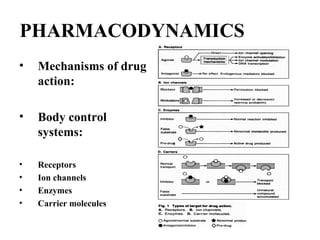
PHARMACODYNAMICS
•   Mechanisms of drug
    action:

•   Body control
    systems:

•   Receptors
•   Ion channels
•   Enzymes
•   Carrier molecules
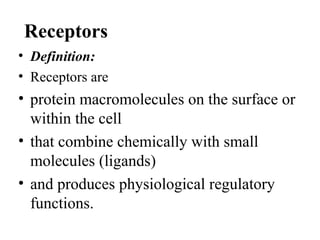
Receptors
• Definition:
• Receptors are
• protein macromolecules on the surface or
  within the cell
• that combine chemically with small
  molecules (ligands)
• and produces physiological regulatory
  functions.
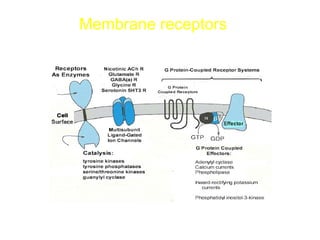
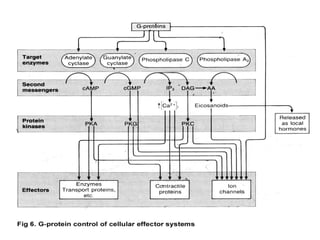
Membrane receptors
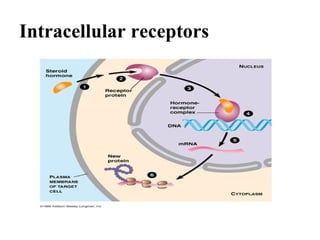
Intracellular receptors
• Ligand: is any molecule that can combine
  with the receptors. A ligand that activates
  the receptor is called agonist. A ligand that
  blocks the receptor is called antagonist.
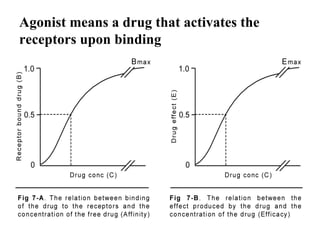
• Affinity: it is the empathy of the receptor
  to the ligand. It determines the ability of the
  drug to bind to receptors.
• Efficacy: it is the ability of the drug to give
  certain Emax. It means the ability of the drug
  to induce effevt
Agonist means a drug that activates the
receptors upon binding
Pharmacologic antagonist:
means a drug that binds without activating its
 receptors and thereby prevents activation by
 an agonist

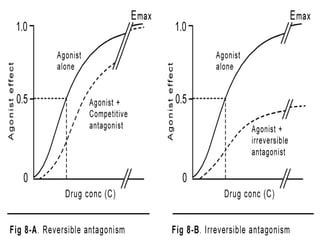
Receptor block may be:
Reversible antagonism (Competitive antagonism)
the antagonist effect can be overcome by increasing the
   concentration of agonist

Irreversible antagonism (Non-competitive antagonism)
the antagonist effect cannot be overcome by increasing the
   concentration of agonist
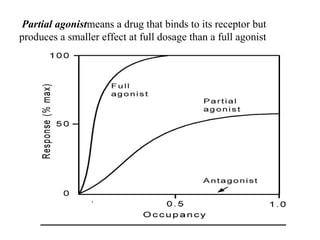
Partial agonistmeans a drug that binds to its receptor but
produces a smaller effect at full dosage than a full agonist
Dose response relationship curves and their
                       importance
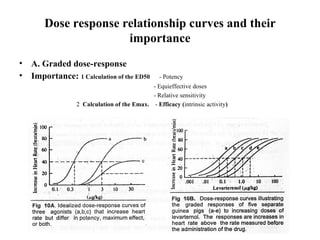
•   A. Graded dose-response
•   Importance: 1 Calculation of the ED50        - Potency
                                             - Equieffective doses
                                             - Relative sensitivity
                  2 Calculation of the Emax. - Efficacy (intrinsic activity)
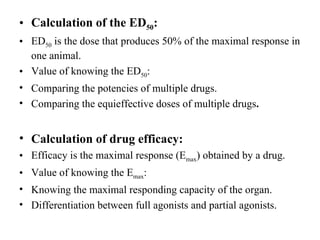
• Calculation of the ED50:
• ED50 is the dose that produces 50% of the maximal response in
  one animal.
• Value of knowing the ED50:
• Comparing the potencies of multiple drugs.
• Comparing the equieffective doses of multiple drugs.


• Calculation of drug efficacy:
• Efficacy is the maximal response (Emax) obtained by a drug.
• Value of knowing the Emax:
• Knowing the maximal responding capacity of the organ.
• Differentiation between full agonists and partial agonists.
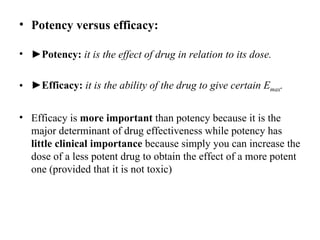
• Potency versus efficacy:

• ►Potency: it is the effect of drug in relation to its dose.

• ►Efficacy: it is the ability of the drug to give certain Emax.

• Efficacy is more important than potency because it is the
  major determinant of drug effectiveness while potency has
  little clinical importance because simply you can increase the
  dose of a less potent drug to obtain the effect of a more potent
  one (provided that it is not toxic)
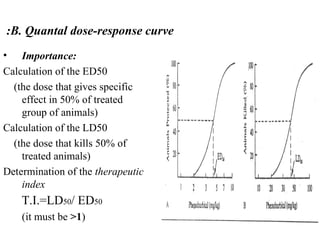
:B. Quantal dose-response curve
•   Importance:
Calculation of the ED50
  (the dose that gives specific
    effect in 50% of treated
    group of animals)
Calculation of the LD50
  (the dose that kills 50% of
    treated animals)
Determination of the therapeutic
    index
    T.I.=LD50/ ED50
    (it must be >1)
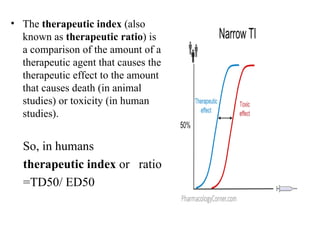
• The therapeutic index (also
  known as therapeutic ratio) is
  a comparison of the amount of a
  therapeutic agent that causes the
  therapeutic effect to the amount
  that causes death (in animal
  studies) or toxicity (in human
  studies).


  So, in humans
  therapeutic index or ratio
  =TD50/ ED50
Quick quiz
1.Which branch of pharmacology studies the
   way drugs work in living organism?

C.   Pharmacotherapeutics
D.   Pharmacokinitics
E.   Pharmacogenitics
F.   Pharmacodynamics
G.   Pharmacovigilance
Quick quiz
•     A 55-year-old woman with congestive heart failure is to
      be treated with a diuretic drug. Drugs X and Y have the
      same mechanism of diuretic action. Drug X in a dose of
      5mg produces the same magnitude of diuresis as 500 mg
      of drug Y. This suggests that:
A.    Drug Y is less efficacious than drug X.
B.   Drug X is about 100 times more potent than drug Y.
C.   Toxicity of drug X is less than that of drug Y.
D.    Drug X is a safer drug than drug Y.
E.   Drug X will have a shorter duration of action than drug Y
      because less of drug X is present for a given effect.
Quick quiz
1.   In the absence of other drug, pindolol causes an increase
     in heart rate by activating beta adrenoceptors. In the
     presence of highly effective beta stimulants, however,
     pindolol causes a dose-dependent, reversible decrease in
     heart rate. Therefore pindolol is probably:
A.   An irreversible antagonist.
B.   A physiologic antagonist.
C.   A chemical antagonist.
D.   A partial agonist.
E.   A Spare receptor agonist.
Quick quiz
1. Which of the following provides
   information about the variation in
   sensitivity to the drug within the
   population studied?
A. Maximal efficacy.
B. Therapeutic index.
C. Drug potency.
D. Graded dose-response curve.
E. Quantal dose-response curve.
Quick quiz
5. Which of the following provides
    information about the largest response a
    drug can produces, regardless of dose?
.A. Drug potency
.B. Maximal efficacy
.C. Mechanism of receptor action
.D. Therapeutic index
.E. Therapeutic window
HYPOREACTIVITY TO
             DRUGS
• Tolerance: decreased response to the same dose of
  the drug. The same response could be obtained by
  higher doses. It occurs over a long period
• Tachyphylaxis: it is a type of tolerance, which occurs
  very rapidly.

Probable mechanisms:
• Change in receptors (desensitization):
• Loss of receptors (down-regulation):
•   Exhaustion of mediators:
•   Increased metabolic degradation:
•   Physiological adaptation:
HYPERREACTIVITY TO DRUGS
overshoot phenomena or hypersusceptibility or
intolerance

Up-regulation means increase number of receptors
due to prolonged exposure to the antagonist or
prolonged deficiency of the natural agonist. When the
antagonist is suddenly withdrawn, severe reaction
occurs in the form of rebound or withdrawal effects
e.g. severe tachycardia & arrhythmia can occur after
sudden stoppage of beta-blockers.
DRUG COMBINATION
• Summation and addition: combined effects of two drugs are
  equal to the sum of their individual effects.
• Synergism or potentiation: combined effects of drugs may be
  greater than the sum of their individual effects.
• Antagonism:
            - Chemical antagonism:
            - Physical antagonism:
            - Physiological antagonism:
            - Competitive antagonism:
            - Non-competitive antagonism
• Which of the following terms best
  describes the antagonism of leukotriene’s
  bronchoconstrictor effect (mediated at
  leukotriene receptors) by terbutaline
  (acting at adrenoceptors) in a patient with
  asthma?
2.   Pharmacologic antagonist.
3.   Partial agonist.
4.   Physiologic antagonist.
5.   Chemical antagonist.
6.   Noncompetitive antagonist.
• Many drugs produce effects by
  interaction with receptors. Other
  cellular components with which drugs
  interact to produce effects include:
2.   Nucleic acids.
3.   Structural proteins.
4.   Enzymes.
5.   Proteins involved in transport processes.
6.   All of the above.
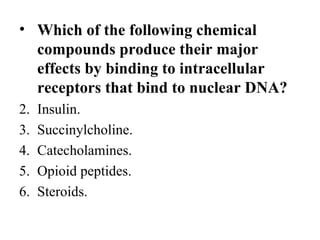
• Which of the following chemical
  compounds produce their major
  effects by binding to intracellular
  receptors that bind to nuclear DNA?
2.   Insulin.
3.   Succinylcholine.
4.   Catecholamines.
5.   Opioid peptides.
6.   Steroids.
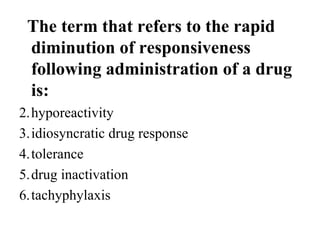
The term that refers to the rapid
 diminution of responsiveness
 following administration of a drug
 is:
2.hyporeactivity
3.idiosyncratic drug response
4.tolerance
5.drug inactivation
6.tachyphylaxis
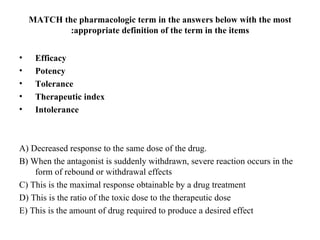
MATCH the pharmacologic term in the answers below with the most
            :appropriate definition of the term in the items


•    Efficacy
•    Potency
•    Tolerance
•    Therapeutic index
•    Intolerance


A) Decreased response to the same dose of the drug.
B) When the antagonist is suddenly withdrawn, severe reaction occurs in the
    form of rebound or withdrawal effects
C) This is the maximal response obtainable by a drug treatment
D) This is the ratio of the toxic dose to the therapeutic dose
E) This is the amount of drug required to produce a desired effect

Pharmacodynamics revised

  • 1.
    General pharmacology By Mohamad-Hesham Daba,MD,PhD Associate professor of Clinical pharmacology
  • 2.
    Intended learning outcomes •Define pharmacodynamics • Recognise targets for drug actions • Classify drug receptors • Identify agonist, antagonist and partial ag • Describe graded and quantal dose response curves • Compare bet. affinity, potency and efficacy • Define therapeutic index • Discuss the clinical importance of drug combination
  • 3.
    Drug-body interactions • Pharmacodynamic interactions: the effects of the drugs on the body • Pharmacokinetic interactions: the way in which the body handles the drugs.
  • 4.
    PHARMACODYNAMICS • Mechanisms of drug action: • Body control systems: • Receptors • Ion channels • Enzymes • Carrier molecules
  • 5.
    Receptors • Definition: • Receptorsare • protein macromolecules on the surface or within the cell • that combine chemically with small molecules (ligands) • and produces physiological regulatory functions.
  • 6.
  • 8.
  • 9.
    • Ligand: isany molecule that can combine with the receptors. A ligand that activates the receptor is called agonist. A ligand that blocks the receptor is called antagonist. • Affinity: it is the empathy of the receptor to the ligand. It determines the ability of the drug to bind to receptors. • Efficacy: it is the ability of the drug to give certain Emax. It means the ability of the drug to induce effevt
  • 10.
    Agonist means adrug that activates the receptors upon binding
  • 12.
    Pharmacologic antagonist: means adrug that binds without activating its receptors and thereby prevents activation by an agonist Receptor block may be: Reversible antagonism (Competitive antagonism) the antagonist effect can be overcome by increasing the concentration of agonist Irreversible antagonism (Non-competitive antagonism) the antagonist effect cannot be overcome by increasing the concentration of agonist
  • 13.
    Partial agonistmeans adrug that binds to its receptor but produces a smaller effect at full dosage than a full agonist
  • 14.
    Dose response relationshipcurves and their importance • A. Graded dose-response • Importance: 1 Calculation of the ED50 - Potency - Equieffective doses - Relative sensitivity 2 Calculation of the Emax. - Efficacy (intrinsic activity)
  • 15.
    • Calculation ofthe ED50: • ED50 is the dose that produces 50% of the maximal response in one animal. • Value of knowing the ED50: • Comparing the potencies of multiple drugs. • Comparing the equieffective doses of multiple drugs. • Calculation of drug efficacy: • Efficacy is the maximal response (Emax) obtained by a drug. • Value of knowing the Emax: • Knowing the maximal responding capacity of the organ. • Differentiation between full agonists and partial agonists.
  • 16.
    • Potency versusefficacy: • ►Potency: it is the effect of drug in relation to its dose. • ►Efficacy: it is the ability of the drug to give certain Emax. • Efficacy is more important than potency because it is the major determinant of drug effectiveness while potency has little clinical importance because simply you can increase the dose of a less potent drug to obtain the effect of a more potent one (provided that it is not toxic)
  • 17.
    :B. Quantal dose-responsecurve • Importance: Calculation of the ED50 (the dose that gives specific effect in 50% of treated group of animals) Calculation of the LD50 (the dose that kills 50% of treated animals) Determination of the therapeutic index T.I.=LD50/ ED50 (it must be >1)
  • 18.
    • The therapeuticindex (also known as therapeutic ratio) is a comparison of the amount of a therapeutic agent that causes the therapeutic effect to the amount that causes death (in animal studies) or toxicity (in human studies). So, in humans therapeutic index or ratio =TD50/ ED50
  • 19.
    Quick quiz 1.Which branchof pharmacology studies the way drugs work in living organism? C. Pharmacotherapeutics D. Pharmacokinitics E. Pharmacogenitics F. Pharmacodynamics G. Pharmacovigilance
  • 20.
    Quick quiz • A 55-year-old woman with congestive heart failure is to be treated with a diuretic drug. Drugs X and Y have the same mechanism of diuretic action. Drug X in a dose of 5mg produces the same magnitude of diuresis as 500 mg of drug Y. This suggests that: A. Drug Y is less efficacious than drug X. B. Drug X is about 100 times more potent than drug Y. C. Toxicity of drug X is less than that of drug Y. D. Drug X is a safer drug than drug Y. E. Drug X will have a shorter duration of action than drug Y because less of drug X is present for a given effect.
  • 21.
    Quick quiz 1. In the absence of other drug, pindolol causes an increase in heart rate by activating beta adrenoceptors. In the presence of highly effective beta stimulants, however, pindolol causes a dose-dependent, reversible decrease in heart rate. Therefore pindolol is probably: A. An irreversible antagonist. B. A physiologic antagonist. C. A chemical antagonist. D. A partial agonist. E. A Spare receptor agonist.
  • 22.
    Quick quiz 1. Whichof the following provides information about the variation in sensitivity to the drug within the population studied? A. Maximal efficacy. B. Therapeutic index. C. Drug potency. D. Graded dose-response curve. E. Quantal dose-response curve.
  • 23.
    Quick quiz 5. Whichof the following provides information about the largest response a drug can produces, regardless of dose? .A. Drug potency .B. Maximal efficacy .C. Mechanism of receptor action .D. Therapeutic index .E. Therapeutic window
  • 24.
    HYPOREACTIVITY TO DRUGS • Tolerance: decreased response to the same dose of the drug. The same response could be obtained by higher doses. It occurs over a long period • Tachyphylaxis: it is a type of tolerance, which occurs very rapidly. Probable mechanisms: • Change in receptors (desensitization): • Loss of receptors (down-regulation): • Exhaustion of mediators: • Increased metabolic degradation: • Physiological adaptation:
  • 25.
    HYPERREACTIVITY TO DRUGS overshootphenomena or hypersusceptibility or intolerance Up-regulation means increase number of receptors due to prolonged exposure to the antagonist or prolonged deficiency of the natural agonist. When the antagonist is suddenly withdrawn, severe reaction occurs in the form of rebound or withdrawal effects e.g. severe tachycardia & arrhythmia can occur after sudden stoppage of beta-blockers.
  • 26.
    DRUG COMBINATION • Summationand addition: combined effects of two drugs are equal to the sum of their individual effects. • Synergism or potentiation: combined effects of drugs may be greater than the sum of their individual effects. • Antagonism: - Chemical antagonism: - Physical antagonism: - Physiological antagonism: - Competitive antagonism: - Non-competitive antagonism
  • 27.
    • Which ofthe following terms best describes the antagonism of leukotriene’s bronchoconstrictor effect (mediated at leukotriene receptors) by terbutaline (acting at adrenoceptors) in a patient with asthma? 2. Pharmacologic antagonist. 3. Partial agonist. 4. Physiologic antagonist. 5. Chemical antagonist. 6. Noncompetitive antagonist.
  • 28.
    • Many drugsproduce effects by interaction with receptors. Other cellular components with which drugs interact to produce effects include: 2. Nucleic acids. 3. Structural proteins. 4. Enzymes. 5. Proteins involved in transport processes. 6. All of the above.
  • 29.
    • Which ofthe following chemical compounds produce their major effects by binding to intracellular receptors that bind to nuclear DNA? 2. Insulin. 3. Succinylcholine. 4. Catecholamines. 5. Opioid peptides. 6. Steroids.
  • 30.
    The term thatrefers to the rapid diminution of responsiveness following administration of a drug is: 2.hyporeactivity 3.idiosyncratic drug response 4.tolerance 5.drug inactivation 6.tachyphylaxis
  • 31.
    MATCH the pharmacologicterm in the answers below with the most :appropriate definition of the term in the items • Efficacy • Potency • Tolerance • Therapeutic index • Intolerance A) Decreased response to the same dose of the drug. B) When the antagonist is suddenly withdrawn, severe reaction occurs in the form of rebound or withdrawal effects C) This is the maximal response obtainable by a drug treatment D) This is the ratio of the toxic dose to the therapeutic dose E) This is the amount of drug required to produce a desired effect