Fractionated Radiation
AndThe Dose-rate
Effect
PARAG ROY
DEPT OF RADIOTHARAPY
LOK NAYAK HOSPITAL
• Classifications of Radiation Damage
• Potentially Lethal Damage Repair
• Sublethal Damage Repair
• Mechanism of Sublethal Damage Repair
• Repair and Radiation Quality
• The Dose-Rate Effect
• Examples of Dose-Rate Effect InVitro and InVivo
• The Inverse Dose-Rate Effect
Overview
Classifications of Radiation Damage
• Radiation damage to mammalian cells can
operationally be divided.
• (1) Lethal damage (LD)
• Irreversible and irreparable
• Leads irrevocably to cell death
• (2) Potentially lethal damage (PLD)
• Can be modified by post-irradiation environmental
conditions
• (3) Sublethal damage (SLD)
• Can be repaired in hours unless additional SLD is added.
Potentially Lethal Damage Repair
• Potentially lethal : under ordinary circumstances, it causes cell
death.
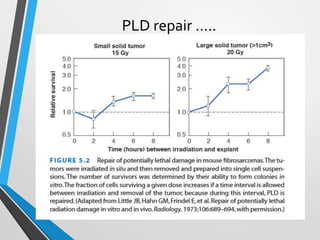
• Manipulation of post-RT environment – PLD can be repaired
• Repaired if cells are incubated in a balanced salt solution.
• But this treatment does not mimic a physiologic condition
• If mitosis is delayed by suboptimal growth conditions, DNA
damage can be repaired.
PLD Repair……
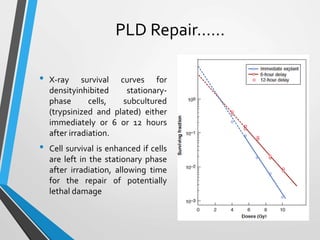
• X-ray survival curves for
densityinhibited stationary-
phase cells, subcultured
(trypsinized and plated) either
immediately or 6 or 12 hours
after irradiation.
• Cell survival is enhanced if cells
are left in the stationary phase
after irradiation, allowing time
for the repair of potentially
lethal damage
PLD repair …..
PLD & Radioresistance
• Radioresistance of certain types of human tumors is
linked to their ability to repair PLD
• Radiosensitive tumors repair PLD inefficiently
• Radioresistant tumors have efficient mechanisms to
repair PLD.
• This is an attractive hypothesis, but never been proven.
Sub Lethal Damage Repair
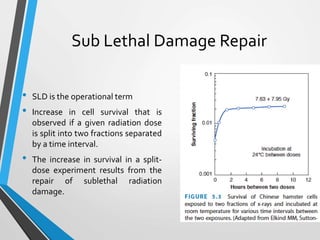
• SLD is the operational term
• Increase in cell survival that is
observed if a given radiation dose
is split into two fractions separated
by a time interval.
• The increase in survival in a split-
dose experiment results from the
repair of sublethal radiation
damage.
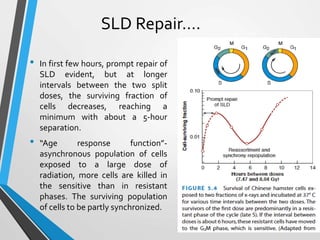
• In first few hours, prompt repair of
SLD evident, but at longer
intervals between the two split
doses, the surviving fraction of
cells decreases, reaching a
minimum with about a 5-hour
separation.
• “Age response function”-
asynchronous population of cells
exposed to a large dose of
radiation, more cells are killed in
the sensitive than in resistant
phases. The surviving population
of cells to be partly synchronized.
SLD Repair….
• Fig is a combination of 3 processes occurring
simultaneously.
• 1. the prompt repair of SLD.
• 2. Reassortment
• Progression of cells through the cell cycle.
• 3. Repopulation
• Increase of surviving fraction resulting from cell division.
SLD Repair……
Four R of Radiobiology
• “Four Rs” of radiobiology
• Repair
• Reassortment
• Repopulation
• Reoxygenation
• The dramatic dip in the split-dose curve at 6 hrs caused
by reassortment.
• The increase in survival by 12 hrs because of repopulation
are seen only for rapidly growing cells.
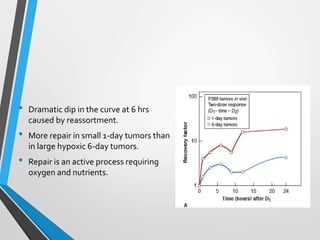
• Dramatic dip in the curve at 6 hrs
caused by reassortment.
• More repair in small 1-day tumors than
in large hypoxic 6-day tumors.
• Repair is an active process requiring
oxygen and nutrients.
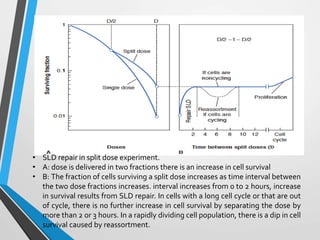
• SLD repair in split dose experiment.
• A: dose is delivered in two fractions there is an increase in cell survival
• B: The fraction of cells surviving a split dose increases as time interval between
the two dose fractions increases. interval increases from 0 to 2 hours, increase
in survival results from SLD repair. In cells with a long cell cycle or that are out
of cycle, there is no further increase in cell survival by separating the dose by
more than 2 or 3 hours. In a rapidly dividing cell population, there is a dip in cell
survival caused by reassortment.
Mechanism of SLD Repair
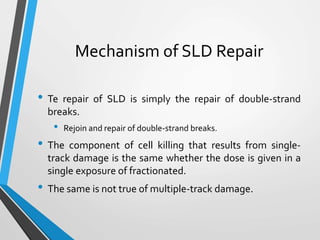
• Te repair of SLD is simply the repair of double-strand
breaks.
• Rejoin and repair of double-strand breaks.
• The component of cell killing that results from single-
track damage is the same whether the dose is given in a
single exposure of fractionated.
• The same is not true of multiple-track damage.
Repair and Radiation Quality
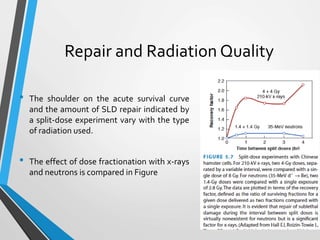
• The shoulder on the acute survival curve
and the amount of SLD repair indicated by
a split-dose experiment vary with the type
of radiation used.
• The effect of dose fractionation with x-rays
and neutrons is compared in Figure
The Dose-Rate Effect
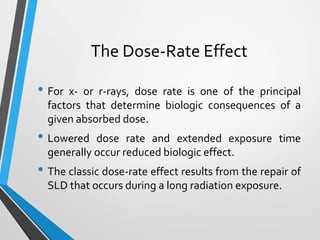
• For x- or r-rays, dose rate is one of the principal
factors that determine biologic consequences of a
given absorbed dose.
• Lowered dose rate and extended exposure time
generally occur reduced biologic effect.
• The classic dose-rate effect results from the repair of
SLD that occurs during a long radiation exposure.
Dose-Rate Effect……
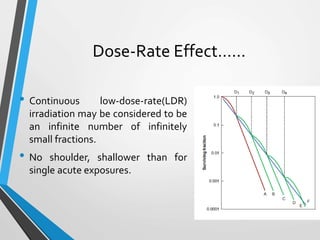
• Continuous low-dose-rate(LDR)
irradiation may be considered to be
an infinite number of infinitely
small fractions.
• No shoulder, shallower than for
single acute exposures.
DRE InVitro & InVivo
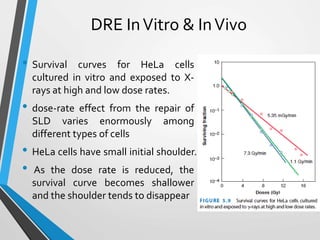
• Survival curves for HeLa cells
cultured in vitro and exposed to X-
rays at high and low dose rates.
• dose-rate effect from the repair of
SLD varies enormously among
different types of cells
• HeLa cells have small initial shoulder.
• As the dose rate is reduced, the
survival curve becomes shallower
and the shoulder tends to disappear
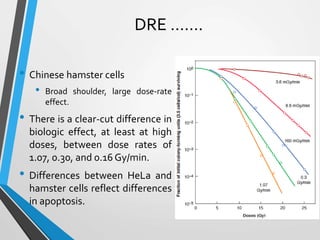
• Chinese hamster cells
• Broad shoulder, large dose-rate
effect.
• There is a clear-cut difference in
biologic effect, at least at high
doses, between dose rates of
1.07, 0.30, and 0.16 Gy/min.
• Differences between HeLa and
hamster cells reflect differences
in apoptosis.
DRE …….
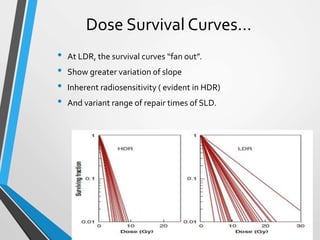
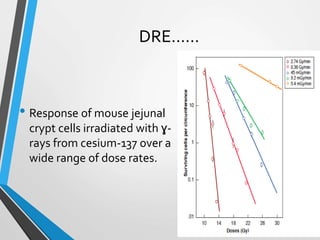
• At LDR, the survival curves “fan out”.
• Show greater variation of slope
• Inherent radiosensitivity ( evident in HDR)
• And variant range of repair times of SLD.
Dose Survival Curves…
• Response of mouse jejunal
crypt cells irradiated with ɣ-
rays from cesium-137 over a
wide range of dose rates.
DRE……
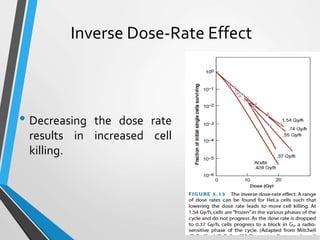
Inverse Dose-Rate Effect
• Decreasing the dose rate
results in increased cell
killing.
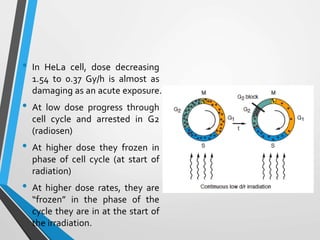
• In HeLa cell, dose decreasing
1.54 to 0.37 Gy/h is almost as
damaging as an acute exposure.
• At low dose progress through
cell cycle and arrested in G2
(radiosen)
• At higher dose they frozen in
phase of cell cycle (at start of
radiation)
• At higher dose rates, they are
“frozen” in the phase of the
cycle they are in at the start of
the irradiation.
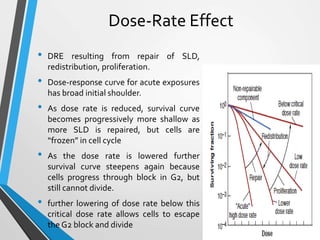
Dose-Rate Effect
• DRE resulting from repair of SLD,
redistribution, proliferation.
• Dose-response curve for acute exposures
has broad initial shoulder.
• As dose rate is reduced, survival curve
becomes progressively more shallow as
more SLD is repaired, but cells are
“frozen” in cell cycle
• As the dose rate is lowered further
survival curve steepens again because
cells progress through block in G2, but
still cannot divide.
• further lowering of dose rate below this
critical dose rate allows cells to escape
the G2 block and divide
Take Home……
• PLD repair can occur if cells are prevented from dividing for 6
hours or more after irradiation
• PLD repair is significant for x-rays but does not occur after
neutron irradiation.
• Half-time of SLD repair in mammalian cells is about 1 hour, but
it may be longer in late-responding normal tissues
• SLD repair is significant for x-rays, but almost nonexistent for
neutrons.
• dose rate is reduced, the slope of the survival curve becomes
shallower (D0 increases), and the shoulder tends to disappear.
Thank you

Fractionated radiation and dose rate effect

  • 1.
    Fractionated Radiation AndThe Dose-rate Effect PARAGROY DEPT OF RADIOTHARAPY LOK NAYAK HOSPITAL
  • 2.
    • Classifications ofRadiation Damage • Potentially Lethal Damage Repair • Sublethal Damage Repair • Mechanism of Sublethal Damage Repair • Repair and Radiation Quality • The Dose-Rate Effect • Examples of Dose-Rate Effect InVitro and InVivo • The Inverse Dose-Rate Effect Overview
  • 3.
    Classifications of RadiationDamage • Radiation damage to mammalian cells can operationally be divided. • (1) Lethal damage (LD) • Irreversible and irreparable • Leads irrevocably to cell death • (2) Potentially lethal damage (PLD) • Can be modified by post-irradiation environmental conditions • (3) Sublethal damage (SLD) • Can be repaired in hours unless additional SLD is added.
  • 4.
    Potentially Lethal DamageRepair • Potentially lethal : under ordinary circumstances, it causes cell death. • Manipulation of post-RT environment – PLD can be repaired • Repaired if cells are incubated in a balanced salt solution. • But this treatment does not mimic a physiologic condition • If mitosis is delayed by suboptimal growth conditions, DNA damage can be repaired.
  • 5.
    PLD Repair…… • X-raysurvival curves for densityinhibited stationary- phase cells, subcultured (trypsinized and plated) either immediately or 6 or 12 hours after irradiation. • Cell survival is enhanced if cells are left in the stationary phase after irradiation, allowing time for the repair of potentially lethal damage
  • 6.
  • 7.
    PLD & Radioresistance •Radioresistance of certain types of human tumors is linked to their ability to repair PLD • Radiosensitive tumors repair PLD inefficiently • Radioresistant tumors have efficient mechanisms to repair PLD. • This is an attractive hypothesis, but never been proven.
  • 8.
    Sub Lethal DamageRepair • SLD is the operational term • Increase in cell survival that is observed if a given radiation dose is split into two fractions separated by a time interval. • The increase in survival in a split- dose experiment results from the repair of sublethal radiation damage.
  • 9.
    • In firstfew hours, prompt repair of SLD evident, but at longer intervals between the two split doses, the surviving fraction of cells decreases, reaching a minimum with about a 5-hour separation. • “Age response function”- asynchronous population of cells exposed to a large dose of radiation, more cells are killed in the sensitive than in resistant phases. The surviving population of cells to be partly synchronized. SLD Repair….
  • 10.
    • Fig isa combination of 3 processes occurring simultaneously. • 1. the prompt repair of SLD. • 2. Reassortment • Progression of cells through the cell cycle. • 3. Repopulation • Increase of surviving fraction resulting from cell division. SLD Repair……
  • 11.
    Four R ofRadiobiology • “Four Rs” of radiobiology • Repair • Reassortment • Repopulation • Reoxygenation • The dramatic dip in the split-dose curve at 6 hrs caused by reassortment. • The increase in survival by 12 hrs because of repopulation are seen only for rapidly growing cells.
  • 12.
    • Dramatic dipin the curve at 6 hrs caused by reassortment. • More repair in small 1-day tumors than in large hypoxic 6-day tumors. • Repair is an active process requiring oxygen and nutrients.
  • 13.
    • SLD repairin split dose experiment. • A: dose is delivered in two fractions there is an increase in cell survival • B: The fraction of cells surviving a split dose increases as time interval between the two dose fractions increases. interval increases from 0 to 2 hours, increase in survival results from SLD repair. In cells with a long cell cycle or that are out of cycle, there is no further increase in cell survival by separating the dose by more than 2 or 3 hours. In a rapidly dividing cell population, there is a dip in cell survival caused by reassortment.
  • 14.
    Mechanism of SLDRepair • Te repair of SLD is simply the repair of double-strand breaks. • Rejoin and repair of double-strand breaks. • The component of cell killing that results from single- track damage is the same whether the dose is given in a single exposure of fractionated. • The same is not true of multiple-track damage.
  • 15.
    Repair and RadiationQuality • The shoulder on the acute survival curve and the amount of SLD repair indicated by a split-dose experiment vary with the type of radiation used. • The effect of dose fractionation with x-rays and neutrons is compared in Figure
  • 16.
    The Dose-Rate Effect •For x- or r-rays, dose rate is one of the principal factors that determine biologic consequences of a given absorbed dose. • Lowered dose rate and extended exposure time generally occur reduced biologic effect. • The classic dose-rate effect results from the repair of SLD that occurs during a long radiation exposure.
  • 17.
    Dose-Rate Effect…… • Continuouslow-dose-rate(LDR) irradiation may be considered to be an infinite number of infinitely small fractions. • No shoulder, shallower than for single acute exposures.
  • 18.
    DRE InVitro &InVivo • Survival curves for HeLa cells cultured in vitro and exposed to X- rays at high and low dose rates. • dose-rate effect from the repair of SLD varies enormously among different types of cells • HeLa cells have small initial shoulder. • As the dose rate is reduced, the survival curve becomes shallower and the shoulder tends to disappear
  • 19.
    • Chinese hamstercells • Broad shoulder, large dose-rate effect. • There is a clear-cut difference in biologic effect, at least at high doses, between dose rates of 1.07, 0.30, and 0.16 Gy/min. • Differences between HeLa and hamster cells reflect differences in apoptosis. DRE …….
  • 20.
    • At LDR,the survival curves “fan out”. • Show greater variation of slope • Inherent radiosensitivity ( evident in HDR) • And variant range of repair times of SLD. Dose Survival Curves…
  • 21.
    • Response ofmouse jejunal crypt cells irradiated with ɣ- rays from cesium-137 over a wide range of dose rates. DRE……
  • 22.
    Inverse Dose-Rate Effect •Decreasing the dose rate results in increased cell killing.
  • 23.
    • In HeLacell, dose decreasing 1.54 to 0.37 Gy/h is almost as damaging as an acute exposure. • At low dose progress through cell cycle and arrested in G2 (radiosen) • At higher dose they frozen in phase of cell cycle (at start of radiation) • At higher dose rates, they are “frozen” in the phase of the cycle they are in at the start of the irradiation.
  • 24.
    Dose-Rate Effect • DREresulting from repair of SLD, redistribution, proliferation. • Dose-response curve for acute exposures has broad initial shoulder. • As dose rate is reduced, survival curve becomes progressively more shallow as more SLD is repaired, but cells are “frozen” in cell cycle • As the dose rate is lowered further survival curve steepens again because cells progress through block in G2, but still cannot divide. • further lowering of dose rate below this critical dose rate allows cells to escape the G2 block and divide
  • 25.
    Take Home…… • PLDrepair can occur if cells are prevented from dividing for 6 hours or more after irradiation • PLD repair is significant for x-rays but does not occur after neutron irradiation. • Half-time of SLD repair in mammalian cells is about 1 hour, but it may be longer in late-responding normal tissues • SLD repair is significant for x-rays, but almost nonexistent for neutrons. • dose rate is reduced, the slope of the survival curve becomes shallower (D0 increases), and the shoulder tends to disappear.
  • 26.

Editor's Notes

  • #15  asymmetric chromosomal aberrations such as dicentrics and rings. This, in turn, is consequence of an interaction between two (more) double-strand breaks in the DNA. Based on this interpretation, the repair of SLD is simply the repair of double-strand breaks. If a dose is split into two parts separated by a time interval, some of the double-strand breaks produced by the fi rst dose are rejoined and repaired before the second dose. The breaks in two chromosomes that must interact to form a lethal lesion such as a dicentric may be formed by (1) a single track breaking both chromosomes (i.e., singletrack damage), or (2) separate tracks breaking the two chromosomes (i.e., multiple-track damage).