Yousaf khan
Renal Dialysis
Lecturer
IPMS-KMU
DIABETIC KIDNEY
DISEASE
(DIABETIC
NEPHROPATHY)
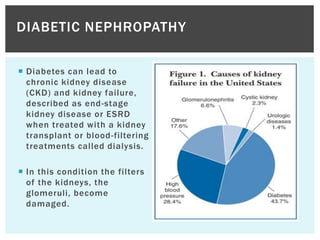
 Diabetes can lead to
chronic kidney disease
(CKD) and kidney failure,
described as end-stage
kidney disease or ESRD
when treated with a kidney
transplant or blood-filtering
treatments called dialysis.
 In this condition the filters
of the kidneys, the
glomeruli, become
damaged.
DIABETIC NEPHROPATHY
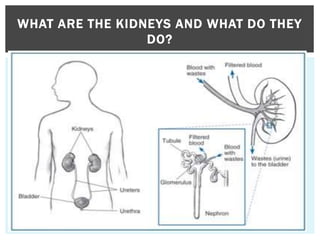
WHAT ARE THE KIDNEYS AND WHAT DO THEY
DO?
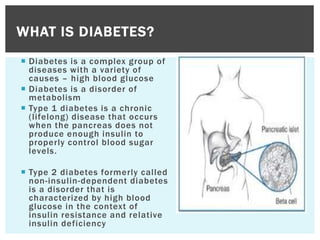
 Diabetes is a complex group of
diseases with a variety of
causes – high blood glucose
 Diabetes is a disorder of
metabolism
 Type 1 diabetes is a chronic
(lifelong) disease that occurs
when the pancreas does not
produce enough insulin to
properly control blood sugar
levels.
 Type 2 diabetes formerly called
non-insulin-dependent diabetes
is a disorder that is
characterized by high blood
glucose in the context of
insulin resistance and relative
insulin deficiency
WHAT IS DIABETES?
 Diabetes leads to kidney disease in several ways.
 At the onset of diabetes, blood flow into the kidneys increases,
which may strain the glomeruli and lessen their ability to filter
blood. Higher levels of blood glucose lead to the buildup of extra
material in the glomeruli, which increases the force of the blood
moving through the kidneys and creates stress in the glomeruli.
 This stress leads to gradual and progressive scarring of the
glomeruli, eventually reducing the kidneys’ ability to filter blood
properly.
 Other factors—including heredity, diet, lifestyle, and other
medical conditions—are also involved in the development of
kidney disease
HOW DOES DIABETES LEAD TO KIDNEY
DISEASE?
 Diabetic kidney disease takes many years to develop.
 High levels of blood glucose cause the kidneys to filter blood
at a higher rate than normal.
 Over time, the stress on the kidneys can decrease their ability
to filter blood normally.
 Albumin, the main protein found in blood, normally remains in
the bloodstream.
 When the kidneys’ filtering units are damaged, albumin may
be able to pass through the filter and into the urine.
 A slightly increased level of albumin in the urine is an early
sign of diabetic kidney disease and the first stage of CKD.
HOW DOES DIABETIC KIDNEY DISEASE
PROGRESS?
 The kidneys’ ability to filter blood typically remains normal
during this stage.
 As CKD progresses, more albumin leaks out of the blood and
into the urine, and it becomes more difficult for the kidneys to
excrete water and salt. As a result, a person may
 hold more salt in the body
 hold various wastes in the body
 have higher blood pressure
 experience swelling of the legs caused by extra fluid in the
body
HOW DOES DIABETIC KIDNEY DISEASE
PROGRESS?
 There are often no symptoms with early diabetic nephropathy.
As the kidney function worsens, symptoms may include:
 Swelling of the hands, feet, and face
 Trouble sleeping or concentrating
 Poor appetite
 Nausea
 Weakness
 Itching (end-stage kidney disease) and extremely dry skin
 Drowsiness (end-stage kidney disease)
 Abnormalities in the hearts' regular rhythm, because of
increased potassium in the blood
 Muscle twitching
SYMPTOMS OF DIABETIC KIDNEY DISEASE
 A health care provider diagnoses diabetic kidney disease
based on
A medical and family history
A physical exam:
(examines the patient’s body to check for changes in skin color
taps on specific areas of the patient’s body, checking for
swelling of the feet, ankles, or lower legs)
urine tests
Dipstick test for albumin
Urine albumin-to-creatinine ratio
HOW IS DIABETIC KIDNEY DISEASE
DIAGNOSED?
Blood Test:
The results of the test indicate the following:
 eGFR of 60 or above is in the normal range
 eGFR below 60 may indicate kidney damage
 eGFR of 15 or below may indicate kidney failure
Get Screened for Kidney Disease
 People with diabetes should get regular screenings for kidney
disease. The National Kidney Disease Education Program
recommends the following:
 urine albumin-to-creatinine ratio measured at least once a year
in all people with type 2 diabetes and people who have had
type 1 diabetes for 5 years or more
 eGFR calculated at least once a year in all people with type 1
or type 2 diabetes
HOW IS DIABETIC KIDNEY DISEASE DIAGNOSED?
Prevent or slow the progression of diabetic kidney disease by
 taking medications to control high blood pressure
 managing blood glucose levels
 making changes in their eating, diet, and nutrition
 losing weight if they are overweight or obese
 getting regular physical activity
PREVENT OR SLOW THE PROGRESSION OF
DIABETIC KIDNEY DISEASE
 People with diabetes should see a health care provider who
will help them learn to manage their diabetes and monitor
their diabetes control
 an endocrinologist—a doctor with special training in diabetes
 a nephrologist—a doctor who specializes in treating people
who have kidney problems or related conditions
 diabetes educators such as a nurse or dietitian
 a podiatrist—a doctor who specializes in foot care
 an ophthalmologist or optometrist for eye care
 a pharmacist
 a dentist
 a mental health counselor for emotional support and access
to community resources
People manage blood glucose levels by
 testing blood glucose throughout the day
 following a diet and physical activity plan
 taking insulin throughout the day based on food and liquid
intake and physical activity
People with diabetes need to talk with their health care team
regularly and follow their directions closely. The goal is to keep
blood glucose levels within the normal range or within a range
set by the person’s health care team
MANAGING BLOOD GLUCOSE LEVELS
 Following a healthy eating plan can help lower blood pressure and
control blood sugar. A health care provider may recommend the
Dietary Approaches to Stop Hypertension (DASH) eating plan.
 DASH focuses on fruits, vegetables, whole grains, and other foods
that are heart healthy and lower in sodium, which often comes from
salt.
 is low in fat and cholesterol
 features fat-free or low-fat milk and dairy products, fish, poultry,
and nuts
 suggests less red meat, and fewer sweets, added sugars, and
sugarcontaining beverages
 is rich in nutrients, protein, and fiber
People with diabetic kidney disease may need to limit sodium and salt
intake to help reduce edema and lower blood pressure. A dietitian
may also recommend a diet low in saturated fat and cholesterol to
help control high levels of lipids, or fats, in the blood.
Weight Loss and Physical Activity
EATING, DIET, AND NUTRITION
 A health care provider may treat kidney failure due to diabetic
kidney disease with dialysis or a kidney transplant. In some
cases, people with diabetic kidney disease receive kidney and
pancreas transplants.
HOW IS KIDNEY FAILURE DUE TO DIABETIC
KIDNEY DISEASE TREATED?
 People with diabetes should work with their health care
team to prevent or manage CKD through the following steps:
 measure A1C levels—a blood test that provides information
about a person’s average blood glucose levels for the
previous 3 months— at least twice a year and keep A1C
levels below 7 percent
 learn about insulin injections, diabetes medications, meal
planning, physical activity, and blood glucose monitoring
WORK WITH THE HEALTH CARE TEAM TO MANAGE
DIABETES AND CHRONIC KIDNEY DISEASE
 find out whether protein, salt, or liquid should be limited in
the diet
 see a registered dietitian to help with meal planning
 check blood pressure every visit with a health care provider or
at least two to four times a year
 learn about possible benefits from taking an ACE inhibitor or
an ARB if a person has high blood pressure
 measure eGFR at least once a year to check kidney function
 get the amount of protein in the urine tested at least once a
year to check for kidney damage
WORK WITH THE HEALTH CARE TEAM TO MANAGE
DIABETES AND CHRONIC KIDNEY DISEASE
Thank You

Diabetic kidney disease

  • 1.
    Yousaf khan Renal Dialysis Lecturer IPMS-KMU DIABETICKIDNEY DISEASE (DIABETIC NEPHROPATHY)
  • 2.
     Diabetes canlead to chronic kidney disease (CKD) and kidney failure, described as end-stage kidney disease or ESRD when treated with a kidney transplant or blood-filtering treatments called dialysis.  In this condition the filters of the kidneys, the glomeruli, become damaged. DIABETIC NEPHROPATHY
  • 3.
    WHAT ARE THEKIDNEYS AND WHAT DO THEY DO?
  • 4.
     Diabetes isa complex group of diseases with a variety of causes – high blood glucose  Diabetes is a disorder of metabolism  Type 1 diabetes is a chronic (lifelong) disease that occurs when the pancreas does not produce enough insulin to properly control blood sugar levels.  Type 2 diabetes formerly called non-insulin-dependent diabetes is a disorder that is characterized by high blood glucose in the context of insulin resistance and relative insulin deficiency WHAT IS DIABETES?
  • 5.
     Diabetes leadsto kidney disease in several ways.  At the onset of diabetes, blood flow into the kidneys increases, which may strain the glomeruli and lessen their ability to filter blood. Higher levels of blood glucose lead to the buildup of extra material in the glomeruli, which increases the force of the blood moving through the kidneys and creates stress in the glomeruli.  This stress leads to gradual and progressive scarring of the glomeruli, eventually reducing the kidneys’ ability to filter blood properly.  Other factors—including heredity, diet, lifestyle, and other medical conditions—are also involved in the development of kidney disease HOW DOES DIABETES LEAD TO KIDNEY DISEASE?
  • 6.
     Diabetic kidneydisease takes many years to develop.  High levels of blood glucose cause the kidneys to filter blood at a higher rate than normal.  Over time, the stress on the kidneys can decrease their ability to filter blood normally.  Albumin, the main protein found in blood, normally remains in the bloodstream.  When the kidneys’ filtering units are damaged, albumin may be able to pass through the filter and into the urine.  A slightly increased level of albumin in the urine is an early sign of diabetic kidney disease and the first stage of CKD. HOW DOES DIABETIC KIDNEY DISEASE PROGRESS?
  • 7.
     The kidneys’ability to filter blood typically remains normal during this stage.  As CKD progresses, more albumin leaks out of the blood and into the urine, and it becomes more difficult for the kidneys to excrete water and salt. As a result, a person may  hold more salt in the body  hold various wastes in the body  have higher blood pressure  experience swelling of the legs caused by extra fluid in the body HOW DOES DIABETIC KIDNEY DISEASE PROGRESS?
  • 8.
     There areoften no symptoms with early diabetic nephropathy. As the kidney function worsens, symptoms may include:  Swelling of the hands, feet, and face  Trouble sleeping or concentrating  Poor appetite  Nausea  Weakness  Itching (end-stage kidney disease) and extremely dry skin  Drowsiness (end-stage kidney disease)  Abnormalities in the hearts' regular rhythm, because of increased potassium in the blood  Muscle twitching SYMPTOMS OF DIABETIC KIDNEY DISEASE
  • 9.
     A healthcare provider diagnoses diabetic kidney disease based on A medical and family history A physical exam: (examines the patient’s body to check for changes in skin color taps on specific areas of the patient’s body, checking for swelling of the feet, ankles, or lower legs) urine tests Dipstick test for albumin Urine albumin-to-creatinine ratio HOW IS DIABETIC KIDNEY DISEASE DIAGNOSED?
  • 10.
    Blood Test: The resultsof the test indicate the following:  eGFR of 60 or above is in the normal range  eGFR below 60 may indicate kidney damage  eGFR of 15 or below may indicate kidney failure Get Screened for Kidney Disease  People with diabetes should get regular screenings for kidney disease. The National Kidney Disease Education Program recommends the following:  urine albumin-to-creatinine ratio measured at least once a year in all people with type 2 diabetes and people who have had type 1 diabetes for 5 years or more  eGFR calculated at least once a year in all people with type 1 or type 2 diabetes HOW IS DIABETIC KIDNEY DISEASE DIAGNOSED?
  • 11.
    Prevent or slowthe progression of diabetic kidney disease by  taking medications to control high blood pressure  managing blood glucose levels  making changes in their eating, diet, and nutrition  losing weight if they are overweight or obese  getting regular physical activity PREVENT OR SLOW THE PROGRESSION OF DIABETIC KIDNEY DISEASE
  • 12.
     People withdiabetes should see a health care provider who will help them learn to manage their diabetes and monitor their diabetes control  an endocrinologist—a doctor with special training in diabetes  a nephrologist—a doctor who specializes in treating people who have kidney problems or related conditions  diabetes educators such as a nurse or dietitian  a podiatrist—a doctor who specializes in foot care  an ophthalmologist or optometrist for eye care  a pharmacist  a dentist  a mental health counselor for emotional support and access to community resources
  • 13.
    People manage bloodglucose levels by  testing blood glucose throughout the day  following a diet and physical activity plan  taking insulin throughout the day based on food and liquid intake and physical activity People with diabetes need to talk with their health care team regularly and follow their directions closely. The goal is to keep blood glucose levels within the normal range or within a range set by the person’s health care team MANAGING BLOOD GLUCOSE LEVELS
  • 14.
     Following ahealthy eating plan can help lower blood pressure and control blood sugar. A health care provider may recommend the Dietary Approaches to Stop Hypertension (DASH) eating plan.  DASH focuses on fruits, vegetables, whole grains, and other foods that are heart healthy and lower in sodium, which often comes from salt.  is low in fat and cholesterol  features fat-free or low-fat milk and dairy products, fish, poultry, and nuts  suggests less red meat, and fewer sweets, added sugars, and sugarcontaining beverages  is rich in nutrients, protein, and fiber People with diabetic kidney disease may need to limit sodium and salt intake to help reduce edema and lower blood pressure. A dietitian may also recommend a diet low in saturated fat and cholesterol to help control high levels of lipids, or fats, in the blood. Weight Loss and Physical Activity EATING, DIET, AND NUTRITION
  • 15.
     A healthcare provider may treat kidney failure due to diabetic kidney disease with dialysis or a kidney transplant. In some cases, people with diabetic kidney disease receive kidney and pancreas transplants. HOW IS KIDNEY FAILURE DUE TO DIABETIC KIDNEY DISEASE TREATED?
  • 16.
     People withdiabetes should work with their health care team to prevent or manage CKD through the following steps:  measure A1C levels—a blood test that provides information about a person’s average blood glucose levels for the previous 3 months— at least twice a year and keep A1C levels below 7 percent  learn about insulin injections, diabetes medications, meal planning, physical activity, and blood glucose monitoring WORK WITH THE HEALTH CARE TEAM TO MANAGE DIABETES AND CHRONIC KIDNEY DISEASE
  • 17.
     find outwhether protein, salt, or liquid should be limited in the diet  see a registered dietitian to help with meal planning  check blood pressure every visit with a health care provider or at least two to four times a year  learn about possible benefits from taking an ACE inhibitor or an ARB if a person has high blood pressure  measure eGFR at least once a year to check kidney function  get the amount of protein in the urine tested at least once a year to check for kidney damage WORK WITH THE HEALTH CARE TEAM TO MANAGE DIABETES AND CHRONIC KIDNEY DISEASE
  • 18.