THERAPEUTIC
INDEX
 A ratio that compares the blood
concentration at which a drug
becomes toxic and the concentration
at which the drug is effective.
 The ratio between the dosage of a
drug that causes a lethal effect and
the dosage that causes a therapeutic
effect.
 The larger the therapeutic index (TI),
the safer the drug is.
 If the TI is small (the difference
between the two concentrations is
very small), the drug must be dosed
carefully and the person receiving
the drug should be monitored closely
for any signs of drug toxicity.
 The Therapeutic Index (TI) is used to compare the therapeutically effective dose to the
toxic dose of a pharmaceutical agent.
 The TI is a statement of relative safety of a drug.
 It is the ratio of the dose that produces toxicity to the dose needed to produce the desired
therapeutic response.
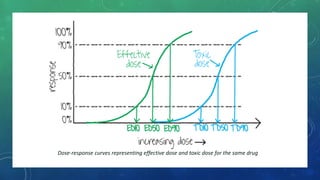
 The common method used to derive the TI is to use the 50% dose-response points,
including TD50 (toxic dose) and ED50 (effective dose).
DOSE RESPONSE
 The dose-response relationship is an essential concept in toxicology. It correlates exposures with
changes in body functions or health.
 In general, the higher the dose, the more severe the response. The dose-response relationship is
based on observed data from experimental animal, human clinical, or cell studies.
 Knowledge of the dose-response relationship establishes:
 Causality — that the chemical has induced the observed effects.
 The threshold effect — the lowest dose where an induced effect occurs.
 The slope for the dose response — the rate at which injury builds up.
LETHAL DOSES/CONCENTRATIONS
Lethal Dose 0% (LD0) — represents the dose at
which no individuals are expected to die. This is
just below the threshold for lethality.
Lethal Dose 10% (LD10) — refers to the dose at
which 10% of the individuals will die.
Lethal Concentration 50% (LC50) — for
inhalation toxicity, air concentrations are used
for exposure values. The LC50 refers to the
calculated concentration of a gas lethal to 50% of a
group. Occasionally LC0 and LC10 are also used.
EFFECTIVE DOSES
(EDS)
 Effective Doses (EDs) are used to
indicate the effectiveness of
a substance.
 Normally, effective dose refers to
a beneficial effect such as relief of
pain. It may also stand for a
harmful effect such as paralysis.
 Thus, the specific endpoint must
be indicated.
Term Effective for this percentage of
the population
ED0 0%
ED10 10%
ED50 50%
ED90 90%
Dose-response curves representing effective dose and toxic dose for the same drug
Therapeutic index

Therapeutic index

  • 1.
  • 2.
     A ratiothat compares the blood concentration at which a drug becomes toxic and the concentration at which the drug is effective.  The ratio between the dosage of a drug that causes a lethal effect and the dosage that causes a therapeutic effect.  The larger the therapeutic index (TI), the safer the drug is.  If the TI is small (the difference between the two concentrations is very small), the drug must be dosed carefully and the person receiving the drug should be monitored closely for any signs of drug toxicity.
  • 4.
     The TherapeuticIndex (TI) is used to compare the therapeutically effective dose to the toxic dose of a pharmaceutical agent.  The TI is a statement of relative safety of a drug.  It is the ratio of the dose that produces toxicity to the dose needed to produce the desired therapeutic response.  The common method used to derive the TI is to use the 50% dose-response points, including TD50 (toxic dose) and ED50 (effective dose).
  • 5.
    DOSE RESPONSE  Thedose-response relationship is an essential concept in toxicology. It correlates exposures with changes in body functions or health.  In general, the higher the dose, the more severe the response. The dose-response relationship is based on observed data from experimental animal, human clinical, or cell studies.  Knowledge of the dose-response relationship establishes:  Causality — that the chemical has induced the observed effects.  The threshold effect — the lowest dose where an induced effect occurs.  The slope for the dose response — the rate at which injury builds up.
  • 6.
    LETHAL DOSES/CONCENTRATIONS Lethal Dose0% (LD0) — represents the dose at which no individuals are expected to die. This is just below the threshold for lethality. Lethal Dose 10% (LD10) — refers to the dose at which 10% of the individuals will die. Lethal Concentration 50% (LC50) — for inhalation toxicity, air concentrations are used for exposure values. The LC50 refers to the calculated concentration of a gas lethal to 50% of a group. Occasionally LC0 and LC10 are also used.
  • 7.
    EFFECTIVE DOSES (EDS)  EffectiveDoses (EDs) are used to indicate the effectiveness of a substance.  Normally, effective dose refers to a beneficial effect such as relief of pain. It may also stand for a harmful effect such as paralysis.  Thus, the specific endpoint must be indicated. Term Effective for this percentage of the population ED0 0% ED10 10% ED50 50% ED90 90%
  • 8.
    Dose-response curves representingeffective dose and toxic dose for the same drug