

Dose Response Curve
Dr. Pankaj Kumar Gupta
Assistant Professor,
Department of Pharmacology,
ESIC Medical College & Hospital, Faridabad
Dose & Response
Dose
• Amount of drug to administered to produce a
certain degree of response in a patient.
Response
• The change in activity of the cell or tissue
produce by the selected dose of the drug is
called the response.
• The dose and response is closely related to each
other and this relationship is called as Dose
response relationship.
• There is direct relationship between dose &
intensity of response of the curve- i.e. the
intensity of response increases with the increase
in dose.
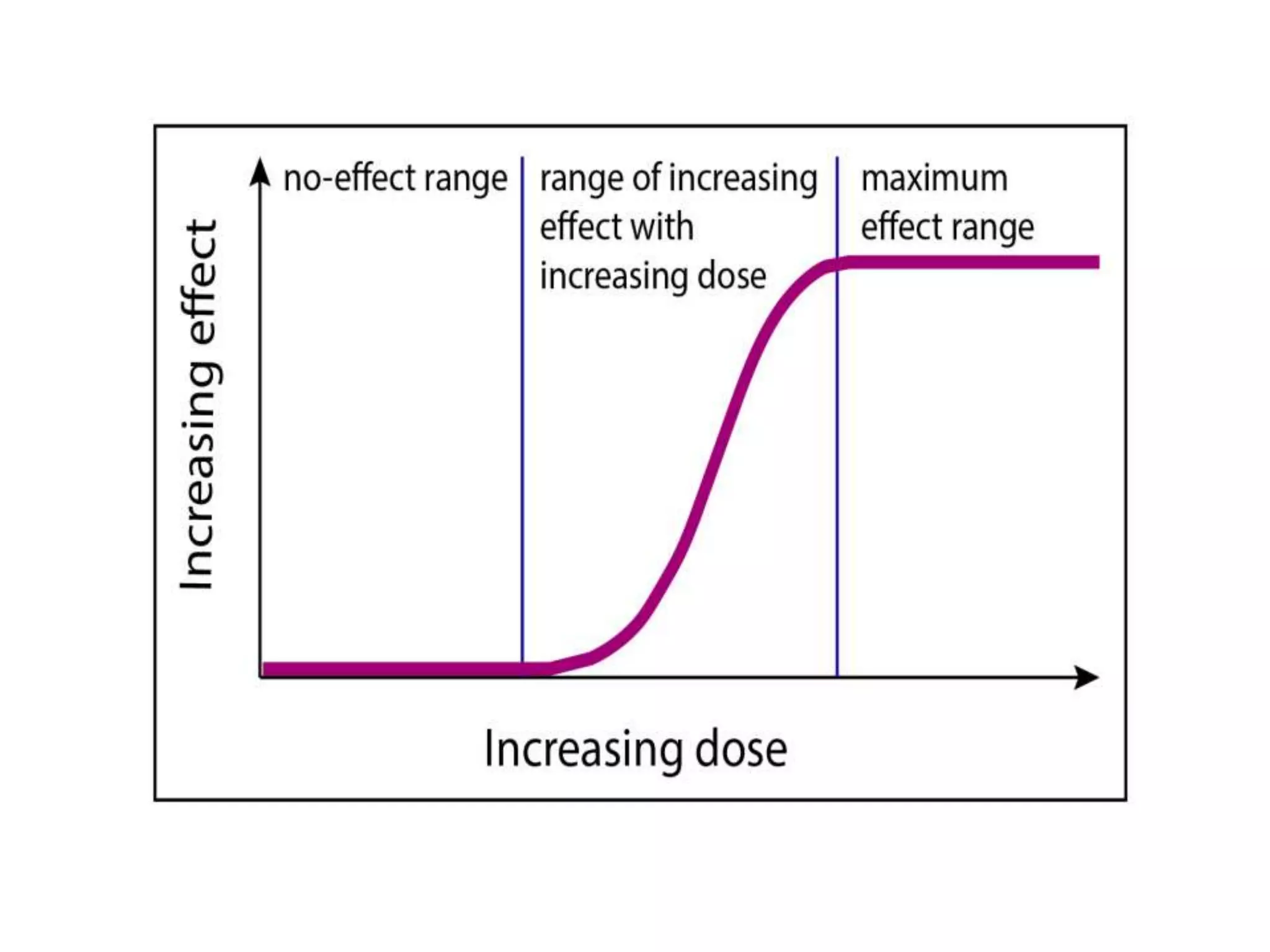
• A typical curve showing the dose response
relationship is called dose response curve (DRC).
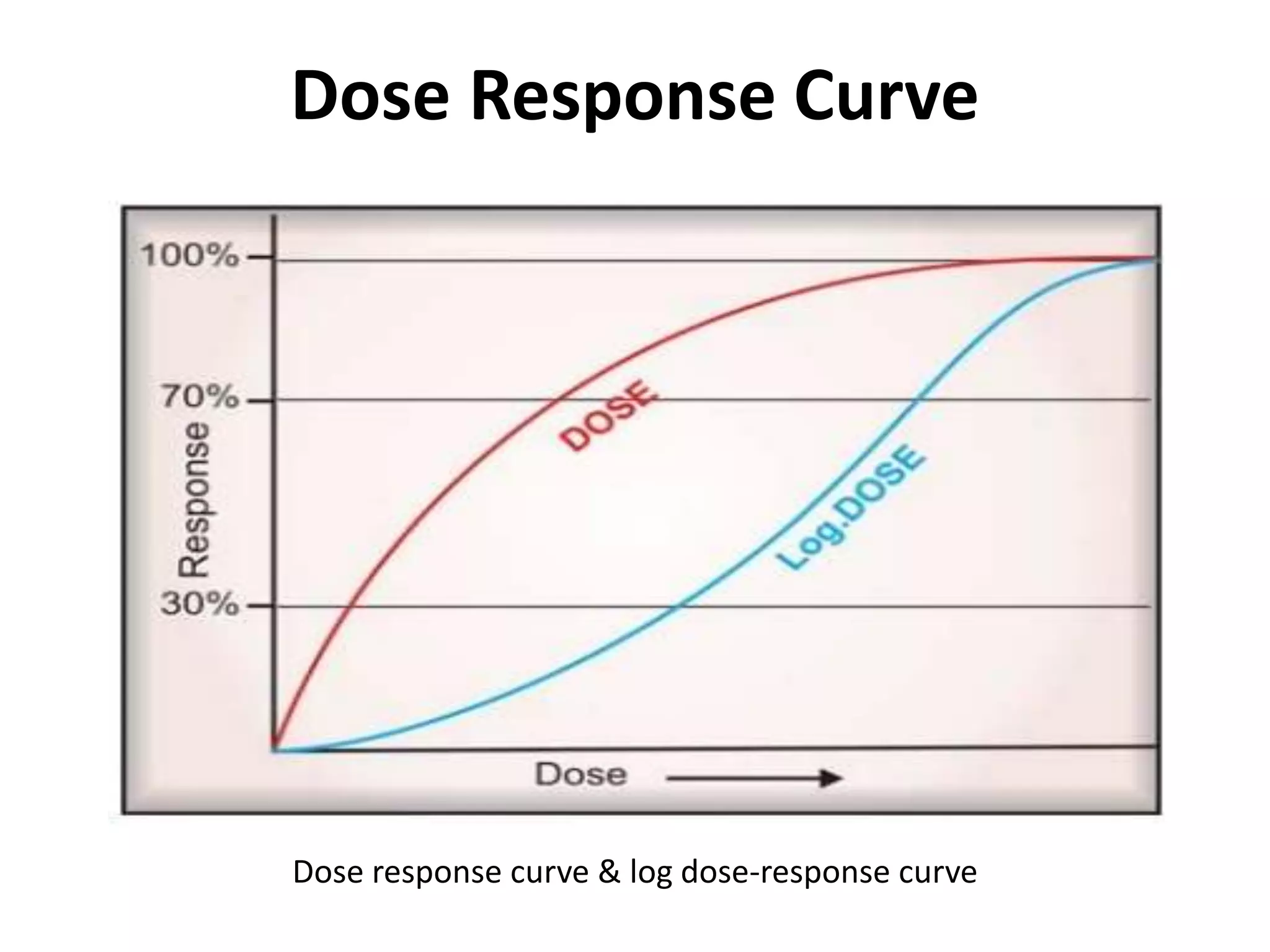
Dose Response Curve
Dose response curve & log dose-response curve
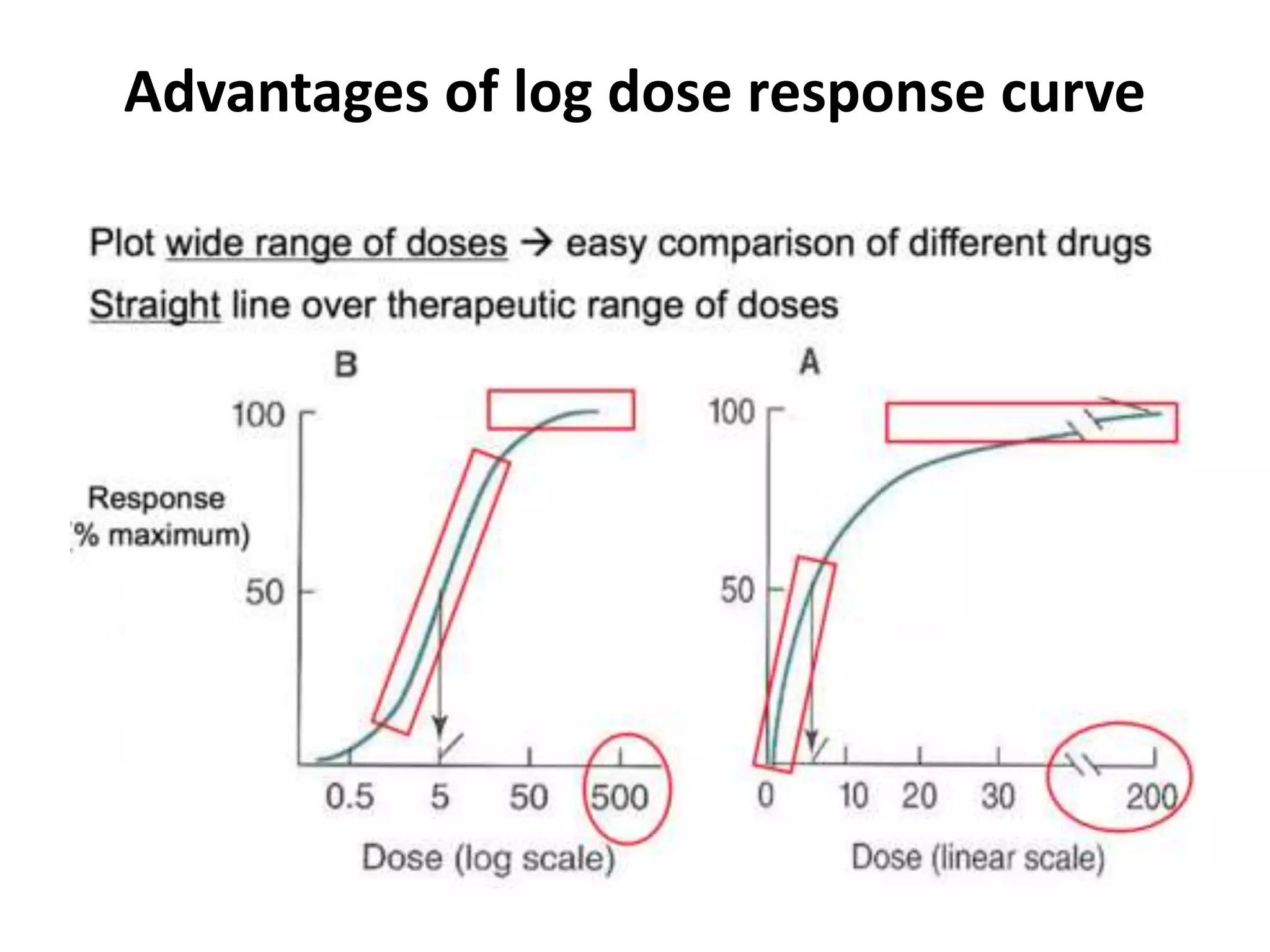
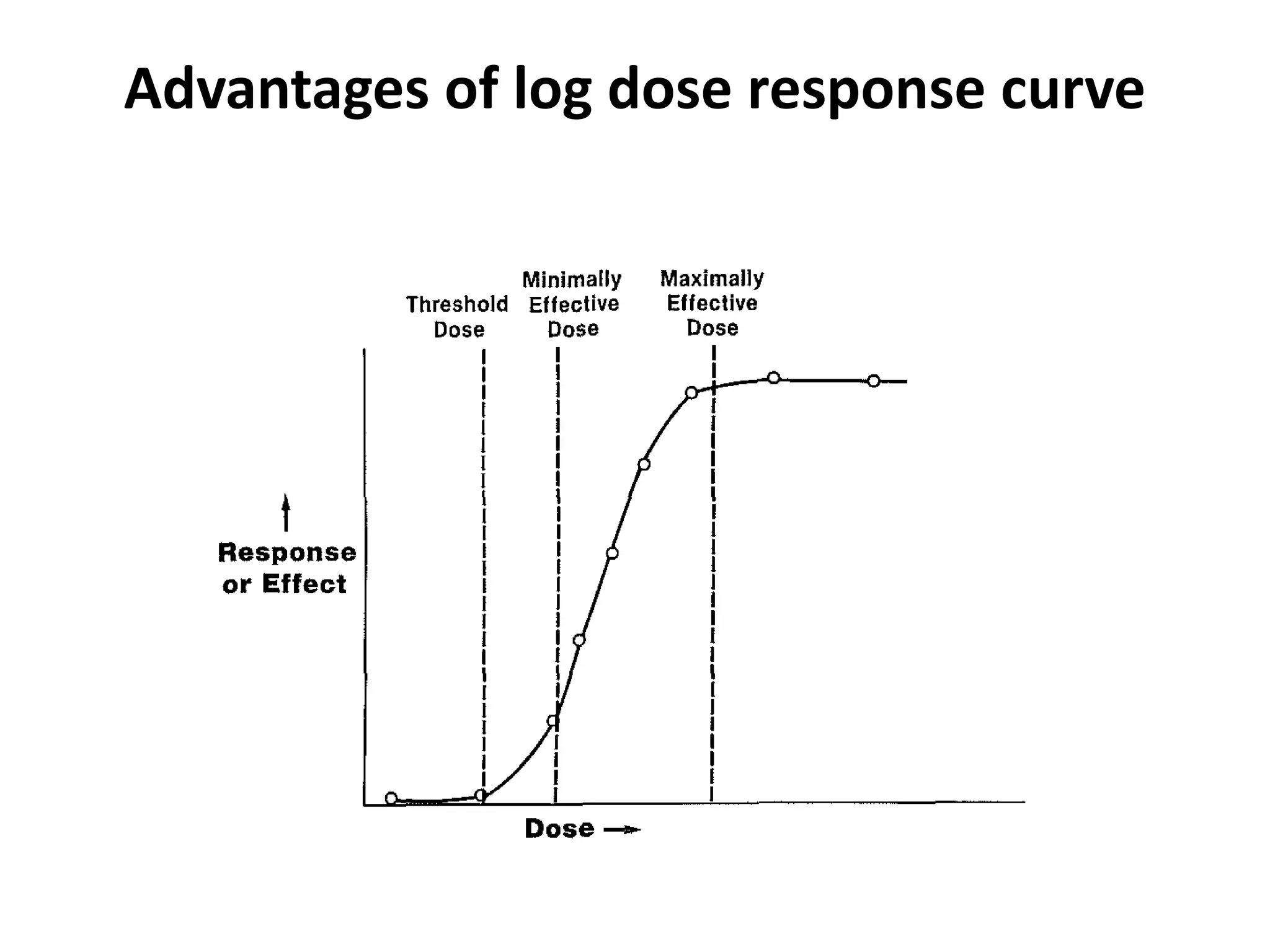
Advantages of log dose response curve
• Curvilinear (rectangular hyperbola) Vs Sigmoid curve.
• If the dose is plotted on a logarithmic scale, the curve
becomes sigmoid (S-shape) & a linear relationship between
log of dose & the response is seen in the intermediate (30-
70% response) zone.
• A wide range of drug doses can be easily displayed on a graph.
• rectangular hyperbola) Vs Sigmoid curve. can be estimated
easily with sigmoid curve as compared to curvilinear curve.
• Comparison between agonists and study of antagonists
becomes easier.
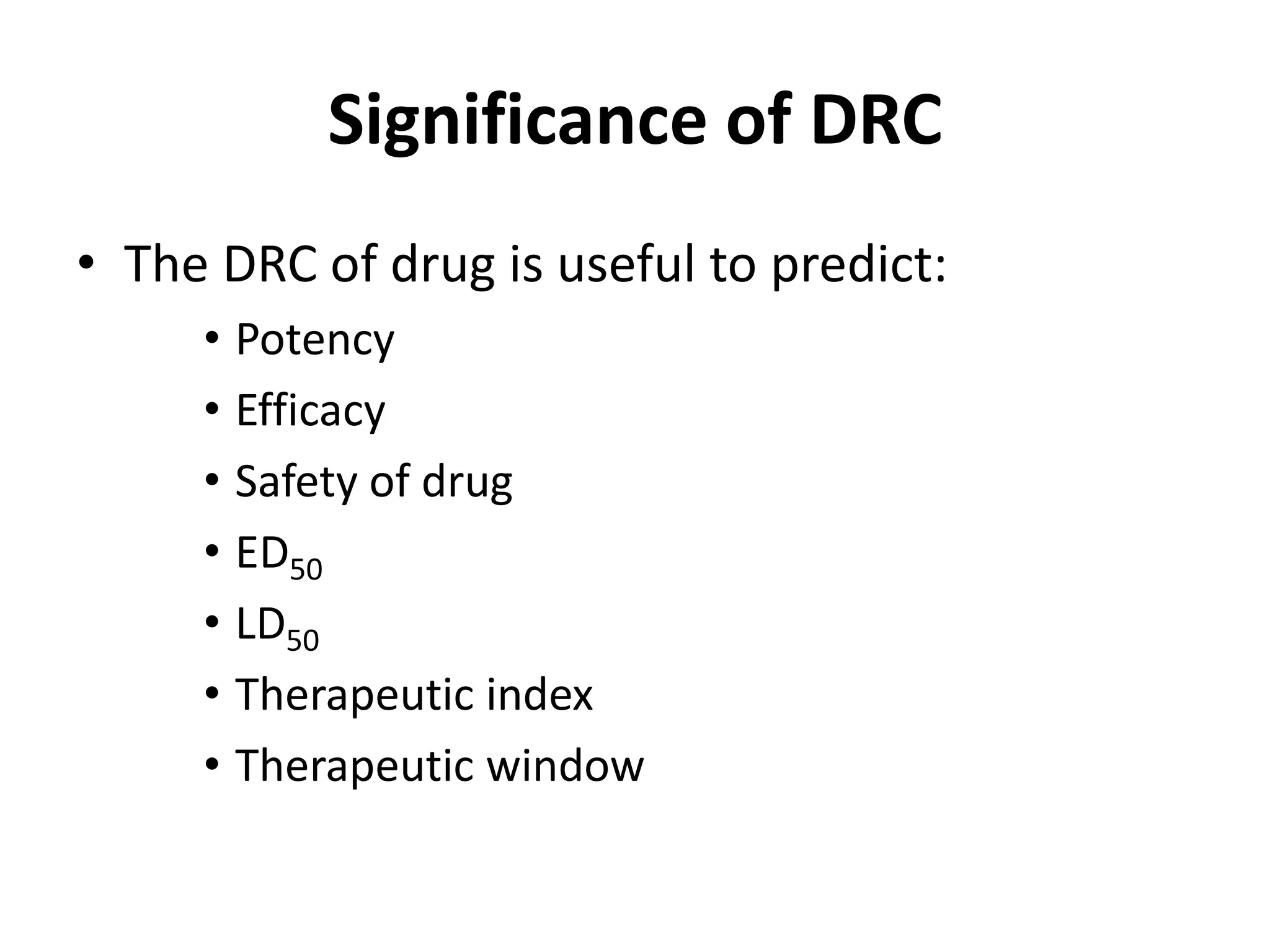
Significance of DRC
• The DRC of drug is useful to predict:
• Potency
• Efficacy
• Safety of drug
• ED50
• LD50
• Therapeutic index
• Therapeutic window
Potency
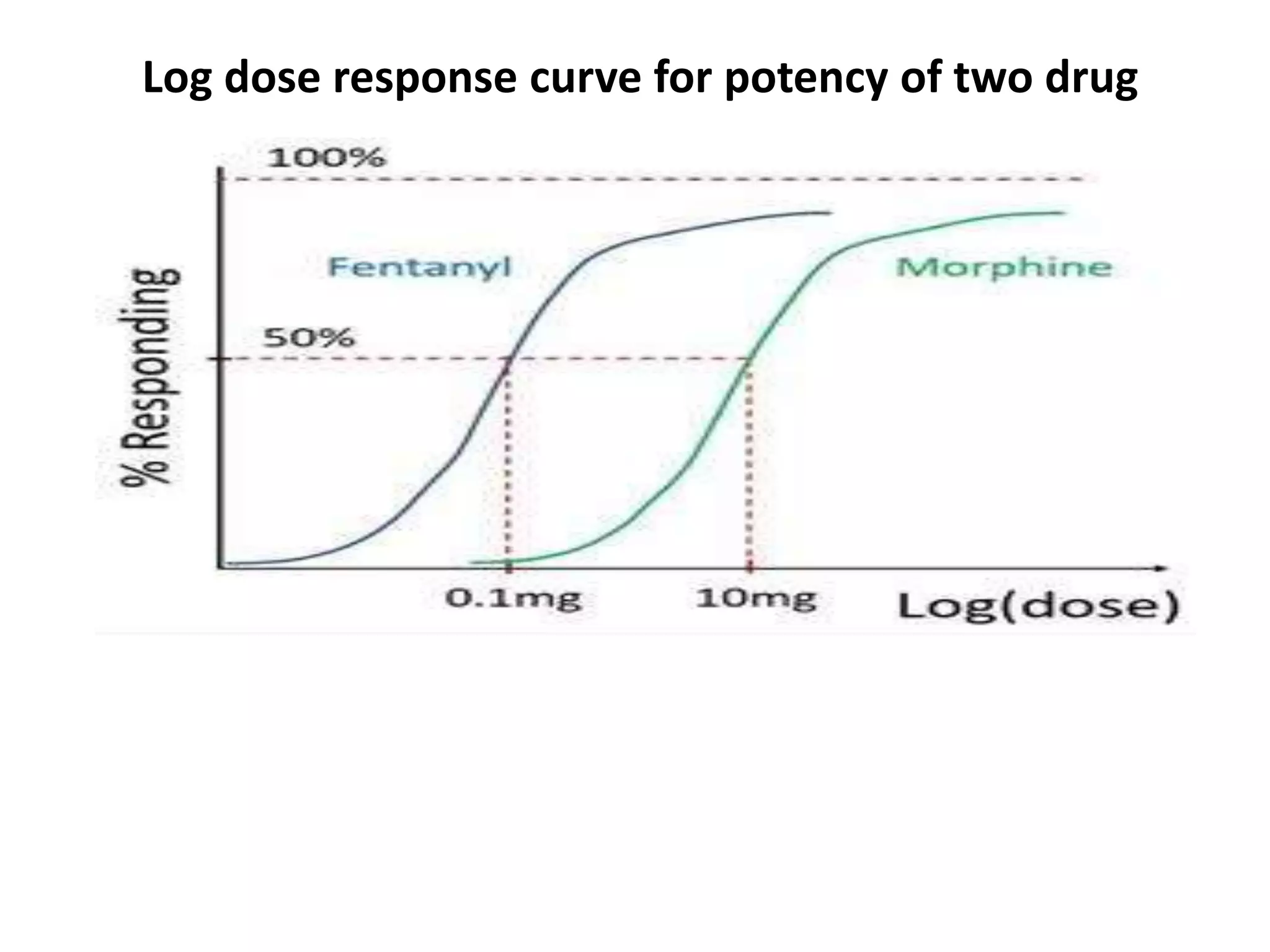
• The position of DRC on the X- axis is an index
of drug potency.
• A DRC positioned rightward indicates lower
potency.
Log dose response curve for potency of two drug
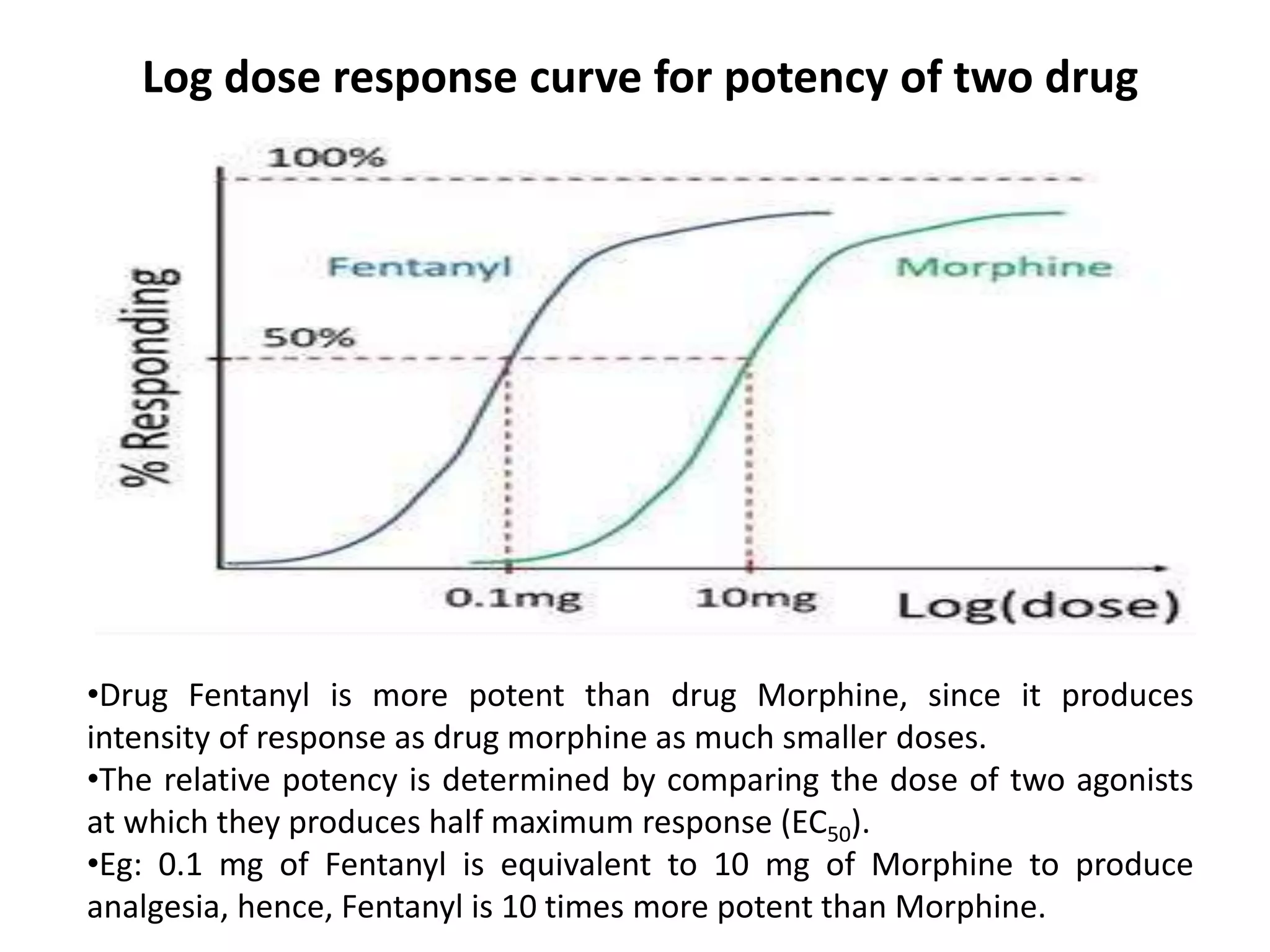
•Drug Fentanyl is more potent than drug Morphine, since it produces
intensity of response as drug morphine as much smaller doses.
•The relative potency is determined by comparing the dose of two agonists
at which they produces half maximum response (EC50).
•Eg: 0.1 mg of Fentanyl is equivalent to 10 mg of Morphine to produce
analgesia, hence, Fentanyl is 10 times more potent than Morphine.
Log dose response curve for potency of two drug
Efficacy
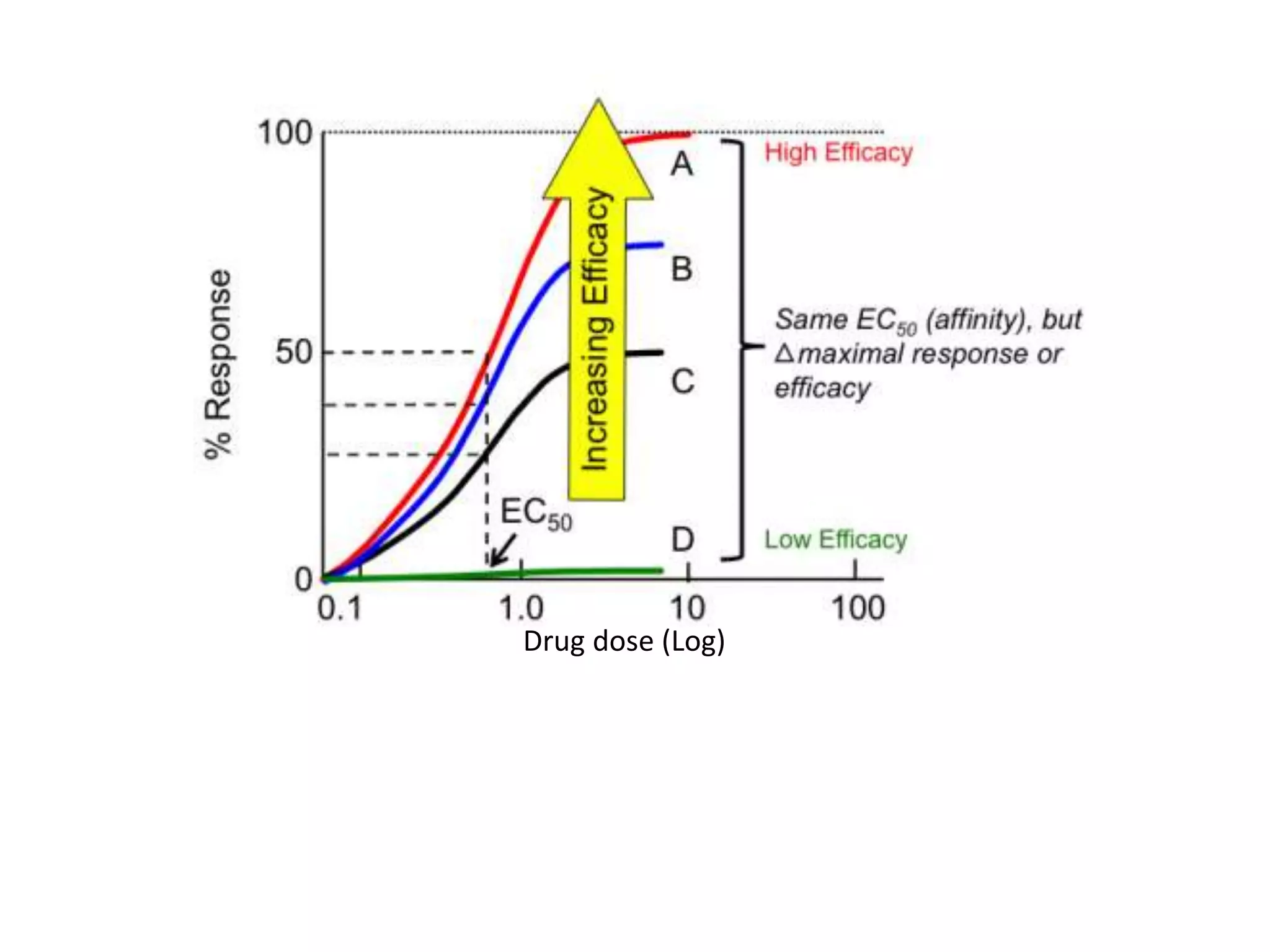
• The upper limit of DRC is the index of drug
efficacy & refers to the maximal response that
can be elicited by the drug.
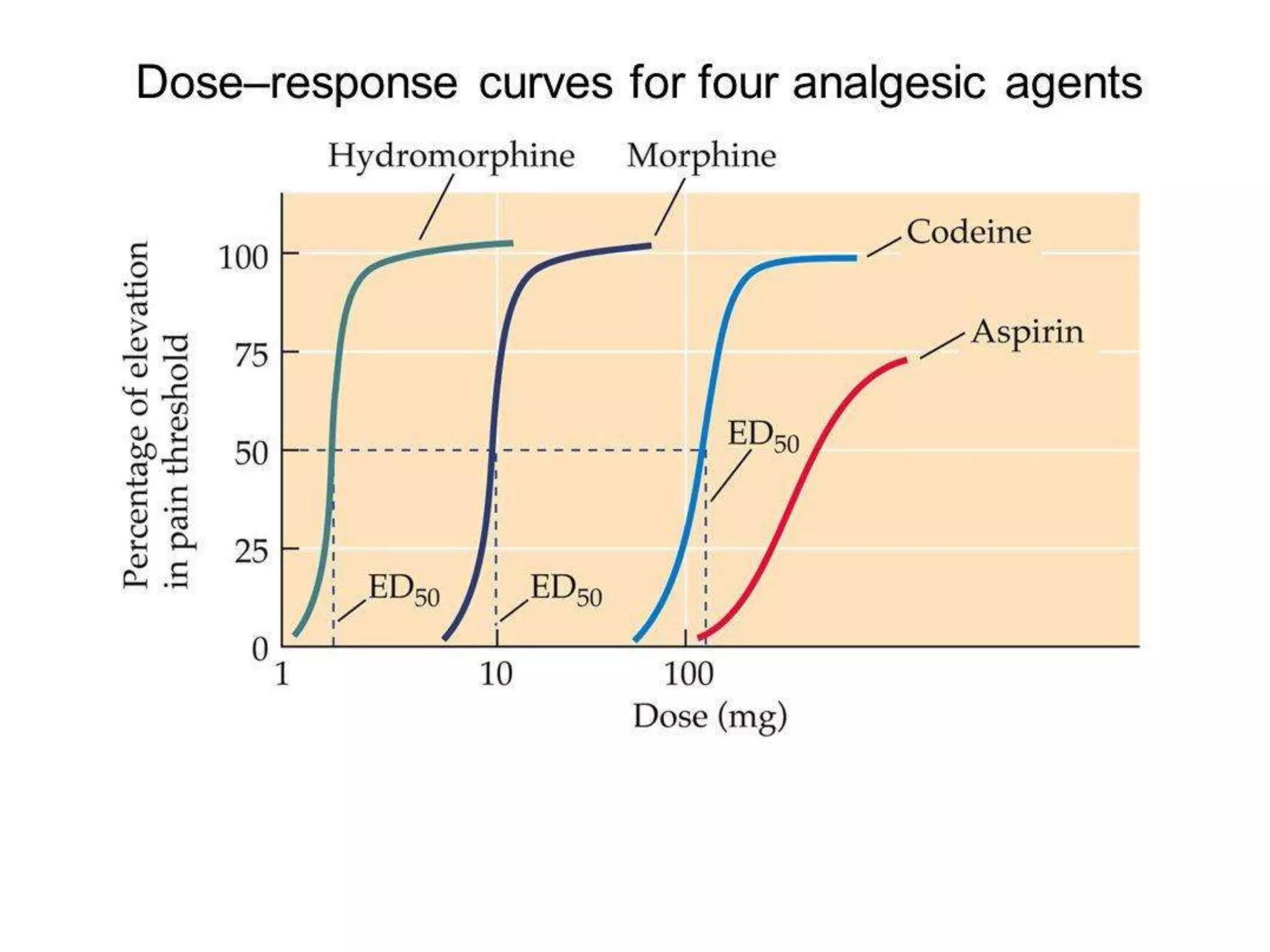
• Eg: Morphine produces a degree of analgesia not
obtain with any dose of aspirin. Morphine is
more efficacious than aspirin.
Drug dose (Log)
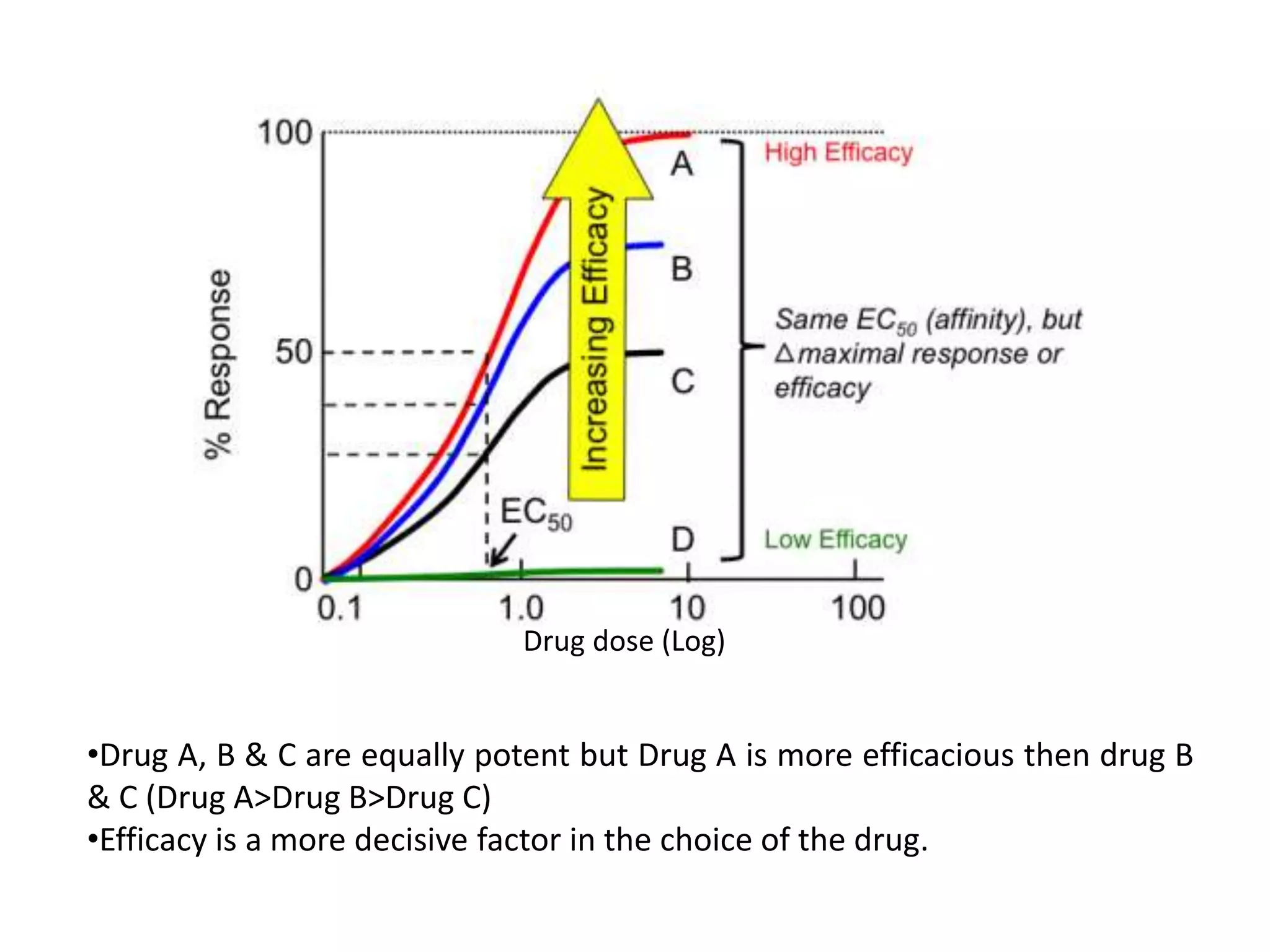
•Drug A, B & C are equally potent but Drug A is more efficacious then drug B
& C (Drug A>Drug B>Drug C)
•Efficacy is a more decisive factor in the choice of the drug.
Drug dose (Log)
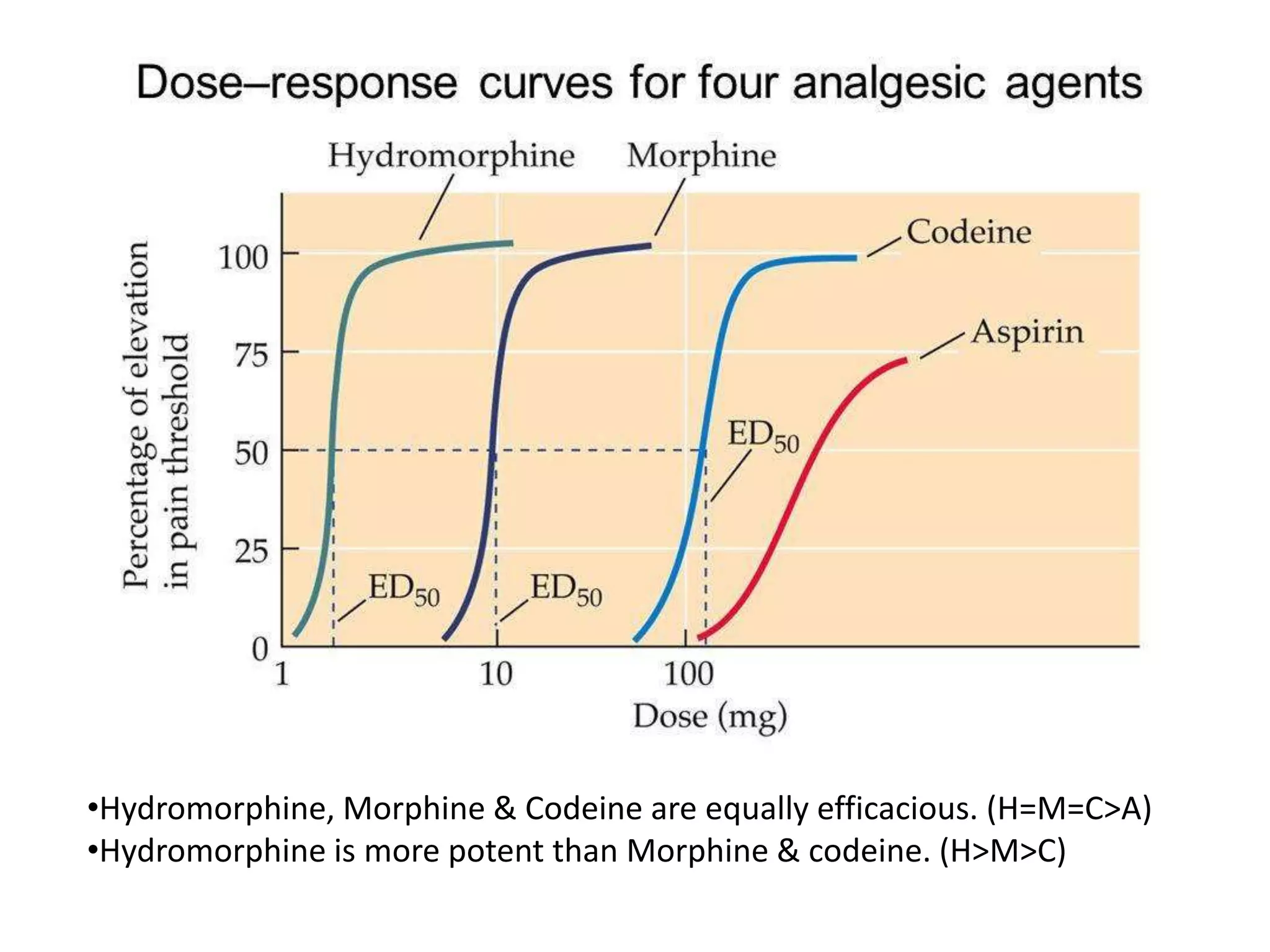
•Hydromorphine, Morphine & Codeine are equally efficacious. (H=M=C>A)
•Hydromorphine is more potent than Morphine & codeine. (H>M>C)
Safety
• The slop of the upper part of the curve is useful
in assessing the relative safety of drug.
• Ex:- Most CNS depressants have steep slope
which indicates a narrow margin of safety
between the dose that produces sedation & the
dose that produces coma.
• The drug with more shallow slope of curve
produces little increase in response over a wide
dose range & has wider margin of safety.
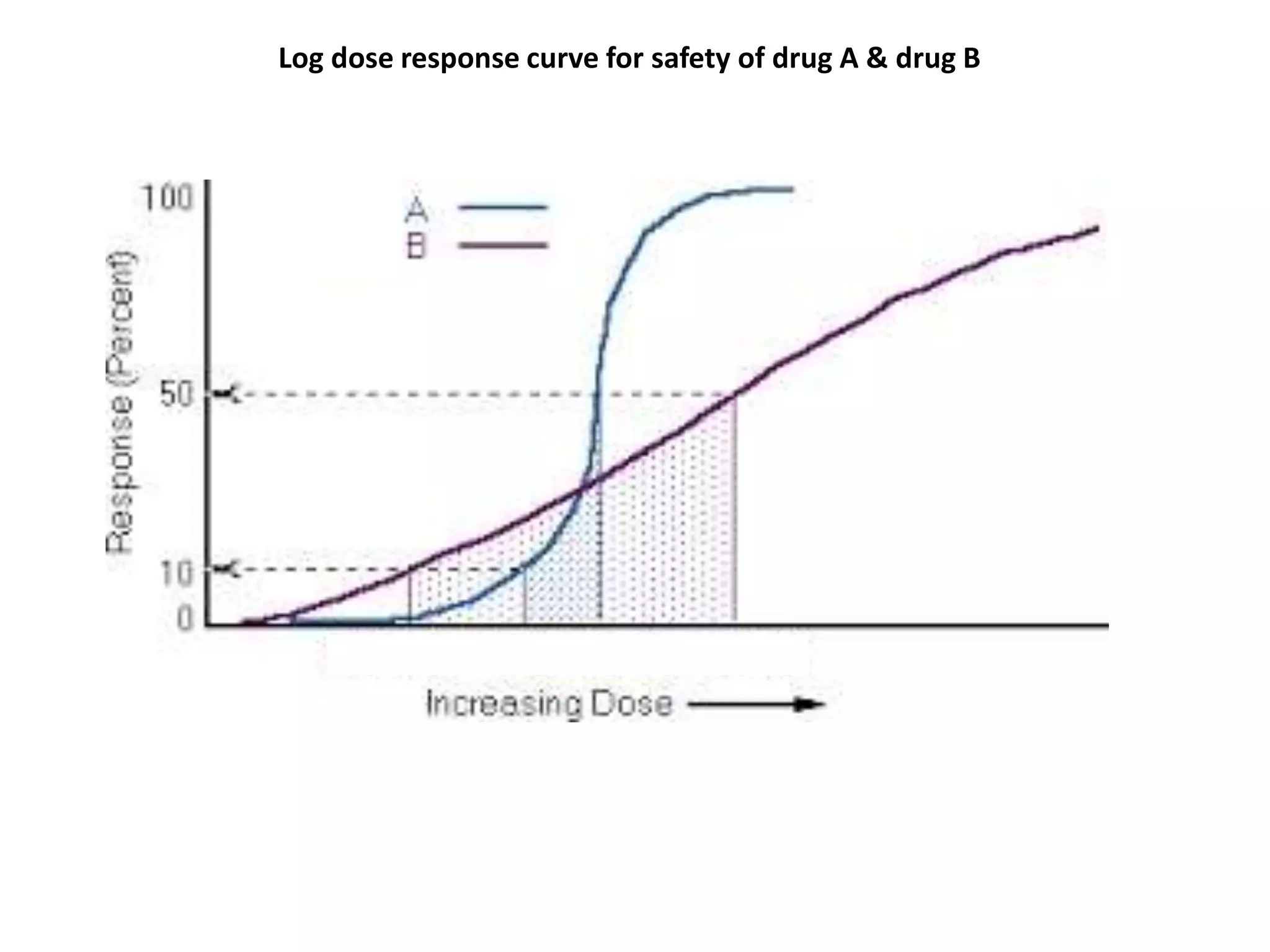
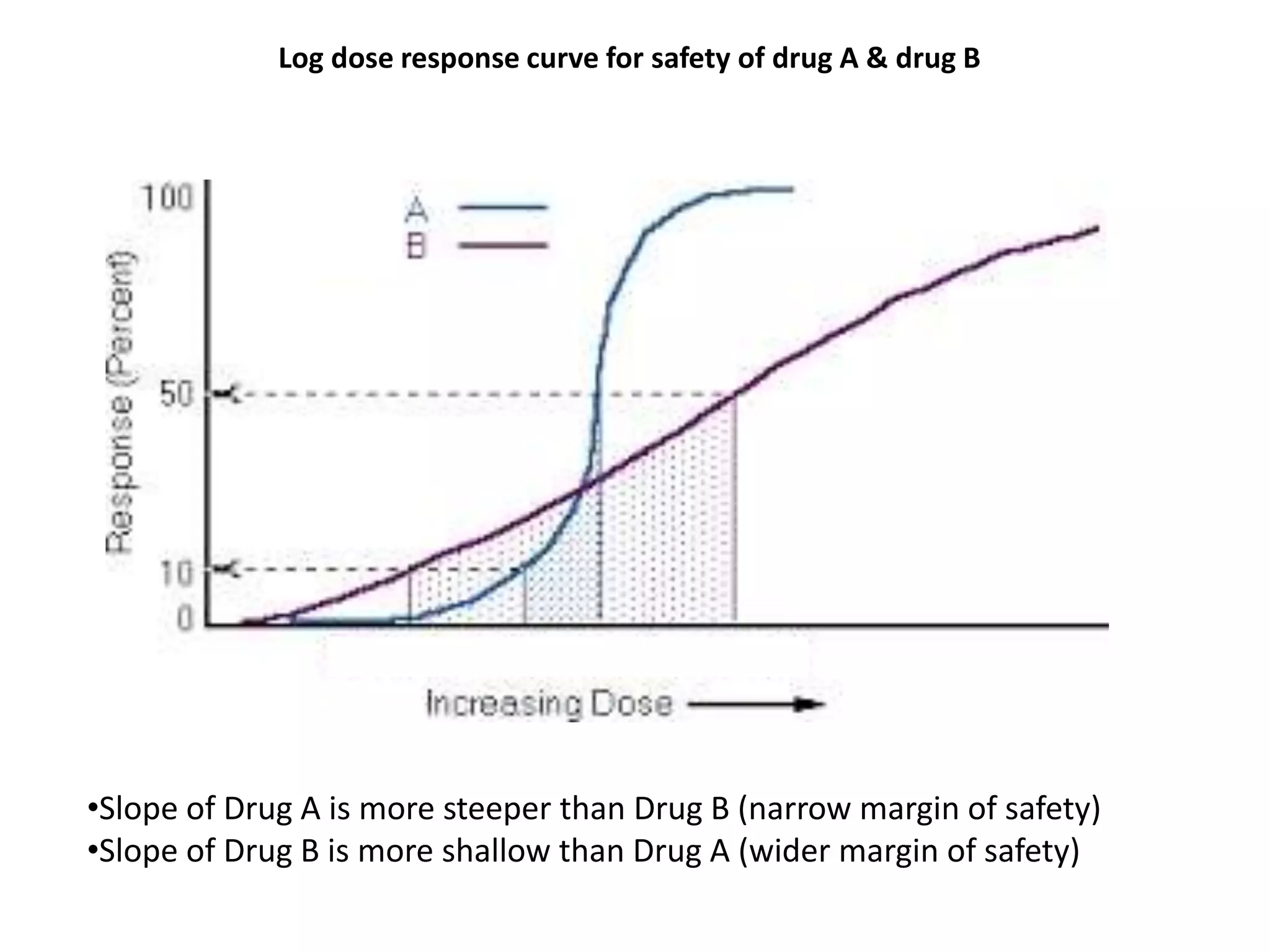
Log dose response curve for safety of drug A & drug B
•Slope of Drug A is more steeper than Drug B (narrow margin of safety)
•Slope of Drug B is more shallow than Drug A (wider margin of safety)
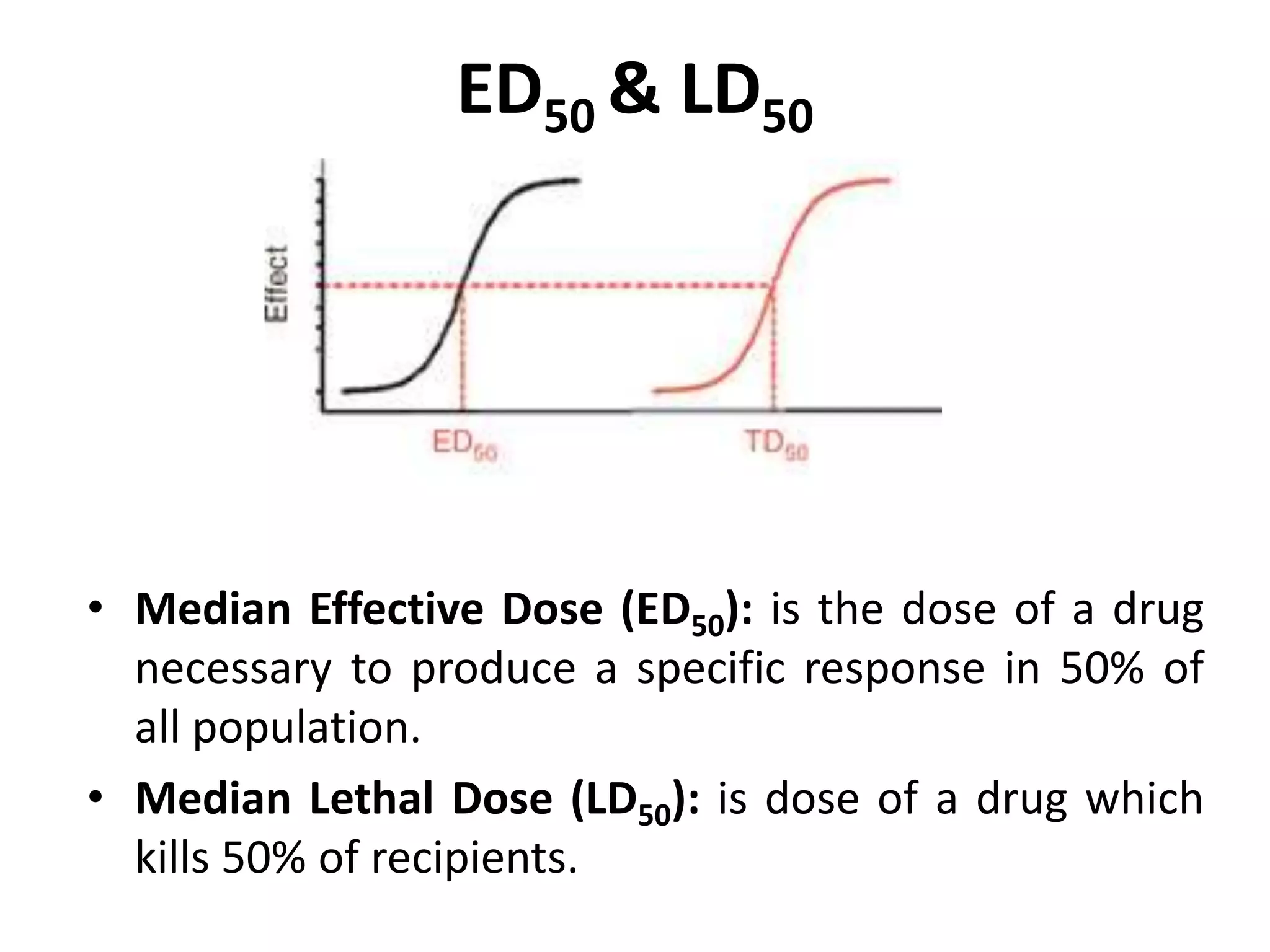
ED50 & LD50
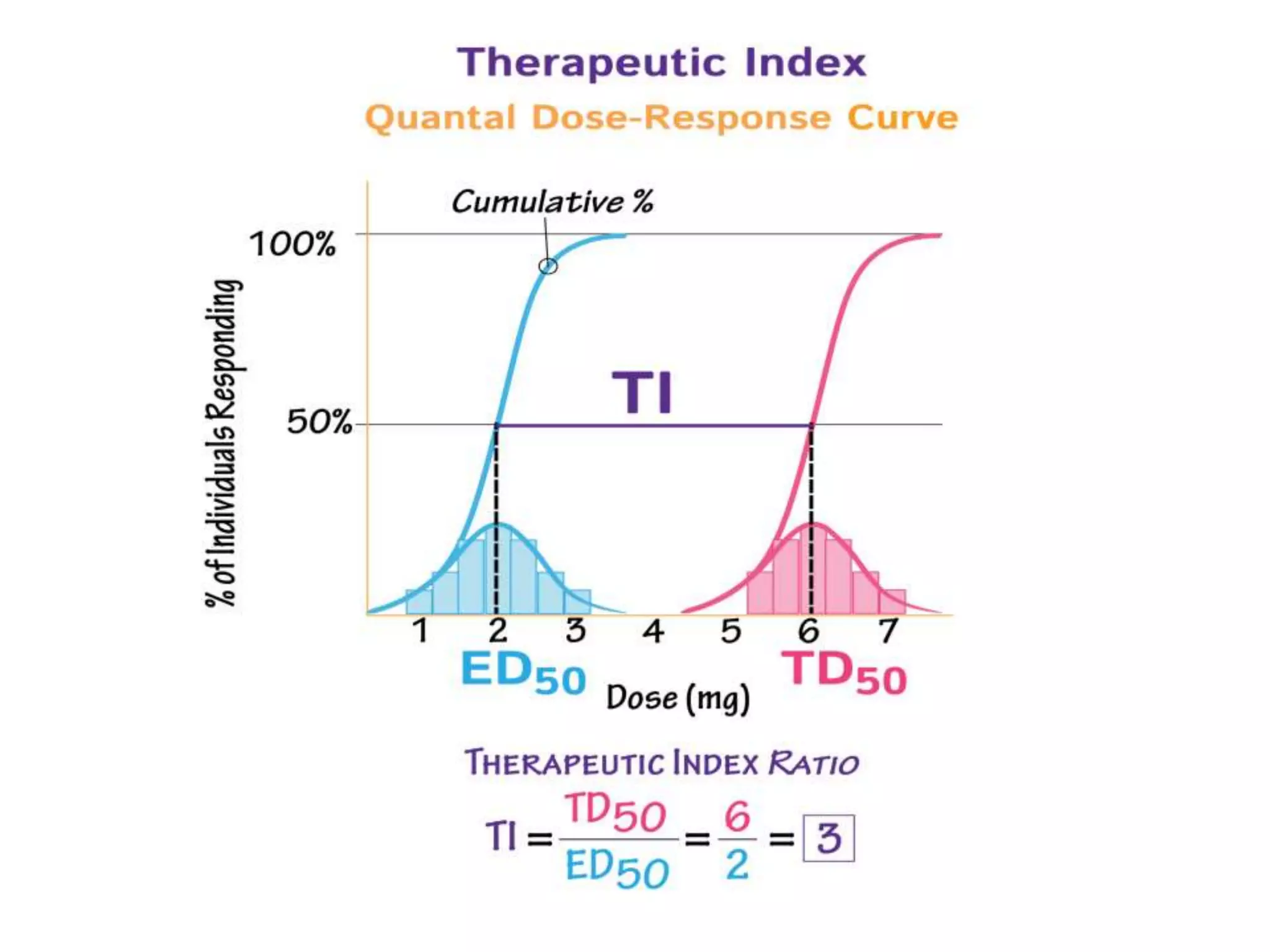
• Median Effective Dose (ED50): is the dose of a drug
necessary to produce a specific response in 50% of
all population.
• Median Lethal Dose (LD50): is dose of a drug which
kills 50% of recipients.
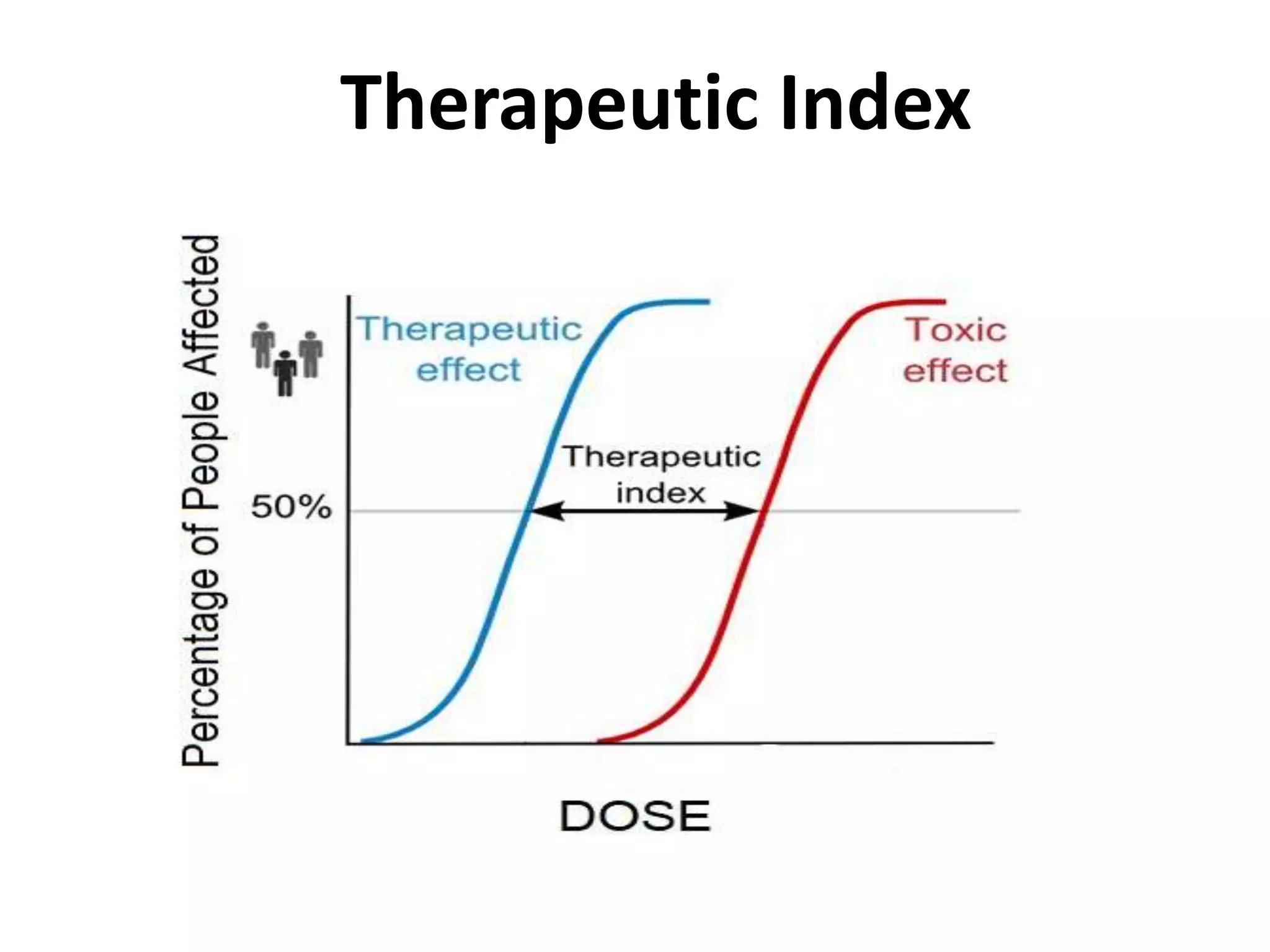
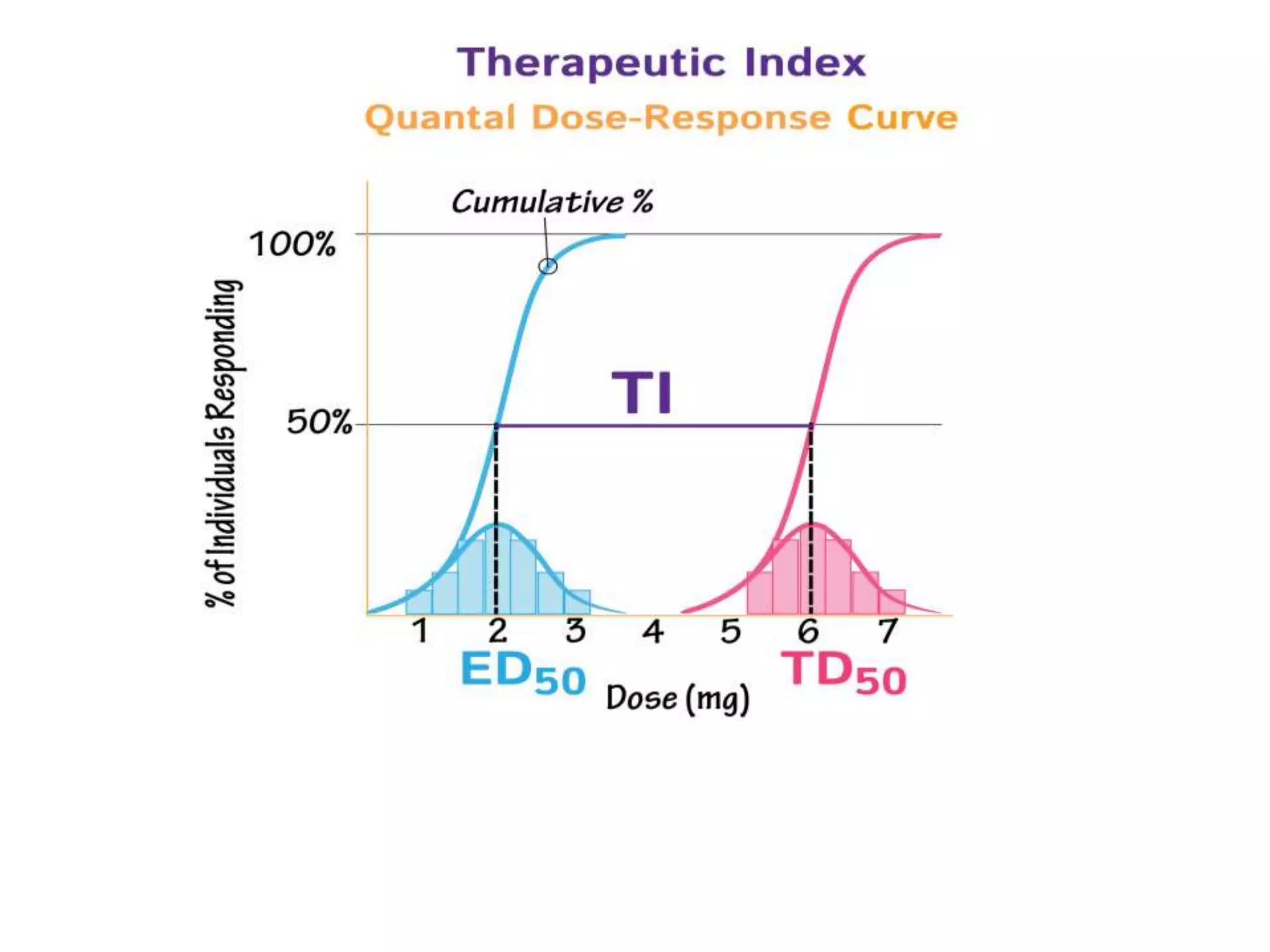
Therapeutic Index
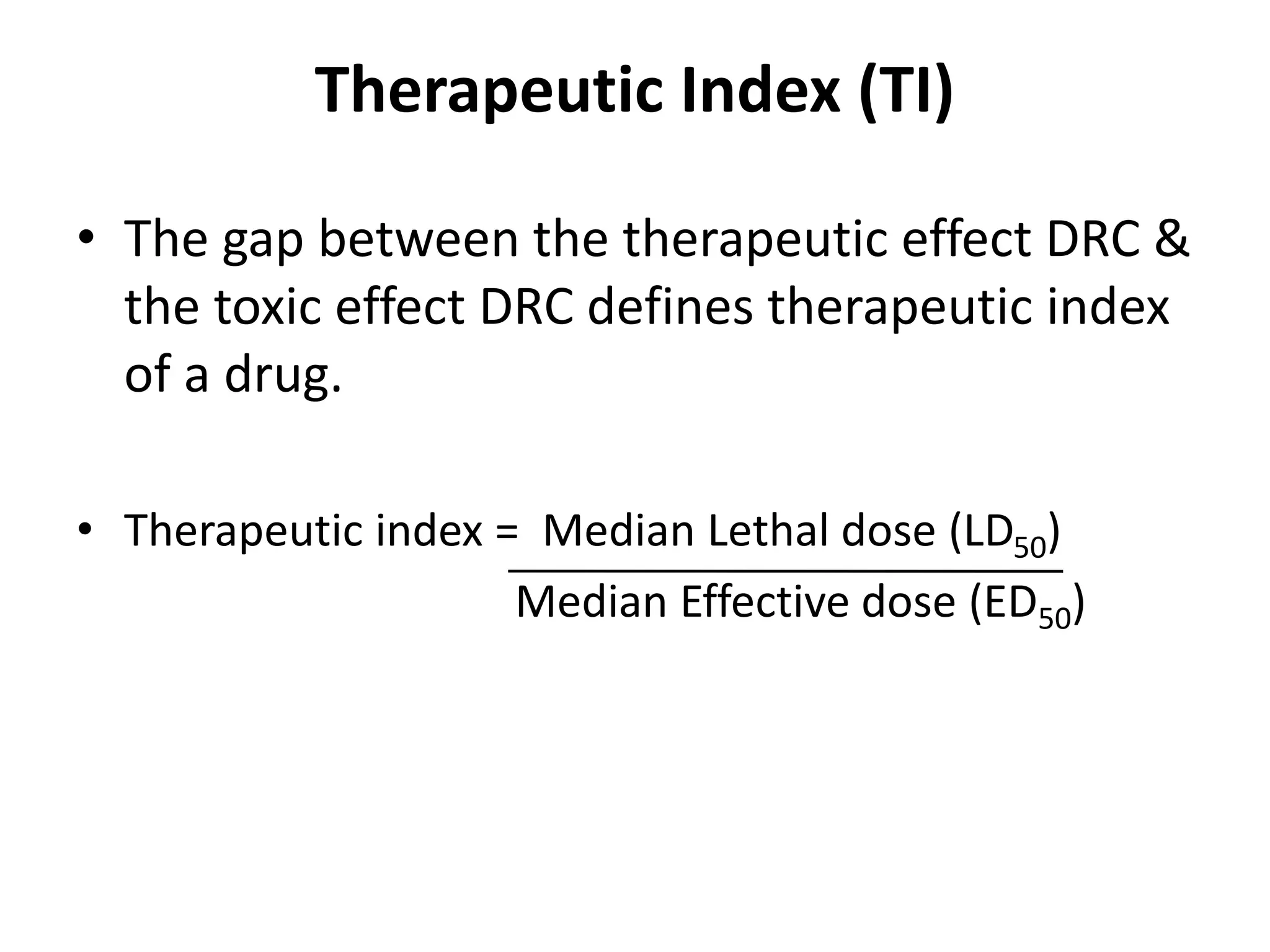
Therapeutic Index (TI)
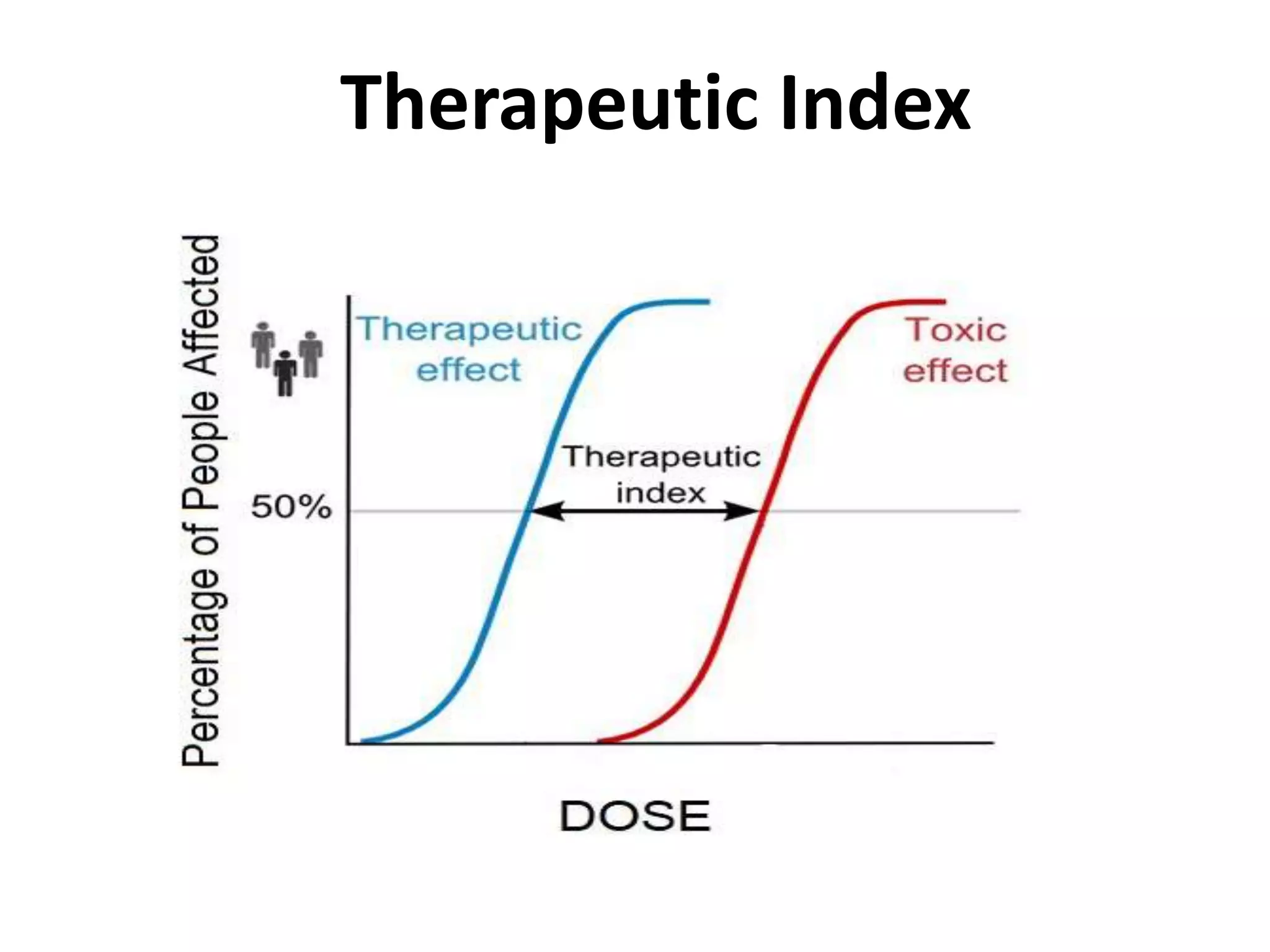
• The gap between the therapeutic effect DRC &
the toxic effect DRC defines therapeutic index
of a drug.
• Therapeutic index = Median Lethal dose (LD50)
Median Effective dose (ED50)
Clinical significance of Therapeutic Index (TI)
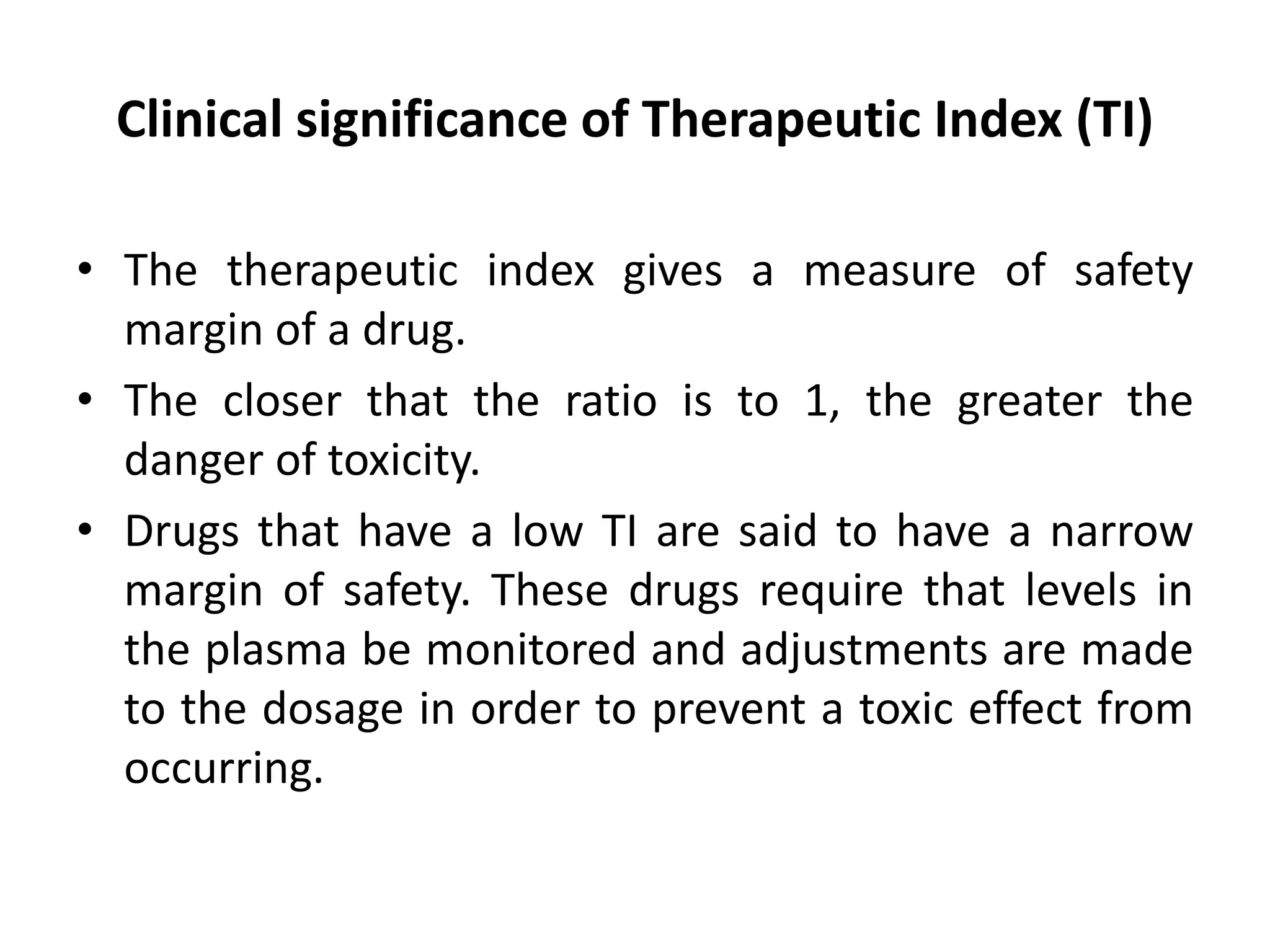
• The therapeutic index gives a measure of safety
margin of a drug.
• The closer that the ratio is to 1, the greater the
danger of toxicity.
• Drugs that have a low TI are said to have a narrow
margin of safety. These drugs require that levels in
the plasma be monitored and adjustments are made
to the dosage in order to prevent a toxic effect from
occurring.
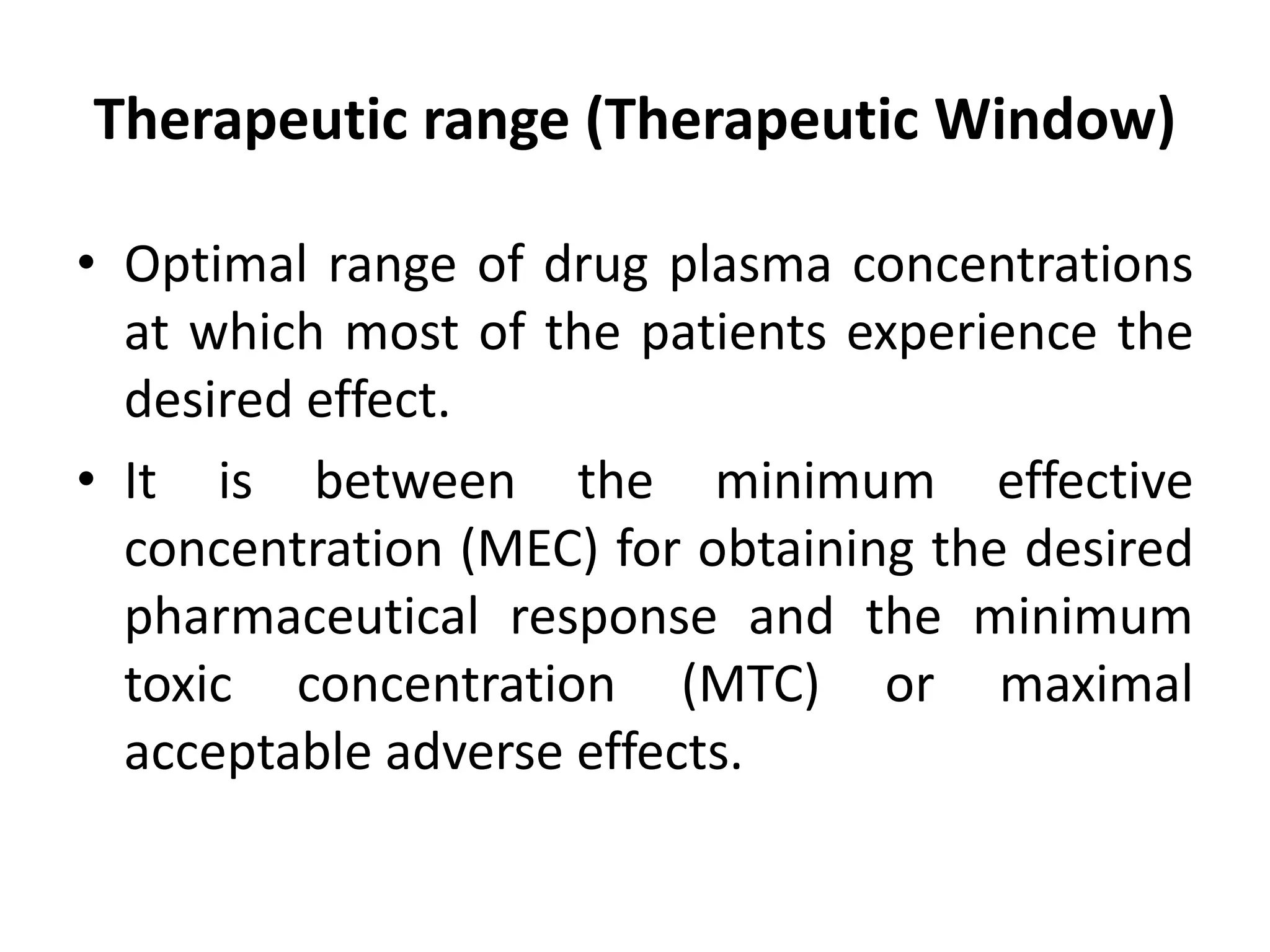
Therapeutic range (Therapeutic Window)
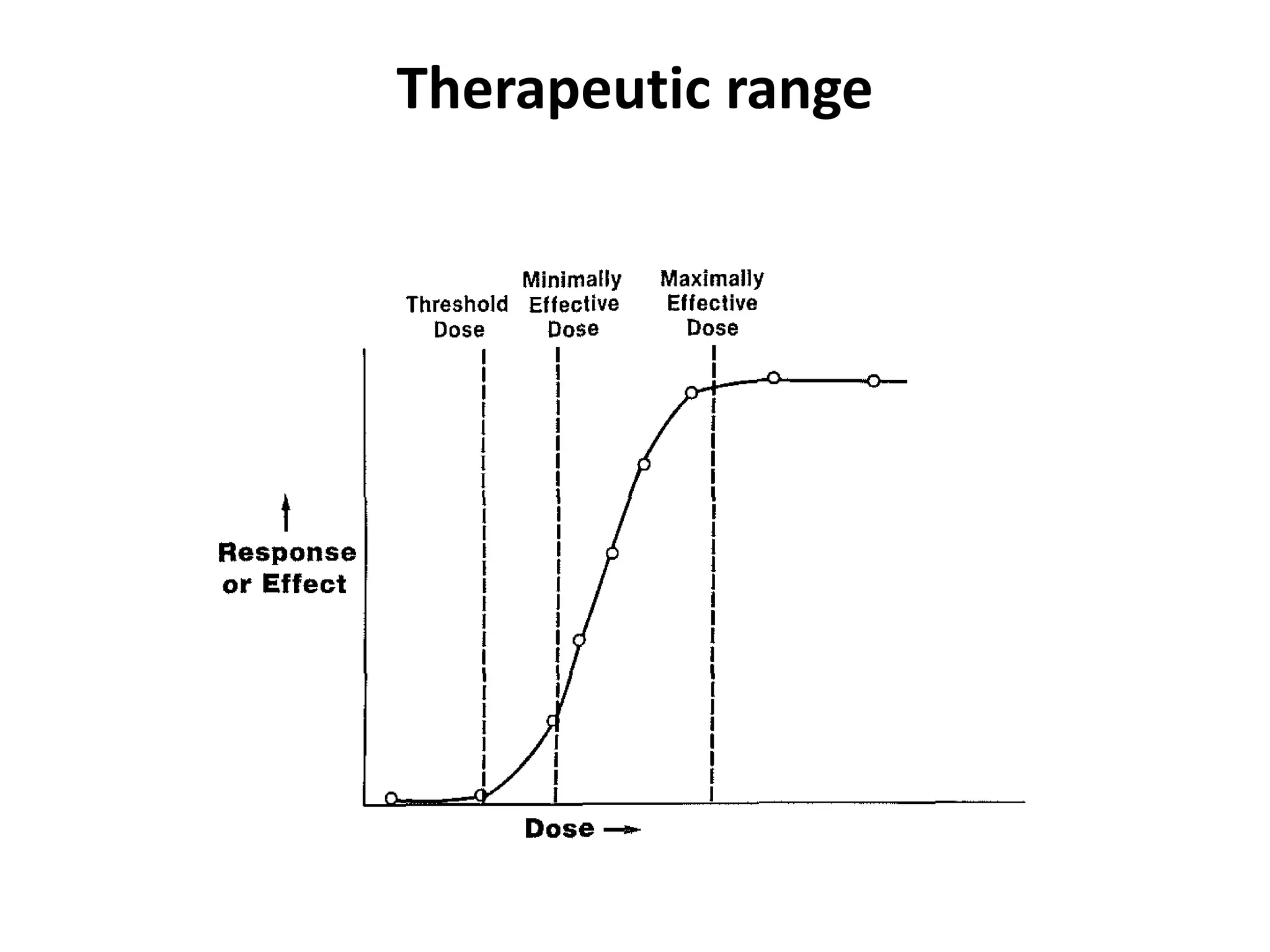
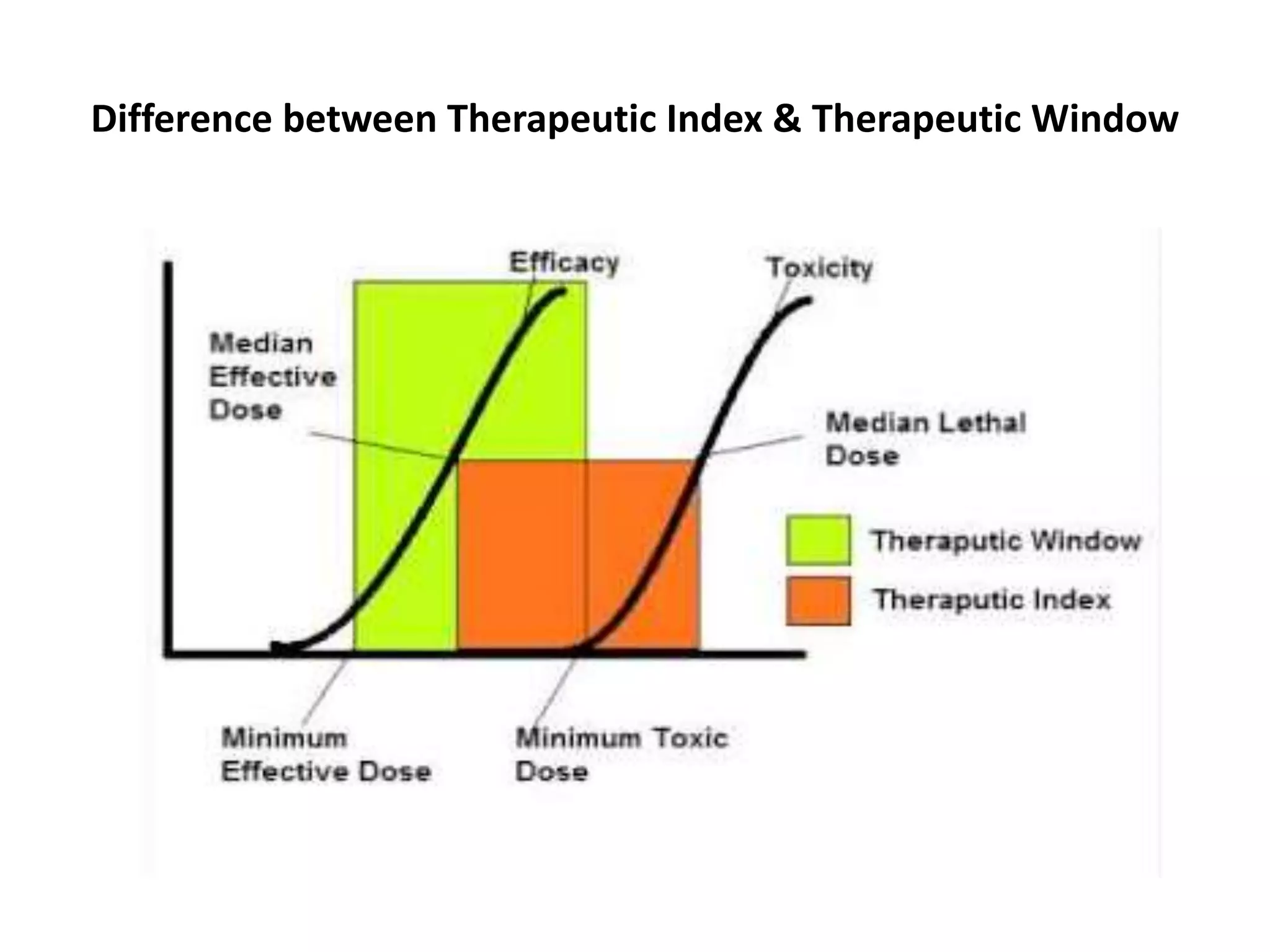
• Optimal range of drug plasma concentrations
at which most of the patients experience the
desired effect.
• It is between the minimum effective
concentration (MEC) for obtaining the desired
pharmaceutical response and the minimum
toxic concentration (MTC) or maximal
acceptable adverse effects.
Therapeutic range
Therapeutic Index
Difference between Therapeutic Index & Therapeutic Window
Risk-benefit Ratio
• A judgement on the estimated harm Vs expected
advantages.
– Estimated harm (adverse effects, cost, inconvenience)
– Estimated advantages (relief of symptoms, cure, reduction
of complications/mortality, improvement in quality of life)
• A drug should be prescribed only when the benefits
outweigh the risk.
TYPES OF DOSE RESPONSE
• GRADED DOSE RESPONSE
– Continuous scale
– Measured in a single biologic unit
– Relates dose to intensity of effect
• QUANTAL DOSE RESPONSE
– All-or-none pharmacologic effect
– Population studies
– Relates dose to frequency of effect
GRADED DOSE RESPONSE CURVES
• Graded dose response curves are constructed for
response that are measured on continuous scale
Eg:- heart rate.
• GRADED dose response curves relates the intensity
of response to size of dose hence, used in
characterizing actions of drug.
• Graded dose response means slight increase of drug
brings small increase in response
• Eg:- increased dose of adrenaline causes gradual
increase of heart rate & BP.
• Very low dose of drug has no
effect and response is
obtained only beyond the
threshold dose.
• Very high dose has no
additional effect and
response remains constant at
this maximal levels
• Graded dose response means
the pharmacological effect of
drug expressed in quality or
number such as heart rate by
beat and blood pressure by
mmHg
QUANTAL DOSE RESPONSE CURVES
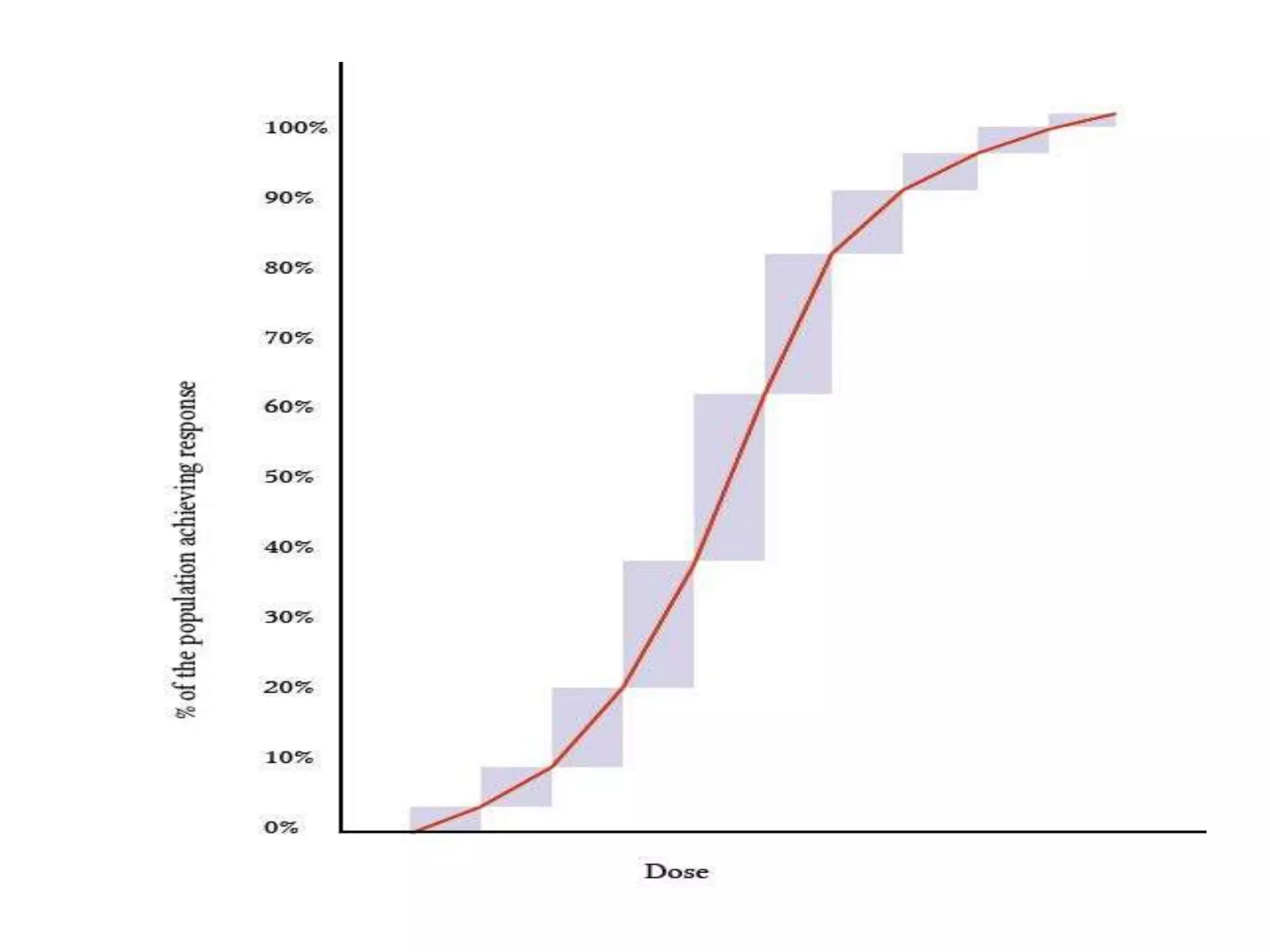
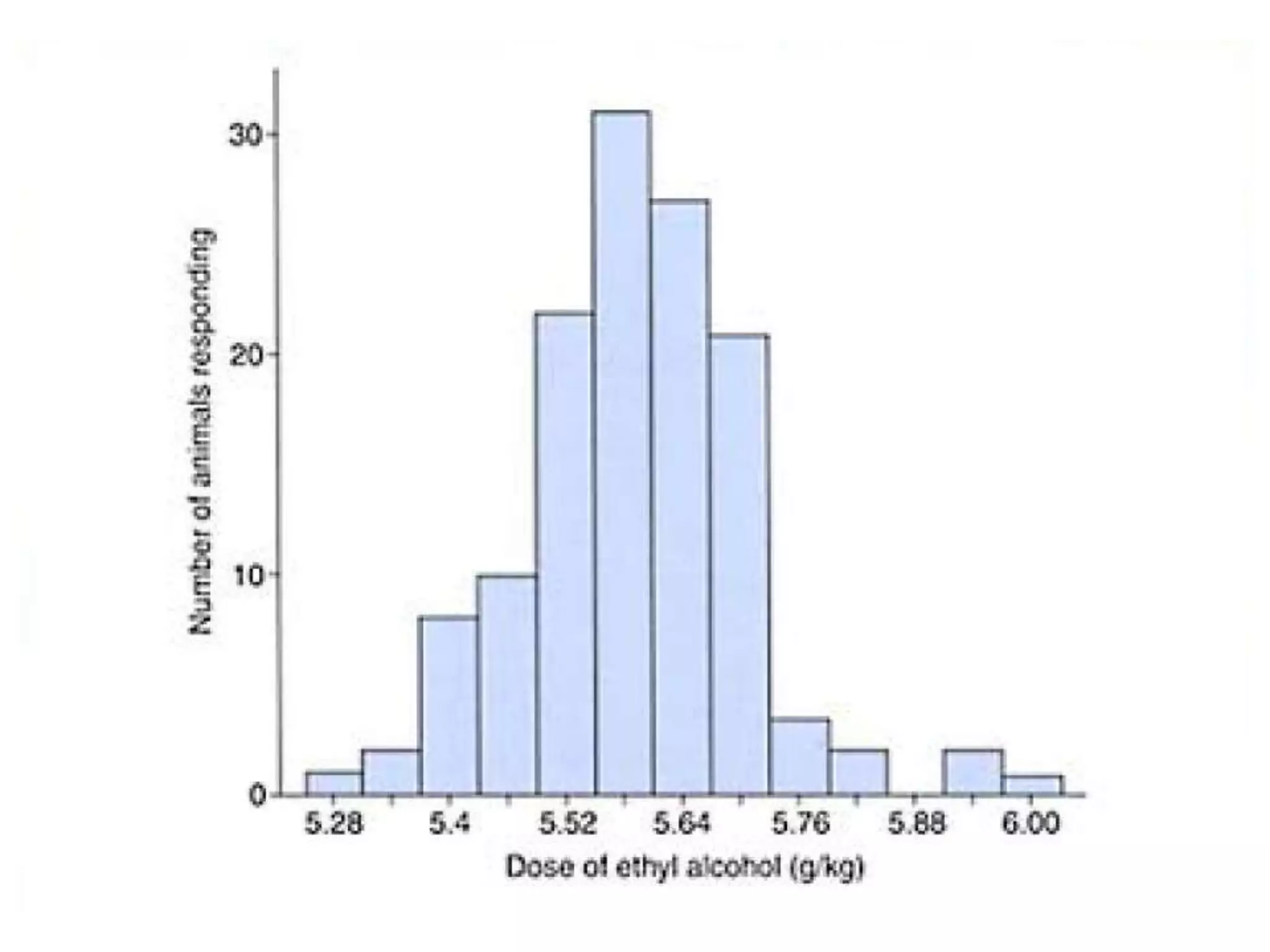
• Quantal dose response curves are constructed for those drugs
that elicit ‘all or none response’.
• A Quantal dose-response relationship describes a drug effect
which is binary (either present or absent).
• A quantal response to a drug is observed in a population, and
is either present or absent in any single individual.
• Quantal dose-response graphs plot the rate of an outcome
occurrence in a population against the drug dose
• Eg: presence or absence of epileptic seizures after an
experimental drug.
Thank You

Dose Response Curve

  • 1.
    Dose Response Curve Dr.Pankaj Kumar Gupta Assistant Professor, Department of Pharmacology, ESIC Medical College & Hospital, Faridabad
  • 2.
    Dose & Response Dose •Amount of drug to administered to produce a certain degree of response in a patient. Response • The change in activity of the cell or tissue produce by the selected dose of the drug is called the response.
  • 3.
    • The doseand response is closely related to each other and this relationship is called as Dose response relationship. • There is direct relationship between dose & intensity of response of the curve- i.e. the intensity of response increases with the increase in dose. • A typical curve showing the dose response relationship is called dose response curve (DRC).
  • 5.
    Dose Response Curve Doseresponse curve & log dose-response curve
  • 6.
    Advantages of logdose response curve
  • 7.
    Advantages of logdose response curve
  • 8.
    Advantages of logdose response curve • Curvilinear (rectangular hyperbola) Vs Sigmoid curve. • If the dose is plotted on a logarithmic scale, the curve becomes sigmoid (S-shape) & a linear relationship between log of dose & the response is seen in the intermediate (30- 70% response) zone. • A wide range of drug doses can be easily displayed on a graph. • rectangular hyperbola) Vs Sigmoid curve. can be estimated easily with sigmoid curve as compared to curvilinear curve. • Comparison between agonists and study of antagonists becomes easier.
  • 9.
    Significance of DRC •The DRC of drug is useful to predict: • Potency • Efficacy • Safety of drug • ED50 • LD50 • Therapeutic index • Therapeutic window
  • 10.
    Potency • The positionof DRC on the X- axis is an index of drug potency. • A DRC positioned rightward indicates lower potency.
  • 11.
    Log dose responsecurve for potency of two drug
  • 12.
    •Drug Fentanyl ismore potent than drug Morphine, since it produces intensity of response as drug morphine as much smaller doses. •The relative potency is determined by comparing the dose of two agonists at which they produces half maximum response (EC50). •Eg: 0.1 mg of Fentanyl is equivalent to 10 mg of Morphine to produce analgesia, hence, Fentanyl is 10 times more potent than Morphine. Log dose response curve for potency of two drug
  • 13.
    Efficacy • The upperlimit of DRC is the index of drug efficacy & refers to the maximal response that can be elicited by the drug. • Eg: Morphine produces a degree of analgesia not obtain with any dose of aspirin. Morphine is more efficacious than aspirin.
  • 14.
  • 15.
    •Drug A, B& C are equally potent but Drug A is more efficacious then drug B & C (Drug A>Drug B>Drug C) •Efficacy is a more decisive factor in the choice of the drug. Drug dose (Log)
  • 17.
    •Hydromorphine, Morphine &Codeine are equally efficacious. (H=M=C>A) •Hydromorphine is more potent than Morphine & codeine. (H>M>C)
  • 18.
    Safety • The slopof the upper part of the curve is useful in assessing the relative safety of drug. • Ex:- Most CNS depressants have steep slope which indicates a narrow margin of safety between the dose that produces sedation & the dose that produces coma. • The drug with more shallow slope of curve produces little increase in response over a wide dose range & has wider margin of safety.
  • 19.
    Log dose responsecurve for safety of drug A & drug B
  • 20.
    Log dose responsecurve for safety of drug A & drug B •Slope of Drug A is more steeper than Drug B (narrow margin of safety) •Slope of Drug B is more shallow than Drug A (wider margin of safety)
  • 21.
    ED50 & LD50 •Median Effective Dose (ED50): is the dose of a drug necessary to produce a specific response in 50% of all population. • Median Lethal Dose (LD50): is dose of a drug which kills 50% of recipients.
  • 22.
  • 23.
    Therapeutic Index (TI) •The gap between the therapeutic effect DRC & the toxic effect DRC defines therapeutic index of a drug. • Therapeutic index = Median Lethal dose (LD50) Median Effective dose (ED50)
  • 26.
    Clinical significance ofTherapeutic Index (TI) • The therapeutic index gives a measure of safety margin of a drug. • The closer that the ratio is to 1, the greater the danger of toxicity. • Drugs that have a low TI are said to have a narrow margin of safety. These drugs require that levels in the plasma be monitored and adjustments are made to the dosage in order to prevent a toxic effect from occurring.
  • 27.
    Therapeutic range (TherapeuticWindow) • Optimal range of drug plasma concentrations at which most of the patients experience the desired effect. • It is between the minimum effective concentration (MEC) for obtaining the desired pharmaceutical response and the minimum toxic concentration (MTC) or maximal acceptable adverse effects.
  • 28.
  • 29.
  • 30.
    Difference between TherapeuticIndex & Therapeutic Window
  • 32.
    Risk-benefit Ratio • Ajudgement on the estimated harm Vs expected advantages. – Estimated harm (adverse effects, cost, inconvenience) – Estimated advantages (relief of symptoms, cure, reduction of complications/mortality, improvement in quality of life) • A drug should be prescribed only when the benefits outweigh the risk.
  • 33.
    TYPES OF DOSERESPONSE • GRADED DOSE RESPONSE – Continuous scale – Measured in a single biologic unit – Relates dose to intensity of effect • QUANTAL DOSE RESPONSE – All-or-none pharmacologic effect – Population studies – Relates dose to frequency of effect
  • 34.
    GRADED DOSE RESPONSECURVES • Graded dose response curves are constructed for response that are measured on continuous scale Eg:- heart rate. • GRADED dose response curves relates the intensity of response to size of dose hence, used in characterizing actions of drug. • Graded dose response means slight increase of drug brings small increase in response • Eg:- increased dose of adrenaline causes gradual increase of heart rate & BP.
  • 35.
    • Very lowdose of drug has no effect and response is obtained only beyond the threshold dose. • Very high dose has no additional effect and response remains constant at this maximal levels • Graded dose response means the pharmacological effect of drug expressed in quality or number such as heart rate by beat and blood pressure by mmHg
  • 36.
    QUANTAL DOSE RESPONSECURVES • Quantal dose response curves are constructed for those drugs that elicit ‘all or none response’. • A Quantal dose-response relationship describes a drug effect which is binary (either present or absent). • A quantal response to a drug is observed in a population, and is either present or absent in any single individual. • Quantal dose-response graphs plot the rate of an outcome occurrence in a population against the drug dose • Eg: presence or absence of epileptic seizures after an experimental drug.
  • 40.