By: Dr. Vahid Nikoui

Email: nikoui@razi.tums.ac.ir
Ligands reside at a point of minimal energy within a
binding locus of a protein according to a ratio of the
rate that the ligand leaves the surface of the protein
(koff) and the rate it approaches the protein surface
(kon).
This ratio is the equilibrium dissociation constant of
the ligand–protein complex (denoted Keq = koff/kon)
and defines the molar concentration of the ligand in
the compartment containing the protein where 50%
of the protein has ligand bound to it at any one
instant.
The “affinity” or attraction of the ligand for the
protein is the reciprocal of Keq.
Association constant :
The ratio of the rate of onset of a molecule to a
receptor binding site and the rate of dissociation
of the molecule away from that site.
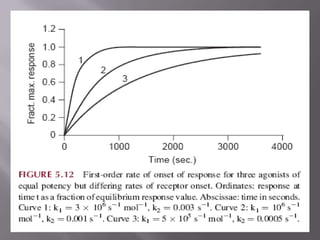
K1 :
       Referring to the rate of onset of a molecule to a receptor.

k2 (k-1):
     Referring to the rate of offset of a molecule from a receptor.

KA :
       Standard pharmacologic convention for the equilibrium dissociation constant of an
       agonist-receptor complex. It is the concentration that occupies half the receptor
       population at equilibrium. It also can be thought of as the reciprocal of affinity.
KB :
       Convention for the equilibrium dissociation constant of an antagonist-receptor
       complex.

Kd:
       Convention for the equilibrium dissociation constant of a radioligand-receptor
       complex.

KI :
       Basically the KB for an antagonist but specifically measured in a biochemical binding
       study or enzyme assay.
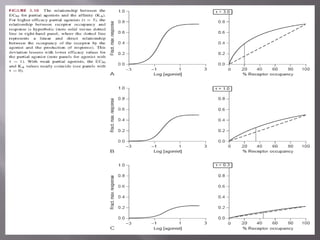
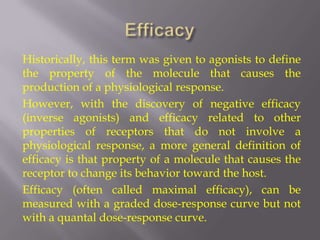
Historically, this term was given to agonists to define
the property of the molecule that causes the
production of a physiological response.
However, with the discovery of negative efficacy
(inverse agonists) and efficacy related to other
properties of receptors that do not involve a
physiological response, a more general definition of
efficacy is that property of a molecule that causes the
receptor to change its behavior toward the host.
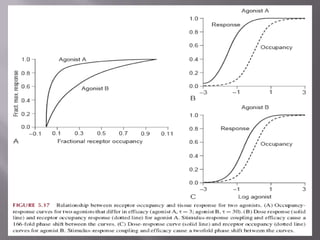
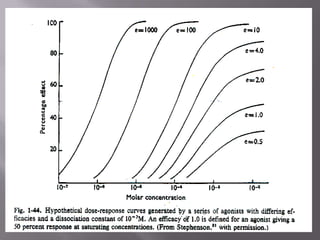
Efficacy (often called maximal efficacy), can be
measured with a graded dose-response curve but not
with a quantal dose-response curve.
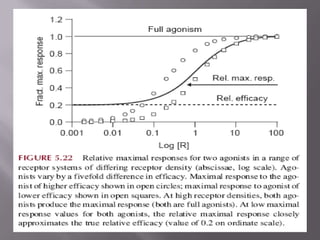
Intrinsic efficacy:
   A solely agonist-specific quantification of the ability
   of the agonist to induce a physiological or
   pharmacological response.
   Thus, efficacy is the product of intrinsic efficacy
   multiplied by the receptor density.

Negative efficacy :
  Property of selective affinity of the molecule for the
  inactive state of the receptor; this results in inverse
  agonism.
  Negative efficacy causes the active antagonism of
  constitutive receptor activity but is observed only in
  systems that have a measurably elevated basal
  response due to constitutive activity.
  It is a property of the molecule and not the system.
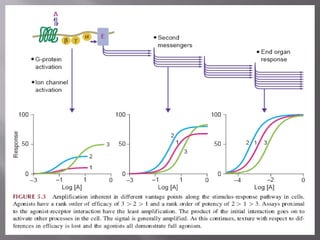
Potency :
   The concentration (usually molar) of a drug that produces a
   defined effect.
   Often, potencies of agonists are defined in terms of EC50 or pEC50
   values. The potency usually does not involve measures of
   maximal effect but rather only in locations along the
   concentration axis of dose response curves.
   Potency is determined mainly by the affinity of the receptor for
   the drug.
   In graded dose-response measurements, the effect usually chosen
   is 50% of the maximal effect ( EC50).
   In quantal dose-response measurements ED50, TD50, and LD50 are
   typical potency variables.
   Potency can be determined from either graded (EC50) or quantal
   dose-response curves (ED50, TD50, and LD50), but the numbers
   obtained are not identical.

Potentiation :
   The increase in effect produced by a molecule or procedure in a
   pharmacological preparation.
   This can be expressed as an apparent increase in efficacy (i.e.,
   maximal response), potency, or both.
EC50/ED50 :
   The “effective concentration” of an agonist producing (in this
  case) 50% maximal response to that particular drug (not
  necessarily 50% of the maximal response of the system).
   ED50 is the in vivo counterpart of EC50 referring to the dose of
  an agonist that produces 50% maximal effect.

Equiactive (equieffective) molar concentration (potency)
ratios (EMR, EPMR) :
    Usually pertaining to agonists, these are the molar
    concentrations that produce the same response in a given
    system.
    These ratios are dependent on the affinity and efficacy of the
    agonists and thus are system independent, that is, characterize
    agonists and receptors in all systems.
    Care must be taken that the maximal responses of the agonists
    concerned are equal.

Emax :
   Conventional term for the maximal response capable of
   being produced in a given system.
Selectivity :
  The difference in activity a given biologically active
  molecule has for two or more processes.
  Thus, if a molecule has a tenfold (for example) greater
  affinity for process A over process B, then it can be
  said to have selectivity for process A.
  However, the implication is that the different activity
  is not absolute, that is, given enough molecule, the
  activation of the other process(es) will occur.

Specificity :
  This can be thought of as an extreme form of
  selectivity where, in this case, no increase in the
  concentration of the molecule will be sufficient to
  activate the other process(es).
Full agonist :
  Name given to an agonist that produces the full
  system maximal response (Emax).
  It is a system dependent phenomenon and should not
  necessarily be associated with a particular agonist, as
  an agonist can be a full agonist in some systems and a
  partial agonist in others.

Partial agonist :
  A partial agonist produces a maximal response that is
  below that of the system maximum (and that of a full
  agonist).
  As well as producing a sub maximal response, partial
  agonists produce antagonism of more efficacious full
  agonists.
PARTIAL AGONISTS – EFFICACY
Even though drugs may occupy the same of receptors, the magnitude of their
effects may differ.

                                                             Full Agonist
                   1.0

                                                             Partial agonist
                   0.8
% Maximal Effect


                   0.6                                       Partial agonist


                   0.4


                   0.2


                   0.0
                      0.01   0.10         1.00       10.00        100.00    1000.00

                                    [D]   (concentration units)
Intrinsic activity :
  The fractional maximal response to an agonist
  relative to a standard “full agonist” in the same
  system (where a full agonist produces the full
  system maximal response).
  Thus, a partial agonist that produces a maximal
  response 50% that of a full agonist has an intrinsic
  activity (denoted α) of 0.5. Full agonists have α = 1
  and antagonists α = 0.
Absolute agonist potency :
 Is the product of receptor stimulus (brought about
  by agonist affinity and efficacy) and the
  processing of the stimulus by the cell into an
  observable response.
  Because this latter process is system (cell type)
  dependent, absolute potencies are system-
  dependent measures of agonist activity.

Relative agonist potency :
  Are system-independent estimates of agonist
  activity that can be compared across systems
  (provided both are full agonists).
Measuring Drug Action

 Efficacy and Potency
                                    More
                                    potent
                                    than D2
                                                D1                 D2
                     100


                  % Response                                       D3
                                                                        Less
                                                                        efficacious
                                                                        than D2
                               0
                                          Log [Drug]

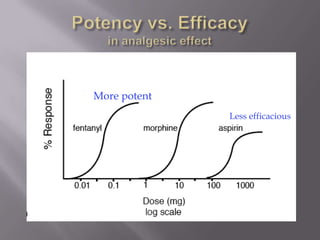
 …… Potency corresponds to the strength of a drug, while Efficacy corresponds to the
 effectiveness of a drug.
  …… e.g., if 5 mg of drug A relieves pain as effectively as 10 mg of drug B, drug A
 is twice as potent as drug B
 …… the diuretic furosemide eliminates much more salt and water through urine than
 does the diuretic chlorothiazide. Thus, furosemide has greater efficacy than
 chlorothiazide.

                                              MEDC 603 Fall 2007
Measuring Drug Action

 Efficacy / Potency / Toxicity

       Desired Response (%)

                              100                                  100


                                                                         Toxicity (%)
                              50                                   50


                               0                                   0
                                      Log [Drug]

                                                               Blue lines …. Drug 1
                                                               Red lines …. Drug 2
                                                               Solid lines …. Desired response
                                                               Dotted lines …. Toxicity response


                                          MEDC 603 Fall 2007
More potent
              Less efficacious
ANTAGONISM
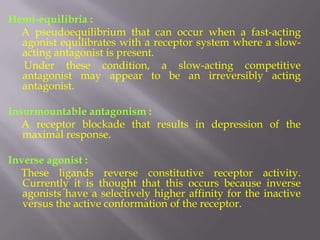
Hemi-equilibria :
  A pseudoequilibrium that can occur when a fast-acting
  agonist equilibrates with a receptor system where a slow-
  acting antagonist is present.
  Under these condition, a slow-acting competitive
  antagonist may appear to be an irreversibly acting
  antagonist.

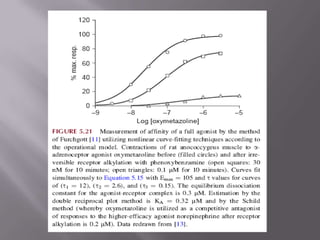
Insurmountable antagonism :
   A receptor blockade that results in depression of the
   maximal response.

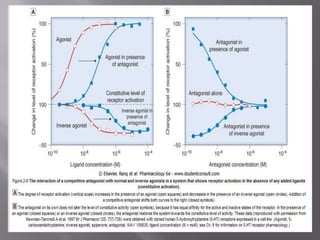
Inverse agonist :
  These ligands reverse constitutive receptor activity.
   Currently it is thought that this occurs because inverse
   agonists have a selectively higher affinity for the inactive
   versus the active conformation of the receptor.
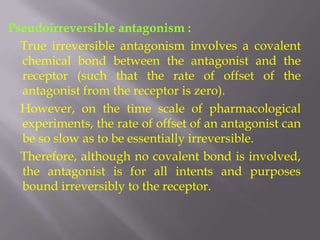
Pseudoirreversible antagonism :
  True irreversible antagonism involves a covalent
  chemical bond between the antagonist and the
  receptor (such that the rate of offset of the
  antagonist from the receptor is zero).
  However, on the time scale of pharmacological
  experiments, the rate of offset of an antagonist can
  be so slow as to be essentially irreversible.
  Therefore, although no covalent bond is involved,
  the antagonist is for all intents and purposes
  bound irreversibly to the receptor.
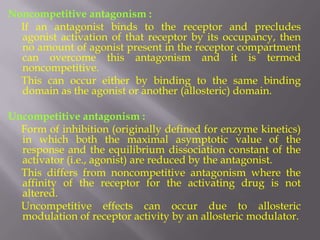
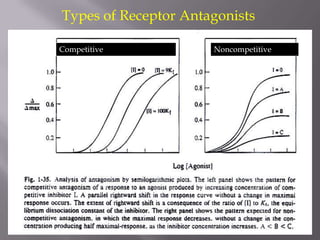
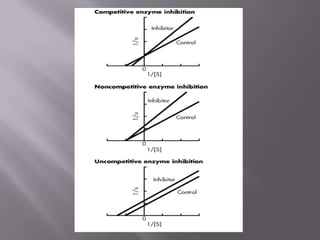
Noncompetitive antagonism :
  If an antagonist binds to the receptor and precludes
  agonist activation of that receptor by its occupancy, then
  no amount of agonist present in the receptor compartment
  can overcome this antagonism and it is termed
  noncompetitive.
  This can occur either by binding to the same binding
  domain as the agonist or another (allosteric) domain.

Uncompetitive antagonism :
  Form of inhibition (originally defined for enzyme kinetics)
  in which both the maximal asymptotic value of the
  response and the equilibrium dissociation constant of the
  activator (i.e., agonist) are reduced by the antagonist.
  This differs from noncompetitive antagonism where the
  affinity of the receptor for the activating drug is not
  altered.
  Uncompetitive effects can occur due to allosteric
  modulation of receptor activity by an allosteric modulator.
pAx :
  Negative logarithm of the molar concentration of an antagonist
  produces a x fold shift to the right of an agonist dose-response
  curve (twofold for pA2).

pKB :
  Negative logarithm of the KB. This is the common currency of
  antagonist pharmacology, as pKB values are log normally
  distributed and thus are used to characterize receptors and
  antagonist potency.

pKI :
  Negative logarithm of the KI, the equilibrium dissociation
  constant of an antagonist-receptor complex measured in a
  biochemical binding or enzyme study.

pD2 :
  Historical term for the negative logarithm of the EC50 for an
  agonist in a functional assay, not often used in present-day
  pharmacology.
Types of Receptor Antagonists

Competitive           Noncompetitive
THANK YOU!

Affinity and Efficacy

  • 1.
    By: Dr. VahidNikoui Email: nikoui@razi.tums.ac.ir
  • 2.
    Ligands reside ata point of minimal energy within a binding locus of a protein according to a ratio of the rate that the ligand leaves the surface of the protein (koff) and the rate it approaches the protein surface (kon). This ratio is the equilibrium dissociation constant of the ligand–protein complex (denoted Keq = koff/kon) and defines the molar concentration of the ligand in the compartment containing the protein where 50% of the protein has ligand bound to it at any one instant. The “affinity” or attraction of the ligand for the protein is the reciprocal of Keq.
  • 3.
    Association constant : Theratio of the rate of onset of a molecule to a receptor binding site and the rate of dissociation of the molecule away from that site.
  • 4.
    K1 : Referring to the rate of onset of a molecule to a receptor. k2 (k-1): Referring to the rate of offset of a molecule from a receptor. KA : Standard pharmacologic convention for the equilibrium dissociation constant of an agonist-receptor complex. It is the concentration that occupies half the receptor population at equilibrium. It also can be thought of as the reciprocal of affinity. KB : Convention for the equilibrium dissociation constant of an antagonist-receptor complex. Kd: Convention for the equilibrium dissociation constant of a radioligand-receptor complex. KI : Basically the KB for an antagonist but specifically measured in a biochemical binding study or enzyme assay.
  • 7.
    Historically, this termwas given to agonists to define the property of the molecule that causes the production of a physiological response. However, with the discovery of negative efficacy (inverse agonists) and efficacy related to other properties of receptors that do not involve a physiological response, a more general definition of efficacy is that property of a molecule that causes the receptor to change its behavior toward the host. Efficacy (often called maximal efficacy), can be measured with a graded dose-response curve but not with a quantal dose-response curve.
  • 9.
    Intrinsic efficacy: A solely agonist-specific quantification of the ability of the agonist to induce a physiological or pharmacological response. Thus, efficacy is the product of intrinsic efficacy multiplied by the receptor density. Negative efficacy : Property of selective affinity of the molecule for the inactive state of the receptor; this results in inverse agonism. Negative efficacy causes the active antagonism of constitutive receptor activity but is observed only in systems that have a measurably elevated basal response due to constitutive activity. It is a property of the molecule and not the system.
  • 10.
    Potency : The concentration (usually molar) of a drug that produces a defined effect. Often, potencies of agonists are defined in terms of EC50 or pEC50 values. The potency usually does not involve measures of maximal effect but rather only in locations along the concentration axis of dose response curves. Potency is determined mainly by the affinity of the receptor for the drug. In graded dose-response measurements, the effect usually chosen is 50% of the maximal effect ( EC50). In quantal dose-response measurements ED50, TD50, and LD50 are typical potency variables. Potency can be determined from either graded (EC50) or quantal dose-response curves (ED50, TD50, and LD50), but the numbers obtained are not identical. Potentiation : The increase in effect produced by a molecule or procedure in a pharmacological preparation. This can be expressed as an apparent increase in efficacy (i.e., maximal response), potency, or both.
  • 12.
    EC50/ED50 : The “effective concentration” of an agonist producing (in this case) 50% maximal response to that particular drug (not necessarily 50% of the maximal response of the system). ED50 is the in vivo counterpart of EC50 referring to the dose of an agonist that produces 50% maximal effect. Equiactive (equieffective) molar concentration (potency) ratios (EMR, EPMR) : Usually pertaining to agonists, these are the molar concentrations that produce the same response in a given system. These ratios are dependent on the affinity and efficacy of the agonists and thus are system independent, that is, characterize agonists and receptors in all systems. Care must be taken that the maximal responses of the agonists concerned are equal. Emax : Conventional term for the maximal response capable of being produced in a given system.
  • 14.
    Selectivity : The difference in activity a given biologically active molecule has for two or more processes. Thus, if a molecule has a tenfold (for example) greater affinity for process A over process B, then it can be said to have selectivity for process A. However, the implication is that the different activity is not absolute, that is, given enough molecule, the activation of the other process(es) will occur. Specificity : This can be thought of as an extreme form of selectivity where, in this case, no increase in the concentration of the molecule will be sufficient to activate the other process(es).
  • 15.
    Full agonist : Name given to an agonist that produces the full system maximal response (Emax). It is a system dependent phenomenon and should not necessarily be associated with a particular agonist, as an agonist can be a full agonist in some systems and a partial agonist in others. Partial agonist : A partial agonist produces a maximal response that is below that of the system maximum (and that of a full agonist). As well as producing a sub maximal response, partial agonists produce antagonism of more efficacious full agonists.
  • 16.
    PARTIAL AGONISTS –EFFICACY Even though drugs may occupy the same of receptors, the magnitude of their effects may differ. Full Agonist 1.0 Partial agonist 0.8 % Maximal Effect 0.6 Partial agonist 0.4 0.2 0.0 0.01 0.10 1.00 10.00 100.00 1000.00 [D] (concentration units)
  • 17.
    Intrinsic activity : The fractional maximal response to an agonist relative to a standard “full agonist” in the same system (where a full agonist produces the full system maximal response). Thus, a partial agonist that produces a maximal response 50% that of a full agonist has an intrinsic activity (denoted α) of 0.5. Full agonists have α = 1 and antagonists α = 0.
  • 18.
    Absolute agonist potency: Is the product of receptor stimulus (brought about by agonist affinity and efficacy) and the processing of the stimulus by the cell into an observable response. Because this latter process is system (cell type) dependent, absolute potencies are system- dependent measures of agonist activity. Relative agonist potency : Are system-independent estimates of agonist activity that can be compared across systems (provided both are full agonists).
  • 19.
    Measuring Drug Action Efficacy and Potency More potent than D2 D1 D2 100 % Response D3 Less efficacious than D2 0 Log [Drug] …… Potency corresponds to the strength of a drug, while Efficacy corresponds to the effectiveness of a drug. …… e.g., if 5 mg of drug A relieves pain as effectively as 10 mg of drug B, drug A is twice as potent as drug B …… the diuretic furosemide eliminates much more salt and water through urine than does the diuretic chlorothiazide. Thus, furosemide has greater efficacy than chlorothiazide. MEDC 603 Fall 2007
  • 20.
    Measuring Drug Action Efficacy / Potency / Toxicity Desired Response (%) 100 100 Toxicity (%) 50 50 0 0 Log [Drug] Blue lines …. Drug 1 Red lines …. Drug 2 Solid lines …. Desired response Dotted lines …. Toxicity response MEDC 603 Fall 2007
  • 21.
    More potent Less efficacious
  • 22.
  • 23.
    Hemi-equilibria : A pseudoequilibrium that can occur when a fast-acting agonist equilibrates with a receptor system where a slow- acting antagonist is present. Under these condition, a slow-acting competitive antagonist may appear to be an irreversibly acting antagonist. Insurmountable antagonism : A receptor blockade that results in depression of the maximal response. Inverse agonist : These ligands reverse constitutive receptor activity. Currently it is thought that this occurs because inverse agonists have a selectively higher affinity for the inactive versus the active conformation of the receptor.
  • 24.
    Pseudoirreversible antagonism : True irreversible antagonism involves a covalent chemical bond between the antagonist and the receptor (such that the rate of offset of the antagonist from the receptor is zero). However, on the time scale of pharmacological experiments, the rate of offset of an antagonist can be so slow as to be essentially irreversible. Therefore, although no covalent bond is involved, the antagonist is for all intents and purposes bound irreversibly to the receptor.
  • 26.
    Noncompetitive antagonism : If an antagonist binds to the receptor and precludes agonist activation of that receptor by its occupancy, then no amount of agonist present in the receptor compartment can overcome this antagonism and it is termed noncompetitive. This can occur either by binding to the same binding domain as the agonist or another (allosteric) domain. Uncompetitive antagonism : Form of inhibition (originally defined for enzyme kinetics) in which both the maximal asymptotic value of the response and the equilibrium dissociation constant of the activator (i.e., agonist) are reduced by the antagonist. This differs from noncompetitive antagonism where the affinity of the receptor for the activating drug is not altered. Uncompetitive effects can occur due to allosteric modulation of receptor activity by an allosteric modulator.
  • 27.
    pAx : Negative logarithm of the molar concentration of an antagonist produces a x fold shift to the right of an agonist dose-response curve (twofold for pA2). pKB : Negative logarithm of the KB. This is the common currency of antagonist pharmacology, as pKB values are log normally distributed and thus are used to characterize receptors and antagonist potency. pKI : Negative logarithm of the KI, the equilibrium dissociation constant of an antagonist-receptor complex measured in a biochemical binding or enzyme study. pD2 : Historical term for the negative logarithm of the EC50 for an agonist in a functional assay, not often used in present-day pharmacology.
  • 28.
    Types of ReceptorAntagonists Competitive Noncompetitive
  • 33.