ANALYSIS OF
      DOSE RESPONSE RELATIONSHIP


by Lee Eun Jin
• DOSE = amount of drug administered to the patient

• RESPONSE = effect in the body produced by   the drug

• Drug + Receptor ⇔ Drug-Receptor Complex
                                ⇓
                             Response
Dose-response relationship
   Depends on multiple factors

   A drug usually has one desired effect that causes
    a change in a target organ or structure

   It will also have secondary effects because it will
    be absorbed by other areas of the body
Main effects and side effects

   Main effect – the effect you want the drug to
    have

   Side effects – secondary effects that may or may
    not be desirable or helpful

   Goal is to use a dose of a drug that is effective,
    but has minimal side effects
Dosage-response curve
   Making dosage decision

   Compare dosage to the percentage of people
    showing different effects

   ED10- effective dose where 10% of people show
    response of interest

   Example – dosages of a drug used to increase
    attention (main effect) but also has 2 side effects
    ◦ Heart palpitations
    ◦ death
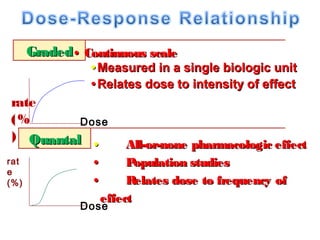
• The dose-response relationships for drugs may be Graded or quantal.
Graded dose-response curve
• can be constructed for responses that are measured on a continuous scale
• Eg, heart rate.
• Graded dose-response curves relate the intensity of response to the size of
   the dose, and hence are useful for characterizing the actions of drugs.
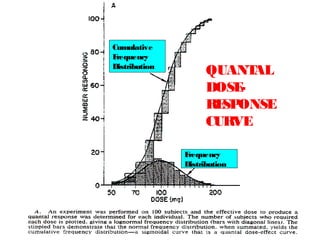
Quantal dose-response curve
• can be constructed for drugs that elicit an all-or-none response
• Eg, presence or absence of epileptic seizures.
• For most drugs, the doses that are required to produce a specified quantal
   effect in a population are log normally distributed, so that the frequency
   distribution of responses plotted against log dose is a gaussian normal
   distribution curve.
• The percentage of the population requiring a particular dose to exhibit the
   effect can be determined from this curve.
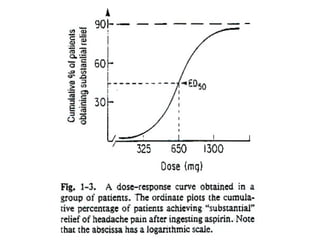
• When these data are plotted as a cumulative frequency distribution, a
   sigmoidal dose-response curve is generated.
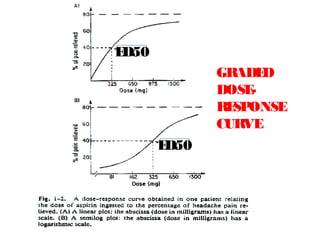
Graded dose response
•   means that a slight increase of drug should bring about a small increase in
    the response
•   For example, increase doses of histamine cause gradual contraction of the
    guinea-pig ileum.
•   Very low doses of histamine have virtually no effect and responses can be
    observed, only beyond a threshold does of about 20ng.
•   Again, very high doses of more than 50µg have no additional effects, and
    the response remains constant at this maximal level.
•   Graded dose response means the pharmacological effects of the drugs
    expressed in quality or number, such as the heart rate by beat, blood
    pressure by mmHg, also the contract of ileum in height effected by the
    drugs.
ED50
              GRADE D
              DOSE-
              RE ONSE
                SP
              CURVE
       ED50
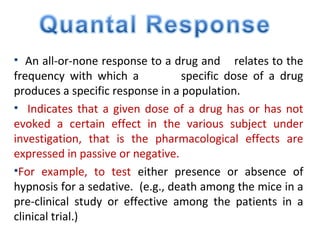
• An all-or-none response to a drug and relates to the
frequency with which a            specific dose of a drug
produces a specific response in a population.
• Indicates that a given dose of a drug has or has not
evoked a certain effect in the various subject under
investigation, that is the pharmacological effects are
expressed in passive or negative.
•For example, to test either presence or absence of
hypnosis for a sedative. (e.g., death among the mice in a
pre-clinical study or effective among the patients in a
clinical trial.)
Cumulative
Frequency
Distribution
                     QUANT AL
                     DOSE-
                     RE ONSE
                       SP
                     CURVE

               Frequency
               Distribution
Graded • Continuous scale
                • Measured in a single biologic unit
                • Relates dose to intensity of effect
rate
(%       Dose
) Quantal
           •            All-or-none pharmacologic effect
rat              •      P opulation studies
e
(%)              •      Relates dose to frequency of
                   effect
              Dose
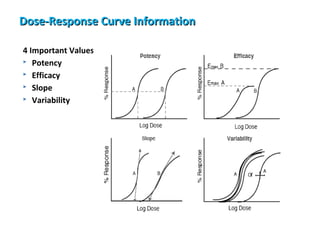
Dose-Response Curve Information

4 Important Values:
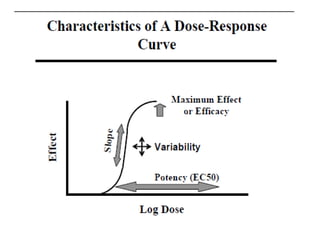
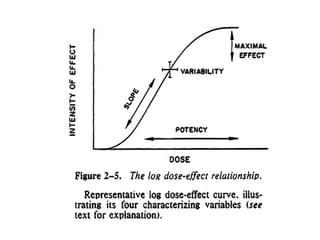
 Potency

 Efficacy

 Slope

 Variability
o Absolute amount of drug required to produce an effect

o More potent drug is the one that requires lower do
  to cause same effect


o Measure of amount of drug required for effect
 (ED50)
Potency
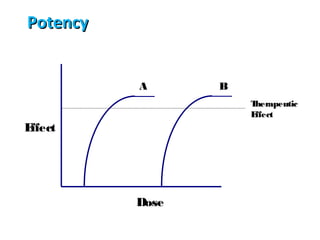
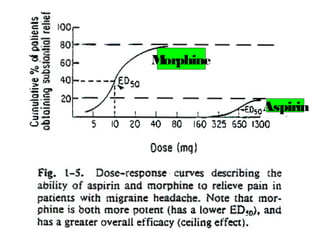
• refers to the concentration (EC50) or dose (ED50) of a drug required to produce
   50% of the drug's maximal effect as depicted by a graded dose-response curve.
• EC50 equals KD when there is a linear relationship between occupancy and
   response.
• Often, signal amplification occurs between receptor occupancy and response,
   which results in the EC50 for response being much less (ie, positioned to the left
   on the abscissa of the log dose-response curve) than K D for receptor occupancy.
•   Potency depends on both the affinity of a drug for its receptor, and the
    efficiency with which drug-receptor interaction is coupled to response.
•   The dose of drug required to produce an effect is inversely related to potency.
•   In general, low potency is important only if it results in a need to administer
    the drug in large doses that are impractical.
•   Quantal dose-response curves provide information on the potency of drugs
    that is different from the information derived from graded dose-response
    curves.
•   In a quantal dose-response relationship, the ED 50 is the dose at which 50% of
    individuals exhibit the specified quantal effect
Potency


          A      B
                     Therapeutic
                     Effect
Effect


          Dose
Efficacy (Intrinsic activity)
• THE Ability of the drug to elicit a response when it binds to
   the receptor.
• Conformational changes in receptors as a result of drug
   occupancy initiate biochemical and physiologic events that
   characterize the drug's response.
• In some tissues, agonists demonstrating high efficacy can
   result in a maximal effect, even when only a small fraction of
   the receptors is occupied
Efficacy
   •   Efficacy – how large an effect the drug produces
   •   Maximum effect obtained with drug (not potency)


             100


 Response 50                     2


               0
                    1
                            E 50
                             D
                        L Drug Concentration [M
                         og                    olar]
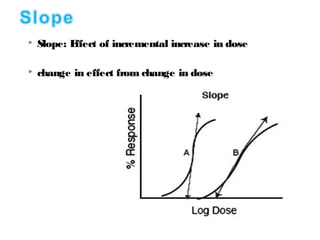
   Slope: Effect of incremental increase in dose

   change in effect from change in dose
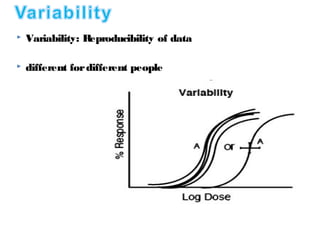
   Variability: Reproducibility of data

   different for different people
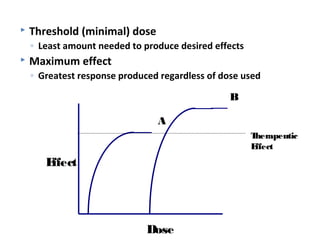
   Threshold (minimal) dose
    ◦ Least amount needed to produce desired effects
   Maximum effect
    ◦ Greatest response produced regardless of dose used

                                                 B

                                A
                                                       Therapeutic
                                                       Effect
       Effect


                              Dose
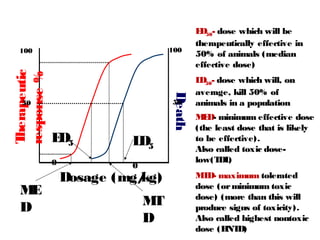
E 50- dose which will be
                                            D
                                           therapeutically effective in
  100                              100
                                           50% of animals (median
                                           effective dose)
T rapeutic
response %

                                           L 50- dose which will, on
                                            D
                                           average, kill 50% of


                                   Death
  50                               50      animals in a population
                                           M D- minimum effective dose
                                             E
 he


                                           (the least dose that is likely
             E 5
              D           L 5
                           D               to be effective).
                                           Also called toxic dose-
             0                             low(T )
                                                 DL
                          0
                 Dosage (mg/
                           kg)             M D- maximum tolerated
                                             T
                                           dose (or minimum toxic
  ME                                       dose) (more than this will
  D                           MT           produce signs of toxicity).
                              D            Also called highest nontoxic
                                           dose (H D)
                                                   NT
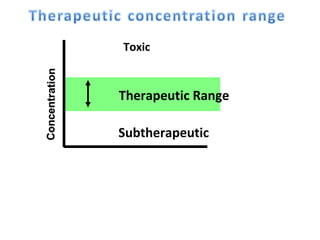
Concen tration   Toxic


                 Therapeutic Range

                 Subtherapeutic
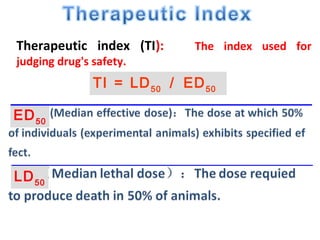
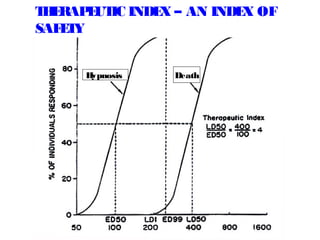
Therapeutic index (TI):      The index used for
judging drug's safety.
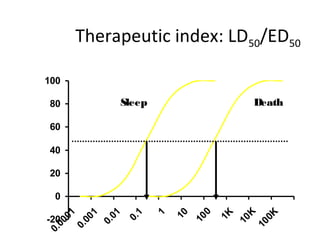
               TI = LD 50 / ED 50

ED 50


LD 50
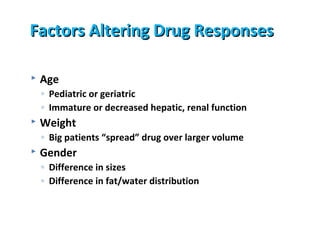
Factors Altering Drug Responses

   Age
    ◦ Pediatric or geriatric
    ◦ Immature or decreased hepatic, renal function
   Weight
    ◦ Big patients “spread” drug over larger volume
   Gender
    ◦ Difference in sizes
    ◦ Difference in fat/water distribution
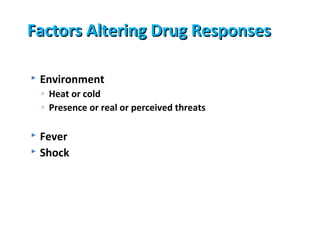
Factors Altering Drug Responses

   Environment
    ◦ Heat or cold
    ◦ Presence or real or perceived threats

 Fever
 Shock
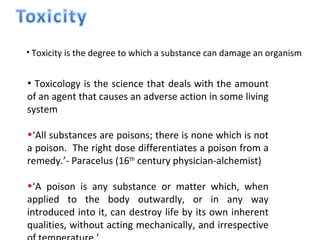
• Toxicity is the degree to which a substance can damage an organism


• Toxicology is the science that deals with the amount
of an agent that causes an adverse action in some living
system

•‘All substances are poisons; there is none which is not
a poison. The right dose differentiates a poison from a
remedy.’- Paracelus (16th century physician-alchemist)

•‘A poison is any substance or matter which, when
applied to the body outwardly, or in any way
introduced into it, can destroy life by its own inherent
qualities, without acting mechanically, and irrespective
Principle causes of drug toxicity/side effects


a. the predictable


b. the less predictable


c. the unpredictable
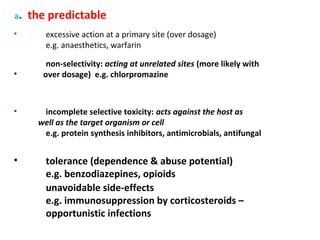
a.   the predictable
•        excessive action at a primary site (over dosage)
         e.g. anaesthetics, warfarin

         non-selectivity: acting at unrelated sites (more likely with
•       over dosage) e.g. chlorpromazine


•       incomplete selective toxicity: acts against the host as
       well as the target organism or cell
        e.g. protein synthesis inhibitors, antimicrobials, antifungal


•        tolerance (dependence & abuse potential)
         e.g. benzodiazepines, opioids
         unavoidable side-effects
         e.g. immunosuppression by corticosteroids –
         opportunistic infections
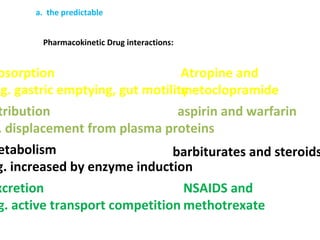
a. the predictable


        Pharmacokinetic Drug interactions:


bsorption                        Atropine and
.g. gastric emptying, gut motility
                                 metoclopramide
tribution                       aspirin and warfarin
. displacement from plasma proteins
etabolism                      barbiturates and steroids
g. increased by enzyme induction
xcretion                        NSAIDS and
g. active transport competition methotrexate
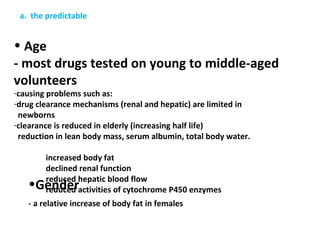
a. the predictable


• Age
- most drugs tested on young to middle-aged
volunteers
-causing problems such as:
-drug clearance mechanisms (renal and hepatic) are limited in
 newborns
-clearance is reduced in elderly (increasing half life)
 reduction in lean body mass, serum albumin, total body water.

        increased body fat
        declined renal function
        reduced hepatic blood flow
   •Gender
        reduced activities of cytochrome P450 enzymes
   - a relative increase of body fat in females
b. the less predictable

   • Genetic factors

   e.g. polymorphism in NAT2 in the liver (N-acetyltransferase2).
   -metabolises about 16 common drugs (phenytoin, hydralazine)

   Plasma esterase – suxamethonium (about 1 in 3000
                                individuals)

 c. the unpredictable

           • untoward adverse reactions

           • drug allergies and anaphylactic reactions
            e.g. penicillin (1 in 50,000 patients exposed)
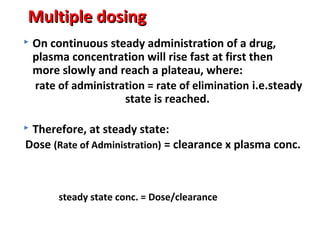
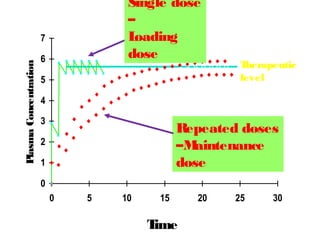
Multiple dosing
   On continuous steady administration of a drug,
    plasma concentration will rise fast at first then
    more slowly and reach a plateau, where:
    rate of administration = rate of elimination i.e.steady
                      state is reached.

Therefore, at steady state:
Dose (Rate of Administration) = clearance x plasma conc.


         steady state conc. = Dose/clearance
Single dose
                                    –
                       7            Loading
                       6            dose
                                                       Therapeutic
 lasma Concentration


                       5                               level

                       4

                       3
                                              Repeated doses
                       2                      –M aintenance
                                              dose
P


                       1

                       0
                           0   5   10    15     20    25     30

                                        Time
• Drug development
  - Site of action
    - Selection of dose and schedule
   - Potency, efficacy and safety
- Drug interactions

 • Patient management

   -Therapeutic drug monitoring
   -Risk benefit (therapeutic indices)
Morphine


           Aspirin
T E
 H RAP UT INDE – AN INDE OF
      E IC    X         X
SAF T
   EY


     Hypnosis   Death
E 99A
                D
           E 50A
            D
L 1A
 D


                          L 1
                           D
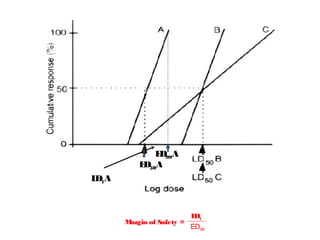
       Margin of Safety =
                          ED99
Desired vs undesired effects: Indices
          of drug safety.
• Safety Index
• Therapeutic Index
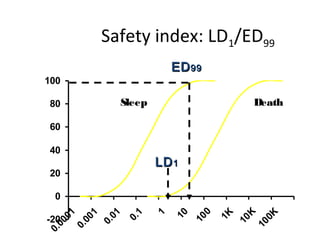
Safety index: LD1/ED99
                        ED 99
100

80          Sleep                               Death

60

40
                    LD 1
20

 0
                                0


                                            K
       01


       01
        1


               1


                        10


                                                   0K
                    1


-20                                 1K
                             10
            0.
    00


                                         10
    0.
   00


                                                10
 0.
0.
Therapeutic index: LD50/ED50

100

80          Sleep                               Death

60

40

20

 0
                                0


                                            K
       01


       01
        1


               1


                        10


                                                   0K
                    1


-20                                 1K
                             10
            0.
    00


                                         10
    0.
   00


                                                10
 0.
0.
Causes of Variability in Drug Response

    Those related to the biological system
1. Body weight and size
2. Age and Sex
3. Genetics - pharmacogenetics
4. Condition of health
5. Placebo effect
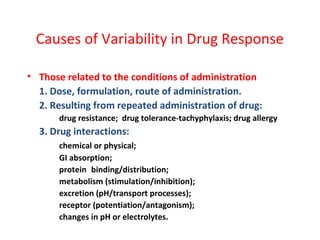
Causes of Variability in Drug Response

• Those related to the conditions of administration
  1. Dose, formulation, route of administration.
  2. Resulting from repeated administration of drug:
       drug resistance; drug tolerance-tachyphylaxis; drug allergy
  3. Drug interactions:
       chemical or physical;
       GI absorption;
       protein binding/distribution;
       metabolism (stimulation/inhibition);
       excretion (pH/transport processes);
       receptor (potentiation/antagonism);
       changes in pH or electrolytes.
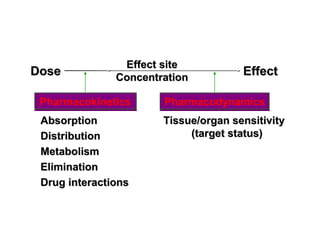
Effect site
Dose           Concentration
                                      Effect

 Pharmacokinetics      Pharmacodynamics
 Absorption            Tissue/organ sensitivity
 Distribution               (target status)
 Metabolism
 Elimination
 Drug interactions
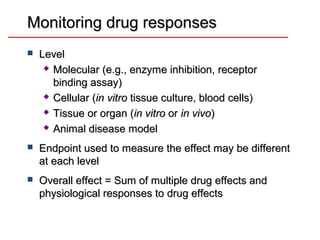
Monitoring drug responses
   Level
      Molecular (e.g., enzyme inhibition, receptor

       binding assay)
      Cellular (in vitro tissue culture, blood cells)

      Tissue or organ (in vitro or in vivo)

      Animal disease model


   Endpoint used to measure the effect may be different
    at each level
   Overall effect = Sum of multiple drug effects and
    physiological responses to drug effects
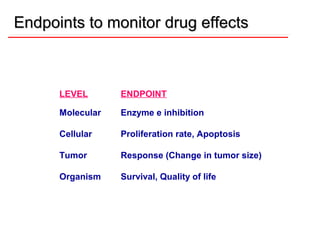
Endpoints to monitor drug effects


      LEVEL       ENDPOINT

      Molecular   Enzyme e inhibition

      Cellular    Proliferation rate, Apoptosis

      Tumor       Response (Change in tumor size)

      Organism    Survival, Quality of life
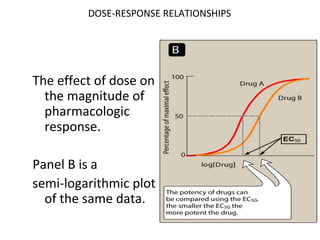
DOSE-RESPONSE RELATIONSHIPS

 The effect of dose on the
   magnitude of
   pharmacologic
   response.

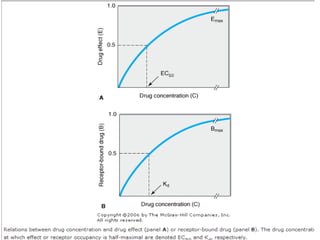
 Panel A is a linear graph.

              EffectMax • [Drug]
*Effect =
                 KD + [Drug]

* E 50=drug dose that shows fifty
   C
percent of maximal response.
DOSE-RESPONSE RELATIONSHIPS


The effect of dose on
  the magnitude of
  pharmacologic
  response.

Panel B is a
semi-logarithmic plot
  of the same data.
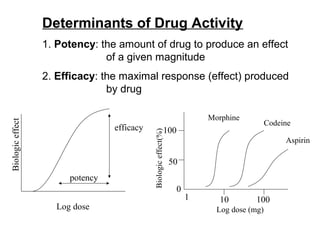
Determinants of Drug Activity
                  1. Potency: the amount of drug to produce an effect
                               of a given magnitude
                  2. Efficacy: the maximal response (effect) produced
                                by drug

                                                                           Morphine
Biologic effect


                                                                                             Codeine
                                 efficacy                    100


                                            Biologic effect(%)
                                                                                                  Aspirin

                                                                 50
                       potency
                                                                   0
                                                                       1      10        100
                    Log dose                                                 Log dose (mg)
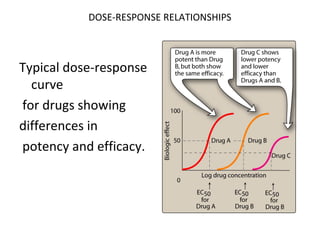
DOSE-RESPONSE RELATIONSHIPS


Typical dose-response
  curve
for drugs showing
differences in
potency and efficacy.
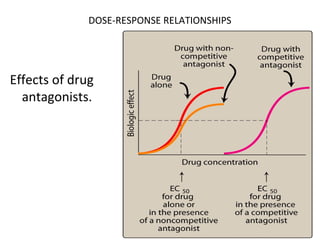
DOSE-RESPONSE RELATIONSHIPS


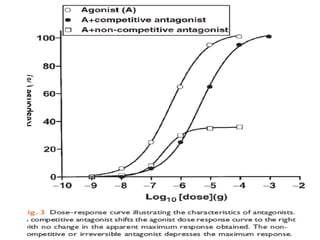
Effects of drug
  antagonists.
DOSE-RESPONSE RELATIONSHIPS


  Effects of partial
    agonists.


                                 Full Agonist


                                 Partial Agonist
ES NOPS E R


                                     Antagonist
              -1    0     1      2
                   Log([A]/KA)
QUANTAL DOSE-RESPONSE RELATIONSHIPS


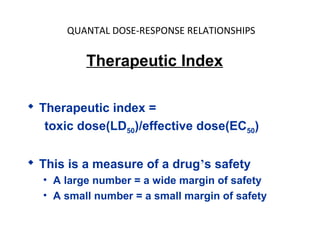
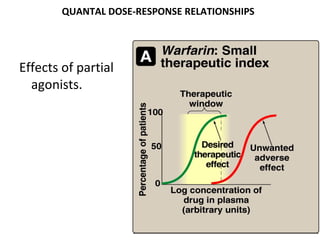
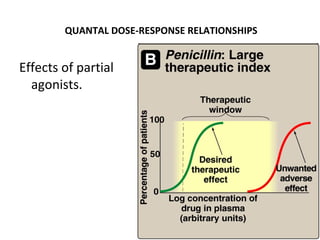
          Therapeutic Index

 Therapeutic index =
   toxic dose(LD50)/effective dose(EC50)

 This is a measure of a drug’s safety
  • A large number = a wide margin of safety
  • A small number = a small margin of safety
QUANTAL DOSE-RESPONSE RELATIONSHIPS


Effects of partial
  agonists.
QUANTAL DOSE-RESPONSE RELATIONSHIPS


Effects of partial
  agonists.
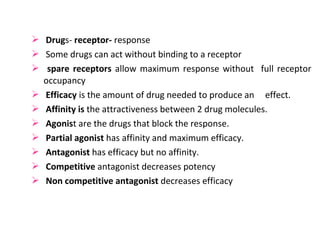
 Drugs- receptor- response
 Some drugs can act without binding to a receptor
 spare receptors allow maximum response without full receptor
  occupancy
 Efficacy is the amount of drug needed to produce an effect.
 Affinity is the attractiveness between 2 drug molecules.
 Agonist are the drugs that block the response.
 Partial agonist has affinity and maximum efficacy.
 Antagonist has efficacy but no affinity.
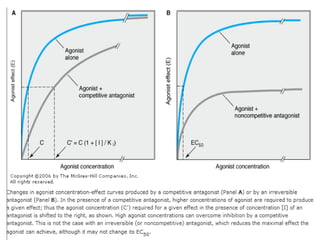
 Competitive antagonist decreases potency
 Non competitive antagonist decreases efficacy
THANK YOU

2. dose resp relationsp presentsn copy - copy

  • 1.
    ANALYSIS OF DOSE RESPONSE RELATIONSHIP by Lee Eun Jin
  • 2.
    • DOSE =amount of drug administered to the patient • RESPONSE = effect in the body produced by the drug • Drug + Receptor ⇔ Drug-Receptor Complex ⇓ Response
  • 3.
    Dose-response relationship  Depends on multiple factors  A drug usually has one desired effect that causes a change in a target organ or structure  It will also have secondary effects because it will be absorbed by other areas of the body
  • 4.
    Main effects andside effects  Main effect – the effect you want the drug to have  Side effects – secondary effects that may or may not be desirable or helpful  Goal is to use a dose of a drug that is effective, but has minimal side effects
  • 5.
    Dosage-response curve  Making dosage decision  Compare dosage to the percentage of people showing different effects  ED10- effective dose where 10% of people show response of interest  Example – dosages of a drug used to increase attention (main effect) but also has 2 side effects ◦ Heart palpitations ◦ death
  • 10.
    • The dose-responserelationships for drugs may be Graded or quantal. Graded dose-response curve • can be constructed for responses that are measured on a continuous scale • Eg, heart rate. • Graded dose-response curves relate the intensity of response to the size of the dose, and hence are useful for characterizing the actions of drugs. Quantal dose-response curve • can be constructed for drugs that elicit an all-or-none response • Eg, presence or absence of epileptic seizures. • For most drugs, the doses that are required to produce a specified quantal effect in a population are log normally distributed, so that the frequency distribution of responses plotted against log dose is a gaussian normal distribution curve. • The percentage of the population requiring a particular dose to exhibit the effect can be determined from this curve. • When these data are plotted as a cumulative frequency distribution, a sigmoidal dose-response curve is generated.
  • 11.
    Graded dose response • means that a slight increase of drug should bring about a small increase in the response • For example, increase doses of histamine cause gradual contraction of the guinea-pig ileum. • Very low doses of histamine have virtually no effect and responses can be observed, only beyond a threshold does of about 20ng. • Again, very high doses of more than 50µg have no additional effects, and the response remains constant at this maximal level. • Graded dose response means the pharmacological effects of the drugs expressed in quality or number, such as the heart rate by beat, blood pressure by mmHg, also the contract of ileum in height effected by the drugs.
  • 12.
    ED50 GRADE D DOSE- RE ONSE SP CURVE ED50
  • 13.
    • An all-or-noneresponse to a drug and relates to the frequency with which a specific dose of a drug produces a specific response in a population. • Indicates that a given dose of a drug has or has not evoked a certain effect in the various subject under investigation, that is the pharmacological effects are expressed in passive or negative. •For example, to test either presence or absence of hypnosis for a sedative. (e.g., death among the mice in a pre-clinical study or effective among the patients in a clinical trial.)
  • 14.
    Cumulative Frequency Distribution QUANT AL DOSE- RE ONSE SP CURVE Frequency Distribution
  • 15.
    Graded • Continuousscale • Measured in a single biologic unit • Relates dose to intensity of effect rate (% Dose ) Quantal • All-or-none pharmacologic effect rat • P opulation studies e (%) • Relates dose to frequency of effect Dose
  • 16.
    Dose-Response Curve Information 4Important Values:  Potency  Efficacy  Slope  Variability
  • 17.
    o Absolute amountof drug required to produce an effect o More potent drug is the one that requires lower do to cause same effect o Measure of amount of drug required for effect (ED50)
  • 18.
    Potency • refers tothe concentration (EC50) or dose (ED50) of a drug required to produce 50% of the drug's maximal effect as depicted by a graded dose-response curve. • EC50 equals KD when there is a linear relationship between occupancy and response. • Often, signal amplification occurs between receptor occupancy and response, which results in the EC50 for response being much less (ie, positioned to the left on the abscissa of the log dose-response curve) than K D for receptor occupancy. • Potency depends on both the affinity of a drug for its receptor, and the efficiency with which drug-receptor interaction is coupled to response. • The dose of drug required to produce an effect is inversely related to potency. • In general, low potency is important only if it results in a need to administer the drug in large doses that are impractical. • Quantal dose-response curves provide information on the potency of drugs that is different from the information derived from graded dose-response curves. • In a quantal dose-response relationship, the ED 50 is the dose at which 50% of individuals exhibit the specified quantal effect
  • 19.
    Potency A B Therapeutic Effect Effect Dose
  • 20.
    Efficacy (Intrinsic activity) •THE Ability of the drug to elicit a response when it binds to the receptor. • Conformational changes in receptors as a result of drug occupancy initiate biochemical and physiologic events that characterize the drug's response. • In some tissues, agonists demonstrating high efficacy can result in a maximal effect, even when only a small fraction of the receptors is occupied
  • 21.
    Efficacy • Efficacy – how large an effect the drug produces • Maximum effect obtained with drug (not potency) 100 Response 50 2 0 1 E 50 D L Drug Concentration [M og olar]
  • 22.
    Slope: Effect of incremental increase in dose  change in effect from change in dose
  • 23.
    Variability: Reproducibility of data  different for different people
  • 24.
    Threshold (minimal) dose ◦ Least amount needed to produce desired effects  Maximum effect ◦ Greatest response produced regardless of dose used B A Therapeutic Effect Effect Dose
  • 25.
    E 50- dosewhich will be D therapeutically effective in 100 100 50% of animals (median effective dose) T rapeutic response % L 50- dose which will, on D average, kill 50% of Death 50 50 animals in a population M D- minimum effective dose E he (the least dose that is likely E 5 D L 5 D to be effective). Also called toxic dose- 0 low(T ) DL 0 Dosage (mg/ kg) M D- maximum tolerated T dose (or minimum toxic ME dose) (more than this will D MT produce signs of toxicity). D Also called highest nontoxic dose (H D) NT
  • 26.
    Concen tration Toxic Therapeutic Range Subtherapeutic
  • 27.
    Therapeutic index (TI): The index used for judging drug's safety. TI = LD 50 / ED 50 ED 50 LD 50
  • 28.
    Factors Altering DrugResponses  Age ◦ Pediatric or geriatric ◦ Immature or decreased hepatic, renal function  Weight ◦ Big patients “spread” drug over larger volume  Gender ◦ Difference in sizes ◦ Difference in fat/water distribution
  • 29.
    Factors Altering DrugResponses  Environment ◦ Heat or cold ◦ Presence or real or perceived threats  Fever  Shock
  • 30.
    • Toxicity isthe degree to which a substance can damage an organism • Toxicology is the science that deals with the amount of an agent that causes an adverse action in some living system •‘All substances are poisons; there is none which is not a poison. The right dose differentiates a poison from a remedy.’- Paracelus (16th century physician-alchemist) •‘A poison is any substance or matter which, when applied to the body outwardly, or in any way introduced into it, can destroy life by its own inherent qualities, without acting mechanically, and irrespective
  • 31.
    Principle causes ofdrug toxicity/side effects a. the predictable b. the less predictable c. the unpredictable
  • 32.
    a. the predictable • excessive action at a primary site (over dosage) e.g. anaesthetics, warfarin non-selectivity: acting at unrelated sites (more likely with • over dosage) e.g. chlorpromazine • incomplete selective toxicity: acts against the host as well as the target organism or cell e.g. protein synthesis inhibitors, antimicrobials, antifungal • tolerance (dependence & abuse potential) e.g. benzodiazepines, opioids unavoidable side-effects e.g. immunosuppression by corticosteroids – opportunistic infections
  • 33.
    a. the predictable Pharmacokinetic Drug interactions: bsorption Atropine and .g. gastric emptying, gut motility metoclopramide tribution aspirin and warfarin . displacement from plasma proteins etabolism barbiturates and steroids g. increased by enzyme induction xcretion NSAIDS and g. active transport competition methotrexate
  • 34.
    a. the predictable •Age - most drugs tested on young to middle-aged volunteers -causing problems such as: -drug clearance mechanisms (renal and hepatic) are limited in newborns -clearance is reduced in elderly (increasing half life) reduction in lean body mass, serum albumin, total body water. increased body fat declined renal function reduced hepatic blood flow •Gender reduced activities of cytochrome P450 enzymes - a relative increase of body fat in females
  • 35.
    b. the lesspredictable • Genetic factors e.g. polymorphism in NAT2 in the liver (N-acetyltransferase2). -metabolises about 16 common drugs (phenytoin, hydralazine) Plasma esterase – suxamethonium (about 1 in 3000 individuals) c. the unpredictable • untoward adverse reactions • drug allergies and anaphylactic reactions e.g. penicillin (1 in 50,000 patients exposed)
  • 36.
    Multiple dosing  On continuous steady administration of a drug, plasma concentration will rise fast at first then more slowly and reach a plateau, where: rate of administration = rate of elimination i.e.steady state is reached. Therefore, at steady state: Dose (Rate of Administration) = clearance x plasma conc. steady state conc. = Dose/clearance
  • 37.
    Single dose – 7 Loading 6 dose Therapeutic lasma Concentration 5 level 4 3 Repeated doses 2 –M aintenance dose P 1 0 0 5 10 15 20 25 30 Time
  • 38.
    • Drug development - Site of action - Selection of dose and schedule - Potency, efficacy and safety - Drug interactions • Patient management -Therapeutic drug monitoring -Risk benefit (therapeutic indices)
  • 40.
    Morphine Aspirin
  • 41.
    T E HRAP UT INDE – AN INDE OF E IC X X SAF T EY Hypnosis Death
  • 42.
    E 99A D E 50A D L 1A D L 1 D Margin of Safety = ED99
  • 43.
    Desired vs undesiredeffects: Indices of drug safety. • Safety Index • Therapeutic Index
  • 44.
    Safety index: LD1/ED99 ED 99 100 80 Sleep Death 60 40 LD 1 20 0 0 K 01 01 1 1 10 0K 1 -20 1K 10 0. 00 10 0. 00 10 0. 0.
  • 45.
    Therapeutic index: LD50/ED50 100 80 Sleep Death 60 40 20 0 0 K 01 01 1 1 10 0K 1 -20 1K 10 0. 00 10 0. 00 10 0. 0.
  • 46.
    Causes of Variabilityin Drug Response Those related to the biological system 1. Body weight and size 2. Age and Sex 3. Genetics - pharmacogenetics 4. Condition of health 5. Placebo effect
  • 47.
    Causes of Variabilityin Drug Response • Those related to the conditions of administration 1. Dose, formulation, route of administration. 2. Resulting from repeated administration of drug: drug resistance; drug tolerance-tachyphylaxis; drug allergy 3. Drug interactions: chemical or physical; GI absorption; protein binding/distribution; metabolism (stimulation/inhibition); excretion (pH/transport processes); receptor (potentiation/antagonism); changes in pH or electrolytes.
  • 48.
    Effect site Dose Concentration Effect Pharmacokinetics Pharmacodynamics Absorption Tissue/organ sensitivity Distribution (target status) Metabolism Elimination Drug interactions
  • 49.
    Monitoring drug responses  Level  Molecular (e.g., enzyme inhibition, receptor binding assay)  Cellular (in vitro tissue culture, blood cells)  Tissue or organ (in vitro or in vivo)  Animal disease model  Endpoint used to measure the effect may be different at each level  Overall effect = Sum of multiple drug effects and physiological responses to drug effects
  • 50.
    Endpoints to monitordrug effects LEVEL ENDPOINT Molecular Enzyme e inhibition Cellular Proliferation rate, Apoptosis Tumor Response (Change in tumor size) Organism Survival, Quality of life
  • 51.
    DOSE-RESPONSE RELATIONSHIPS Theeffect of dose on the magnitude of pharmacologic response. Panel A is a linear graph. EffectMax • [Drug] *Effect = KD + [Drug] * E 50=drug dose that shows fifty C percent of maximal response.
  • 52.
    DOSE-RESPONSE RELATIONSHIPS The effectof dose on the magnitude of pharmacologic response. Panel B is a semi-logarithmic plot of the same data.
  • 53.
    Determinants of DrugActivity 1. Potency: the amount of drug to produce an effect of a given magnitude 2. Efficacy: the maximal response (effect) produced by drug Morphine Biologic effect Codeine efficacy 100 Biologic effect(%) Aspirin 50 potency 0 1 10 100 Log dose Log dose (mg)
  • 54.
    DOSE-RESPONSE RELATIONSHIPS Typical dose-response curve for drugs showing differences in potency and efficacy.
  • 55.
  • 56.
    DOSE-RESPONSE RELATIONSHIPS Effects of partial agonists. Full Agonist Partial Agonist ES NOPS E R Antagonist -1 0 1 2 Log([A]/KA)
  • 57.
    QUANTAL DOSE-RESPONSE RELATIONSHIPS Therapeutic Index  Therapeutic index = toxic dose(LD50)/effective dose(EC50)  This is a measure of a drug’s safety • A large number = a wide margin of safety • A small number = a small margin of safety
  • 58.
  • 59.
  • 62.
     Drugs- receptor-response  Some drugs can act without binding to a receptor  spare receptors allow maximum response without full receptor occupancy  Efficacy is the amount of drug needed to produce an effect.  Affinity is the attractiveness between 2 drug molecules.  Agonist are the drugs that block the response.  Partial agonist has affinity and maximum efficacy.  Antagonist has efficacy but no affinity.  Competitive antagonist decreases potency  Non competitive antagonist decreases efficacy
  • 63.