Dose Response Phenomenon
Dr. AWAIS IRSHAD
Lecture Objectives:
After completion of the lecture, students will be able to:
• Describe Quantitatively describe the relationship between drug, receptor,
and the pharmacologic response.
• Explain why the intensity of the pharmacologic response increases with
drug concentrations and/or dose up to a maximum response.
• Describe relationship of dose to pharmacologic effect
Dose-Response Relationship:
A drug's pharmacological effect is determined by its concentration at the site
of action, which is determined by the dose administered. Such a relationship
is called 'dose-response relationship’.
Types of Dose-Response Curves
• Graded dose-response
• Quantal dose-response curve
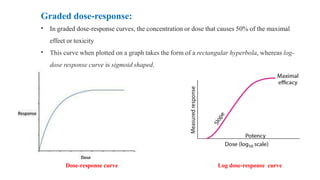
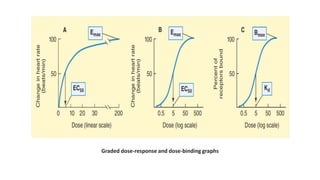
Graded dose-response:
• In graded dose-response curves, the concentration or dose that causes 50% of the maximal
effect or toxicity
• This curve when plotted on a graph takes the form of a rectangular hyperbola, whereas log-
dose response curve is sigmoid shaped.
Dose-response curve Log dose-response curve
Graded dose-response and dose-binding graphs
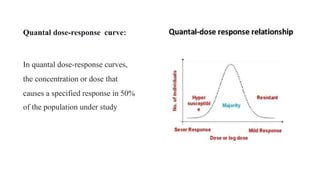
Quantal dose-response curve:
In quantal dose-response curves,
the concentration or dose that
causes a specified response in 50%
of the population under study
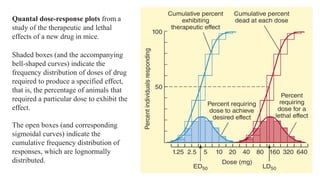
Quantal dose-response plots from a
study of the therapeutic and lethal
effects of a new drug in mice.
Shaded boxes (and the accompanying
bell-shaped curves) indicate the
frequency distribution of doses of drug
required to produce a specified effect,
that is, the percentage of animals that
required a particular dose to exhibit the
effect.
The open boxes (and corresponding
sigmoidal curves) indicate the
cumulative frequency distribution of
responses, which are lognormally
distributed.
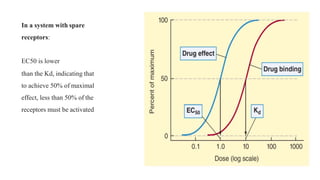
In a system with spare
receptors:
EC50 is lower
than the Kd, indicating that
to achieve 50% of maximal
effect, less than 50% of the
receptors must be activated
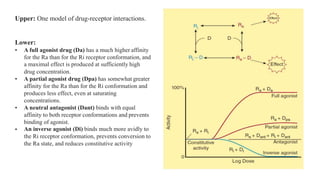
Upper: One model of drug-receptor interactions.
Lower:
• A full agonist drug (Da) has a much higher affinity
for the Ra than for the Ri receptor conformation, and
a maximal effect is produced at sufficiently high
drug concentration.
• A partial agonist drug (Dpa) has somewhat greater
affinity for the Ra than for the Ri conformation and
produces less effect, even at saturating
concentrations.
• A neutral antagonist (Dant) binds with equal
affinity to both receptor conformations and prevents
binding of agonist.
• An inverse agonist (Di) binds much more avidly to
the Ri receptor conformation, prevents conversion to
the Ra state, and reduces constitutive activity
Agonist dose-response curves in the presence of competitive and irreversible antagonists
A. Competitive antagonist has an effect illustrated by the shift of the agonist curve to the right.
B. An irreversible (or noncompetitive) antagonist shifts the agonist curve downward.
When a drug is administered systemically, the dose-response relationship
has two components:
• dose-plasma concentration relationship (pharmacokinetic
considerations)
• plasma concentration-response relationship (dose
response relationship)
Drug-receptor interaction obeys law of mass action, accordingly:-
Where E: Observed effect at a dose [D] of the drug.
Emax: Maximal response.
KD: Dissociation constant of the drug-receptor complex, which is equal to the dose of
the drug at which half maximal response is produced.
• Stimuli are graded by fractional change in stimulus intensity
• e.g. 1 kg and 2 kg weights held in two hands can be easily
differentiated, but not 10 kg and 11 kg weights.
• Difference in both cases remains 1kg, there is a 100% fractional
change in the former case but only 10% change in the latter case.
• In other words, response is proportional to an exponential function
(log) of the dose.
Plotting a log dose-response curves (DRC):
(i) A wide range of drug doses can be easily displayed on a
graph.
(ii) Comparison between agonists and study of antagonists
becomes easier.
The log dose-response curve (DRC) can be characterized by its shape
(slope and maxima) and position on the dose axis.
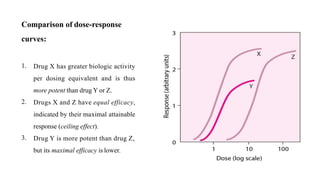
Comparison of dose-response
curves:
1. Drug X has greater biologic activity
per dosing equivalent and is thus
more potent than drug Y or Z.
2. Drugs X and Z have equal efficacy,
indicated by their maximal attainable
response (ceiling effect).
3. Drug Y is more potent than drug Z,
but its maximal efficacy is lower.
RELATIONSHIPOFDOSE TO PHARMACOLOGIC EFFECT:
The onset, intensity, and duration of the pharmacologic effect depend on the
dose and the pharmacokinetics of the drug.
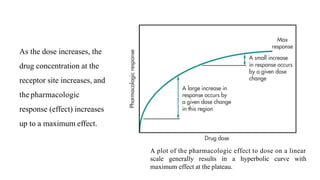
As the dose increases, the
drug concentration at the
receptor site increases, and
the pharmacologic
response (effect) increases
up to a maximum effect.
A plot of the pharmacologic effect to dose on a linear
scale generally results in a hyperbolic curve with
maximum effect at the plateau.
The same data may be
compressed and plotted on
a log-linear scale and
result in a sigmoid curve.
A typical log dose-versus-pharmacologic
response curve
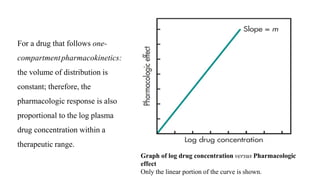
For a drug that follows one-
compartmentpharmacokinetics:
the volume of distribution is
constant; therefore, the
pharmacologic response is also
proportional to the log plasma
drug concentration within a
therapeutic range.
Graph of log drug concentration versus Pharmacologic
effect
Only the linear portion of the curve is shown.
Depression of normal muscle activity as a
function of time after IV administration of
0.1–0.2 mg ± Tubocurarine /Kg to
unanesthetized volunteers, presenting mean
values of six experiments on five subjects.
• Circles represent head lift
• Squares, hand grip
• Triangles, inspiratory flow
Mean plasma concentrations
of LysergicAcid Diethylamide
(LSD) and performance test
scores as a function of time
after IV administration of 2 mg
LSD per kilogram to five
normal human subjects.
References:
• Katzung BG, Masters SB and Trevor AJ eds, 2018. Basic & clinical pharmacology.
• Rosenbaum SE ed, 2016. Basic pharmacokinetics and pharmacodynamics: An integrated
textbook and computer simulations. John Wiley & Sons.
• Tripathi KD, 2013. Essentials of medical pharmacology. JP Medical Ltd.
• Rang And Dale’s Pharmacology (© 2020, Elsevier) James M. Ritter, Rod Flower, Graeme
Henderson, EtAl.
• Shanbhag, T. and Shenoy, S., 2020. Pharmacology for Medical Graduates, 4th Updated
Edition-E-Book. Elsevier India.

Dose Response Phenomenon.pptx

  • 1.
  • 2.
    Lecture Objectives: After completionof the lecture, students will be able to: • Describe Quantitatively describe the relationship between drug, receptor, and the pharmacologic response. • Explain why the intensity of the pharmacologic response increases with drug concentrations and/or dose up to a maximum response. • Describe relationship of dose to pharmacologic effect
  • 3.
    Dose-Response Relationship: A drug'spharmacological effect is determined by its concentration at the site of action, which is determined by the dose administered. Such a relationship is called 'dose-response relationship’.
  • 4.
    Types of Dose-ResponseCurves • Graded dose-response • Quantal dose-response curve
  • 5.
    Graded dose-response: • Ingraded dose-response curves, the concentration or dose that causes 50% of the maximal effect or toxicity • This curve when plotted on a graph takes the form of a rectangular hyperbola, whereas log- dose response curve is sigmoid shaped. Dose-response curve Log dose-response curve
  • 6.
    Graded dose-response anddose-binding graphs
  • 7.
    Quantal dose-response curve: Inquantal dose-response curves, the concentration or dose that causes a specified response in 50% of the population under study
  • 8.
    Quantal dose-response plotsfrom a study of the therapeutic and lethal effects of a new drug in mice. Shaded boxes (and the accompanying bell-shaped curves) indicate the frequency distribution of doses of drug required to produce a specified effect, that is, the percentage of animals that required a particular dose to exhibit the effect. The open boxes (and corresponding sigmoidal curves) indicate the cumulative frequency distribution of responses, which are lognormally distributed.
  • 9.
    In a systemwith spare receptors: EC50 is lower than the Kd, indicating that to achieve 50% of maximal effect, less than 50% of the receptors must be activated
  • 10.
    Upper: One modelof drug-receptor interactions. Lower: • A full agonist drug (Da) has a much higher affinity for the Ra than for the Ri receptor conformation, and a maximal effect is produced at sufficiently high drug concentration. • A partial agonist drug (Dpa) has somewhat greater affinity for the Ra than for the Ri conformation and produces less effect, even at saturating concentrations. • A neutral antagonist (Dant) binds with equal affinity to both receptor conformations and prevents binding of agonist. • An inverse agonist (Di) binds much more avidly to the Ri receptor conformation, prevents conversion to the Ra state, and reduces constitutive activity
  • 11.
    Agonist dose-response curvesin the presence of competitive and irreversible antagonists A. Competitive antagonist has an effect illustrated by the shift of the agonist curve to the right. B. An irreversible (or noncompetitive) antagonist shifts the agonist curve downward.
  • 12.
    When a drugis administered systemically, the dose-response relationship has two components: • dose-plasma concentration relationship (pharmacokinetic considerations) • plasma concentration-response relationship (dose response relationship)
  • 13.
    Drug-receptor interaction obeyslaw of mass action, accordingly:- Where E: Observed effect at a dose [D] of the drug. Emax: Maximal response. KD: Dissociation constant of the drug-receptor complex, which is equal to the dose of the drug at which half maximal response is produced.
  • 14.
    • Stimuli aregraded by fractional change in stimulus intensity • e.g. 1 kg and 2 kg weights held in two hands can be easily differentiated, but not 10 kg and 11 kg weights. • Difference in both cases remains 1kg, there is a 100% fractional change in the former case but only 10% change in the latter case. • In other words, response is proportional to an exponential function (log) of the dose.
  • 15.
    Plotting a logdose-response curves (DRC): (i) A wide range of drug doses can be easily displayed on a graph. (ii) Comparison between agonists and study of antagonists becomes easier. The log dose-response curve (DRC) can be characterized by its shape (slope and maxima) and position on the dose axis.
  • 16.
    Comparison of dose-response curves: 1.Drug X has greater biologic activity per dosing equivalent and is thus more potent than drug Y or Z. 2. Drugs X and Z have equal efficacy, indicated by their maximal attainable response (ceiling effect). 3. Drug Y is more potent than drug Z, but its maximal efficacy is lower.
  • 17.
    RELATIONSHIPOFDOSE TO PHARMACOLOGICEFFECT: The onset, intensity, and duration of the pharmacologic effect depend on the dose and the pharmacokinetics of the drug.
  • 18.
    As the doseincreases, the drug concentration at the receptor site increases, and the pharmacologic response (effect) increases up to a maximum effect. A plot of the pharmacologic effect to dose on a linear scale generally results in a hyperbolic curve with maximum effect at the plateau.
  • 19.
    The same datamay be compressed and plotted on a log-linear scale and result in a sigmoid curve. A typical log dose-versus-pharmacologic response curve
  • 20.
    For a drugthat follows one- compartmentpharmacokinetics: the volume of distribution is constant; therefore, the pharmacologic response is also proportional to the log plasma drug concentration within a therapeutic range. Graph of log drug concentration versus Pharmacologic effect Only the linear portion of the curve is shown.
  • 21.
    Depression of normalmuscle activity as a function of time after IV administration of 0.1–0.2 mg ± Tubocurarine /Kg to unanesthetized volunteers, presenting mean values of six experiments on five subjects. • Circles represent head lift • Squares, hand grip • Triangles, inspiratory flow
  • 22.
    Mean plasma concentrations ofLysergicAcid Diethylamide (LSD) and performance test scores as a function of time after IV administration of 2 mg LSD per kilogram to five normal human subjects.
  • 23.
    References: • Katzung BG,Masters SB and Trevor AJ eds, 2018. Basic & clinical pharmacology. • Rosenbaum SE ed, 2016. Basic pharmacokinetics and pharmacodynamics: An integrated textbook and computer simulations. John Wiley & Sons. • Tripathi KD, 2013. Essentials of medical pharmacology. JP Medical Ltd. • Rang And Dale’s Pharmacology (© 2020, Elsevier) James M. Ritter, Rod Flower, Graeme Henderson, EtAl. • Shanbhag, T. and Shenoy, S., 2020. Pharmacology for Medical Graduates, 4th Updated Edition-E-Book. Elsevier India.