DOSE RESPONSE CURVE
Dr.M.JEGADEESHKRISHNAN
FIRST YEAR PG
DEPARTMENT OF PHARMACOLOGY
OVERVIEW
• Introduction
• Types of Dose-Response relationship
• Graded dose response relationship
• Quantal dose response relationship
• Therapeutic index
• Effect of drug concentration on receptor binding
• Relationship of drug binding to pharmacologic effect
• Intrinsic activity
• References
2
INTRODUCTION
• DRUG;
Chemical with a known structure,that alters the pathophysiology for
therapeutic gain
• DOSE;
It is the amount of drug administered to produce a certain degree of response
in a patient
3
Contd…
• RECEPTOR;
The component of a cell or organism that interacts with a drug and initiates
the chain of events leading to the drug’s observed effects
Functions of receptors;
1)Receptors largely determine the quantitative relations between dose of
drug and pharmacologic effects
2)Receptors are responsible for selectivity of drug action
3)Receptors mediate the actions of pharmacologic agonists and antagonists
4
DOSE RESPONSE CURVE
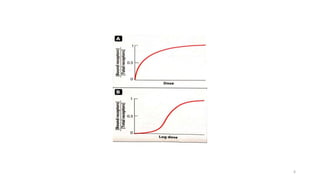
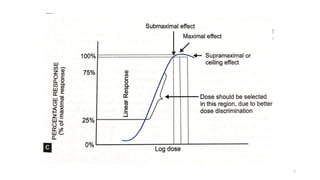
• The log dose response curve is the graphical representation of the relationship
between the dose of a drug versus the effects that the drug exerts
• X-axis = Dose of the drug
• Y-axis = Response
• Sigmoidal curve with top and bottom plateaus
5
6
7
ADVANTAGES
• Wide range of drug doses are represented
• Easy comparison between agonists
• Easy study of antagonists
• The middle portion (30-70%) of the curve is linear; direct relationship between
dose and response can be obtained
8
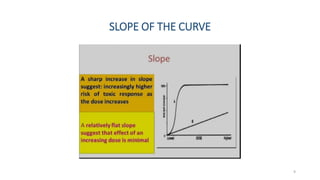
SLOPE OF THE CURVE
9
TYPES OF DOSE-RESPONSE RELATIONSHIP
1)Graded dose response relationship
2)Quantal dose response relationship
10
GRADED DOSE RESPONSE RELATIONSHIP
• DRC in an individual
• As the concentration of a drug increases,its pharmacologic effect also gradually
increases until all the receptors are occupied
• It determines;
Potency and Efficacy
11
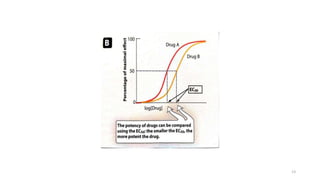
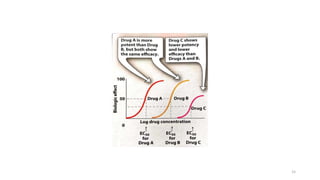
POTENCY
• It is a measure of the amount of drug necessary to produce an effect
• The concentration of drug producing 50% of the maximum effect (EC50) is often
used to determine potency
12
13
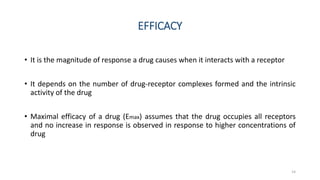
EFFICACY
• It is the magnitude of response a drug causes when it interacts with a receptor
• It depends on the number of drug-receptor complexes formed and the intrinsic
activity of the drug
• Maximal efficacy of a drug (Emax) assumes that the drug occupies all receptors
and no increase in response is observed in response to higher concentrations of
drug
14
15
QUANTAL DOSE RESPONSE RELATIONSHIP
• Quantal dose-response curves are useful for determining doses to which most of
the population responds
• They have similar shapes to log-dose response curves
• Effective Dose(ED50);
The dose that causes a therapeutic response in half of the population
16
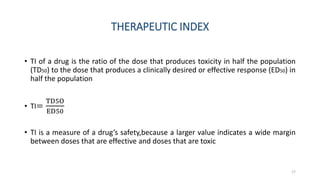
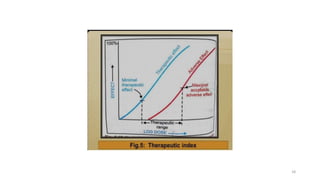
THERAPEUTIC INDEX
• TI of a drug is the ratio of the dose that produces toxicity in half the population
(TD50) to the dose that produces a clinically desired or effective response (ED50) in
half the population
• TI=
TD5O
ED50
• TI is a measure of a drug’s safety,because a larger value indicates a wide margin
between doses that are effective and doses that are toxic
17
18
EFFECTS OF DRUG CONCENTRATION ON BINDING
• The quantitative relationship between drug concentration and receptor
occupancy applies the law of mass action to the kinetics of the binding of drug
and receptor molecules
• Drug+Receptor ↔ Drug-receptor complex → Biologic effect
•
[DR]
[Rt]
=
[D]
Kd+[D]
• Kd;
1)Used to determine the affinity of drug for its receptor
2)Higher the value, the weaker the interaction and lower the affinity and vice
versa
19
RELATIONSHIP OF DRUG BINDING TO PHARMACOLOGIC
EFFECT
• The law of mass action can be applied to drug concentration and response
providing the following assumptions are met;
1)The magnitude of the response is proportional to the amount of receptors
occupied by drug
2)The Emax occurs when all receptors are bound
3)One molecule of drug binds to only one molecule of receptor
•
[𝐸]
[𝐸𝑚𝑎𝑥]
=
[𝐷]
𝐾𝑑+[𝐷]
20
INTRINSIC ACTIVITY
• Mathematical designation for effect
• An agonist binds to a receptor and produces a biologic response based on the
concentration of the agonist, its affinity for the receptor and hence the fraction of
occupied receptors
• Intrinsic activity of a drug determines its ability to fully or partially activate the
receptors
• Drugs may be categorised according to their intrinsic activity and resulting Emax
values
21
Contd…
• Types;
1)Full agonists
2)Partial agonists
3)Inverse agonists
4)Antagonists
22
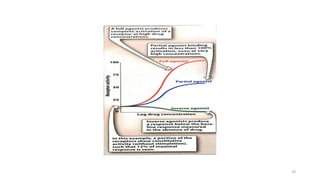
FULL AGONISTS
• Drug that binds to target(receptor) → maximal effect
• Full agonists bind to a receptor, stabilizing the receptor in its active state
• It has an intrinsic activity of one
• Ex;
Phenylephrine binds to alpha 1 adrenoceptors(Gq) causes vasoconstriction and
↑ blood pressure
23
24
PARTIAL AGONIST
• Drug that binds to receptor → submaximal effect
• Even all the receptors are occupied, partial agonists cannot produce the same
Emax as a full agonist
• IA of greater than zero but less than one
• A partial agonist may also act as a partial antagonist of a full agonist
• Therefore Emax would decrease until it reached Emax of the partial agonist
25
Contd…
• Example;
Aripiprazole (an atypical antipsychotic) acts on selected dopamine receptors
→Overactive dopaminergic pathways - inhibited
→Underactive dopaminergic pathways - stimulated
This might explain the ability of Aripiprazole to improve the symptoms of
schizophrenia with a small risk of causing extrapyramidal adverse effects
26
INVERSE AGONIST
• It reverses the activation state of receptors and exert the opposite
pharmacological effect of agonists
[Drug + Receptor → Opposite effect ]
• It has an intrinsic activity of less than zero
27
ANTAGONISTS
• Antagonists bind to a receptor and produces zero IA
• An antagonist can decrease the effect of an agonist when present
• Antagonism may occur either by blocking the drug’s ability to bind to the
receptor or by blocking its ability to activate the receptor
• Types;
1)Reversible antagonists
2)Irreversible antagonists
3)Allosteric antagonists
4)Functional antagonists
28
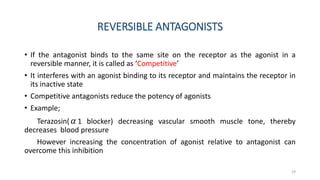
REVERSIBLE ANTAGONISTS
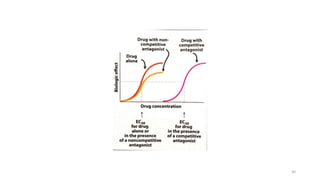
• If the antagonist binds to the same site on the receptor as the agonist in a
reversible manner, it is called as ‘Competitive’
• It interferes with an agonist binding to its receptor and maintains the receptor in
its inactive state
• Competitive antagonists reduce the potency of agonists
• Example;
Terazosin(𝛼 1 blocker) decreasing vascular smooth muscle tone, thereby
decreases blood pressure
However increasing the concentration of agonist relative to antagonist can
overcome this inhibition
29
30
SCHILD EQUATION
•
𝐶′
𝐶
= 1 +
[𝐼]
𝐾𝑖
C’- concentration of agonist in presence of competitive
antagonist
[I] – concentration of competitive antagonist
• Pharmacologists often use this relation to determine the Ki of a competitive
antagonist
• Dissociative constant- Measures the propensity of larger object to separate
reversibly into small components
31
Contd…
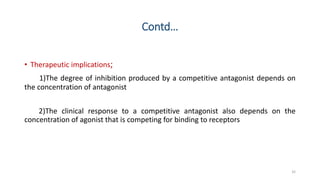
• Therapeutic implications;
1)The degree of inhibition produced by a competitive antagonist depends on
the concentration of antagonist
2)The clinical response to a competitive antagonist also depends on the
concentration of agonist that is competing for binding to receptors
32
IRREVERSIBLE ANTAGONISTS
• Bind covalently to the active site of the receptor, thereby permanently reducing
the number of receptors available to the agonist
• An irreversible antagonist causes downward shift of the Emax, with no shift of
EC50 values
• Addition of more agonist does not overcome the effect of irreversible antagonists
• It reduces the efficacy of an agonist
33
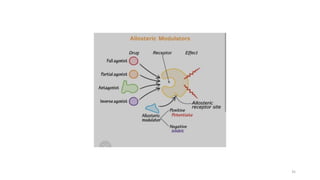
ALLOSTERIC ANTAGONISTS
• Binds to a site other than the agonist binding site and prevents receptor
activation by the agonist
• It causes downward shift of the Emax of an agonist and no change in the EC50
value
34
35
FUNCTIONAL ANTAGONISTS
• An antagonist may act at a completely separate receptor,initiating effects that are
functionally opposite those of the agonist
• Also called – “Physiologic antagonism”
• Example;
Epinephrine to Histamine induced bronchoconstriction
→ Histamine – H1 receptors causes bronchoconstriction
→ Epinephrine – β2 receptors causes bronchodilation
36
REFERENCES
1)Mc Graw hill,Basic&clinical pharmacology,Special India 15th edition,In:Bertram
G.Katzung,Todd W.Vanderah,editors;2020. p.22-26&37-38
2)Karen whalen,Lippincott illustrated reviews of pharmacology,South Asian
edition,In: Sangeeta Sharma,Thirumurthy Velpandian, editors; 2020. p.61-68
3)KD Tripathi,Essentials of Medical pharmacology,8th edition,2019. p.63-70
37

1.DOSE RESPONSE CURVE.pptx

  • 1.
    DOSE RESPONSE CURVE Dr.M.JEGADEESHKRISHNAN FIRSTYEAR PG DEPARTMENT OF PHARMACOLOGY
  • 2.
    OVERVIEW • Introduction • Typesof Dose-Response relationship • Graded dose response relationship • Quantal dose response relationship • Therapeutic index • Effect of drug concentration on receptor binding • Relationship of drug binding to pharmacologic effect • Intrinsic activity • References 2
  • 3.
    INTRODUCTION • DRUG; Chemical witha known structure,that alters the pathophysiology for therapeutic gain • DOSE; It is the amount of drug administered to produce a certain degree of response in a patient 3
  • 4.
    Contd… • RECEPTOR; The componentof a cell or organism that interacts with a drug and initiates the chain of events leading to the drug’s observed effects Functions of receptors; 1)Receptors largely determine the quantitative relations between dose of drug and pharmacologic effects 2)Receptors are responsible for selectivity of drug action 3)Receptors mediate the actions of pharmacologic agonists and antagonists 4
  • 5.
    DOSE RESPONSE CURVE •The log dose response curve is the graphical representation of the relationship between the dose of a drug versus the effects that the drug exerts • X-axis = Dose of the drug • Y-axis = Response • Sigmoidal curve with top and bottom plateaus 5
  • 6.
  • 7.
  • 8.
    ADVANTAGES • Wide rangeof drug doses are represented • Easy comparison between agonists • Easy study of antagonists • The middle portion (30-70%) of the curve is linear; direct relationship between dose and response can be obtained 8
  • 9.
    SLOPE OF THECURVE 9
  • 10.
    TYPES OF DOSE-RESPONSERELATIONSHIP 1)Graded dose response relationship 2)Quantal dose response relationship 10
  • 11.
    GRADED DOSE RESPONSERELATIONSHIP • DRC in an individual • As the concentration of a drug increases,its pharmacologic effect also gradually increases until all the receptors are occupied • It determines; Potency and Efficacy 11
  • 12.
    POTENCY • It isa measure of the amount of drug necessary to produce an effect • The concentration of drug producing 50% of the maximum effect (EC50) is often used to determine potency 12
  • 13.
  • 14.
    EFFICACY • It isthe magnitude of response a drug causes when it interacts with a receptor • It depends on the number of drug-receptor complexes formed and the intrinsic activity of the drug • Maximal efficacy of a drug (Emax) assumes that the drug occupies all receptors and no increase in response is observed in response to higher concentrations of drug 14
  • 15.
  • 16.
    QUANTAL DOSE RESPONSERELATIONSHIP • Quantal dose-response curves are useful for determining doses to which most of the population responds • They have similar shapes to log-dose response curves • Effective Dose(ED50); The dose that causes a therapeutic response in half of the population 16
  • 17.
    THERAPEUTIC INDEX • TIof a drug is the ratio of the dose that produces toxicity in half the population (TD50) to the dose that produces a clinically desired or effective response (ED50) in half the population • TI= TD5O ED50 • TI is a measure of a drug’s safety,because a larger value indicates a wide margin between doses that are effective and doses that are toxic 17
  • 18.
  • 19.
    EFFECTS OF DRUGCONCENTRATION ON BINDING • The quantitative relationship between drug concentration and receptor occupancy applies the law of mass action to the kinetics of the binding of drug and receptor molecules • Drug+Receptor ↔ Drug-receptor complex → Biologic effect • [DR] [Rt] = [D] Kd+[D] • Kd; 1)Used to determine the affinity of drug for its receptor 2)Higher the value, the weaker the interaction and lower the affinity and vice versa 19
  • 20.
    RELATIONSHIP OF DRUGBINDING TO PHARMACOLOGIC EFFECT • The law of mass action can be applied to drug concentration and response providing the following assumptions are met; 1)The magnitude of the response is proportional to the amount of receptors occupied by drug 2)The Emax occurs when all receptors are bound 3)One molecule of drug binds to only one molecule of receptor • [𝐸] [𝐸𝑚𝑎𝑥] = [𝐷] 𝐾𝑑+[𝐷] 20
  • 21.
    INTRINSIC ACTIVITY • Mathematicaldesignation for effect • An agonist binds to a receptor and produces a biologic response based on the concentration of the agonist, its affinity for the receptor and hence the fraction of occupied receptors • Intrinsic activity of a drug determines its ability to fully or partially activate the receptors • Drugs may be categorised according to their intrinsic activity and resulting Emax values 21
  • 22.
    Contd… • Types; 1)Full agonists 2)Partialagonists 3)Inverse agonists 4)Antagonists 22
  • 23.
    FULL AGONISTS • Drugthat binds to target(receptor) → maximal effect • Full agonists bind to a receptor, stabilizing the receptor in its active state • It has an intrinsic activity of one • Ex; Phenylephrine binds to alpha 1 adrenoceptors(Gq) causes vasoconstriction and ↑ blood pressure 23
  • 24.
  • 25.
    PARTIAL AGONIST • Drugthat binds to receptor → submaximal effect • Even all the receptors are occupied, partial agonists cannot produce the same Emax as a full agonist • IA of greater than zero but less than one • A partial agonist may also act as a partial antagonist of a full agonist • Therefore Emax would decrease until it reached Emax of the partial agonist 25
  • 26.
    Contd… • Example; Aripiprazole (anatypical antipsychotic) acts on selected dopamine receptors →Overactive dopaminergic pathways - inhibited →Underactive dopaminergic pathways - stimulated This might explain the ability of Aripiprazole to improve the symptoms of schizophrenia with a small risk of causing extrapyramidal adverse effects 26
  • 27.
    INVERSE AGONIST • Itreverses the activation state of receptors and exert the opposite pharmacological effect of agonists [Drug + Receptor → Opposite effect ] • It has an intrinsic activity of less than zero 27
  • 28.
    ANTAGONISTS • Antagonists bindto a receptor and produces zero IA • An antagonist can decrease the effect of an agonist when present • Antagonism may occur either by blocking the drug’s ability to bind to the receptor or by blocking its ability to activate the receptor • Types; 1)Reversible antagonists 2)Irreversible antagonists 3)Allosteric antagonists 4)Functional antagonists 28
  • 29.
    REVERSIBLE ANTAGONISTS • Ifthe antagonist binds to the same site on the receptor as the agonist in a reversible manner, it is called as ‘Competitive’ • It interferes with an agonist binding to its receptor and maintains the receptor in its inactive state • Competitive antagonists reduce the potency of agonists • Example; Terazosin(𝛼 1 blocker) decreasing vascular smooth muscle tone, thereby decreases blood pressure However increasing the concentration of agonist relative to antagonist can overcome this inhibition 29
  • 30.
  • 31.
    SCHILD EQUATION • 𝐶′ 𝐶 = 1+ [𝐼] 𝐾𝑖 C’- concentration of agonist in presence of competitive antagonist [I] – concentration of competitive antagonist • Pharmacologists often use this relation to determine the Ki of a competitive antagonist • Dissociative constant- Measures the propensity of larger object to separate reversibly into small components 31
  • 32.
    Contd… • Therapeutic implications; 1)Thedegree of inhibition produced by a competitive antagonist depends on the concentration of antagonist 2)The clinical response to a competitive antagonist also depends on the concentration of agonist that is competing for binding to receptors 32
  • 33.
    IRREVERSIBLE ANTAGONISTS • Bindcovalently to the active site of the receptor, thereby permanently reducing the number of receptors available to the agonist • An irreversible antagonist causes downward shift of the Emax, with no shift of EC50 values • Addition of more agonist does not overcome the effect of irreversible antagonists • It reduces the efficacy of an agonist 33
  • 34.
    ALLOSTERIC ANTAGONISTS • Bindsto a site other than the agonist binding site and prevents receptor activation by the agonist • It causes downward shift of the Emax of an agonist and no change in the EC50 value 34
  • 35.
  • 36.
    FUNCTIONAL ANTAGONISTS • Anantagonist may act at a completely separate receptor,initiating effects that are functionally opposite those of the agonist • Also called – “Physiologic antagonism” • Example; Epinephrine to Histamine induced bronchoconstriction → Histamine – H1 receptors causes bronchoconstriction → Epinephrine – β2 receptors causes bronchodilation 36
  • 37.
    REFERENCES 1)Mc Graw hill,Basic&clinicalpharmacology,Special India 15th edition,In:Bertram G.Katzung,Todd W.Vanderah,editors;2020. p.22-26&37-38 2)Karen whalen,Lippincott illustrated reviews of pharmacology,South Asian edition,In: Sangeeta Sharma,Thirumurthy Velpandian, editors; 2020. p.61-68 3)KD Tripathi,Essentials of Medical pharmacology,8th edition,2019. p.63-70 37