Dose Response
Relationship Curve
Md. Masudur Rahman
Id:- 161-29-943
Daffodil International University
Some basic concepts
• DOSE – amount of drug administered in the patient E.G If 500 mg of
paracetamol is taken dose is 500mg
• RESPONSE – effect shown by the body to a particular drug E.G
Paracetamol is antipyretic drug so response is it should bring body
temperature to normal
How Drug response is obtained
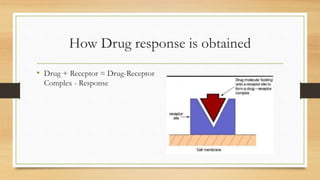
• Drug + Receptor = Drug-Receptor
Complex - Response
Dose Response Relationship
• Relationship used to analyze a kind of response Obtained after administering
specific does of drug E.G If 10mg of ILLAPRAZOLE [ppi] is administered
response is it should inhibit formation of proton pumps at 10mg specifically
• Dose response relationship has two components
1. Dose plasma concentration relationship
2. Plasma concentration response relationship
What is dose Response curve
• Relationship of dose to Response can be illustrated by a graph which is
called as dose Response curve.
• Dose response curve is required
1. Decliding dose of drug
2. Comparing dosage to percentage of people showing different effects
Dose Response curve
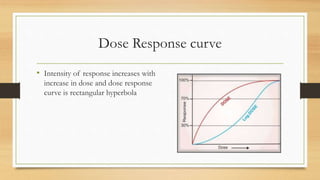
• Intensity of response increases with
increase in dose and dose response
curve is rectangular hyperbola
Why dose response curve is Rectangular
hyperbola
• This is because drug-receptor interaction obeys law of mass action,
accordingly ,
• E = Emax × [D] / Kd + [D]
• Where, E = Observed effect of dose of drug , Emax = maximal respons,
Kd = dissociation constant of drug receptor complex
Threshold
• Dose below which there are no
adverse effects from exposure to
chemicals
Types of dose Response curve
• Graded dose response curves are
constructed for response that are
measured on continuous scale E.G heart
rate
• Graded dose response curves relates the
intensity of response to size of dose hence
used in characterizing actions of drug
Graded dose response means slight
increase of drug brings small increase in
response E.G increased dose of Histamine
causes gradual contraction of guinea pig
ileum
• Quantal dose response curves are
constructed for those drugs that elicit all
or none response E.G presence or absence
of epileptic seizures Indicates that given
dose of drug has or has not evoked a
certain effect in various subject under
investigation that is pharmacological
effects are expressed in passive or negative
Drug potency and efficacy
• Drug potency refers to amount of drug needed to produce a
response.Relative potency is more meaningful than absolute potency E.G If
10 mg of morphine=100 mg of pethidine, morphine is 10 times more
potent than pethidine
• Drug efficacy refers to ability of drug to elicit a response when it binds to a
receptor E.G Morphine produces a degree of analgesia not obtainable with
any dose of aspirin hence Morphine is more efficacious than aspirin
Drug potency and efficacy curve
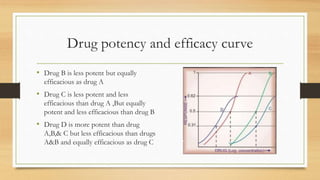
• Drug B is less potent but equally
efficacious as drug A
• Drug C is less potent and less
efficacious than drug A ,But equally
potent and less efficacious than drug B
• Drug D is more potent than drug
A,B,& C but less efficacious than drugs
A&B and equally efficacious as drug C
Slope and Variability
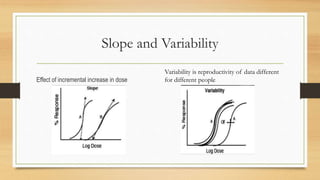
Effect of incremental increase in dose
Variability is reproductivity of data different
for different people
Therapeutic index
• Therapeutic index is used for judging drug safety . Therapeutic index is ratio
of Ld50 to Ed50
• Ed50 – Median effective dose at which 50% of individuals exhibit a specific
effect
• Ld50 – Median lethal dose required to produce death in 50% individuals
Thank you

Dose Response Relationship Curve.pptx

  • 1.
    Dose Response Relationship Curve Md.Masudur Rahman Id:- 161-29-943 Daffodil International University
  • 2.
    Some basic concepts •DOSE – amount of drug administered in the patient E.G If 500 mg of paracetamol is taken dose is 500mg • RESPONSE – effect shown by the body to a particular drug E.G Paracetamol is antipyretic drug so response is it should bring body temperature to normal
  • 3.
    How Drug responseis obtained • Drug + Receptor = Drug-Receptor Complex - Response
  • 4.
    Dose Response Relationship •Relationship used to analyze a kind of response Obtained after administering specific does of drug E.G If 10mg of ILLAPRAZOLE [ppi] is administered response is it should inhibit formation of proton pumps at 10mg specifically • Dose response relationship has two components 1. Dose plasma concentration relationship 2. Plasma concentration response relationship
  • 5.
    What is doseResponse curve • Relationship of dose to Response can be illustrated by a graph which is called as dose Response curve. • Dose response curve is required 1. Decliding dose of drug 2. Comparing dosage to percentage of people showing different effects
  • 6.
    Dose Response curve •Intensity of response increases with increase in dose and dose response curve is rectangular hyperbola
  • 7.
    Why dose responsecurve is Rectangular hyperbola • This is because drug-receptor interaction obeys law of mass action, accordingly , • E = Emax × [D] / Kd + [D] • Where, E = Observed effect of dose of drug , Emax = maximal respons, Kd = dissociation constant of drug receptor complex
  • 8.
    Threshold • Dose belowwhich there are no adverse effects from exposure to chemicals
  • 9.
    Types of doseResponse curve • Graded dose response curves are constructed for response that are measured on continuous scale E.G heart rate • Graded dose response curves relates the intensity of response to size of dose hence used in characterizing actions of drug Graded dose response means slight increase of drug brings small increase in response E.G increased dose of Histamine causes gradual contraction of guinea pig ileum • Quantal dose response curves are constructed for those drugs that elicit all or none response E.G presence or absence of epileptic seizures Indicates that given dose of drug has or has not evoked a certain effect in various subject under investigation that is pharmacological effects are expressed in passive or negative
  • 10.
    Drug potency andefficacy • Drug potency refers to amount of drug needed to produce a response.Relative potency is more meaningful than absolute potency E.G If 10 mg of morphine=100 mg of pethidine, morphine is 10 times more potent than pethidine • Drug efficacy refers to ability of drug to elicit a response when it binds to a receptor E.G Morphine produces a degree of analgesia not obtainable with any dose of aspirin hence Morphine is more efficacious than aspirin
  • 11.
    Drug potency andefficacy curve • Drug B is less potent but equally efficacious as drug A • Drug C is less potent and less efficacious than drug A ,But equally potent and less efficacious than drug B • Drug D is more potent than drug A,B,& C but less efficacious than drugs A&B and equally efficacious as drug C
  • 12.
    Slope and Variability Effectof incremental increase in dose Variability is reproductivity of data different for different people
  • 13.
    Therapeutic index • Therapeuticindex is used for judging drug safety . Therapeutic index is ratio of Ld50 to Ed50 • Ed50 – Median effective dose at which 50% of individuals exhibit a specific effect • Ld50 – Median lethal dose required to produce death in 50% individuals
  • 14.