Renal Stone
Diseases
M.Hudaib
202086
Learning objectives
 Introduction and Etiology of renal stone
diseases
 History taking
 Examination
 Differentials
 Management
Renal Calculi
 Called nephrolithiasis or urolithiasis
 Most commonly develop in the renal pelvis
but can be anywhere in the urinary tract
 May stay in kidney or urinary tract
 May stay in kidney or travel to the ureter
 May cause hydronephrosis
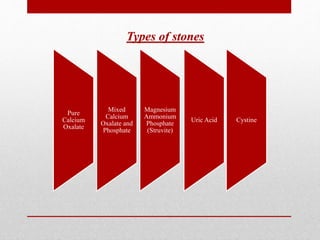
Types of stones
Pure
Calcium
Oxalate
Mixed
Calcium
Oxalate and
Phosphate
Magnesium
Ammonium
Phosphate
(Struvite)
Uric Acid Cystine
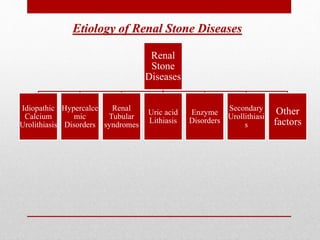
Renal
Stone
Diseases
Idiopathic
Calcium
Urolithiasis
Hypercalce
mic
Disorders
Renal
Tubular
syndromes
Uric acid
Lithiasis
Enzyme
Disorders
Secondary
Urollithiasi
s
Other
factors
Etiology of Renal Stone Diseases
Etiology (continued)
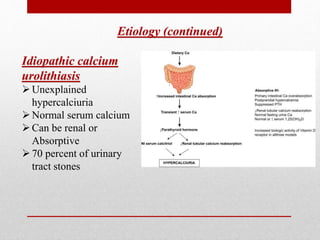
Idiopathic calcium
urolithiasis
Unexplained
hypercalciuria
Normal serum calcium
Can be renal or
Absorptive
70 percent of urinary
tract stones
Etiology (continued)
Hypercalcemic
disorders
1. Primary Hyperparathyroidism
 Due to parathyroid Adenoma
 Increased production of 1,25
dihydroxycholecalciferol
 Increased intestinal and renal
Ca2+ tubular reabsorption
 < 5 percent of people with radio-
opaque stones
2. Prolonged Immobilization
 Hypercalcemia and hypercalciuria
from bone resorption
3. Milk – Alkali Syndrome
 Ingestion of large quantities of
Ca2+, Vitamin D and Alkali results
in hypercalcemia, alkalosis and
possible renal impairment
 Compromised renal excretion of
Ca2+ promoting soft tissue
calcification
4. Sarcoidosis
 Non – Caseating granulomata
produce 1,25
dihydroxycholecalciferol
Etiology ( continued)
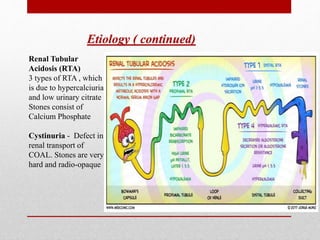
Renal Tubular
Acidosis (RTA)
3 types of RTA , which
is due to hypercalciuria
and low urinary citrate
Stones consist of
Calcium Phosphate
Cystinuria - Defect in
renal transport of
COAL. Stones are very
hard and radio-opaque
Etiology (continued)
Uric acid stones
 5-10 percent of urinary tract stones
 Due to excess amount of uric acid excretion or uric acid in insoluble form
Enzyme Disorders
 Primary Hyperoxaluria
 Xanthuria
 2,8 Dihydroadeninuria
Secondary Urolithiasis
 Secondary Hyperoxaluria
 Dietary Excess
 Infection
 Obstruction and Stasis
History taking
Age – mostly between 30 and 50 years
Sex – More common in men than in women
Season – Summer. Why ?
Symptoms : Pain
Hematuria
dysuria
Symptoms of acute pyelonephritis
symptoms associated with uraemia in severe cases such
as headaches, restlessness, twitching, fits, convulsions,
drowsiness and coma
Past medical history : UTI, gout, parathyroidism , IBD
Family History : gout and parathyroidism
Personal History : Water intake, Foods high in Oxalates, High Na+
and Ca+
Examination
Abdominal examination
Costovertebral angle tenderness
Differential Diagnosis
Acute Pyelonephritis
Renal cell carcinoma
Management of Stones in
emergency setting
 CT scan
 Stones in the distal ureter treated expectantly, medical expulsive treatment
maybe considered
 NSAIDs eg : diclofenac
 Monitor vitals and WBC count
 eGFR measurement
 For urgent pain :
• In situ ESWL
• Cystoscopy and inserting stent
• Primary ureteroscopic stone retrieval , lasertripsy
Management in elective setting
ESWL ( Extracorporeal
shockwave Lithotropsy)
Shockwaves generated
outside the body
Needs to be coordinated
with ECG
Prophylactic antibodies
are given
Cystine stones are
relatively resistant
Can result in hematuria
Management in Elective setting
Ureteroscopy
Used for
endoscopic
examination and
visualization
Stones then
retrieved by
wire retrieval
baskets
Management in Elective setting
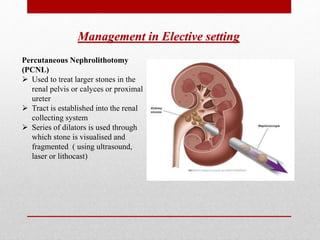
Percutaneous Nephrolithotomy
(PCNL)
 Used to treat larger stones in the
renal pelvis or calyces or proximal
ureter
 Tract is established into the renal
collecting system
 Series of dilators is used through
which stone is visualised and
fragmented ( using ultrasound,
laser or lithocast)
Thank You

Renal Stone Diseases.pptx.....defination

  • 1.
  • 2.
    Learning objectives  Introductionand Etiology of renal stone diseases  History taking  Examination  Differentials  Management
  • 3.
    Renal Calculi  Callednephrolithiasis or urolithiasis  Most commonly develop in the renal pelvis but can be anywhere in the urinary tract  May stay in kidney or urinary tract  May stay in kidney or travel to the ureter  May cause hydronephrosis
  • 4.
    Types of stones Pure Calcium Oxalate Mixed Calcium Oxalateand Phosphate Magnesium Ammonium Phosphate (Struvite) Uric Acid Cystine
  • 5.
  • 6.
    Etiology (continued) Idiopathic calcium urolithiasis Unexplained hypercalciuria Normalserum calcium Can be renal or Absorptive 70 percent of urinary tract stones
  • 7.
    Etiology (continued) Hypercalcemic disorders 1. PrimaryHyperparathyroidism  Due to parathyroid Adenoma  Increased production of 1,25 dihydroxycholecalciferol  Increased intestinal and renal Ca2+ tubular reabsorption  < 5 percent of people with radio- opaque stones
  • 8.
    2. Prolonged Immobilization Hypercalcemia and hypercalciuria from bone resorption 3. Milk – Alkali Syndrome  Ingestion of large quantities of Ca2+, Vitamin D and Alkali results in hypercalcemia, alkalosis and possible renal impairment  Compromised renal excretion of Ca2+ promoting soft tissue calcification 4. Sarcoidosis  Non – Caseating granulomata produce 1,25 dihydroxycholecalciferol
  • 9.
    Etiology ( continued) RenalTubular Acidosis (RTA) 3 types of RTA , which is due to hypercalciuria and low urinary citrate Stones consist of Calcium Phosphate Cystinuria - Defect in renal transport of COAL. Stones are very hard and radio-opaque
  • 10.
    Etiology (continued) Uric acidstones  5-10 percent of urinary tract stones  Due to excess amount of uric acid excretion or uric acid in insoluble form Enzyme Disorders  Primary Hyperoxaluria  Xanthuria  2,8 Dihydroadeninuria Secondary Urolithiasis  Secondary Hyperoxaluria  Dietary Excess  Infection  Obstruction and Stasis
  • 11.
    History taking Age –mostly between 30 and 50 years Sex – More common in men than in women Season – Summer. Why ? Symptoms : Pain Hematuria dysuria Symptoms of acute pyelonephritis symptoms associated with uraemia in severe cases such as headaches, restlessness, twitching, fits, convulsions, drowsiness and coma Past medical history : UTI, gout, parathyroidism , IBD Family History : gout and parathyroidism Personal History : Water intake, Foods high in Oxalates, High Na+ and Ca+
  • 12.
    Examination Abdominal examination Costovertebral angletenderness Differential Diagnosis Acute Pyelonephritis Renal cell carcinoma
  • 14.
    Management of Stonesin emergency setting  CT scan  Stones in the distal ureter treated expectantly, medical expulsive treatment maybe considered  NSAIDs eg : diclofenac  Monitor vitals and WBC count  eGFR measurement  For urgent pain : • In situ ESWL • Cystoscopy and inserting stent • Primary ureteroscopic stone retrieval , lasertripsy
  • 15.
    Management in electivesetting ESWL ( Extracorporeal shockwave Lithotropsy) Shockwaves generated outside the body Needs to be coordinated with ECG Prophylactic antibodies are given Cystine stones are relatively resistant Can result in hematuria
  • 16.
    Management in Electivesetting Ureteroscopy Used for endoscopic examination and visualization Stones then retrieved by wire retrieval baskets
  • 17.
    Management in Electivesetting Percutaneous Nephrolithotomy (PCNL)  Used to treat larger stones in the renal pelvis or calyces or proximal ureter  Tract is established into the renal collecting system  Series of dilators is used through which stone is visualised and fragmented ( using ultrasound, laser or lithocast)
  • 18.