BULE HORA UNIVERSITY
COLLEGE OF HEALTH AND MEDICAL
SCIENCES
DEPARTMENT OF PHARMACY
TOXICOLOGY
For 4th year Medical Laboratoy Students
Principle of Analytic Toxicology 1
By:Aliyi G.(B.Pharm)
2
5.Principles of Analytic
Toxicology
. Applications in general and forensic
toxicology and clinical practice
. Interpretation of analytic results
Principle of Analytic Toxicology
3
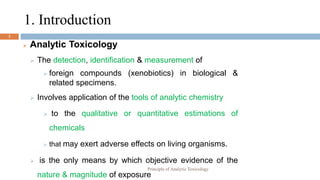
 Analytic Toxicology
 The detection, identification & measurement of
 foreign compounds (xenobiotics) in biological &
related specimens.
 Involves application of the tools of analytic chemistry
 to the qualitative or quantitative estimations of
chemicals
 that may exert adverse effects on living organisms.
 is the only means by which objective evidence of the
nature & magnitude of exposure
1. Introduction
Principle of Analytic Toxicology
Introduction Cont’d,...
4
Forensic Toxicology
 The use of toxicology for purposes of the law.
 To identify any chemical that may serve as a
 causative agent in inflicting death or injury/damage
on humans/property.
Principle of Analytic Toxicology
Introduction Cont’d,...
5
 Separation is more often a prerequisite for analytical determination.
 Gases
 Volatile Substances
 Corrosive Agents
 Metals
 Anions and Nonmetals
 Nonvolatile Organic Substances
 Miscellaneous
Principle of Analytic Toxicology
Application of Analytic Toxicology
6
Principle of Analytic Toxicology
1. Role in General Toxicology
7
 Ascertaining purity of a chemical or contaminants of chemical to be
studied
 The chemical under study must be pure or the nature of any contaminant
must be known to interpret experimental results with validity.
 Monitoring dosage forms or solutions for stability throughout the
course of an experimental study.
 Important in establishing the bioavailability of a compound under
study
 Rather than observing dose-effect r/n ships ,
Principle of Analytic Toxicology
2. Analytic Role in Clinical Toxicology
8
 Used to
 identify the nature of the toxic exposure and
 measure the amount of the toxic substance that
has been absorbed.
 monitoring the amount of the toxic agent
remaining in circulation or measuring what is
excreted.
 Important in establishing
 a diagnosis of poisoning &
 guiding treatment
Principle of Analytic Toxicology
Importance
9
 Both the identity/nature & amount of toxic s/ce
– aid in diagnosis, t/t, monitoring the effectiveness of t/t
regimens.
 Nature & amount coupled by information on the clinical state
 permits to relate the signs & symptoms observed to the anticipated
effects of the toxic agent.
Principle of Analytic Toxicology
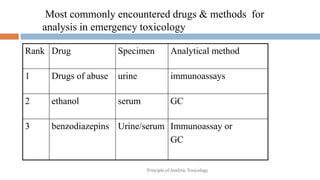
Most commonly encountered drugs & methods for
analysis in emergency toxicology
Rank Drug Specimen Analytical method
1 Drugs of abuse urine immunoassays
2 ethanol serum GC
3 benzodiazepins Urine/serum Immunoassay or
GC
10
Principle of Analytic Toxicology
3. Analytic Role in Therapeutic Monitoring
11
 Factors responsible for individual variability in responses to drug
therapy include:
 Rate and extent of drug absorption
 Distribution and binding in body tissues and fluids
 Rate of metabolism and excretion
 Pathologic conditions
 Interaction with other drugs
 Monitoring of the plasma or serum conc.
 at regular intervals will detect deviations &
 suggest that one or more of these of variables need to be identified
& corrected.
Principle of Analytic Toxicology
4. Analytic Role in Biologic Monitoring
12
 Monitor workers directly for exposure
 Exposures are to a mixture of compounds.
 Measure changes of normal metabolites induced by
xenobiotics.
eg. the profile of glucouronic acid metabolites excreted
in urine can be altered after exposure to substance
that induce monoxygenase activity..
Principle of Analytic Toxicology
5. Role in Forensic Toxicology
13
 Postmortem Investigations
 Qualitative & quantitative analysis of drugs/poisons
in biological specimen collected.
+
 Interpretation of analytic finding in regard to
physiologic & behavioral effects.
 NB: many drugs or poisons do not produce
characteristic pathologic lesions;
their presence in the body can be demonstrated
only by chemical method of isolation &
identification Principle of Analytic Toxicology
Application of forensic toxicology
14
Principle of Analytic Toxicology
Application of forensic toxicology
Cause of death in .
 Assist in cause of death for a court of law.
Presence of intoxicating concentration of ethanol in car accidents.
Carbon Monoxide detection in fire victims.
Provide data for substance abuse.
Principle of Analytic Toxicology
15
1. Toxicological Investigation of a Poison Death
16
 3 steps
1. Obtaining case history and suitable specimens
2. Toxicologic analyses
3. Interpretation of Analytic findings
Principle of Analytic Toxicology
1.1. Case History and Specimens
17
 Collect facts (age, sex, wt, medical history, occupation, t/t
administered before death).
 Gross autopsy findings.
 Drugs available to the decedent.
 Interval between the onset of symptoms and death.
Principle of Analytic Toxicology
1.2. Toxicologic Analyses
18
 Factors to consider
 Amount of specimen available
 Nature of the poison
 Possible biotransformation of the poison
Eg.cocaine.
Principle of Analytic Toxicology
Toxicologic Analyses…
19
 In case of involving oral administration of the poison
 Organs Analyzed
1st Gastrointestinal contents (residual unabsorbed
poison found )
2nd Urine (high conc. of toxic s/b &its metabolites)
Liver….1st internal organ analyzed
 Specific poison is suspected to have caused or
contributed to a death, the tissue & fluids in which
the poison concentrates
Principle of Analytic Toxicology
Toxicologic Analyses…
20
 The analysis (the autopsy & toxicological) should be
started soon after death.
 Problems:
 Hydrolysis, oxidation or reduction of proteins,
nucleic acids, or lipids that may generate compounds
that interfere with identification.
Principle of Analytic Toxicology
Toxicologic Analyses…
21
 Testing
 Non-specific test
 Ferric chloride, perchloric and nitric acid color test for
phenothiazine drugs and
 immunoassays for the detection of amphetamines,
benzodiazepines and opiates in the urine.
 Specific test
 GC or HPLC is most widely used for most drug identification.
Principle of Analytic Toxicology
1.3. Interpretation of Analytic Results
22
 Provides answers
 Route of Administration
 Dosage and if conc. of toxicant present is enough to
cause death or alter action enough to cause death.
 Tests on blood, tissue, and plasma
 Results are often used to corroborate investigative
findings
Eg. Continuously elevated hair arsenic values indicates
chronic rather than acute poisoning as the cause of
Principle of Analytic Toxicology
Interpretation of Analytic Results…
23
 A new extension of forensic toxicology
 is the analysis of impurities of illicit drug synthesis in biological
specimens.
Eg. Methamphetamine
Principle of Analytic Toxicology
2. Criminal Poisoning of the Living
24
 GC or HPLC tests are used for 2 types of poisoning
 Administration of drugs to incapacitate victims of
kidnapping, robbery, or sexual assault.
 Eg. Ethanol, BDZ, marijuana, amphetamine, opaites etc
 Poisoning as a form of child abuse;
 deliberate administration of toxic or injurious substances to a
child, usually by a parent or other caregiver
 Eg. Syrup of ipecac, table salt, laxative, diuretics, narcotics etc
Principle of Analytic Toxicology
3.Forensic Urine Drug Testing
25
 Urine tested for a limited number of drugs.
 Sample is checked for adulteration
 by checking the
 pH,
 creatine,
 specific gravity and
 for any unusual color or smell.
Principle of Analytic Toxicology
Forensic Urine Drug Testing…
26
 There may be valid reasons other than
substance abuse for positive drug findings
eg. Poppy seed (papaver somniferum) is
common ingredeint in many pastries & breads.
 poppy seeds may contain significant
amounts of
morphine.
 Morphine is a major metabolites of heroin,
 to readily differentiate heroin abuse from
poppy seed ingestion,
 analysis may be performed for 6-
Principle of Analytic Toxicology
4. Human Performance Testing
27
 Tests for ethanol and chemicals in blood, breath
or other specimens that may modify performance
of behavior.
 Alcohol related accidents are responsible for
55-65% of fatalities in drivers
Principle of Analytic Toxicology
5. Courtroom Testimony
 Lay(uncertified) witness Vs expert witness
 Toxicologist
 an expert witness providing an objective testimony and opinion.
 Objective~ Involves description of his or her analytic methods and
findings
 Opinion~how the person interprets the results.
Principle of Analytic Toxicology
28
Principle of Analytic Toxicology
29

5. analytic and forensic toxicology

  • 1.
    BULE HORA UNIVERSITY COLLEGEOF HEALTH AND MEDICAL SCIENCES DEPARTMENT OF PHARMACY TOXICOLOGY For 4th year Medical Laboratoy Students Principle of Analytic Toxicology 1 By:Aliyi G.(B.Pharm)
  • 2.
    2 5.Principles of Analytic Toxicology .Applications in general and forensic toxicology and clinical practice . Interpretation of analytic results Principle of Analytic Toxicology
  • 3.
    3  Analytic Toxicology The detection, identification & measurement of  foreign compounds (xenobiotics) in biological & related specimens.  Involves application of the tools of analytic chemistry  to the qualitative or quantitative estimations of chemicals  that may exert adverse effects on living organisms.  is the only means by which objective evidence of the nature & magnitude of exposure 1. Introduction Principle of Analytic Toxicology
  • 4.
    Introduction Cont’d,... 4 Forensic Toxicology The use of toxicology for purposes of the law.  To identify any chemical that may serve as a  causative agent in inflicting death or injury/damage on humans/property. Principle of Analytic Toxicology
  • 5.
    Introduction Cont’d,... 5  Separationis more often a prerequisite for analytical determination.  Gases  Volatile Substances  Corrosive Agents  Metals  Anions and Nonmetals  Nonvolatile Organic Substances  Miscellaneous Principle of Analytic Toxicology
  • 6.
    Application of AnalyticToxicology 6 Principle of Analytic Toxicology
  • 7.
    1. Role inGeneral Toxicology 7  Ascertaining purity of a chemical or contaminants of chemical to be studied  The chemical under study must be pure or the nature of any contaminant must be known to interpret experimental results with validity.  Monitoring dosage forms or solutions for stability throughout the course of an experimental study.  Important in establishing the bioavailability of a compound under study  Rather than observing dose-effect r/n ships , Principle of Analytic Toxicology
  • 8.
    2. Analytic Rolein Clinical Toxicology 8  Used to  identify the nature of the toxic exposure and  measure the amount of the toxic substance that has been absorbed.  monitoring the amount of the toxic agent remaining in circulation or measuring what is excreted.  Important in establishing  a diagnosis of poisoning &  guiding treatment Principle of Analytic Toxicology
  • 9.
    Importance 9  Both theidentity/nature & amount of toxic s/ce – aid in diagnosis, t/t, monitoring the effectiveness of t/t regimens.  Nature & amount coupled by information on the clinical state  permits to relate the signs & symptoms observed to the anticipated effects of the toxic agent. Principle of Analytic Toxicology
  • 10.
    Most commonly encountereddrugs & methods for analysis in emergency toxicology Rank Drug Specimen Analytical method 1 Drugs of abuse urine immunoassays 2 ethanol serum GC 3 benzodiazepins Urine/serum Immunoassay or GC 10 Principle of Analytic Toxicology
  • 11.
    3. Analytic Rolein Therapeutic Monitoring 11  Factors responsible for individual variability in responses to drug therapy include:  Rate and extent of drug absorption  Distribution and binding in body tissues and fluids  Rate of metabolism and excretion  Pathologic conditions  Interaction with other drugs  Monitoring of the plasma or serum conc.  at regular intervals will detect deviations &  suggest that one or more of these of variables need to be identified & corrected. Principle of Analytic Toxicology
  • 12.
    4. Analytic Rolein Biologic Monitoring 12  Monitor workers directly for exposure  Exposures are to a mixture of compounds.  Measure changes of normal metabolites induced by xenobiotics. eg. the profile of glucouronic acid metabolites excreted in urine can be altered after exposure to substance that induce monoxygenase activity.. Principle of Analytic Toxicology
  • 13.
    5. Role inForensic Toxicology 13  Postmortem Investigations  Qualitative & quantitative analysis of drugs/poisons in biological specimen collected. +  Interpretation of analytic finding in regard to physiologic & behavioral effects.  NB: many drugs or poisons do not produce characteristic pathologic lesions; their presence in the body can be demonstrated only by chemical method of isolation & identification Principle of Analytic Toxicology
  • 14.
    Application of forensictoxicology 14 Principle of Analytic Toxicology
  • 15.
    Application of forensictoxicology Cause of death in .  Assist in cause of death for a court of law. Presence of intoxicating concentration of ethanol in car accidents. Carbon Monoxide detection in fire victims. Provide data for substance abuse. Principle of Analytic Toxicology 15
  • 16.
    1. Toxicological Investigationof a Poison Death 16  3 steps 1. Obtaining case history and suitable specimens 2. Toxicologic analyses 3. Interpretation of Analytic findings Principle of Analytic Toxicology
  • 17.
    1.1. Case Historyand Specimens 17  Collect facts (age, sex, wt, medical history, occupation, t/t administered before death).  Gross autopsy findings.  Drugs available to the decedent.  Interval between the onset of symptoms and death. Principle of Analytic Toxicology
  • 18.
    1.2. Toxicologic Analyses 18 Factors to consider  Amount of specimen available  Nature of the poison  Possible biotransformation of the poison Eg.cocaine. Principle of Analytic Toxicology
  • 19.
    Toxicologic Analyses… 19  Incase of involving oral administration of the poison  Organs Analyzed 1st Gastrointestinal contents (residual unabsorbed poison found ) 2nd Urine (high conc. of toxic s/b &its metabolites) Liver….1st internal organ analyzed  Specific poison is suspected to have caused or contributed to a death, the tissue & fluids in which the poison concentrates Principle of Analytic Toxicology
  • 20.
    Toxicologic Analyses… 20  Theanalysis (the autopsy & toxicological) should be started soon after death.  Problems:  Hydrolysis, oxidation or reduction of proteins, nucleic acids, or lipids that may generate compounds that interfere with identification. Principle of Analytic Toxicology
  • 21.
    Toxicologic Analyses… 21  Testing Non-specific test  Ferric chloride, perchloric and nitric acid color test for phenothiazine drugs and  immunoassays for the detection of amphetamines, benzodiazepines and opiates in the urine.  Specific test  GC or HPLC is most widely used for most drug identification. Principle of Analytic Toxicology
  • 22.
    1.3. Interpretation ofAnalytic Results 22  Provides answers  Route of Administration  Dosage and if conc. of toxicant present is enough to cause death or alter action enough to cause death.  Tests on blood, tissue, and plasma  Results are often used to corroborate investigative findings Eg. Continuously elevated hair arsenic values indicates chronic rather than acute poisoning as the cause of Principle of Analytic Toxicology
  • 23.
    Interpretation of AnalyticResults… 23  A new extension of forensic toxicology  is the analysis of impurities of illicit drug synthesis in biological specimens. Eg. Methamphetamine Principle of Analytic Toxicology
  • 24.
    2. Criminal Poisoningof the Living 24  GC or HPLC tests are used for 2 types of poisoning  Administration of drugs to incapacitate victims of kidnapping, robbery, or sexual assault.  Eg. Ethanol, BDZ, marijuana, amphetamine, opaites etc  Poisoning as a form of child abuse;  deliberate administration of toxic or injurious substances to a child, usually by a parent or other caregiver  Eg. Syrup of ipecac, table salt, laxative, diuretics, narcotics etc Principle of Analytic Toxicology
  • 25.
    3.Forensic Urine DrugTesting 25  Urine tested for a limited number of drugs.  Sample is checked for adulteration  by checking the  pH,  creatine,  specific gravity and  for any unusual color or smell. Principle of Analytic Toxicology
  • 26.
    Forensic Urine DrugTesting… 26  There may be valid reasons other than substance abuse for positive drug findings eg. Poppy seed (papaver somniferum) is common ingredeint in many pastries & breads.  poppy seeds may contain significant amounts of morphine.  Morphine is a major metabolites of heroin,  to readily differentiate heroin abuse from poppy seed ingestion,  analysis may be performed for 6- Principle of Analytic Toxicology
  • 27.
    4. Human PerformanceTesting 27  Tests for ethanol and chemicals in blood, breath or other specimens that may modify performance of behavior.  Alcohol related accidents are responsible for 55-65% of fatalities in drivers Principle of Analytic Toxicology
  • 28.
    5. Courtroom Testimony Lay(uncertified) witness Vs expert witness  Toxicologist  an expert witness providing an objective testimony and opinion.  Objective~ Involves description of his or her analytic methods and findings  Opinion~how the person interprets the results. Principle of Analytic Toxicology 28
  • 29.
    Principle of AnalyticToxicology 29

Editor's Notes