Pharmacodynamics-II
Dr. Pravin Prasad
M.B.B.S., MD Clinical Pharmacology
Lecturer, Lumbini Medical College & TH
12 December, 2018 (26 Mangsir, 2075),
Wednesday
Questions from yesterday…
What do you understand by the term
pharmacodynamics?
Name five principles of drug action.
What are common drug targets?
Define receptor.
By the end of the class, MBBS
Ist year students will be able to:
Appraise the different types of:
Drug enzyme interaction
Drug receptor interaction
Explain the Intracellular signaling mechanism
Interpret the Dose Response Curve
Explain the difference between therapeutic
index and therapeutic Window
Drug – Enzyme Interaction
Enzyme
Normal
Substrate
Product
Drug – Enzyme Interaction
Enzyme
Competitive Inhibition
Inhibitor
No Product
Substrate
Competition
for the binding
site
Non functional
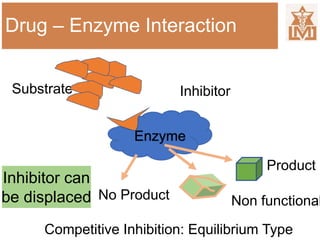
Drug – Enzyme Interaction
Enzyme
Competitive Inhibition: Equilibrium Type
Inhibitor
No Product
Substrate
Product
Inhibitor can
be displaced Non functional
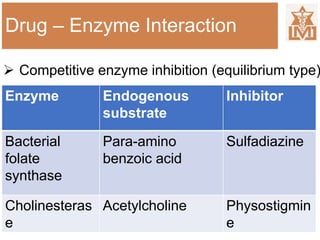
Drug – Enzyme Interaction
Enzyme Endogenous
substrate
Inhibitor
Bacterial
folate
synthase
Para-amino
benzoic acid
Sulfadiazine
Cholinesteras
e
Acetylcholine Physostigmin
e
 Competitive enzyme inhibition (equilibrium type)
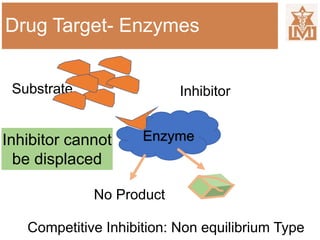
Drug Target- Enzymes
Enzyme
Competitive Inhibition: Non equilibrium Type
Inhibitor
No Product
Substrate
Inhibitor cannot
be displaced
Drug – Enzyme Interaction
 Competitive enzyme inhibition (nonequilibrium ty
Enzyme Endogenous
substrate
Inhibitor
Cholinesteras
e
Acetylcholine Malathion, OPs
Dihydrofolate
reductase
DHF Methotrexate
Enzyme
Drug – Enzyme Interaction
Enzyme
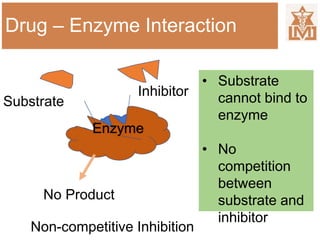
Non-competitive Inhibition
Inhibitor
No Product
Substrate
• Substrate
cannot bind to
enzyme
• No
competition
between
substrate and
inhibitor
Drug – Enzyme Interaction
 Non-Competitive enzyme inhibition
Enzyme
Endogenous
substrate
Inhibitor
Carbonic
anhydrase
H2O and CO2 Acetazolamide
H+-K+ ATPase H+ and K+ Omeprazole
Cyclooxygena
se
Arachidonic
acid
Aspirin
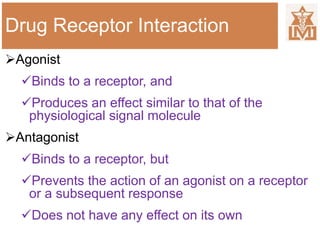
Drug Receptor Interaction
Agonist
Binds to a receptor, and
Produces an effect similar to that of the
physiological signal molecule
Antagonist
Binds to a receptor, but
Prevents the action of an agonist on a receptor
or a subsequent response
Does not have any effect on its own
Drug-Receptor Interactions
Log [drug]
LevelofResponse
Full agonist
Partial agonist
Baseline activity
Inverse agonis
Antagonist
Drug-Receptor Interaction:
Agonists
Full agonist:
Activates the receptor maximally
Partial agonist:
Activates the receptor sub-maximally
Inverse agonist:
Activates the receptor, but in opposite
direction
GPCRs: Intra-cellular signaling
Mechanism (cAMP pathway)
β Gsα
Gγ
Adenyl
yl
Cyclase
GD
P
GT
P
ATP
cAM
P
PKA
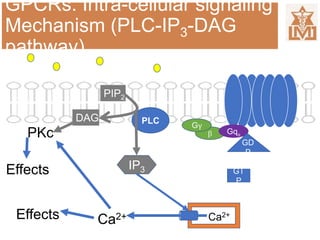
GPCRs: Intra-cellular signaling
Mechanism (PLC-IP3-DAG
pathway)
β Gqα
Gγ
PLC
GD
P
GT
P
IP3
Ca2+
PIP2
DAG
PKc
Effects
Effects
Ca2+
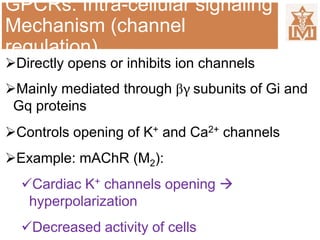
GPCRs: Intra-cellular signaling
Mechanism (channel
regulation)
Directly opens or inhibits ion channels
Mainly mediated through βγ subunits of Gi and
Gq proteins
Controls opening of K+ and Ca2+ channels
Example: mAChR (M2):
Cardiac K+ channels opening 
hyperpolarization
Decreased activity of cells
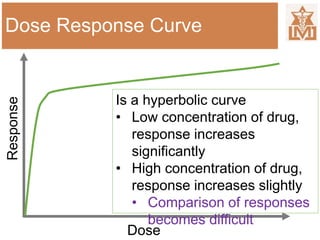
Dose Response Curve
Dose
Response
Is a hyperbolic curve
• Low concentration of drug,
response increases
significantly
• High concentration of drug,
response increases slightly
• Comparison of responses
becomes difficult
Dose Response Curve
Log[Dose]
Response
Sigmoid curve
• Wider range can be
plotted
• Intermediate
portion essentially
linear
• Comparison of
responses can
be made
Dose Response Curve
Log[Dose]
Response
Maximal Response
50% response
Efficacy
Potency
EC50
Slope
Dose Response Curve
Potency on DRC:
Depicted by position of DRC on Log[dose]
axis
• More left- more potent
Comparison of potency of two drugs done at
EC50
• Drug Concentration at which 50%
response is obtained
Dose Response Curve
Efficacy on DRC:
Maximal response that can be elicited by a
drug
• Upper limit of DRC
Dictates the choice of drug
Efficacy and Potency: independent of each
other
Dose Response Curve
Slope of DRC:
Steep graph:
• Response changes rapidly with change in
dose
• Dose needs to be individualised
Flat graph:
• Response changes slowly with change in
dose
Therapeutic index
Calculated in experimental animals
2 DRC plotted:
Effective dose DRC
Lethal dose DRC
Separation of these DRC: Therapeutic index
Calculated as:
𝑇ℎ𝑒𝑟𝑎𝑝𝑒𝑢𝑡𝑖𝑐 𝑖𝑛𝑑𝑒𝑥 =
𝐿𝑒𝑡ℎ𝑎𝑙 𝐷𝑜𝑠𝑒 50
𝐸𝑓𝑓𝑒𝑐𝑡𝑖𝑣𝑒 𝐷𝑜𝑠𝑒 50
Dose Response Curve
Log[Dose]
Response(numberofanimals)
50% response
ED50
LD50
Effective dose
DRC Lethal dose
DRC
TI= LD50/ED50
Therapeutic Window
Also known as therapeutic range
More relevant in clinical set up
Two DRCs:
Effective dose DRC
Adverse effect DRC
Minimal therapeutic effect to Maximal
acceptable adverse effect
Dose Response Curve
Log[Dose]
Response(%)
Maximal
acceptable
adverse
effect
Therapeuti
c Window/
range
Effective dose
DRC Adverse
effect DRC
Minimal
therapeutic
effect
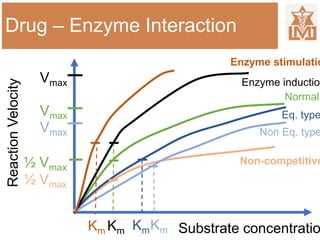
Drug – Enzyme Interaction
Vmax
½ Vmax
½ Vmax
Vmax
Km KmKmKm
Vmax
ReactionVelocity
Substrate concentratio
Normal
Non Eq. type
Eq. type
Non-competitive
Enzyme induction
Enzyme stimulatio
Drug – Enzyme Interaction
km Vmax
Competitive (Equilibrium) Increased
Not
changed
Competitive (Non-
equilibrium)
Increased Decreased
Non-competitive
Not
changed
Decreased
Enzyme induction
Not
changed
Increased
Post-Test
Log[Dose]
Response
Identify the drug
with highest:
• Potency
• Efficacy
A
B
C
Conclusion
Competitive enzyme inhibition (equilibrium type)
can be reversed by increasing the concentration of
substrate
Agonists have affinity to receptors, but differ in
their intrinsic activity
Depending on the G-protein of GPCRs, signalling
pathway may include cAMP, IP3-DAG or ion
channels themselves
Log[dose] response curve is used for comparing
drugs
Therapeutic window is more clinically applicable
Next class…
Tomorrow (9-10 am)
Topics:
Factors modifying drug action
Any queries?
Thank you!

Pharmacodynamics part 2

  • 1.
    Pharmacodynamics-II Dr. Pravin Prasad M.B.B.S.,MD Clinical Pharmacology Lecturer, Lumbini Medical College & TH 12 December, 2018 (26 Mangsir, 2075), Wednesday
  • 2.
    Questions from yesterday… Whatdo you understand by the term pharmacodynamics? Name five principles of drug action. What are common drug targets? Define receptor.
  • 3.
    By the endof the class, MBBS Ist year students will be able to: Appraise the different types of: Drug enzyme interaction Drug receptor interaction Explain the Intracellular signaling mechanism Interpret the Dose Response Curve Explain the difference between therapeutic index and therapeutic Window
  • 4.
    Drug – EnzymeInteraction Enzyme Normal Substrate Product
  • 5.
    Drug – EnzymeInteraction Enzyme Competitive Inhibition Inhibitor No Product Substrate Competition for the binding site Non functional
  • 6.
    Drug – EnzymeInteraction Enzyme Competitive Inhibition: Equilibrium Type Inhibitor No Product Substrate Product Inhibitor can be displaced Non functional
  • 7.
    Drug – EnzymeInteraction Enzyme Endogenous substrate Inhibitor Bacterial folate synthase Para-amino benzoic acid Sulfadiazine Cholinesteras e Acetylcholine Physostigmin e  Competitive enzyme inhibition (equilibrium type)
  • 8.
    Drug Target- Enzymes Enzyme CompetitiveInhibition: Non equilibrium Type Inhibitor No Product Substrate Inhibitor cannot be displaced
  • 9.
    Drug – EnzymeInteraction  Competitive enzyme inhibition (nonequilibrium ty Enzyme Endogenous substrate Inhibitor Cholinesteras e Acetylcholine Malathion, OPs Dihydrofolate reductase DHF Methotrexate
  • 10.
    Enzyme Drug – EnzymeInteraction Enzyme Non-competitive Inhibition Inhibitor No Product Substrate • Substrate cannot bind to enzyme • No competition between substrate and inhibitor
  • 11.
    Drug – EnzymeInteraction  Non-Competitive enzyme inhibition Enzyme Endogenous substrate Inhibitor Carbonic anhydrase H2O and CO2 Acetazolamide H+-K+ ATPase H+ and K+ Omeprazole Cyclooxygena se Arachidonic acid Aspirin
  • 12.
    Drug Receptor Interaction Agonist Bindsto a receptor, and Produces an effect similar to that of the physiological signal molecule Antagonist Binds to a receptor, but Prevents the action of an agonist on a receptor or a subsequent response Does not have any effect on its own
  • 13.
    Drug-Receptor Interactions Log [drug] LevelofResponse Fullagonist Partial agonist Baseline activity Inverse agonis Antagonist
  • 14.
    Drug-Receptor Interaction: Agonists Full agonist: Activatesthe receptor maximally Partial agonist: Activates the receptor sub-maximally Inverse agonist: Activates the receptor, but in opposite direction
  • 15.
    GPCRs: Intra-cellular signaling Mechanism(cAMP pathway) β Gsα Gγ Adenyl yl Cyclase GD P GT P ATP cAM P PKA
  • 16.
    GPCRs: Intra-cellular signaling Mechanism(PLC-IP3-DAG pathway) β Gqα Gγ PLC GD P GT P IP3 Ca2+ PIP2 DAG PKc Effects Effects Ca2+
  • 17.
    GPCRs: Intra-cellular signaling Mechanism(channel regulation) Directly opens or inhibits ion channels Mainly mediated through βγ subunits of Gi and Gq proteins Controls opening of K+ and Ca2+ channels Example: mAChR (M2): Cardiac K+ channels opening  hyperpolarization Decreased activity of cells
  • 18.
    Dose Response Curve Dose Response Isa hyperbolic curve • Low concentration of drug, response increases significantly • High concentration of drug, response increases slightly • Comparison of responses becomes difficult
  • 19.
    Dose Response Curve Log[Dose] Response Sigmoidcurve • Wider range can be plotted • Intermediate portion essentially linear • Comparison of responses can be made
  • 20.
    Dose Response Curve Log[Dose] Response MaximalResponse 50% response Efficacy Potency EC50 Slope
  • 21.
    Dose Response Curve Potencyon DRC: Depicted by position of DRC on Log[dose] axis • More left- more potent Comparison of potency of two drugs done at EC50 • Drug Concentration at which 50% response is obtained
  • 22.
    Dose Response Curve Efficacyon DRC: Maximal response that can be elicited by a drug • Upper limit of DRC Dictates the choice of drug Efficacy and Potency: independent of each other
  • 23.
    Dose Response Curve Slopeof DRC: Steep graph: • Response changes rapidly with change in dose • Dose needs to be individualised Flat graph: • Response changes slowly with change in dose
  • 24.
    Therapeutic index Calculated inexperimental animals 2 DRC plotted: Effective dose DRC Lethal dose DRC Separation of these DRC: Therapeutic index Calculated as: 𝑇ℎ𝑒𝑟𝑎𝑝𝑒𝑢𝑡𝑖𝑐 𝑖𝑛𝑑𝑒𝑥 = 𝐿𝑒𝑡ℎ𝑎𝑙 𝐷𝑜𝑠𝑒 50 𝐸𝑓𝑓𝑒𝑐𝑡𝑖𝑣𝑒 𝐷𝑜𝑠𝑒 50
  • 25.
    Dose Response Curve Log[Dose] Response(numberofanimals) 50%response ED50 LD50 Effective dose DRC Lethal dose DRC TI= LD50/ED50
  • 26.
    Therapeutic Window Also knownas therapeutic range More relevant in clinical set up Two DRCs: Effective dose DRC Adverse effect DRC Minimal therapeutic effect to Maximal acceptable adverse effect
  • 27.
    Dose Response Curve Log[Dose] Response(%) Maximal acceptable adverse effect Therapeuti cWindow/ range Effective dose DRC Adverse effect DRC Minimal therapeutic effect
  • 28.
    Drug – EnzymeInteraction Vmax ½ Vmax ½ Vmax Vmax Km KmKmKm Vmax ReactionVelocity Substrate concentratio Normal Non Eq. type Eq. type Non-competitive Enzyme induction Enzyme stimulatio
  • 29.
    Drug – EnzymeInteraction km Vmax Competitive (Equilibrium) Increased Not changed Competitive (Non- equilibrium) Increased Decreased Non-competitive Not changed Decreased Enzyme induction Not changed Increased
  • 30.
    Post-Test Log[Dose] Response Identify the drug withhighest: • Potency • Efficacy A B C
  • 31.
    Conclusion Competitive enzyme inhibition(equilibrium type) can be reversed by increasing the concentration of substrate Agonists have affinity to receptors, but differ in their intrinsic activity Depending on the G-protein of GPCRs, signalling pathway may include cAMP, IP3-DAG or ion channels themselves Log[dose] response curve is used for comparing drugs Therapeutic window is more clinically applicable
  • 32.
    Next class… Tomorrow (9-10am) Topics: Factors modifying drug action Any queries? Thank you!