PHARMACODYNAMICS
Mr. Jaineel Dharod
Dept. of Pharmacology
PHARMACODYNAMICS
INTRODUCTION
Pharmakon – Drug
Dynamics – Action / movement / power
It covers all the aspects relating to “What a drug
does to the body”
i.e. Mechanism of action
REVISION
 Agonist
 Antagonist
 Inverse / Partial agonist
 Efficacy
 Intrinsic Activity
 Ligand
 Dose
PRINCIPLES OF DRUG ACTION
• Do NOT impart new functions on any system, organ or cell.
• Only alter the PACE of ongoing activity.
 STIMULATION
 DEPRESSION
 IRRITATION
 REPLACEMENT
 CYTOTOXIC ACTION
WHERE CAN DRUG BIND?
MAJORITY OF DRUGS INTERACT WITH TARGET BIOMOLECULES:
Usually a Protein
1. ENZYMES
2. ION CHANNELS
3. TRANSPORTERS
4. RECEPTORS
TRANSDUCTION OF SIGNAL
• Most transmembrane signaling is accomplished by a small number
of different molecular mechanisms (transducer mechanisms)
• Large number of receptors share these handful of transducer
mechanisms to generate an integrated and amplified response
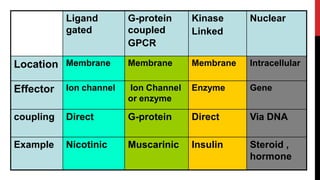
RECEPTOR FAMILIES
1. Ligand-gated ion channels (inotropic receptors)
2. G - Protein coupled receptor (Metabotropic receptors)
3. Enzymatic receptors (tyrosine kinase)
4. Receptor regulating gene expression (transcription factors/
Steroid)
Ligand
gated
G-protein
coupled
GPCR
Kinase
Linked
Nuclear
Location Membrane Membrane Membrane Intracellular
Effector Ion channel Ion Channel
or enzyme
Enzyme Gene
coupling Direct G-protein Direct Via DNA
Example Nicotinic Muscarinic Insulin Steroid ,
hormone
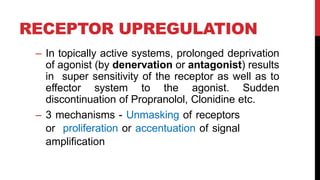
RECEPTOR UPREGULATION
– In topically active systems, prolonged deprivation
of agonist (by denervation or antagonist) results
in super sensitivity of the receptor as well as to
effector system to the agonist. Sudden
discontinuation of Propranolol, Clonidine etc.
– 3 mechanisms - Unmasking of receptors
or proliferation or accentuation of signal
amplification
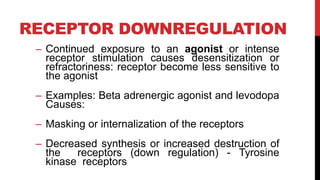
RECEPTOR DOWNREGULATION
– Continued exposure to an agonist or intense
receptor stimulation causes desensitization or
refractoriness: receptor become less sensitive to
the agonist
– Examples: Beta adrenergic agonist and levodopa
Causes:
– Masking or internalization of the receptors
– Decreased synthesis or increased destruction of
the receptors (down regulation) - Tyrosine
kinase receptors
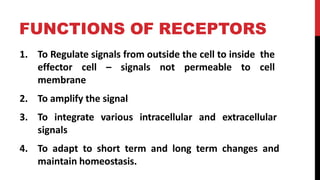
FUNCTIONS OF RECEPTORS
1. To Regulate signals from outside the cell to inside the
effector cell – signals not permeable to cell
membrane
2. To amplify the signal
3. To integrate various intracellular and extracellular
signals
4. To adapt to short term and long term changes and
maintain homeostasis.
DRUG ACTION NON-RECEPTOR MEDIATED
• Physical and chemical means - Antacids, chelating
agents and cholestyramine etc.
• Alkylating agents: binding with nucleic acid and
render cytotoxic activity – Cyclophosphamide etc.
• Antimetabolites: purine and pyrimidine analogues – 6 MP
and 5 FU – antineoplastic and immunosuppressant activity
• False incorporation (PABA)
• Protoplasmic action (antiseptics)
• Formation of antibody (Vaccines)
TYPES OF AGONISM
1. Summation: Two drugs eliciting same response, but with
different mechanism and their combined effect is equal
to their summation. (1+1=2)
2. Additive: Two drugs eliciting same response, with same
mechanism and their combined effect is equal to their
summation. (1+1=2)
3. Synergistic: The combined effect of two drug effect is
higher than either individual effect. (1+1=3)
DOSE
• It is the required amount of drug in weight,
volumes, moles or IU to provide a desired effect.
• In clinical it is called as Therapeutic dose
• In experimental purpose it is called as effective
dose.
• The therapeutic dose varies from person to
person
Single dose:
 Piperazine (4-5g) is sufficient to eradicate round worm.
 Single IM dose of 250mg of ceftriaxone to treat
gonorrhoea.
Daily dose:
It is the quantity of a drug to be administered in 24hr, all at
once or equally divided dose.
 Erythromycin is 1g per day to be given in 4 equally divided
dose (i.e., 250mg every 6 hr)
Total dose: It is the maximum quantity of the drug that is needed
the complete course of the therapy.
Ex:- procaine penicillin  early syphilis is 6 million unit 
given as 0.6 million units per day for 10days.
Loading dose: It is the large dose of drug to be given initially to
provide the effective plasma concentration rapidly. The drugs
having high Vd of distribution.
Chloroquine in Malaria:
 600 mg Start
 300mg after 8 hours
 300 mg after 2 days
Maintenance dose:
Loading dose normally followed by maintenance dose.
Needed to maintain the steady state plasma concentration
attained after giving the loading dose.
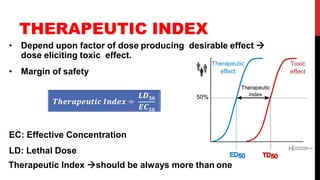
THERAPEUTIC INDEX
• Depend upon factor of dose producing desirable effect 
dose eliciting toxic effect.
• Margin of safety
EC: Effective Concentration
LD: Lethal Dose
Therapeutic Index should be always more than one
𝑻𝒉𝒆𝒓𝒂𝒑𝒆𝒖𝒕𝒊𝒄 𝑰𝒏𝒅𝒆𝒙 =
𝑳𝑫 𝟓𝟎
𝑬𝑪 𝟓𝟎
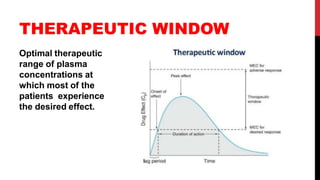
THERAPEUTIC WINDOW
Optimal therapeutic
range of plasma
concentrations at
which most of the
patients experience
the desired effect.
DRC
The dose–response relationship, or exposure–response
relationship, describes the magnitude of the response of
an organism, as a function of exposure (or doses) to
a stimulus or stressor (usually a chemical) after a certain
exposure time. Dose–response relationships can be described
by dose–response curves.
DOSE RESPONSE CURVE
Emax X [D]
E =
Kd + [D]
dose
%response
100% -
50% -
Log dose%response
100% -
50% -
Saturation of Receptors
POTENCY AND EFFICACY
Potency: It is the amount of drug required to produce a certain response
Efficacy: Maximal response that can be elicited by the drug
Aspirin is less potent as well as less efficacious than Morphine
Pethidine is less potent analgesic than Morphine but equally efficacious
Diazepam is more potent but less efficacious than Phenobarbitone
Furosemide is less potent but more efficacious than Metalozone
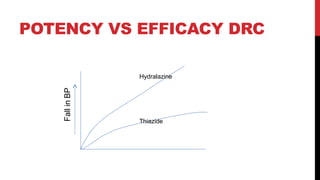
POTENCY VS EFFICACY DRC
Hydralazine
Thiazide
FallinBP
DRUG TOLERANCE
Acquired Drug Tolerance in Monday Morning Disease.
• Nitro-glycerine – Monday, Tuesday workers get
headache, after they get tolerances.
• After holiday (Sunday) they get again headache .
Reverse tolerance:- Same amount drug produces increase
pharmacological response
Innate tolerance: Genetically lack of sensitivity to a drug.
Cross tolerances: Cross tolerance among drugs belonging to
same category
THANK
YOU

Principles of pharmacodynamics

  • 1.
  • 2.
  • 3.
    INTRODUCTION Pharmakon – Drug Dynamics– Action / movement / power It covers all the aspects relating to “What a drug does to the body” i.e. Mechanism of action
  • 4.
    REVISION  Agonist  Antagonist Inverse / Partial agonist  Efficacy  Intrinsic Activity  Ligand  Dose
  • 5.
    PRINCIPLES OF DRUGACTION • Do NOT impart new functions on any system, organ or cell. • Only alter the PACE of ongoing activity.  STIMULATION  DEPRESSION  IRRITATION  REPLACEMENT  CYTOTOXIC ACTION
  • 6.
    WHERE CAN DRUGBIND? MAJORITY OF DRUGS INTERACT WITH TARGET BIOMOLECULES: Usually a Protein 1. ENZYMES 2. ION CHANNELS 3. TRANSPORTERS 4. RECEPTORS
  • 7.
    TRANSDUCTION OF SIGNAL •Most transmembrane signaling is accomplished by a small number of different molecular mechanisms (transducer mechanisms) • Large number of receptors share these handful of transducer mechanisms to generate an integrated and amplified response
  • 8.
    RECEPTOR FAMILIES 1. Ligand-gatedion channels (inotropic receptors) 2. G - Protein coupled receptor (Metabotropic receptors) 3. Enzymatic receptors (tyrosine kinase) 4. Receptor regulating gene expression (transcription factors/ Steroid)
  • 9.
    Ligand gated G-protein coupled GPCR Kinase Linked Nuclear Location Membrane MembraneMembrane Intracellular Effector Ion channel Ion Channel or enzyme Enzyme Gene coupling Direct G-protein Direct Via DNA Example Nicotinic Muscarinic Insulin Steroid , hormone
  • 10.
    RECEPTOR UPREGULATION – Intopically active systems, prolonged deprivation of agonist (by denervation or antagonist) results in super sensitivity of the receptor as well as to effector system to the agonist. Sudden discontinuation of Propranolol, Clonidine etc. – 3 mechanisms - Unmasking of receptors or proliferation or accentuation of signal amplification
  • 11.
    RECEPTOR DOWNREGULATION – Continuedexposure to an agonist or intense receptor stimulation causes desensitization or refractoriness: receptor become less sensitive to the agonist – Examples: Beta adrenergic agonist and levodopa Causes: – Masking or internalization of the receptors – Decreased synthesis or increased destruction of the receptors (down regulation) - Tyrosine kinase receptors
  • 12.
    FUNCTIONS OF RECEPTORS 1.To Regulate signals from outside the cell to inside the effector cell – signals not permeable to cell membrane 2. To amplify the signal 3. To integrate various intracellular and extracellular signals 4. To adapt to short term and long term changes and maintain homeostasis.
  • 13.
    DRUG ACTION NON-RECEPTORMEDIATED • Physical and chemical means - Antacids, chelating agents and cholestyramine etc. • Alkylating agents: binding with nucleic acid and render cytotoxic activity – Cyclophosphamide etc. • Antimetabolites: purine and pyrimidine analogues – 6 MP and 5 FU – antineoplastic and immunosuppressant activity • False incorporation (PABA) • Protoplasmic action (antiseptics) • Formation of antibody (Vaccines)
  • 14.
    TYPES OF AGONISM 1.Summation: Two drugs eliciting same response, but with different mechanism and their combined effect is equal to their summation. (1+1=2) 2. Additive: Two drugs eliciting same response, with same mechanism and their combined effect is equal to their summation. (1+1=2) 3. Synergistic: The combined effect of two drug effect is higher than either individual effect. (1+1=3)
  • 15.
    DOSE • It isthe required amount of drug in weight, volumes, moles or IU to provide a desired effect. • In clinical it is called as Therapeutic dose • In experimental purpose it is called as effective dose. • The therapeutic dose varies from person to person
  • 16.
    Single dose:  Piperazine(4-5g) is sufficient to eradicate round worm.  Single IM dose of 250mg of ceftriaxone to treat gonorrhoea. Daily dose: It is the quantity of a drug to be administered in 24hr, all at once or equally divided dose.  Erythromycin is 1g per day to be given in 4 equally divided dose (i.e., 250mg every 6 hr)
  • 17.
    Total dose: Itis the maximum quantity of the drug that is needed the complete course of the therapy. Ex:- procaine penicillin  early syphilis is 6 million unit  given as 0.6 million units per day for 10days. Loading dose: It is the large dose of drug to be given initially to provide the effective plasma concentration rapidly. The drugs having high Vd of distribution. Chloroquine in Malaria:  600 mg Start  300mg after 8 hours  300 mg after 2 days
  • 18.
    Maintenance dose: Loading dosenormally followed by maintenance dose. Needed to maintain the steady state plasma concentration attained after giving the loading dose.
  • 19.
    THERAPEUTIC INDEX • Dependupon factor of dose producing desirable effect  dose eliciting toxic effect. • Margin of safety EC: Effective Concentration LD: Lethal Dose Therapeutic Index should be always more than one 𝑻𝒉𝒆𝒓𝒂𝒑𝒆𝒖𝒕𝒊𝒄 𝑰𝒏𝒅𝒆𝒙 = 𝑳𝑫 𝟓𝟎 𝑬𝑪 𝟓𝟎
  • 20.
    THERAPEUTIC WINDOW Optimal therapeutic rangeof plasma concentrations at which most of the patients experience the desired effect.
  • 21.
    DRC The dose–response relationship,or exposure–response relationship, describes the magnitude of the response of an organism, as a function of exposure (or doses) to a stimulus or stressor (usually a chemical) after a certain exposure time. Dose–response relationships can be described by dose–response curves.
  • 22.
    DOSE RESPONSE CURVE EmaxX [D] E = Kd + [D] dose %response 100% - 50% - Log dose%response 100% - 50% - Saturation of Receptors
  • 24.
    POTENCY AND EFFICACY Potency:It is the amount of drug required to produce a certain response Efficacy: Maximal response that can be elicited by the drug Aspirin is less potent as well as less efficacious than Morphine Pethidine is less potent analgesic than Morphine but equally efficacious Diazepam is more potent but less efficacious than Phenobarbitone Furosemide is less potent but more efficacious than Metalozone
  • 25.
    POTENCY VS EFFICACYDRC Hydralazine Thiazide FallinBP
  • 26.
    DRUG TOLERANCE Acquired DrugTolerance in Monday Morning Disease. • Nitro-glycerine – Monday, Tuesday workers get headache, after they get tolerances. • After holiday (Sunday) they get again headache . Reverse tolerance:- Same amount drug produces increase pharmacological response Innate tolerance: Genetically lack of sensitivity to a drug. Cross tolerances: Cross tolerance among drugs belonging to same category
  • 27.