DRUG CLEARANCE 
Dr. Rajib Bhattacharjee 
Asstt. Professor 
Dept of Pharmacy, NSU
EFFECT OF URINE PH ON 
TUBULAR REABSORPTION & RENAL DRUG SECRETION 
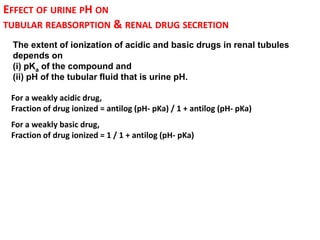
The extent of ionization of acidic and basic drugs in renal tubules 
depends on 
(i) pKa of the compound and 
(ii) pH of the tubular fluid that is urine pH. 
For a weakly acidic drug, 
Fraction of drug ionized = antilog (pH- pKa) / 1 + antilog (pH- pKa) 
For a weakly basic drug, 
Fraction of drug ionized = 1 / 1 + antilog (pH- pKa)
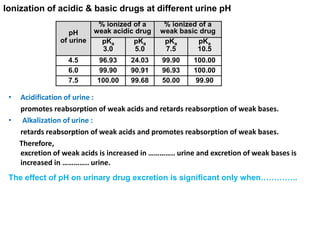
Ionization of acidic & basic drugs at different urine pH 
pH 
of urine 
4.5 96.93 24.03 99.90 100.00 
6.0 99.90 90.91 96.93 100.00 
7.5 100.00 99.68 50.00 99.90 
• Acidification of urine : 
% ionized of a 
weak acidic drug 
% ionized of a 
weak basic drug 
pKa 
3.0 
pKa 
5.0 
pKa 
7.5 
pKa 
10.5 
promotes reabsorption of weak acids and retards reabsorption of weak bases. 
• Alkalization of urine : 
retards reabsorption of weak acids and promotes reabsorption of weak bases. 
Therefore, 
excretion of weak acids is increased in ………….. urine and excretion of weak bases is 
increased in ………….. urine. 
The effect of pH on urinary drug excretion is significant only when…………..
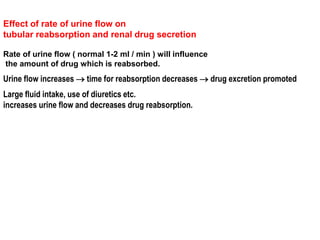
Effect of rate of urine flow on 
tubular reabsorption and renal drug secretion 
Rate of urine flow ( normal 1-2 ml / min ) will influence 
the amount of drug which is reabsorbed. 
Urine flow increases  time for reabsorption decreases  drug excretion promoted 
Large fluid intake, use of diuretics etc. 
increases urine flow and decreases drug reabsorption.
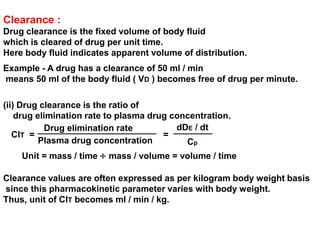
Clearance : 
Drug clearance is the fixed volume of body fluid 
which is cleared of drug per unit time. 
Here body fluid indicates apparent volume of distribution. 
Example - A drug has a clearance of 50 ml / min 
means 50 ml of the body fluid ( VD ) becomes free of drug per minute. 
(ii) Drug clearance is the ratio of 
drug elimination rate to plasma drug concentration. 
Drug elimination rate 
Plasma drug concentration 
ClT = 
dDE / dt 
= 
Cp 
Unit = mass / time  mass / volume = volume / time 
Clearance values are often expressed as per kilogram body weight basis 
since this pharmacokinetic parameter varies with body weight. 
Thus, unit of ClT becomes ml / min / kg.
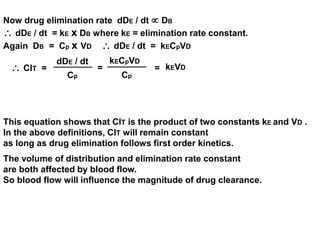
Now drug elimination rate dDE / dt  DB 
 dDE / dt = kE x DB where kE = elimination rate constant. 
Again DB = Cp x VD  dDE / dt = kECpVD 
 ClT = = 
Cp 
dDE / dt 
Cp 
kECpVD 
= kEVD 
This equation shows that ClT is the product of two constants kE and VD . 
In the above definitions, ClT will remain constant 
as long as drug elimination follows first order kinetics. 
The volume of distribution and elimination rate constant 
are both affected by blood flow. 
So blood flow will influence the magnitude of drug clearance.
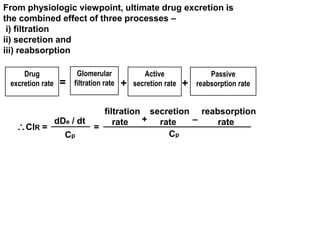
From physiologic viewpoint, ultimate drug excretion is 
the combined effect of three processes – 
i) filtration 
ii) secretion and 
iii) reabsorption 
Drug 
excretion rate 
Glomerular 
Active 
= filtration rate + secretion rate 
+ 
Passive 
reabsorption rate 
ClR = = 
Cp 
dDe / dt 
Cp 
filtration secretion reabsorption 
rate + rate – rate
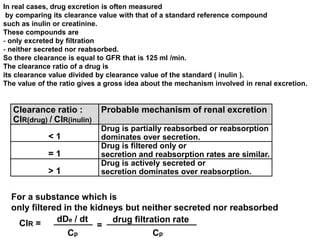
In real cases, drug excretion is often measured 
by comparing its clearance value with that of a standard reference compound 
such as inulin or creatinine. 
These compounds are 
- only excreted by filtration 
- neither secreted nor reabsorbed. 
So there clearance is equal to GFR that is 125 ml /min. 
The clearance ratio of a drug is 
its clearance value divided by clearance value of the standard ( inulin ). 
The value of the ratio gives a gross idea about the mechanism involved in renal excretion. 
Clearance ratio : 
ClR(drug) / ClR(inulin) 
Probable mechanism of renal excretion 
< 1 
Drug is partially reabsorbed or reabsorption 
dominates over secretion. 
= 1 
Drug is filtered only or 
secretion and reabsorption rates are similar. 
> 1 
Drug is actively secreted or 
secretion dominates over reabsorption. 
For a substance which is 
only filtered in the kidneys but neither secreted nor reabsorbed 
ClR = = 
Cp 
dDe / dt 
Cp 
drug filtration rate
ClR = 
dDe / dt 
Cp 
A 
B 
Cp 
dDedt 
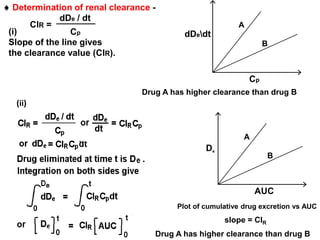
 Determination of renal clearance - 
(i) 
Slope of the line gives 
the clearance value (ClR). 
Drug A has higher clearance than drug B 
(ii) 
A 
B 
AUC 
De 
Plot of cumulative drug excretion vs AUC 
slope = ClR 
Drug A has higher clearance than drug B
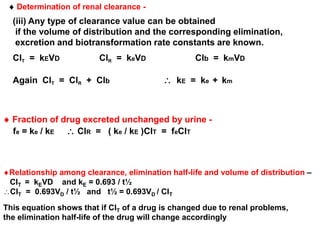
 Determination of renal clearance - 
(iii) Any type of clearance value can be obtained 
if the volume of distribution and the corresponding elimination, 
excretion and biotransformation rate constants are known. 
ClT = kEVD ClR = keVD Clb = kmVD 
Again ClT = ClR + Clb  kE = ke + km 
 Fraction of drug excreted unchanged by urine - 
fe = ke / kE  ClR = ( ke / kE )ClT = feClT 
Relationship among clearance, elimination half-life and volume of distribution – 
ClT = kEVD and kE = 0.693 / t½ 
ClT = 0.693VD / t½ and t½ = 0.693VD / ClT 
This equation shows that if ClT of a drug is changed due to renal problems, 
the elimination half-life of the drug will change accordingly
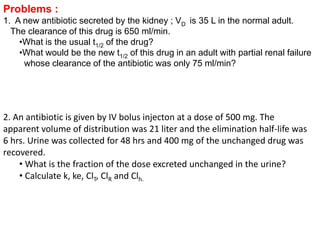
Problems : 
1. A new antibiotic secreted by the kidney ; VD is 35 L in the normal adult. 
The clearance of this drug is 650 ml/min. 
•What is the usual t1/2 of the drug? 
•What would be the new t1/2 of this drug in an adult with partial renal failure 
whose clearance of the antibiotic was only 75 ml/min? 
2. An antibiotic is given by IV bolus injecton at a dose of 500 mg. The 
apparent volume of distribution was 21 liter and the elimination half-life was 
6 hrs. Urine was collected for 48 hrs and 400 mg of the unchanged drug was 
recovered. 
• What is the fraction of the dose excreted unchanged in the urine? 
• Calculate k, ke, ClT, ClR and Clh.

Drug Clearance

  • 1.
    DRUG CLEARANCE Dr.Rajib Bhattacharjee Asstt. Professor Dept of Pharmacy, NSU
  • 2.
    EFFECT OF URINEPH ON TUBULAR REABSORPTION & RENAL DRUG SECRETION The extent of ionization of acidic and basic drugs in renal tubules depends on (i) pKa of the compound and (ii) pH of the tubular fluid that is urine pH. For a weakly acidic drug, Fraction of drug ionized = antilog (pH- pKa) / 1 + antilog (pH- pKa) For a weakly basic drug, Fraction of drug ionized = 1 / 1 + antilog (pH- pKa)
  • 3.
    Ionization of acidic& basic drugs at different urine pH pH of urine 4.5 96.93 24.03 99.90 100.00 6.0 99.90 90.91 96.93 100.00 7.5 100.00 99.68 50.00 99.90 • Acidification of urine : % ionized of a weak acidic drug % ionized of a weak basic drug pKa 3.0 pKa 5.0 pKa 7.5 pKa 10.5 promotes reabsorption of weak acids and retards reabsorption of weak bases. • Alkalization of urine : retards reabsorption of weak acids and promotes reabsorption of weak bases. Therefore, excretion of weak acids is increased in ………….. urine and excretion of weak bases is increased in ………….. urine. The effect of pH on urinary drug excretion is significant only when…………..
  • 4.
    Effect of rateof urine flow on tubular reabsorption and renal drug secretion Rate of urine flow ( normal 1-2 ml / min ) will influence the amount of drug which is reabsorbed. Urine flow increases  time for reabsorption decreases  drug excretion promoted Large fluid intake, use of diuretics etc. increases urine flow and decreases drug reabsorption.
  • 5.
    Clearance : Drugclearance is the fixed volume of body fluid which is cleared of drug per unit time. Here body fluid indicates apparent volume of distribution. Example - A drug has a clearance of 50 ml / min means 50 ml of the body fluid ( VD ) becomes free of drug per minute. (ii) Drug clearance is the ratio of drug elimination rate to plasma drug concentration. Drug elimination rate Plasma drug concentration ClT = dDE / dt = Cp Unit = mass / time  mass / volume = volume / time Clearance values are often expressed as per kilogram body weight basis since this pharmacokinetic parameter varies with body weight. Thus, unit of ClT becomes ml / min / kg.
  • 6.
    Now drug eliminationrate dDE / dt  DB  dDE / dt = kE x DB where kE = elimination rate constant. Again DB = Cp x VD  dDE / dt = kECpVD  ClT = = Cp dDE / dt Cp kECpVD = kEVD This equation shows that ClT is the product of two constants kE and VD . In the above definitions, ClT will remain constant as long as drug elimination follows first order kinetics. The volume of distribution and elimination rate constant are both affected by blood flow. So blood flow will influence the magnitude of drug clearance.
  • 7.
    From physiologic viewpoint,ultimate drug excretion is the combined effect of three processes – i) filtration ii) secretion and iii) reabsorption Drug excretion rate Glomerular Active = filtration rate + secretion rate + Passive reabsorption rate ClR = = Cp dDe / dt Cp filtration secretion reabsorption rate + rate – rate
  • 8.
    In real cases,drug excretion is often measured by comparing its clearance value with that of a standard reference compound such as inulin or creatinine. These compounds are - only excreted by filtration - neither secreted nor reabsorbed. So there clearance is equal to GFR that is 125 ml /min. The clearance ratio of a drug is its clearance value divided by clearance value of the standard ( inulin ). The value of the ratio gives a gross idea about the mechanism involved in renal excretion. Clearance ratio : ClR(drug) / ClR(inulin) Probable mechanism of renal excretion < 1 Drug is partially reabsorbed or reabsorption dominates over secretion. = 1 Drug is filtered only or secretion and reabsorption rates are similar. > 1 Drug is actively secreted or secretion dominates over reabsorption. For a substance which is only filtered in the kidneys but neither secreted nor reabsorbed ClR = = Cp dDe / dt Cp drug filtration rate
  • 9.
    ClR = dDe/ dt Cp A B Cp dDedt  Determination of renal clearance - (i) Slope of the line gives the clearance value (ClR). Drug A has higher clearance than drug B (ii) A B AUC De Plot of cumulative drug excretion vs AUC slope = ClR Drug A has higher clearance than drug B
  • 10.
     Determination ofrenal clearance - (iii) Any type of clearance value can be obtained if the volume of distribution and the corresponding elimination, excretion and biotransformation rate constants are known. ClT = kEVD ClR = keVD Clb = kmVD Again ClT = ClR + Clb  kE = ke + km  Fraction of drug excreted unchanged by urine - fe = ke / kE  ClR = ( ke / kE )ClT = feClT Relationship among clearance, elimination half-life and volume of distribution – ClT = kEVD and kE = 0.693 / t½ ClT = 0.693VD / t½ and t½ = 0.693VD / ClT This equation shows that if ClT of a drug is changed due to renal problems, the elimination half-life of the drug will change accordingly
  • 11.
    Problems : 1.A new antibiotic secreted by the kidney ; VD is 35 L in the normal adult. The clearance of this drug is 650 ml/min. •What is the usual t1/2 of the drug? •What would be the new t1/2 of this drug in an adult with partial renal failure whose clearance of the antibiotic was only 75 ml/min? 2. An antibiotic is given by IV bolus injecton at a dose of 500 mg. The apparent volume of distribution was 21 liter and the elimination half-life was 6 hrs. Urine was collected for 48 hrs and 400 mg of the unchanged drug was recovered. • What is the fraction of the dose excreted unchanged in the urine? • Calculate k, ke, ClT, ClR and Clh.