#
#
Mohi-ud-din islaMic instituteMohi-ud-din islaMic institute
ofof
PharMaceutical sciences.PharMaceutical sciences.
#
-:PRESENTED BY:-
Muslim Khan
Class: 4th
Year Pharm-D
Roll No# 19
#
CONTENTS
Introduction
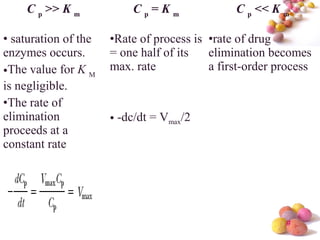
 Nonlinearity Pharmacokinetic
Causes of nonlinearity
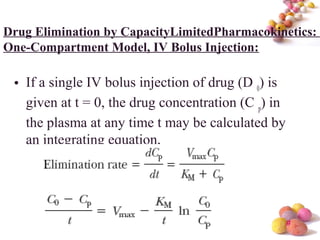
Michaelis – Menten equation
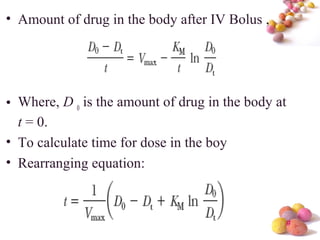
Estimation of Km and Vmax
Estimation of Km and Vmax at steady-state concentration
#
» Dose independent paharmacokinetic
Pharmacokinetic paraméters dont change with increse or
decrease in dose
» In such situation the rate processes are follw first order or
linear kinetics and all semilog plots of C Vs t for different
doses are superimposable.
LINEAR PHARMACOKINETICS
#
NONLINEAR PHARMACOKINETICS
» Dose dependent paharmacokinetic
Pharmacokinetic paraméters change with increse or decrease
in dose
Pharmacokinetic paraméters(ADME ) are depend upon carrier
or enzymes that are substrate specific, have definite
capacities and are susceptible to saturation at a high drug
concentration.
» In such cases, first-order kinetics transform into a mixture of
first-order and zero-order rate processes
»
#
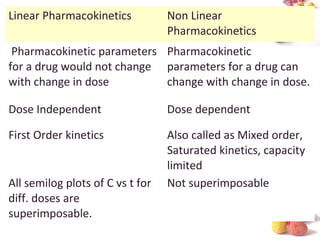
Linear Pharmacokinetics Non Linear
Pharmacokinetics
Pharmacokinetic parameters
for a drug would not change
with change in dose
Pharmacokinetic
parameters for a drug can
change with change in dose.
Dose Independent Dose dependent
First Order kinetics Also called as Mixed order,
Saturated kinetics, capacity
limited
All semilog plots of C vs t for
diff. doses are
superimposable.
Not superimposable
#
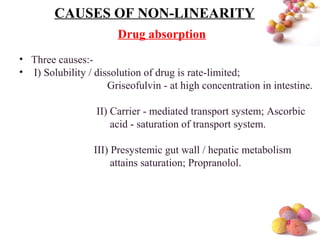
CAUSES OF NON-LINEARITY
• Three causes:-
• I) Solubility / dissolution of drug is rate-limited;
Griseofulvin - at high concentration in intestine.
II) Carrier - mediated transport system; Ascorbic
acid - saturation of transport system.
III) Presystemic gut wall / hepatic metabolism
attains saturation; Propranolol.
Drug absorption
#
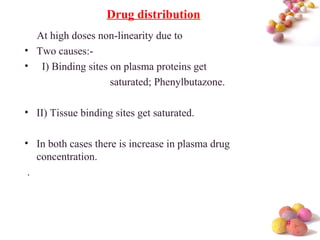
At high doses non-linearity due to
• Two causes:-
• I) Binding sites on plasma proteins get
saturated; Phenylbutazone.
• II) Tissue binding sites get saturated.
• In both cases there is increase in plasma drug
concentration.
.
Drug distribution
#
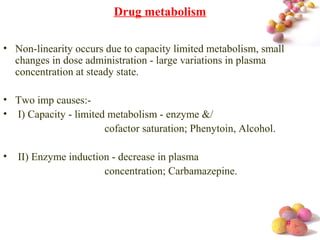
• Non-linearity occurs due to capacity limited metabolism, small
changes in dose administration - large variations in plasma
concentration at steady state.
• Two imp causes:-
• I) Capacity - limited metabolism - enzyme &/
cofactor saturation; Phenytoin, Alcohol.
• II) Enzyme induction - decrease in plasma
concentration; Carbamazepine.
Drug metabolism
#
Drug excretion
• Two active processes which are saturable,
I) Active tubular secretion - Penicillin G
II) Active tubular reabsorption - Water soluble
vitamins & Glucose.
• Saturation of carrier systems - decrease in renal clearance
& increase in Half life.
• Other reasons like forced diuresis, change in urine pH,
nephrotoxicity & saturation of binding sites.
• In case of biliary excretion non - linearity due to saturation -
Tetracycline & Indomethacin.
#
Drugs that demonstrate saturation kinetics
usually show the following characteristics:
1. Elimination of drug does not follow simple first-order kinetics—
that is, elimination kinetics are nonlinear.
2. The elimination half-life changes as dose is increased. Usually,
the elimination half-life increases with increased dose due to
saturation of an enzyme system.
#
3. The area under the curve (AUC) is not proportional to
the amount of bioavailable drug.
4. The saturation of capacity-limited processes may be
affected by other drugs that require the same
enzyme or carrier-mediated system
(ie,competition effects).
#
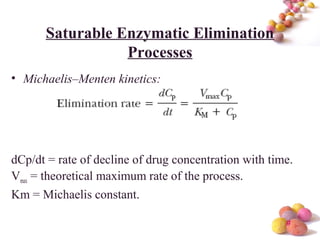
Saturable Enzymatic Elimination
Processes
• Michaelis–Menten kinetics:
dCp/dt = rate of decline of drug concentration with time.
Vmax = theoretical maximum rate of the process.
Km = Michaelis constant.
#
C p
>> K m
C p
= K m
C p
<< K m
• saturation of the
enzymes occurs.
•The value for K M
is negligible.
•The rate of
elimination
proceeds at a
constant rate
•Rate of process is
= one half of its
max. rate
• -dc/dt = Vmax/2
•rate of drug
elimination becomes
a first-order process
#
Drug Elimination by CapacityLimitedPharmacokinetics:
One-Compartment Model, IV Bolus Injection:
• If a single IV bolus injection of drug (D 0
) is
given at t = 0, the drug concentration (C p
) in
the plasma at any time t may be calculated by
an integrating equation,
#
• Amount of drug in the body after IV Bolus ,
• Where, D 0
is the amount of drug in the body at
t = 0.
• To calculate time for dose in the boy
• Rearranging equation:
#
Determination of K M
and V max
#
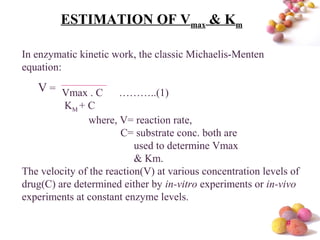
ESTIMATION OF Vmax & Km
In enzymatic kinetic work, the classic Michaelis-Menten
equation:
Vmax . C ………..(1)
KM + C
where, V= reaction rate,
C= substrate conc. both are
used to determine Vmax
& Km.
The velocity of the reaction(V) at various concentration levels of
drug(C) are determined either by in-vitro experiments or in-vivo
experiments at constant enzyme levels.
V =
#
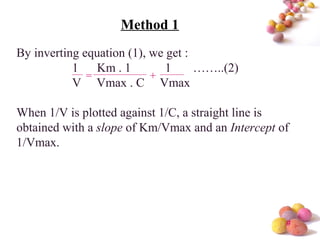
Method 1
By inverting equation (1), we get :
1 Km . 1 1 ……..(2)
V Vmax . C Vmax
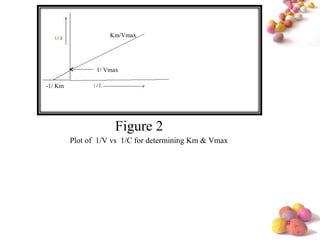
When 1/V is plotted against 1/C, a straight line is
obtained with a slope of Km/Vmax and an Intercept of
1/Vmax.
= +
#
Figure 2
Plot of 1/V vs 1/C for determining Km & Vmax
-1/ Km
Km/Vmax
1/ Vmax
#
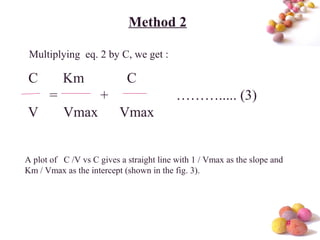
Multiplying eq. 2 by C, we get :
C Km C
= + ………..... (3)
V Vmax Vmax
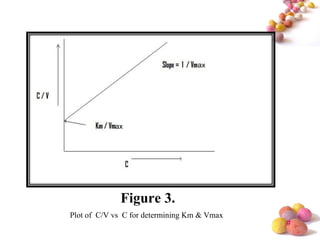
A plot of C /V vs C gives a straight line with 1 / Vmax as the slope and
Km / Vmax as the intercept (shown in the fig. 3).
Method 2
#
Figure 3.
Plot of C/V vs C for determining Km & Vmax
ax
ax
#
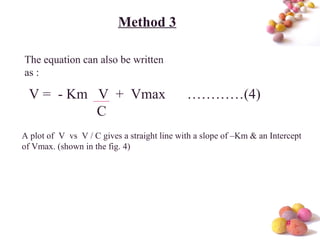
The equation can also be written
as :
V = - Km V + Vmax …………(4)
C
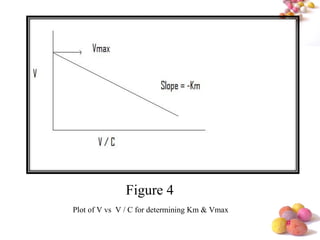
A plot of V vs V / C gives a straight line with a slope of –Km & an Intercept
of Vmax. (shown in the fig. 4)
Method 3
#
Figure 4
Plot of V vs V / C for determining Km & Vmax
#
CALCULATION OF KM & VMAX
STEADY- STATE CONCENTRATION
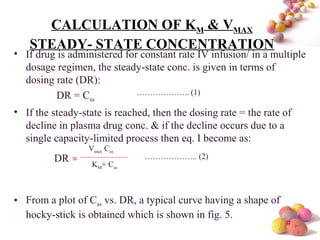
• If drug is administered for constant rate IV infusion/ in a multiple
dosage regimen, the steady-state conc. is given in terms of
dosing rate (DR):
DR = Css
• If the steady-state is reached, then the dosing rate = the rate of
decline in plasma drug conc. & if the decline occurs due to a
single capacity-limited process then eq. I become as:
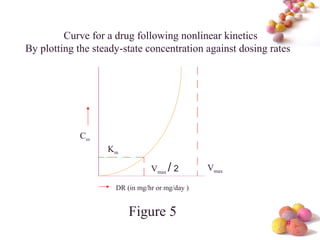
• From a plot of Css vs. DR, a typical curve having a shape of
hocky-stick is obtained which is shown in fig. 5.
……………….. (1)
=
Vmax Css
KM+ Css
DR ……………….. (2)
#
Css
Km
Vmax / 2 Vmax
DR (in mg/hr or mg/day )
Curve for a drug following nonlinear kinetics
By plotting the steady-state concentration against dosing rates
Figure 5
#
METHODS USED TO
DETERMINE THE
KM & VMAX AT
STEADY-STATE
#
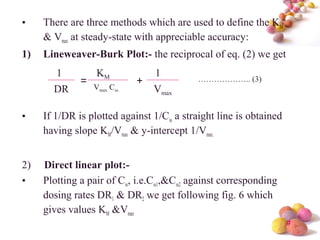
• There are three methods which are used to define the KM
& Vmax at steady-state with appreciable accuracy:
1) Lineweaver-Burk Plot:- the reciprocal of eq. (2) we get
• If 1/DR is plotted against 1/Css a straight line is obtained
having slope KM/Vmax & y-intercept 1/Vmax.
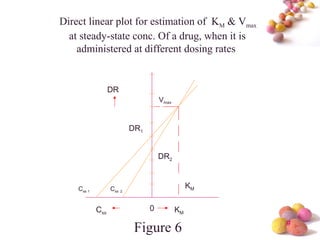
2) Direct linear plot:-
• Plotting a pair of Css, i.e.Css1,&Css2 against corresponding
dosing rates DR1 & DR2 we get following fig. 6 which
gives values KM &Vmax
1
DR
=
KM
Vmax Css
1
Vmax
+ ……………….. (3)
#
Css
Css 1 Css 2
0 KM
KM
DR
DR1
DR2
Vmax
Direct linear plot for estimation of KM & Vmax
at steady-state conc. Of a drug, when it is
administered at different dosing rates
Figure 6
#
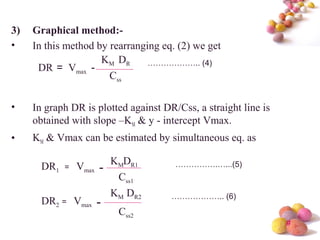
3) Graphical method:-
• In this method by rearranging eq. (2) we get
• In graph DR is plotted against DR/Css, a straight line is
obtained with slope –KM & y - intercept Vmax.
• KM & Vmax can be estimated by simultaneous eq. as
DR
DR
Css
KM
= Vmax
……………….. (4)
=DR1
=DR2
……………….. (6)
…………….…...(5)
-
Vmax
Vmax
-
-
KM
KM
DR1
DR2
Css1
Css2
#
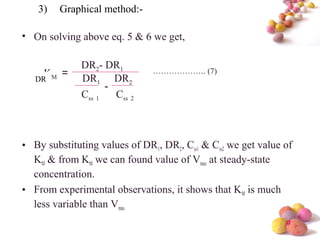
• On solving above eq. 5 & 6 we get,
• By substituting values of DR1, DR2, Css1 & Css2 we get value of
KM & from KM we can found value of Vmax at steady-state
concentration.
• From experimental observations, it shows that KM is much
less variable than Vmax.
KM =
DR2- DR1
Css 1 Css 2
DR1 DR2
-
……………….. (7)
DR
3) Graphical method:-
#

Nonlinear pharmacokinetic

  • 1.
  • 2.
    # Mohi-ud-din islaMic instituteMohi-ud-dinislaMic institute ofof PharMaceutical sciences.PharMaceutical sciences.
  • 3.
    # -:PRESENTED BY:- Muslim Khan Class:4th Year Pharm-D Roll No# 19
  • 4.
    # CONTENTS Introduction  Nonlinearity Pharmacokinetic Causesof nonlinearity Michaelis – Menten equation Estimation of Km and Vmax Estimation of Km and Vmax at steady-state concentration
  • 5.
    # » Dose independent paharmacokinetic Pharmacokineticparaméters dont change with increse or decrease in dose » In such situation the rate processes are follw first order or linear kinetics and all semilog plots of C Vs t for different doses are superimposable. LINEAR PHARMACOKINETICS
  • 6.
    # NONLINEAR PHARMACOKINETICS » Dosedependent paharmacokinetic Pharmacokinetic paraméters change with increse or decrease in dose Pharmacokinetic paraméters(ADME ) are depend upon carrier or enzymes that are substrate specific, have definite capacities and are susceptible to saturation at a high drug concentration. » In such cases, first-order kinetics transform into a mixture of first-order and zero-order rate processes »
  • 7.
    # Linear Pharmacokinetics NonLinear Pharmacokinetics Pharmacokinetic parameters for a drug would not change with change in dose Pharmacokinetic parameters for a drug can change with change in dose. Dose Independent Dose dependent First Order kinetics Also called as Mixed order, Saturated kinetics, capacity limited All semilog plots of C vs t for diff. doses are superimposable. Not superimposable
  • 8.
    # CAUSES OF NON-LINEARITY •Three causes:- • I) Solubility / dissolution of drug is rate-limited; Griseofulvin - at high concentration in intestine. II) Carrier - mediated transport system; Ascorbic acid - saturation of transport system. III) Presystemic gut wall / hepatic metabolism attains saturation; Propranolol. Drug absorption
  • 9.
    # At high dosesnon-linearity due to • Two causes:- • I) Binding sites on plasma proteins get saturated; Phenylbutazone. • II) Tissue binding sites get saturated. • In both cases there is increase in plasma drug concentration. . Drug distribution
  • 10.
    # • Non-linearity occursdue to capacity limited metabolism, small changes in dose administration - large variations in plasma concentration at steady state. • Two imp causes:- • I) Capacity - limited metabolism - enzyme &/ cofactor saturation; Phenytoin, Alcohol. • II) Enzyme induction - decrease in plasma concentration; Carbamazepine. Drug metabolism
  • 11.
    # Drug excretion • Twoactive processes which are saturable, I) Active tubular secretion - Penicillin G II) Active tubular reabsorption - Water soluble vitamins & Glucose. • Saturation of carrier systems - decrease in renal clearance & increase in Half life. • Other reasons like forced diuresis, change in urine pH, nephrotoxicity & saturation of binding sites. • In case of biliary excretion non - linearity due to saturation - Tetracycline & Indomethacin.
  • 12.
    # Drugs that demonstratesaturation kinetics usually show the following characteristics: 1. Elimination of drug does not follow simple first-order kinetics— that is, elimination kinetics are nonlinear. 2. The elimination half-life changes as dose is increased. Usually, the elimination half-life increases with increased dose due to saturation of an enzyme system.
  • 13.
    # 3. The areaunder the curve (AUC) is not proportional to the amount of bioavailable drug. 4. The saturation of capacity-limited processes may be affected by other drugs that require the same enzyme or carrier-mediated system (ie,competition effects).
  • 14.
    # Saturable Enzymatic Elimination Processes •Michaelis–Menten kinetics: dCp/dt = rate of decline of drug concentration with time. Vmax = theoretical maximum rate of the process. Km = Michaelis constant.
  • 15.
    # C p >> Km C p = K m C p << K m • saturation of the enzymes occurs. •The value for K M is negligible. •The rate of elimination proceeds at a constant rate •Rate of process is = one half of its max. rate • -dc/dt = Vmax/2 •rate of drug elimination becomes a first-order process
  • 16.
    # Drug Elimination byCapacityLimitedPharmacokinetics: One-Compartment Model, IV Bolus Injection: • If a single IV bolus injection of drug (D 0 ) is given at t = 0, the drug concentration (C p ) in the plasma at any time t may be calculated by an integrating equation,
  • 17.
    # • Amount ofdrug in the body after IV Bolus , • Where, D 0 is the amount of drug in the body at t = 0. • To calculate time for dose in the boy • Rearranging equation:
  • 18.
  • 19.
    # ESTIMATION OF Vmax& Km In enzymatic kinetic work, the classic Michaelis-Menten equation: Vmax . C ………..(1) KM + C where, V= reaction rate, C= substrate conc. both are used to determine Vmax & Km. The velocity of the reaction(V) at various concentration levels of drug(C) are determined either by in-vitro experiments or in-vivo experiments at constant enzyme levels. V =
  • 20.
    # Method 1 By invertingequation (1), we get : 1 Km . 1 1 ……..(2) V Vmax . C Vmax When 1/V is plotted against 1/C, a straight line is obtained with a slope of Km/Vmax and an Intercept of 1/Vmax. = +
  • 21.
    # Figure 2 Plot of1/V vs 1/C for determining Km & Vmax -1/ Km Km/Vmax 1/ Vmax
  • 22.
    # Multiplying eq. 2by C, we get : C Km C = + ………..... (3) V Vmax Vmax A plot of C /V vs C gives a straight line with 1 / Vmax as the slope and Km / Vmax as the intercept (shown in the fig. 3). Method 2
  • 23.
    # Figure 3. Plot ofC/V vs C for determining Km & Vmax ax ax
  • 24.
    # The equation canalso be written as : V = - Km V + Vmax …………(4) C A plot of V vs V / C gives a straight line with a slope of –Km & an Intercept of Vmax. (shown in the fig. 4) Method 3
  • 25.
    # Figure 4 Plot ofV vs V / C for determining Km & Vmax
  • 26.
    # CALCULATION OF KM& VMAX STEADY- STATE CONCENTRATION • If drug is administered for constant rate IV infusion/ in a multiple dosage regimen, the steady-state conc. is given in terms of dosing rate (DR): DR = Css • If the steady-state is reached, then the dosing rate = the rate of decline in plasma drug conc. & if the decline occurs due to a single capacity-limited process then eq. I become as: • From a plot of Css vs. DR, a typical curve having a shape of hocky-stick is obtained which is shown in fig. 5. ……………….. (1) = Vmax Css KM+ Css DR ……………….. (2)
  • 27.
    # Css Km Vmax / 2Vmax DR (in mg/hr or mg/day ) Curve for a drug following nonlinear kinetics By plotting the steady-state concentration against dosing rates Figure 5
  • 28.
    # METHODS USED TO DETERMINETHE KM & VMAX AT STEADY-STATE
  • 29.
    # • There arethree methods which are used to define the KM & Vmax at steady-state with appreciable accuracy: 1) Lineweaver-Burk Plot:- the reciprocal of eq. (2) we get • If 1/DR is plotted against 1/Css a straight line is obtained having slope KM/Vmax & y-intercept 1/Vmax. 2) Direct linear plot:- • Plotting a pair of Css, i.e.Css1,&Css2 against corresponding dosing rates DR1 & DR2 we get following fig. 6 which gives values KM &Vmax 1 DR = KM Vmax Css 1 Vmax + ……………….. (3)
  • 30.
    # Css Css 1 Css2 0 KM KM DR DR1 DR2 Vmax Direct linear plot for estimation of KM & Vmax at steady-state conc. Of a drug, when it is administered at different dosing rates Figure 6
  • 31.
    # 3) Graphical method:- •In this method by rearranging eq. (2) we get • In graph DR is plotted against DR/Css, a straight line is obtained with slope –KM & y - intercept Vmax. • KM & Vmax can be estimated by simultaneous eq. as DR DR Css KM = Vmax ……………….. (4) =DR1 =DR2 ……………….. (6) …………….…...(5) - Vmax Vmax - - KM KM DR1 DR2 Css1 Css2
  • 32.
    # • On solvingabove eq. 5 & 6 we get, • By substituting values of DR1, DR2, Css1 & Css2 we get value of KM & from KM we can found value of Vmax at steady-state concentration. • From experimental observations, it shows that KM is much less variable than Vmax. KM = DR2- DR1 Css 1 Css 2 DR1 DR2 - ……………….. (7) DR 3) Graphical method:-
  • 33.