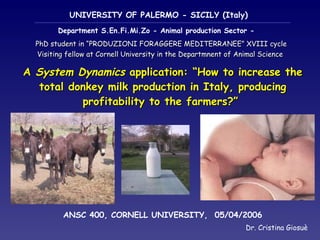
UNIVERSITY OF PALERMO - SICILY (Italy)   Department S.En.Fi.Mi.Zo - Animal production Sector -   ANSC 400, CORNELL UNIVERSITY,  05/04/2006 Dr. Cristina Giosuè A  System Dynamics  application: “How to increase the total donkey milk production in Italy, producing profitability to the farmers?”  PhD student in “PRODUZIONI FORAGGERE MEDITERRANEE” XVIII cycle Visiting fellow at Cornell University in the Departmnent of Animal Science
Outline Introduction to  System Dynamics modeling   Examples of  System Dynamics application  on a donkey milk production model
Introduction to  System Dynamics modeling
What is System Dynamics and why it is important? - The complexity of the systems in which we live is growing (accelerating economic, technological, social, and environmental changes) - Many of the problems we now face arise as unanticipated side effect of our own past actions - All too often the policies we implement to solve important problem fail, make the problem worse, or create new problems CSDNet
System Dynamics  is  - perspective and set of conceptual tools that enable us to understand the structure and dynamics of complex systems - qualitative modeling method that enables us to build formal computer simulations of complex systems and use them to design more effective policies and organizations - a rigorous way to help thinking, visualizing, sharing, and communication of the future evolution of complex organizations and issues over time for the purpose of solving problems and creating more robust designs, reducing the likelihood of counterintuitive or unintended consequences What is System Dynamics and why it is important? CSDNet
Figure 1-3 in Sterman Assumes a clear and linear  response of results to our decision Why  unintended consequences ? Event-oriented world view Every event has a (single) cause Leads to event-oriented problem solving
 
System Dynamics involve the use of : Diagrams, graphs, words, and basic algebra to activate and capture existing knowledge about a particular observed problem situation Frameworks to help both researchers and practitioners organize, filter and structure that knowledge Mathematical simulation models and learning environments that  help researchers and decision makers to identify more sustainable solutions and further refine their conceptual models CSDNet
“ All models are wrong, some models are useful” All models are simplifications and must omit elements of reality Despite these omissions, “good models” can enhance our thinking and problem solving All models have “clients” Clients are people you must influence for your work to have impact Help clients solve their problem……but also challenge their thinking
Examples of  System Dynamics application  on a donkey milk production model
The SD Modeling Process Iteration can occur from any step to any other Modeling effort will go through each of these step many times
The SD Modeling Process Iteration can occur from any  step to any other Modeling effort will go through each of these step many times Real world Information feedback Mental models of real world Strategy, structure, decision rules Decisions (Organizational Experiments)
The researchable  PROBLEM is: How to increase the total donkey milk production in Italy, producing profitability to the farmers?”…….. Problem articulation
… ..and WHY? Problem articulation
General problem (background) Food Allergies a)   In the last 20 years the population of developed countries suffering food allergies has increased (from 5 to 10%), the children and the babies are the most affected  (www.italiasalute.it) b)   FA develop when intestinal immune system doesn’t respond normally to the food proteins or protein fragments which have escaped lumen hydrolysis Problem articulation
General problem (background) Food Allergies The main foods, that frequently cause allergy, are: egg (albumin), peanut, walnut,hazelnut, fish,shellfish, cow milk, chocolate, fruit (strawberry, pineapple,  orange, tropical fruit ecc), cheese and vegetable (tomate ecc) ecc. The common symptoms of FA are:  nausea, vomiting, abdominal pain, distension, flatulence and diarrhea; sometime skin and respiratory tract may be involved. Occasionally, severe systemic (anaphylactic) reactions are provoked and these reactions may be fatal (Sampson et al., 1996; Kimber et al., 2002).   Problem articulation
General problem (background) Cow Milk Protein Allergy (CMPA) Cow milk protein allergy ( CMPA) is the most relevant with higher social implications in developed countries . Prevalence:   2-5% of the children and babies in the developed countries (Pizzin et al., 2003; Villoslada et al., 2005) and 1% in the adults (E. Smith, 1997). Problem articulation
CMPA Most children with CMPA synthesize  specific immunoglobulin E to proteinic antigens   (Iacono et al., 1992),   such as  α ,  β  and k caseins,  β  lactoglobuline,  α  lactoalbumine and lactoferine   (Teschemacher et al., 1997;  F. Lara-Villoslada et al., 2005; CMPA in infancy and childhood)  General problem (background) Problem articulation
CMPA Actual alternative feeding systems........   - Dietary products for infants derived from several different protein sources  (such as bovine casein, bovine whey, bovine or porcine collagen, soy, or mixtures of these)  exposed to different procedures of hydrolysis and further processing  (heat treatment or ultrafiltration) - Dietary products based on amino acid mixtures   (Fiocchi et al., 2003).   General problem (background) Problem articulation
CMPA … ..but Some patients with CMAP can also react to these foods  ( multiple food allergies)  (Iannolino et al., 2005) General problem (background) Problem articulation
Researchable problem The donkey milk and CMPA Since 1990, in Italy, some researches in regard to donkey milk use on children with strong food allergies have started.   In some regions of Italy the use of donkey milk to feed the babies is not new (in Sicily until the end of the Second War and in Germany) ( Oftedal et al., 1988).   The economical, social changes and the industrial progress have caused an increase in the use of milk substitutes.  Iacono et al. (1992) showed good results by the use of donkey milk on 9 babies with  multiple food allergies. The donkey milk was well tolerated and no negative reactions were recorded. These results were confirmed by Carroccio et al. (2000) on 18/21 patients. Problem articulation
Milk composition (%) of different species and Energy (KJ/kg) (Polidori 1994)   *Salimei et al., 1999; **Salimei et al, 2001; ***Polidori 1994 2855 0.22 6.69 0.40 1.64 3.38 12.43 87.57 Woman 1939*** 0.39 6.88 0.38** 1.72   0.38  8.84 91.16 Donkey* 4846 0.80 4.70 3.84 4.80 7.50 17.8 82.2 Cow buffalo 3399 0.73 4.47 3.10 3.41 4.62 13.23 86.77 Goat 5289 0.92 4.89 4.50 6.17 7.50 19.52 80.48 Sheep 2983 0.78 4.71 2.50 3.43 3.46 12.38 87.62 Cow Casein %  Energy KJ/kg  Ash %  Lactose %  Protein %  Fat %  Total solids % Water % Species
Average nitrogen composition of the milk in some species 14.0 4000 48.0 38.0 86.0 donkey 700 500 trace trace - (Lisozime, ppm) 10 45 45 90 Horse 11.4 5 – 7.43 8.7 – 7.13 4.66 Non proteic nitrogen 58.2 17.0 15.7 16.8 Whey protein (%) 30.4 78.0 75.6 78.5 Casein (%) 88.6 95.0 91.3 95.3 Protein (%) Woman Cow Goat Sheep
Some Milk Proteic Fractions  + Jenness, 1980; *Doreau et Boulot, 1989; **Buscemi, 2000;***Ambruzzi, 2003 More investigations are necessary! 30-35 2.5 12 45 28 64 Cow+ 75 3.9 8.1 0 – 5(as1) 12,6(as2) 47 56 Goat+ No 30 60 β  lactoglobuline (% of total wheyprotein)  High  22 2-15 α  lactoalbumine  (% of total wheyprotein) no Yes Yes αs  casein (% of casein) Yes Yes β   casein  (% of casein) Woman*** Yes Yes γ   casein  (% of casein) ? ? K casein (% of casein) Donkey** Horse*
Acidic composition of the donkey milk fat ( Chiofalo 2001)   0.86 Polynsaturated  ω   3/  ω   6 8.65 Polyunsaturated  ω   6 % 7.45 Polyunsaturated  ω 3 % 16.60 Total Polyunsaturated % 15.82 Total Monounsaturated% 0.91 volatile, soluble saturated  % 67.58 Total saturated %   Average value
Essential Fatty Acids (EFAs) and human health EFAs  are long-chain polyunsaturated fatty acids derived from linolenic ( Omega-3 ), linoleic ( Omega-6 ), and oleic acids ( Omega-9 ) (The number following "Omega-" represents the position of the first double bond, counting from the terminal methyl group on the molecule)  Omega-9   is "non-essential"  because the body can manufacture a modest amount on its own, provided essential EFAs are present   EFAs  are necessary fats that humans cannot synthesize, and must be obtained through diet and support the cardiovascular, reproductive, immune, and nervous systems by the production of prostaglandines   (they are fundamental for growth in fetuses (by mother’s dietary intake) and children, particularly for neural development and maturation of sensory system   (www.goodfats.pamrotella.com )
Essential Fatty Acids (EFAs) and human health Corn, safflower, sunflower, soybean, and cottonseed oils are also sources of linoleic acid, but are refined and may be nutrient-deficient as sold in stores. chicken Fish chestnut oil wheat germ oil black currant seed oil soybean oil evening primrose oil canola oil (cold-pressed and unrefined) olive oil, olives, borage oil some dark leafy green vegetables sunflower seeds (raw) Avocados pistachio nuts sesame seeds pine nuts Brazil nuts pumpkin seeds pumpkin seeds Grapeseed oil walnuts hempseed oil and hempseeds hempseed oil and hempseeds Flaxseed oil, flaxseeds and flaxseed meal Flaxseed oil (flaxseed oil has the highest linolenic content of any food), flaxseeds and flaxseed meal Foods that contain omega 6: Foods that contain omega 3:
Conjugated linoleic acids (CLA) and human health Mixture of positional and geometric isomers of linoleic acids with two double bonds, which can be different in the position and orientation ( cis  or  trans ) located on adjacent carbons.   The main source of CLA in human diets: -food products derived from ruminants (meat and dairy products)  The CLA are showing   impressive range of beneficial health effects in biomedical studies with animal models, like: Anti-carcinogenic  Anti-obesity and altered nutrient partitioning  Anti-atherogenic and reduces cholesterol  Enhance the immune system  Enhance bone mineralization   (Bauman & Lock, 2006)
Conjugated linoleic acids (CLA) cis -9,  trans -11 CLA and  trans -10,  cis -12 CLA  cis -9,  trans -11  conjugated linoleic acid is the predominant CLA isomer found in ruminant fat including milk fat. CLA is produced as an intermediate in rumen biohydrogenation of linoleic acid present in the cows diet and a portion of the CLA in milk fat comes from that which has escaped complete biohydrogenation in the rumen.  However, the majority is made by the cow herself using the desaturase enzyme and  trans -11 18:1 (vaccenic acid), another fatty acid intermediate produced during rumen biohydrogenation. With certain diets the rumen environment is changed and a portion of the biohydrogenation produces,  trans -10,  cis -12 CLA  and  trans -10 C18:1 as intermediates.  trans -10,  cis -12 CLA is present at only trace levels in milk fat  (Bauman & Lock, 2006) cis -9,  trans -11 CLA
Trans vaccenic and CLA content in milk fat of different species in comparison with human milk fat  (Jahreis et al., 1999)
Collaborative Research project : effect of different diet and oxytocin use on donkey milk fat yield and fatty acids composition INVESTIGATORS:  Cornell University Department of Animal Science (USA) , Istituto Sperimentale Zootecnico per la Sicilia and University of Palermo Department SEn. Fi.Mi.Zo. (Italy) OBJECTIVES: To investigate changes in the pattern of donkey milk fatty acids, using two different diets, one of them with an extra virgin olive oil integration.  To investigate changes in donkey milk fat yield and fatty acids composition, using oxytocin
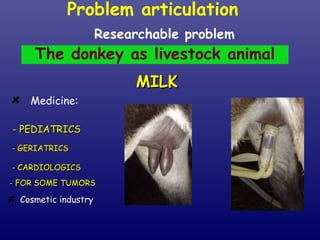
Researchable problem The donkey as livestock animal MILK Medicine: - PEDIATRICS - GERIATRICS - CARDIOLOGICS - FOR SOME TUMORS Cosmetic industry  Problem articulation
Researchable problem The donkey as livestock animal MEAT - brasato Stracotto - Smoked meat  Cold meat and  salami Problem articulation
Researchable problem The EU is showing a particular attention to promote the livestock production in marginal areas ,  to prevent and to stop the abandon of these rural areas, which can cause very relevant and negative consequences on the environment, the economical and social aspect. The  donkey is a breed in extinction  in developed countries, and this animal is presented in marginal areas, thanks its high resistance and adaptation capacity Problem articulation
Donkey breeds in Italy 6 main donkey breeds Martina Franca Sardo
Donkey breeds in Italy 6 main donkey breeds Amiata Asinara Romagnolo
Donkey breeds in Italy 6 main donkey breeds Ragusano Pantesco Sicilian
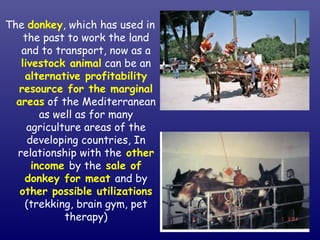
The  donkey , which has used in the past to work the land and to transport, now as a  livestock animal  can be an  alternative profitability resource for the marginal areas  of the Mediterranean as well as for many agriculture areas of the developing countries, In relationship with the   other income   by the   sale of donkey for meat   and by   other possible utilizations   (trekking, brain gym, pet therapy)
The  donkey  milk is  not  included in the DPR 54/97  The sale can be only direct (from the farmer to the consumer) through autorization from the  ASL (local sanitary agency) ( Regio Decreto 9 th  May 1929 n° 994) The VETERINARY INSPECTORATE  has institued in Sicily a  TECHNICAL AND SCIENTIFIC COMMITTEE  to investigate more donkey milk production and health aspects, to establish policies and marketing strategies improving this new productive sector Problem of Donkey milk sale in Italy
Dynamic problem definition  Define a “Reference Mode” Graphs or other information showing the development of the relevant problem over time The information about the donkey milk production and donkey milk consume is not registered by the statistical institutions in Italy; The donkey indeed is not included into animals producing milk but only meat, considering the low incidence of this product and the actual selling and production restrictions.  Problem articulation
In Italy, since 1960, donkey number has decreased highly  (FAO 2005).
Qualitative reference mode of donkey milk production (liter/month)
Qualitative future reference mode of donkey milk production (liter/month)
It is important to define the relevant time horizon enough of past to show problem development enough into future to show possible delayed effects of potential policies In this case I have chosen  8 years  like time horizon, because I think that this can be enough to evaluate the results of application of different policies and strategies, increasing the milk production and then the milk available for the market  Problem articulation  Dynamic problem definition
Dynamic Hypothesis A proposed explanation for the behavior Explicit structure that creates behavior Provisional, subject to revision (working theory) Endogenous focus Behavior arising from within the system Not (just) external shocks Avoid “narrow” model boundaries
Tools for Dynamic Hypotheses Model Boundary Chart What variables included, excluded What variables exogenous, endogenous Causal Loop Diagrams (CLD) Show causal linkages among variables Focus on feedback structure Stock-Flow Diagrams (SFD) Characterize physical stock-flow structure Dynamic Hypothesis
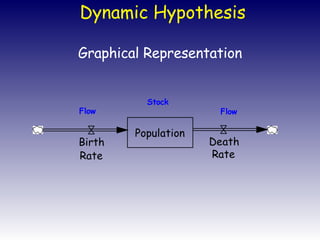
Population and birth rate loop INCREASE  in population increases births,  INCREASE  in births increases population. This is a  POSITIVE  feedback loop , which will cause population to grow. Dynamic Hypothesis
Population and death rate loop Population  INCREASES  death rate, death rate  DECREASES  population This is a  NEGATIVE or BALANCING  feedback   loop Dynamic Hypothesis
The simple system has two feedback loops These operate together to produce the behavior of the system. Population increases birth rate, birth rate increases population Population increases death rate, death rate decreases population Dynamic Hypothesis
Dynamic Hypothesis
Dynamic Hypothesis
Dynamic Hypothesis
Dynamic Hypothesis
Dynamic Hypothesis
Dynamic Hypothesis
Dynamic Hypothesis


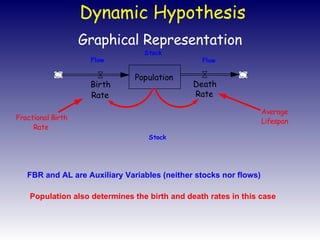
Explicit delineation of stocks and flows Stocks  (states) are accumulations Material or information Can be counted at a given time Change only through flows Flows  (rates) are quantities per some amount of time Change states Cannot be measured instantaneously Can be affected by many other variables Dynamic Hypothesis
“ State-rate” structure Rates affect states, states affect rates Units consistency for variables, equations Explicit specification of units for each element Dynamic Hypothesis
Graphical Representation Dynamic Hypothesis
Graphical Representation FBR and AL are Auxiliary Variables (neither stocks nor flows) Population also determines the birth and death rates in this case Dynamic Hypothesis
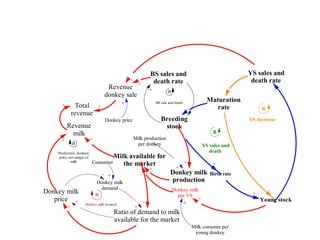
Stock and flows diagrams AGING CHAIN DONKEYS
Stock and flows diagrams  MILK PRODUCTION, MILK DEMAND AND MILK PRICE
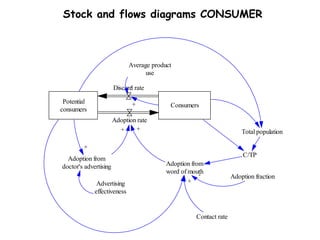
Stock and flows diagrams CONSUMER
Stock and flows diagrams FEED RESOURCE
Stock and flows diagrams DONKEY FARM SYSTEM
Stock and flows diagrams REVENUE, COSTS AND NET MARGIN
Mathematics of SD models System of ordinary differential equations Solved by numerical integration S t  =  ∫(Inflow-Outflow) ds + S 0 Inflow = f(S, other variables) Outflow = f(S, other variables) Many software programs available Vensim® is good for research purposes Dynamic Hypothesis
Testing (Formulate Simulation Model)  An explicit mathematical representation helps to : Identify vague concepts Resolve contradictions previously unnoticed Provides a real test of understanding of the problem and its elements Specification must be complete and consistent Many softwares available I’m using Vensim ® from Ventana Systems
Model Evaluation Begins with first equation Comparison of behavior in model to real world Concepts in model should correspond to a meaningful real world concept Check for Dimensional consistency Sensitivity to parameter changes Response to “extreme conditions”
Policy Design and Evaluation Modifications to relevant parameters Creation of entirely new strategies and structures Modifying the feedback structure Reducing or eliminating the delays Changing information flows Altering decision rules Assess sensitivity of policy results
And now a little bit of practice! Milk production model
Thank you !

Donkey Milk

  • 1.
    UNIVERSITY OF PALERMO- SICILY (Italy) Department S.En.Fi.Mi.Zo - Animal production Sector -   ANSC 400, CORNELL UNIVERSITY, 05/04/2006 Dr. Cristina Giosuè A System Dynamics application: “How to increase the total donkey milk production in Italy, producing profitability to the farmers?” PhD student in “PRODUZIONI FORAGGERE MEDITERRANEE” XVIII cycle Visiting fellow at Cornell University in the Departmnent of Animal Science
  • 2.
    Outline Introduction to System Dynamics modeling Examples of System Dynamics application on a donkey milk production model
  • 3.
    Introduction to System Dynamics modeling
  • 4.
    What is SystemDynamics and why it is important? - The complexity of the systems in which we live is growing (accelerating economic, technological, social, and environmental changes) - Many of the problems we now face arise as unanticipated side effect of our own past actions - All too often the policies we implement to solve important problem fail, make the problem worse, or create new problems CSDNet
  • 5.
    System Dynamics is - perspective and set of conceptual tools that enable us to understand the structure and dynamics of complex systems - qualitative modeling method that enables us to build formal computer simulations of complex systems and use them to design more effective policies and organizations - a rigorous way to help thinking, visualizing, sharing, and communication of the future evolution of complex organizations and issues over time for the purpose of solving problems and creating more robust designs, reducing the likelihood of counterintuitive or unintended consequences What is System Dynamics and why it is important? CSDNet
  • 6.
    Figure 1-3 inSterman Assumes a clear and linear response of results to our decision Why unintended consequences ? Event-oriented world view Every event has a (single) cause Leads to event-oriented problem solving
  • 7.
  • 8.
    System Dynamics involvethe use of : Diagrams, graphs, words, and basic algebra to activate and capture existing knowledge about a particular observed problem situation Frameworks to help both researchers and practitioners organize, filter and structure that knowledge Mathematical simulation models and learning environments that help researchers and decision makers to identify more sustainable solutions and further refine their conceptual models CSDNet
  • 9.
    “ All modelsare wrong, some models are useful” All models are simplifications and must omit elements of reality Despite these omissions, “good models” can enhance our thinking and problem solving All models have “clients” Clients are people you must influence for your work to have impact Help clients solve their problem……but also challenge their thinking
  • 10.
    Examples of System Dynamics application on a donkey milk production model
  • 11.
    The SD ModelingProcess Iteration can occur from any step to any other Modeling effort will go through each of these step many times
  • 12.
    The SD ModelingProcess Iteration can occur from any step to any other Modeling effort will go through each of these step many times Real world Information feedback Mental models of real world Strategy, structure, decision rules Decisions (Organizational Experiments)
  • 13.
    The researchable PROBLEM is: How to increase the total donkey milk production in Italy, producing profitability to the farmers?”…….. Problem articulation
  • 14.
    … ..and WHY?Problem articulation
  • 15.
    General problem (background)Food Allergies a) In the last 20 years the population of developed countries suffering food allergies has increased (from 5 to 10%), the children and the babies are the most affected (www.italiasalute.it) b) FA develop when intestinal immune system doesn’t respond normally to the food proteins or protein fragments which have escaped lumen hydrolysis Problem articulation
  • 16.
    General problem (background)Food Allergies The main foods, that frequently cause allergy, are: egg (albumin), peanut, walnut,hazelnut, fish,shellfish, cow milk, chocolate, fruit (strawberry, pineapple, orange, tropical fruit ecc), cheese and vegetable (tomate ecc) ecc. The common symptoms of FA are: nausea, vomiting, abdominal pain, distension, flatulence and diarrhea; sometime skin and respiratory tract may be involved. Occasionally, severe systemic (anaphylactic) reactions are provoked and these reactions may be fatal (Sampson et al., 1996; Kimber et al., 2002). Problem articulation
  • 17.
    General problem (background)Cow Milk Protein Allergy (CMPA) Cow milk protein allergy ( CMPA) is the most relevant with higher social implications in developed countries . Prevalence: 2-5% of the children and babies in the developed countries (Pizzin et al., 2003; Villoslada et al., 2005) and 1% in the adults (E. Smith, 1997). Problem articulation
  • 18.
    CMPA Most childrenwith CMPA synthesize specific immunoglobulin E to proteinic antigens (Iacono et al., 1992), such as α , β and k caseins, β lactoglobuline, α lactoalbumine and lactoferine (Teschemacher et al., 1997; F. Lara-Villoslada et al., 2005; CMPA in infancy and childhood) General problem (background) Problem articulation
  • 19.
    CMPA Actual alternativefeeding systems........ - Dietary products for infants derived from several different protein sources (such as bovine casein, bovine whey, bovine or porcine collagen, soy, or mixtures of these) exposed to different procedures of hydrolysis and further processing (heat treatment or ultrafiltration) - Dietary products based on amino acid mixtures (Fiocchi et al., 2003). General problem (background) Problem articulation
  • 20.
    CMPA … ..butSome patients with CMAP can also react to these foods ( multiple food allergies) (Iannolino et al., 2005) General problem (background) Problem articulation
  • 21.
    Researchable problem Thedonkey milk and CMPA Since 1990, in Italy, some researches in regard to donkey milk use on children with strong food allergies have started. In some regions of Italy the use of donkey milk to feed the babies is not new (in Sicily until the end of the Second War and in Germany) ( Oftedal et al., 1988). The economical, social changes and the industrial progress have caused an increase in the use of milk substitutes. Iacono et al. (1992) showed good results by the use of donkey milk on 9 babies with multiple food allergies. The donkey milk was well tolerated and no negative reactions were recorded. These results were confirmed by Carroccio et al. (2000) on 18/21 patients. Problem articulation
  • 22.
    Milk composition (%)of different species and Energy (KJ/kg) (Polidori 1994) *Salimei et al., 1999; **Salimei et al, 2001; ***Polidori 1994 2855 0.22 6.69 0.40 1.64 3.38 12.43 87.57 Woman 1939*** 0.39 6.88 0.38** 1.72 0.38 8.84 91.16 Donkey* 4846 0.80 4.70 3.84 4.80 7.50 17.8 82.2 Cow buffalo 3399 0.73 4.47 3.10 3.41 4.62 13.23 86.77 Goat 5289 0.92 4.89 4.50 6.17 7.50 19.52 80.48 Sheep 2983 0.78 4.71 2.50 3.43 3.46 12.38 87.62 Cow Casein % Energy KJ/kg Ash % Lactose % Protein % Fat % Total solids % Water % Species
  • 23.
    Average nitrogen compositionof the milk in some species 14.0 4000 48.0 38.0 86.0 donkey 700 500 trace trace - (Lisozime, ppm) 10 45 45 90 Horse 11.4 5 – 7.43 8.7 – 7.13 4.66 Non proteic nitrogen 58.2 17.0 15.7 16.8 Whey protein (%) 30.4 78.0 75.6 78.5 Casein (%) 88.6 95.0 91.3 95.3 Protein (%) Woman Cow Goat Sheep
  • 24.
    Some Milk ProteicFractions + Jenness, 1980; *Doreau et Boulot, 1989; **Buscemi, 2000;***Ambruzzi, 2003 More investigations are necessary! 30-35 2.5 12 45 28 64 Cow+ 75 3.9 8.1 0 – 5(as1) 12,6(as2) 47 56 Goat+ No 30 60 β lactoglobuline (% of total wheyprotein) High 22 2-15 α lactoalbumine (% of total wheyprotein) no Yes Yes αs casein (% of casein) Yes Yes β casein (% of casein) Woman*** Yes Yes γ casein (% of casein) ? ? K casein (% of casein) Donkey** Horse*
  • 25.
    Acidic composition ofthe donkey milk fat ( Chiofalo 2001) 0.86 Polynsaturated ω 3/ ω 6 8.65 Polyunsaturated ω 6 % 7.45 Polyunsaturated ω 3 % 16.60 Total Polyunsaturated % 15.82 Total Monounsaturated% 0.91 volatile, soluble saturated % 67.58 Total saturated % Average value
  • 26.
    Essential Fatty Acids(EFAs) and human health EFAs are long-chain polyunsaturated fatty acids derived from linolenic ( Omega-3 ), linoleic ( Omega-6 ), and oleic acids ( Omega-9 ) (The number following "Omega-" represents the position of the first double bond, counting from the terminal methyl group on the molecule) Omega-9 is "non-essential" because the body can manufacture a modest amount on its own, provided essential EFAs are present EFAs are necessary fats that humans cannot synthesize, and must be obtained through diet and support the cardiovascular, reproductive, immune, and nervous systems by the production of prostaglandines (they are fundamental for growth in fetuses (by mother’s dietary intake) and children, particularly for neural development and maturation of sensory system (www.goodfats.pamrotella.com )
  • 27.
    Essential Fatty Acids(EFAs) and human health Corn, safflower, sunflower, soybean, and cottonseed oils are also sources of linoleic acid, but are refined and may be nutrient-deficient as sold in stores. chicken Fish chestnut oil wheat germ oil black currant seed oil soybean oil evening primrose oil canola oil (cold-pressed and unrefined) olive oil, olives, borage oil some dark leafy green vegetables sunflower seeds (raw) Avocados pistachio nuts sesame seeds pine nuts Brazil nuts pumpkin seeds pumpkin seeds Grapeseed oil walnuts hempseed oil and hempseeds hempseed oil and hempseeds Flaxseed oil, flaxseeds and flaxseed meal Flaxseed oil (flaxseed oil has the highest linolenic content of any food), flaxseeds and flaxseed meal Foods that contain omega 6: Foods that contain omega 3:
  • 28.
    Conjugated linoleic acids(CLA) and human health Mixture of positional and geometric isomers of linoleic acids with two double bonds, which can be different in the position and orientation ( cis or trans ) located on adjacent carbons. The main source of CLA in human diets: -food products derived from ruminants (meat and dairy products) The CLA are showing impressive range of beneficial health effects in biomedical studies with animal models, like: Anti-carcinogenic Anti-obesity and altered nutrient partitioning Anti-atherogenic and reduces cholesterol Enhance the immune system Enhance bone mineralization (Bauman & Lock, 2006)
  • 29.
    Conjugated linoleic acids(CLA) cis -9, trans -11 CLA and trans -10, cis -12 CLA cis -9, trans -11 conjugated linoleic acid is the predominant CLA isomer found in ruminant fat including milk fat. CLA is produced as an intermediate in rumen biohydrogenation of linoleic acid present in the cows diet and a portion of the CLA in milk fat comes from that which has escaped complete biohydrogenation in the rumen. However, the majority is made by the cow herself using the desaturase enzyme and trans -11 18:1 (vaccenic acid), another fatty acid intermediate produced during rumen biohydrogenation. With certain diets the rumen environment is changed and a portion of the biohydrogenation produces, trans -10, cis -12 CLA and trans -10 C18:1 as intermediates. trans -10, cis -12 CLA is present at only trace levels in milk fat (Bauman & Lock, 2006) cis -9, trans -11 CLA
  • 30.
    Trans vaccenic andCLA content in milk fat of different species in comparison with human milk fat (Jahreis et al., 1999)
  • 31.
    Collaborative Research project: effect of different diet and oxytocin use on donkey milk fat yield and fatty acids composition INVESTIGATORS: Cornell University Department of Animal Science (USA) , Istituto Sperimentale Zootecnico per la Sicilia and University of Palermo Department SEn. Fi.Mi.Zo. (Italy) OBJECTIVES: To investigate changes in the pattern of donkey milk fatty acids, using two different diets, one of them with an extra virgin olive oil integration. To investigate changes in donkey milk fat yield and fatty acids composition, using oxytocin
  • 32.
    Researchable problem Thedonkey as livestock animal MILK Medicine: - PEDIATRICS - GERIATRICS - CARDIOLOGICS - FOR SOME TUMORS Cosmetic industry Problem articulation
  • 33.
    Researchable problem Thedonkey as livestock animal MEAT - brasato Stracotto - Smoked meat Cold meat and salami Problem articulation
  • 34.
    Researchable problem TheEU is showing a particular attention to promote the livestock production in marginal areas , to prevent and to stop the abandon of these rural areas, which can cause very relevant and negative consequences on the environment, the economical and social aspect. The donkey is a breed in extinction in developed countries, and this animal is presented in marginal areas, thanks its high resistance and adaptation capacity Problem articulation
  • 35.
    Donkey breeds inItaly 6 main donkey breeds Martina Franca Sardo
  • 36.
    Donkey breeds inItaly 6 main donkey breeds Amiata Asinara Romagnolo
  • 37.
    Donkey breeds inItaly 6 main donkey breeds Ragusano Pantesco Sicilian
  • 38.
    The donkey, which has used in the past to work the land and to transport, now as a livestock animal can be an alternative profitability resource for the marginal areas of the Mediterranean as well as for many agriculture areas of the developing countries, In relationship with the other income by the sale of donkey for meat and by other possible utilizations (trekking, brain gym, pet therapy)
  • 39.
    The donkey milk is not included in the DPR 54/97 The sale can be only direct (from the farmer to the consumer) through autorization from the ASL (local sanitary agency) ( Regio Decreto 9 th May 1929 n° 994) The VETERINARY INSPECTORATE has institued in Sicily a TECHNICAL AND SCIENTIFIC COMMITTEE to investigate more donkey milk production and health aspects, to establish policies and marketing strategies improving this new productive sector Problem of Donkey milk sale in Italy
  • 40.
    Dynamic problem definition Define a “Reference Mode” Graphs or other information showing the development of the relevant problem over time The information about the donkey milk production and donkey milk consume is not registered by the statistical institutions in Italy; The donkey indeed is not included into animals producing milk but only meat, considering the low incidence of this product and the actual selling and production restrictions. Problem articulation
  • 41.
    In Italy, since1960, donkey number has decreased highly (FAO 2005).
  • 42.
    Qualitative reference modeof donkey milk production (liter/month)
  • 43.
    Qualitative future referencemode of donkey milk production (liter/month)
  • 44.
    It is importantto define the relevant time horizon enough of past to show problem development enough into future to show possible delayed effects of potential policies In this case I have chosen 8 years like time horizon, because I think that this can be enough to evaluate the results of application of different policies and strategies, increasing the milk production and then the milk available for the market Problem articulation Dynamic problem definition
  • 45.
    Dynamic Hypothesis Aproposed explanation for the behavior Explicit structure that creates behavior Provisional, subject to revision (working theory) Endogenous focus Behavior arising from within the system Not (just) external shocks Avoid “narrow” model boundaries
  • 46.
    Tools for DynamicHypotheses Model Boundary Chart What variables included, excluded What variables exogenous, endogenous Causal Loop Diagrams (CLD) Show causal linkages among variables Focus on feedback structure Stock-Flow Diagrams (SFD) Characterize physical stock-flow structure Dynamic Hypothesis
  • 47.
    Population and birthrate loop INCREASE in population increases births, INCREASE in births increases population. This is a POSITIVE feedback loop , which will cause population to grow. Dynamic Hypothesis
  • 48.
    Population and deathrate loop Population INCREASES death rate, death rate DECREASES population This is a NEGATIVE or BALANCING feedback loop Dynamic Hypothesis
  • 49.
    The simple systemhas two feedback loops These operate together to produce the behavior of the system. Population increases birth rate, birth rate increases population Population increases death rate, death rate decreases population Dynamic Hypothesis
  • 50.
  • 51.
  • 52.
  • 53.
  • 54.
  • 55.
  • 56.
  • 57.
  • 58.
  • 59.
  • 60.
  • 61.
  • 62.
  • 63.
  • 64.
    Explicit delineation ofstocks and flows Stocks (states) are accumulations Material or information Can be counted at a given time Change only through flows Flows (rates) are quantities per some amount of time Change states Cannot be measured instantaneously Can be affected by many other variables Dynamic Hypothesis
  • 65.
    “ State-rate” structureRates affect states, states affect rates Units consistency for variables, equations Explicit specification of units for each element Dynamic Hypothesis
  • 66.
  • 67.
    Graphical Representation FBRand AL are Auxiliary Variables (neither stocks nor flows) Population also determines the birth and death rates in this case Dynamic Hypothesis
  • 68.
    Stock and flowsdiagrams AGING CHAIN DONKEYS
  • 69.
    Stock and flowsdiagrams MILK PRODUCTION, MILK DEMAND AND MILK PRICE
  • 70.
    Stock and flowsdiagrams CONSUMER
  • 71.
    Stock and flowsdiagrams FEED RESOURCE
  • 72.
    Stock and flowsdiagrams DONKEY FARM SYSTEM
  • 73.
    Stock and flowsdiagrams REVENUE, COSTS AND NET MARGIN
  • 74.
    Mathematics of SDmodels System of ordinary differential equations Solved by numerical integration S t = ∫(Inflow-Outflow) ds + S 0 Inflow = f(S, other variables) Outflow = f(S, other variables) Many software programs available Vensim® is good for research purposes Dynamic Hypothesis
  • 75.
    Testing (Formulate SimulationModel) An explicit mathematical representation helps to : Identify vague concepts Resolve contradictions previously unnoticed Provides a real test of understanding of the problem and its elements Specification must be complete and consistent Many softwares available I’m using Vensim ® from Ventana Systems
  • 76.
    Model Evaluation Beginswith first equation Comparison of behavior in model to real world Concepts in model should correspond to a meaningful real world concept Check for Dimensional consistency Sensitivity to parameter changes Response to “extreme conditions”
  • 77.
    Policy Design andEvaluation Modifications to relevant parameters Creation of entirely new strategies and structures Modifying the feedback structure Reducing or eliminating the delays Changing information flows Altering decision rules Assess sensitivity of policy results
  • 78.
    And now alittle bit of practice! Milk production model
  • 79.