MILK LIPIDS
MILK LIPIDS
• Lipids are one of the large group of organic compounds
• The milks of all mammals contain lipids, but the concentration varies widely
among different species
• The principal function of dietary lipids is to serve as a source of energy for the
neonate and therefore, the fat content in milk largely reflects the energy
requirements of the species
FACTORS THAT AFFECT THE FAT CONTENT OF BOVINE MILK
• Bovine milk on an average contains 3.5- 4.0 % fat and the level varies widely
depending on several factors:
1. Breed
2. Individuality of the animal
3. Stage of lactation
4. Nutritional status
5. Type of feed
5. Health and age of the animal
6. Interval between milkings etc.
SIGNIFICANCE OF LIPIDS IN MILK & MILK PRODUCTS:
1. Economic value:
• Milk fat have an important bearing on economic value of milk & milk products
• Milk fat is more expensive than other milk constituents
• Most of the price plans for milk & milk products are based largely on the fat
content
2. Nutritive value:
• It serves as a rich source of energy, yielding approximately 9- 9.3 kcal/gm
• It serves as a carrier of fat soluble vitamins (A,D,E,K)
• It supplies significant amount of essential fatty acids
3. Flavour:
• Milk fat plays a distinctive role in the flavour of milk & milk products
• It provides a rich pleasing flavour which can’t be duplicated by any other fat
• Because of its wide range of fatty acids, the flavour of milk fat is superior to that
of other fats
• In certain products and after certain processes, fatty acids serve as precursors of
very flavourful compounds such as methyl ketones and lactones
• Milk fat also serve as precursors of compounds that cause off- flavour defects
(hydrolytic & oxidative rancidity)
4. Body & texture:
• The fine body & texture of most dairy products is determined primarily by milk
fat
• They impart soft, smooth texture & overcome hard, grainy or watery
characteristics which are normally encountered in their absence
PHYSICAL FORM OF MILK LIPIDS
• Majority of fat in milk (98-99%) exist in the form of small globules with an
average size of 2- 5µm
• These globules are very small in size and very large in number
• Number of fat globules is 1.5 to 3.0 X 10⁹ /ml of milk
• Fat in milk is present in fairly stable emulsion form in a continuous phase of
serum
• i.e., milk fat is an oil in water type emulsion
Fat globules → dispersed phase
Milk serum → dispersion medium
STRUCTURE OF FAT GLOBULE
• Milk fat is predominantly present as spherical droplets which range in diameter
from less than 0.2 to 15 µm
• Globule size can considerably be altered by various treatments particularly
homogenization
• The fat globules of milk differ in composition
• The size of the fat globule will also alter the composition. This is because the
quantity of membrane lipids (predominantly phospholipids) per unit mass of fat is
higher for smaller globules
• The fat globules are enveloped by a layer called the fat globule membrane
Milk Fat Globule Membrane (MFGM):
• The surface of the fat globules is coated with an adsorbed layer of material
commonly known as milk fat globule membrane (MFGM)
• This membrane is approximately 10 nm in cross section
• The fat globule membrane contains phospholipids and proteins in the form of a
complex
• This membrane of phospholipid-protein complex does two functions:
1) Stabilizes the emulsion of the fat in milk
2) Preserves the individual identities of the globules
• The membrane acts as a natural emulsifying agent enabling the fat globule to
remain dispersed throughout the aqueous phase of milk
• The membrane consists of a well organized sequence of different components
arranged according to their polarity and hydrophobicity
• This layer is predominantly proteinaceous in nature
• Protein constitutes nearly 25 to 60 per cent of the total dry weight
• 25 different enzymes have been reported and MFGM is a rich source of enzymes
including alkaline phosphatase, acid phosphatase, aldolase & xanthine oxidase
• Proteins of the MFGM could be in the form of polypeptides of varying molecular
weight
• Lipids are the next major constituent of the MFGM
• The lipid portion comprises of neutral lipids and phospholipids
• Due to their amphiphilic nature, the phospholipids have an important role in
maintaining the stability of fat emulsion
• Glycerides constitute a major portion of the neutral lipids of the membrane
• Other constituents like cerebrosides, gangliosides, sialic acid, cytochrome and
hexoses have also been reported
• Protein of MFGM: 1 % of total milk protein
• Lipid of MFGM: 1-2% of total milk lipid
• The constituents of the MFGM are specifically oriented on the fat surface
• The inner most layer consists of the high melting triglycerides
• The next layer consists of the phospholipids with their hydrophobic portion
oriented towards inwards while the hydrophilic portion oriented outwards
• The phospholipids are interspaced with cholesterol, vitamin A etc.
• The outermost layer is made up of protein, enzymes etc absorbed on to the surface
COMPOSITION OF LIPIDS IN BOVINE MILK
Lipid Percentage
Triacylglycerols 97- 98
Diacylglycerols 0.28- 0.59
Monoacylglycerols 0.016- 0.038
Free Sterols 0.22- 0.41
Free Fatty acids 0.10- 0.44
Phospholipids 0.20- 1.0
Hydrocarbons Traces
Sterol esters Traces
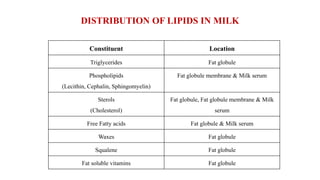
DISTRIBUTION OF LIPIDS IN MILK
Constituent Location
Triglycerides Fat globule
Phospholipids
(Lecithin, Cephalin, Sphingomyelin)
Fat globule membrane & Milk serum
Sterols
(Cholesterol)
Fat globule, Fat globule membrane & Milk
serum
Free Fatty acids Fat globule & Milk serum
Waxes Fat globule
Squalene Fat globule
Fat soluble vitamins Fat globule
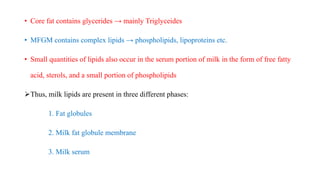
• Core fat contains glycerides → mainly Triglyceides
• MFGM contains complex lipids → phospholipids, lipoproteins etc.
• Small quantities of lipids also occur in the serum portion of milk in the form of free fatty
acid, sterols, and a small portion of phospholipids
Thus, milk lipids are present in three different phases:
1. Fat globules
2. Milk fat globule membrane
3. Milk serum
Thank You

MILK LIPIDS 2.pptx

  • 1.
  • 2.
    MILK LIPIDS • Lipidsare one of the large group of organic compounds • The milks of all mammals contain lipids, but the concentration varies widely among different species • The principal function of dietary lipids is to serve as a source of energy for the neonate and therefore, the fat content in milk largely reflects the energy requirements of the species
  • 3.
    FACTORS THAT AFFECTTHE FAT CONTENT OF BOVINE MILK • Bovine milk on an average contains 3.5- 4.0 % fat and the level varies widely depending on several factors: 1. Breed 2. Individuality of the animal 3. Stage of lactation 4. Nutritional status 5. Type of feed 5. Health and age of the animal 6. Interval between milkings etc.
  • 4.
    SIGNIFICANCE OF LIPIDSIN MILK & MILK PRODUCTS: 1. Economic value: • Milk fat have an important bearing on economic value of milk & milk products • Milk fat is more expensive than other milk constituents • Most of the price plans for milk & milk products are based largely on the fat content 2. Nutritive value: • It serves as a rich source of energy, yielding approximately 9- 9.3 kcal/gm • It serves as a carrier of fat soluble vitamins (A,D,E,K) • It supplies significant amount of essential fatty acids
  • 5.
    3. Flavour: • Milkfat plays a distinctive role in the flavour of milk & milk products • It provides a rich pleasing flavour which can’t be duplicated by any other fat • Because of its wide range of fatty acids, the flavour of milk fat is superior to that of other fats • In certain products and after certain processes, fatty acids serve as precursors of very flavourful compounds such as methyl ketones and lactones • Milk fat also serve as precursors of compounds that cause off- flavour defects (hydrolytic & oxidative rancidity) 4. Body & texture: • The fine body & texture of most dairy products is determined primarily by milk fat • They impart soft, smooth texture & overcome hard, grainy or watery characteristics which are normally encountered in their absence
  • 6.
    PHYSICAL FORM OFMILK LIPIDS • Majority of fat in milk (98-99%) exist in the form of small globules with an average size of 2- 5µm • These globules are very small in size and very large in number • Number of fat globules is 1.5 to 3.0 X 10⁹ /ml of milk • Fat in milk is present in fairly stable emulsion form in a continuous phase of serum • i.e., milk fat is an oil in water type emulsion Fat globules → dispersed phase Milk serum → dispersion medium
  • 7.
    STRUCTURE OF FATGLOBULE • Milk fat is predominantly present as spherical droplets which range in diameter from less than 0.2 to 15 µm • Globule size can considerably be altered by various treatments particularly homogenization • The fat globules of milk differ in composition • The size of the fat globule will also alter the composition. This is because the quantity of membrane lipids (predominantly phospholipids) per unit mass of fat is higher for smaller globules • The fat globules are enveloped by a layer called the fat globule membrane
  • 8.
    Milk Fat GlobuleMembrane (MFGM): • The surface of the fat globules is coated with an adsorbed layer of material commonly known as milk fat globule membrane (MFGM) • This membrane is approximately 10 nm in cross section • The fat globule membrane contains phospholipids and proteins in the form of a complex • This membrane of phospholipid-protein complex does two functions: 1) Stabilizes the emulsion of the fat in milk 2) Preserves the individual identities of the globules
  • 9.
    • The membraneacts as a natural emulsifying agent enabling the fat globule to remain dispersed throughout the aqueous phase of milk • The membrane consists of a well organized sequence of different components arranged according to their polarity and hydrophobicity • This layer is predominantly proteinaceous in nature • Protein constitutes nearly 25 to 60 per cent of the total dry weight • 25 different enzymes have been reported and MFGM is a rich source of enzymes including alkaline phosphatase, acid phosphatase, aldolase & xanthine oxidase • Proteins of the MFGM could be in the form of polypeptides of varying molecular weight
  • 10.
    • Lipids arethe next major constituent of the MFGM • The lipid portion comprises of neutral lipids and phospholipids • Due to their amphiphilic nature, the phospholipids have an important role in maintaining the stability of fat emulsion • Glycerides constitute a major portion of the neutral lipids of the membrane • Other constituents like cerebrosides, gangliosides, sialic acid, cytochrome and hexoses have also been reported • Protein of MFGM: 1 % of total milk protein • Lipid of MFGM: 1-2% of total milk lipid
  • 11.
    • The constituentsof the MFGM are specifically oriented on the fat surface • The inner most layer consists of the high melting triglycerides • The next layer consists of the phospholipids with their hydrophobic portion oriented towards inwards while the hydrophilic portion oriented outwards • The phospholipids are interspaced with cholesterol, vitamin A etc. • The outermost layer is made up of protein, enzymes etc absorbed on to the surface
  • 12.
    COMPOSITION OF LIPIDSIN BOVINE MILK Lipid Percentage Triacylglycerols 97- 98 Diacylglycerols 0.28- 0.59 Monoacylglycerols 0.016- 0.038 Free Sterols 0.22- 0.41 Free Fatty acids 0.10- 0.44 Phospholipids 0.20- 1.0 Hydrocarbons Traces Sterol esters Traces
  • 13.
    DISTRIBUTION OF LIPIDSIN MILK Constituent Location Triglycerides Fat globule Phospholipids (Lecithin, Cephalin, Sphingomyelin) Fat globule membrane & Milk serum Sterols (Cholesterol) Fat globule, Fat globule membrane & Milk serum Free Fatty acids Fat globule & Milk serum Waxes Fat globule Squalene Fat globule Fat soluble vitamins Fat globule
  • 14.
    • Core fatcontains glycerides → mainly Triglyceides • MFGM contains complex lipids → phospholipids, lipoproteins etc. • Small quantities of lipids also occur in the serum portion of milk in the form of free fatty acid, sterols, and a small portion of phospholipids Thus, milk lipids are present in three different phases: 1. Fat globules 2. Milk fat globule membrane 3. Milk serum
  • 15.