Breast Feeding


                                         Dr. Kalpana Malla
                                      MD Pediatrics
                           Manipal Teaching Hospital

Download more documents and slide shows on The Medical Post [ www.themedicalpost.net ]
1)Milk secretion initiated by prolactin

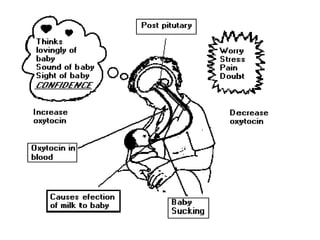
2) Oxytocin reflex (let down reflex or milk
  ejection reflex) from post. pit - contraction of
  neuroepithelial cells surrounding alveoli -
  ejection of milk.
Varying composition of Breast Milk
•   Colostrum
•   Transitional milk
•   Mature milk
•   Fore milk
•   Hind milk
•   Preterm milk
Colostrum

• Thick, yellowish milk secreted in the first
  several days (5-7 days) after delivery
• Alkaline
• Amount - approximately 100 cc's / 24-hour
• More rich in protein (2.3gm/dl) but less CHO or
  fat
Composition
• Antibody ( Ig A) rich – protects against infection
  and allergy
• Purgative( Laxative effect) - enhances GIT motility
  - reducing enterohepatic circulation - clears
  meconium helps prevent NNJ
• Growth factors – help intestine to mature
  , prevents allergy & intolerance
• Vit A rich – reduces severity of infection
Composition
- Antibacterial – (lactoalbumin, lactoferin )
- Rich in cholesterol , Na , K , Cl , Zinc , Copper
  , leucocytes ( macrophages , lymphocytes
• Transitional milk - is secreted between about
  four days and ten days postpartum
• It is intermediate in composition in between
  colostrum and mature milk
• The volume increases during this time
• Mature milk is produced from approximately
  ten days after delivery up until the
  termination of the breastfeeding
Mature milk contains on average:

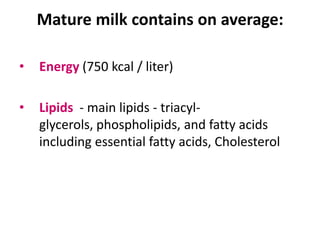
•   Energy (750 kcal / liter)

•   Lipids - main lipids - triacyl-
    glycerols, phospholipids, and fatty acids
    including essential fatty acids, Cholesterol
Mature milk contains on average:
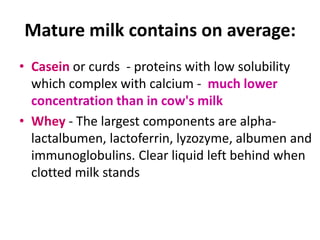
• Casein or curds - proteins with low solubility
  which complex with calcium - much lower
  concentration than in cow's milk
• Whey - The largest components are alpha-
  lactalbumen, lactoferrin, lyzozyme, albumen and
  immunoglobulins. Clear liquid left behind when
  clotted milk stands
Mature milk contains on average:
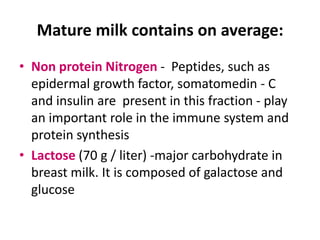
• Non protein Nitrogen - Peptides, such as
  epidermal growth factor, somatomedin - C
  and insulin are present in this fraction - play
  an important role in the immune system and
  protein synthesis
• Lactose (70 g / liter) -major carbohydrate in
  breast milk. It is composed of galactose and
  glucose
Breast milk - minerals:
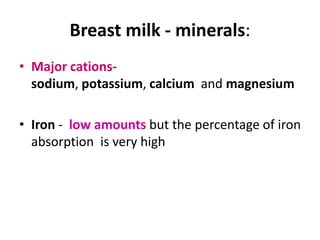
• Major cations-
  sodium, potassium, calcium and magnesium

• Iron - low amounts but the percentage of iron
  absorption is very high
Breast milk - minerals:
• Zinc, selenium, chromium, manganese, molyb
  denum , copper and nickel are present in
  small amounts in breast milk

• Vit - K is low in breast milk - hemorrhagic
  disease of the newborn

• The vitamin D content of breast milk is less
• Hind milk - Fats and lipids are high at the end
  of the feeding (hind milk)
Preterm milk has more of the
                following
•   Protein nitrogen
•   Immunologic factors
•   Medium chain fatty acids
•   Sodium
•   Chloride
•   Iron
•   This difference lasts approximately 4 weeks.
Less of
•   Calories
•   Protein
•   Calcium/phosphorus
•   Trace minerals
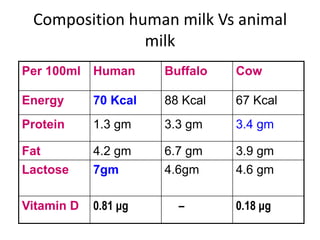
Composition human milk Vs animal
               milk
Per 100ml   Human     Buffalo   Cow

Energy      70 Kcal   88 Kcal   67 Kcal
Protein     1.3 gm    3.3 gm    3.4 gm

Fat         4.2 gm    6.7 gm    3.9 gm
Lactose     7gm       4.6gm     4.6 gm

Vitamin D   0.81 μg     –       0.18 μg
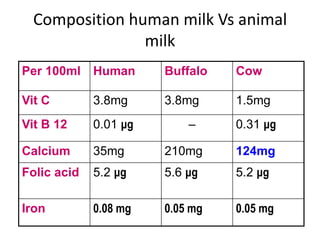
Composition human milk Vs animal
                milk
Per 100ml    Human     Buffalo   Cow

Vit C        3.8mg     3.8mg     1.5mg
Vit B 12     0.01 μg       –     0.31 μg

Calcium      35mg      210mg     124mg
Folic acid   5.2 μg    5.6 μg    5.2 μg

Iron         0.08 mg   0.05 mg   0.05 mg
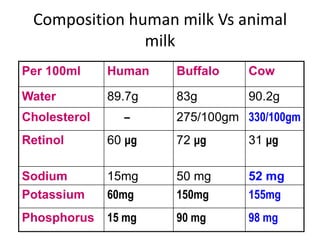
Composition human milk Vs animal
               milk
Per 100ml     Human   Buffalo    Cow

Water         89.7g   83g        90.2g
Cholesterol     –     275/100gm 330/100gm
Retinol       60 μg   72 μg      31 μg

Sodium        15mg    50 mg      52 mg
Potassium     60mg    150mg      155mg
Phosphorus    15 mg   90 mg      98 mg
Breast feeding Reflexes
• Rooting reflex
• Sucking reflex
• Swallowing reflex
Advantages of BF

1. Normal temperature
2. Economical
3. Convenient
4. Balanced diet
5. Anti-anaemic
6. Anti-allergic
7) Anti-ricketic
8) Anti-infective
7) Anti-ricketic
8) Anti-infective
1)Balanced diet:
A) Protein: 70% soluble ; easily digested.
B) Fat: essential fatty acid - for brain develop.
C) High cholesterol: myelination of nervous
    system brain growth
E) High lactose
F) Colostrum: increasing zinc - prevent NEC
G) Low phosphate - prevent neonatal
     hypocalcemic convulsions
2) Anti-anaemic:


- Lower risk of iron deficiency anemia - first 6 months of life
   because:
 A) Higher iron content (1.5 times cow's milk)
 B) Better iron absorption due to acidic medium and due to
   presence vitamins C,E and copper
3) Anti-allergic
It protects against - infantile eczema , allergic rhinitis , asthma
    and other allergies
Mechanism:
• In the intestinal tract there are minute pores - high
    molecular protein can directly pass into the circulation
    leading to antibodies formation

• Breast milk has secretory IgA - which coats the GIT –
  pores closed - prevents leakage of lactoproteins into the
  circulation and no formation of antibodies
4) Anti-ricketic


A) higher content of biologically active
   vit. D.

B) Ideal Cal/phosph ratio - helps optimal
   absorption of both. (Ca/P ratio = 2:1)

C) higher lactose content enhances
   calcium absorption from the gut
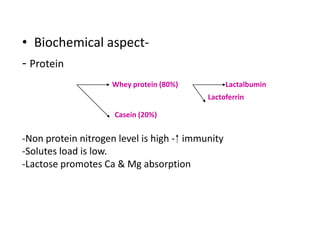
• Biochemical aspect-
- Protein
                     Whey protein (80%)            Lactalbumin
                                            Lactoferrin

                      Casein (20%)


-Non protein nitrogen level is high -  immunity
-Solutes load is low.
-Lactose promotes Ca & Mg absorption
Microbiological aspect
- Sterile milk with less chance of contamination
- Lactoferrin (iron-binding protein) absorbs iron from bacteria
  - inhibits growth of E. coli by depriving it from iron.
• B.S.S.L( bile salt stimulated lipase) kills amoeba and
  giardia
- Lactose and bifidus factor promote growth of
  protecting flora (lactobacilli)
Immunological aspect:

• Safe , non-allergic

• Milk B-lymphocytes secrete IgA

• Milk T-lymphocytes involved in cell-mediated immunity

• Milk macrophages synthesize complement , lysozyme and
  lactoferrin
Psychological factor-
• Emotional bonding

• Maternal benefits- less risk of
  ovarian/ breast ca. , involution
  of uterus

•   Epidemiology
-   14 times less risk of diarrhoea
-   4 times less risk of A.R.I
-   2.8 times less risk of infections.
Technique of breast feeding:-

1- Both hands and nipple should be clean

2- Baby should be , warm ; not wet

3- Mother relaxed (sitting or lying on her
  side)

4- Support of the breast during feeding
Criteria of good position:-
1 Baby’s body is close to
  the mother

2 Baby’s body is turned
 to the mother

3 Baby’s whole body is
  supported (not only
  head or neck).

4 Baby’s neck is straight
  or bent slightly back
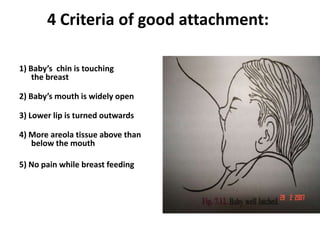
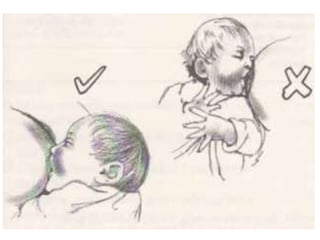
4 Criteria of good attachment:

1) Baby’s chin is touching
    the breast

2) Baby’s mouth is widely open

3) Lower lip is turned outwards

4) More areola tissue above than
   below the mouth

5) No pain while breast feeding
Criteria for Adequate Breast feeding

   Baby feeds at least 8 times  24 hrs
   Baby is calm satisfied after feeds
   Baby sleeps well 2-4 hours after feeding
   Normal motion no constipation
   Normal amount of urine :- 6 or more / 24 hours
   Normal weight gain (20-30 gm/ day or 150-210 gm
    / week
II) Criteria of under feeding


•   Wt gain ; slow
•   Decreased amount of urine
•   Crying unsatisfied after feed
•   Suckling of fists between the feeds
•   Sleeplessness or v. short sleep
•   Air swallowing colics, vomiting,
•   Constipation or hunger stool (
    frequent, small, green color)
Criteria of overfeeding

•   Frequent regurgitation , vomiting colics
•   Large bulky stools undigested curds
•   Abdomen distesion
•   Skin eruption sore buttocks
•   Polyuria
•   Excessive sweating at head
•   Baby over weight
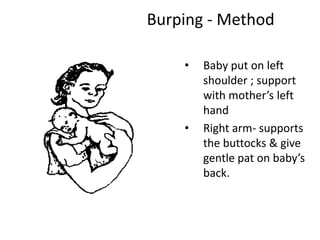
Burping - Method

    •   Baby put on left
        shoulder ; support
        with mother’s left
        hand
    •   Right arm- supports
        the buttocks & give
        gentle pat on baby’s
        back.
Burping - Method

2. Alternative method
• Baby placed prone in mother’s lap
• Gentle tap given on back.
Breast feeding- BFHI

• BFHI- Baby friendly hospital initiative.
- Global programme organised by unicef.
- Launched in 1992
- WABA- World Alliance for breast feeding
  action ; global agency for promotion of
  breast feeding
- World breast feeding week- 1st -7th august
10 steps of BHFI
1.Written breast feeding policy given to all
  health care staff
2.Training of all health care staff
3.Inform mother about benefit and
  management of BF
4.Help mother initiate BF within an Hour of
  birth
5.Show how to BF even if separated from
  infant
10 steps of BHFI
6.Unless medically indicated- no food or drink
  should be given to infant
7.Practice rooming-in ; allows mother & child to
  be together 24hrs a day
8.Encourage BF on demand
9.No artificial teats or pacifiers to breast feeding
  infants
10.Establish BF support group and refer mothers
  to them.
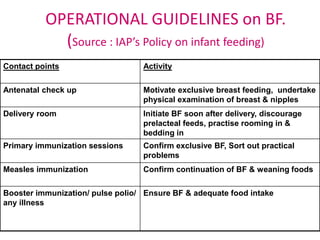
OPERATIONAL GUIDELINES on BF.
            (Source : IAP’s Policy on infant feeding)
Contact points                    Activity

Antenatal check up                Motivate exclusive breast feeding, undertake
                                  physical examination of breast & nipples
Delivery room                     Initiate BF soon after delivery, discourage
                                  prelacteal feeds, practise rooming in &
                                  bedding in
Primary immunization sessions     Confirm exclusive BF, Sort out practical
                                  problems
Measles immunization              Confirm continuation of BF & weaning foods

Booster immunization/ pulse polio/ Ensure BF & adequate food intake
any illness
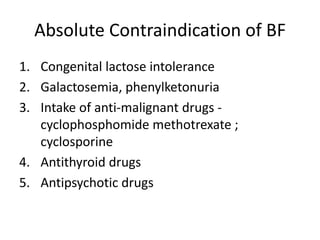
Absolute Contraindication of BF
1. Congenital lactose intolerance
2. Galactosemia, phenylketonuria
3. Intake of anti-malignant drugs -
   cyclophosphomide methotrexate ;
   cyclosporine
4. Antithyroid drugs
5. Antipsychotic drugs
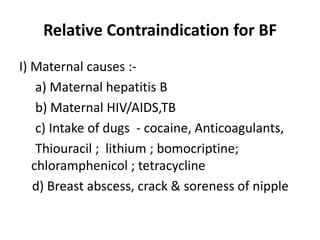
Relative Contraindication for BF
I) Maternal causes :-
    a) Maternal hepatitis B
    b) Maternal HIV/AIDS,TB
    c) Intake of dugs - cocaine, Anticoagulants,
    Thiouracil ; lithium ; bomocriptine;
   chloramphenicol ; tetracycline
   d) Breast abscess, crack & soreness of nipple
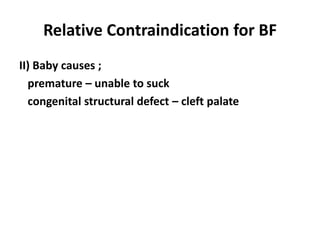
Relative Contraindication for BF
II) Baby causes ;
  premature – unable to suck
  congenital structural defect – cleft palate
Artificial feeding
when:

- Mother is critically ill
- Mother is unavailable
- Or mother is dead.
Process of artificial feeding

• Formula feeding
Full strength (1:1) prepared by adding
- One level measure of powder
- One ounce of 30 ml water
• Alternative to Formula feeding is Cow’s milk
-1st week of life – 1:1 dilution
- 2nd week – 2:1 dilution
- 3rd week – 3:1 dilution
- 4th week onwards – undiluted milk

* Adverse effect – diluted cows milk has low
  nitrogen and calories so more chances of
  malnutrition.
Adverse effects of artificial feeding
1. Malnutrition due to dilution
2. More diarrhea and respiratory infections due
   to contamination
3. More allergy & milk intolerance
4. Salt sensitive hypertension
5. Hypercholesterolemia
6. Coronary artery disease and cerebrovascular
   disease
7. Iron deficiency anemia
8. High incidence of diabetes mellitus
9. Lowered IQ
10.Protein intolerance
11.Hypocalcemia - Tetany , Convulsion
12. Vitamin A deficiency
13.Overweight
14. Interferes with bonding
Average Feeding levels

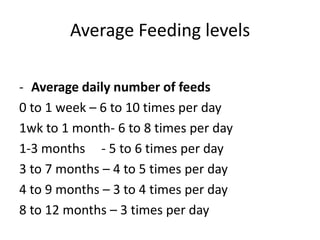
- Average daily number of feeds
0 to 1 week – 6 to 10 times per day
1wk to 1 month- 6 to 8 times per day
1-3 months - 5 to 6 times per day
3 to 7 months – 4 to 5 times per day
4 to 9 months – 3 to 4 times per day
8 to 12 months – 3 times per day
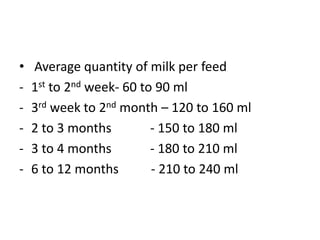
•   Average quantity of milk per feed
-   1st to 2nd week- 60 to 90 ml
-   3rd week to 2nd month – 120 to 160 ml
-   2 to 3 months         - 150 to 180 ml
-   3 to 4 months         - 180 to 210 ml
-   6 to 12 months        - 210 to 240 ml
Thank you
Download more documents and slide shows on The
    Medical Post [ www.themedicalpost.net ]

Breast feeding

  • 1.
    Breast Feeding Dr. Kalpana Malla MD Pediatrics Manipal Teaching Hospital Download more documents and slide shows on The Medical Post [ www.themedicalpost.net ]
  • 2.
    1)Milk secretion initiatedby prolactin 2) Oxytocin reflex (let down reflex or milk ejection reflex) from post. pit - contraction of neuroepithelial cells surrounding alveoli - ejection of milk.
  • 4.
    Varying composition ofBreast Milk • Colostrum • Transitional milk • Mature milk • Fore milk • Hind milk • Preterm milk
  • 5.
    Colostrum • Thick, yellowishmilk secreted in the first several days (5-7 days) after delivery • Alkaline • Amount - approximately 100 cc's / 24-hour • More rich in protein (2.3gm/dl) but less CHO or fat
  • 6.
    Composition • Antibody (Ig A) rich – protects against infection and allergy • Purgative( Laxative effect) - enhances GIT motility - reducing enterohepatic circulation - clears meconium helps prevent NNJ • Growth factors – help intestine to mature , prevents allergy & intolerance • Vit A rich – reduces severity of infection
  • 7.
    Composition - Antibacterial –(lactoalbumin, lactoferin ) - Rich in cholesterol , Na , K , Cl , Zinc , Copper , leucocytes ( macrophages , lymphocytes
  • 8.
    • Transitional milk- is secreted between about four days and ten days postpartum • It is intermediate in composition in between colostrum and mature milk • The volume increases during this time
  • 9.
    • Mature milkis produced from approximately ten days after delivery up until the termination of the breastfeeding
  • 10.
    Mature milk containson average: • Energy (750 kcal / liter) • Lipids - main lipids - triacyl- glycerols, phospholipids, and fatty acids including essential fatty acids, Cholesterol
  • 11.
    Mature milk containson average: • Casein or curds - proteins with low solubility which complex with calcium - much lower concentration than in cow's milk • Whey - The largest components are alpha- lactalbumen, lactoferrin, lyzozyme, albumen and immunoglobulins. Clear liquid left behind when clotted milk stands
  • 12.
    Mature milk containson average: • Non protein Nitrogen - Peptides, such as epidermal growth factor, somatomedin - C and insulin are present in this fraction - play an important role in the immune system and protein synthesis • Lactose (70 g / liter) -major carbohydrate in breast milk. It is composed of galactose and glucose
  • 13.
    Breast milk -minerals: • Major cations- sodium, potassium, calcium and magnesium • Iron - low amounts but the percentage of iron absorption is very high
  • 14.
    Breast milk -minerals: • Zinc, selenium, chromium, manganese, molyb denum , copper and nickel are present in small amounts in breast milk • Vit - K is low in breast milk - hemorrhagic disease of the newborn • The vitamin D content of breast milk is less
  • 15.
    • Hind milk- Fats and lipids are high at the end of the feeding (hind milk)
  • 16.
    Preterm milk hasmore of the following • Protein nitrogen • Immunologic factors • Medium chain fatty acids • Sodium • Chloride • Iron • This difference lasts approximately 4 weeks.
  • 17.
    Less of • Calories • Protein • Calcium/phosphorus • Trace minerals
  • 18.
    Composition human milkVs animal milk Per 100ml Human Buffalo Cow Energy 70 Kcal 88 Kcal 67 Kcal Protein 1.3 gm 3.3 gm 3.4 gm Fat 4.2 gm 6.7 gm 3.9 gm Lactose 7gm 4.6gm 4.6 gm Vitamin D 0.81 μg – 0.18 μg
  • 19.
    Composition human milkVs animal milk Per 100ml Human Buffalo Cow Vit C 3.8mg 3.8mg 1.5mg Vit B 12 0.01 μg – 0.31 μg Calcium 35mg 210mg 124mg Folic acid 5.2 μg 5.6 μg 5.2 μg Iron 0.08 mg 0.05 mg 0.05 mg
  • 20.
    Composition human milkVs animal milk Per 100ml Human Buffalo Cow Water 89.7g 83g 90.2g Cholesterol – 275/100gm 330/100gm Retinol 60 μg 72 μg 31 μg Sodium 15mg 50 mg 52 mg Potassium 60mg 150mg 155mg Phosphorus 15 mg 90 mg 98 mg
  • 21.
    Breast feeding Reflexes •Rooting reflex • Sucking reflex • Swallowing reflex
  • 22.
    Advantages of BF 1.Normal temperature 2. Economical 3. Convenient 4. Balanced diet 5. Anti-anaemic 6. Anti-allergic 7) Anti-ricketic 8) Anti-infective
  • 23.
  • 24.
    1)Balanced diet: A) Protein:70% soluble ; easily digested. B) Fat: essential fatty acid - for brain develop. C) High cholesterol: myelination of nervous system brain growth E) High lactose F) Colostrum: increasing zinc - prevent NEC G) Low phosphate - prevent neonatal hypocalcemic convulsions
  • 25.
    2) Anti-anaemic: - Lowerrisk of iron deficiency anemia - first 6 months of life because: A) Higher iron content (1.5 times cow's milk) B) Better iron absorption due to acidic medium and due to presence vitamins C,E and copper
  • 26.
    3) Anti-allergic It protectsagainst - infantile eczema , allergic rhinitis , asthma and other allergies Mechanism: • In the intestinal tract there are minute pores - high molecular protein can directly pass into the circulation leading to antibodies formation • Breast milk has secretory IgA - which coats the GIT – pores closed - prevents leakage of lactoproteins into the circulation and no formation of antibodies
  • 27.
    4) Anti-ricketic A) highercontent of biologically active vit. D. B) Ideal Cal/phosph ratio - helps optimal absorption of both. (Ca/P ratio = 2:1) C) higher lactose content enhances calcium absorption from the gut
  • 28.
    • Biochemical aspect- -Protein Whey protein (80%) Lactalbumin Lactoferrin Casein (20%) -Non protein nitrogen level is high -  immunity -Solutes load is low. -Lactose promotes Ca & Mg absorption
  • 29.
    Microbiological aspect - Sterilemilk with less chance of contamination - Lactoferrin (iron-binding protein) absorbs iron from bacteria - inhibits growth of E. coli by depriving it from iron. • B.S.S.L( bile salt stimulated lipase) kills amoeba and giardia - Lactose and bifidus factor promote growth of protecting flora (lactobacilli)
  • 30.
    Immunological aspect: • Safe, non-allergic • Milk B-lymphocytes secrete IgA • Milk T-lymphocytes involved in cell-mediated immunity • Milk macrophages synthesize complement , lysozyme and lactoferrin
  • 31.
    Psychological factor- • Emotionalbonding • Maternal benefits- less risk of ovarian/ breast ca. , involution of uterus • Epidemiology - 14 times less risk of diarrhoea - 4 times less risk of A.R.I - 2.8 times less risk of infections.
  • 32.
    Technique of breastfeeding:- 1- Both hands and nipple should be clean 2- Baby should be , warm ; not wet 3- Mother relaxed (sitting or lying on her side) 4- Support of the breast during feeding
  • 33.
    Criteria of goodposition:- 1 Baby’s body is close to the mother 2 Baby’s body is turned to the mother 3 Baby’s whole body is supported (not only head or neck). 4 Baby’s neck is straight or bent slightly back
  • 34.
    4 Criteria ofgood attachment: 1) Baby’s chin is touching the breast 2) Baby’s mouth is widely open 3) Lower lip is turned outwards 4) More areola tissue above than below the mouth 5) No pain while breast feeding
  • 36.
    Criteria for AdequateBreast feeding  Baby feeds at least 8 times 24 hrs  Baby is calm satisfied after feeds  Baby sleeps well 2-4 hours after feeding  Normal motion no constipation  Normal amount of urine :- 6 or more / 24 hours  Normal weight gain (20-30 gm/ day or 150-210 gm / week
  • 37.
    II) Criteria ofunder feeding • Wt gain ; slow • Decreased amount of urine • Crying unsatisfied after feed • Suckling of fists between the feeds • Sleeplessness or v. short sleep • Air swallowing colics, vomiting, • Constipation or hunger stool ( frequent, small, green color)
  • 38.
    Criteria of overfeeding • Frequent regurgitation , vomiting colics • Large bulky stools undigested curds • Abdomen distesion • Skin eruption sore buttocks • Polyuria • Excessive sweating at head • Baby over weight
  • 39.
    Burping - Method • Baby put on left shoulder ; support with mother’s left hand • Right arm- supports the buttocks & give gentle pat on baby’s back.
  • 40.
    Burping - Method 2.Alternative method • Baby placed prone in mother’s lap • Gentle tap given on back.
  • 41.
    Breast feeding- BFHI •BFHI- Baby friendly hospital initiative. - Global programme organised by unicef. - Launched in 1992 - WABA- World Alliance for breast feeding action ; global agency for promotion of breast feeding - World breast feeding week- 1st -7th august
  • 42.
    10 steps ofBHFI 1.Written breast feeding policy given to all health care staff 2.Training of all health care staff 3.Inform mother about benefit and management of BF 4.Help mother initiate BF within an Hour of birth 5.Show how to BF even if separated from infant
  • 43.
    10 steps ofBHFI 6.Unless medically indicated- no food or drink should be given to infant 7.Practice rooming-in ; allows mother & child to be together 24hrs a day 8.Encourage BF on demand 9.No artificial teats or pacifiers to breast feeding infants 10.Establish BF support group and refer mothers to them.
  • 44.
    OPERATIONAL GUIDELINES onBF. (Source : IAP’s Policy on infant feeding) Contact points Activity Antenatal check up Motivate exclusive breast feeding, undertake physical examination of breast & nipples Delivery room Initiate BF soon after delivery, discourage prelacteal feeds, practise rooming in & bedding in Primary immunization sessions Confirm exclusive BF, Sort out practical problems Measles immunization Confirm continuation of BF & weaning foods Booster immunization/ pulse polio/ Ensure BF & adequate food intake any illness
  • 45.
    Absolute Contraindication ofBF 1. Congenital lactose intolerance 2. Galactosemia, phenylketonuria 3. Intake of anti-malignant drugs - cyclophosphomide methotrexate ; cyclosporine 4. Antithyroid drugs 5. Antipsychotic drugs
  • 46.
    Relative Contraindication forBF I) Maternal causes :- a) Maternal hepatitis B b) Maternal HIV/AIDS,TB c) Intake of dugs - cocaine, Anticoagulants, Thiouracil ; lithium ; bomocriptine; chloramphenicol ; tetracycline d) Breast abscess, crack & soreness of nipple
  • 47.
    Relative Contraindication forBF II) Baby causes ; premature – unable to suck congenital structural defect – cleft palate
  • 48.
    Artificial feeding when: - Motheris critically ill - Mother is unavailable - Or mother is dead.
  • 49.
    Process of artificialfeeding • Formula feeding Full strength (1:1) prepared by adding - One level measure of powder - One ounce of 30 ml water
  • 50.
    • Alternative toFormula feeding is Cow’s milk -1st week of life – 1:1 dilution - 2nd week – 2:1 dilution - 3rd week – 3:1 dilution - 4th week onwards – undiluted milk * Adverse effect – diluted cows milk has low nitrogen and calories so more chances of malnutrition.
  • 51.
    Adverse effects ofartificial feeding 1. Malnutrition due to dilution 2. More diarrhea and respiratory infections due to contamination 3. More allergy & milk intolerance 4. Salt sensitive hypertension 5. Hypercholesterolemia 6. Coronary artery disease and cerebrovascular disease
  • 52.
    7. Iron deficiencyanemia 8. High incidence of diabetes mellitus 9. Lowered IQ 10.Protein intolerance 11.Hypocalcemia - Tetany , Convulsion 12. Vitamin A deficiency 13.Overweight 14. Interferes with bonding
  • 53.
    Average Feeding levels -Average daily number of feeds 0 to 1 week – 6 to 10 times per day 1wk to 1 month- 6 to 8 times per day 1-3 months - 5 to 6 times per day 3 to 7 months – 4 to 5 times per day 4 to 9 months – 3 to 4 times per day 8 to 12 months – 3 times per day
  • 54.
    Average quantity of milk per feed - 1st to 2nd week- 60 to 90 ml - 3rd week to 2nd month – 120 to 160 ml - 2 to 3 months - 150 to 180 ml - 3 to 4 months - 180 to 210 ml - 6 to 12 months - 210 to 240 ml
  • 55.
    Thank you Download moredocuments and slide shows on The Medical Post [ www.themedicalpost.net ]