Platform Tests at Raw Milk Reception Dock
Speaker- Sunil Meena
Class- M.Tech. (Dairy Technology)
(Sunildt410@gmail.com)
Platform Tests
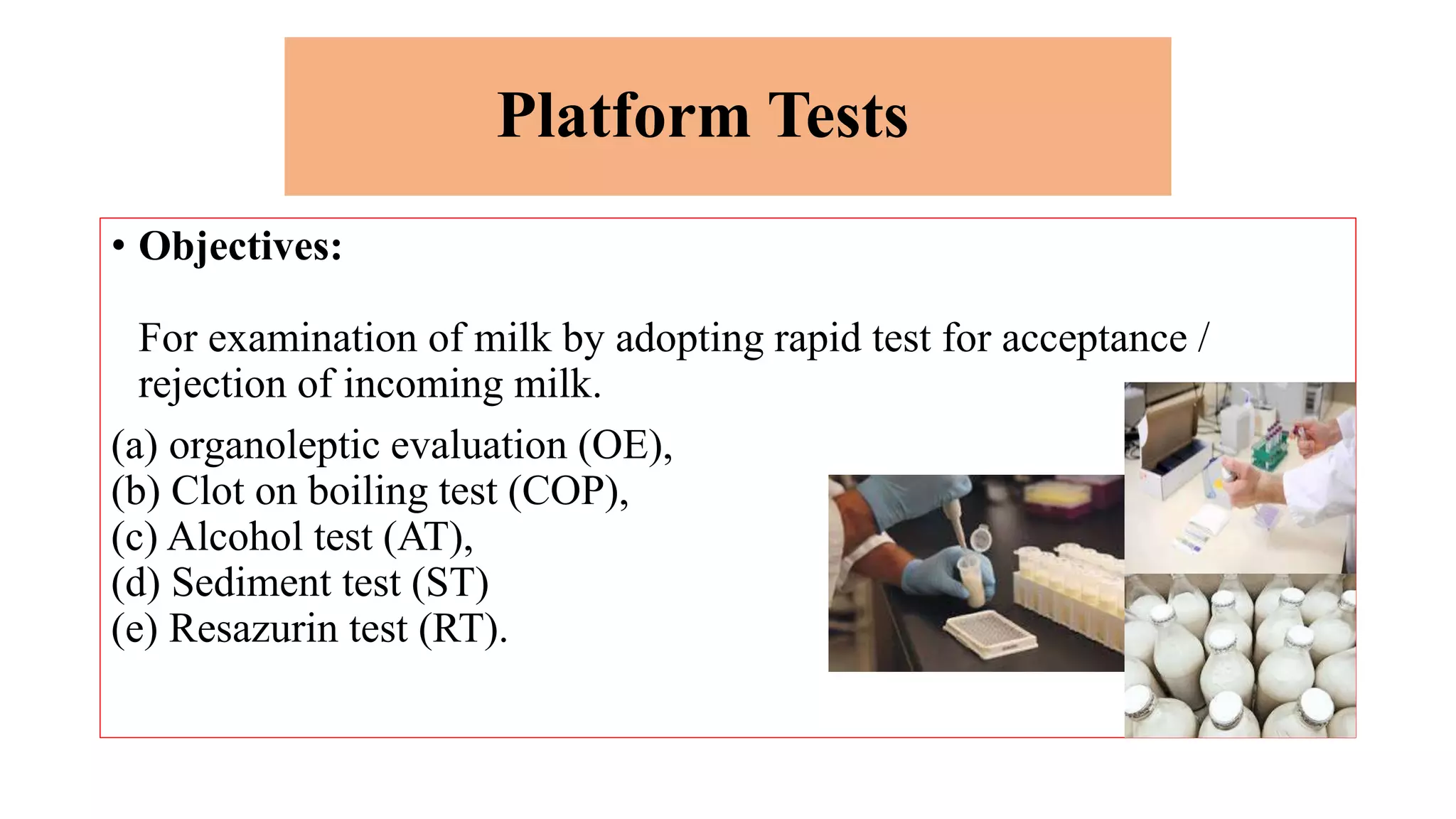
• Objectives:
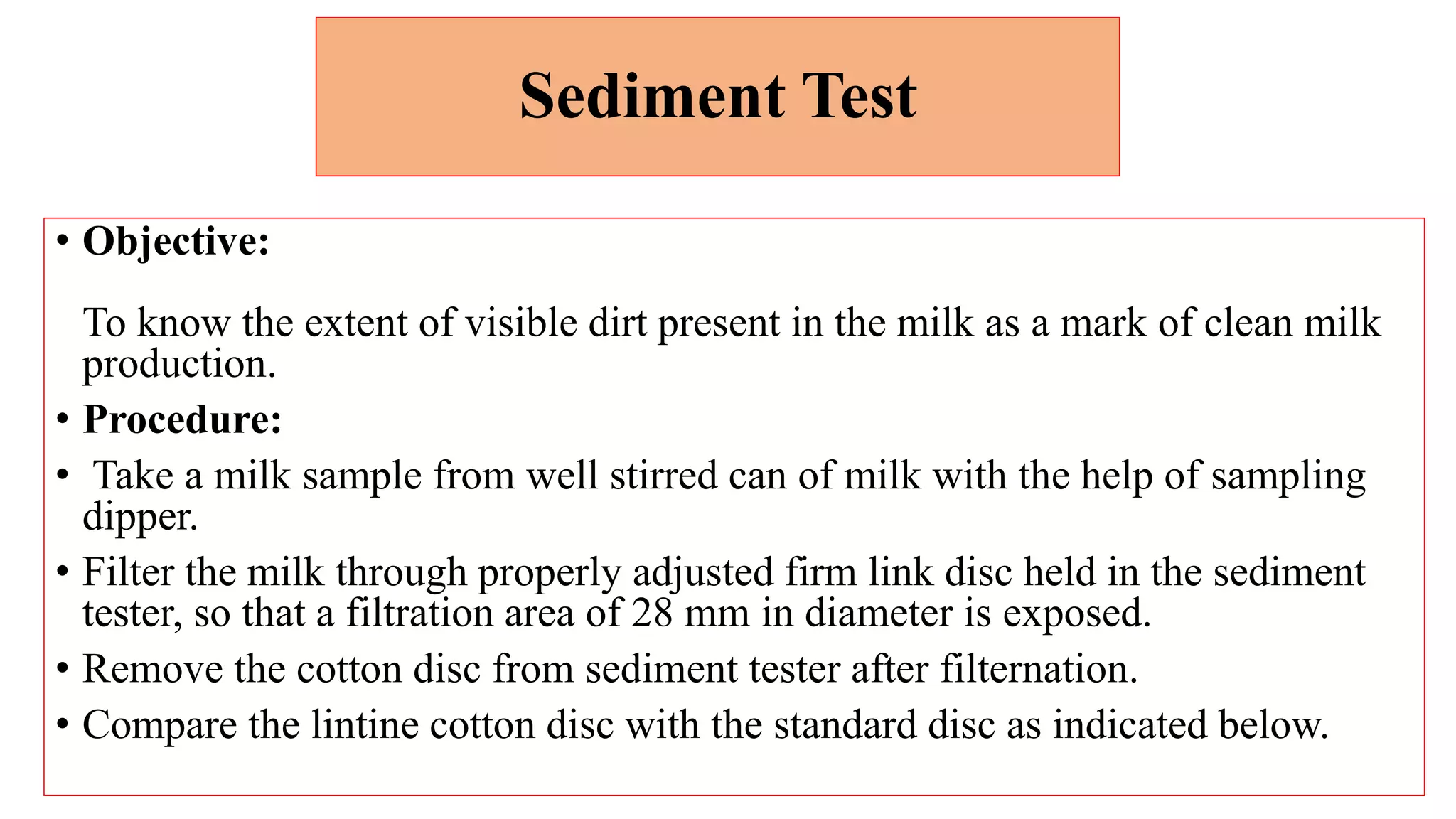
For examination of milk by adopting rapid test for acceptance /
rejection of incoming milk.
(a) organoleptic evaluation (OE),
(b) Clot on boiling test (COP),
(c) Alcohol test (AT),
(d) Sediment test (ST)
(e) Resazurin test (RT).
Organoleptic Evaluation
• Odor / Smell
• General Appearance
• Colour
• Consistency
• Temperature
Clot on Boiling Test (COB)
• Objectives:
To determine the stability of milk for heat processing.
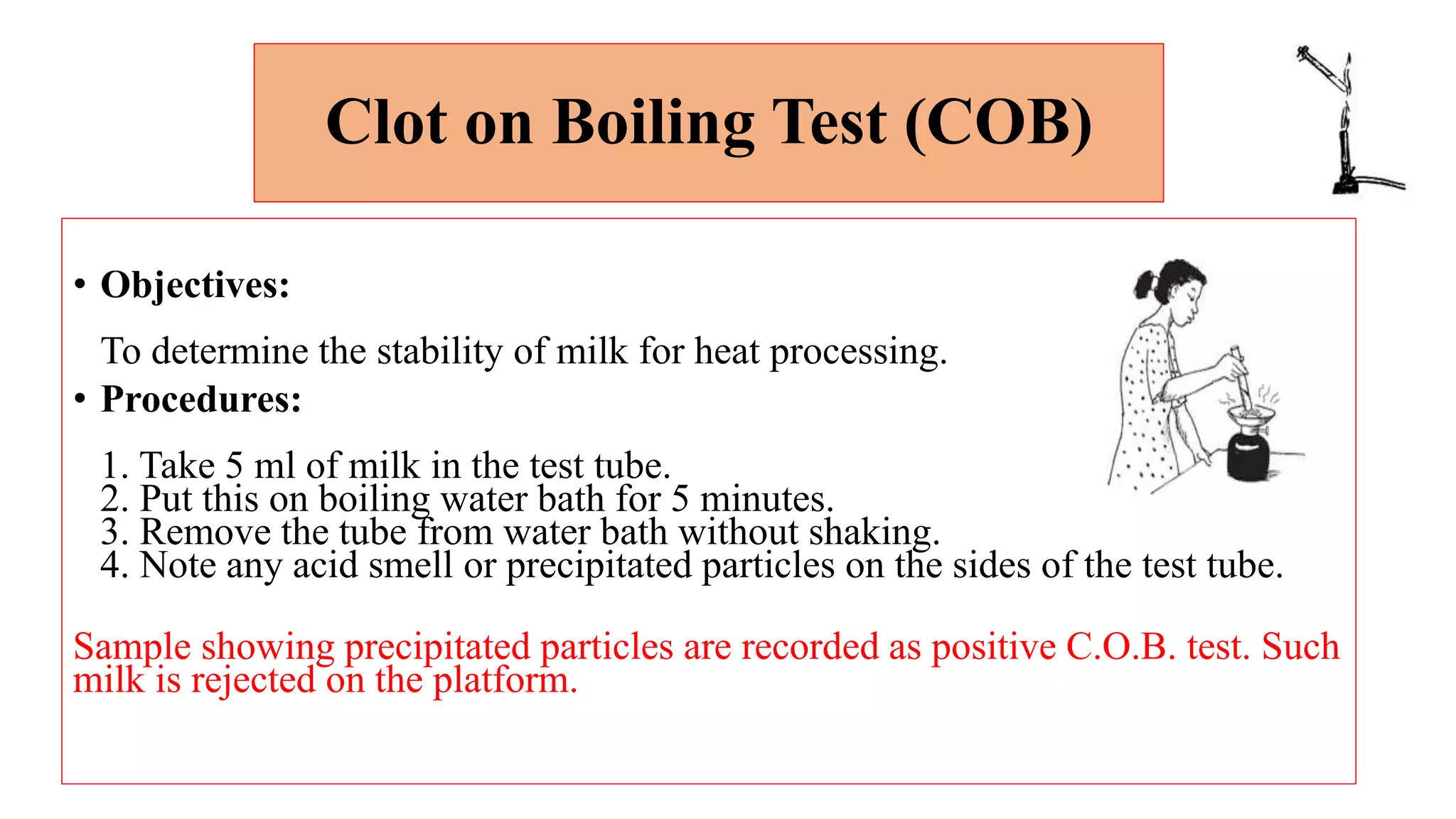
• Procedures:
1. Take 5 ml of milk in the test tube.
2. Put this on boiling water bath for 5 minutes.
3. Remove the tube from water bath without shaking.
4. Note any acid smell or precipitated particles on the sides of the test tube.
Sample showing precipitated particles are recorded as positive C.O.B. test. Such
milk is rejected on the platform.
Alcohol Test
• Objective:
To detect abnormal milk such as colostrums or mastitis milk.
• Procedure:
1. Take 5 ml. of milk in test tube.
2. Add equal quantity of 68% Ethyl alcohol.
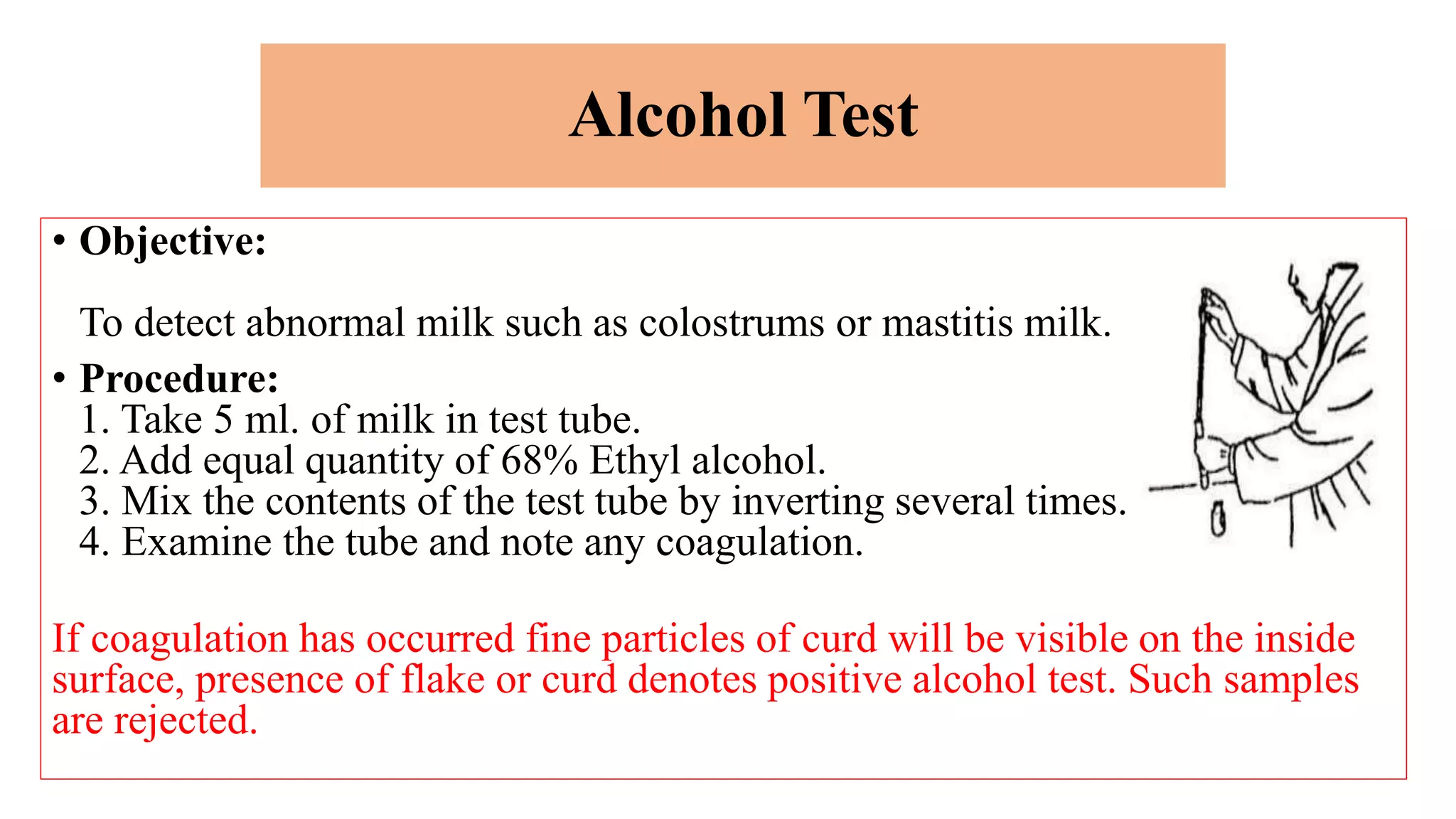
3. Mix the contents of the test tube by inverting several times.
4. Examine the tube and note any coagulation.
If coagulation has occurred fine particles of curd will be visible on the inside
surface, presence of flake or curd denotes positive alcohol test. Such samples
are rejected.
Sediment Test
• Objective:
To know the extent of visible dirt present in the milk as a mark of clean milk
production.
• Procedure:
• Take a milk sample from well stirred can of milk with the help of sampling
dipper.
• Filter the milk through properly adjusted firm link disc held in the sediment
tester, so that a filtration area of 28 mm in diameter is exposed.
• Remove the cotton disc from sediment tester after filternation.
• Compare the lintine cotton disc with the standard disc as indicated below.
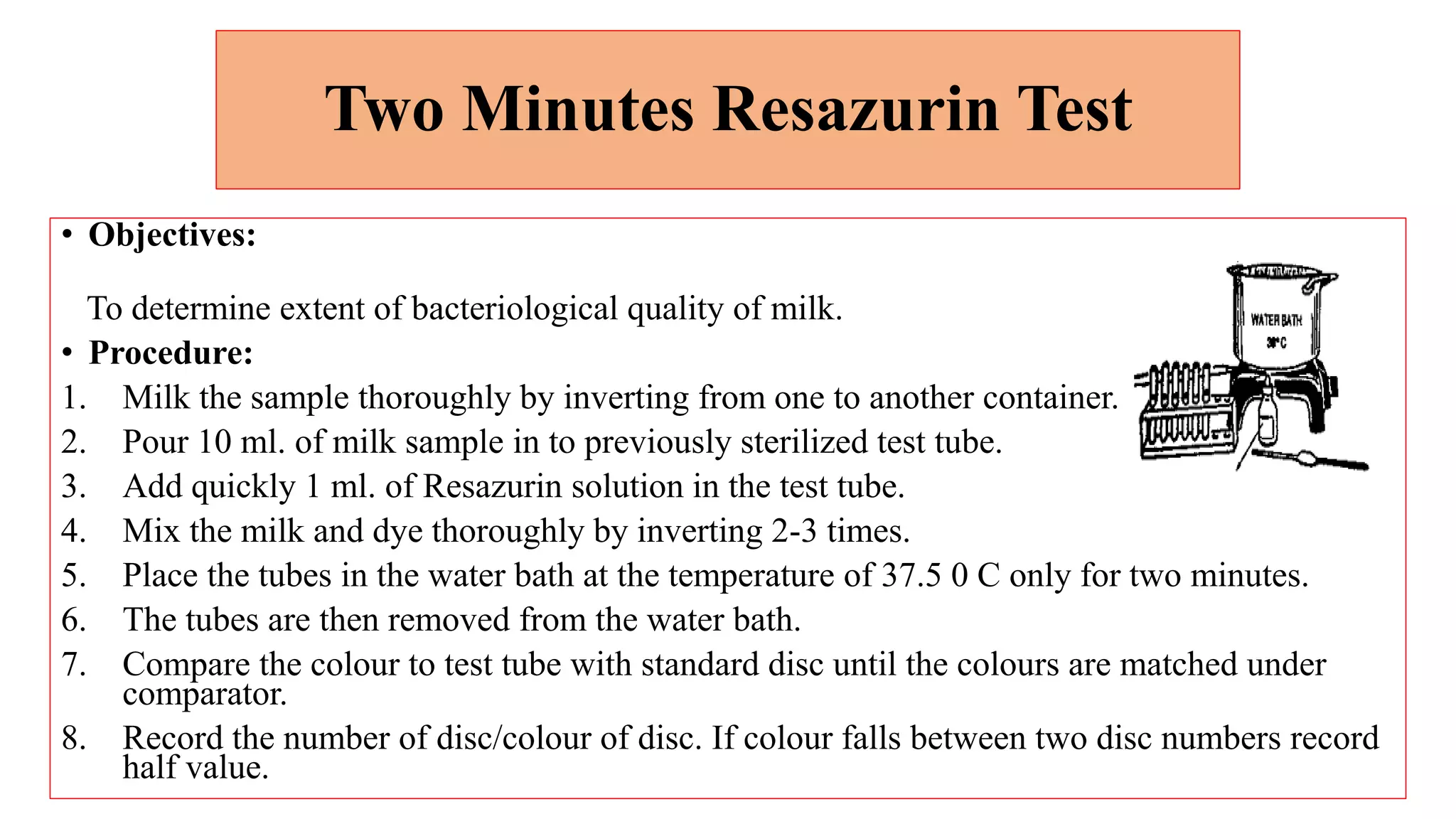
Two Minutes Resazurin Test
• Objectives:
To determine extent of bacteriological quality of milk.
• Procedure:
1. Milk the sample thoroughly by inverting from one to another container.
2. Pour 10 ml. of milk sample in to previously sterilized test tube.
3. Add quickly 1 ml. of Resazurin solution in the test tube.
4. Mix the milk and dye thoroughly by inverting 2-3 times.
5. Place the tubes in the water bath at the temperature of 37.5 0 C only for two minutes.
6. The tubes are then removed from the water bath.
7. Compare the colour to test tube with standard disc until the colours are matched under
comparator.
8. Record the number of disc/colour of disc. If colour falls between two disc numbers record
half value.
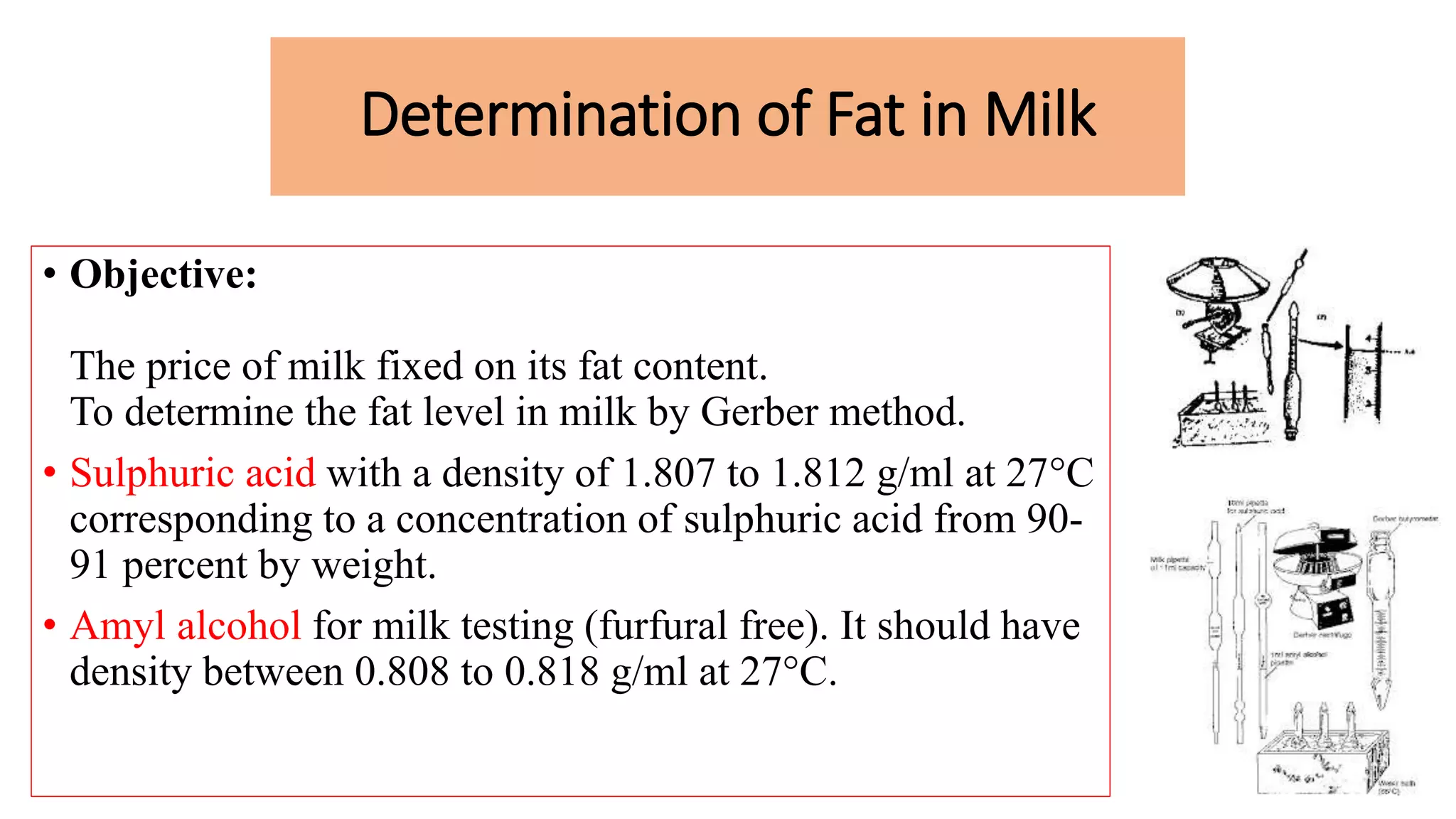
Determination of Fat in Milk
• Objective:
The price of milk fixed on its fat content.
To determine the fat level in milk by Gerber method.
• Sulphuric acid with a density of 1.807 to 1.812 g/ml at 27°C
corresponding to a concentration of sulphuric acid from 90-
91 percent by weight.
• Amyl alcohol for milk testing (furfural free). It should have
density between 0.808 to 0.818 g/ml at 27°C.
Procedure determination of fat in milk
1. Put the clean and dry butyrometer in a butyrometer stand with open mouth upwards.
2. Run 10 ml of sulphuric acid with the tilt measure in the butyrometer.
3. Pipette out 10.75 ml of milk sample gently by the side of butyrometer, whose temperature is about 60-70
0 F.
4. Pour 1 ml. of amyl alcohol with tilt measure.
5. Stopper the butyrometer with the help of lock stopper using regulating pin/guiding pin.
6. The tube is well (mixed) shaken till mahogany red colour is obtained. Keep the butyrometer in hot water
bath till it attains 60-70 0 F and the butyrometer are placed in the centrifuged machine that is revolved at
1100 rpm for 4 minutes.
7. Take out the butyrometer in an upright position with the stopper end down wards.
8. Keep the butyrometer in hot water bath a 149 0 F (600 C) for some time.
9. Adjust the fat column which will appear clear and yellowish within the graduation with the help of key.
10. Note the reading. Reading should be taken from bottom of the fat column to lower border of meniscus on
the scale.
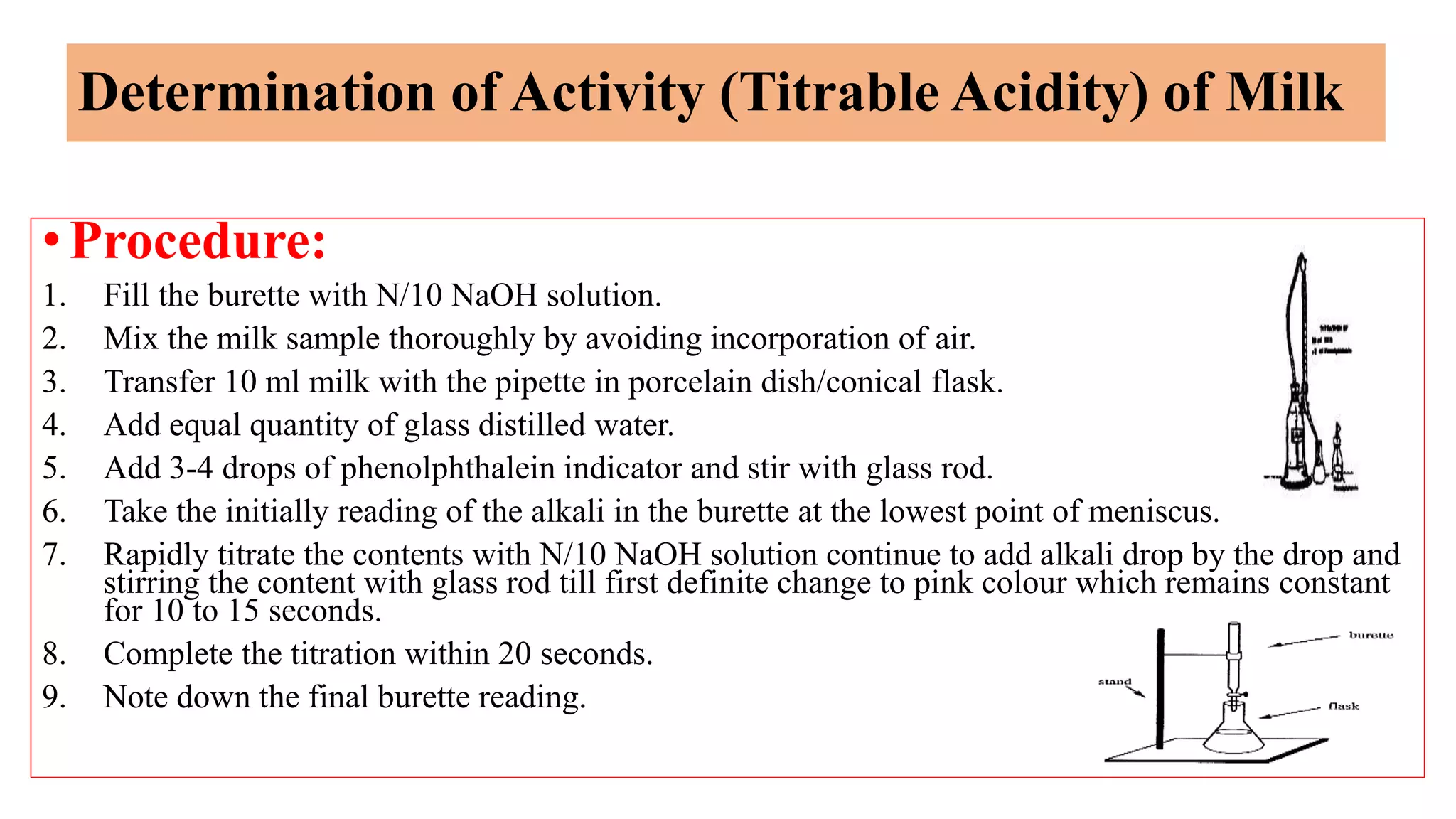
Determination of Activity (Titrable Acidity) of Milk
•Procedure:
1. Fill the burette with N/10 NaOH solution.
2. Mix the milk sample thoroughly by avoiding incorporation of air.
3. Transfer 10 ml milk with the pipette in porcelain dish/conical flask.
4. Add equal quantity of glass distilled water.
5. Add 3-4 drops of phenolphthalein indicator and stir with glass rod.
6. Take the initially reading of the alkali in the burette at the lowest point of meniscus.
7. Rapidly titrate the contents with N/10 NaOH solution continue to add alkali drop by the drop and
stirring the content with glass rod till first definite change to pink colour which remains constant
for 10 to 15 seconds.
8. Complete the titration within 20 seconds.
9. Note down the final burette reading.
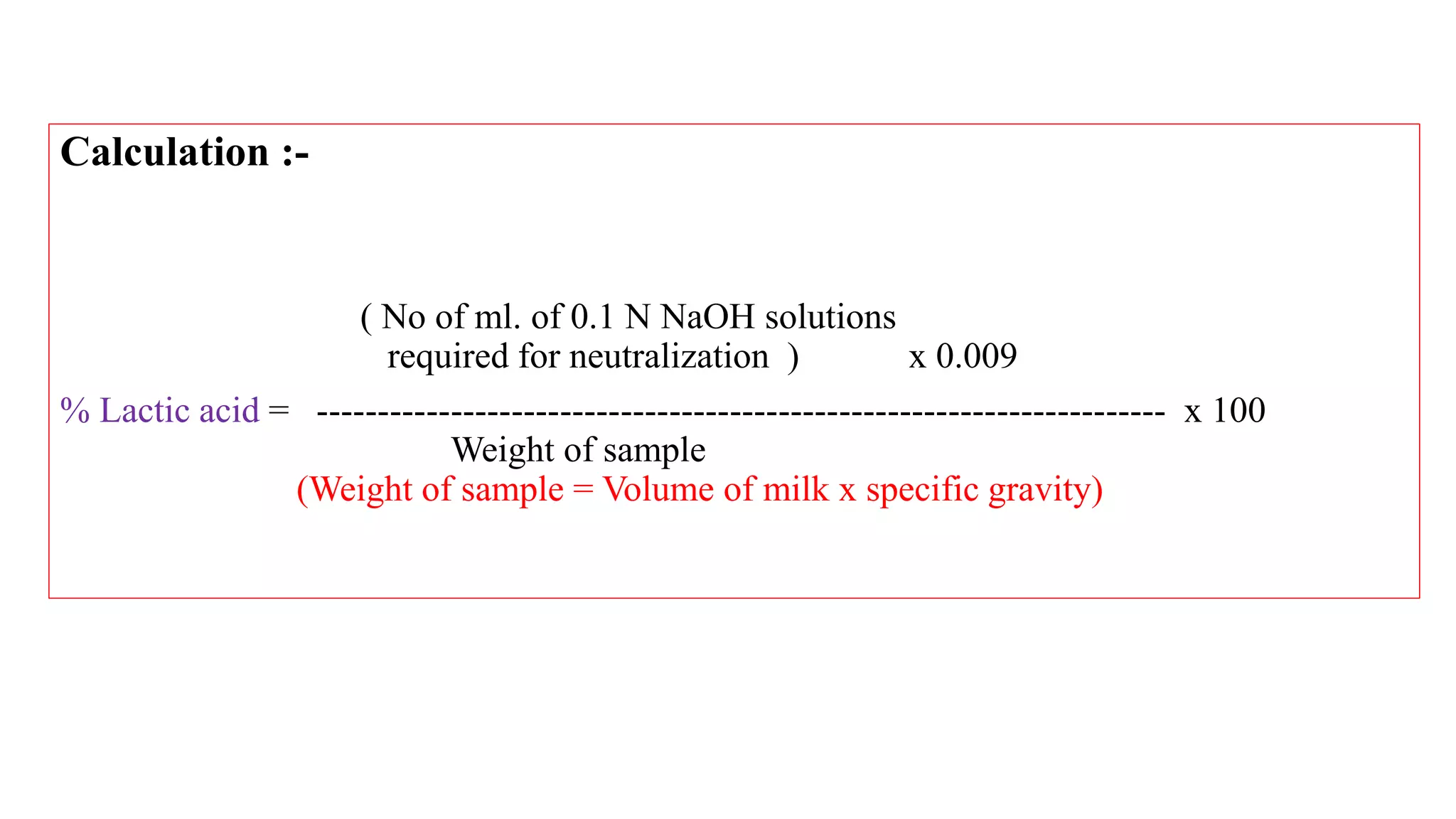
Calculation :-
( No of ml. of 0.1 N NaOH solutions
required for neutralization ) x 0.009
% Lactic acid = ---------------------------------------------------------------------- x 100
Weight of sample
(Weight of sample = Volume of milk x specific gravity)
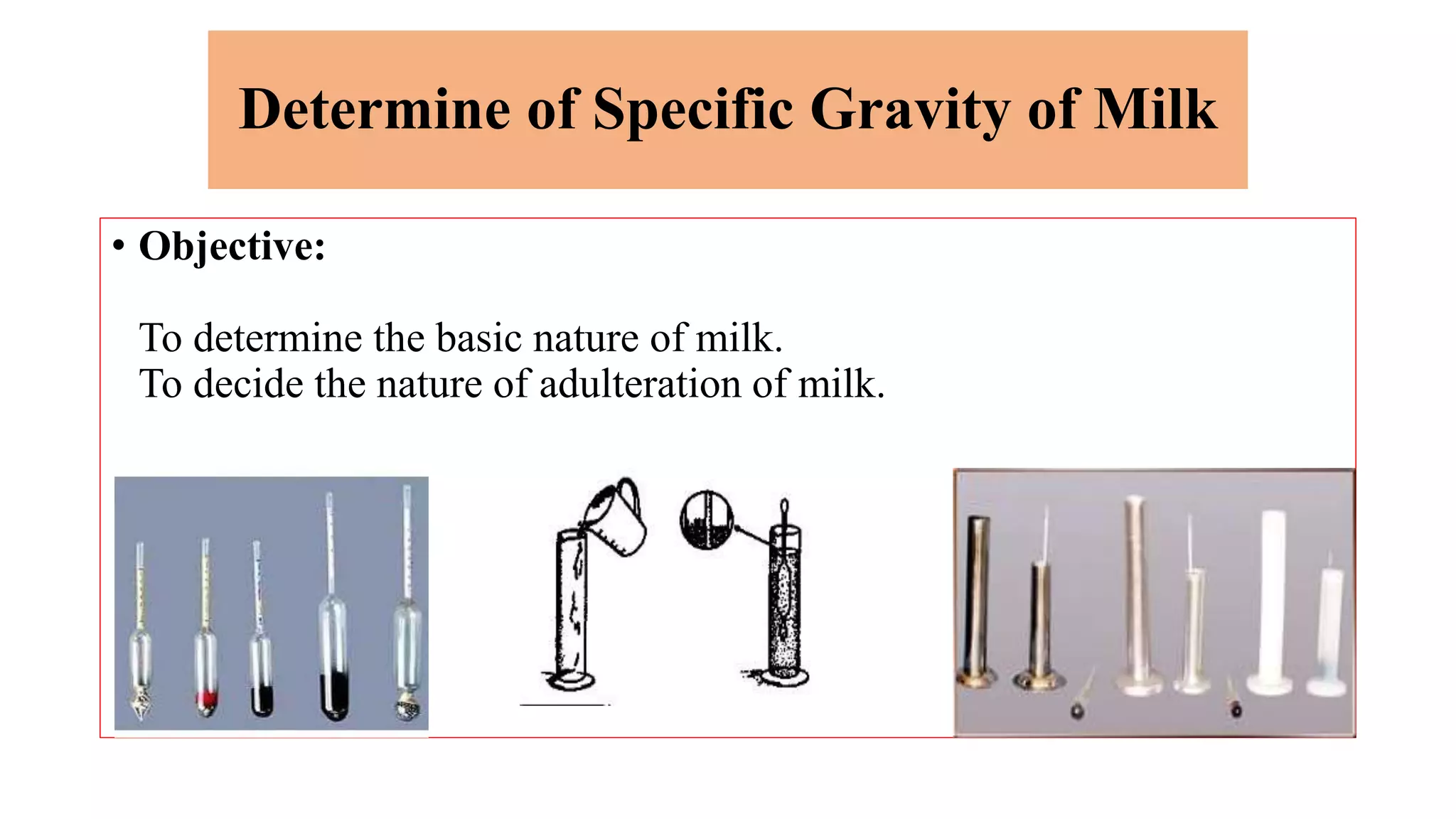
Determine of Specific Gravity of Milk
• Objective:
To determine the basic nature of milk.
To decide the nature of adulteration of milk.
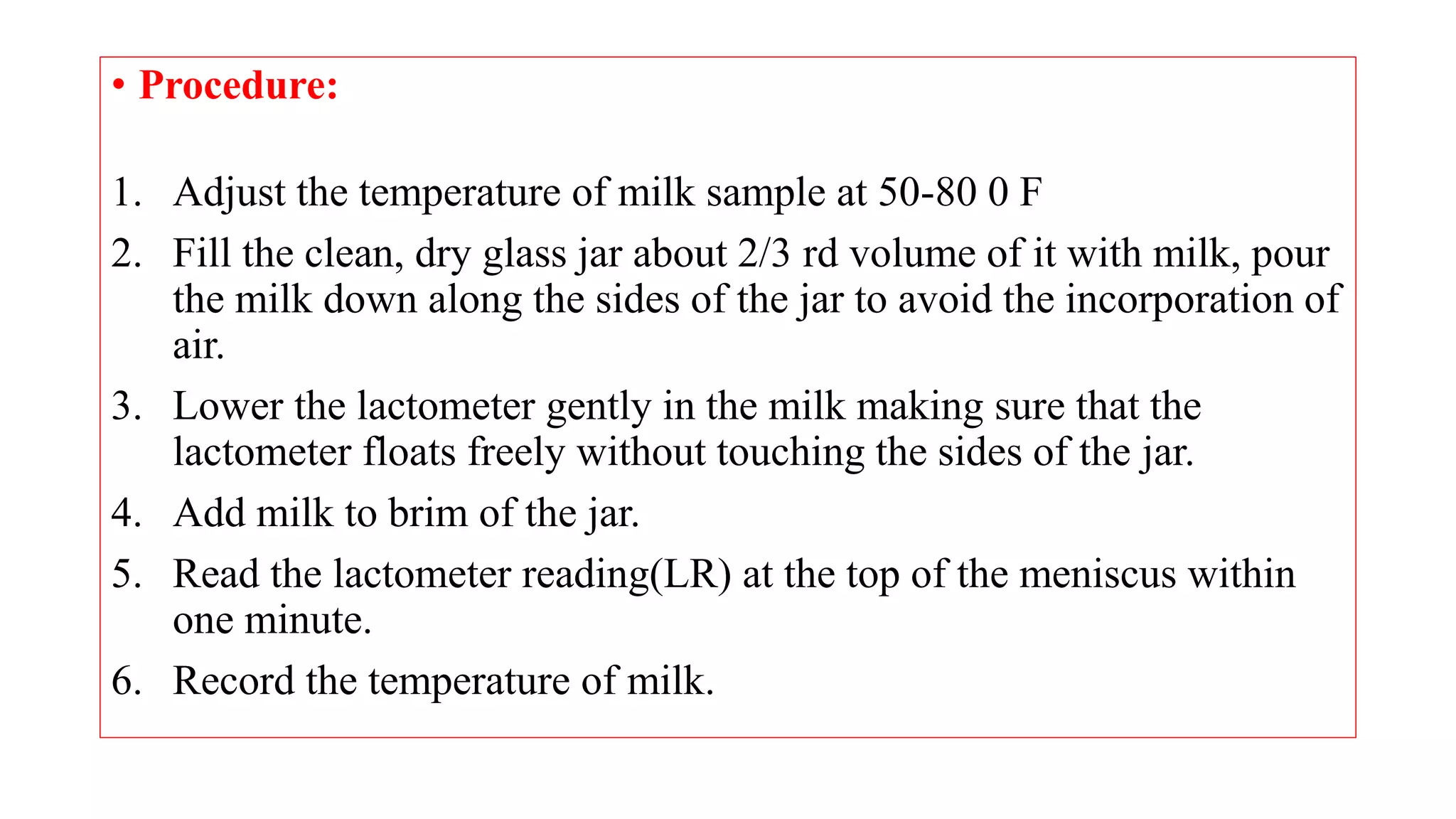
• Procedure:
1. Adjust the temperature of milk sample at 50-80 0 F
2. Fill the clean, dry glass jar about 2/3 rd volume of it with milk, pour
the milk down along the sides of the jar to avoid the incorporation of
air.
3. Lower the lactometer gently in the milk making sure that the
lactometer floats freely without touching the sides of the jar.
4. Add milk to brim of the jar.
5. Read the lactometer reading(LR) at the top of the meniscus within
one minute.
6. Record the temperature of milk.
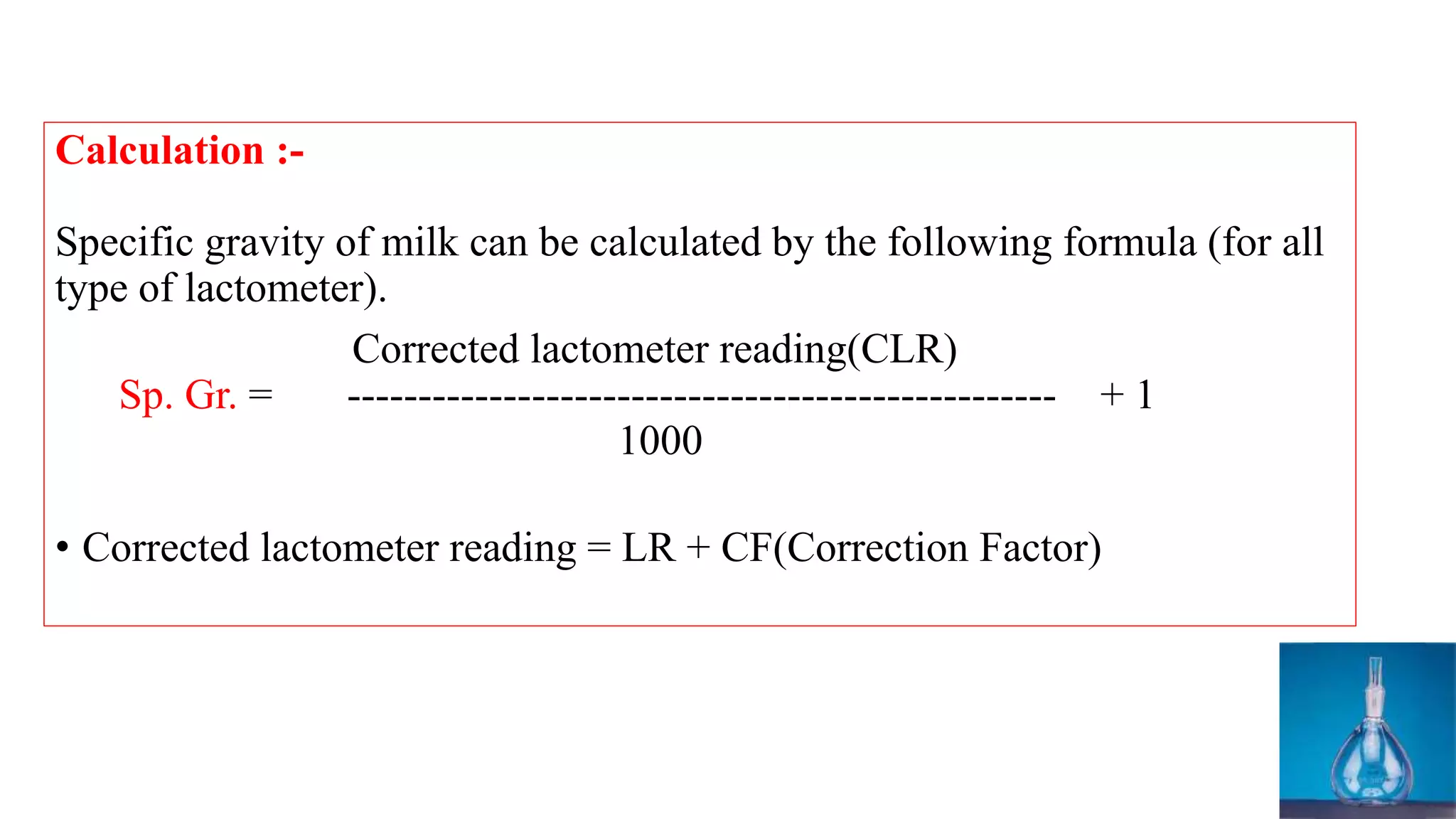
Calculation :-
Specific gravity of milk can be calculated by the following formula (for all
type of lactometer).
Corrected lactometer reading(CLR)
Sp. Gr. = -------------------------------------------------- + 1
1000
• Corrected lactometer reading = LR + CF(Correction Factor)
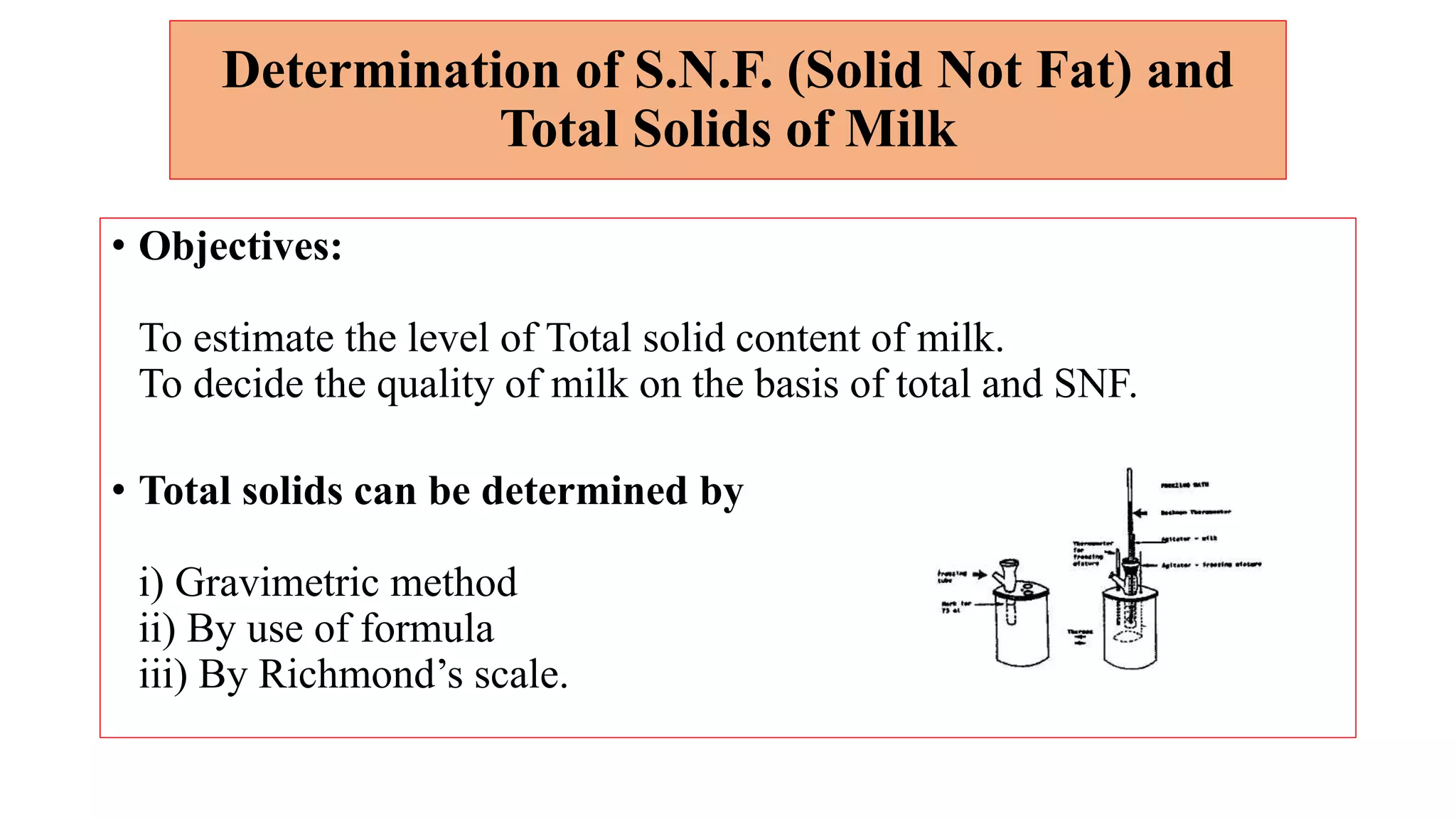
Determination of S.N.F. (Solid Not Fat) and
Total Solids of Milk
• Objectives:
To estimate the level of Total solid content of milk.
To decide the quality of milk on the basis of total and SNF.
• Total solids can be determined by
i) Gravimetric method
ii) By use of formula
iii) By Richmond’s scale.
• Procedure :-
I) Gravimetric method:
i. This is an accurate method but not practicable and hence is not used.
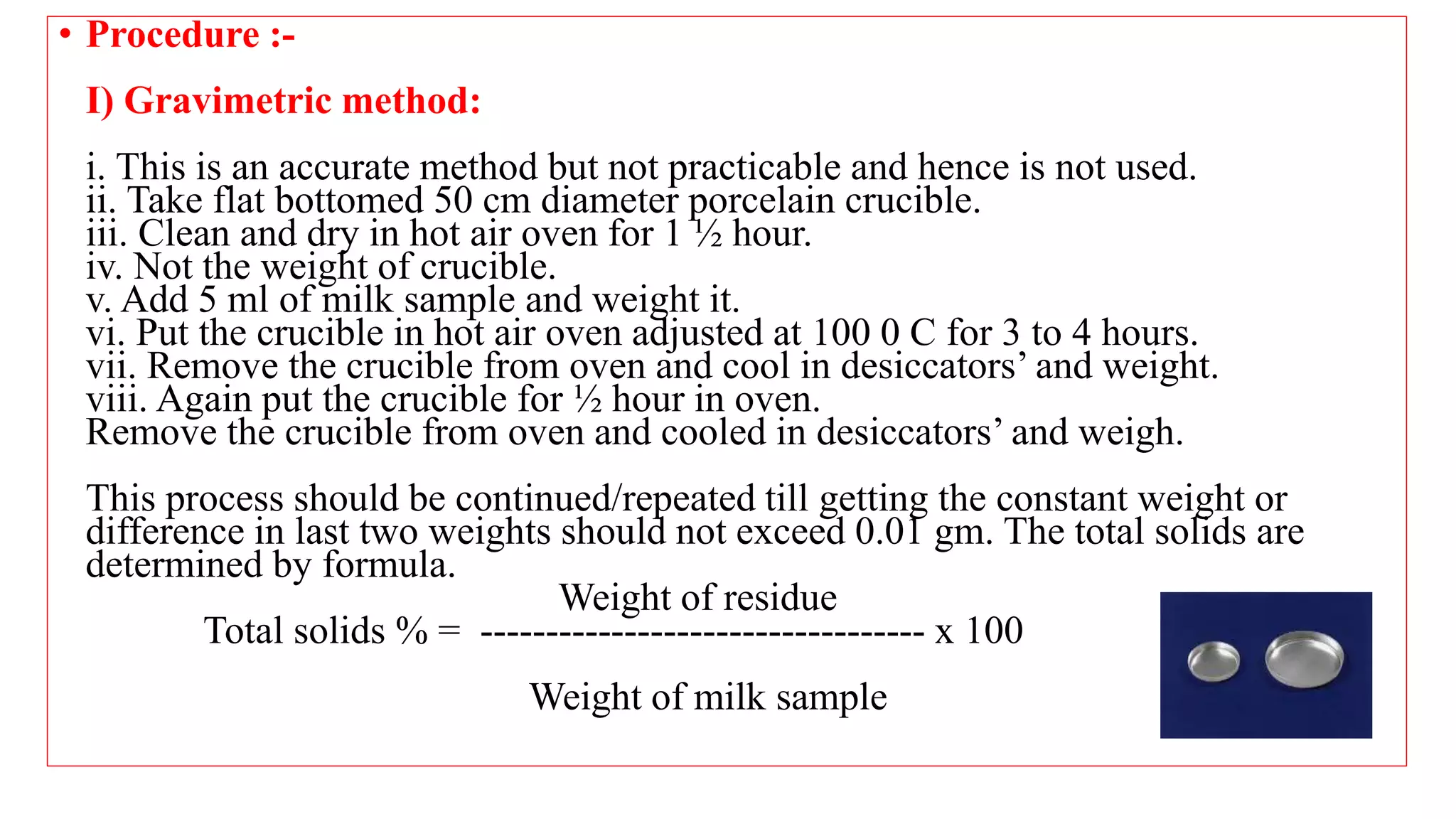
ii. Take flat bottomed 50 cm diameter porcelain crucible.
iii. Clean and dry in hot air oven for 1 ½ hour.
iv. Not the weight of crucible.
v. Add 5 ml of milk sample and weight it.
vi. Put the crucible in hot air oven adjusted at 100 0 C for 3 to 4 hours.
vii. Remove the crucible from oven and cool in desiccators’ and weight.
viii. Again put the crucible for ½ hour in oven.
Remove the crucible from oven and cooled in desiccators’ and weigh.
This process should be continued/repeated till getting the constant weight or
difference in last two weights should not exceed 0.01 gm. The total solids are
determined by formula.
Weight of residue
Total solids % = ---------------------------------- x 100
Weight of milk sample
• II) By use of Formula :-
i) Determine the fat percentage of milk sample by Gerber’s method.
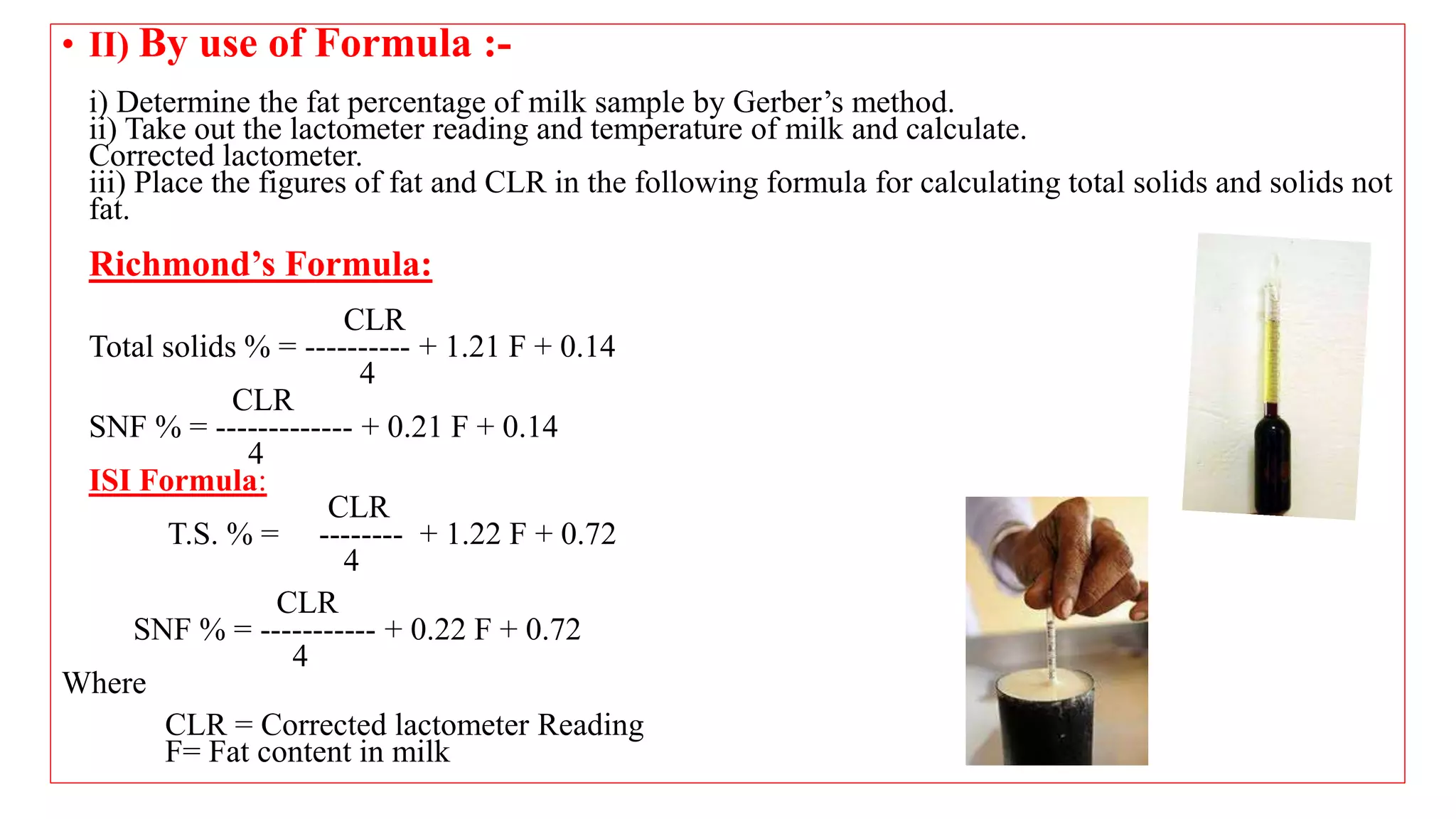
ii) Take out the lactometer reading and temperature of milk and calculate.
Corrected lactometer.
iii) Place the figures of fat and CLR in the following formula for calculating total solids and solids not
fat.
Richmond’s Formula:
CLR
Total solids % = ---------- + 1.21 F + 0.14
4
CLR
SNF % = ------------- + 0.21 F + 0.14
4
ISI Formula:
CLR
T.S. % = -------- + 1.22 F + 0.72
4
CLR
SNF % = ----------- + 0.22 F + 0.72
4
Where
CLR = Corrected lactometer Reading
F= Fat content in milk
III) By Richmond’s Scale:
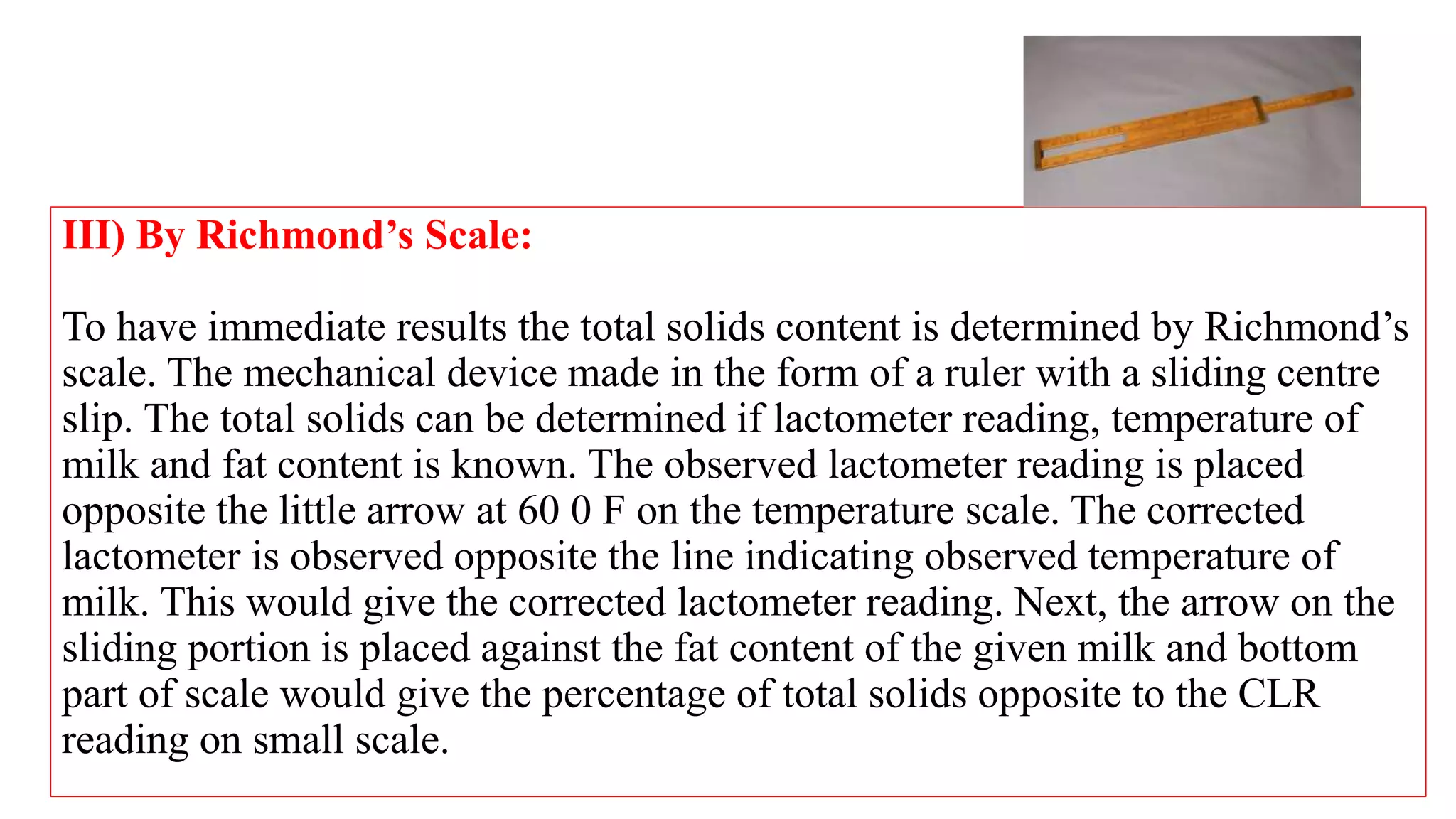
To have immediate results the total solids content is determined by Richmond’s
scale. The mechanical device made in the form of a ruler with a sliding centre
slip. The total solids can be determined if lactometer reading, temperature of
milk and fat content is known. The observed lactometer reading is placed
opposite the little arrow at 60 0 F on the temperature scale. The corrected
lactometer is observed opposite the line indicating observed temperature of
milk. This would give the corrected lactometer reading. Next, the arrow on the
sliding portion is placed against the fat content of the given milk and bottom
part of scale would give the percentage of total solids opposite to the CLR
reading on small scale.
19

Different Platform Tests for Raw Milk at Raw Milk Reception Dock(RMRD)

  • 1.
    Platform Tests atRaw Milk Reception Dock Speaker- Sunil Meena Class- M.Tech. (Dairy Technology) (Sunildt410@gmail.com)
  • 2.
    Platform Tests • Objectives: Forexamination of milk by adopting rapid test for acceptance / rejection of incoming milk. (a) organoleptic evaluation (OE), (b) Clot on boiling test (COP), (c) Alcohol test (AT), (d) Sediment test (ST) (e) Resazurin test (RT).
  • 3.
    Organoleptic Evaluation • Odor/ Smell • General Appearance • Colour • Consistency • Temperature
  • 4.
    Clot on BoilingTest (COB) • Objectives: To determine the stability of milk for heat processing. • Procedures: 1. Take 5 ml of milk in the test tube. 2. Put this on boiling water bath for 5 minutes. 3. Remove the tube from water bath without shaking. 4. Note any acid smell or precipitated particles on the sides of the test tube. Sample showing precipitated particles are recorded as positive C.O.B. test. Such milk is rejected on the platform.
  • 5.
    Alcohol Test • Objective: Todetect abnormal milk such as colostrums or mastitis milk. • Procedure: 1. Take 5 ml. of milk in test tube. 2. Add equal quantity of 68% Ethyl alcohol. 3. Mix the contents of the test tube by inverting several times. 4. Examine the tube and note any coagulation. If coagulation has occurred fine particles of curd will be visible on the inside surface, presence of flake or curd denotes positive alcohol test. Such samples are rejected.
  • 6.
    Sediment Test • Objective: Toknow the extent of visible dirt present in the milk as a mark of clean milk production. • Procedure: • Take a milk sample from well stirred can of milk with the help of sampling dipper. • Filter the milk through properly adjusted firm link disc held in the sediment tester, so that a filtration area of 28 mm in diameter is exposed. • Remove the cotton disc from sediment tester after filternation. • Compare the lintine cotton disc with the standard disc as indicated below.
  • 7.
    Two Minutes ResazurinTest • Objectives: To determine extent of bacteriological quality of milk. • Procedure: 1. Milk the sample thoroughly by inverting from one to another container. 2. Pour 10 ml. of milk sample in to previously sterilized test tube. 3. Add quickly 1 ml. of Resazurin solution in the test tube. 4. Mix the milk and dye thoroughly by inverting 2-3 times. 5. Place the tubes in the water bath at the temperature of 37.5 0 C only for two minutes. 6. The tubes are then removed from the water bath. 7. Compare the colour to test tube with standard disc until the colours are matched under comparator. 8. Record the number of disc/colour of disc. If colour falls between two disc numbers record half value.
  • 8.
    Determination of Fatin Milk • Objective: The price of milk fixed on its fat content. To determine the fat level in milk by Gerber method. • Sulphuric acid with a density of 1.807 to 1.812 g/ml at 27°C corresponding to a concentration of sulphuric acid from 90- 91 percent by weight. • Amyl alcohol for milk testing (furfural free). It should have density between 0.808 to 0.818 g/ml at 27°C.
  • 9.
    Procedure determination offat in milk 1. Put the clean and dry butyrometer in a butyrometer stand with open mouth upwards. 2. Run 10 ml of sulphuric acid with the tilt measure in the butyrometer. 3. Pipette out 10.75 ml of milk sample gently by the side of butyrometer, whose temperature is about 60-70 0 F. 4. Pour 1 ml. of amyl alcohol with tilt measure. 5. Stopper the butyrometer with the help of lock stopper using regulating pin/guiding pin. 6. The tube is well (mixed) shaken till mahogany red colour is obtained. Keep the butyrometer in hot water bath till it attains 60-70 0 F and the butyrometer are placed in the centrifuged machine that is revolved at 1100 rpm for 4 minutes. 7. Take out the butyrometer in an upright position with the stopper end down wards. 8. Keep the butyrometer in hot water bath a 149 0 F (600 C) for some time. 9. Adjust the fat column which will appear clear and yellowish within the graduation with the help of key. 10. Note the reading. Reading should be taken from bottom of the fat column to lower border of meniscus on the scale.
  • 10.
    Determination of Activity(Titrable Acidity) of Milk •Procedure: 1. Fill the burette with N/10 NaOH solution. 2. Mix the milk sample thoroughly by avoiding incorporation of air. 3. Transfer 10 ml milk with the pipette in porcelain dish/conical flask. 4. Add equal quantity of glass distilled water. 5. Add 3-4 drops of phenolphthalein indicator and stir with glass rod. 6. Take the initially reading of the alkali in the burette at the lowest point of meniscus. 7. Rapidly titrate the contents with N/10 NaOH solution continue to add alkali drop by the drop and stirring the content with glass rod till first definite change to pink colour which remains constant for 10 to 15 seconds. 8. Complete the titration within 20 seconds. 9. Note down the final burette reading.
  • 11.
    Calculation :- ( Noof ml. of 0.1 N NaOH solutions required for neutralization ) x 0.009 % Lactic acid = ---------------------------------------------------------------------- x 100 Weight of sample (Weight of sample = Volume of milk x specific gravity)
  • 12.
    Determine of SpecificGravity of Milk • Objective: To determine the basic nature of milk. To decide the nature of adulteration of milk.
  • 13.
    • Procedure: 1. Adjustthe temperature of milk sample at 50-80 0 F 2. Fill the clean, dry glass jar about 2/3 rd volume of it with milk, pour the milk down along the sides of the jar to avoid the incorporation of air. 3. Lower the lactometer gently in the milk making sure that the lactometer floats freely without touching the sides of the jar. 4. Add milk to brim of the jar. 5. Read the lactometer reading(LR) at the top of the meniscus within one minute. 6. Record the temperature of milk.
  • 14.
    Calculation :- Specific gravityof milk can be calculated by the following formula (for all type of lactometer). Corrected lactometer reading(CLR) Sp. Gr. = -------------------------------------------------- + 1 1000 • Corrected lactometer reading = LR + CF(Correction Factor)
  • 15.
    Determination of S.N.F.(Solid Not Fat) and Total Solids of Milk • Objectives: To estimate the level of Total solid content of milk. To decide the quality of milk on the basis of total and SNF. • Total solids can be determined by i) Gravimetric method ii) By use of formula iii) By Richmond’s scale.
  • 16.
    • Procedure :- I)Gravimetric method: i. This is an accurate method but not practicable and hence is not used. ii. Take flat bottomed 50 cm diameter porcelain crucible. iii. Clean and dry in hot air oven for 1 ½ hour. iv. Not the weight of crucible. v. Add 5 ml of milk sample and weight it. vi. Put the crucible in hot air oven adjusted at 100 0 C for 3 to 4 hours. vii. Remove the crucible from oven and cool in desiccators’ and weight. viii. Again put the crucible for ½ hour in oven. Remove the crucible from oven and cooled in desiccators’ and weigh. This process should be continued/repeated till getting the constant weight or difference in last two weights should not exceed 0.01 gm. The total solids are determined by formula. Weight of residue Total solids % = ---------------------------------- x 100 Weight of milk sample
  • 17.
    • II) Byuse of Formula :- i) Determine the fat percentage of milk sample by Gerber’s method. ii) Take out the lactometer reading and temperature of milk and calculate. Corrected lactometer. iii) Place the figures of fat and CLR in the following formula for calculating total solids and solids not fat. Richmond’s Formula: CLR Total solids % = ---------- + 1.21 F + 0.14 4 CLR SNF % = ------------- + 0.21 F + 0.14 4 ISI Formula: CLR T.S. % = -------- + 1.22 F + 0.72 4 CLR SNF % = ----------- + 0.22 F + 0.72 4 Where CLR = Corrected lactometer Reading F= Fat content in milk
  • 18.
    III) By Richmond’sScale: To have immediate results the total solids content is determined by Richmond’s scale. The mechanical device made in the form of a ruler with a sliding centre slip. The total solids can be determined if lactometer reading, temperature of milk and fat content is known. The observed lactometer reading is placed opposite the little arrow at 60 0 F on the temperature scale. The corrected lactometer is observed opposite the line indicating observed temperature of milk. This would give the corrected lactometer reading. Next, the arrow on the sliding portion is placed against the fat content of the given milk and bottom part of scale would give the percentage of total solids opposite to the CLR reading on small scale.
  • 19.