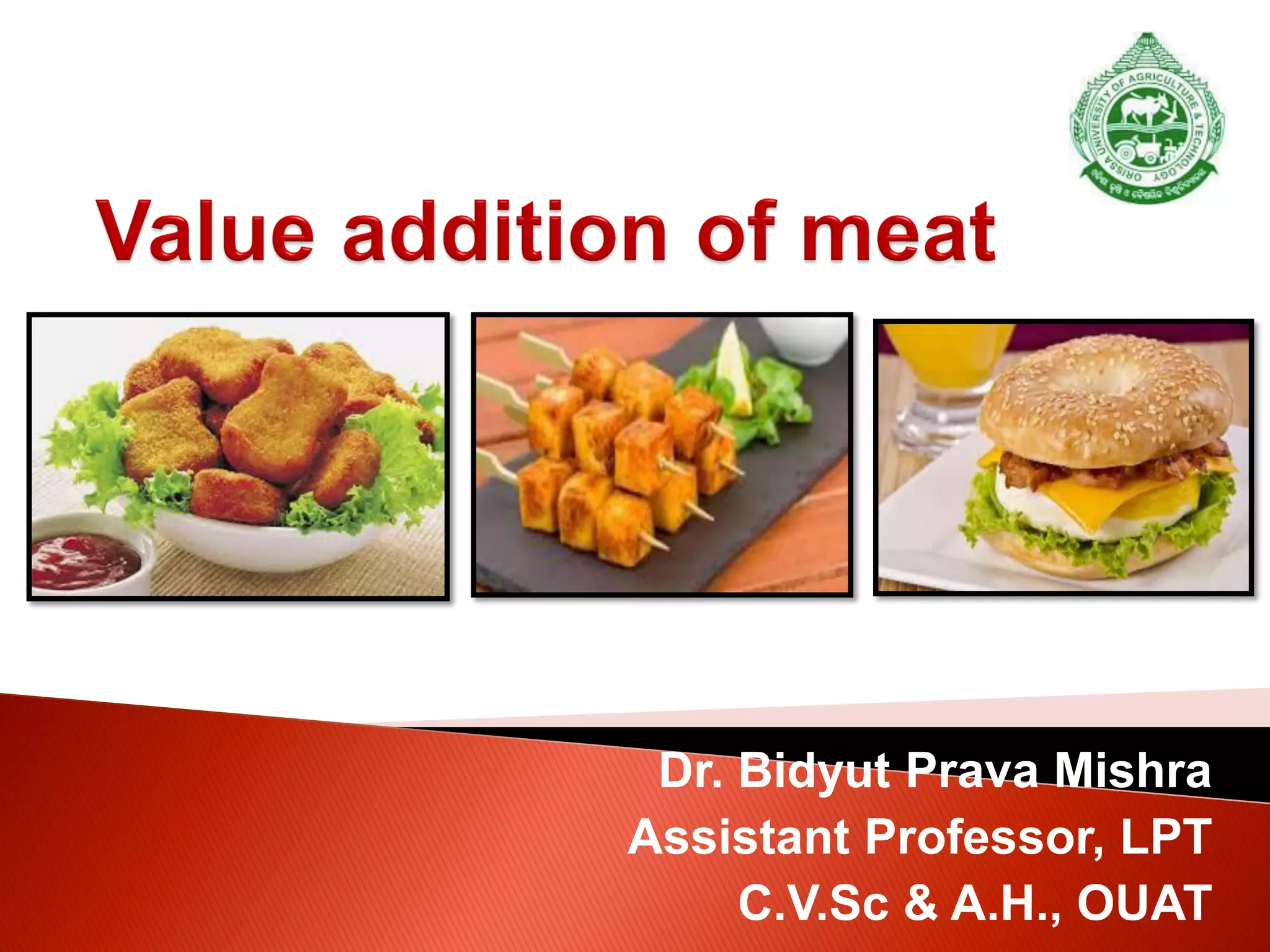
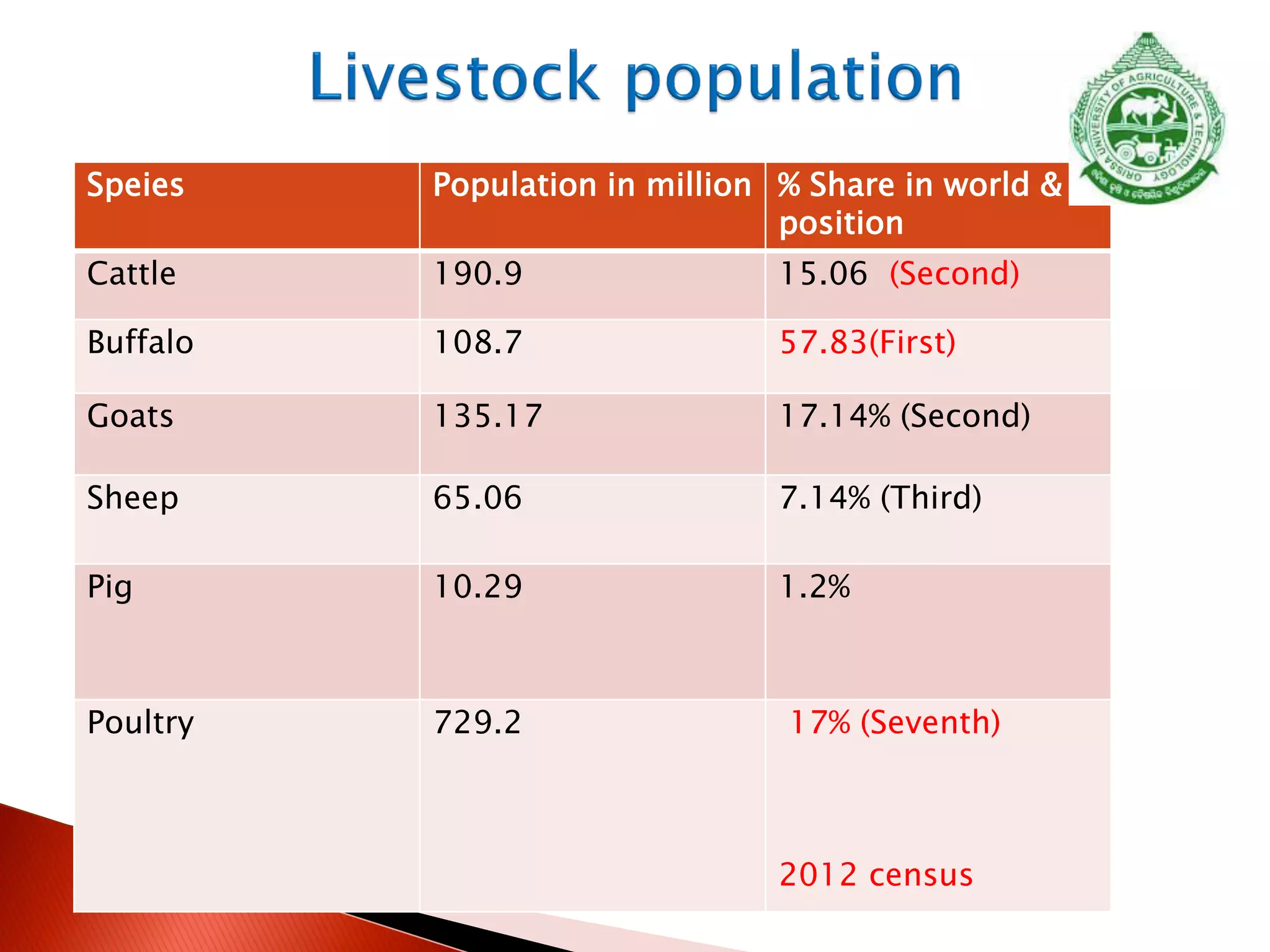
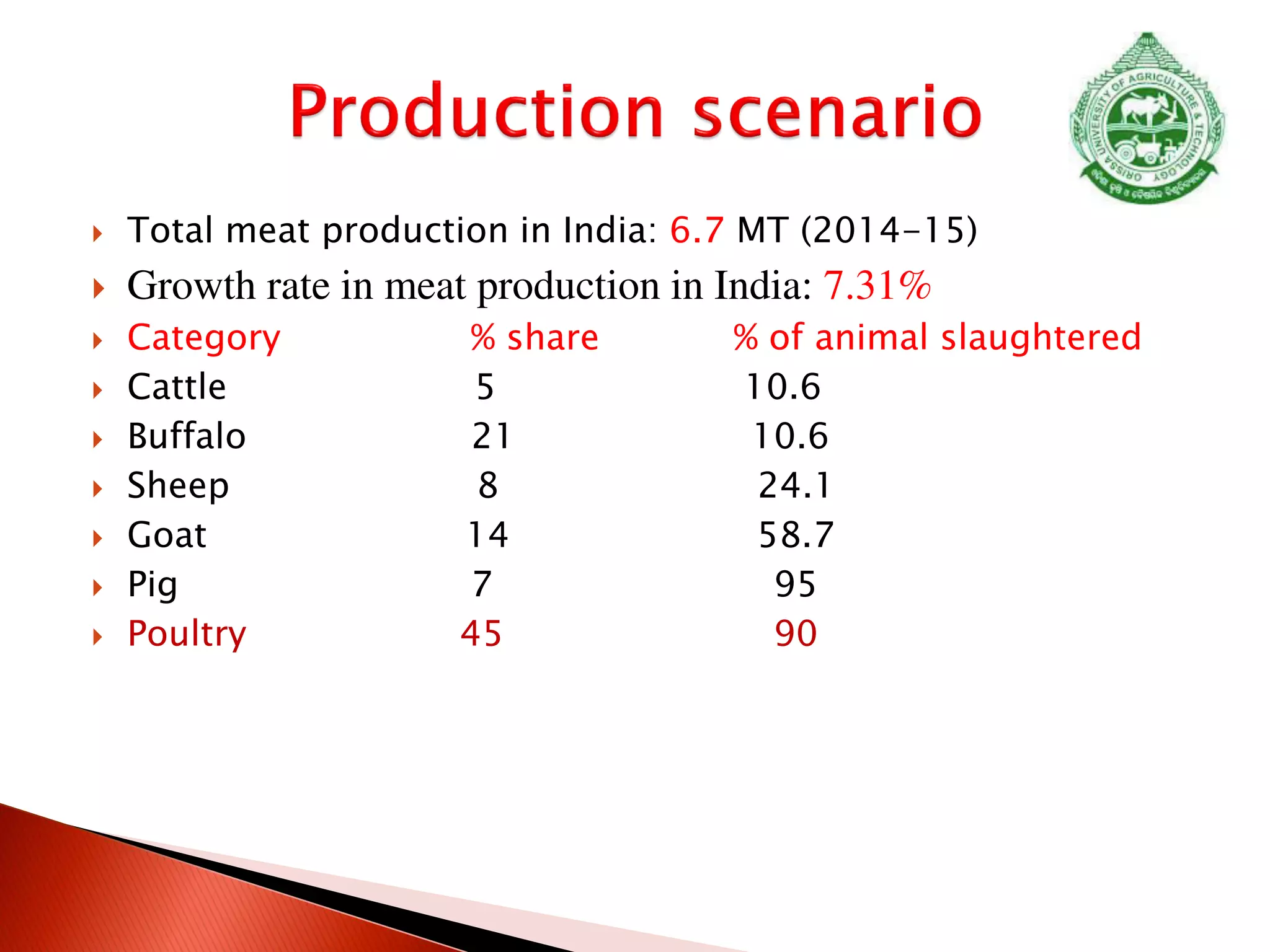
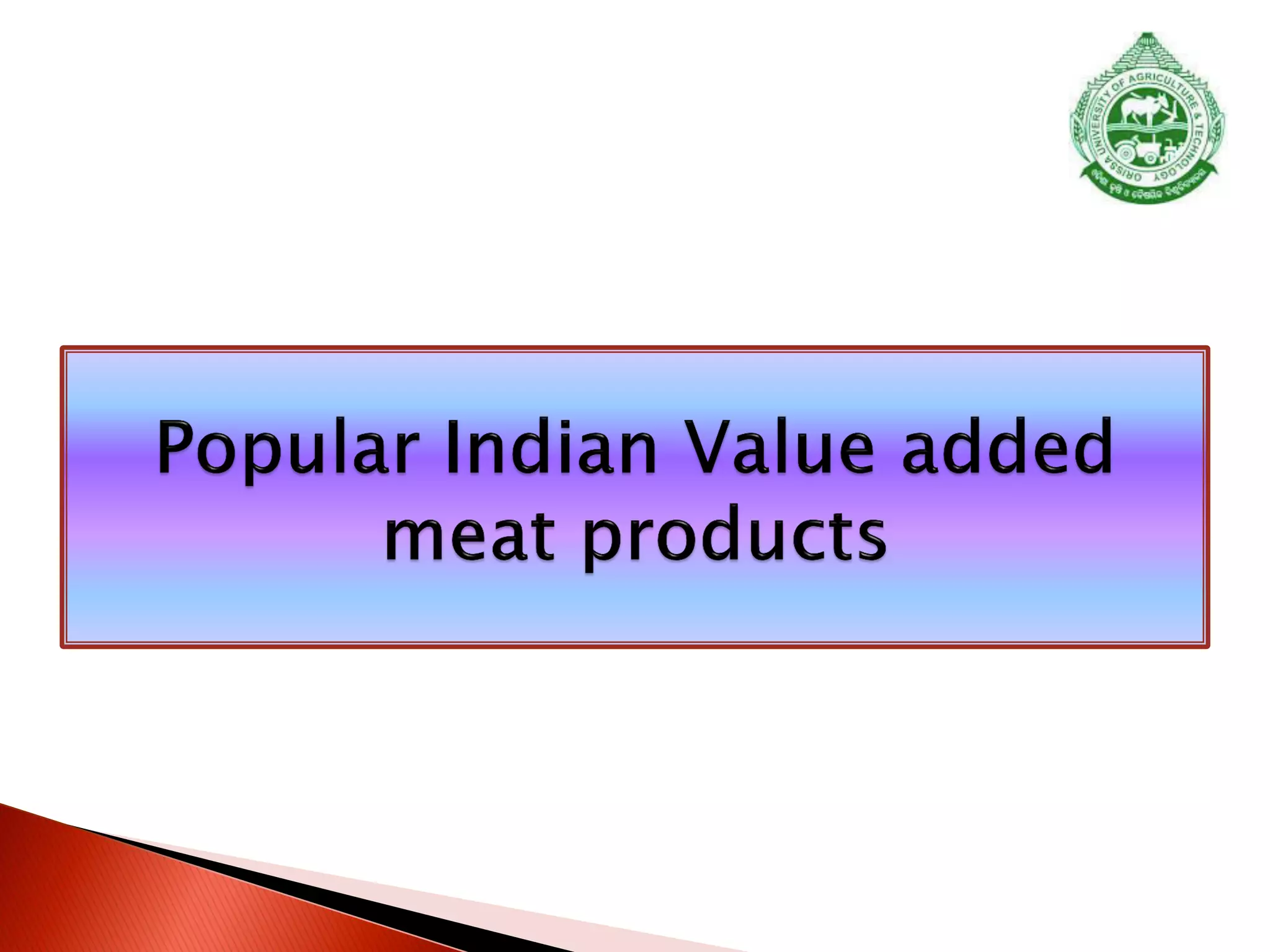
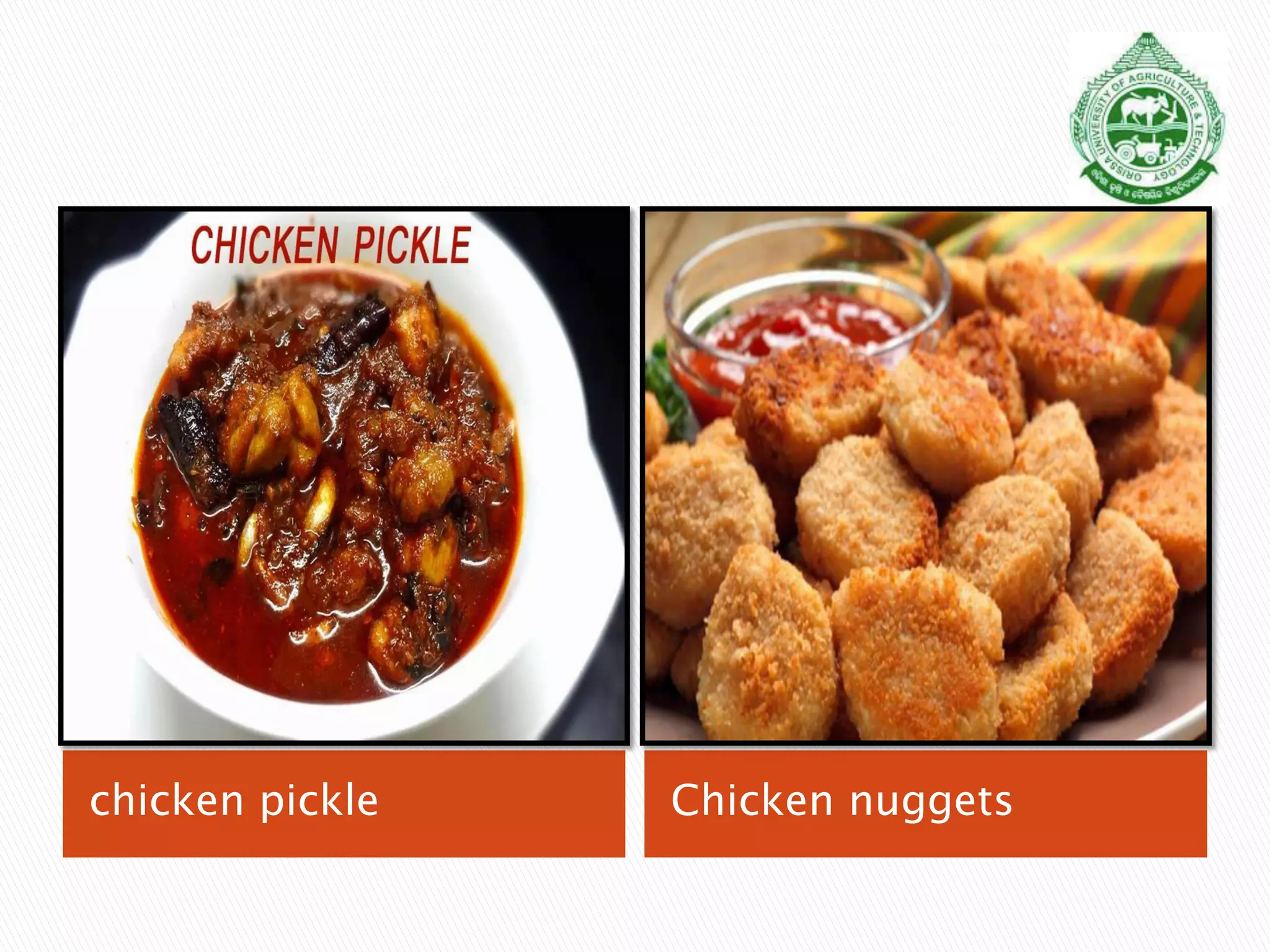
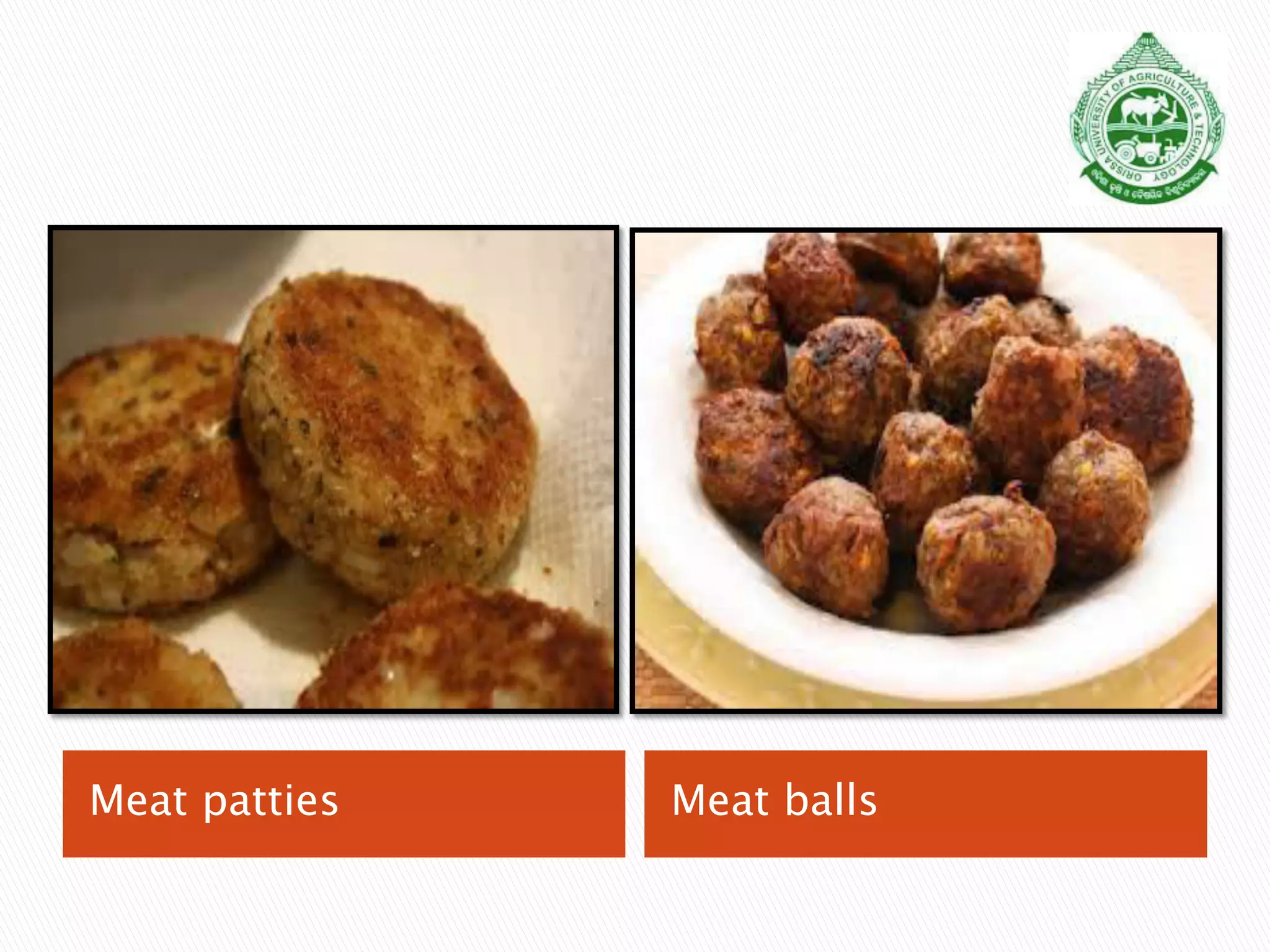
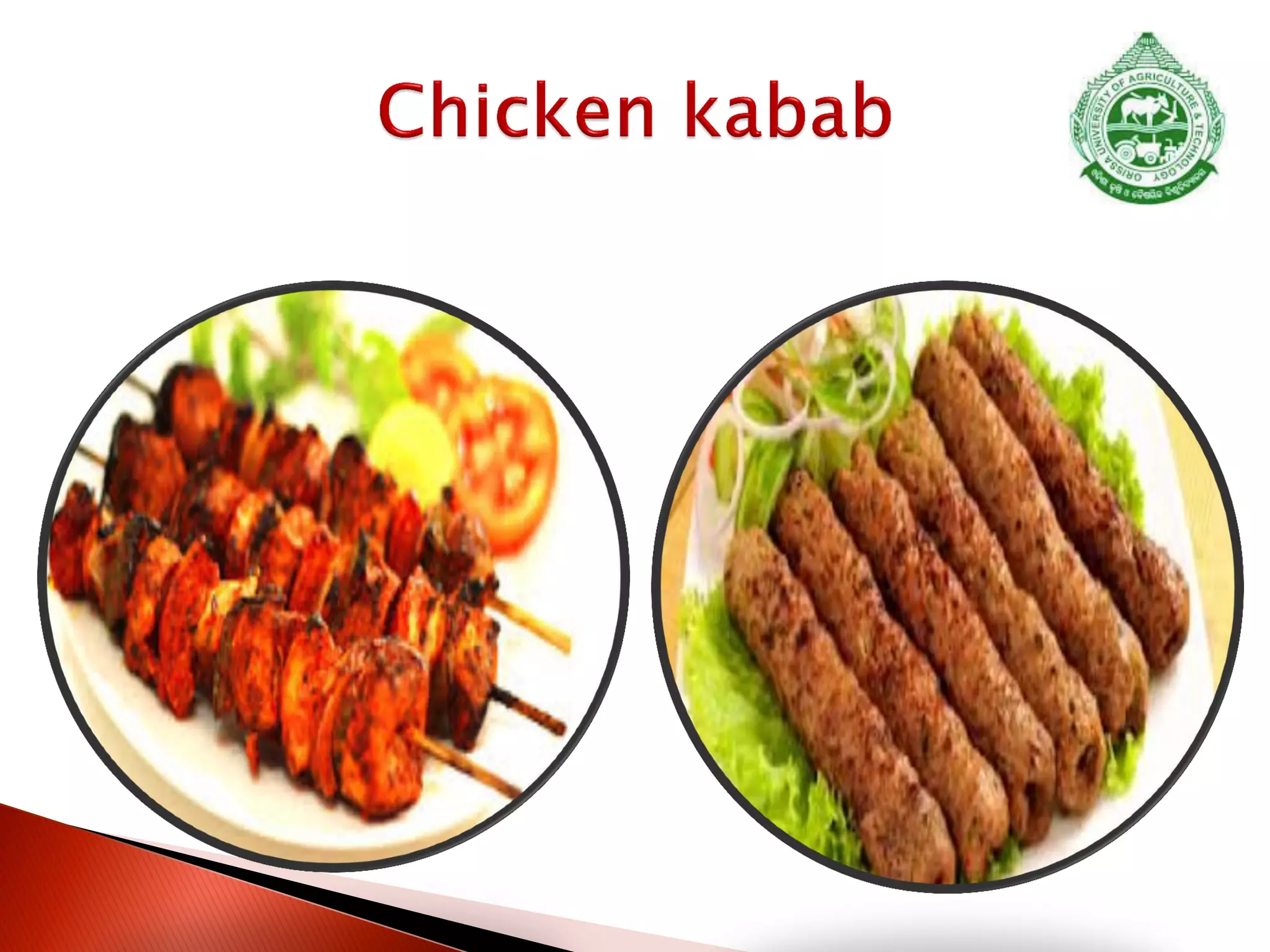
This document provides information on India's livestock population and meat production statistics. It notes that India has the world's largest populations of cattle, buffalo, goats and is among the top producers of meat globally. However, per capita meat consumption and contribution to global meat trade remains low in India. There is potential to increase meat processing and exports through the development of value-added meat products and using technologies to enhance product quality, safety, and shelf life. Challenges include lack of infrastructure, skills, and overcoming socio-cultural taboos against meat consumption.
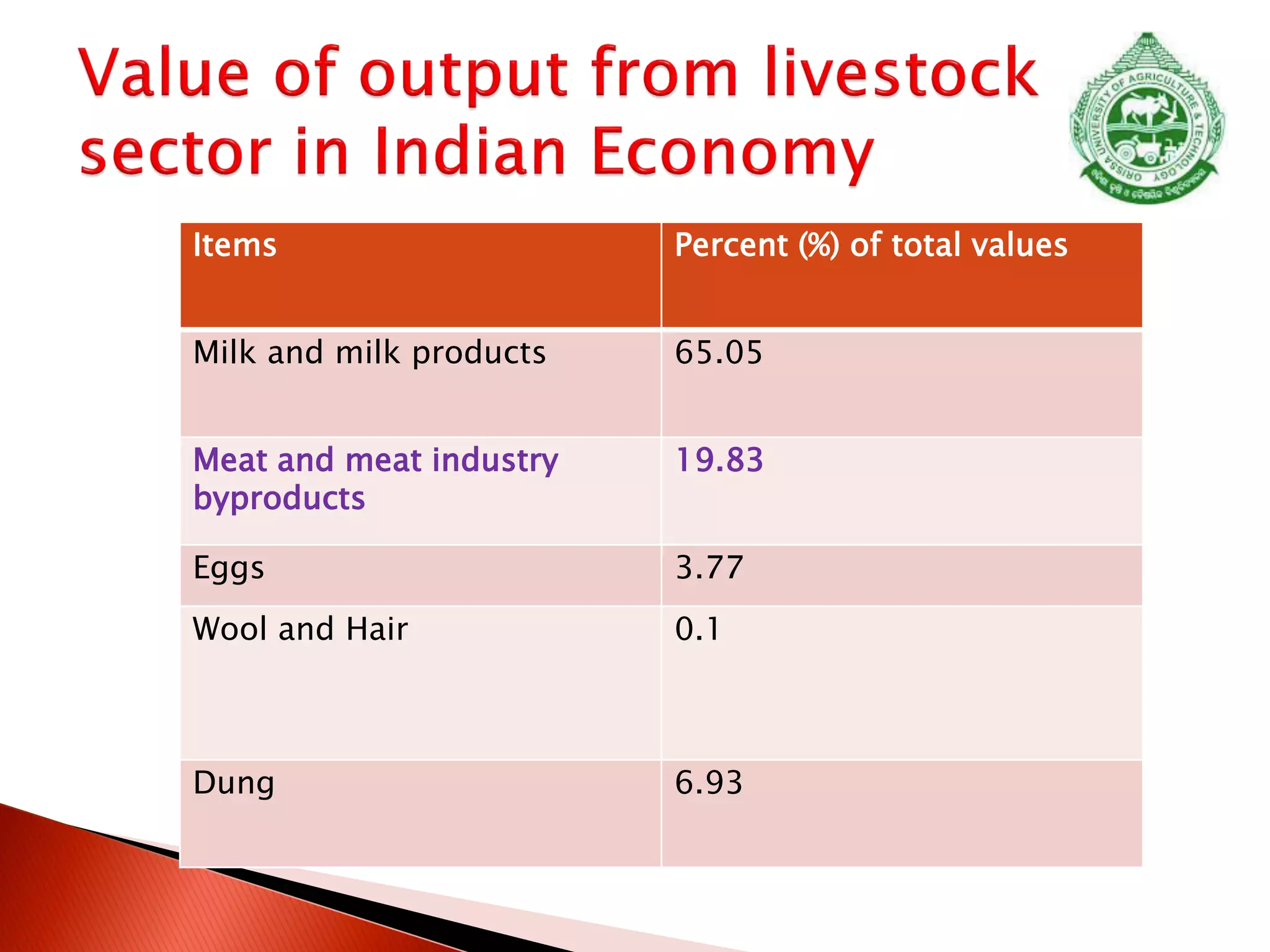
Items Percent (%)of total values
Milk and milk products 65.05
Meat and meat industry
byproducts
19.83
Eggs 3.77
Wool and Hair 0.1
Dung 6.93
8.
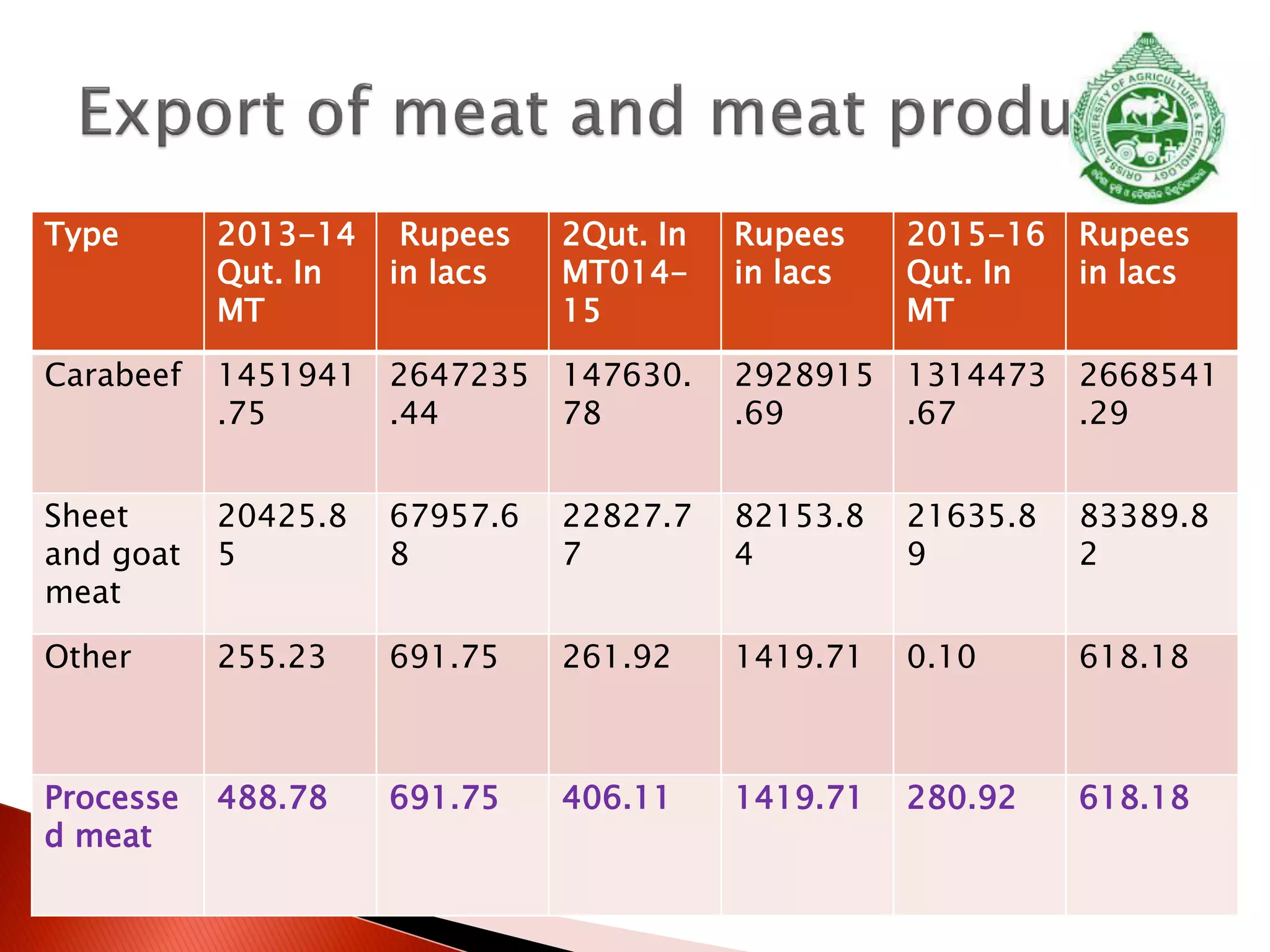
Type 2013-14
Qut. In
MT
Rupees
inlacs
2Qut. In
MT014-
15
Rupees
in lacs
2015-16
Qut. In
MT
Rupees
in lacs
Carabeef 1451941
.75
2647235
.44
147630.
78
2928915
.69
1314473
.67
2668541
.29
Sheet
and goat
meat
20425.8
5
67957.6
8
22827.7
7
82153.8
4
21635.8
9
83389.8
2
Other 255.23 691.75 261.92 1419.71 0.10 618.18
Processe
d meat
488.78 691.75 406.11 1419.71 280.92 618.18
9.
India’s internationaltrade in livestock and
livestock products is mainly in live animals
(17%), meat and meat products (82%), dairy
products and eggs (1%).
India does not even contribute 1 per cent to the
world export of the livestock products
10.
20.5 millionpeople depend upon livestock for their livelihood
Livestock sector contributed 16% to the income for all rural
households.
Indian Meat export: growing at 13% annually
In spite of big potential because of large livestock population,
the meat industry in India has not taken its due share.
India is still a small player in global market of livestock trade
11.
The totalprocessing capacity in India is over 1 million tons per
annum
Only 2% of total meat produced utilized for processed meat product
In developed countries , 60% meat is utilized
Remaining meat sold in fresh or frozen forms
Only 34 modern meat processing plants approved for export of meat
75 no. of Abattoir cum meat processing plants are approved under
APEDA for export
Allanasons Limited pioneered Indian meat exports in 1969 and
continuous to be the leader in meat export
12.
Uttar Pradesh,Andhra Pradesh , West Bengal ,
Maharashtra , Kerala, Delhi , Rajasthan are the key areas
of Processed meat production in India.
Major Export Destinations (2015-16) : Korea Republic,
United Arab Emirates, Saudi Arabia, Thailand and
Maldives.
Even though production is in accelerated trend still processing and
marketing strategies are not in a well defined manner which leads
to overall moderate profitability and less export promotion.
13.
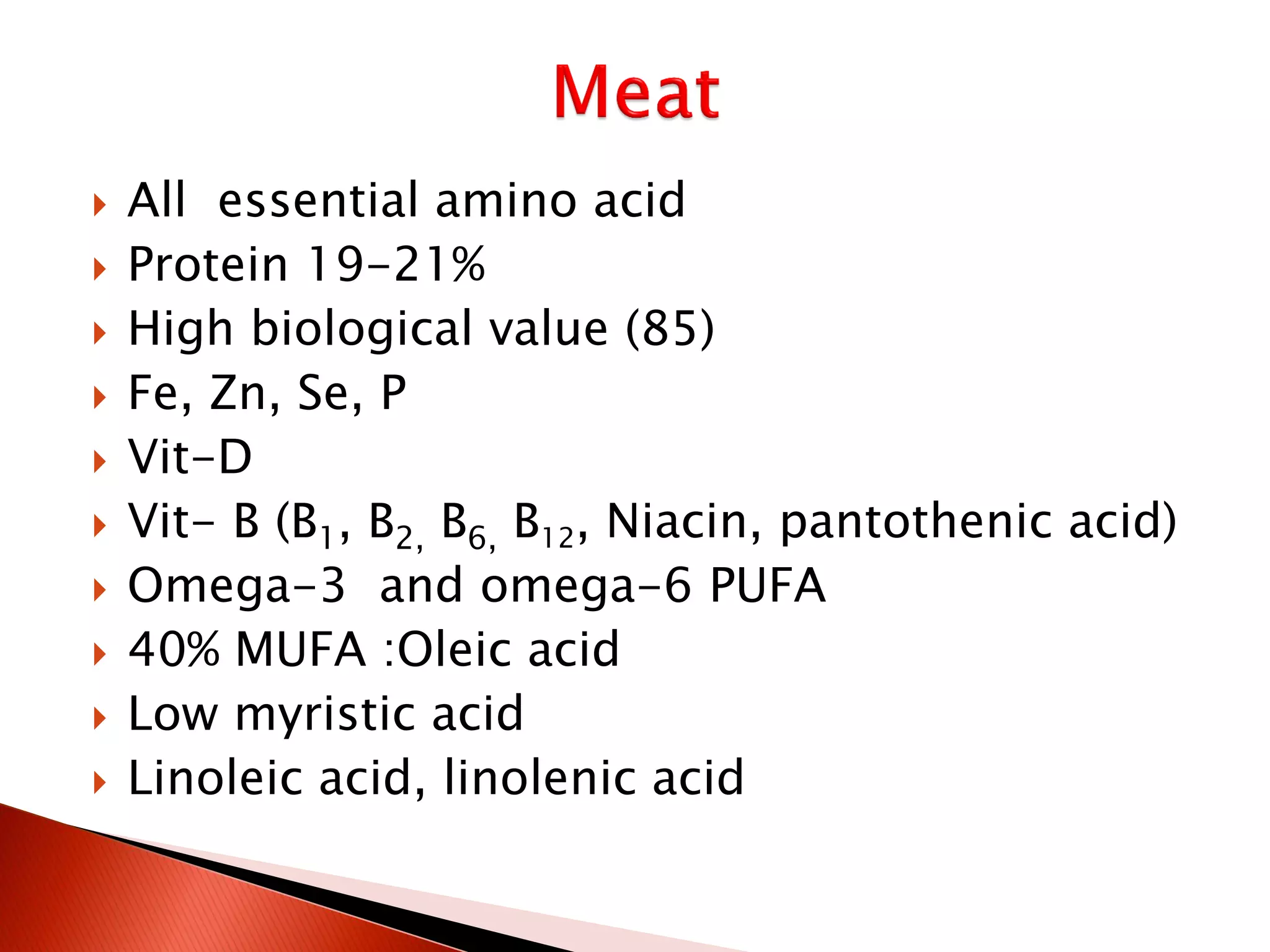
All essentialamino acid
Protein 19-21%
High biological value (85)
Fe, Zn, Se, P
Vit-D
Vit- B (B1, B2, B6, B12, Niacin, pantothenic acid)
Omega-3 and omega-6 PUFA
40% MUFA :Oleic acid
Low myristic acid
Linoleic acid, linolenic acid
14.
Process ofchanging or transforming a product
from its original state to a more valuable state.
Product development in a way that enhances its
value
A broad definition of value added is to economically
add value to a product by changing its current
place, time, and form characteristics to
characteristics more preferred in the marketplace.
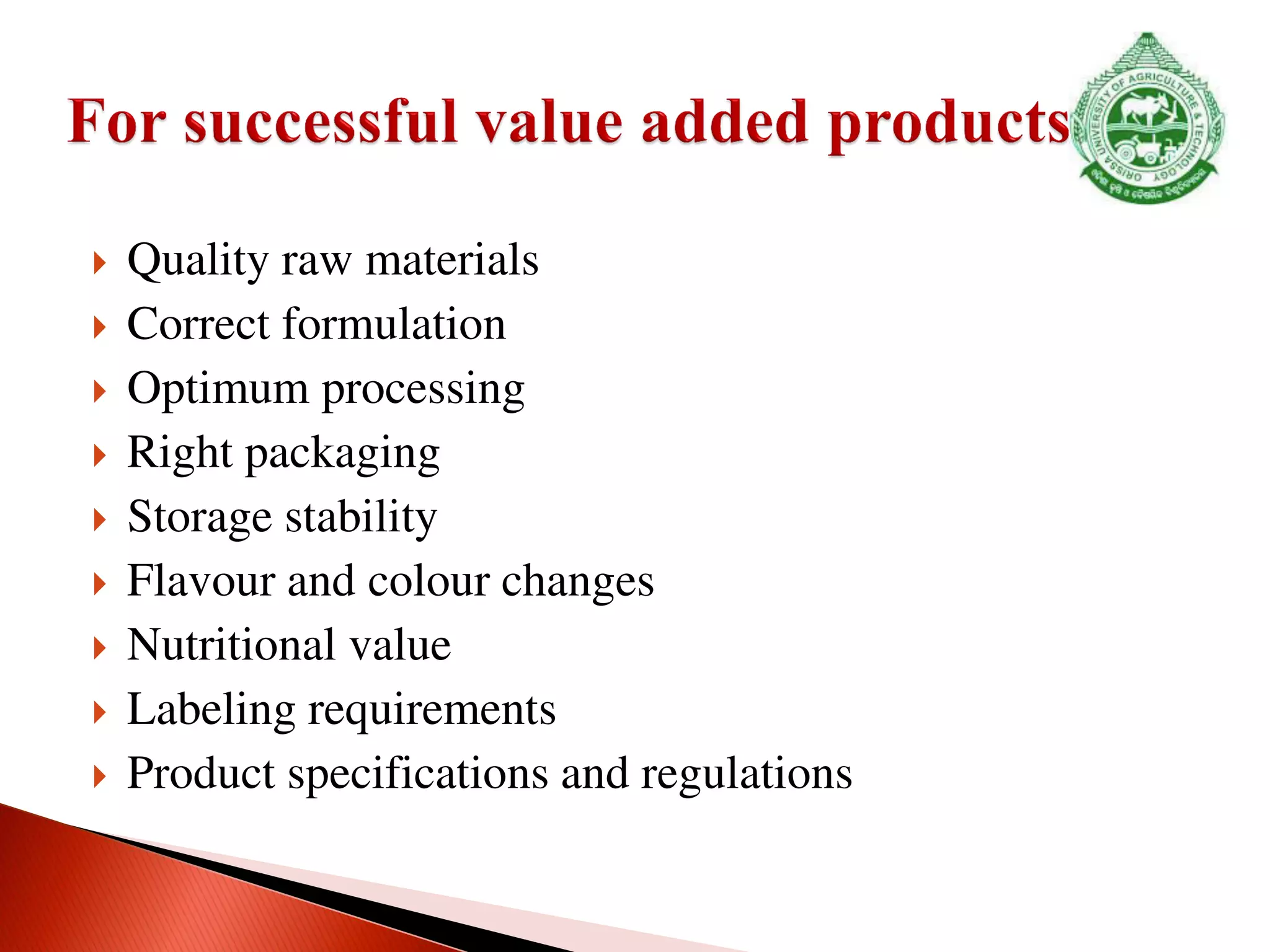
Quality rawmaterials
Correct formulation
Optimum processing
Right packaging
Storage stability
Flavour and colour changes
Nutritional value
Labeling requirements
Product specifications and regulations
19.
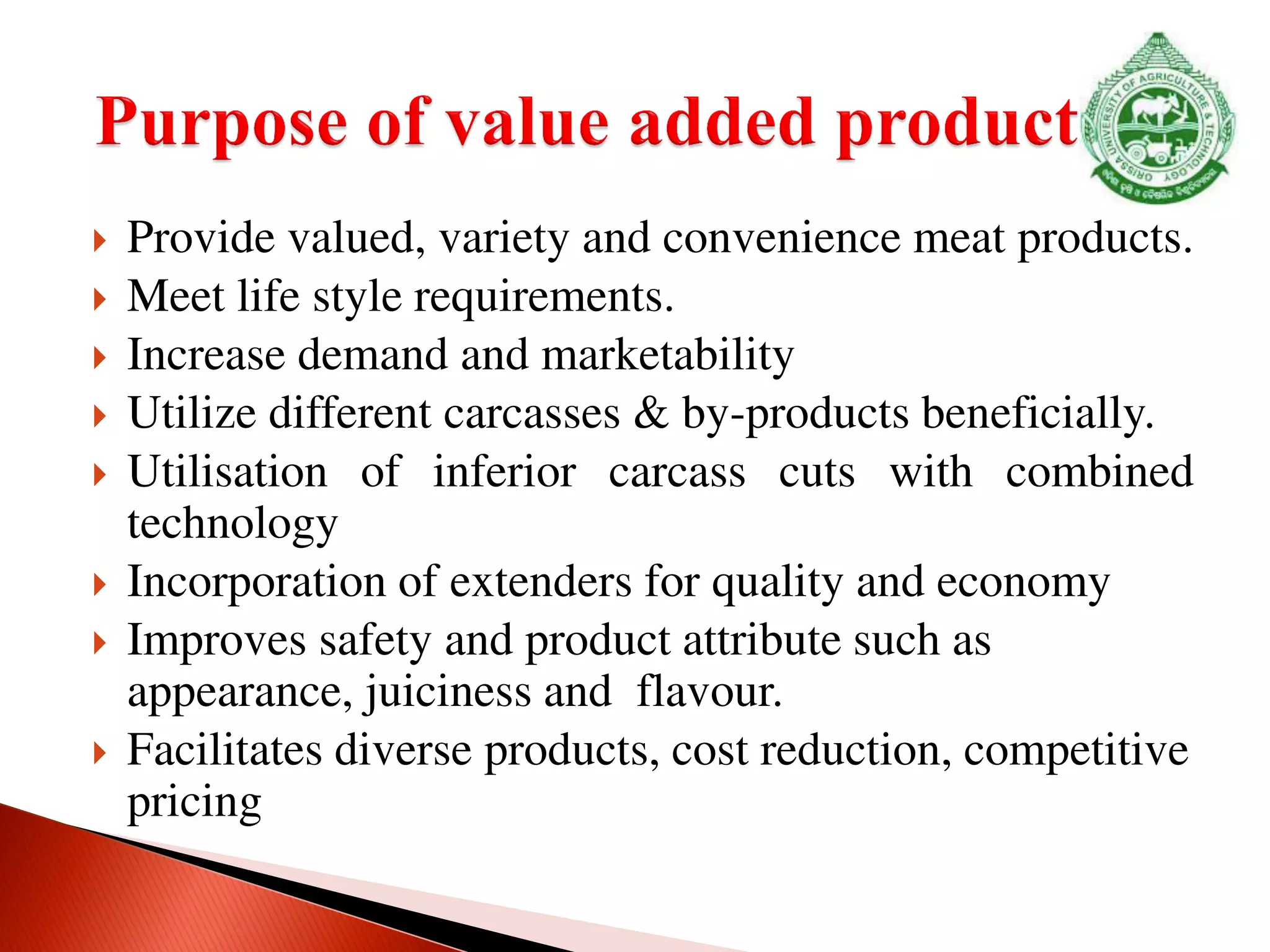
Provide valued,variety and convenience meat products.
Meet life style requirements.
Increase demand and marketability
Utilize different carcasses & by-products beneficially.
Utilisation of inferior carcass cuts with combined
technology
Incorporation of extenders for quality and economy
Improves safety and product attribute such as
appearance, juiciness and flavour.
Facilitates diverse products, cost reduction, competitive
pricing
20.
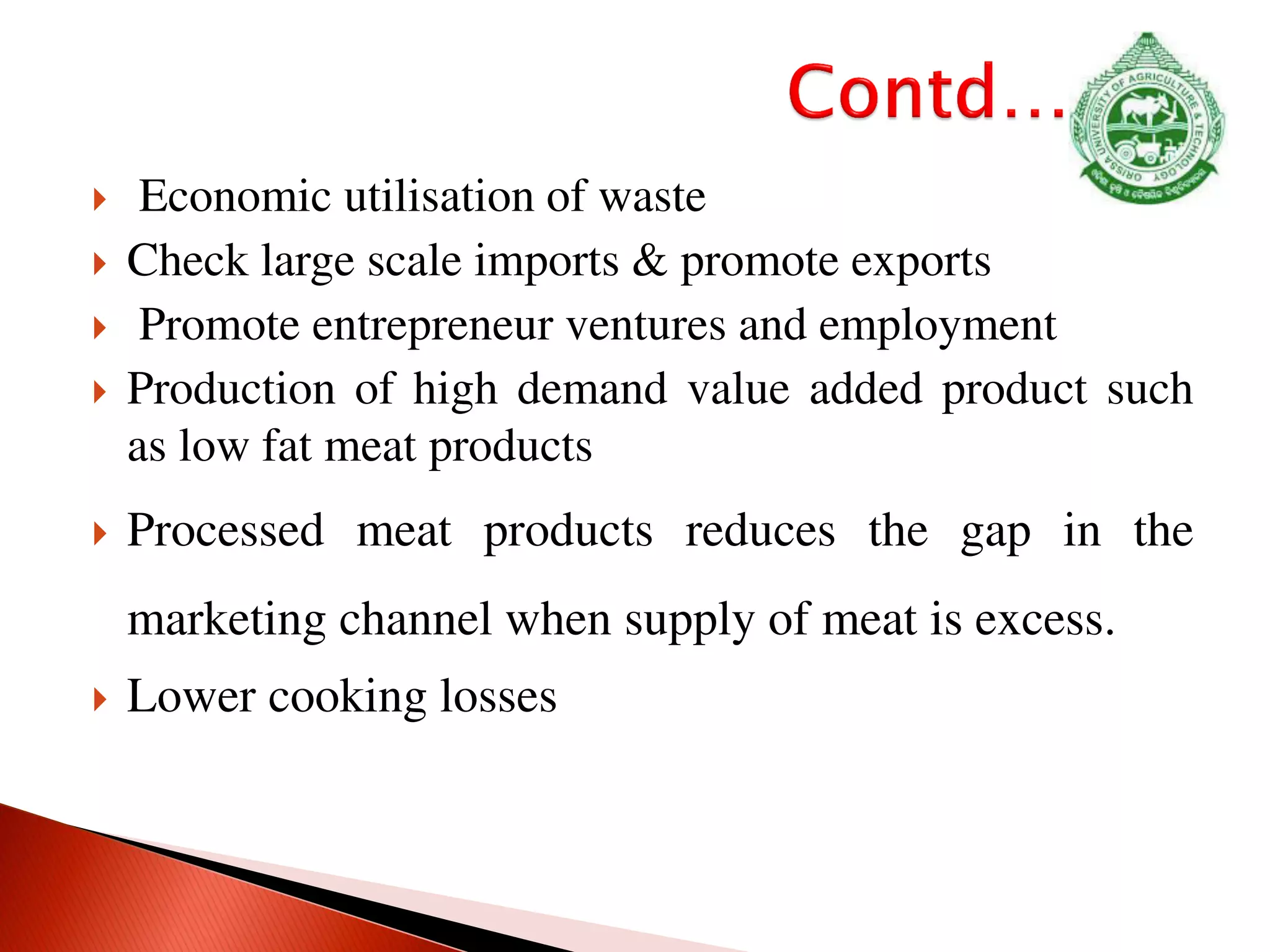
Economic utilisationof waste
Check large scale imports & promote exports
Promote entrepreneur ventures and employment
Production of high demand value added product such
as low fat meat products
Processed meat products reduces the gap in the
marketing channel when supply of meat is excess.
Lower cooking losses
21.
Largest populationof Livestock (Large amount of raw
material)
Tough meat from spent animals will be successfully utilised
for development of palatable and qualitative products.
Rapid urbanization and industrialisation & change of food
habits resulted in increase in demand.
22.
Increase indemand mostly by nuclear families
Higher middle class income group
Export prospects (Global market)
Availability of contemporary technology
23.
Less preferencefor frozen meat by the consumer
Insufficient cold chain facilities
Lack of well organized marketing system
Less domestic demand for value added meat products
Lack of infrastructure facilities for processing and storage
Non availability of adequate technology in most parts of the
country
Fluctuating export trade
High import duty and stringent SPS measures of respective
importing countries
24.
Inadequate focuson quality & safety standards
Traceability
Lack of skilled & trained personnel
Low availability of reliable & accurate instruments &
equipments
High requirement of working capital.
Negative attitude of public towards meat on account of
misinformation campaign and socio- religious taboos.
25.
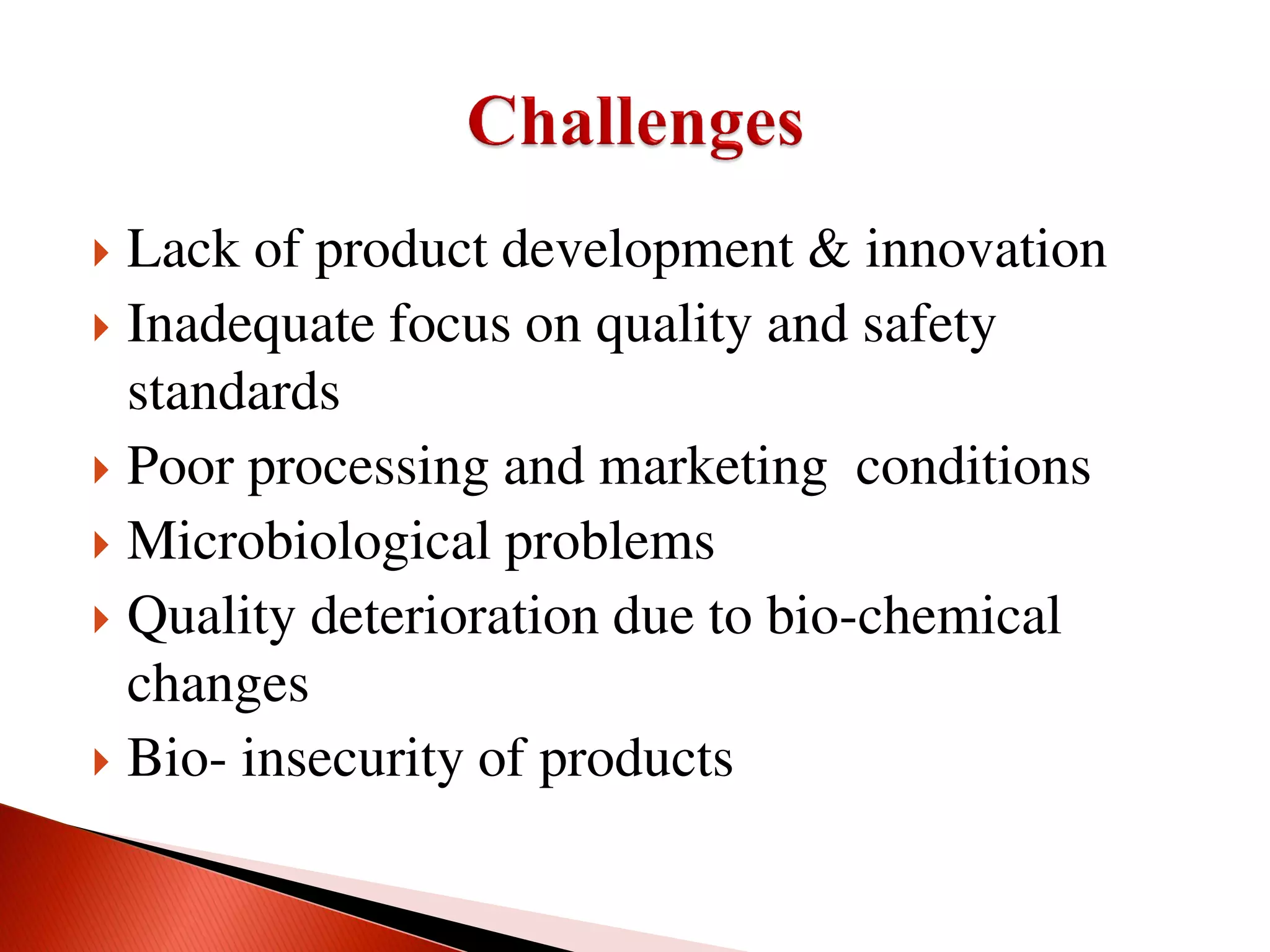
Lack ofproduct development & innovation
Inadequate focus on quality and safety
standards
Poor processing and marketing conditions
Microbiological problems
Quality deterioration due to bio-chemical
changes
Bio- insecurity of products
26.
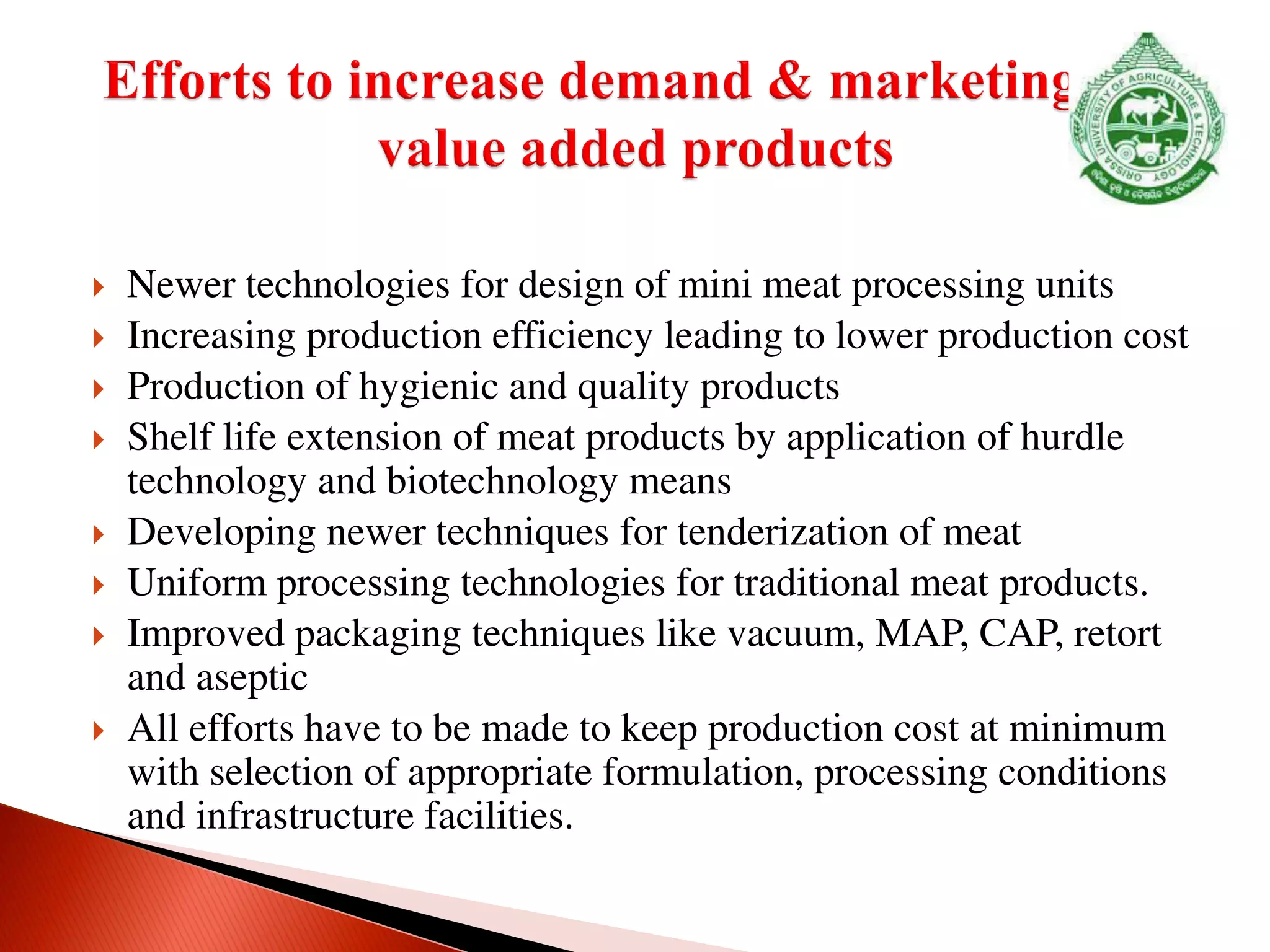
Newer technologiesfor design of mini meat processing units
Increasing production efficiency leading to lower production cost
Production of hygienic and quality products
Shelf life extension of meat products by application of hurdle
technology and biotechnology means
Developing newer techniques for tenderization of meat
Uniform processing technologies for traditional meat products.
Improved packaging techniques like vacuum, MAP, CAP, retort
and aseptic
All efforts have to be made to keep production cost at minimum
with selection of appropriate formulation, processing conditions
and infrastructure facilities.
27.
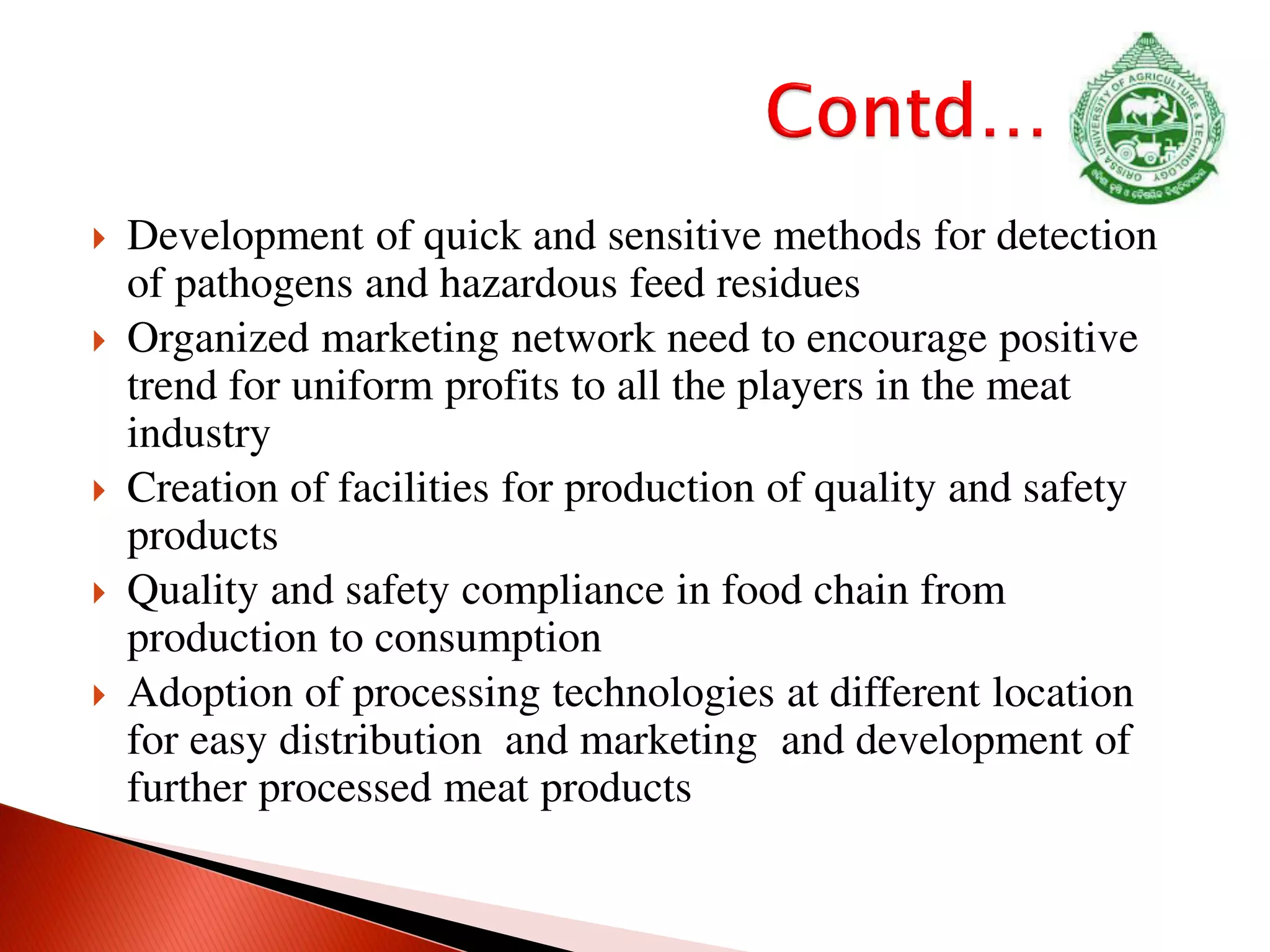
Development ofquick and sensitive methods for detection
of pathogens and hazardous feed residues
Organized marketing network need to encourage positive
trend for uniform profits to all the players in the meat
industry
Creation of facilities for production of quality and safety
products
Quality and safety compliance in food chain from
production to consumption
Adoption of processing technologies at different location
for easy distribution and marketing and development of
further processed meat products
28.
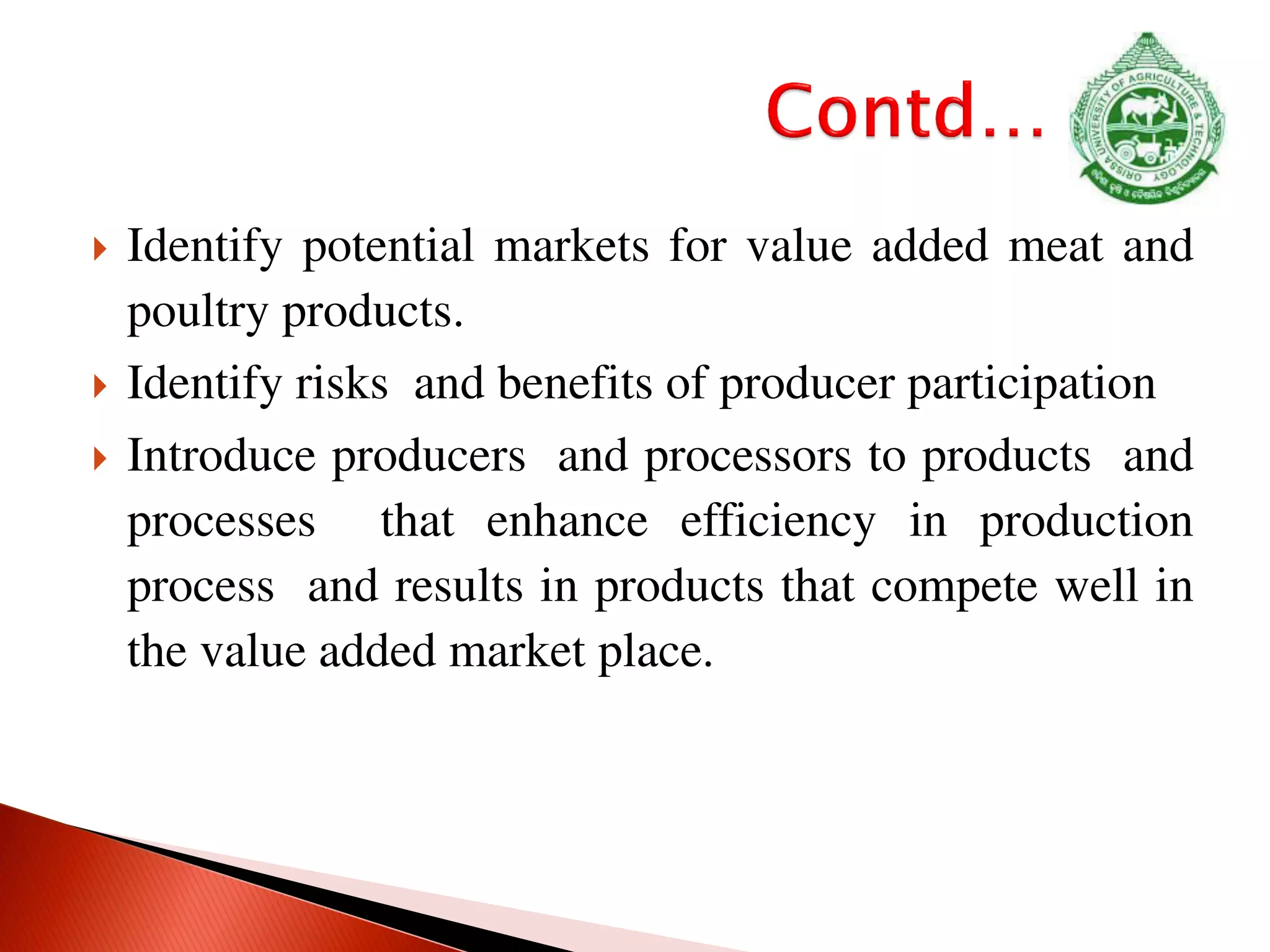
Identify potentialmarkets for value added meat and
poultry products.
Identify risks and benefits of producer participation
Introduce producers and processors to products and
processes that enhance efficiency in production
process and results in products that compete well in
the value added market place.