DNA replication
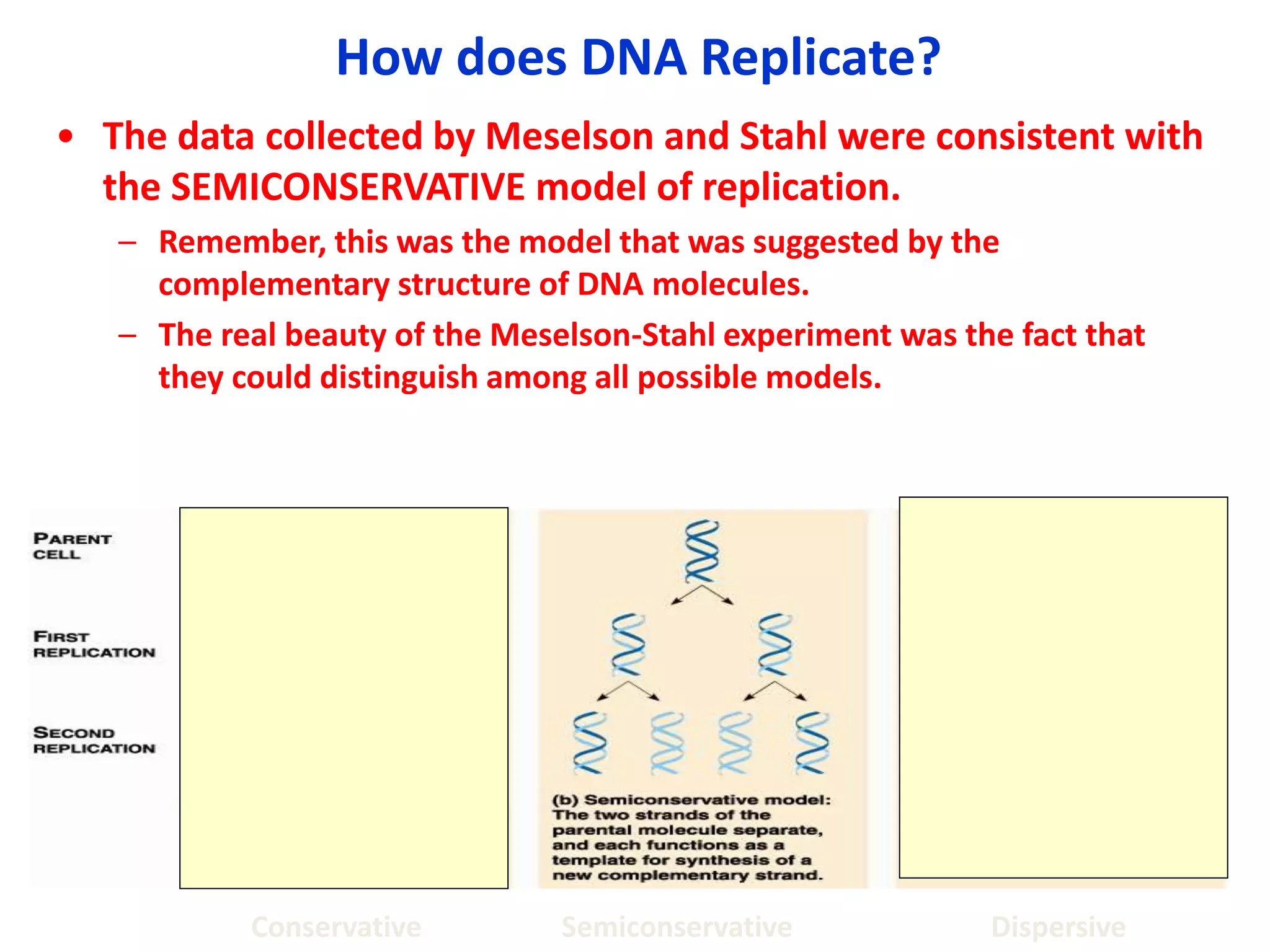
How does DNA Replicate?
• The data collected by Meselson and Stahl were consistent with
the SEMICONSERVATIVE model of replication.
– Remember, this was the model that was suggested by the
complementary structure of DNA molecules.
– The real beauty of the Meselson-Stahl experiment was the fact that
they could distinguish among all possible models.
Conservative Semiconservative Dispersive
Features of DNA Replication
• DNA replication is semi-conservative
– Each strand of template DNA is being copied.
• DNA replication is bidirectional
– Bidirectional replication involves two replication forks,
which move in opposite directions
• DNA replication is semi-discontinuous
– The leading strand copies continuously
– The lagging strand copies in segments (Okazaki
fragments) which must be joined
Steps in DNA Replication
• Replication involves 3 stages:
- initiation
- elongation
- termination
• Replication begins at site called origin of
replication
- 1 in prokaryotes
- numerous in eukaryotes
• Opening DNA double helix
– initiating replication
– unwinding duplex
– stabilizing single strands
– relieve torque
• Building a primer
• Assembling complementary strands
• Removing the primer
• Joining Okazaki fragments
Replication Process
Overview
1. An initiator protein binds to and separates the strands at the
replication origin
2. Helicase separates the strands at the replication fork
3. Gyrase relieves supercoiling as it develops
4. Primase creates a short RNA primer
5. DNA polymerase III extends the strand
6. DNA polymerase I replaces the RNA primer with DNA
7. Ligase repairs missing phosphodiester bonds between fragments
Replication as a process
• Double-stranded DNA unwinds.
The junction of the unwound
molecules is a replication fork.
A new strand is formed by pairing
complementary bases with the
old strand.
Two strands are made.
Each has one new and one old
DNA strand.
The process of DNA Replication
• Unwinding of DNA with helicase: Unwinding
a portion of the DNA double helix using energy
derived from ATP
• Binding Single-stranded proteins :Keeps the
unwound DNA strands from re-annealing
• Gyrases: Eliminates super coiling that
accompanies unwinding removes torsion strain
by opening double helix.
The process of DNA Replication
• RNA Primase: Attaches RNA primers (5-15 bp) on
to DNA template to initiate DNA synthesis. Initiation
of okazaki fragment on lagging strand by primosome-
a protein complex contain DNA primase and DNA
helicase.
• DNA Polymerase delta (ð): Binds to the 5' - 3'
strand in order to bring nucleotides and create the
daughter leading strand.
The process of DNA Replication
• DNA Polymerase epsilon (å): Binds to the 3' - 5'
strand in order to create discontinuous segments starting
from different RNA primers.
Exonuclease (DNA Polymerase I): Finds and
removes the RNA Primers
DNA Ligase: Adds phosphate in the remaining gaps of
the phosphate - sugar backbone
Nucleases: Remove wrong nucleotides from the
daughter strand
Initiation
• Initiator protein (Dna A) is responsible for
intial step in unwinding the helix, binds to the
origin and separates strands
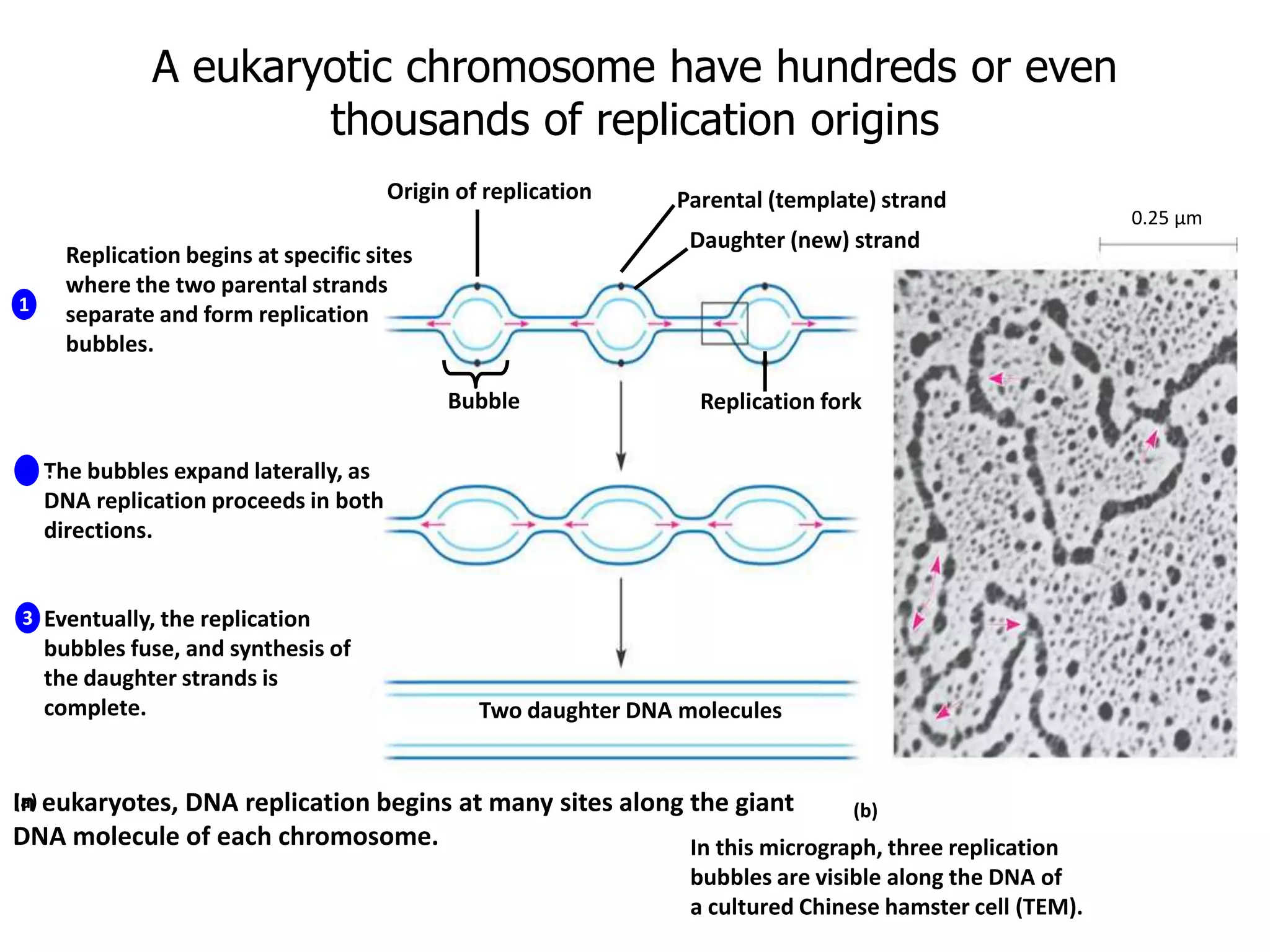
A eukaryotic chromosome have hundreds or even
thousands of replication origins
Replication begins at specific sites
where the two parental strands
separate and form replication
bubbles.
The bubbles expand laterally, as
DNA replication proceeds in both
directions.
Eventually, the replication
bubbles fuse, and synthesis of
the daughter strands is
complete.
1
2
3
Origin of replication
Bubble
Parental (template) strand
Daughter (new) strand
Replication fork
Two daughter DNA molecules
In eukaryotes, DNA replication begins at many sites along the giant
DNA molecule of each chromosome. In this micrograph, three replication
bubbles are visible along the DNA of
a cultured Chinese hamster cell (TEM).
(b)
(a)
0.25 µm
Replication fork
1. As the strands of DNA
unwind, an area of
replication called the
replication fork is
created
2. As nucleotides are
added, the replication
fork moves down the
parental strand
3. Replication is completed
when the replication
fork reaches the end of
the parent strand
DNA Replication Fork
DNA polymerases
• Add nucleotides against a DNA template to the 3' end of
the growing strand (5’3’ growth)
Requirements
1. A template
2. Deoxyribonucleoside
triphosphates which
serve both as the
source for the
nucleotide and as
the energy source
3. A primer
Primase
• DNA polymerase needs a primer
• Short bits of RNA serve as the primer
• The primer is added by a DNA-dependent RNA
polymerase called primase
• RNA polymerases are different from DNA
polymerases as they can initiate a new strand
based on a template strand
Primer
• Only one primer is needed for synthesis of
the leading strand
– But for synthesis of the lagging strand, each
Okazaki fragment must be primed separately
Type I Topoisomerases
• One strand is
“nicked,” allowing
the remaining intact
phosphate backbone
to twist under
torsion
• The nicked strand is
then rejoined
• No net energy
expenditure
DNA polymerase I
(α in eukaryotes)
• Does all the stuff DNA poly III does
– 5‘3' polymerase
– 3‘5' exonuclease
• Also a 5‘3' exonuclease
– removes damaged bases
– removes primers
• Slower than DNA poly III. abundant
DNA polymerase III
(δ in eukaryotes)
The main polymerase in bacteria consists of 10 peptide sub
units
5‘3' polymerase
3‘5' exonuclease for proof reading
Elongation of DNA Replication
• DNA polymerase binds to 3'-end of RNA primer
- makes DNA in 5' --> 3' direction
- slides along template strand in 3' --> 5'
direction
• Elongation can occur continuously on one of the
template strands as helix opens in front of it
- strand with continuous replication is called
leading strand
Termination of DNA Replication
• RNA primers removed from newly
synthesized DNA molecules and replaced
by DNA
• DNA ligase seals gaps between these
fragments
Replication Process
• Single stranded breaks are sealed by DNA
ligase
Ligation and Primer removal
Figure 16.16
Overall direction of replication
Leading
strand
Lagging
strand
Lagging
strand
Leading
strand
OVERVIEW
Leading
strand
Replication fork
DNA pol III
Primase
Primer
DNA pol III Lagging
strand
DNA pol I
Parental DNA
5
3
4
3
2
Origin of replication
DNA ligase
1
5
3
Helicase unwinds the
parental double helix.
1
Molecules of single-
strand binding protein
stabilize the unwound
template strands.
2 The leading strand is
synthesized continuously in the
5 3 direction by DNA pol III.
3
Primase begins synthesis
of RNA primer for fifth
Okazaki fragment.
4
DNA pol III is completing synthesis of
the fourth fragment, when it reaches the
RNA primer on the third fragment, it will
dissociate, move to the replication fork,
and add DNA nucleotides to the 3 end
of the fifth fragment primer.
5
DNA pol I removes the primer from the 5 end
of the second fragment, replacing it with DNA
nucleotides that it adds one by one to the 3 end
of the third fragment. The replacement of the
last RNA nucleotide with DNA leaves the sugar-
phosphate backbone with a free 3 end.
6
DNA ligase bonds
the 3 end of the
second fragment to
the 5 end of the first
fragment.
7
A summary of DNA replication
Replication forks

DNA replication.ppt

  • 1.
  • 2.
    How does DNAReplicate? • The data collected by Meselson and Stahl were consistent with the SEMICONSERVATIVE model of replication. – Remember, this was the model that was suggested by the complementary structure of DNA molecules. – The real beauty of the Meselson-Stahl experiment was the fact that they could distinguish among all possible models. Conservative Semiconservative Dispersive
  • 3.
    Features of DNAReplication • DNA replication is semi-conservative – Each strand of template DNA is being copied. • DNA replication is bidirectional – Bidirectional replication involves two replication forks, which move in opposite directions • DNA replication is semi-discontinuous – The leading strand copies continuously – The lagging strand copies in segments (Okazaki fragments) which must be joined
  • 4.
    Steps in DNAReplication • Replication involves 3 stages: - initiation - elongation - termination • Replication begins at site called origin of replication - 1 in prokaryotes - numerous in eukaryotes
  • 5.
    • Opening DNAdouble helix – initiating replication – unwinding duplex – stabilizing single strands – relieve torque • Building a primer • Assembling complementary strands • Removing the primer • Joining Okazaki fragments Replication Process
  • 6.
    Overview 1. An initiatorprotein binds to and separates the strands at the replication origin 2. Helicase separates the strands at the replication fork 3. Gyrase relieves supercoiling as it develops 4. Primase creates a short RNA primer 5. DNA polymerase III extends the strand 6. DNA polymerase I replaces the RNA primer with DNA 7. Ligase repairs missing phosphodiester bonds between fragments
  • 7.
    Replication as aprocess • Double-stranded DNA unwinds. The junction of the unwound molecules is a replication fork. A new strand is formed by pairing complementary bases with the old strand. Two strands are made. Each has one new and one old DNA strand.
  • 8.
    The process ofDNA Replication • Unwinding of DNA with helicase: Unwinding a portion of the DNA double helix using energy derived from ATP • Binding Single-stranded proteins :Keeps the unwound DNA strands from re-annealing • Gyrases: Eliminates super coiling that accompanies unwinding removes torsion strain by opening double helix.
  • 10.
    The process ofDNA Replication • RNA Primase: Attaches RNA primers (5-15 bp) on to DNA template to initiate DNA synthesis. Initiation of okazaki fragment on lagging strand by primosome- a protein complex contain DNA primase and DNA helicase. • DNA Polymerase delta (ð): Binds to the 5' - 3' strand in order to bring nucleotides and create the daughter leading strand.
  • 11.
    The process ofDNA Replication • DNA Polymerase epsilon (å): Binds to the 3' - 5' strand in order to create discontinuous segments starting from different RNA primers. Exonuclease (DNA Polymerase I): Finds and removes the RNA Primers DNA Ligase: Adds phosphate in the remaining gaps of the phosphate - sugar backbone Nucleases: Remove wrong nucleotides from the daughter strand
  • 12.
    Initiation • Initiator protein(Dna A) is responsible for intial step in unwinding the helix, binds to the origin and separates strands
  • 13.
    A eukaryotic chromosomehave hundreds or even thousands of replication origins Replication begins at specific sites where the two parental strands separate and form replication bubbles. The bubbles expand laterally, as DNA replication proceeds in both directions. Eventually, the replication bubbles fuse, and synthesis of the daughter strands is complete. 1 2 3 Origin of replication Bubble Parental (template) strand Daughter (new) strand Replication fork Two daughter DNA molecules In eukaryotes, DNA replication begins at many sites along the giant DNA molecule of each chromosome. In this micrograph, three replication bubbles are visible along the DNA of a cultured Chinese hamster cell (TEM). (b) (a) 0.25 µm
  • 14.
    Replication fork 1. Asthe strands of DNA unwind, an area of replication called the replication fork is created 2. As nucleotides are added, the replication fork moves down the parental strand 3. Replication is completed when the replication fork reaches the end of the parent strand
  • 16.
  • 17.
    DNA polymerases • Addnucleotides against a DNA template to the 3' end of the growing strand (5’3’ growth) Requirements 1. A template 2. Deoxyribonucleoside triphosphates which serve both as the source for the nucleotide and as the energy source 3. A primer
  • 18.
    Primase • DNA polymeraseneeds a primer • Short bits of RNA serve as the primer • The primer is added by a DNA-dependent RNA polymerase called primase • RNA polymerases are different from DNA polymerases as they can initiate a new strand based on a template strand
  • 19.
    Primer • Only oneprimer is needed for synthesis of the leading strand – But for synthesis of the lagging strand, each Okazaki fragment must be primed separately
  • 20.
    Type I Topoisomerases •One strand is “nicked,” allowing the remaining intact phosphate backbone to twist under torsion • The nicked strand is then rejoined • No net energy expenditure
  • 21.
    DNA polymerase I (αin eukaryotes) • Does all the stuff DNA poly III does – 5‘3' polymerase – 3‘5' exonuclease • Also a 5‘3' exonuclease – removes damaged bases – removes primers • Slower than DNA poly III. abundant
  • 22.
    DNA polymerase III (δin eukaryotes) The main polymerase in bacteria consists of 10 peptide sub units 5‘3' polymerase 3‘5' exonuclease for proof reading
  • 23.
    Elongation of DNAReplication • DNA polymerase binds to 3'-end of RNA primer - makes DNA in 5' --> 3' direction - slides along template strand in 3' --> 5' direction • Elongation can occur continuously on one of the template strands as helix opens in front of it - strand with continuous replication is called leading strand
  • 24.
    Termination of DNAReplication • RNA primers removed from newly synthesized DNA molecules and replaced by DNA • DNA ligase seals gaps between these fragments
  • 25.
    Replication Process • Singlestranded breaks are sealed by DNA ligase
  • 26.
  • 27.
    Figure 16.16 Overall directionof replication Leading strand Lagging strand Lagging strand Leading strand OVERVIEW Leading strand Replication fork DNA pol III Primase Primer DNA pol III Lagging strand DNA pol I Parental DNA 5 3 4 3 2 Origin of replication DNA ligase 1 5 3 Helicase unwinds the parental double helix. 1 Molecules of single- strand binding protein stabilize the unwound template strands. 2 The leading strand is synthesized continuously in the 5 3 direction by DNA pol III. 3 Primase begins synthesis of RNA primer for fifth Okazaki fragment. 4 DNA pol III is completing synthesis of the fourth fragment, when it reaches the RNA primer on the third fragment, it will dissociate, move to the replication fork, and add DNA nucleotides to the 3 end of the fifth fragment primer. 5 DNA pol I removes the primer from the 5 end of the second fragment, replacing it with DNA nucleotides that it adds one by one to the 3 end of the third fragment. The replacement of the last RNA nucleotide with DNA leaves the sugar- phosphate backbone with a free 3 end. 6 DNA ligase bonds the 3 end of the second fragment to the 5 end of the first fragment. 7 A summary of DNA replication
  • 28.