Presented By ,
MouMita Kanrar
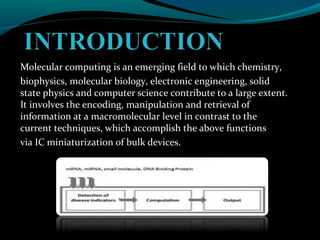
Molecular computing is an emerging field to which chemistry,
biophysics, molecular biology, electronic engineering, solid
state physics and computer science contribute to a large extent.
It involves the encoding, manipulation and retrieval of
information at a macromolecular level in contrast to the
current techniques, which accomplish the above functions
via IC miniaturization of bulk devices.
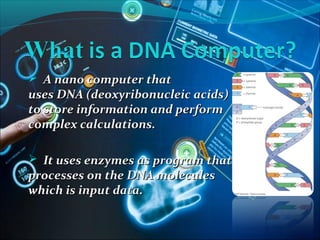
 A nano computer thatA nano computer that
uses DNA (deoxyribonucleic acids)uses DNA (deoxyribonucleic acids)
to store information and performto store information and perform
complex calculations.complex calculations.
 It uses enzymes as program thatIt uses enzymes as program that
processes on the DNA moleculesprocesses on the DNA molecules
which is input data.which is input data.
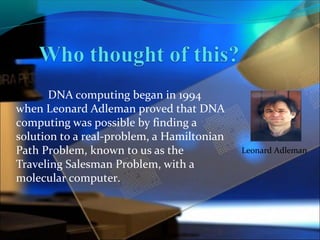
DNA computing began in 1994
when Leonard Adleman proved that DNA
computing was possible by finding a
solution to a real-problem, a Hamiltonian
Path Problem, known to us as the
Traveling Salesman Problem, with a
molecular computer.
Leonard Adleman
The goal of the problem is to find the shortest route
between a numbers of cities, going through each city
only once. If we add more cities the problem becomes
more difficult.
Figure showing the possible flight routes between the seven cities
 Under a high proton concentration, the
formation of ATP takes place and this ATP is used to
catalyse a reaction. By measuring the rate of
reaction, one can create a logic gate.
 The bR molecule can act as the basis for a
molecular binary switch. This can be used to make
large optical memories with access time below two
nano seconds.
o Massive parallel processing of data,
o Expanded capacity of storing information and
o Compatibility with living organisms
o Time-consuming procedures of preparing of input
o Problems in detecting output signals
o Interference with by-products
In both the solid-surface glass-plate approach and the test
tube approach, each DNA strand represents one possible
answer to the problem that the computer is trying to solve.
The strands have been synthesized by combining the
building blocks of DNA, called nucleotides, with one
another, using techniques developed for biotechnology. The
set of DNA strands is manufactured so that all conceivable
answers are included. Because a set of strands is tailored to a
specific problem, a new set would have to be made for each
new problem.
The costs to design and build a 64 mega-bit memory chip
run into billions of dollars and these costs would raise
higher for larger memory-sized chips. In contrast, some bio
molecular systems like bR offer the promise of being
economically grown in a vat and can quickly be harvested
in a normal environment which is controlled via ordinary
chemistry or use of shelf laser diodes.
Bio-molecular computers have the real potential for solving
problems of high computational complexities and therefore,
many problems are still associated with this field. The difficulty
of devising an interface is therefore the sensitive dependence on
a biological environment, susceptibility to degradation,
senescence and infection, etc. Nevertheless, it offers the best
approach to human cognitive equivalence.
Bio-Molecular computers

Bio-Molecular computers

  • 1.
  • 2.
    Molecular computing isan emerging field to which chemistry, biophysics, molecular biology, electronic engineering, solid state physics and computer science contribute to a large extent. It involves the encoding, manipulation and retrieval of information at a macromolecular level in contrast to the current techniques, which accomplish the above functions via IC miniaturization of bulk devices.
  • 3.
     A nanocomputer thatA nano computer that uses DNA (deoxyribonucleic acids)uses DNA (deoxyribonucleic acids) to store information and performto store information and perform complex calculations.complex calculations.  It uses enzymes as program thatIt uses enzymes as program that processes on the DNA moleculesprocesses on the DNA molecules which is input data.which is input data.
  • 4.
    DNA computing beganin 1994 when Leonard Adleman proved that DNA computing was possible by finding a solution to a real-problem, a Hamiltonian Path Problem, known to us as the Traveling Salesman Problem, with a molecular computer. Leonard Adleman
  • 5.
    The goal ofthe problem is to find the shortest route between a numbers of cities, going through each city only once. If we add more cities the problem becomes more difficult. Figure showing the possible flight routes between the seven cities
  • 6.
     Under ahigh proton concentration, the formation of ATP takes place and this ATP is used to catalyse a reaction. By measuring the rate of reaction, one can create a logic gate.  The bR molecule can act as the basis for a molecular binary switch. This can be used to make large optical memories with access time below two nano seconds.
  • 7.
    o Massive parallelprocessing of data, o Expanded capacity of storing information and o Compatibility with living organisms
  • 8.
    o Time-consuming proceduresof preparing of input o Problems in detecting output signals o Interference with by-products
  • 9.
    In both thesolid-surface glass-plate approach and the test tube approach, each DNA strand represents one possible answer to the problem that the computer is trying to solve. The strands have been synthesized by combining the building blocks of DNA, called nucleotides, with one another, using techniques developed for biotechnology. The set of DNA strands is manufactured so that all conceivable answers are included. Because a set of strands is tailored to a specific problem, a new set would have to be made for each new problem.
  • 10.
    The costs todesign and build a 64 mega-bit memory chip run into billions of dollars and these costs would raise higher for larger memory-sized chips. In contrast, some bio molecular systems like bR offer the promise of being economically grown in a vat and can quickly be harvested in a normal environment which is controlled via ordinary chemistry or use of shelf laser diodes.
  • 11.
    Bio-molecular computers havethe real potential for solving problems of high computational complexities and therefore, many problems are still associated with this field. The difficulty of devising an interface is therefore the sensitive dependence on a biological environment, susceptibility to degradation, senescence and infection, etc. Nevertheless, it offers the best approach to human cognitive equivalence.