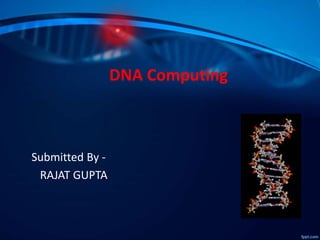
DNA Computing
Submitted By -
RAJAT GUPTA
Outline Of Contents
• What Is DNA
• Uniqueness Of DNA
• Introduction To DNA Computing
• Travelling Salesman Problem
• Advantages Of DNA Computing
• Disadvantages Of DNA Computing
• Conclusion
What Is DNA ?
• DNA stands for Deoxyribonucleic Acid
• DNA contains instructions for assembling cells
• DNA represents the genetic blueprint of living
creatures
• DNA is unique for each individual
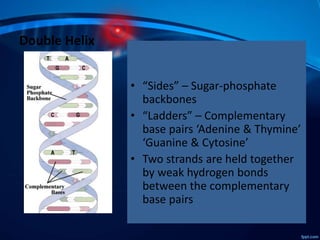
Double Helix
• “Sides” – Sugar-phosphate
backbones
• “Ladders” – Complementary
base pairs ‘Adenine & Thymine’
‘Guanine & Cytosine’
• Two strands are held together
by weak hydrogen bonds
between the complementary
base pairs
Uniqueness Of DNA
Why is DNA a Unique Computational Element ?
• Extremely dense information storage.
• Enormous parallelism.
• Extraordinary energy efficiency.
Dense Information Storage
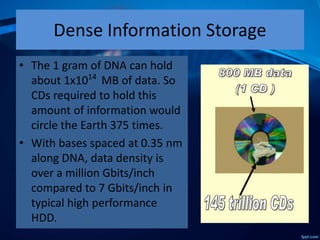
• The 1 gram of DNA can hold
about 1x10¹⁴
MB of data. So
CDs required to hold this
amount of information would
circle the Earth 375 times.
• With bases spaced at 0.35 nm
along DNA, data density is
over a million Gbits/inch
compared to 7 Gbits/inch in
typical high performance
HDD.
Enormous Parallelism
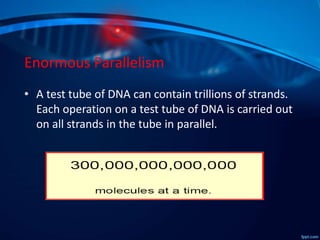
• A test tube of DNA can contain trillions of strands.
Each operation on a test tube of DNA is carried out
on all strands in the tube in parallel.
Energy Efficiency
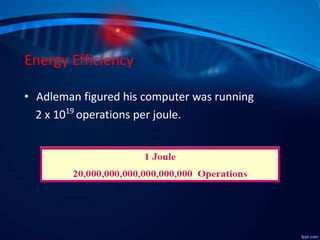
• Adleman figured his computer was running
2 x 10¹⁹
operations per joule.
Origin of DNA Computing
• Firstly Leonard Adleman in 1994 proposed that
the makeup of DNA and its features of
combining nucleotides could have application in
computational research techniques.
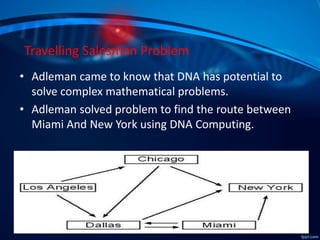
Travelling Salesman Problem
• Adleman came to know that DNA has potential to
solve complex mathematical problems.
• Adleman solved problem to find the route between
Miami And New York using DNA Computing.
Continued..
He carried out the experiment in following manner
• Strands of DNA represent the five cities. In genes,
genetic coding is represented by the letters A, T, C and
G. Some sequence of these six letters represented each
city and possible flight path.
• These molecules are then mixed in a test tube, with
some of these DNA strands sticking together. A chain of
these strands represents a possible answer.
Continued..
• Within a few seconds, all of the possible
combinations of DNA strands, which represent
answers, are created in the test tube.
• Adleman eliminates the wrong molecules through
chemical reactions, which leaves behind only the
flight paths that connect all seven cities.
Continued..
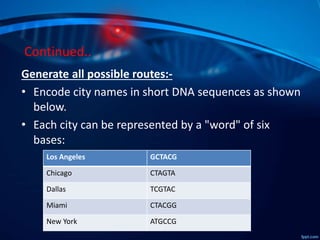
Generate all possible routes:-
• Encode city names in short DNA sequences as shown
below.
• Each city can be represented by a "word" of six
bases:
Los Angeles GCTACG
Chicago CTAGTA
Dallas TCGTAC
Miami CTACGG
New York ATGCCG
Continued..
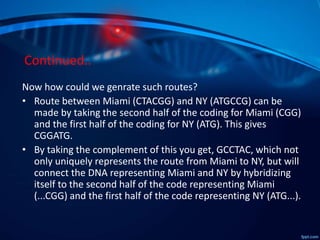
Now how could we genrate such routes?
• Route between Miami (CTACGG) and NY (ATGCCG) can be
made by taking the second half of the coding for Miami (CGG)
and the first half of the coding for NY (ATG). This gives
CGGATG.
• By taking the complement of this you get, GCCTAC, which not
only uniquely represents the route from Miami to NY, but will
connect the DNA representing Miami and NY by hybridizing
itself to the second half of the code representing Miami
(...CGG) and the first half of the code representing NY (ATG...).
Continued..
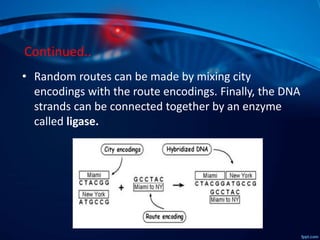
• Random routes can be made by mixing city
encodings with the route encodings. Finally, the DNA
strands can be connected together by an enzyme
called ligase.
Advantages of DNA Computing
• Perform millions of operations simultaneously
(Parallel Computing).
• Capable of storing billions of times more data
• Minimal storage requirements.
• Minimal power requirements.
• They are inexpensive to build, being made of
common biological materials.
• DNA computers smaller than any computer
Disadvantages of DNA Computing
• Generating solution sets, even for some relatively
simple problems, may require impractically large
amounts of memory (lots and lots of DNA strands are
required).
• DNA computers could not (at this point) replace
traditional computers.
• They are not programmable and the common human
being can not sit down at a familiar keyboard and get
to work.
• It requires human assistance.
Conclusion
• DNA computers can't be found at your local electronics
store yet. The technology is still in development.
• Bio molecular computers, made of DNA and other
biological molecules, only exist today in a few specialized
labs.
• The current applications of DNA chips are restricted to
the field of medicine.
• If developed, their powerful computing power will be
used by national governments for cracking secret codes,
or by airlines wanting to map more efficient routes.
Thank You!!

DNA Computing

  • 1.
  • 2.
    Outline Of Contents •What Is DNA • Uniqueness Of DNA • Introduction To DNA Computing • Travelling Salesman Problem • Advantages Of DNA Computing • Disadvantages Of DNA Computing • Conclusion
  • 3.
    What Is DNA? • DNA stands for Deoxyribonucleic Acid • DNA contains instructions for assembling cells • DNA represents the genetic blueprint of living creatures • DNA is unique for each individual
  • 4.
    Double Helix • “Sides”– Sugar-phosphate backbones • “Ladders” – Complementary base pairs ‘Adenine & Thymine’ ‘Guanine & Cytosine’ • Two strands are held together by weak hydrogen bonds between the complementary base pairs
  • 5.
    Uniqueness Of DNA Whyis DNA a Unique Computational Element ? • Extremely dense information storage. • Enormous parallelism. • Extraordinary energy efficiency.
  • 6.
    Dense Information Storage •The 1 gram of DNA can hold about 1x1014 MB of data. So CDs required to hold this amount of information would circle the Earth 375 times. • With bases spaced at 0.35 nm along DNA, data density is over a million Gbits/inch compared to 7 Gbits/inch in typical high performance HDD.
  • 7.
    Enormous Parallelism • Atest tube of DNA can contain trillions of strands. Each operation on a test tube of DNA is carried out on all strands in the tube in parallel.
  • 8.
    Energy Efficiency • Adlemanfigured his computer was running 2 x 10¹⁹ operations per joule.
  • 9.
    Origin of DNAComputing • Firstly Leonard Adleman in 1994 proposed that the makeup of DNA and its features of combining nucleotides could have application in computational research techniques.
  • 10.
    Travelling Salesman Problem •Adleman came to know that DNA has potential to solve complex mathematical problems. • Adleman solved problem to find the route between Miami And New York using DNA Computing.
  • 11.
    Continued.. He carried outthe experiment in following manner • Strands of DNA represent the five cities. In genes, genetic coding is represented by the letters A, T, C and G. Some sequence of these six letters represented each city and possible flight path. • These molecules are then mixed in a test tube, with some of these DNA strands sticking together. A chain of these strands represents a possible answer.
  • 12.
    Continued.. • Within afew seconds, all of the possible combinations of DNA strands, which represent answers, are created in the test tube. • Adleman eliminates the wrong molecules through chemical reactions, which leaves behind only the flight paths that connect all seven cities.
  • 13.
    Continued.. Generate all possibleroutes:- • Encode city names in short DNA sequences as shown below. • Each city can be represented by a "word" of six bases: Los Angeles GCTACG Chicago CTAGTA Dallas TCGTAC Miami CTACGG New York ATGCCG
  • 14.
    Continued.. Now how couldwe genrate such routes? • Route between Miami (CTACGG) and NY (ATGCCG) can be made by taking the second half of the coding for Miami (CGG) and the first half of the coding for NY (ATG). This gives CGGATG. • By taking the complement of this you get, GCCTAC, which not only uniquely represents the route from Miami to NY, but will connect the DNA representing Miami and NY by hybridizing itself to the second half of the code representing Miami (...CGG) and the first half of the code representing NY (ATG...).
  • 15.
    Continued.. • Random routescan be made by mixing city encodings with the route encodings. Finally, the DNA strands can be connected together by an enzyme called ligase.
  • 16.
    Advantages of DNAComputing • Perform millions of operations simultaneously (Parallel Computing). • Capable of storing billions of times more data • Minimal storage requirements. • Minimal power requirements. • They are inexpensive to build, being made of common biological materials. • DNA computers smaller than any computer
  • 17.
    Disadvantages of DNAComputing • Generating solution sets, even for some relatively simple problems, may require impractically large amounts of memory (lots and lots of DNA strands are required). • DNA computers could not (at this point) replace traditional computers. • They are not programmable and the common human being can not sit down at a familiar keyboard and get to work. • It requires human assistance.
  • 18.
    Conclusion • DNA computerscan't be found at your local electronics store yet. The technology is still in development. • Bio molecular computers, made of DNA and other biological molecules, only exist today in a few specialized labs. • The current applications of DNA chips are restricted to the field of medicine. • If developed, their powerful computing power will be used by national governments for cracking secret codes, or by airlines wanting to map more efficient routes.
  • 19.