Bio Computing
Abdullah Farhad
MCSCE,1st Semester
Topics
 Bio Computing
 DNA
 DNA computing
 Conventional vs DNA computer
 Application
ABDULLAH FARHAD
Why Bio Computing ??
ABDULLAH FARHAD
 Moore’s Law states that silicon microprocessor
complexity will double in every 18 months.
 One day this will no longer hold true when
miniaturization limits are reached.
 Solving complex problems which today's
supercomputers are unable to perform in
stipulated period of time.
 Require a Successor to Silicon
BIOLOGICAL COMPUTERS
ABDULLAH FARHAD
What is Biological Computing?
 Biological Computing means such a
computing process which use synthesized
biological components to store and
manipulate data analogous to processes in
the human body.
 The result is small ; faster computing process
that operates with great accuracy.
 Main biological component used in
Biological Computing is : DNA
ABDULLAH FARHAD
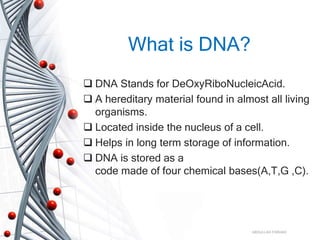
What is DNA?
 DNA Stands for DeOxyRiboNucleicAcid.
 A hereditary material found in almost all living
organisms.
 Located inside the nucleus of a cell.
 Helps in long term storage of information.
 DNA is stored as a
code made of four chemical bases(A,T,G ,C).
ABDULLAH FARHAD
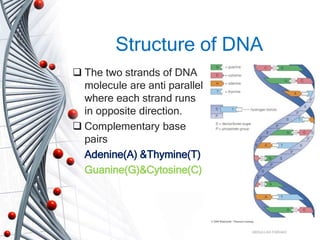
Structure of DNA
 The two strands of DNA
molecule are anti parallel
where each strand runs
in opposite direction.
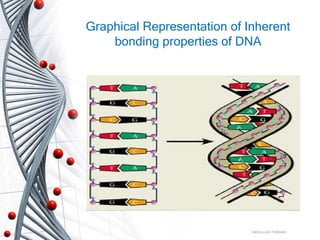
 Complementary base
pairs
Adenine(A) &Thymine(T)
Guanine(G)&Cytosine(C)
ABDULLAH FARHAD
Graphical Representation of Inherent
bonding properties of DNA
ABDULLAH FARHAD
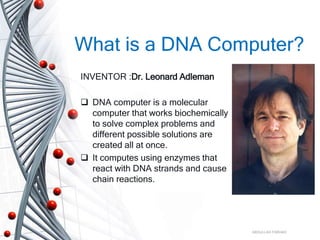
What is a DNA Computer?
INVENTOR :Dr. Leonard Adleman
 DNA computer is a molecular
computer that works biochemically
to solve complex problems and
different possible solutions are
created all at once.
 It computes using enzymes that
react with DNA strands and cause
chain reactions.
ABDULLAH FARHAD
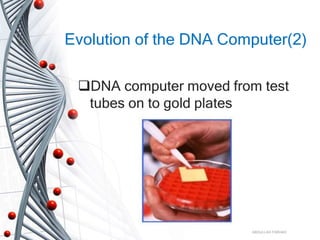
Evolution of the DNA Computer(2)
DNA computer moved from test
tubes on to gold plates
ABDULLAH FARHAD
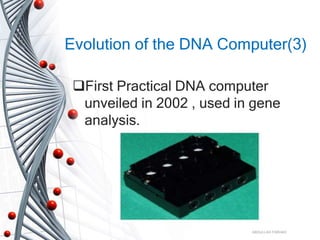
Evolution of the DNA Computer(3)
First Practical DNA computer
unveiled in 2002 , used in gene
analysis.
ABDULLAH FARHAD
Evolution of the DNA Computer(4)
Self powered DNA computer
unveiled in 2003.
o First programmable autonomous computing
machine in which the input,output,software
and hardware are all made of DNA
molecules.
o Can perform a billion operations per second
with 99.8% accuracy
ABDULLAH FARHAD
Properties of a DNA computer
Dense data storage.
Massively parallel computation.
Extraordinary energy efficiency.
ABDULLAH FARHAD
How Dense is the Data Storage?
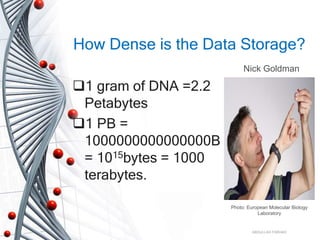
1 gram of DNA =2.2
Petabytes
1 PB =
1000000000000000B
= 1015bytes = 1000
terabytes.
ABDULLAH FARHAD
Photo: European Molecular Biology
Laboratory
Nick Goldman
How Dense is the Data
Storage?(Continuous……….)
ABDULLAH FARHAD
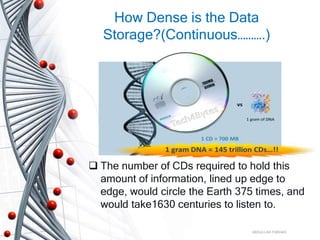
 The number of CDs required to hold this
amount of information, lined up edge to
edge, would circle the Earth 375 times, and
would take1630 centuries to listen to.
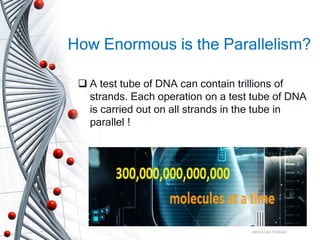
How Enormous is the Parallelism?
 A test tube of DNA can contain trillions of
strands. Each operation on a test tube of DNA
is carried out on all strands in the tube in
parallel !
ABDULLAH FARHAD
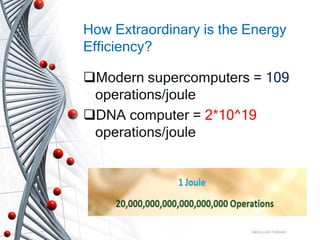
How Extraordinary is the Energy
Efficiency?
Modern supercomputers = 109
operations/joule
DNA computer = 2*10^19
operations/joule
ABDULLAH FARHAD
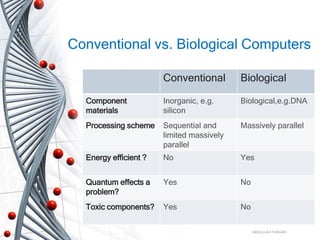
Conventional vs. Biological Computers
Conventional Biological
Component
materials
Inorganic, e.g.
silicon
Biological,e.g.DNA
Processing scheme Sequential and
limited massively
parallel
Massively parallel
Energy efficient ? No Yes
Quantum effects a
problem?
Yes No
Toxic components? Yes No
ABDULLAH FARHAD
Advantages of DNA computers
Cheap resource & plentiful supply.
DNA biochips can be made
cleanly so no toxic materials are
used.
Many times smaller in size than
current Computers.
ABDULLAH FARHAD
Advantages(Continuous...)
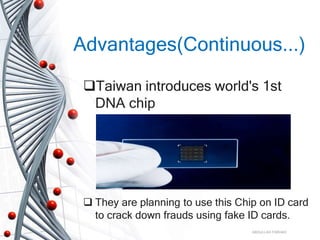
Taiwan introduces world's 1st
DNA chip
 They are planning to use this Chip on ID card
to crack down frauds using fake ID cards.
ABDULLAH FARHAD
Disadvantages
Not completely accurate at this
moment in time.
During an operation, 95% chance a particular
DNA molecule will “Compute” correctly.
DNA has a Half life
Solutions could dissolve away before the end
result is found
ABDULLAH FARHAD
Applications of DNA computing
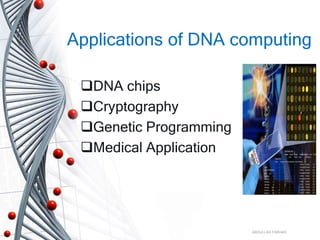
DNA chips
Cryptography
Genetic Programming
Medical Application
ABDULLAH FARHAD
Conclusion
DNA computers showing enormous
potential, especially for medical
purposes as well as data processing
applications.
Still a lot of work and resources
required to develop it into a fully
fledged product.
ABDULLAH FARHAD
Reference
• http://www.neatorama.com/2013/01/23/Each-Gram-of-DNA-
Holds-Half-a-Million-DVDs/#!GuIF3
• http://en.wikipedia.org/wiki/Biological_computer
• http://sgugenetics.pbworks.com/w/page/47747543/DNA%20Micr
oarray%20Manufacture1
• http://learn.genetics.utah.edu/content/labs/microarray/
• http://www.transcriptome.ens.fr/sgdb/presentation/principle.php#
data_analysis
• http://en.wikipedia.org/wiki/DNA_microarray
• http://www.slideshare.net/TJPetry/BIOInspiredComputingFinalV
ersion
ABDULLAH FARHAD
ABDULLAH FARHAD

biocomputing-140723074801-phpapp01.pdf

  • 1.
  • 2.
    Topics  Bio Computing DNA  DNA computing  Conventional vs DNA computer  Application ABDULLAH FARHAD
  • 3.
    Why Bio Computing?? ABDULLAH FARHAD  Moore’s Law states that silicon microprocessor complexity will double in every 18 months.  One day this will no longer hold true when miniaturization limits are reached.  Solving complex problems which today's supercomputers are unable to perform in stipulated period of time.  Require a Successor to Silicon
  • 4.
  • 5.
    What is BiologicalComputing?  Biological Computing means such a computing process which use synthesized biological components to store and manipulate data analogous to processes in the human body.  The result is small ; faster computing process that operates with great accuracy.  Main biological component used in Biological Computing is : DNA ABDULLAH FARHAD
  • 6.
    What is DNA? DNA Stands for DeOxyRiboNucleicAcid.  A hereditary material found in almost all living organisms.  Located inside the nucleus of a cell.  Helps in long term storage of information.  DNA is stored as a code made of four chemical bases(A,T,G ,C). ABDULLAH FARHAD
  • 7.
    Structure of DNA The two strands of DNA molecule are anti parallel where each strand runs in opposite direction.  Complementary base pairs Adenine(A) &Thymine(T) Guanine(G)&Cytosine(C) ABDULLAH FARHAD
  • 8.
    Graphical Representation ofInherent bonding properties of DNA ABDULLAH FARHAD
  • 9.
    What is aDNA Computer? INVENTOR :Dr. Leonard Adleman  DNA computer is a molecular computer that works biochemically to solve complex problems and different possible solutions are created all at once.  It computes using enzymes that react with DNA strands and cause chain reactions. ABDULLAH FARHAD
  • 10.
    Evolution of theDNA Computer(2) DNA computer moved from test tubes on to gold plates ABDULLAH FARHAD
  • 11.
    Evolution of theDNA Computer(3) First Practical DNA computer unveiled in 2002 , used in gene analysis. ABDULLAH FARHAD
  • 12.
    Evolution of theDNA Computer(4) Self powered DNA computer unveiled in 2003. o First programmable autonomous computing machine in which the input,output,software and hardware are all made of DNA molecules. o Can perform a billion operations per second with 99.8% accuracy ABDULLAH FARHAD
  • 13.
    Properties of aDNA computer Dense data storage. Massively parallel computation. Extraordinary energy efficiency. ABDULLAH FARHAD
  • 14.
    How Dense isthe Data Storage? 1 gram of DNA =2.2 Petabytes 1 PB = 1000000000000000B = 1015bytes = 1000 terabytes. ABDULLAH FARHAD Photo: European Molecular Biology Laboratory Nick Goldman
  • 15.
    How Dense isthe Data Storage?(Continuous……….) ABDULLAH FARHAD  The number of CDs required to hold this amount of information, lined up edge to edge, would circle the Earth 375 times, and would take1630 centuries to listen to.
  • 16.
    How Enormous isthe Parallelism?  A test tube of DNA can contain trillions of strands. Each operation on a test tube of DNA is carried out on all strands in the tube in parallel ! ABDULLAH FARHAD
  • 17.
    How Extraordinary isthe Energy Efficiency? Modern supercomputers = 109 operations/joule DNA computer = 2*10^19 operations/joule ABDULLAH FARHAD
  • 18.
    Conventional vs. BiologicalComputers Conventional Biological Component materials Inorganic, e.g. silicon Biological,e.g.DNA Processing scheme Sequential and limited massively parallel Massively parallel Energy efficient ? No Yes Quantum effects a problem? Yes No Toxic components? Yes No ABDULLAH FARHAD
  • 19.
    Advantages of DNAcomputers Cheap resource & plentiful supply. DNA biochips can be made cleanly so no toxic materials are used. Many times smaller in size than current Computers. ABDULLAH FARHAD
  • 20.
    Advantages(Continuous...) Taiwan introduces world's1st DNA chip  They are planning to use this Chip on ID card to crack down frauds using fake ID cards. ABDULLAH FARHAD
  • 21.
    Disadvantages Not completely accurateat this moment in time. During an operation, 95% chance a particular DNA molecule will “Compute” correctly. DNA has a Half life Solutions could dissolve away before the end result is found ABDULLAH FARHAD
  • 22.
    Applications of DNAcomputing DNA chips Cryptography Genetic Programming Medical Application ABDULLAH FARHAD
  • 23.
    Conclusion DNA computers showingenormous potential, especially for medical purposes as well as data processing applications. Still a lot of work and resources required to develop it into a fully fledged product. ABDULLAH FARHAD
  • 24.
    Reference • http://www.neatorama.com/2013/01/23/Each-Gram-of-DNA- Holds-Half-a-Million-DVDs/#!GuIF3 • http://en.wikipedia.org/wiki/Biological_computer •http://sgugenetics.pbworks.com/w/page/47747543/DNA%20Micr oarray%20Manufacture1 • http://learn.genetics.utah.edu/content/labs/microarray/ • http://www.transcriptome.ens.fr/sgdb/presentation/principle.php# data_analysis • http://en.wikipedia.org/wiki/DNA_microarray • http://www.slideshare.net/TJPetry/BIOInspiredComputingFinalV ersion ABDULLAH FARHAD
  • 25.