Guided By:
Megha Kulhia Mam
Neeraj Arya Sir
Presented By:
Pappoo Sahu
Rahul Tripathi
• Introduction
• History
• Data Storage Technique
• Basic Concepts
• Salmon RAM
• Biological Computer
• Conclusion
• Bibliography
• A bioengineer and geneticist at Harvard’s Wyss Institute have successfully
stored 5.5 petabits of data — around 700 terabytes — in a single gram of
DNA, smashing the previous DNA data density record by a thousand times.
• The work, carried out by George Church and Sri Kosuri, basically treats DNA
as just another digital storage device.
• Instead of binary data being encoded as magnetic regions on a hard drive
platter, strands of DNA that store 96 bits are synthesized, with each of the
bases (TGAC) representing a binary value (T and G = 1, A and C = 0).
• It has been around since 1988, the J. Craig Venter Institute, a non profit
genomics research organization with facilities in 3 different US states. These
investigators were able to encode 7920 bits into DNA.
• In Frank Herbert’s novel Dune (Clinton Book Company, 1965), spaceships are
able to navigate only because their control systems know at all times the
positions of all celestial bodies. The Navigators can do this because their DNA
contains all of the information needed for space travel.
• This technique was inspired by the World War II microdot technique of
Germany, in which an entire page of information was photographed and
reduced to the size of the dot at end of this sentence. DNA microdots can be
hidden in general genetic material with their locations known only to those who
know the primers marking the beginning and end of their specific DNA
segments, which can then be resolved and read with PCR.
• Sequencing the human genome.
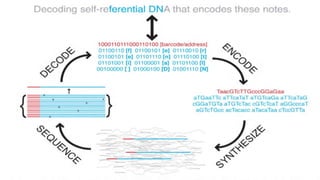
• Convert each of the TGAC bases back into binary. To aid with sequencing,
each strand of DNA has a 19-bit address block at the start (the red bits in
the image below)
• So a whole vat of DNA can be sequenced out of order, and then sorted into
usable data using the addresses.
• Microfluidics and labs-on-a-chip that synthesizing and sequencing DNA has
become an everyday task, though. While it took years for the original
Human Genome Project to analyse a single human genome (some 3 billion
DNA base pairs), modern lab equipment with microfluidic chips can do it
in hours.
• Now this isn’t to say that Church and Kosuri’s DNA storage is fast — but it’s
fast enough for very-long-term archival.
Scientists have been eyeing up DNA as a potential storage medium for a long time,
for three very good reasons:
• It’s incredibly dense (we can store one bit per base, and a base is only a few atoms large).
• it’s volumetric (beaker) rather than planar (hard disk).
• it’s incredibly stable — where other bleeding-edge storage mediums need to be kept in
sub-zero vacuums, DNA can survive for hundreds of thousands of years in a box in your
garage.
• One gram of DNA can store 700 terabytes of data. That’s 14,000 50-gigabyte Blu-ray discs.
• To store the same kind of data on hard drives
• The densest storage medium in use today
• Need 233 3TB drives, weighing a total of 151 kilos. In Church and Kosuri’s case, they
have successfully stored around 700 kilobytes of data in DNA totalling 44 petabytes of
data stored.
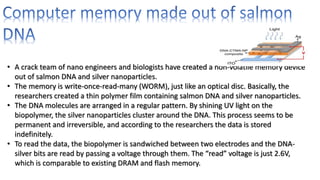
• A crack team of nano engineers and biologists have created a non-volatile memory device
out of salmon DNA and silver nanoparticles.
• The memory is write-once-read-many (WORM), just like an optical disc. Basically, the
researchers created a thin polymer film containing salmon DNA and silver nanoparticles.
• The DNA molecules are arranged in a regular pattern. By shining UV light on the
biopolymer, the silver nanoparticles cluster around the DNA. This process seems to be
permanent and irreversible, and according to the researchers the data is stored
indefinitely.
• To read the data, the biopolymer is sandwiched between two electrodes and the DNA-
silver bits are read by passing a voltage through them. The “read” voltage is just 2.6V,
which is comparable to existing DRAM and flash memory.
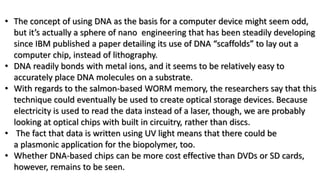
• The concept of using DNA as the basis for a computer device might seem odd,
but it’s actually a sphere of nano engineering that has been steadily developing
since IBM published a paper detailing its use of DNA “scaffolds” to lay out a
computer chip, instead of lithography.
• DNA readily bonds with metal ions, and it seems to be relatively easy to
accurately place DNA molecules on a substrate.
• With regards to the salmon-based WORM memory, the researchers say that this
technique could eventually be used to create optical storage devices. Because
electricity is used to read the data instead of a laser, though, we are probably
looking at optical chips with built in circuitry, rather than discs.
• The fact that data is written using UV light means that there could be
a plasmonic application for the biopolymer, too.
• Whether DNA-based chips can be more cost effective than DVDs or SD cards,
however, remains to be seen.
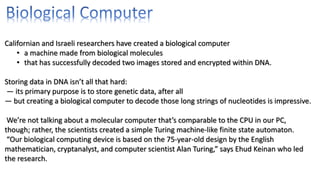
Californian and Israeli researchers have created a biological computer
• a machine made from biological molecules
• that has successfully decoded two images stored and encrypted within DNA.
Storing data in DNA isn’t all that hard:
— its primary purpose is to store genetic data, after all
— but creating a biological computer to decode those long strings of nucleotides is impressive.
We’re not talking about a molecular computer that’s comparable to the CPU in our PC,
though; rather, the scientists created a simple Turing machine-like finite state automaton.
“Our biological computing device is based on the 75-year-old design by the English
mathematician, cryptanalyst, and computer scientist Alan Turing,” says Ehud Keinan who led
the research.
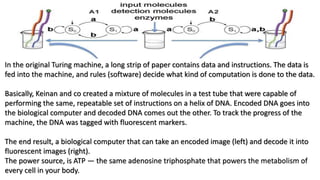
In the original Turing machine, a long strip of paper contains data and instructions. The data is
fed into the machine, and rules (software) decide what kind of computation is done to the data.
Basically, Keinan and co created a mixture of molecules in a test tube that were capable of
performing the same, repeatable set of instructions on a helix of DNA. Encoded DNA goes into
the biological computer and decoded DNA comes out the other. To track the progress of the
machine, the DNA was tagged with fluorescent markers.
The end result, a biological computer that can take an encoded image (left) and decode it into
fluorescent images (right).
The power source, is ATP — the same adenosine triphosphate that powers the metabolism of
every cell in your body.
• Molecular computers are nothing like digital computers: Where
a CPU generally processes data in a linear fashion.
• Biological systems are basically a huge mess of chemical reactions that occur
autonomously and without much in the way of timing. As such, biological
computers are massively parallel.
• Molecular computers are also incredibly specialized: We can’t make a
molecular CPU (at least not yet!); We have to carefully craft a mixture of
molecules that perform a very specific task.
• It’s unlikely, at least for the time being, that biological computers will ever
replace general purpose digital computers.
Looking forward, they foresee a world where biological storage would allow us to
record anything and everything without reservation.
Today, we wouldn’t dream of blanketing every square meter of Earth with cameras,
and recording every moment for all eternity/human posterity:
• We simply don’t have the storage capacity. There is a reason that backed up
data is usually only kept for a few weeks or months
• It just isn’t feasible to have warehouses full of hard drives, which could fail at
any time. If the entirety of human knowledge every book, uttered word, and
funny cat video can be stored in a few hundred kilos of DNA, though… well, it
might just be possible to record everything (hello, police state!)
It’s also worth noting that it’s possible to store data in the DNA of living cells —
though only for a short time. Storing data in your skin would be a fantastic way of
transferring data securely…
• http://www.extremetech.com/extreme/117463-biological-computer-can-
decrypt-images-stored-in-dna.
• horizon-magazine.eu/article/it-s-genes-data-storage-turns-dna_en.html
• http://www.extremetech.com/extreme/117191-computer-memory-made-
out-of-salmon-dna.

Genetic data storage

  • 1.
    Guided By: Megha KulhiaMam Neeraj Arya Sir Presented By: Pappoo Sahu Rahul Tripathi
  • 2.
    • Introduction • History •Data Storage Technique • Basic Concepts • Salmon RAM • Biological Computer • Conclusion • Bibliography
  • 3.
    • A bioengineerand geneticist at Harvard’s Wyss Institute have successfully stored 5.5 petabits of data — around 700 terabytes — in a single gram of DNA, smashing the previous DNA data density record by a thousand times. • The work, carried out by George Church and Sri Kosuri, basically treats DNA as just another digital storage device. • Instead of binary data being encoded as magnetic regions on a hard drive platter, strands of DNA that store 96 bits are synthesized, with each of the bases (TGAC) representing a binary value (T and G = 1, A and C = 0).
  • 4.
    • It hasbeen around since 1988, the J. Craig Venter Institute, a non profit genomics research organization with facilities in 3 different US states. These investigators were able to encode 7920 bits into DNA. • In Frank Herbert’s novel Dune (Clinton Book Company, 1965), spaceships are able to navigate only because their control systems know at all times the positions of all celestial bodies. The Navigators can do this because their DNA contains all of the information needed for space travel. • This technique was inspired by the World War II microdot technique of Germany, in which an entire page of information was photographed and reduced to the size of the dot at end of this sentence. DNA microdots can be hidden in general genetic material with their locations known only to those who know the primers marking the beginning and end of their specific DNA segments, which can then be resolved and read with PCR.
  • 5.
    • Sequencing thehuman genome. • Convert each of the TGAC bases back into binary. To aid with sequencing, each strand of DNA has a 19-bit address block at the start (the red bits in the image below) • So a whole vat of DNA can be sequenced out of order, and then sorted into usable data using the addresses. • Microfluidics and labs-on-a-chip that synthesizing and sequencing DNA has become an everyday task, though. While it took years for the original Human Genome Project to analyse a single human genome (some 3 billion DNA base pairs), modern lab equipment with microfluidic chips can do it in hours. • Now this isn’t to say that Church and Kosuri’s DNA storage is fast — but it’s fast enough for very-long-term archival.
  • 7.
    Scientists have beeneyeing up DNA as a potential storage medium for a long time, for three very good reasons: • It’s incredibly dense (we can store one bit per base, and a base is only a few atoms large). • it’s volumetric (beaker) rather than planar (hard disk). • it’s incredibly stable — where other bleeding-edge storage mediums need to be kept in sub-zero vacuums, DNA can survive for hundreds of thousands of years in a box in your garage. • One gram of DNA can store 700 terabytes of data. That’s 14,000 50-gigabyte Blu-ray discs. • To store the same kind of data on hard drives • The densest storage medium in use today • Need 233 3TB drives, weighing a total of 151 kilos. In Church and Kosuri’s case, they have successfully stored around 700 kilobytes of data in DNA totalling 44 petabytes of data stored.
  • 8.
    • A crackteam of nano engineers and biologists have created a non-volatile memory device out of salmon DNA and silver nanoparticles. • The memory is write-once-read-many (WORM), just like an optical disc. Basically, the researchers created a thin polymer film containing salmon DNA and silver nanoparticles. • The DNA molecules are arranged in a regular pattern. By shining UV light on the biopolymer, the silver nanoparticles cluster around the DNA. This process seems to be permanent and irreversible, and according to the researchers the data is stored indefinitely. • To read the data, the biopolymer is sandwiched between two electrodes and the DNA- silver bits are read by passing a voltage through them. The “read” voltage is just 2.6V, which is comparable to existing DRAM and flash memory.
  • 9.
    • The conceptof using DNA as the basis for a computer device might seem odd, but it’s actually a sphere of nano engineering that has been steadily developing since IBM published a paper detailing its use of DNA “scaffolds” to lay out a computer chip, instead of lithography. • DNA readily bonds with metal ions, and it seems to be relatively easy to accurately place DNA molecules on a substrate. • With regards to the salmon-based WORM memory, the researchers say that this technique could eventually be used to create optical storage devices. Because electricity is used to read the data instead of a laser, though, we are probably looking at optical chips with built in circuitry, rather than discs. • The fact that data is written using UV light means that there could be a plasmonic application for the biopolymer, too. • Whether DNA-based chips can be more cost effective than DVDs or SD cards, however, remains to be seen.
  • 10.
    Californian and Israeliresearchers have created a biological computer • a machine made from biological molecules • that has successfully decoded two images stored and encrypted within DNA. Storing data in DNA isn’t all that hard: — its primary purpose is to store genetic data, after all — but creating a biological computer to decode those long strings of nucleotides is impressive. We’re not talking about a molecular computer that’s comparable to the CPU in our PC, though; rather, the scientists created a simple Turing machine-like finite state automaton. “Our biological computing device is based on the 75-year-old design by the English mathematician, cryptanalyst, and computer scientist Alan Turing,” says Ehud Keinan who led the research.
  • 11.
    In the originalTuring machine, a long strip of paper contains data and instructions. The data is fed into the machine, and rules (software) decide what kind of computation is done to the data. Basically, Keinan and co created a mixture of molecules in a test tube that were capable of performing the same, repeatable set of instructions on a helix of DNA. Encoded DNA goes into the biological computer and decoded DNA comes out the other. To track the progress of the machine, the DNA was tagged with fluorescent markers. The end result, a biological computer that can take an encoded image (left) and decode it into fluorescent images (right). The power source, is ATP — the same adenosine triphosphate that powers the metabolism of every cell in your body.
  • 12.
    • Molecular computersare nothing like digital computers: Where a CPU generally processes data in a linear fashion. • Biological systems are basically a huge mess of chemical reactions that occur autonomously and without much in the way of timing. As such, biological computers are massively parallel. • Molecular computers are also incredibly specialized: We can’t make a molecular CPU (at least not yet!); We have to carefully craft a mixture of molecules that perform a very specific task. • It’s unlikely, at least for the time being, that biological computers will ever replace general purpose digital computers.
  • 13.
    Looking forward, theyforesee a world where biological storage would allow us to record anything and everything without reservation. Today, we wouldn’t dream of blanketing every square meter of Earth with cameras, and recording every moment for all eternity/human posterity: • We simply don’t have the storage capacity. There is a reason that backed up data is usually only kept for a few weeks or months • It just isn’t feasible to have warehouses full of hard drives, which could fail at any time. If the entirety of human knowledge every book, uttered word, and funny cat video can be stored in a few hundred kilos of DNA, though… well, it might just be possible to record everything (hello, police state!) It’s also worth noting that it’s possible to store data in the DNA of living cells — though only for a short time. Storing data in your skin would be a fantastic way of transferring data securely…
  • 14.