The document discusses biocomputing, a process that utilizes synthesized biological components like DNA to store and manipulate data, resulting in faster and more accurate computations. It explains the workings of DNA computers, their applications in various fields, and highlights their advantages such as dense data storage and energy efficiency. It also addresses the current challenges in controlling molecular computing and the need for advancements in biotechnology.
WHAT IS BIOLOGICALCOMPUTING?
“Biological Computing means such a computing process which use
synthesized biological components to store and manipulate data
analogous to processes in the human body.”
The result is small ; faster computing process that operates with great
accuracy.
Main biological component used in Biological Computing is : DNA
4.
BIOCOMPUTERS
Biocomputers arenot robots or any spiritual being but they work like a
powerful computer,
CPU as its brain and DNA are its softwares.
Biocomputing uses molecular biology parts as the hardware.
Biocomputers are able to process inputs and return outputs—thus
computing information.
Perform computational calculations involving storing, retrieving, and
processing data.
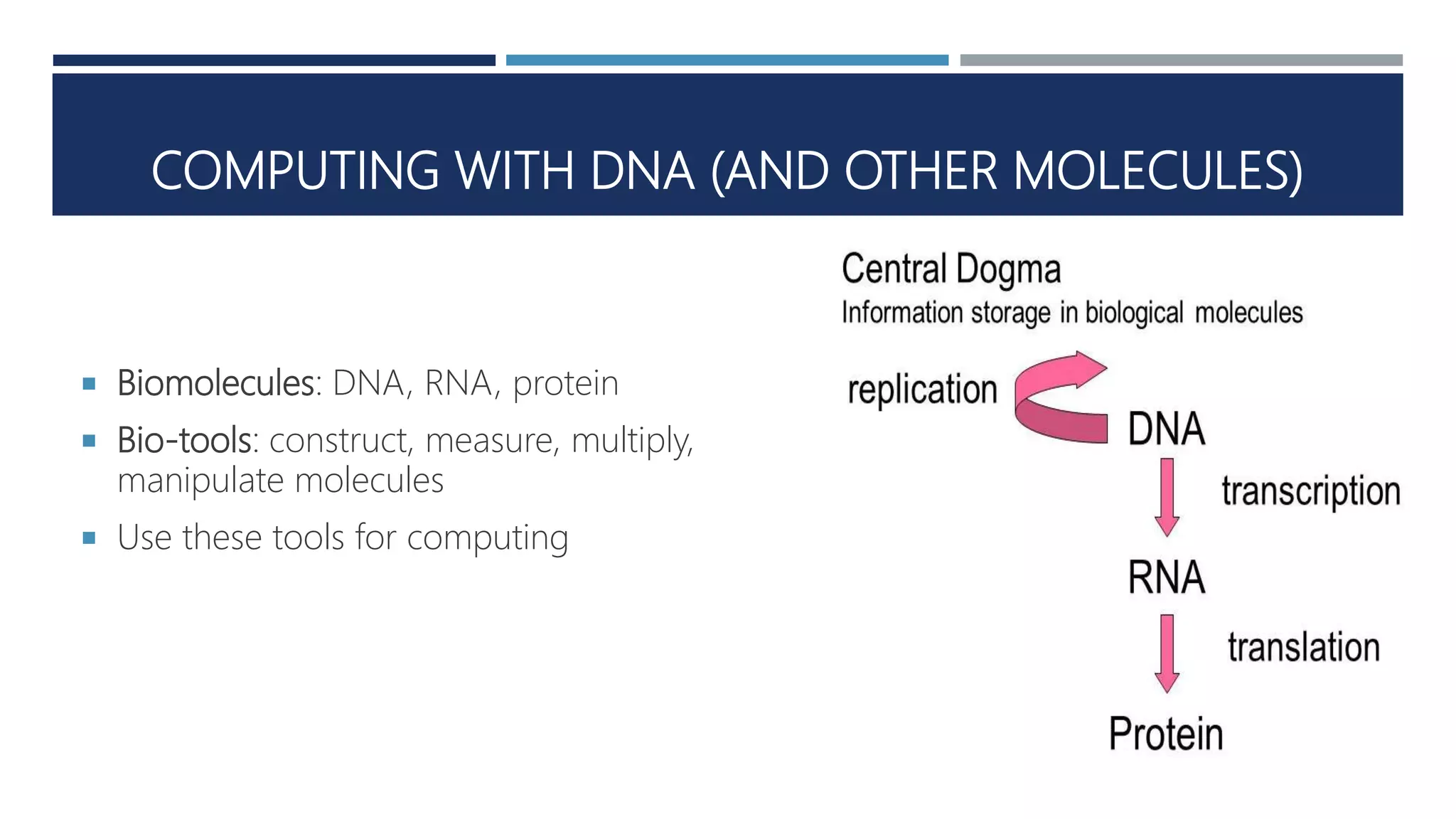
COMPUTING WITH DNA(AND OTHER MOLECULES)
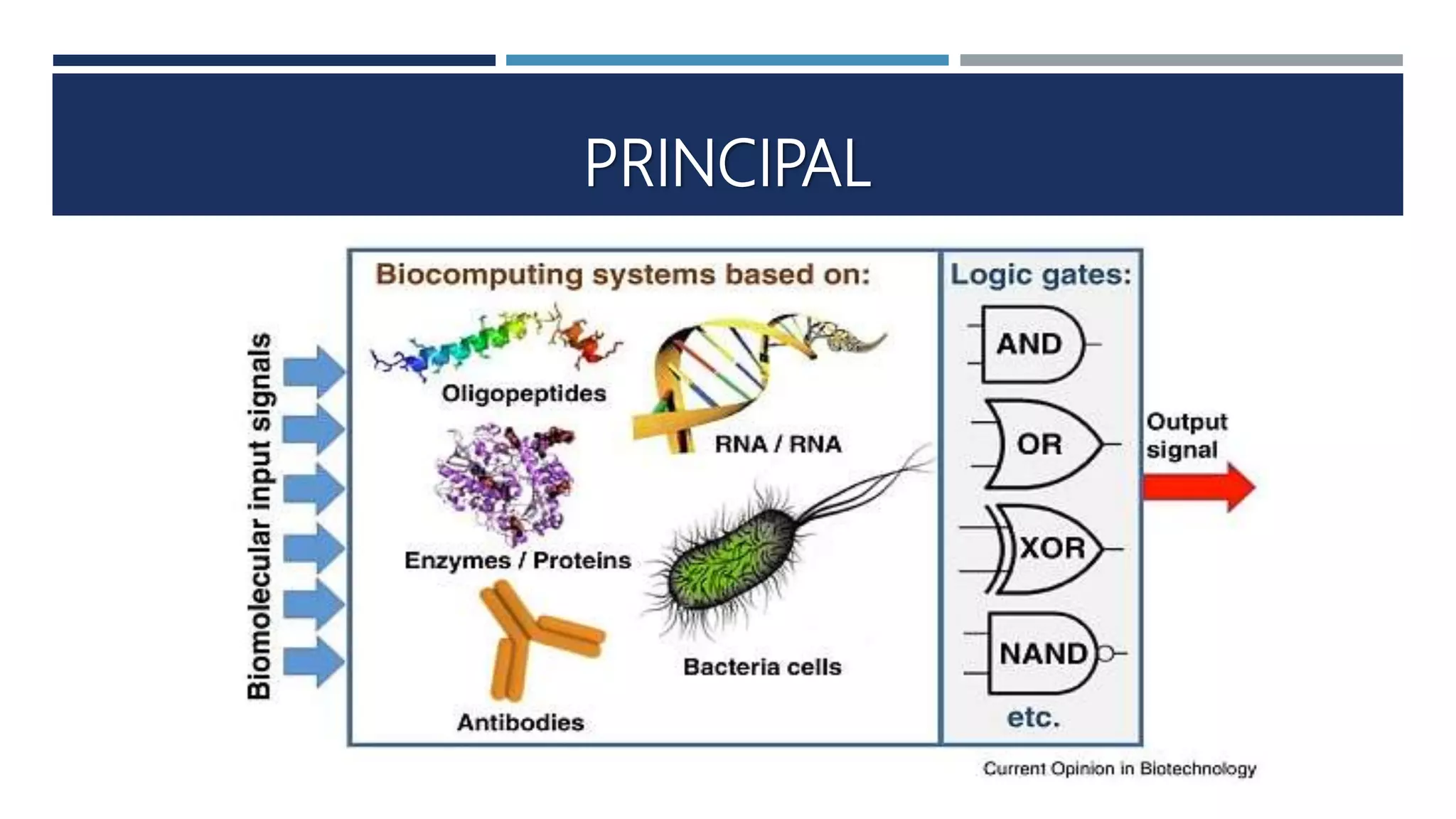
Biomolecules: DNA, RNA, protein
Bio-tools: construct, measure, multiply,
manipulate molecules
Use these tools for computing
7.
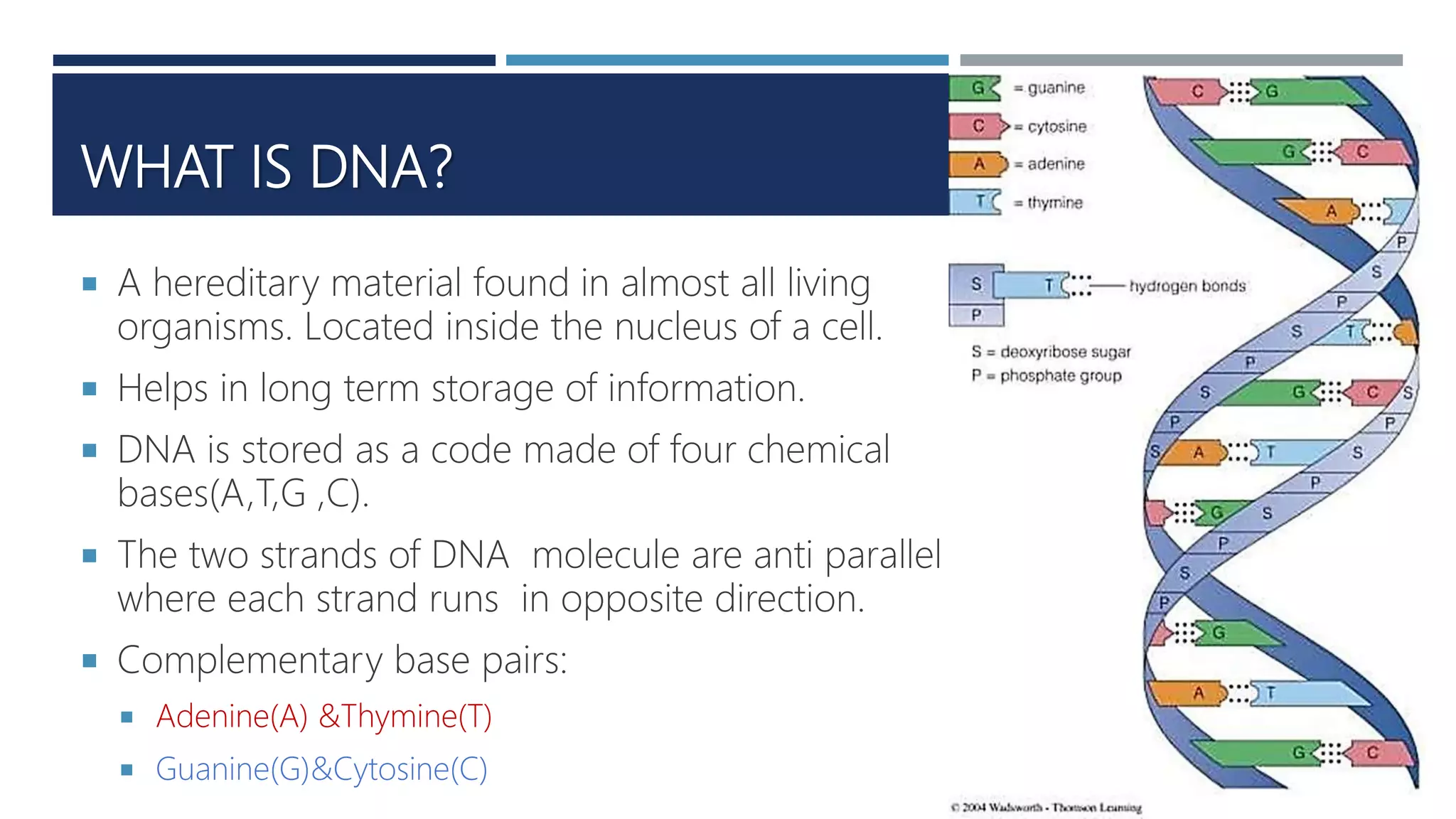
WHAT IS DNA?
A hereditary material found in almost all living
organisms. Located inside the nucleus of a cell.
Helps in long term storage of information.
DNA is stored as a code made of four chemical
bases(A,T,G ,C).
The two strands of DNA molecule are anti parallel
where each strand runs in opposite direction.
Complementary base pairs:
Adenine(A) &Thymine(T)
Guanine(G)&Cytosine(C)
8.
COMPUTING USING DNASTRUCTURES
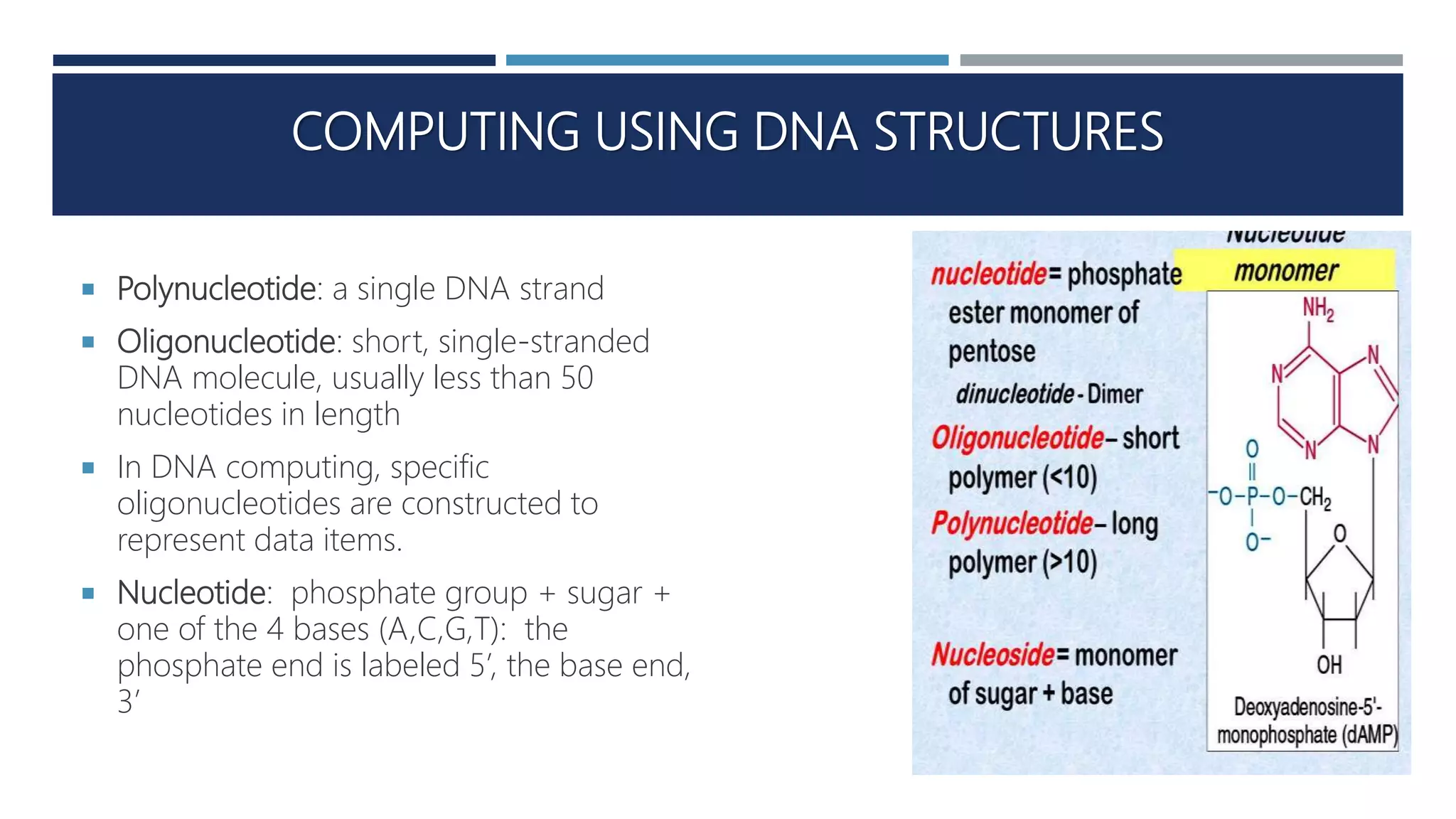
Polynucleotide: a single DNA strand
Oligonucleotide: short, single-stranded
DNA molecule, usually less than 50
nucleotides in length
In DNA computing, specific
oligonucleotides are constructed to
represent data items.
Nucleotide: phosphate group + sugar +
one of the 4 bases (A,C,G,T): the
phosphate end is labeled 5’, the base end,
3’
9.
WHAT IS ADNA COMPUTER?
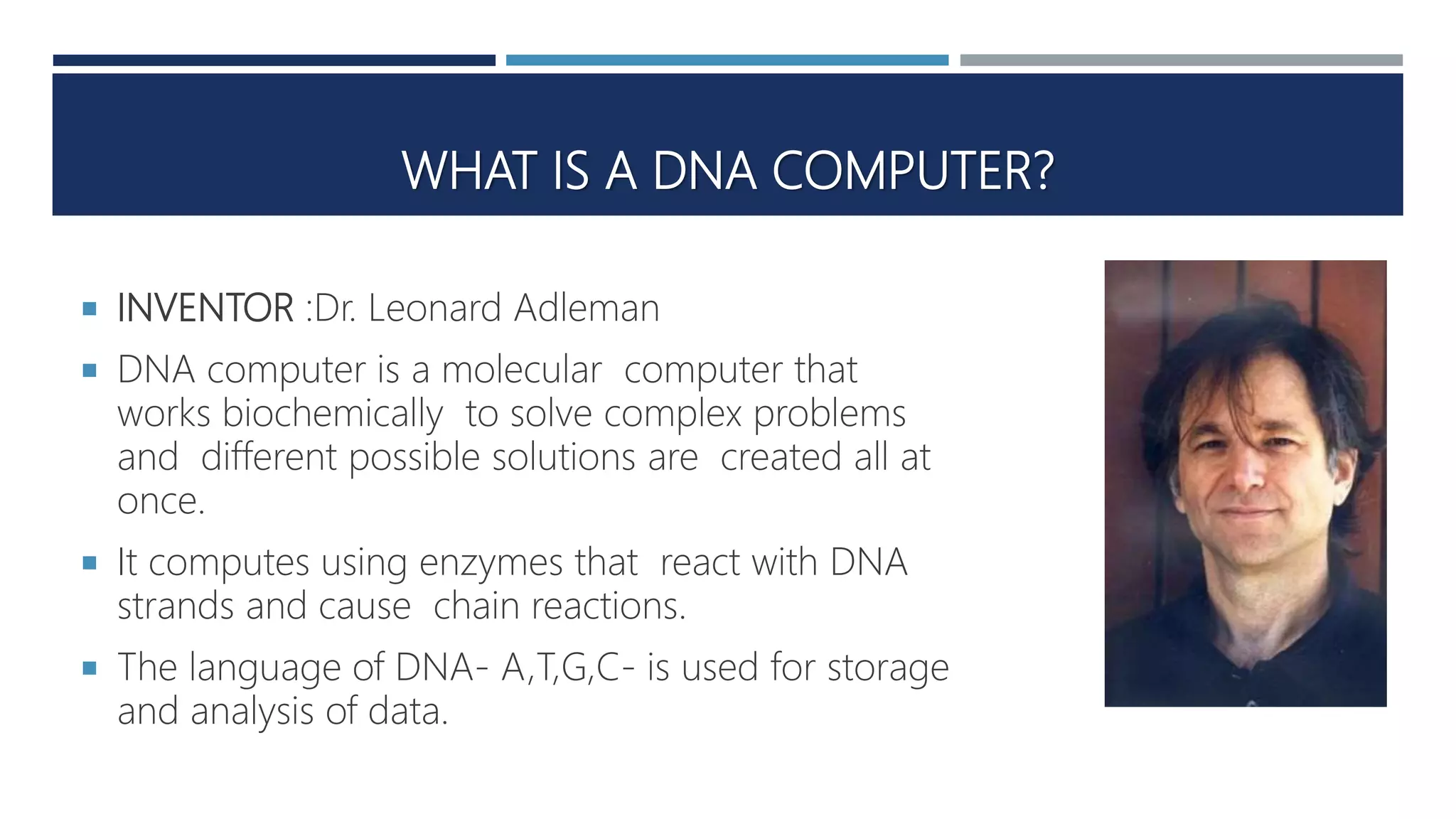
INVENTOR :Dr. Leonard Adleman
DNA computer is a molecular computer that
works biochemically to solve complex problems
and different possible solutions are created all at
once.
It computes using enzymes that react with DNA
strands and cause chain reactions.
The language of DNA- A,T,G,C- is used for storage
and analysis of data.
10.
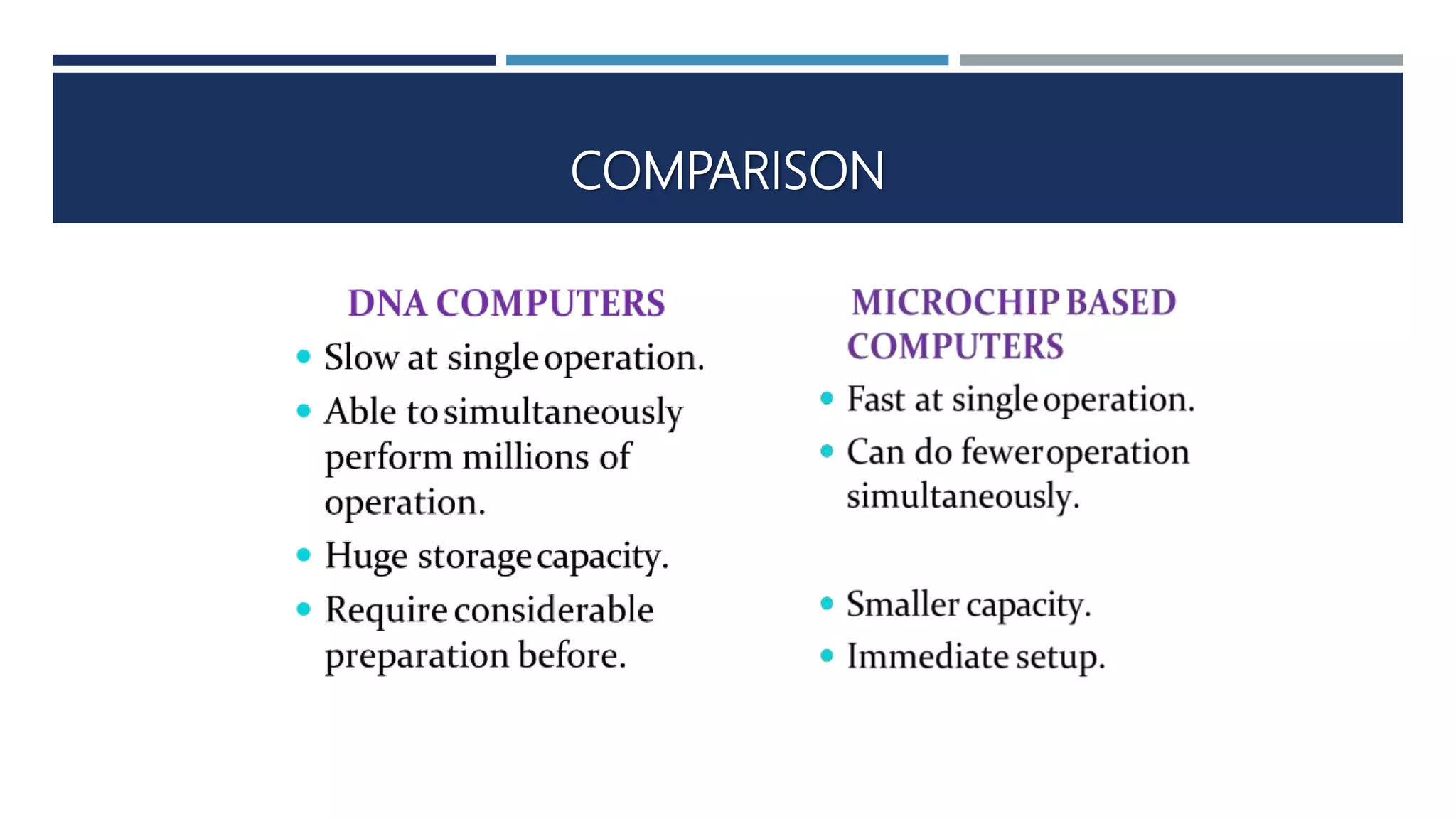
WHY DNA COMPUTING?
Objective reasons: very small,
very precise,
very specific, very cheap, and
very energy efficient
Dense data storage.
Massively parallel computation.
Extraordinary energy efficiency.
11.
HOW DENSE ISTHE DATA STORAGE?
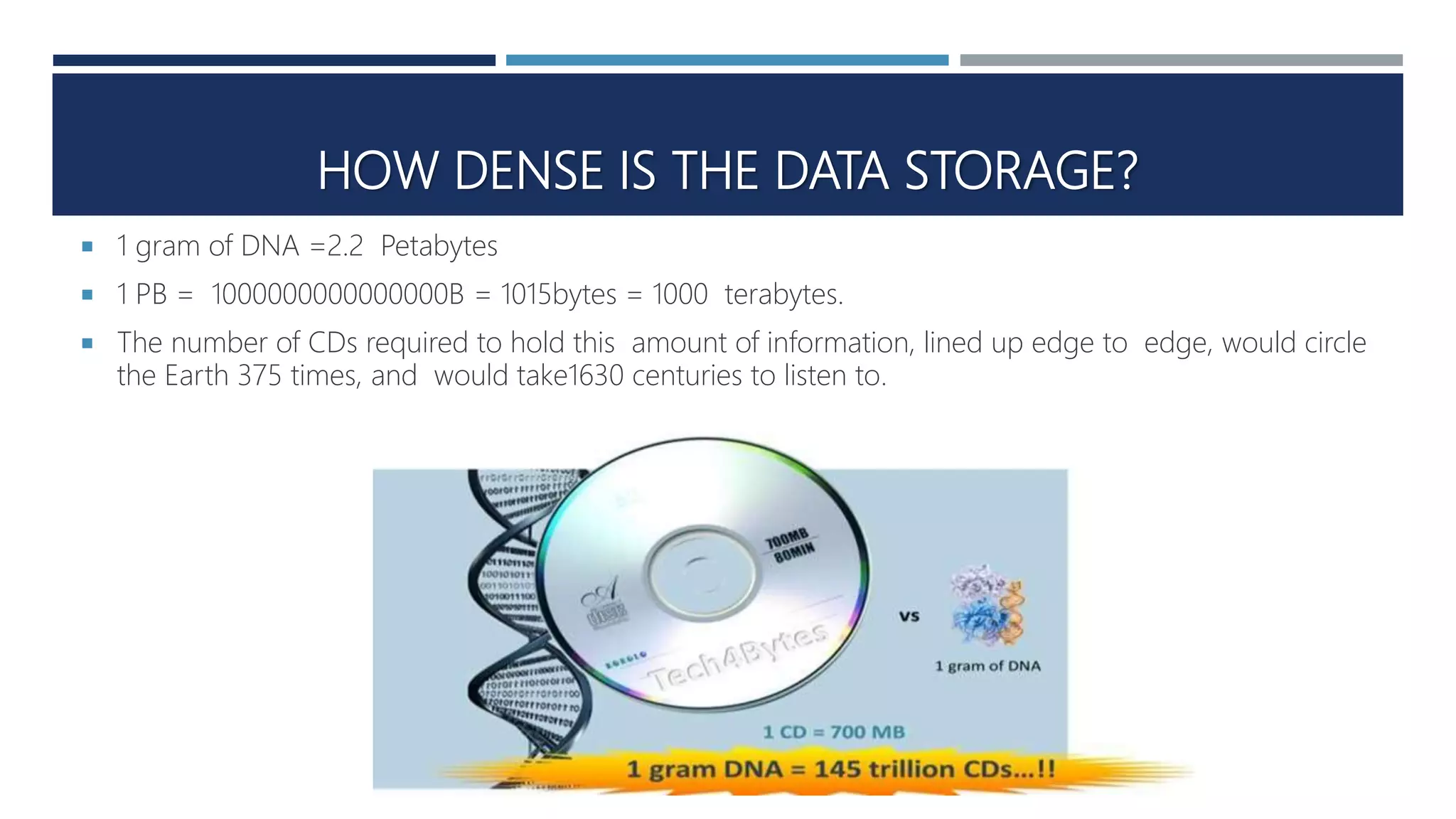
1 gram of DNA =2.2 Petabytes
1 PB = 1000000000000000B = 1015bytes = 1000 terabytes.
The number of CDs required to hold this amount of information, lined up edge to edge, would circle
the Earth 375 times, and would take1630 centuries to listen to.
12.
HOW ENORMOUS ISTHE PARALLELISM?
The main benefit of using DNA computers
to solve complex problems is that different
possible solutions are created all at once.
This is known as parallel processing.
Large size Increase yield
and decrease error
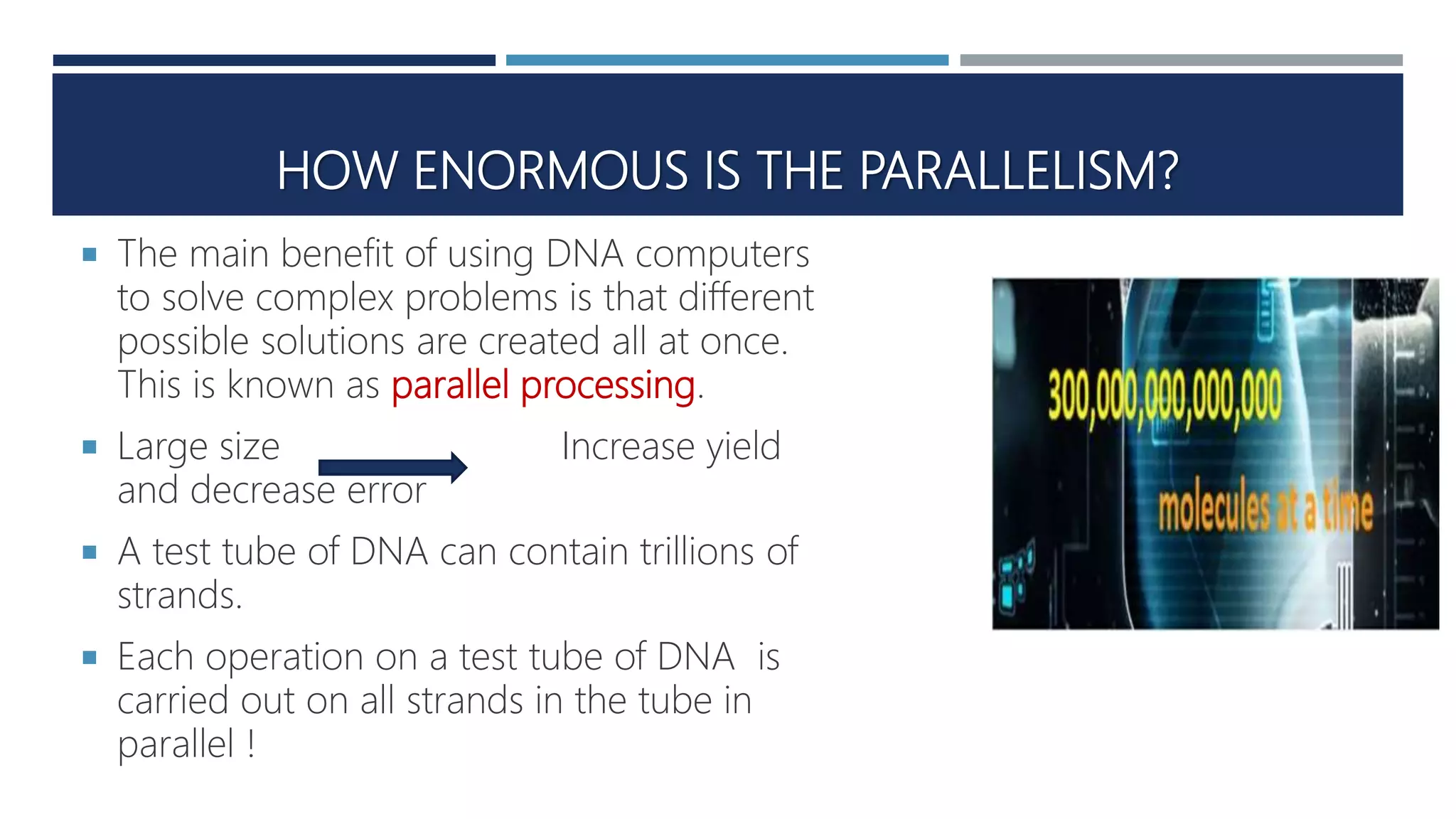
A test tube of DNA can contain trillions of
strands.
Each operation on a test tube of DNA is
carried out on all strands in the tube in
parallel !
13.
HOW EXTRAORDINARY ISTHE ENERGY EFFICIENCY?
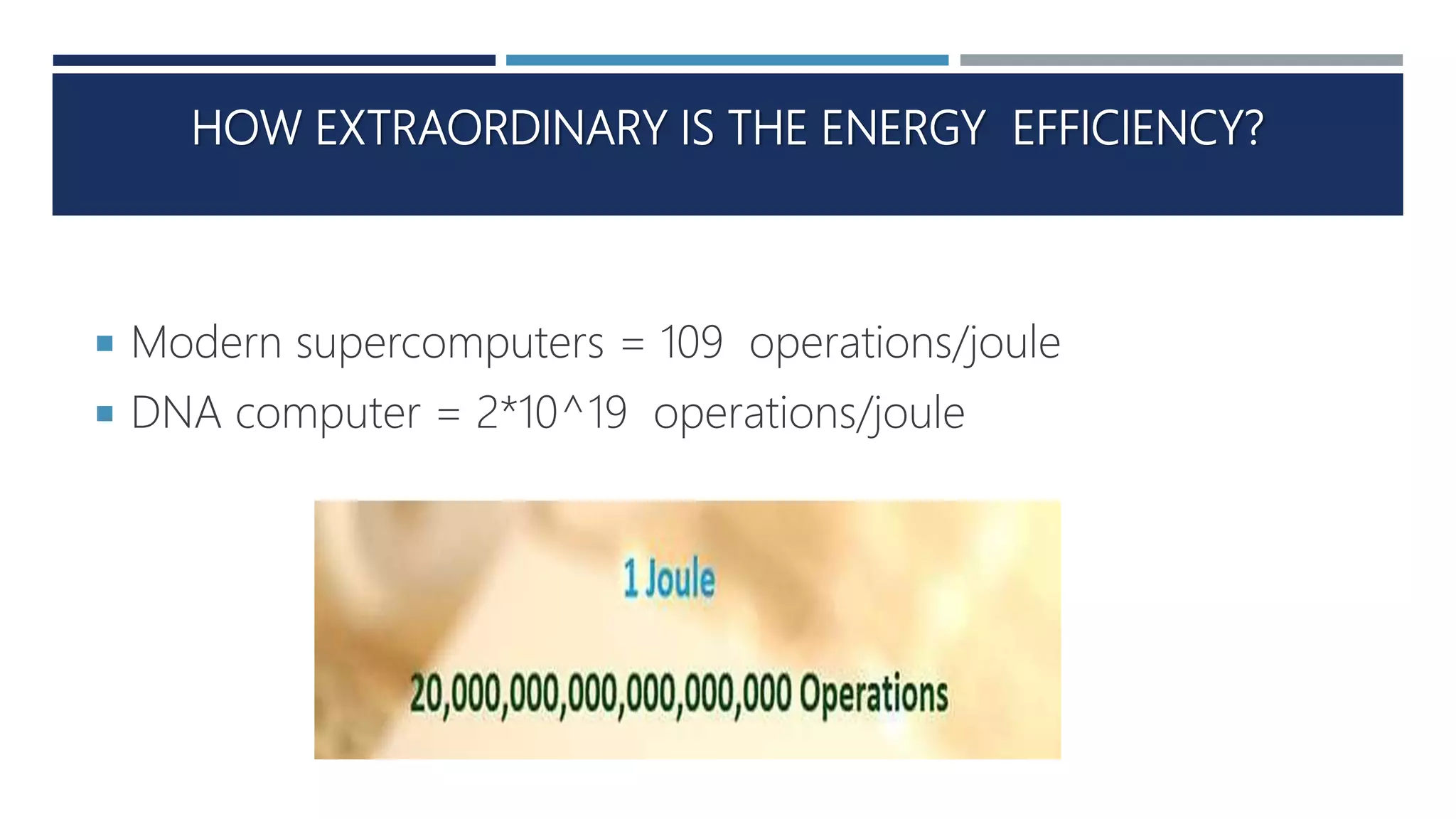
Modern supercomputers = 109 operations/joule
DNA computer = 2*10^19 operations/joule
14.
OTHER REASONS FORMOLECULAR COMPUTING
Physical boundaries for the performances of the electronic computers
Fast development of biotechnologies, genetics, and pharmaceutics
(Theoretical) Understanding the essence of computation
15.
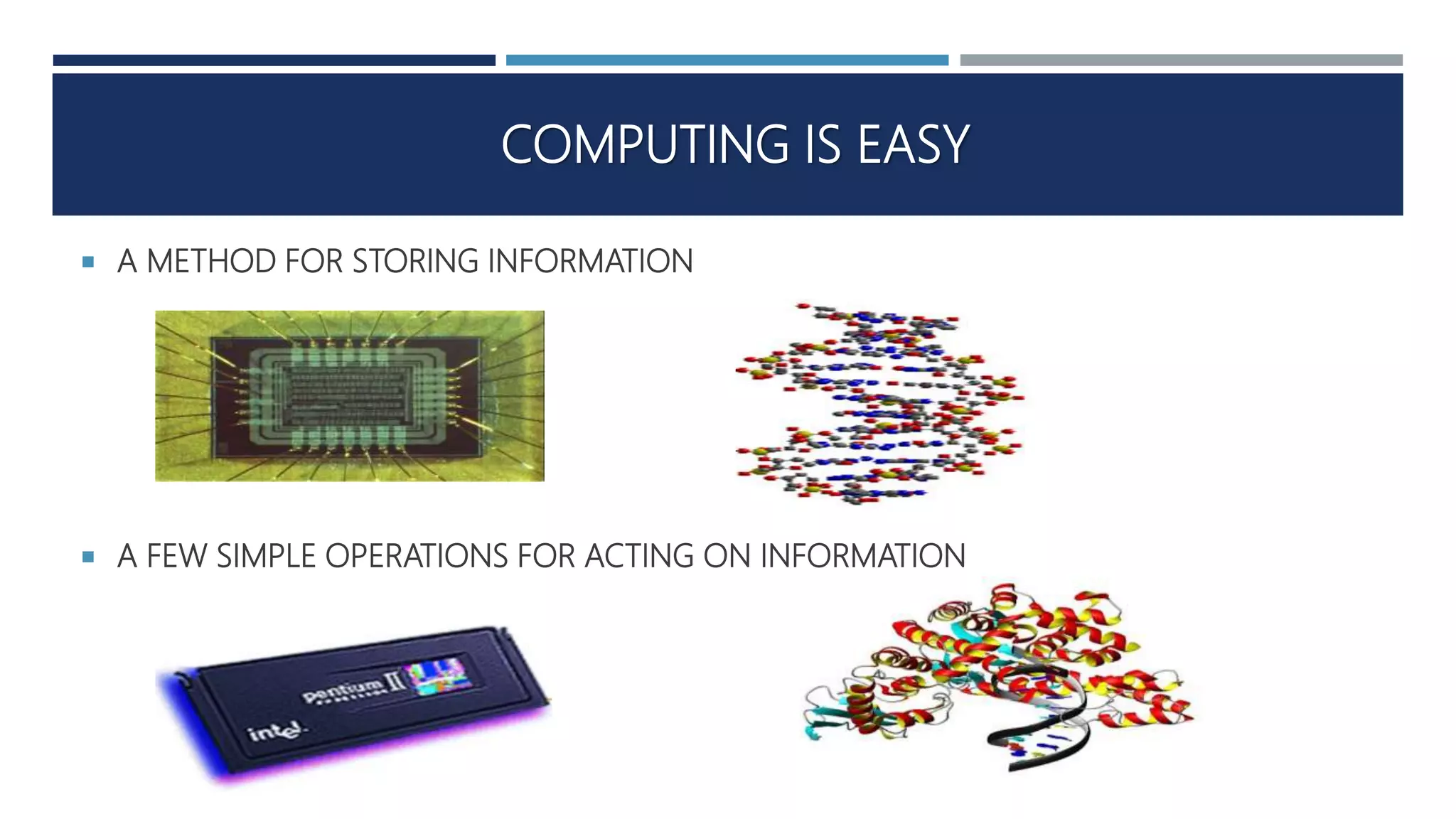
COMPUTING IS EASY
A METHOD FOR STORING INFORMATION
A FEW SIMPLE OPERATIONS FOR ACTING ON INFORMATION
17.
APPLICATIONS
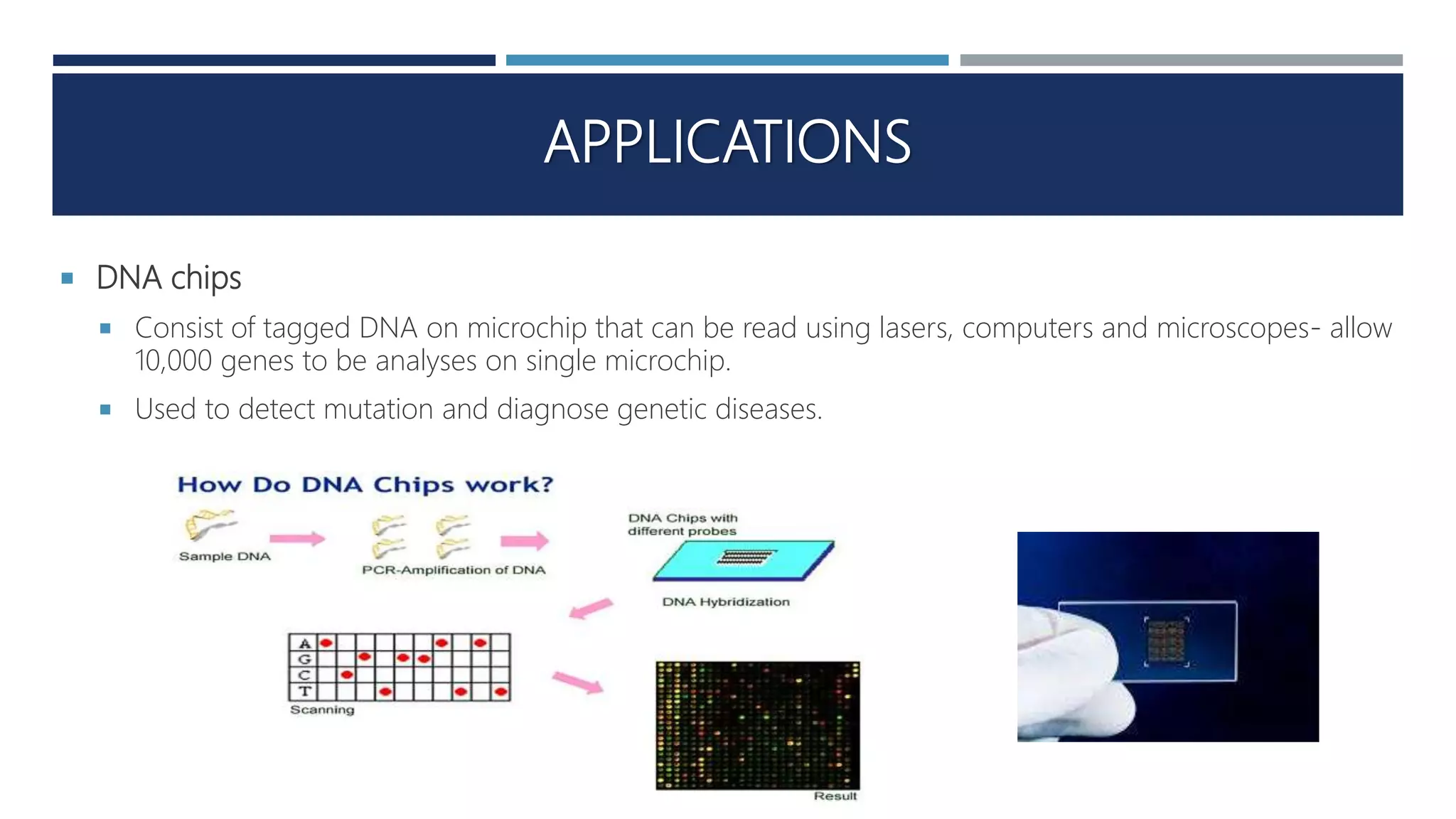
DNA chips
Consist of tagged DNA on microchip that can be read using lasers, computers and microscopes- allow
10,000 genes to be analyses on single microchip.
Used to detect mutation and diagnose genetic diseases.
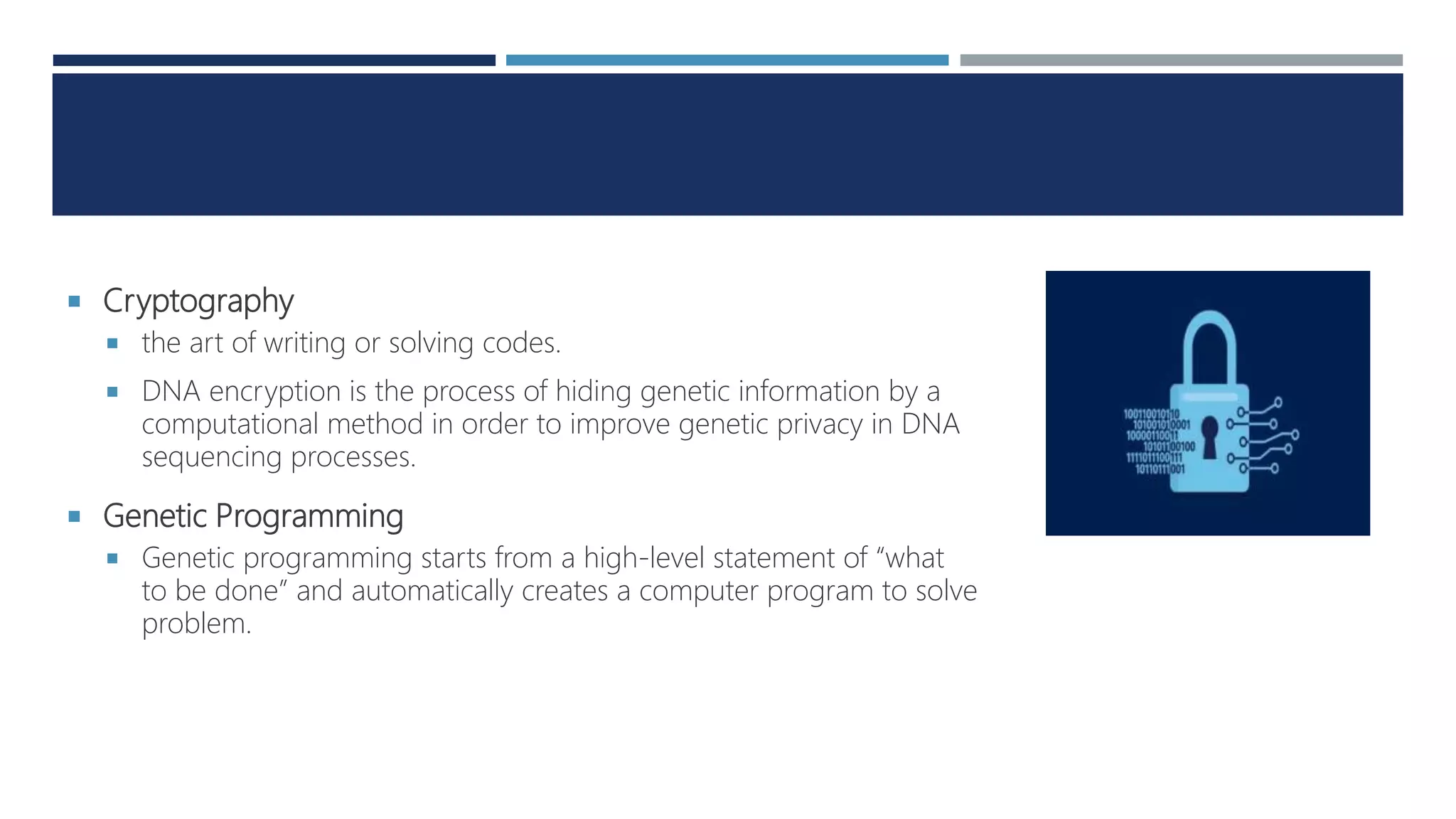
Cryptography
theart of writing or solving codes.
DNA encryption is the process of hiding genetic information by a
computational method in order to improve genetic privacy in DNA
sequencing processes.
Genetic Programming
Genetic programming starts from a high-level statement of “what
to be done” and automatically creates a computer program to solve
problem.
20.
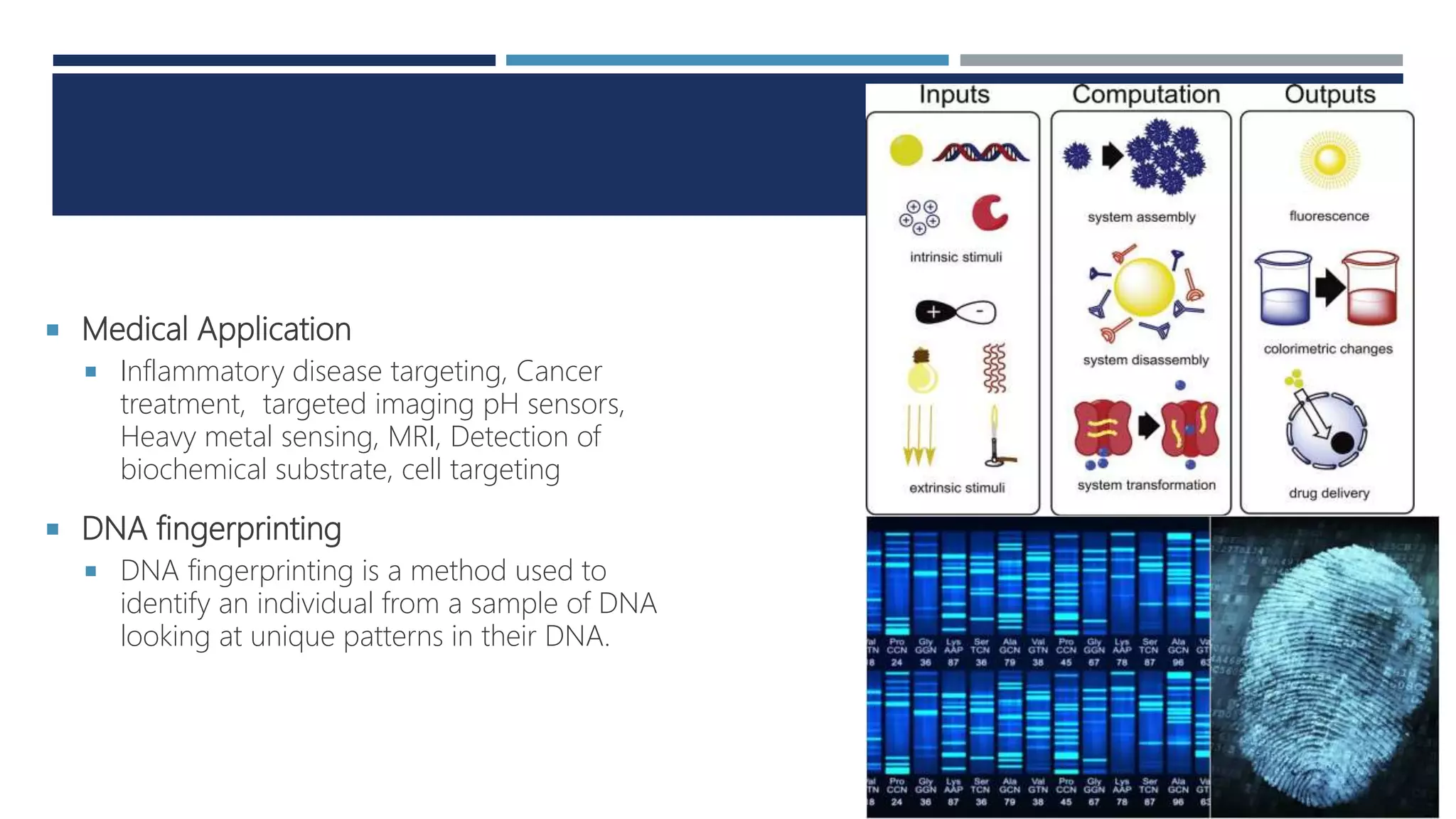
Medical Application
Inflammatory disease targeting, Cancer
treatment, targeted imaging pH sensors,
Heavy metal sensing, MRI, Detection of
biochemical substrate, cell targeting
DNA fingerprinting
DNA fingerprinting is a method used to
identify an individual from a sample of DNA
looking at unique patterns in their DNA.
21.
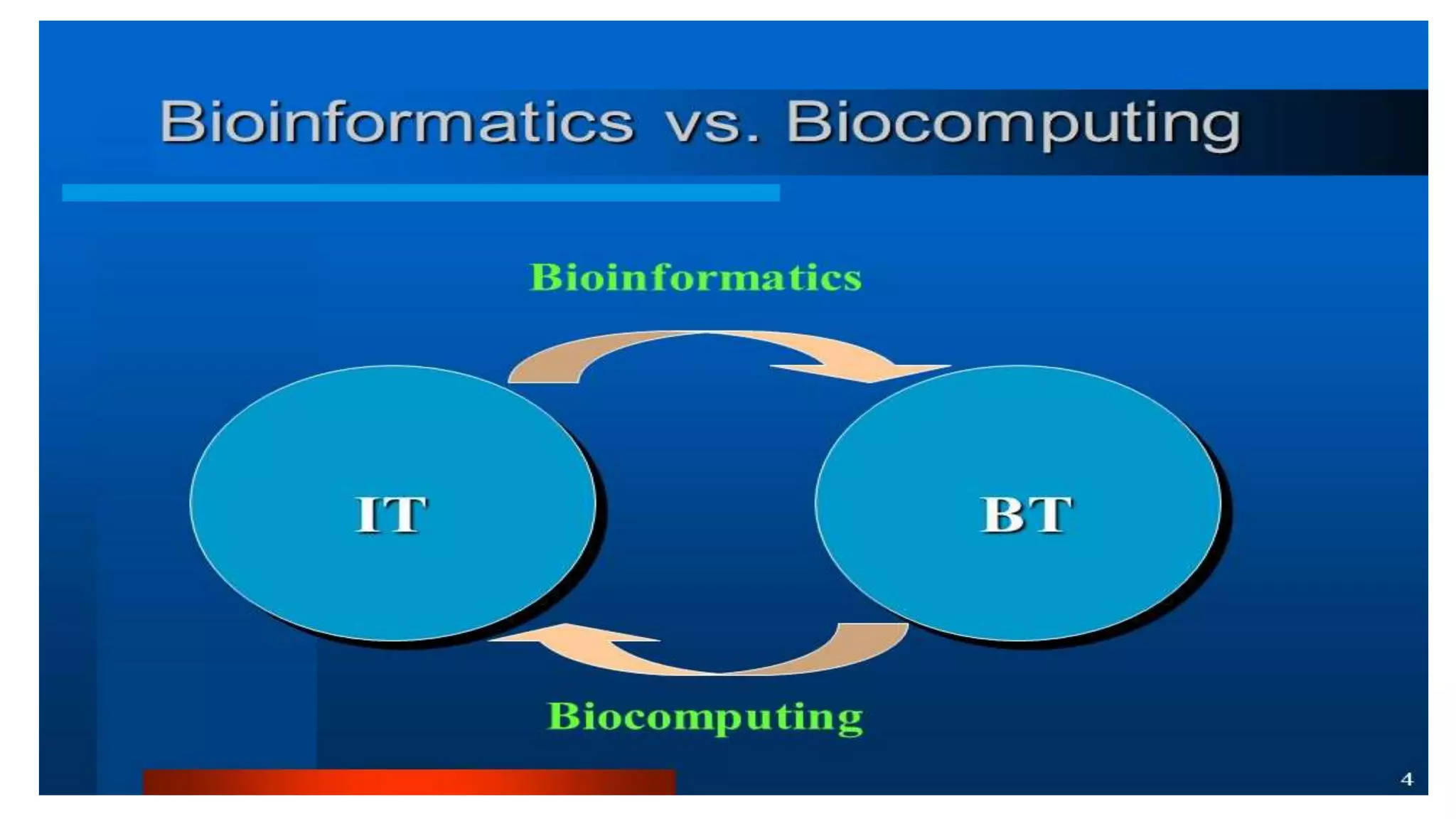
BIO COMPUTING –PERSPECTIVES
What can we compute with DNA ?
“Killer” application is needed – challenge for computer scientists
Better algorithms than exhaustive search – same comment
We need better biotech tools to control the molecules (do they exist already?) – challenge for biotech
Cope with the errors: impact on the size of the solutions (in number of strands)
How much can we compute –impact on the size of the solutions (in number of strands)
22.
BIO COMPUTING –PERSPECTIVES
Positive side
Applications to biotechnology, Bioinformatics and Biochemistry.
Useful in specialized environments: e.g., extreme energy efficiency or extreme information
density required
Provide the means to control biochemical systems just like electronic computers provide
the means to control electromechanical systems
23.
BIO COMPUTING –PERSPECTIVES
Bad news
At this moment, we cannot control the molecules with the precision the physicists and
electrical engineers control electrons
Need of a breakthrough in biotechnology: more automation, more precise techniques
Not completely accurate at this moment in time. During an operation, 95% chance a
particular DNA molecule will “Compute” correctly.
DNA has a Half life. Solutions could dissolve away before the end result is found