Experiments to prove DNA as
genetic material
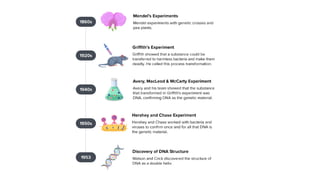
Griffith’s Transformation Experiment
• In 1928, a young scientist Frederick Griffith discovered the transforming principle. In 1918,
millions of people were killed by the terrible Spanish influenza epidemic, and pneumococcal
infections were a common cause of death among influenza-infected patients. This triggered him
to study the bacteria Streptococcus pneumoniae and work on designing a vaccine against it. It
became evident that bacterial pneumonia was caused by multiple strains of S. pneumoniae, and
patients developed antibodies against the particular strain with which they were infected.
Hence, serum samples and bacterial isolates used in experiments helped to identify DNA as the
hereditary material.
• He used two related strains of S. pneumoniae and mice and conducted a series of experiments
using them.
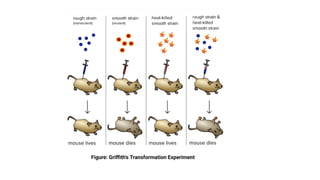
• When type II R-strain bacteria were grown on a culture plate, they produced rough colonies.
They were non-virulent as they lacked an outer polysaccharide coat. Thus, when RII strain
bacteria were injected into a mouse, they did not cause any disease and survived.
• When type I S-strain bacteria were grown on a culture plate, they produced smooth, glistening,
and white colonies. The smooth appearance was apparent due to a polysaccharide coat around
them that provided resistance to the host’s immune system. It was virulent and thus, when
injected into a mouse, resulted in pneumonia and death.
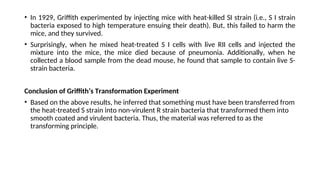
• In 1929, Griffith experimented by injecting mice with heat-killed SI strain (i.e., S I strain
bacteria exposed to high temperature ensuing their death). But, this failed to harm the
mice, and they survived.
• Surprisingly, when he mixed heat-treated S I cells with live RII cells and injected the
mixture into the mice, the mice died because of pneumonia. Additionally, when he
collected a blood sample from the dead mouse, he found that sample to contain live S-
strain bacteria.
Conclusion of Griffith’s Transformation Experiment
• Based on the above results, he inferred that something must have been transferred from
the heat-treated S strain into non-virulent R strain bacteria that transformed them into
smooth coated and virulent bacteria. Thus, the material was referred to as the
transforming principle.
Natural Competence: Griffith’s experiment
• The natural competency or transformability of bacteria was first reported by Frederick
Griffith in 1928.
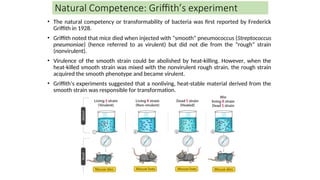
• Griffith noted that mice died when injected with “smooth” pneumococcus (Streptococcus
pneumoniae) (hence referred to as virulent) but did not die from the “rough” strain
(nonvirulent).
• Virulence of the smooth strain could be abolished by heat-killing. However, when the
heat-killed smooth strain was mixed with the nonvirulent rough strain, the rough strain
acquired the smooth phenotype and became virulent.
• Griffith’s experiments suggested that a nonliving, heat-stable material derived from the
smooth strain was responsible for transformation.
Avery, McCarty, and MacLeod Experiment
• During World War II, in 1943, Oswald Avery, Maclyn McCarty, and Colin MacLeod
working at Rockefeller University in New York, dedicated themselves to continuing the
work of Griffith in order to determine the biochemical nature of Griffith’s transforming
principle in an in vitro system.
• They used the phenotype of S. pneumoniae cells expressed on blood agar in order to
figure out whether transformation had taken place or not, rather than working with
mice.
• The transforming principle was partially purified from the cell extract (i.e., cell-free
extract of heat-killed type III S cells) to determine which macromolecule of S cell
transformed type II R-strain into the type III S-strain.
• They demonstrated DNA to be that particular transforming principle.
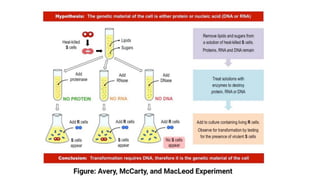
• Initially, type III S cells were heat-killed, and lipids and carbohydrates were removed from the
solution.
• Secondly, they treated heat-killed S cells with digestive enzymes such as RNases and proteases to
degrade RNA and proteins. Subsequently, they also treated it with DNases to digest DNA, each
added separately in different tubes.
• Eventually, they introduced living type II R cells mixed with heat-killed III S cells onto the culture
medium containing antibodies for II R cells. Antibodies for II R cells were used to inactivate some
II R cells such that their number doesn’t exceed the count of III S cells. that help to provide the
distinct phenotypic differences in culture media that contained transformed S strain bacteria.
Observation of Avery, McCarty, and MacLeod Experiment
• The culture treated with DNase did not yield transformed type III S strain bacteria which
indicated that DNA was the hereditary material responsible for transformation.
Conclusion of Avery, McCarty, and MacLeod Experiment
• DNA was found to be the genetic material that was being transferred between cells, not
proteins.
Hershey and Chase Experiment
• Although Avery and his fellows found that DNA was the hereditary material, the scientists were
reluctant to accept the finding. But, not that long afterward, eight years after in 1952, Alfred
Hershey and Martha Chase concluded that DNA is the genetic material.
• Their experimental tool was bacteriophages-viruses that attack bacteria which specifically
involved the infection of Escherichia coli with T2 bacteriophage.
• T2 virus depends on the host body for its reproduction process. When they find bacteria as a
host cell, they adhere to its surface and inject its genetic material into the bacteria. The injected
hereditary material hijacks the host’s machinery such that a large number of viral particles are
released from them.
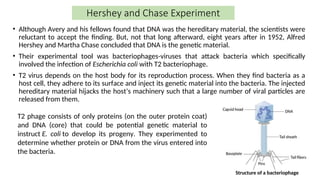
T2 phage consists of only proteins (on the outer protein coat)
and DNA (core) that could be potential genetic material to
instruct E. coli to develop its progeny. They experimented to
determine whether protein or DNA from the virus entered into
the bacteria.
Structure of a bacteriophage
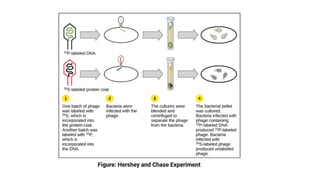
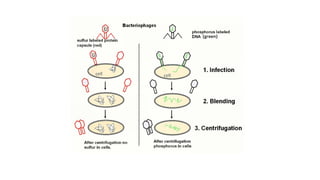
• Bacteriophage was allowed to grow on two media: one containing a radioactive isotope
of phosphorus (32
P) and the other containing a radioactive isotope of sulfur (35
S).
• Phages grown on radioactive phosphorus (32
P) contained radioactive P labeled DNA (not
radioactive protein) as DNA contains phosphorus but not sulfur.
• Similarly, the viruses grown in the medium containing radioactive sulfur (35
S) contained
radioactive 35
S labeled protein (but not radioactive DNA) because sulfur is found in many
proteins but is absent from DNA.
• E. coli were introduced to be infected by the radioactive phages.
• After the progression of infection, the blender was used to remove the remains of phage
and phage parts from the outside of the bacteria, followed by centrifugation in order to
separate the bacteria from the phage debris.
• Centrifugation results in the settling down of heavier particles like bacteria in the form of
pellet while those light particles such as medium, phage, and phage parts, etc., float near
the top of the tube, called supernatant.
Observation of Hershey and Chase Experiment
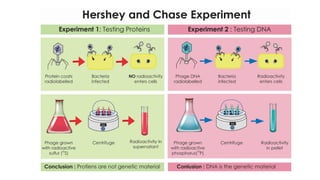
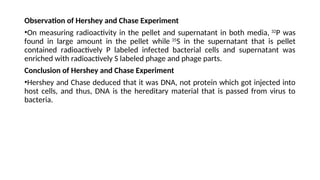
•On measuring radioactivity in the pellet and supernatant in both media, 32
P was
found in large amount in the pellet while 35
S in the supernatant that is pellet
contained radioactively P labeled infected bacterial cells and supernatant was
enriched with radioactively S labeled phage and phage parts.
Conclusion of Hershey and Chase Experiment
•Hershey and Chase deduced that it was DNA, not protein which got injected into
host cells, and thus, DNA is the hereditary material that is passed from virus to
bacteria.

DNA as genetic material experiments and explanation .ppt

  • 1.
    Experiments to proveDNA as genetic material
  • 3.
    Griffith’s Transformation Experiment •In 1928, a young scientist Frederick Griffith discovered the transforming principle. In 1918, millions of people were killed by the terrible Spanish influenza epidemic, and pneumococcal infections were a common cause of death among influenza-infected patients. This triggered him to study the bacteria Streptococcus pneumoniae and work on designing a vaccine against it. It became evident that bacterial pneumonia was caused by multiple strains of S. pneumoniae, and patients developed antibodies against the particular strain with which they were infected. Hence, serum samples and bacterial isolates used in experiments helped to identify DNA as the hereditary material. • He used two related strains of S. pneumoniae and mice and conducted a series of experiments using them. • When type II R-strain bacteria were grown on a culture plate, they produced rough colonies. They were non-virulent as they lacked an outer polysaccharide coat. Thus, when RII strain bacteria were injected into a mouse, they did not cause any disease and survived. • When type I S-strain bacteria were grown on a culture plate, they produced smooth, glistening, and white colonies. The smooth appearance was apparent due to a polysaccharide coat around them that provided resistance to the host’s immune system. It was virulent and thus, when injected into a mouse, resulted in pneumonia and death.
  • 5.
    • In 1929,Griffith experimented by injecting mice with heat-killed SI strain (i.e., S I strain bacteria exposed to high temperature ensuing their death). But, this failed to harm the mice, and they survived. • Surprisingly, when he mixed heat-treated S I cells with live RII cells and injected the mixture into the mice, the mice died because of pneumonia. Additionally, when he collected a blood sample from the dead mouse, he found that sample to contain live S- strain bacteria. Conclusion of Griffith’s Transformation Experiment • Based on the above results, he inferred that something must have been transferred from the heat-treated S strain into non-virulent R strain bacteria that transformed them into smooth coated and virulent bacteria. Thus, the material was referred to as the transforming principle.
  • 6.
    Natural Competence: Griffith’sexperiment • The natural competency or transformability of bacteria was first reported by Frederick Griffith in 1928. • Griffith noted that mice died when injected with “smooth” pneumococcus (Streptococcus pneumoniae) (hence referred to as virulent) but did not die from the “rough” strain (nonvirulent). • Virulence of the smooth strain could be abolished by heat-killing. However, when the heat-killed smooth strain was mixed with the nonvirulent rough strain, the rough strain acquired the smooth phenotype and became virulent. • Griffith’s experiments suggested that a nonliving, heat-stable material derived from the smooth strain was responsible for transformation.
  • 7.
    Avery, McCarty, andMacLeod Experiment • During World War II, in 1943, Oswald Avery, Maclyn McCarty, and Colin MacLeod working at Rockefeller University in New York, dedicated themselves to continuing the work of Griffith in order to determine the biochemical nature of Griffith’s transforming principle in an in vitro system. • They used the phenotype of S. pneumoniae cells expressed on blood agar in order to figure out whether transformation had taken place or not, rather than working with mice. • The transforming principle was partially purified from the cell extract (i.e., cell-free extract of heat-killed type III S cells) to determine which macromolecule of S cell transformed type II R-strain into the type III S-strain. • They demonstrated DNA to be that particular transforming principle.
  • 8.
    • Initially, typeIII S cells were heat-killed, and lipids and carbohydrates were removed from the solution. • Secondly, they treated heat-killed S cells with digestive enzymes such as RNases and proteases to degrade RNA and proteins. Subsequently, they also treated it with DNases to digest DNA, each added separately in different tubes. • Eventually, they introduced living type II R cells mixed with heat-killed III S cells onto the culture medium containing antibodies for II R cells. Antibodies for II R cells were used to inactivate some II R cells such that their number doesn’t exceed the count of III S cells. that help to provide the distinct phenotypic differences in culture media that contained transformed S strain bacteria. Observation of Avery, McCarty, and MacLeod Experiment • The culture treated with DNase did not yield transformed type III S strain bacteria which indicated that DNA was the hereditary material responsible for transformation. Conclusion of Avery, McCarty, and MacLeod Experiment • DNA was found to be the genetic material that was being transferred between cells, not proteins.
  • 10.
    Hershey and ChaseExperiment • Although Avery and his fellows found that DNA was the hereditary material, the scientists were reluctant to accept the finding. But, not that long afterward, eight years after in 1952, Alfred Hershey and Martha Chase concluded that DNA is the genetic material. • Their experimental tool was bacteriophages-viruses that attack bacteria which specifically involved the infection of Escherichia coli with T2 bacteriophage. • T2 virus depends on the host body for its reproduction process. When they find bacteria as a host cell, they adhere to its surface and inject its genetic material into the bacteria. The injected hereditary material hijacks the host’s machinery such that a large number of viral particles are released from them. T2 phage consists of only proteins (on the outer protein coat) and DNA (core) that could be potential genetic material to instruct E. coli to develop its progeny. They experimented to determine whether protein or DNA from the virus entered into the bacteria. Structure of a bacteriophage
  • 11.
    • Bacteriophage wasallowed to grow on two media: one containing a radioactive isotope of phosphorus (32 P) and the other containing a radioactive isotope of sulfur (35 S). • Phages grown on radioactive phosphorus (32 P) contained radioactive P labeled DNA (not radioactive protein) as DNA contains phosphorus but not sulfur. • Similarly, the viruses grown in the medium containing radioactive sulfur (35 S) contained radioactive 35 S labeled protein (but not radioactive DNA) because sulfur is found in many proteins but is absent from DNA. • E. coli were introduced to be infected by the radioactive phages. • After the progression of infection, the blender was used to remove the remains of phage and phage parts from the outside of the bacteria, followed by centrifugation in order to separate the bacteria from the phage debris. • Centrifugation results in the settling down of heavier particles like bacteria in the form of pellet while those light particles such as medium, phage, and phage parts, etc., float near the top of the tube, called supernatant.
  • 15.
    Observation of Hersheyand Chase Experiment •On measuring radioactivity in the pellet and supernatant in both media, 32 P was found in large amount in the pellet while 35 S in the supernatant that is pellet contained radioactively P labeled infected bacterial cells and supernatant was enriched with radioactively S labeled phage and phage parts. Conclusion of Hershey and Chase Experiment •Hershey and Chase deduced that it was DNA, not protein which got injected into host cells, and thus, DNA is the hereditary material that is passed from virus to bacteria.