DMA Data Transfer
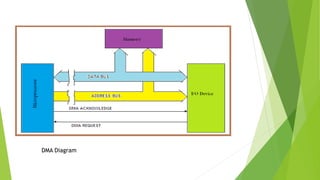
Data transfer from I/O device to memory or vice-versa
is controlled by a DMA controller.
•This scheme is employed when large amount of data is
to be transferred.
•The DMA requests the control of buses through the
HOLD signal and the MPU acknowledges the request
through HLDA signal and releases the control of buses
to DMA.
•It’s a faster scheme and hence used for high speed
printers.
DMA Diagram
There are three types of techniques
under the Direct Memory Access Data
Transfer:
 Burst or block transfer DMA
 Cycle steal or the single-byte
transfer DMA
 Transparent or hidden DMA
1.Burst or Block Transfer DMA
In this scheme the I/O device
withdraws the DMA request
only after all the data bytes
have been transferred.
In this mode the DMA controller
acts the master.
2.Cycle steal or Single-Byte transfer DMA
In this mode, only a single byte is
transferred at a time.
In this scheme the bytes are divided into several
parts and after transferring every part the control
of buses is given back to MPU and later stolen
back when MPU does not need it.
3.Transparent & Interleave or Hidden
DMA transfer
 The Hidden DMA Transfer method is considered the slowest among all the
other DMA transfers.
 Here, the microprocessor executes some of its states during which it floats
the data bus and the address bus.
 In these states, the microprocessor gets isolated from the main system bus.
 In this isolation, the DMA controller transfers the information byte between
the external peripherals and the memory. This, thus,
becomes transparent to the microprocessor.
 The instruction execution speed of the microprocessor does not get reduced.
However, this DMA mode requires extra logic to sense the states in which
the processor is floating the buses.
 This mode is favored at the time when we do not want the CPU to stop
executing its main program, as the data transfer is performed only when the
CPU does not need the system bus.
Dma data transfer

Dma data transfer

  • 1.
  • 2.
    Data transfer fromI/O device to memory or vice-versa is controlled by a DMA controller. •This scheme is employed when large amount of data is to be transferred. •The DMA requests the control of buses through the HOLD signal and the MPU acknowledges the request through HLDA signal and releases the control of buses to DMA. •It’s a faster scheme and hence used for high speed printers.
  • 3.
  • 4.
    There are threetypes of techniques under the Direct Memory Access Data Transfer:  Burst or block transfer DMA  Cycle steal or the single-byte transfer DMA  Transparent or hidden DMA
  • 5.
    1.Burst or BlockTransfer DMA In this scheme the I/O device withdraws the DMA request only after all the data bytes have been transferred. In this mode the DMA controller acts the master.
  • 6.
    2.Cycle steal orSingle-Byte transfer DMA In this mode, only a single byte is transferred at a time. In this scheme the bytes are divided into several parts and after transferring every part the control of buses is given back to MPU and later stolen back when MPU does not need it.
  • 7.
    3.Transparent & Interleaveor Hidden DMA transfer  The Hidden DMA Transfer method is considered the slowest among all the other DMA transfers.  Here, the microprocessor executes some of its states during which it floats the data bus and the address bus.  In these states, the microprocessor gets isolated from the main system bus.  In this isolation, the DMA controller transfers the information byte between the external peripherals and the memory. This, thus, becomes transparent to the microprocessor.  The instruction execution speed of the microprocessor does not get reduced. However, this DMA mode requires extra logic to sense the states in which the processor is floating the buses.  This mode is favored at the time when we do not want the CPU to stop executing its main program, as the data transfer is performed only when the CPU does not need the system bus.