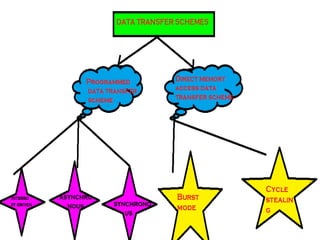
Data transfer
Schemes
By,
Kaavya.b
Holy Cross College,Trichy 2
DMA
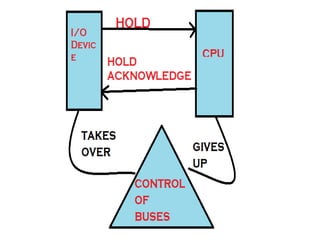
• CPU does not participate.
• Data are directly transferred from an
I/O to the memory.
• It is controlled by the I/O device or a
DMA controller.
• This scheme is employed when large
amount of data are to be transferred.
Merits and Uses
• It is a faster scheme.
• It is used to transfer data from
mass storage devices such as hard
disks,optical disks and also for
high speed printers.
Burst Mode
• The I/O device withdraws the
DMA request only after all the
data bytes have been transferred.
• A block of data is transferred.
• It is used in magnetic disks drive.
Cycle Stealing Technique
• A long block of data is transferred
by a sequence of DMA cycles.
• After transferring one byte or
several bytes the I/O device
withdraws DMA request.
• This method reduces interference
in CPU’s activities.
• Interference can be eliminated with an
interfacing ciruitry which can steal bus
cycle for DMA data transfer only when
the CPU is not using the system bus.
• I/O devices must have
1. registers to store memory
addresses & byte count.
2. electronic ciruitry to produce
control signals.
Programmed DTS
• This is controlled by the CPU.
• Data are transferred from an I/O device
to the memory through the CPU.
• The programs are executed by the CPU
when an I/O device is ready to transfer
data.
• This scheme is employed when small
amount of data are to be transferred.
Synchronous Data transfer
• Synchronous means “at the same
time”.
• The device which sends data and the
device which receives data are
synchronised with the same clock.
• CPU and the I/O devices must match
in speed.
• The status of the I/O device whether
it is ready or not is not examined
before data are transferred.
• But this technique is used only with
compatible memory devices.
• The I/O devices compatible with
microprocessors in speed are not
available.
Asynchronous Data Transfer
• Asynchronous means “at irregular intervals”.
• DT is not based on perdetermined timing
pattern.
• It is used when the speed of an I/O device
does not match the speed of the
microprocessor.
• The status of the I/O device is checked by the
microprocessor before the data are
transferred.
HANDSHAKING MODE:
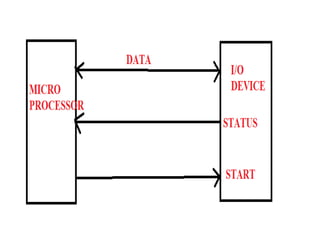
• The microprocessor initiates the I/O
device to get ready .
• Then continously checks the status of the
I/O device till the I/O device becomes
ready to transfer data.
• When I/O device becomes ready, the
microprocessor sends instructions to
transfer data.
HANDSHAKING SIGNALS:
• The microprocessor issues an
initiating signal to the I/O device
to get ready.
• When I/O device becomes ready it
sends signals to the processor to
indicate that it is ready.
DEMERITS
•It is used for slow I/O
devices.
•The precious time of the
microprocessor is wasted
in waiting.
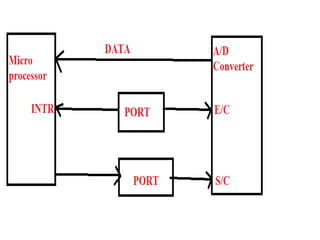
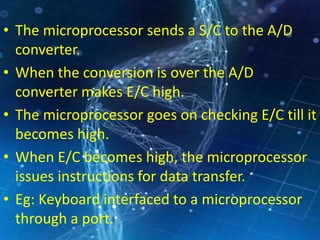
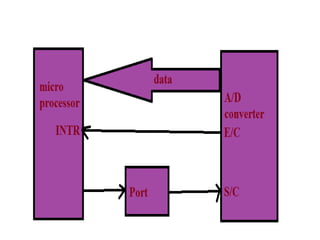
• The microprocessor sends a S/C to the A/D
converter.
• When the conversion is over the A/D
converter makes E/C high.
• The microprocessor goes on checking E/C till it
becomes high.
• When E/C becomes high, the microprocessor
issues instructions for data transfer.
• Eg: Keyboard interfaced to a microprocessor
through a port.
Interrupt Driven DT
• The microprocessor initiates an I/O
device to get ready and then it executes
its main program instead of remaining in
a program loop to check the status of the
I/O device.
• When the I/O device becomes ready to
transfer data, it sends a high signal to the
microprocessor through a special input
line called an interrupt line.
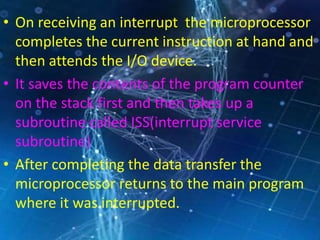
• On receiving an interrupt the microprocessor
completes the current instruction at hand and
then attends the I/O device.
• It saves the contents of the program counter
on the stack first and then takes up a
subroutine called ISS(interrupt service
subroutine)
• After completing the data transfer the
microprocessor returns to the main program
where it was interrupted.
Merits and Demerits
•Used for slow I/O devices.
•Efficient technique
•Precious time of the
microprocessor is not wasted
in waiting while an I/O device
is getting ready.
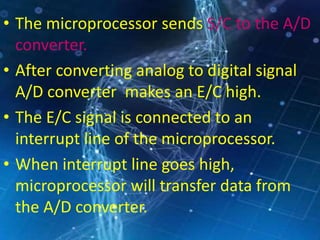
• The microprocessor sends S/C to the A/D
converter.
• After converting analog to digital signal
A/D converter makes an E/C high.
• The E/C signal is connected to an
interrupt line of the microprocessor.
• When interrupt line goes high,
microprocessor will transfer data from
the A/D converter.
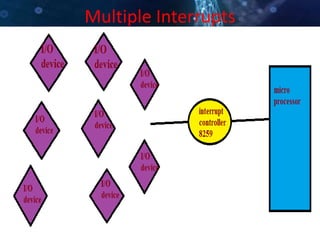
Multiple Interrupts
One Device connected to each level ofinterrupt:
• When a device interrupts microprocessor, it
immediately knows which device has
interrupted.
• The processor automatically transfers its
program to a specific memory location that
has been assigned to the interrupt line.
• It executes ISS for the device which has
interrupted.
• Such an interrupt scheme is known as
vectored interrupt.

Data transfer scheme

  • 1.
  • 3.
    DMA • CPU doesnot participate. • Data are directly transferred from an I/O to the memory. • It is controlled by the I/O device or a DMA controller. • This scheme is employed when large amount of data are to be transferred.
  • 5.
    Merits and Uses •It is a faster scheme. • It is used to transfer data from mass storage devices such as hard disks,optical disks and also for high speed printers.
  • 6.
    Burst Mode • TheI/O device withdraws the DMA request only after all the data bytes have been transferred. • A block of data is transferred. • It is used in magnetic disks drive.
  • 7.
    Cycle Stealing Technique •A long block of data is transferred by a sequence of DMA cycles. • After transferring one byte or several bytes the I/O device withdraws DMA request. • This method reduces interference in CPU’s activities.
  • 8.
    • Interference canbe eliminated with an interfacing ciruitry which can steal bus cycle for DMA data transfer only when the CPU is not using the system bus. • I/O devices must have 1. registers to store memory addresses & byte count. 2. electronic ciruitry to produce control signals.
  • 9.
    Programmed DTS • Thisis controlled by the CPU. • Data are transferred from an I/O device to the memory through the CPU. • The programs are executed by the CPU when an I/O device is ready to transfer data. • This scheme is employed when small amount of data are to be transferred.
  • 10.
    Synchronous Data transfer •Synchronous means “at the same time”. • The device which sends data and the device which receives data are synchronised with the same clock. • CPU and the I/O devices must match in speed.
  • 12.
    • The statusof the I/O device whether it is ready or not is not examined before data are transferred. • But this technique is used only with compatible memory devices. • The I/O devices compatible with microprocessors in speed are not available.
  • 13.
    Asynchronous Data Transfer •Asynchronous means “at irregular intervals”. • DT is not based on perdetermined timing pattern. • It is used when the speed of an I/O device does not match the speed of the microprocessor. • The status of the I/O device is checked by the microprocessor before the data are transferred.
  • 14.
    HANDSHAKING MODE: • Themicroprocessor initiates the I/O device to get ready . • Then continously checks the status of the I/O device till the I/O device becomes ready to transfer data. • When I/O device becomes ready, the microprocessor sends instructions to transfer data.
  • 15.
    HANDSHAKING SIGNALS: • Themicroprocessor issues an initiating signal to the I/O device to get ready. • When I/O device becomes ready it sends signals to the processor to indicate that it is ready.
  • 17.
    DEMERITS •It is usedfor slow I/O devices. •The precious time of the microprocessor is wasted in waiting.
  • 19.
    • The microprocessorsends a S/C to the A/D converter. • When the conversion is over the A/D converter makes E/C high. • The microprocessor goes on checking E/C till it becomes high. • When E/C becomes high, the microprocessor issues instructions for data transfer. • Eg: Keyboard interfaced to a microprocessor through a port.
  • 20.
    Interrupt Driven DT •The microprocessor initiates an I/O device to get ready and then it executes its main program instead of remaining in a program loop to check the status of the I/O device. • When the I/O device becomes ready to transfer data, it sends a high signal to the microprocessor through a special input line called an interrupt line.
  • 21.
    • On receivingan interrupt the microprocessor completes the current instruction at hand and then attends the I/O device. • It saves the contents of the program counter on the stack first and then takes up a subroutine called ISS(interrupt service subroutine) • After completing the data transfer the microprocessor returns to the main program where it was interrupted.
  • 22.
    Merits and Demerits •Usedfor slow I/O devices. •Efficient technique •Precious time of the microprocessor is not wasted in waiting while an I/O device is getting ready.
  • 24.
    • The microprocessorsends S/C to the A/D converter. • After converting analog to digital signal A/D converter makes an E/C high. • The E/C signal is connected to an interrupt line of the microprocessor. • When interrupt line goes high, microprocessor will transfer data from the A/D converter.
  • 25.
  • 26.
    One Device connectedto each level ofinterrupt: • When a device interrupts microprocessor, it immediately knows which device has interrupted. • The processor automatically transfers its program to a specific memory location that has been assigned to the interrupt line. • It executes ISS for the device which has interrupted. • Such an interrupt scheme is known as vectored interrupt.