PLANT SCIENCE
(AGR122)
NOOR ZUHAIRAH SAMSUDDIN
012-3563140
F104 C (STAR COMPLEX)
FACULTY OF PLANTATION AND AGROTECHNOLOGY
DIPLOMA IN PLANTATION INDUSTRY MANAGEMENT
PLANT CLASSIFICATION PRINCIPLES
At the end of this lecture students are able to;
1. Identify Plant taxonomy and importance of
taxonomy
2. Describe two major plant classes; Angiosperm,
gymnosperm
3. Identify angiosperm classification and
characteristics; dicotyledonous and
Monocotyledonous,
4. Distinguish the growth types (Determinant,
Indeterminant, Monocarpic, Polycarpic, Annual,
Biennial, Herbaceous Perennial, Woody
Perennial)
PLANT TAXONOMY AND
IMPORTANCE OF TAXONOMY
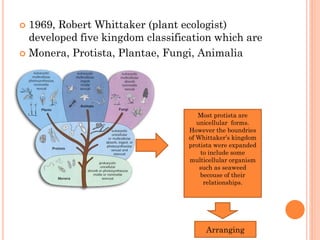
 1969, Robert Whittaker (plant ecologist)
developed five kingdom classification which are
 Monera, Protista, Plantae, Fungi, Animalia
Most protista are
unicellular forms.
However the boundries
of Whittaker’s kingdom
protista were expanded
to include some
multicellular organism
such as seaweed
becouse of their
relationships.
Arranging
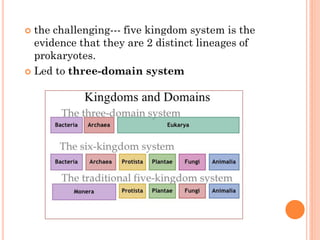
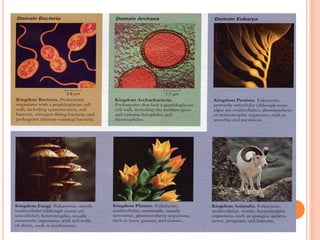
 the challenging--- five kingdom system is the
evidence that they are 2 distinct lineages of
prokaryotes.
 Led to three-domain system
DEFINITION
 TAXONOMY is the science of naming, describing &
classifying organisms.
 It is the process of
-sorting (SYSTEMATIC) and
-naming (NOMENCLATURE) the multitude of life forms
 CLASSIFICATION is a grouping of similar things for a
specific purpose
NOMENCLATURE – naming the organisms &
taxa they belong. Refer to scientific name based
on binomial system
SYSTEMATIC – the placing of organisms into
theirs groups. Systematic includes taxonomy,
which is naming and classification of species and
groups of species.
IMPORTANCE OF TAXONOMY
1. Manage information and data
2. Give the universal name (scientific name) to
the organism
3. Gives the approaches to biologist to study the
diversity of biology and the natural connection
among the organism in the web of life
4. Support the organic evolution theory where
the biologist can find the natural connection
among the organism
CONTINUE:
5. Study other field/ area such as
morphology, anatomy and physiology
6. Find the connection between
individuals and the individual with the
environment efficiently and systematic
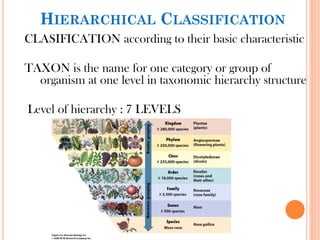
HIERARCHICAL CLASSIFICATION
CLASIFICATION according to their basic characteristic
TAXON is the name for one category or group of
organism at one level in taxonomic hierarchy structure
Level of hierarchy : 7 LEVELS
NOMENCLATURE SYSTEM
Brief introduction:
 In 18th century, Carolus Linnaeus (swedish botanist)
developed a hierarchical system of naming / biological
nomenclature.
 Refer as Linnaeus binomial system or binomial system
of nomenclature.
 He assigned a 2 part naming system in latin
1st part of the name is referring to genus
(plural ; genera)
2nd part is the specific epithet refer to species
of that genus
Both names MUST be in italics or
underlined (handwriting)
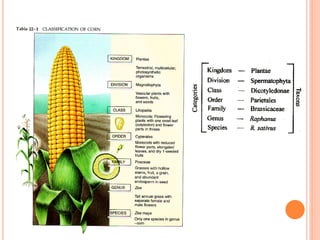
Eg. Zea mays – corn
Oryza sativa - paddy
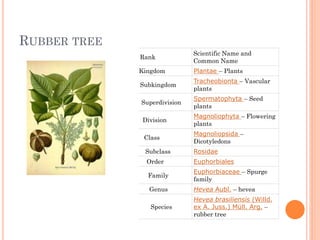
Hevea braziliensis – rubber
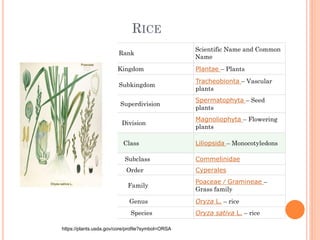
RICE
Rank
Scientific Name and Common
Name
Kingdom Plantae – Plants
Subkingdom
Tracheobionta – Vascular
plants
Superdivision
Spermatophyta – Seed
plants
Division
Magnoliophyta – Flowering
plants
Class Liliopsida – Monocotyledons
Subclass Commelinidae
Order Cyperales
Family
Poaceae ⁄ Gramineae –
Grass family
Genus Oryza L. – rice
Species Oryza sativa L. – rice
https://plants.usda.gov/core/profile?symbol=ORSA
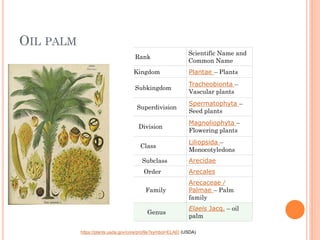
OIL PALM
Rank
Scientific Name and
Common Name
Kingdom Plantae – Plants
Subkingdom
Tracheobionta –
Vascular plants
Superdivision
Spermatophyta –
Seed plants
Division
Magnoliophyta –
Flowering plants
Class
Liliopsida –
Monocotyledons
Subclass Arecidae
Order Arecales
Family
Arecaceae ⁄
Palmae – Palm
family
Genus
Elaeis Jacq. – oil
palm
https://plants.usda.gov/core/profile?symbol=ELAEI (USDA)
RUBBER TREE
Rank
Scientific Name and
Common Name
Kingdom Plantae – Plants
Subkingdom
Tracheobionta – Vascular
plants
Superdivision
Spermatophyta – Seed
plants
Division
Magnoliophyta – Flowering
plants
Class
Magnoliopsida –
Dicotyledons
Subclass Rosidae
Order Euphorbiales
Family
Euphorbiaceae – Spurge
family
Genus Hevea Aubl. – hevea
Species
Hevea brasiliensis (Willd.
ex A. Juss.) Müll. Arg. –
rubber tree
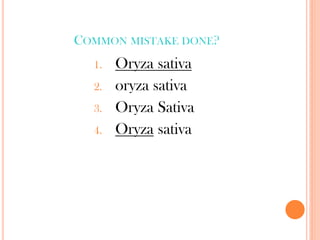
COMMON MISTAKE DONE?
1. Oryza sativa
2. oryza sativa
3. Oryza Sativa
4. Oryza sativa
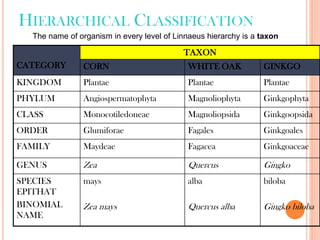
HIERARCHICAL CLASSIFICATION
CATEGORY
TAXON
CORN WHITE OAK GINKGO
KINGDOM Plantae Plantae Plantae
PHYLUM Angiospermatophyta Magnoliophyta Ginkgophyta
CLASS Monocotiledoneae Magnoliopsida Ginkgoopsida
ORDER Glumiforae Fagales Ginkgoales
FAMILY Maydeae Fagacea Ginkgoaceae
GENUS Zea Quercus Gingko
SPECIES
EPITHAT
BINOMIAL
NAME
mays
Zea mays
alba
Quercus alba
biloba
Gingko biloba
The name of organism in every level of Linnaeus hierarchy is a taxon
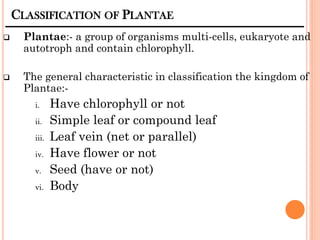
CLASSIFICATION OF PLANTAE
 Plantae:- a group of organisms multi-cells, eukaryote and
autotroph and contain chlorophyll.
 The general characteristic in classification the kingdom of
Plantae:-
i. Have chlorophyll or not
ii. Simple leaf or compound leaf
iii. Leaf vein (net or parallel)
iv. Have flower or not
v. Seed (have or not)
vi. Body
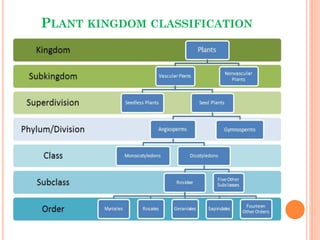
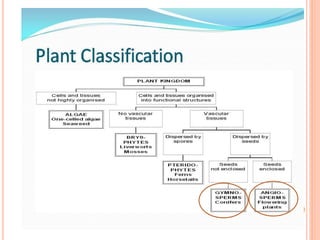
PLANT KINGDOM CLASSIFICATION
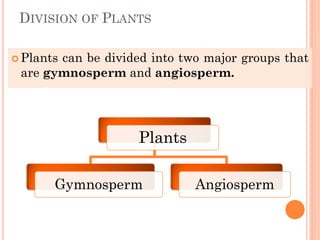
 Plants can be divided into two major groups that
are gymnosperm and angiosperm.
DIVISION OF PLANTS
Plants
Gymnosperm Angiosperm
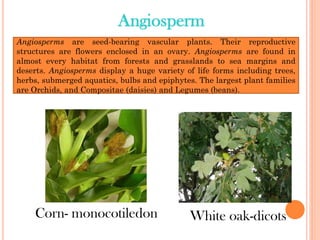
Angiosperm
Corn- monocotiledon White oak-dicots
Angiosperms are seed-bearing vascular plants. Their reproductive
structures are flowers enclosed in an ovary. Angiosperms are found in
almost every habitat from forests and grasslands to sea margins and
deserts. Angiosperms display a huge variety of life forms including trees,
herbs, submerged aquatics, bulbs and epiphytes. The largest plant families
are Orchids, and Compositae (daisies) and Legumes (beans).
GYMNOSPERM
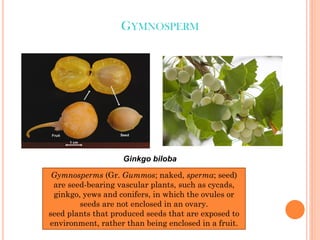
Ginkgo biloba
Gymnosperms (Gr. Gummos; naked, sperma; seed)
are seed-bearing vascular plants, such as cycads,
ginkgo, yews and conifers, in which the ovules or
seeds are not enclosed in an ovary.
seed plants that produced seeds that are exposed to
environment, rather than being enclosed in a fruit.
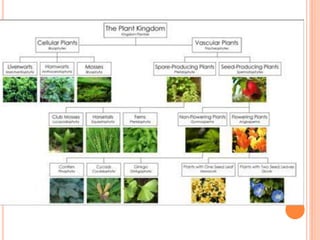
KINGDOM PLANTAE
Classified into:
Lower plants:
 Algae
 Brophytes
Higher Plants:
 Pterydophytes
 Gymnosperms
 Angiosperms
LOWER PLANTS
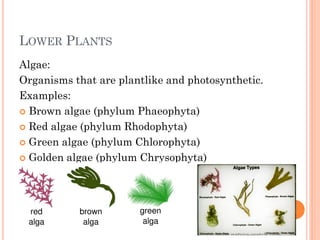
Algae:
Organisms that are plantlike and photosynthetic.
Examples:
 Brown algae (phylum Phaeophyta)
 Red algae (phylum Rhodophyta)
 Green algae (phylum Chlorophyta)
 Golden algae (phylum Chrysophyta)
LOWER PLANTS
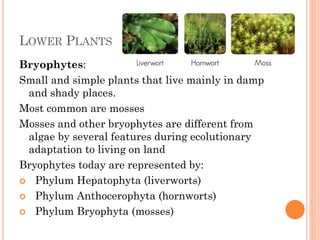
Bryophytes:
Small and simple plants that live mainly in damp
and shady places.
Most common are mosses
Mosses and other bryophytes are different from
algae by several features during ecolutionary
adaptation to living on land
Bryophytes today are represented by:
 Phylum Hepatophyta (liverworts)
 Phylum Anthocerophyta (hornworts)
 Phylum Bryophyta (mosses)
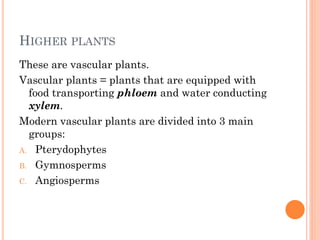
HIGHER PLANTS
These are vascular plants.
Vascular plants = plants that are equipped with
food transporting phloem and water conducting
xylem.
Modern vascular plants are divided into 3 main
groups:
A. Pterydophytes
B. Gymnosperms
C. Angiosperms
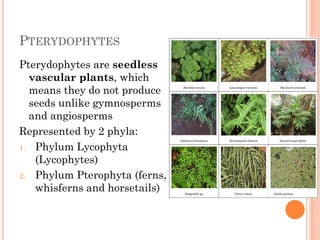
PTERYDOPHYTES
Pterydophytes are seedless
vascular plants, which
means they do not produce
seeds unlike gymnosperms
and angiosperms
Represented by 2 phyla:
1. Phylum Lycophyta
(Lycophytes)
2. Phylum Pterophyta (ferns,
whisferns and horsetails)
GYMNOSPERMS
Vascular plants that bear naked seeds, represented
normally by plants or trees such as conifers,
cone-bearing plants such as pines.
They lack enclosed chambers (ovaries) and the
ovules and seeds develop on the scales of cones
The 4 phyla of extant gymnosperms are:
1. Ginkophyta
2. Cycadophyta
3. Gnetophyta
4. Coniferphyta
ANGIOSPERM
These flowering plants are vascular seed
plants that produce the reproductive
structures called flowers and fruits
The most diverse and geographically
widespread of all plant species
There are about 250,000 known species
of angiosperms compared to about 720
gymnosperm species
ANGIOSPERM
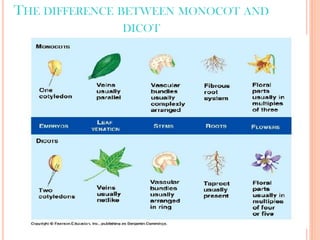
Angiosperms divided into two main
classes :
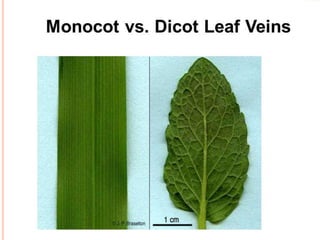
a. Monocot (monoctyledon) – having
veins running parallel (as in grass
blade
b. Dicot (dicotyledon) – have netlike
veination in their leaves
THE TAXONOMIC CHARACTERISTICS OF
MONOCOTYLEDON & DICOTYLEDON
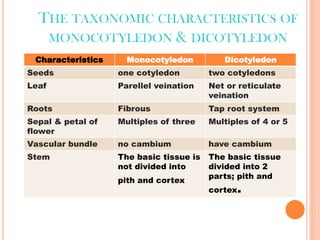
Characteristics Monocotyledon Dicotyledon
Seeds one cotyledon two cotyledons
Leaf Parellel veination Net or reticulate
veination
Roots Fibrous Tap root system
Sepal & petal of
flower
Multiples of three Multiples of 4 or 5
Vascular bundle no cambium have cambium
Stem The basic tissue is
not divided into
pith and cortex
The basic tissue
divided into 2
parts; pith and
cortex.
THE DIFFERENCE BETWEEN MONOCOT AND
DICOT
IDENTIFY TYPES OF GROWTH WITH
EXAMPLE??
1. Determinant,
2. Indeterminant
3. Monocarpic
4. Polycarpic
5. Annual
6. Biennial
7. Herbaceous Perennial
8. Woody Perennial
GROWTH TYPES;
DETERMINATE AND INDETERMINATE
 Indeterminate:
means the plants will keep on growing
(continuos), continuing extending their
stems, branches and reproductive buds will
develop from time to time
Until stopped by environmental or internal
signal
Examples: coconut, mangoes, apple, rattans
 Determinate :
means plants that appeared to be stop growing
once terminal buds change from vegetative to
reproductive buds
Eg: banana, sago
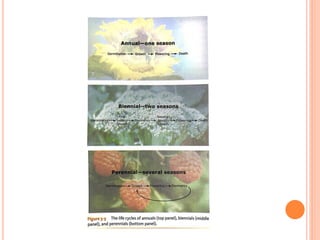
SEASONAL GROWTH CYCLE
Annuals – Plants which complete their life
cycle in one season and reproduce by seed
only.
Biennials – plants which required two years
from germination to flowering and seed
production. Rare in the tropics, mostly in
temperate regions.
Perennials – produce seeds every season, but
sometimes once in several seasons.
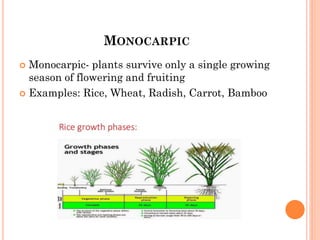
MONOCARPIC
 Monocarpic- plants survive only a single growing
season of flowering and fruiting
 Examples: Rice, Wheat, Radish, Carrot, Bamboo
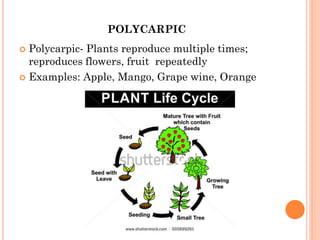
POLYCARPIC
 Polycarpic- Plants reproduce multiple times;
reproduces flowers, fruit repeatedly
 Examples: Apple, Mango, Grape wine, Orange
REINFORCEMENT
1. List down hierarchy of binomial Linnaeus system
2. Give a definition:
Taxonomy, nomenclature, systematic, taxon
3. Differentiate between
a)Angiosperm and Gymnosperm
b)Monocots and Dicots
4. Describe the difference between monocot & dicots
according to their characteristic

CHAPTER 1 PLANT CLASSIFICATION PRINCIPLE 07072010.pdf

  • 1.
    PLANT SCIENCE (AGR122) NOOR ZUHAIRAHSAMSUDDIN 012-3563140 F104 C (STAR COMPLEX) FACULTY OF PLANTATION AND AGROTECHNOLOGY DIPLOMA IN PLANTATION INDUSTRY MANAGEMENT
  • 2.
    PLANT CLASSIFICATION PRINCIPLES Atthe end of this lecture students are able to; 1. Identify Plant taxonomy and importance of taxonomy 2. Describe two major plant classes; Angiosperm, gymnosperm 3. Identify angiosperm classification and characteristics; dicotyledonous and Monocotyledonous, 4. Distinguish the growth types (Determinant, Indeterminant, Monocarpic, Polycarpic, Annual, Biennial, Herbaceous Perennial, Woody Perennial)
  • 3.
  • 4.
     1969, RobertWhittaker (plant ecologist) developed five kingdom classification which are  Monera, Protista, Plantae, Fungi, Animalia Most protista are unicellular forms. However the boundries of Whittaker’s kingdom protista were expanded to include some multicellular organism such as seaweed becouse of their relationships. Arranging
  • 5.
     the challenging---five kingdom system is the evidence that they are 2 distinct lineages of prokaryotes.  Led to three-domain system
  • 7.
    DEFINITION  TAXONOMY isthe science of naming, describing & classifying organisms.  It is the process of -sorting (SYSTEMATIC) and -naming (NOMENCLATURE) the multitude of life forms  CLASSIFICATION is a grouping of similar things for a specific purpose
  • 8.
    NOMENCLATURE – namingthe organisms & taxa they belong. Refer to scientific name based on binomial system SYSTEMATIC – the placing of organisms into theirs groups. Systematic includes taxonomy, which is naming and classification of species and groups of species.
  • 9.
    IMPORTANCE OF TAXONOMY 1.Manage information and data 2. Give the universal name (scientific name) to the organism 3. Gives the approaches to biologist to study the diversity of biology and the natural connection among the organism in the web of life 4. Support the organic evolution theory where the biologist can find the natural connection among the organism
  • 10.
    CONTINUE: 5. Study otherfield/ area such as morphology, anatomy and physiology 6. Find the connection between individuals and the individual with the environment efficiently and systematic
  • 11.
    HIERARCHICAL CLASSIFICATION CLASIFICATION accordingto their basic characteristic TAXON is the name for one category or group of organism at one level in taxonomic hierarchy structure Level of hierarchy : 7 LEVELS
  • 12.
    NOMENCLATURE SYSTEM Brief introduction: In 18th century, Carolus Linnaeus (swedish botanist) developed a hierarchical system of naming / biological nomenclature.  Refer as Linnaeus binomial system or binomial system of nomenclature.  He assigned a 2 part naming system in latin
  • 13.
    1st part ofthe name is referring to genus (plural ; genera) 2nd part is the specific epithet refer to species of that genus Both names MUST be in italics or underlined (handwriting) Eg. Zea mays – corn Oryza sativa - paddy Hevea braziliensis – rubber
  • 15.
    RICE Rank Scientific Name andCommon Name Kingdom Plantae – Plants Subkingdom Tracheobionta – Vascular plants Superdivision Spermatophyta – Seed plants Division Magnoliophyta – Flowering plants Class Liliopsida – Monocotyledons Subclass Commelinidae Order Cyperales Family Poaceae ⁄ Gramineae – Grass family Genus Oryza L. – rice Species Oryza sativa L. – rice https://plants.usda.gov/core/profile?symbol=ORSA
  • 16.
    OIL PALM Rank Scientific Nameand Common Name Kingdom Plantae – Plants Subkingdom Tracheobionta – Vascular plants Superdivision Spermatophyta – Seed plants Division Magnoliophyta – Flowering plants Class Liliopsida – Monocotyledons Subclass Arecidae Order Arecales Family Arecaceae ⁄ Palmae – Palm family Genus Elaeis Jacq. – oil palm https://plants.usda.gov/core/profile?symbol=ELAEI (USDA)
  • 17.
    RUBBER TREE Rank Scientific Nameand Common Name Kingdom Plantae – Plants Subkingdom Tracheobionta – Vascular plants Superdivision Spermatophyta – Seed plants Division Magnoliophyta – Flowering plants Class Magnoliopsida – Dicotyledons Subclass Rosidae Order Euphorbiales Family Euphorbiaceae – Spurge family Genus Hevea Aubl. – hevea Species Hevea brasiliensis (Willd. ex A. Juss.) Müll. Arg. – rubber tree
  • 18.
    COMMON MISTAKE DONE? 1.Oryza sativa 2. oryza sativa 3. Oryza Sativa 4. Oryza sativa
  • 19.
    HIERARCHICAL CLASSIFICATION CATEGORY TAXON CORN WHITEOAK GINKGO KINGDOM Plantae Plantae Plantae PHYLUM Angiospermatophyta Magnoliophyta Ginkgophyta CLASS Monocotiledoneae Magnoliopsida Ginkgoopsida ORDER Glumiforae Fagales Ginkgoales FAMILY Maydeae Fagacea Ginkgoaceae GENUS Zea Quercus Gingko SPECIES EPITHAT BINOMIAL NAME mays Zea mays alba Quercus alba biloba Gingko biloba The name of organism in every level of Linnaeus hierarchy is a taxon
  • 20.
    CLASSIFICATION OF PLANTAE Plantae:- a group of organisms multi-cells, eukaryote and autotroph and contain chlorophyll.  The general characteristic in classification the kingdom of Plantae:- i. Have chlorophyll or not ii. Simple leaf or compound leaf iii. Leaf vein (net or parallel) iv. Have flower or not v. Seed (have or not) vi. Body
  • 21.
  • 24.
     Plants canbe divided into two major groups that are gymnosperm and angiosperm. DIVISION OF PLANTS Plants Gymnosperm Angiosperm
  • 25.
    Angiosperm Corn- monocotiledon Whiteoak-dicots Angiosperms are seed-bearing vascular plants. Their reproductive structures are flowers enclosed in an ovary. Angiosperms are found in almost every habitat from forests and grasslands to sea margins and deserts. Angiosperms display a huge variety of life forms including trees, herbs, submerged aquatics, bulbs and epiphytes. The largest plant families are Orchids, and Compositae (daisies) and Legumes (beans).
  • 26.
    GYMNOSPERM Ginkgo biloba Gymnosperms (Gr.Gummos; naked, sperma; seed) are seed-bearing vascular plants, such as cycads, ginkgo, yews and conifers, in which the ovules or seeds are not enclosed in an ovary. seed plants that produced seeds that are exposed to environment, rather than being enclosed in a fruit.
  • 27.
    KINGDOM PLANTAE Classified into: Lowerplants:  Algae  Brophytes Higher Plants:  Pterydophytes  Gymnosperms  Angiosperms
  • 28.
    LOWER PLANTS Algae: Organisms thatare plantlike and photosynthetic. Examples:  Brown algae (phylum Phaeophyta)  Red algae (phylum Rhodophyta)  Green algae (phylum Chlorophyta)  Golden algae (phylum Chrysophyta)
  • 29.
    LOWER PLANTS Bryophytes: Small andsimple plants that live mainly in damp and shady places. Most common are mosses Mosses and other bryophytes are different from algae by several features during ecolutionary adaptation to living on land Bryophytes today are represented by:  Phylum Hepatophyta (liverworts)  Phylum Anthocerophyta (hornworts)  Phylum Bryophyta (mosses)
  • 30.
    HIGHER PLANTS These arevascular plants. Vascular plants = plants that are equipped with food transporting phloem and water conducting xylem. Modern vascular plants are divided into 3 main groups: A. Pterydophytes B. Gymnosperms C. Angiosperms
  • 31.
    PTERYDOPHYTES Pterydophytes are seedless vascularplants, which means they do not produce seeds unlike gymnosperms and angiosperms Represented by 2 phyla: 1. Phylum Lycophyta (Lycophytes) 2. Phylum Pterophyta (ferns, whisferns and horsetails)
  • 32.
    GYMNOSPERMS Vascular plants thatbear naked seeds, represented normally by plants or trees such as conifers, cone-bearing plants such as pines. They lack enclosed chambers (ovaries) and the ovules and seeds develop on the scales of cones The 4 phyla of extant gymnosperms are: 1. Ginkophyta 2. Cycadophyta 3. Gnetophyta 4. Coniferphyta
  • 33.
    ANGIOSPERM These flowering plantsare vascular seed plants that produce the reproductive structures called flowers and fruits The most diverse and geographically widespread of all plant species There are about 250,000 known species of angiosperms compared to about 720 gymnosperm species
  • 34.
    ANGIOSPERM Angiosperms divided intotwo main classes : a. Monocot (monoctyledon) – having veins running parallel (as in grass blade b. Dicot (dicotyledon) – have netlike veination in their leaves
  • 36.
    THE TAXONOMIC CHARACTERISTICSOF MONOCOTYLEDON & DICOTYLEDON Characteristics Monocotyledon Dicotyledon Seeds one cotyledon two cotyledons Leaf Parellel veination Net or reticulate veination Roots Fibrous Tap root system Sepal & petal of flower Multiples of three Multiples of 4 or 5 Vascular bundle no cambium have cambium Stem The basic tissue is not divided into pith and cortex The basic tissue divided into 2 parts; pith and cortex.
  • 37.
    THE DIFFERENCE BETWEENMONOCOT AND DICOT
  • 38.
    IDENTIFY TYPES OFGROWTH WITH EXAMPLE?? 1. Determinant, 2. Indeterminant 3. Monocarpic 4. Polycarpic 5. Annual 6. Biennial 7. Herbaceous Perennial 8. Woody Perennial
  • 39.
    GROWTH TYPES; DETERMINATE ANDINDETERMINATE  Indeterminate: means the plants will keep on growing (continuos), continuing extending their stems, branches and reproductive buds will develop from time to time Until stopped by environmental or internal signal Examples: coconut, mangoes, apple, rattans
  • 40.
     Determinate : meansplants that appeared to be stop growing once terminal buds change from vegetative to reproductive buds Eg: banana, sago
  • 41.
    SEASONAL GROWTH CYCLE Annuals– Plants which complete their life cycle in one season and reproduce by seed only. Biennials – plants which required two years from germination to flowering and seed production. Rare in the tropics, mostly in temperate regions. Perennials – produce seeds every season, but sometimes once in several seasons.
  • 43.
    MONOCARPIC  Monocarpic- plantssurvive only a single growing season of flowering and fruiting  Examples: Rice, Wheat, Radish, Carrot, Bamboo
  • 44.
    POLYCARPIC  Polycarpic- Plantsreproduce multiple times; reproduces flowers, fruit repeatedly  Examples: Apple, Mango, Grape wine, Orange
  • 45.
    REINFORCEMENT 1. List downhierarchy of binomial Linnaeus system 2. Give a definition: Taxonomy, nomenclature, systematic, taxon 3. Differentiate between a)Angiosperm and Gymnosperm b)Monocots and Dicots 4. Describe the difference between monocot & dicots according to their characteristic