


DISTILLATION UNDER
REDUCED PRESSURE
CONTENTS
• Principle
• Construction
• Working
• Advantage
• Disadvantage
• Use
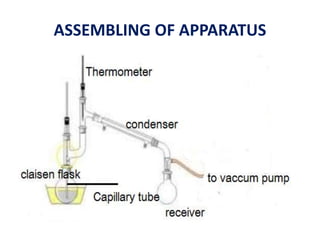
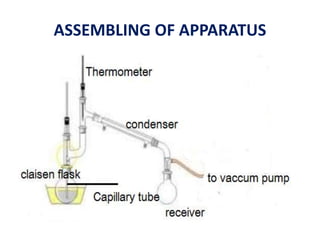
ASSEMBLING OF APPARATUS
PRINCIPLE
• Liquid boils when its vapor pressure is equal
to atmospheric pressure, i.e. pressure on its
surface
• If the external pressure is reduced by applying
vacuum, the boiling point of the liquid
decreases . i.e. liquid boils at a low
temperature
PRINCIPLE
E.g.
• Water boils at 100°C - atmospheric pressure
of 131.31KPa
• At 40°c the vapor pressure of water- 9.33KPa
• So the external pressure is reduced to 9.33KPa
Where water boils at 40°c
The net result is increase in the rate of mass
transfer in to vapor
CONSTRUCTION
• Thick walled glass apparatus with
interchangeable standard glass joints are used
• Double neck distillation flask – claisen flask
• In one of the neck of the claisen flask, a
thermometer is fitted
ASSEMBLING OF APPARATUS
• A capillary tube placed in the second neck to
prevent bumping
• This capillary tube is dipped in the boiling
liquid, so that air bubbles is drawn out
• The claisen flask is connected to a receiver
through a condenser
ASSEMBLING OF APPARATUS
• Vacuum pump is attached through an adapter
to the receiver
• A small manometer should be inserted
between the pump and the receiver
PROCEDURE :
• The liquid to be distilled is placed in the flask
• The volume should be one half to two third of the
flask
• Porcelain pieces added to the flask to prevent
bumping
• The capillary tube and thermometer are placed in
the flask
PROCEDURE :
• The required vacuum is applied
• The contents are heated gradually
• The temperature rises and liquid gets heated
rapidly due to vacuum
PROCEDURE
• The vapor passes through the condenser
• The condensate is collected in to the receiver
• The temperature is noted down which will be
less than the boiling point of the liquid
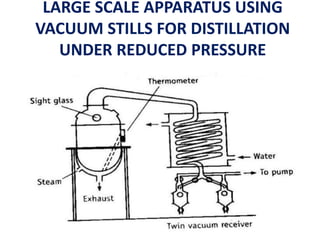
LARGE SCALE APPARATUS USING
VACUUM STILLS FOR DISTILLATION
UNDER REDUCED PRESSURE
CONSTRUCTION
• Vacuum jacketed still – stainless steel ,copper
which can withstand high vacuum
• Observation window – to see the progress of
distillation
• Steam inlet and exhaust at the bottom
CONSTRUCTION
• The still is connected to a condenser
• A thermometer incorporated in to the still
• A vacuum pump
WORKING
• The still is filled with the liquid to be distilled
• Vacuum is created by means of a vacuum
pump
• Steam is applied
• The contents heated gradually
WORKING
• The temperature rises and the liquid gets
vaporized rapidly due to vacuum
• Vapor passes through the condenser and
condensate is collected in to the receiver
• Normally two receivers are fitted with suitable
arrangement of cocks so that they can be used
alternatively
WORKING
• The distillate is collected from one while the
other is connected to the still under vacuum
therefore distillation need not be stopped
THANK YOU
STEAM
DISTILLATION
STEAM DISTILLATION
• Distillation is carried out with the aid of steam
• It used to separate high boiling substances
from non volatile impurities
• Used for the separation of immiscible liquids
STEAM DISTILLATION
• High boiling liquids can not be purified by
simple distillation because at high
temperature the liquid undergo
decomposition.
• In such cases steam distillation is used
PRINCIPLE
• A mixture of immiscible liquids begins to boil
when the sum of their vapor pressure is equal
to the atmospheric pressure
PRINCIPLE
E.g.
• Water and turpentine mixture - boils below the
boiling point of pure water ( 95.6° c)
• Turpentine 160° c water 100°c
• At this temperature (95.6° c)
VP of water = 86.245 kpa
Turpentine = 15.06 kpa
The sum of the VP = 101.31 kpa
• Which is normally atmospheric pressure
PRINCIPLE
• The high boiling substances may be distilled at
a temperature much below its boiling point
when water is used
APPLICATIONS :
• Used for the separation of immiscible liquids
e.g. toluene and water
• Extraction of volatile oils from clove, anise
seed and eucalyptus leaves
APPLICATIONS :
• Used in purification of liquids with high boiling
point
Essential oil of almond
• Preparation of aromatic water
ADVANTAGE :-
• Volatile oils can be separated at lower
temperature in steam distillation without any
decomposition and loss of aroma
• Low volatile substances with higher molecular
weight (higher than water) can be distilled
DISADVANTAGE
• Steam distillation is not suitable when
immiscible liquid and water react with each
other
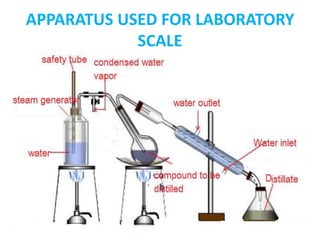
APPARATUS USED FOR LABORATORY
SCALE
CONSTRUCTION
• It consists of a metallic steam can fitted with a
cork having two holes
• Through one hole a long tube is placed, it almost
reaches the bottom of the steam generator
• This tube act as safety tube
CONSTRUCTION
• If pressure inside the steam generator
increases ,water will be forced out through
the tube and pressure will relieved
• Other hole a bent tube is placed
• Other end of the bent tube is connected to
the flask containing non aqueous liquid
through a rubber bung
CONSTRUCTION
• This tube should reach almost bottom of the
flask
• Through the other hole of the rubber bung a
delivery tube is placed
• Delivery tube connect the flask and the
condenser
CONSTRUCTION
• Condenser is connected to the receiver via an
adaptor
• Provisions are made to heat the steam can
and the flask
PROCEDURE
• The non aqueous liquid is placed in the flask
• A small quantity of water is added to it
• Steam can is filled with water
• The steam can and the flask are heated
simultaneously, so that a uniform flow of steam
passes through the boiling mixture
PROCEDURE
• The mixture gets heated
• The steam carries the volatile oil and passes
in to the condenser
• Condensed immiscible liquid collected in to
the receiver
PROCEDURE
• Distillation continued until all the non
aqueous has been distilled
• Water and organic liquid form two separate
layers in the receiver ,which can be easily
separated using separating flask
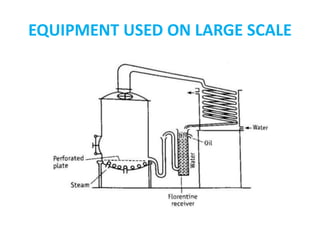
EQUIPMENT USED ON LARGE SCALE
CONSTRUCTION
• It consists of a jacketed still with a perforated
plate which forms a false bottom.
• Manholes are provided at the top and side for
charging and discharging
• A Florentine receiver is placed between the
condenser and the still
WORKING
• The material from which the volatile oil has to be
separated is placed in the still above the
perforated plate
• Steam admitted to the jacket of the still
• Water and material present in the still are
heated to boiling
WORKING
• Stem also injected below the material through
a steam pipe from the jacket
• The steam carries the volatile oil and gets
condensed in the condenser
WORKING
• The condensate is collected in to the Florentine
receiver
• Most volatile oils are lighter then water and well
separated from the distillate as an upper layer
and removed from the upper spout
• Water return to the still
THANK YOU
DISTILLATION UNDER REDUCED PRESSURE.pptx

DISTILLATION UNDER REDUCED PRESSURE.pptx

  • 1.
  • 2.
    CONTENTS • Principle • Construction •Working • Advantage • Disadvantage • Use
  • 3.
  • 4.
    PRINCIPLE • Liquid boilswhen its vapor pressure is equal to atmospheric pressure, i.e. pressure on its surface • If the external pressure is reduced by applying vacuum, the boiling point of the liquid decreases . i.e. liquid boils at a low temperature
  • 5.
    PRINCIPLE E.g. • Water boilsat 100°C - atmospheric pressure of 131.31KPa • At 40°c the vapor pressure of water- 9.33KPa • So the external pressure is reduced to 9.33KPa Where water boils at 40°c The net result is increase in the rate of mass transfer in to vapor
  • 6.
    CONSTRUCTION • Thick walledglass apparatus with interchangeable standard glass joints are used • Double neck distillation flask – claisen flask • In one of the neck of the claisen flask, a thermometer is fitted
  • 7.
  • 8.
    ASSEMBLING OF APPARATUS •A capillary tube placed in the second neck to prevent bumping • This capillary tube is dipped in the boiling liquid, so that air bubbles is drawn out • The claisen flask is connected to a receiver through a condenser
  • 9.
    ASSEMBLING OF APPARATUS •Vacuum pump is attached through an adapter to the receiver • A small manometer should be inserted between the pump and the receiver
  • 10.
    PROCEDURE : • Theliquid to be distilled is placed in the flask • The volume should be one half to two third of the flask • Porcelain pieces added to the flask to prevent bumping • The capillary tube and thermometer are placed in the flask
  • 11.
    PROCEDURE : • Therequired vacuum is applied • The contents are heated gradually • The temperature rises and liquid gets heated rapidly due to vacuum
  • 12.
    PROCEDURE • The vaporpasses through the condenser • The condensate is collected in to the receiver • The temperature is noted down which will be less than the boiling point of the liquid
  • 13.
    LARGE SCALE APPARATUSUSING VACUUM STILLS FOR DISTILLATION UNDER REDUCED PRESSURE
  • 14.
    CONSTRUCTION • Vacuum jacketedstill – stainless steel ,copper which can withstand high vacuum • Observation window – to see the progress of distillation • Steam inlet and exhaust at the bottom
  • 15.
    CONSTRUCTION • The stillis connected to a condenser • A thermometer incorporated in to the still • A vacuum pump
  • 16.
    WORKING • The stillis filled with the liquid to be distilled • Vacuum is created by means of a vacuum pump • Steam is applied • The contents heated gradually
  • 17.
    WORKING • The temperaturerises and the liquid gets vaporized rapidly due to vacuum • Vapor passes through the condenser and condensate is collected in to the receiver • Normally two receivers are fitted with suitable arrangement of cocks so that they can be used alternatively
  • 18.
    WORKING • The distillateis collected from one while the other is connected to the still under vacuum therefore distillation need not be stopped
  • 19.
  • 20.
  • 21.
    STEAM DISTILLATION • Distillationis carried out with the aid of steam • It used to separate high boiling substances from non volatile impurities • Used for the separation of immiscible liquids
  • 22.
    STEAM DISTILLATION • Highboiling liquids can not be purified by simple distillation because at high temperature the liquid undergo decomposition. • In such cases steam distillation is used
  • 23.
    PRINCIPLE • A mixtureof immiscible liquids begins to boil when the sum of their vapor pressure is equal to the atmospheric pressure
  • 24.
    PRINCIPLE E.g. • Water andturpentine mixture - boils below the boiling point of pure water ( 95.6° c) • Turpentine 160° c water 100°c • At this temperature (95.6° c) VP of water = 86.245 kpa Turpentine = 15.06 kpa The sum of the VP = 101.31 kpa • Which is normally atmospheric pressure
  • 25.
    PRINCIPLE • The highboiling substances may be distilled at a temperature much below its boiling point when water is used
  • 26.
    APPLICATIONS : • Usedfor the separation of immiscible liquids e.g. toluene and water • Extraction of volatile oils from clove, anise seed and eucalyptus leaves
  • 27.
    APPLICATIONS : • Usedin purification of liquids with high boiling point Essential oil of almond • Preparation of aromatic water
  • 28.
    ADVANTAGE :- • Volatileoils can be separated at lower temperature in steam distillation without any decomposition and loss of aroma • Low volatile substances with higher molecular weight (higher than water) can be distilled
  • 29.
    DISADVANTAGE • Steam distillationis not suitable when immiscible liquid and water react with each other
  • 30.
    APPARATUS USED FORLABORATORY SCALE
  • 31.
    CONSTRUCTION • It consistsof a metallic steam can fitted with a cork having two holes • Through one hole a long tube is placed, it almost reaches the bottom of the steam generator • This tube act as safety tube
  • 32.
    CONSTRUCTION • If pressureinside the steam generator increases ,water will be forced out through the tube and pressure will relieved • Other hole a bent tube is placed • Other end of the bent tube is connected to the flask containing non aqueous liquid through a rubber bung
  • 33.
    CONSTRUCTION • This tubeshould reach almost bottom of the flask • Through the other hole of the rubber bung a delivery tube is placed • Delivery tube connect the flask and the condenser
  • 34.
    CONSTRUCTION • Condenser isconnected to the receiver via an adaptor • Provisions are made to heat the steam can and the flask
  • 35.
    PROCEDURE • The nonaqueous liquid is placed in the flask • A small quantity of water is added to it • Steam can is filled with water • The steam can and the flask are heated simultaneously, so that a uniform flow of steam passes through the boiling mixture
  • 36.
    PROCEDURE • The mixturegets heated • The steam carries the volatile oil and passes in to the condenser • Condensed immiscible liquid collected in to the receiver
  • 37.
    PROCEDURE • Distillation continueduntil all the non aqueous has been distilled • Water and organic liquid form two separate layers in the receiver ,which can be easily separated using separating flask
  • 38.
    EQUIPMENT USED ONLARGE SCALE
  • 39.
    CONSTRUCTION • It consistsof a jacketed still with a perforated plate which forms a false bottom. • Manholes are provided at the top and side for charging and discharging • A Florentine receiver is placed between the condenser and the still
  • 40.
    WORKING • The materialfrom which the volatile oil has to be separated is placed in the still above the perforated plate • Steam admitted to the jacket of the still • Water and material present in the still are heated to boiling
  • 41.
    WORKING • Stem alsoinjected below the material through a steam pipe from the jacket • The steam carries the volatile oil and gets condensed in the condenser
  • 42.
    WORKING • The condensateis collected in to the Florentine receiver • Most volatile oils are lighter then water and well separated from the distillate as an upper layer and removed from the upper spout • Water return to the still
  • 43.