Distillation
Name: Hoorub Ahmad
Roll no: 35334
List of Contents
• History
• Definition
• Principle
• Types
• Uses
History
The earliest known evidence of distillation comes from
terracotta distillation apparatus dating to 3000BC in the
Indus value of Pakistan. Distillation was known to be
used by Babylonians of Mesopotamia. Initially distillation
is believed to have been used to make perfumes.
Distillation of beverages occurred much later. The Arab
chemist AL-kindi distilled alcohol in 9th century.
Distillation of common alcoholic beverages appears
common in Italy and China starting in 12th century.
Definition
Distillation is a powerful technique for separating the component
substance from a miscible fluid mixture by means of selective
evaporation and condensation.
Principle
Distillation is a widely used method for separating mixtures based on differences in the
conditions required to change the phase of components of the mixture. To separate a mixture
of liquids, the liquid can be heated to force components, which have different boiling
points, into the gas phase. The gas is then condensed back into liquid form and collected.
Repeating the process on the collected liquid to improve the purity of the product is called
double distillation. Although the term is most commonly applied to liquids, the reverse
process can be used to separate gases by liquefying components using changes in temperature
and/or pressure.
A plant that performs distillation is called a distillery. The apparatus used to perform
distillation is called a still.
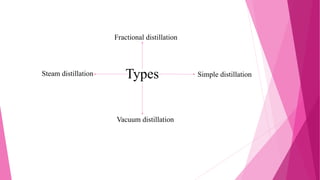
Types Simple distillation
Vacuum distillation
Fractional distillation
Steam distillation
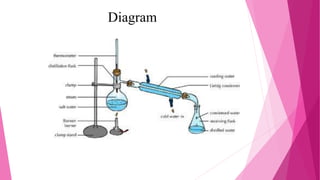
Simple distillation
Simple distillation may be used when the boiling points
of two liquids are significantly different from each
other or to separate liquids from solids or nonvolatile
components. In simple distillation, a mixture is heated
to change the most volatile component from a liquid
into vapor. The vapor rises and passes into a condenser.
Usually, the condenser is cooled (e.g., by running cold
water around it) to promote condensation of the vapor,
which is collected.
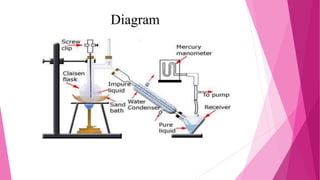
Diagram
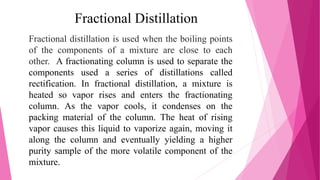
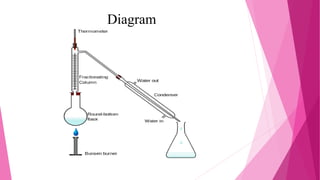
Fractional Distillation
Fractional distillation is used when the boiling points
of the components of a mixture are close to each
other. A fractionating column is used to separate the
components used a series of distillations called
rectification. In fractional distillation, a mixture is
heated so vapor rises and enters the fractionating
column. As the vapor cools, it condenses on the
packing material of the column. The heat of rising
vapor causes this liquid to vaporize again, moving it
along the column and eventually yielding a higher
purity sample of the more volatile component of the
mixture.
Diagram
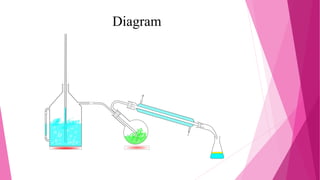
Steam Distillation
Steam distillation is used to separate heat-sensitive
components. Steam is added to the mixture, causing
some of it to vaporize. This vapor is cooled and
condensed into two liquid fractions. Sometimes the
fractions are collected separately, or they may have
different density values, so they separate on their own.
An example is steam distillation of flowers to yield
essential oil and a water-based distillate.
Diagram
Vacuum Distillation
Vacuum distillation is used to separate components that
have high boiling points. Lowering the pressure of the
apparatus also lowers boiling points. Otherwise, the
process is similar to other forms of distillation. Vacuum
distillation is particularly useful when the normal
boiling point exceeds the decomposition temperature of
a compound.
Diagram
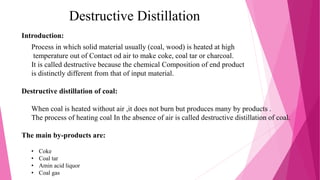
Destructive Distillation
Introduction:
Process in which solid material usually (coal, wood) is heated at high
temperature out of Contact od air to make coke, coal tar or charcoal.
It is called destructive because the chemical Composition of end product
is distinctly different from that of input material.
Destructive distillation of coal:
When coal is heated without air ,it does not burn but produces many by products .
The process of heating coal In the absence of air is called destructive distillation of coal.
The main by-products are:
• Coke
• Coal tar
• Amin acid liquor
• Coal gas
Uses of Distillation
Distillation is used for many commercial processes,
such as the production of gasoline, distilled water,
xylene, alcohol, paraffin, kerosene, and many other
liquids. Gas may be liquefied and separate. For
example: nitrogen, oxygen, and argon are distilled
from air.
References
https://www.thoughtco.com/what-is-distillation-601964
https://www.google.com/search?q=diagram+of+vacuum+distillation&source
=lnms&tbm=isch&sa=X&ved=0ahUKEwjZ9ILlpvjiAhW-RBUIHTN-
DHYQ_AUIECgB&biw=1366&bih=608#imgrc=G2qojuukUpcL1M:
https://www.google.com/search?biw=1366&bih=608&tbm=isch&sa=1&ei=0Z
sLXb6QBeqFjLsP_PG8gAM&q=diagram+of+steamdistillation&oq=diagram+of+s
teamdistillation&gs_l=img.3..0i7i30j0i8i7i30.32281.33859..34170...0.0..0.34
7.1506.2-3j2......0....1..gws-wiz-img.JvJ6BvDhRJY#imgrc=Bry9jGWDc5qsKM:

Distillation, History, Principle Its Types and USES

  • 1.
  • 2.
    List of Contents •History • Definition • Principle • Types • Uses
  • 3.
    History The earliest knownevidence of distillation comes from terracotta distillation apparatus dating to 3000BC in the Indus value of Pakistan. Distillation was known to be used by Babylonians of Mesopotamia. Initially distillation is believed to have been used to make perfumes. Distillation of beverages occurred much later. The Arab chemist AL-kindi distilled alcohol in 9th century. Distillation of common alcoholic beverages appears common in Italy and China starting in 12th century.
  • 4.
    Definition Distillation is apowerful technique for separating the component substance from a miscible fluid mixture by means of selective evaporation and condensation.
  • 5.
    Principle Distillation is awidely used method for separating mixtures based on differences in the conditions required to change the phase of components of the mixture. To separate a mixture of liquids, the liquid can be heated to force components, which have different boiling points, into the gas phase. The gas is then condensed back into liquid form and collected. Repeating the process on the collected liquid to improve the purity of the product is called double distillation. Although the term is most commonly applied to liquids, the reverse process can be used to separate gases by liquefying components using changes in temperature and/or pressure. A plant that performs distillation is called a distillery. The apparatus used to perform distillation is called a still.
  • 6.
    Types Simple distillation Vacuumdistillation Fractional distillation Steam distillation
  • 7.
    Simple distillation Simple distillationmay be used when the boiling points of two liquids are significantly different from each other or to separate liquids from solids or nonvolatile components. In simple distillation, a mixture is heated to change the most volatile component from a liquid into vapor. The vapor rises and passes into a condenser. Usually, the condenser is cooled (e.g., by running cold water around it) to promote condensation of the vapor, which is collected.
  • 8.
  • 9.
    Fractional Distillation Fractional distillationis used when the boiling points of the components of a mixture are close to each other. A fractionating column is used to separate the components used a series of distillations called rectification. In fractional distillation, a mixture is heated so vapor rises and enters the fractionating column. As the vapor cools, it condenses on the packing material of the column. The heat of rising vapor causes this liquid to vaporize again, moving it along the column and eventually yielding a higher purity sample of the more volatile component of the mixture.
  • 10.
  • 11.
    Steam Distillation Steam distillationis used to separate heat-sensitive components. Steam is added to the mixture, causing some of it to vaporize. This vapor is cooled and condensed into two liquid fractions. Sometimes the fractions are collected separately, or they may have different density values, so they separate on their own. An example is steam distillation of flowers to yield essential oil and a water-based distillate.
  • 12.
  • 13.
    Vacuum Distillation Vacuum distillationis used to separate components that have high boiling points. Lowering the pressure of the apparatus also lowers boiling points. Otherwise, the process is similar to other forms of distillation. Vacuum distillation is particularly useful when the normal boiling point exceeds the decomposition temperature of a compound.
  • 14.
  • 15.
    Destructive Distillation Introduction: Process inwhich solid material usually (coal, wood) is heated at high temperature out of Contact od air to make coke, coal tar or charcoal. It is called destructive because the chemical Composition of end product is distinctly different from that of input material. Destructive distillation of coal: When coal is heated without air ,it does not burn but produces many by products . The process of heating coal In the absence of air is called destructive distillation of coal. The main by-products are: • Coke • Coal tar • Amin acid liquor • Coal gas
  • 16.
    Uses of Distillation Distillationis used for many commercial processes, such as the production of gasoline, distilled water, xylene, alcohol, paraffin, kerosene, and many other liquids. Gas may be liquefied and separate. For example: nitrogen, oxygen, and argon are distilled from air.
  • 17.