Presented By:Presented By:
Engineer LATIF HYDER WADHOEngineer LATIF HYDER WADHO
Mehran University of Engg: & Technology KhairpurMehran University of Engg: & Technology Khairpur
Civil Engineering MaterialsCivil Engineering Materials
11stst
Term 1Term 1stst
Year B.E.CivilYear B.E.Civil
DISTEMPER
AND
ADHESIVES
DISTEMPERDISTEMPER
These are paints used for the treatment
of masonry walls. In distempers water
instead of oil is used as a carrier. These
are also known as water paints. It is
made by mixing whiting and glue boiled
in water is known as the size. In market a
number of distempers are available. All
prepared distempers are mixed with
water only before being used. As the
distemper is affected by weather and
comes off, if washed, so is use is
restricted only to interior works.
It forms a cheap, durable and easy finish for interiors.
These should be applied in dry weather after the
surface has been cleaned and dried.
There are some points which should be kept in mind
while applying distempers.
The surface should be completely dry, there should
be no patches of efflorescence, also surface should
be smooth, if not surface should be smoothening with
sand paper.
Old surface should be cleaned properly.
These may be applied in two or more coats also.
On drying of primary coat (1st
), prepared distemper
solution in water is applied on the surface with brush.
ADHESIVES
ADHESIVES
It is a substance that binds two or more
surfaces together. Some times it can be
better substitute for welding/riveting.
Adhesive may be applied by brushing,
spraying, etc. Before applying the
adhesive the surfaces should be cleaned
of all oils, grease, dirt, etc.
Adhesives can join a variety of surfaces
like wood, glass, metals and plastic etc.
Adhesives applied joints may be
impervious to gases and liquids. How
ever adhesives can not be used to all
materials and also choice of adhesive
depends upon the nature of material to
be jointed. It takes time to gain strength.
Joints made with adhesives loose their
stability at high temperatures.
Adhesives are either glues or resins.
(i) Glues: Glues are derived from animals or
from vegetables. Animal glues are derived from
different parts like hides or bones of animals.
These are prepared by boiling in water horns,
hoofs, bones or skins of animals. Animal glues
are prepared from blood and eggs too. It is
available in the forms of flakes, granules, cakes
and jelly.
Animal glues are easy to apply and are stronger
than vegetable glues but are nor resistant to
moisture and fungus.
Vegetable glues are mostly used in wood etc.
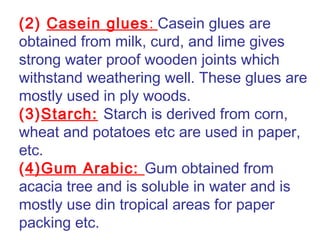
(2) Casein glues: Casein glues are
obtained from milk, curd, and lime gives
strong water proof wooden joints which
withstand weathering well. These glues are
mostly used in ply woods.
(3)Starch: Starch is derived from corn,
wheat and potatoes etc are used in paper,
etc.
(4)Gum Arabic: Gum obtained from
acacia tree and is soluble in water and is
mostly use din tropical areas for paper
packing etc.
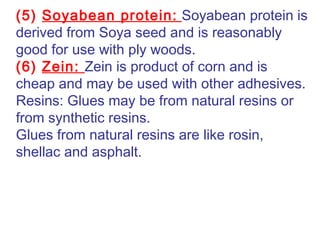
(5) Soyabean protein: Soyabean protein is
derived from Soya seed and is reasonably
good for use with ply woods.
(6) Zein: Zein is product of corn and is
cheap and may be used with other adhesives.
Resins: Glues may be from natural resins or
from synthetic resins.
Glues from natural resins are like rosin,
shellac and asphalt.
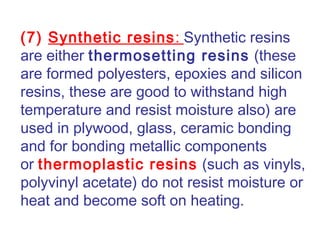
(7) Synthetic resins: Synthetic resins
are either thermosetting resins (these
are formed polyesters, epoxies and silicon
resins, these are good to withstand high
temperature and resist moisture also) are
used in plywood, glass, ceramic bonding
and for bonding metallic components
or thermoplastic resins (such as vinyls,
polyvinyl acetate) do not resist moisture or
heat and become soft on heating.
 

Distemper, adhesives

  • 2.
    Presented By:Presented By: EngineerLATIF HYDER WADHOEngineer LATIF HYDER WADHO Mehran University of Engg: & Technology KhairpurMehran University of Engg: & Technology Khairpur Civil Engineering MaterialsCivil Engineering Materials 11stst Term 1Term 1stst Year B.E.CivilYear B.E.Civil
  • 3.
  • 4.
    DISTEMPERDISTEMPER These are paintsused for the treatment of masonry walls. In distempers water instead of oil is used as a carrier. These are also known as water paints. It is made by mixing whiting and glue boiled in water is known as the size. In market a number of distempers are available. All prepared distempers are mixed with water only before being used. As the distemper is affected by weather and comes off, if washed, so is use is restricted only to interior works.
  • 5.
    It forms acheap, durable and easy finish for interiors. These should be applied in dry weather after the surface has been cleaned and dried. There are some points which should be kept in mind while applying distempers. The surface should be completely dry, there should be no patches of efflorescence, also surface should be smooth, if not surface should be smoothening with sand paper. Old surface should be cleaned properly. These may be applied in two or more coats also. On drying of primary coat (1st ), prepared distemper solution in water is applied on the surface with brush.
  • 6.
  • 7.
    ADHESIVES It is asubstance that binds two or more surfaces together. Some times it can be better substitute for welding/riveting. Adhesive may be applied by brushing, spraying, etc. Before applying the adhesive the surfaces should be cleaned of all oils, grease, dirt, etc.
  • 8.
    Adhesives can joina variety of surfaces like wood, glass, metals and plastic etc. Adhesives applied joints may be impervious to gases and liquids. How ever adhesives can not be used to all materials and also choice of adhesive depends upon the nature of material to be jointed. It takes time to gain strength. Joints made with adhesives loose their stability at high temperatures.
  • 9.
    Adhesives are eitherglues or resins. (i) Glues: Glues are derived from animals or from vegetables. Animal glues are derived from different parts like hides or bones of animals. These are prepared by boiling in water horns, hoofs, bones or skins of animals. Animal glues are prepared from blood and eggs too. It is available in the forms of flakes, granules, cakes and jelly. Animal glues are easy to apply and are stronger than vegetable glues but are nor resistant to moisture and fungus. Vegetable glues are mostly used in wood etc.
  • 10.
    (2) Casein glues:Casein glues are obtained from milk, curd, and lime gives strong water proof wooden joints which withstand weathering well. These glues are mostly used in ply woods. (3)Starch: Starch is derived from corn, wheat and potatoes etc are used in paper, etc. (4)Gum Arabic: Gum obtained from acacia tree and is soluble in water and is mostly use din tropical areas for paper packing etc.
  • 11.
    (5) Soyabean protein:Soyabean protein is derived from Soya seed and is reasonably good for use with ply woods. (6) Zein: Zein is product of corn and is cheap and may be used with other adhesives. Resins: Glues may be from natural resins or from synthetic resins. Glues from natural resins are like rosin, shellac and asphalt.
  • 12.
    (7) Synthetic resins:Synthetic resins are either thermosetting resins (these are formed polyesters, epoxies and silicon resins, these are good to withstand high temperature and resist moisture also) are used in plywood, glass, ceramic bonding and for bonding metallic components or thermoplastic resins (such as vinyls, polyvinyl acetate) do not resist moisture or heat and become soft on heating.